



The Wick Spans
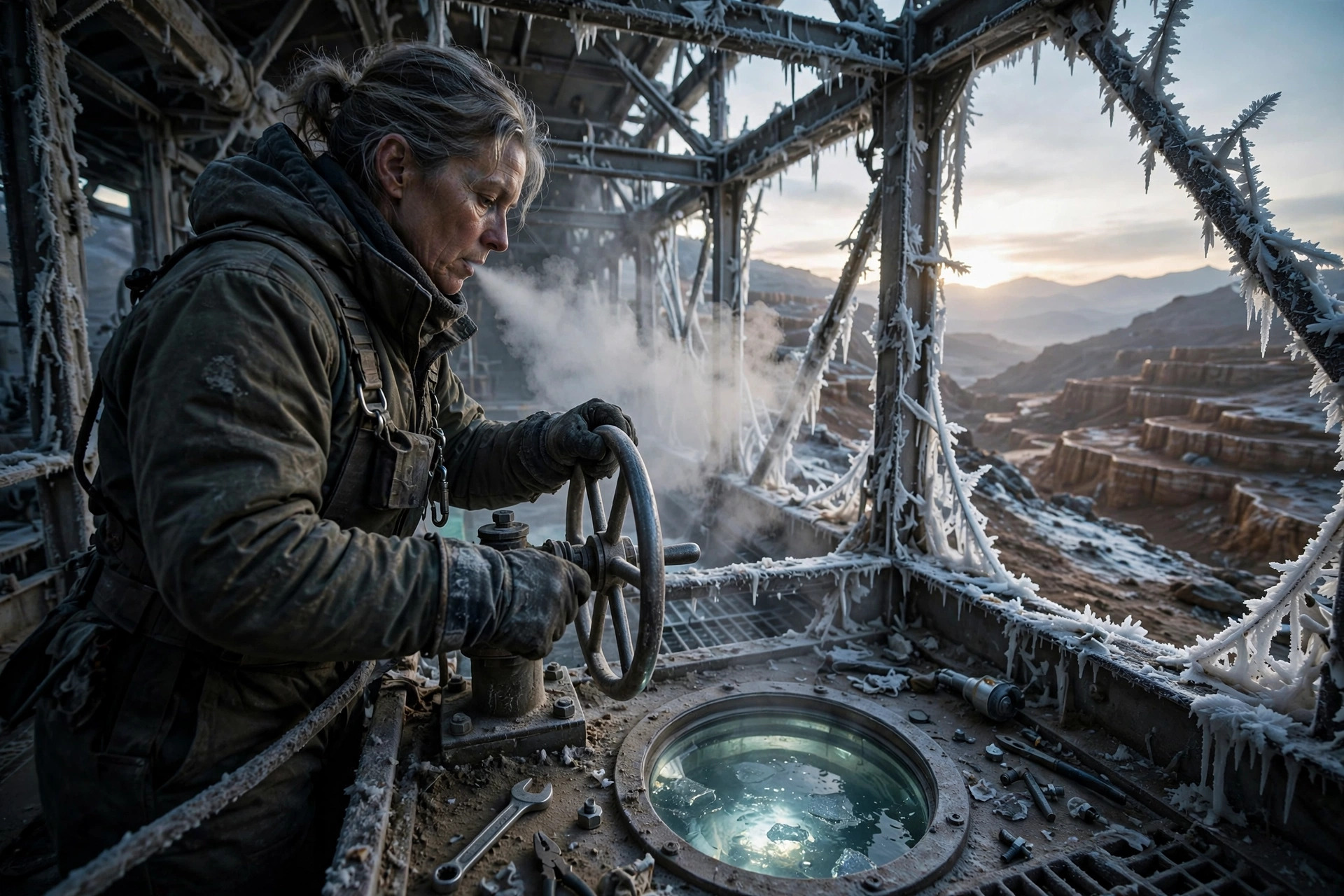
Ilma Brask woke before the melt bell, as she had every morning for eleven years, with her hand already reaching for the crank handle she wasn't touching yet. Habit had a shape, and hers was a steel wheel the size of a dinner plate, three meters of pipe, and forty terraces waiting on her grip.
The flume house stood at the head of the lower cut, where the capstone sill broke the surface of Tarrelo Station's high ground like a bone through skin. Frost limbed every strut. She keyed the door, and her breath came out in flat white sheets that the weak sun took apart before they reached the floor.
The gate valve waited where it always waited. Hand-forged twelve years ago, when the terraces were first cut, welded by Teo Ansel and the crew back when Teo still had both eyebrows and she still thought of this place as a posting rather than a home. No motor drive. Meridian's engineers had offered to retrofit one, years back, back when Meridian was just a name on a prospectus. She'd refused. A valve with a motor can be opened by anyone with a login. A valve with a crank opens for whoever is standing there, sweating, counting threads.
She set her palm on the wheel and leaned in. Steel bit through her gloves. Nine turns to full, and she took them slow, one per breath, listening with her shoulder the way Teo had taught her: any shudder in the stem meant grit in the seat, and grit in the seat meant a rebuild week she didn't have.
No shudder. The stem ran true. She counted the turns off against the tally plate anyway, because the tally plate didn't care about her feel for the machine.
"Six," she said to the empty flume house, and turned the seventh.
Below her, through the inspection port, the first melt of the day moved in the channel. Clear water, snow-bright, sliding down off the capstone sill and into the flume that split and split again into forty terrace rows. Forty-one million cubic meters of water ice sat locked in that sill, more fresh water than the whole settlement would drink in a hundred lifetimes, and every morning of it belonged, by charter, first to the soil.
Because soil was the thing nobody shipped in. Soil you built, centimeter by centimeter, out of sintered basalt fiber and patience.
She finished the ninth turn, dogged the lock ring, and went out into the morning to check on that patience.
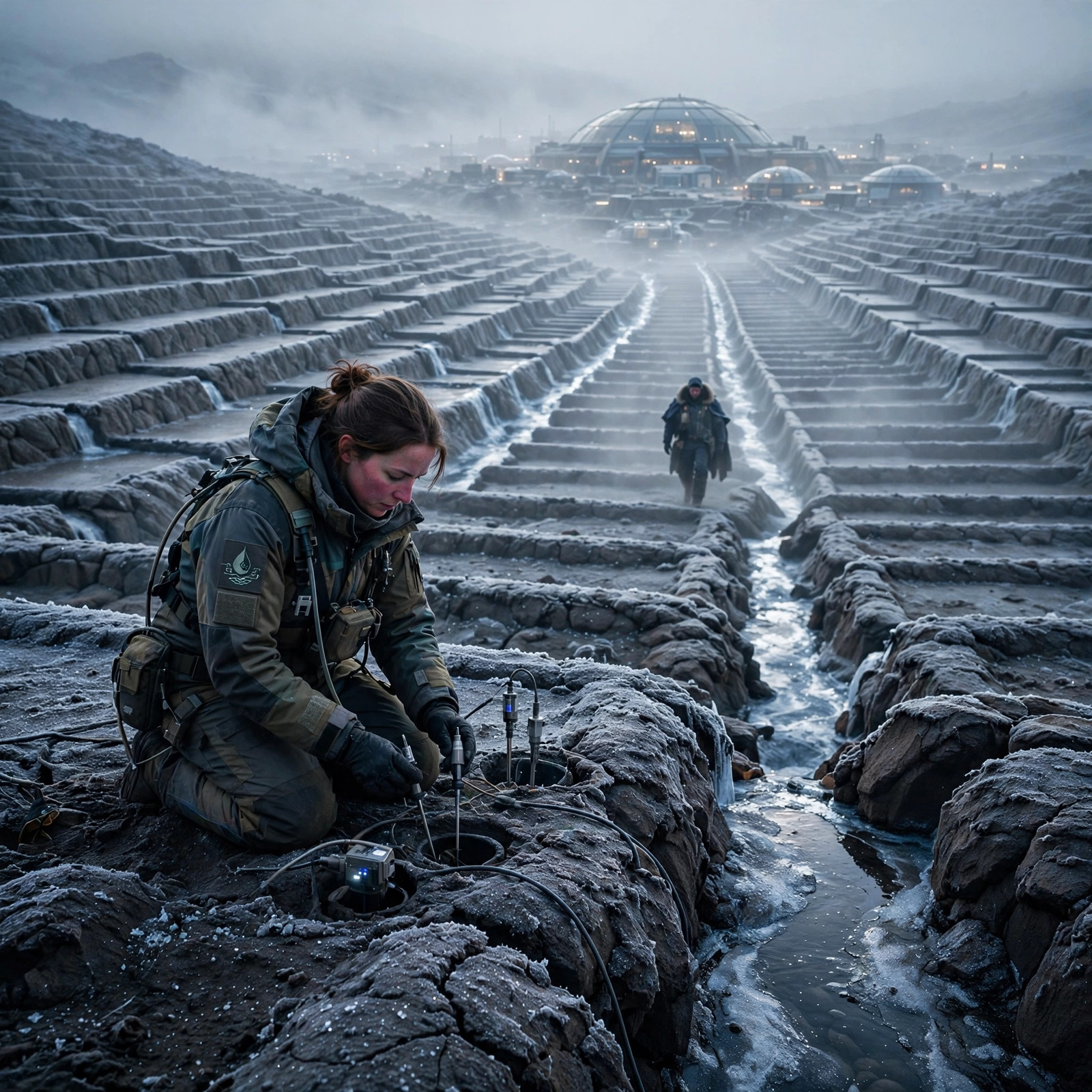
Ruvé Okano was already on row one, kneeling in the frost with a moisture probe in each of the terrace's shoulder vents. They looked up at her approach and didn't stand, which meant the numbers were bad enough to keep both hands busy.
"Morning, steward."
"Morning. Tell me something I'll like."
"The lower rows are drinking fine. Rows one through twelve, we're at spec or better." Ruvé pulled the probe, wiped it on their thigh, moved one vent over. "The top's another story."
Ilma walked up the terrace stair. Row by row, the wick spans ran beneath the surface like veins under skin: capillary mats of sintered basalt fiber, laid season by season over eleven years, pulling trace moisture out of the flume seep and through the engineered soil. From above, all she could see was the dark line of each span's inspection seam, and the pale crust of salt that had begun, in the top rows, to gather at the edges.
"How bad?"
"Row thirty-eight is at sixty percent saturation. Thirty-nine and forty are holding at half." Ruvé stood, knees cracking, and offered her the probe without being asked. "The top of the hill dries first. You know that better than I do."
She did know. She crouched and pressed the probe into the seam of row forty's span, down past the fiber, into the soil beneath. The readout crawled, steadied, and gave her a number she'd been afraid of.
Half-saturated. Twelve days from dust, if the weather held. Fewer, if it didn't.
"The gate's metering true," she said. "I cranked it through the full cycle before I came up. Flume volume's on spec."
"Then it's not the gate." Ruvé looked down the hill, past the terraces, to where the lower cut ran out toward the survey sheds and the landing pads beyond. "It's the ice. We're getting melt, but we're not getting enough of it. I've been running the spreads. We're short three hundred forty cubic meters against soil spec, just this week."
Ilma let that sit. Three hundred forty. Against a daily need of twelve thousand, it sounded small. It wasn't. The terraces didn't fail all at once; they failed at the top, quietly, one dry span at a time, and then the salt crust came, and then the soil you'd spent a decade building blew off the hill in one bad storm.
"Options?"
"Wet the top rows by hand from the reserve line, buy them a week, and hope the audit comes back generous." Ruvé said it evenly, which was the kindest way to say it. "Or find more melt. And there's no more melt to find, steward. The capstone gives what it gives."
She looked at the sill above the flume house, the great grey-blue shoulder of it, catching the first hard light of morning. Forty-one million cubic meters, and every one of them spoken for, by charter, by soil, by the forty rows under her boots.
"Then we wet the top rows by hand and I sharpen my pencil for the audit," she said. "Nine days out. I want your spreads on my bench by tonight, full week, all forty rows. If we're going to stand in front of the charter authority and beg, we beg with numbers."
"Nine days." Ruvé squinted at the sky, where the gas giant hung low and huge over the eastern ridgeline, banded and patient, the charter authority somewhere in orbit around it, three light-hours of lag away. "That's not a lot of runway."
"It's the runway we've got."
Teo Ansel found her at row thirty-four with a hand cart, four jerry cans of reserve-line water, and his grin already loaded. "Ruvé radioed. Said the steward was up here arguing with a hill."
"The hill's winning."
"Hills usually do." He set the cart down and cracked the first can, and the two of them worked along the row, tipping measured water into each span's feeder cup while Ilma logged the amounts. He'd been crew chief for nine years and could read a terrace the way she read a ledger, so she didn't have to explain the arithmetic, and he didn't offer her any comfort about it. That was the whole reason she'd kept him this long, and she'd have followed him into a reactor before saying so.
"You hear the noise last night?" he asked, tipping the last can.
"What noise?"
"Landing lights. About two. I was up replacing a wick coupling on row eleven, and I watched it come in over the ridge without a transponder squawk until final." He wiped his hands. "Big frame. Corporate lines. Didn't touch down at the cargo pads, either. Went straight out to the survey ground by the lower cut."
Ilma's hand stopped on the ledger page.
"Meridian," she said. Not a question.
"That's the gossip on the crew channel, anyway." Teo looked out toward the sheds, and his easy voice dropped a register. "Rig's already off the cradle. Tracked. They had ground crew out there unloading drums before the sun cleared the ridge."
She stood, dusted the grit from her knees, and looked down the hill. At this distance the survey ground was just a scatter of shadows and a low gantry, but she could imagine the rest: a drill rig walking itself onto the lower cut, corporate boots, a field office with the windows facing the capstone sill instead of the town. Meridian Extraction Concern had a prospectus on this sill three centimeters thick. She'd read every page of it twice.
"They could have sent a letter," she said.
"They sent a rig. Cheaper, probably, once you account for the lag." Teo shouldered the empty cans back onto the cart. "Three hours each way to the charter office, every appeal. You'd be old before you finished arguing."
"I'm old now."
"You're forty-six and you say that every morning." He said it lightly, but he watched her face while he said it, and when she didn't rise to it, he nodded once, slow. "Yeah. Nine days to the audit. I did the math too."
They walked the rows down together, and the morning got on with being morning: frost burning off the flume channels, the melt running bright under it, Ruvé's probes clicking through the mid rows where the soil drank at spec and the wick spans held their dark, healthy color. Whatever was coming, it wasn't here yet. The terraces were alive. That was the only fact she'd ever been able to hold onto for more than a season at a stretch.
In the flume house she closed out the day's accounts. Gate cycle: nine turns, stem true, metering to flume spec. Upper rows: hand-watered from reserve line, forty-one cans logged. Deficit against soil spec for the week: three hundred forty cubic meters, and she wrote the number twice, once in ink and once in the margin, because the margin was where she kept the figures she intended to fight about.
Then, at the bottom of the page, in the space marked Noted, no action: Unannounced corporate landing, lower cut survey ground, approx. 02:00. Meridian livery reported. No council notice posted.
She read that back, pressed her thumb against the ink until it stopped shining, and thought about a letter arriving by light-lag from an office orbiting a gas giant, arriving whenever it pleased, while a rig with corporate drums walked onto her hill under cover of dark.
Ilma signed the melt ledger, folded the paper copy in thirds, and pressed it into the flume-house drawer, into the same slot where eleven years of her mornings already lay stacked like tree rings. She left the drawer unlocked. If Meridian wanted to know what the terraces cost, she had nothing to hide. She'd written it all down, every cubic meter of it, in her own hand.
Outside, the melt ran on, and the sun climbed, and somewhere down at the lower cut a drill rig was being walked toward her capstone sill.
The Lower Cut
Two days later the station hall smelled like hot dust and cold coffee, and every chair in it was full. Ilma came in late on purpose, because a steward who arrived late could pick her seat, and she picked the wall bench where she could see both doors and the survey map Sella Corin had hung off the front table with magnetic tabs.
Corin was younger than her voice on the comm had sounded, and better prepared than anyone Ilma had argued with in years. She stood with her hands flat on the table, no slides, no showmanship, just the map and a paper handout she'd run off on the station press, and she waited out the last coughs before she spoke.
"I'll give you the whole thing in one breath," Corin said, "and then you can take it apart. Meridian wants to put a fast-crack fuel plant at the lower cut. Forty thousand cubic meters of capstone ice a day, cracked to hydrogen and carbon feedstock. In exchange, Tarrelo Station gets a shuttle link inside two years, built and crewed and maintained by Meridian, plus a funded expansion of your medical bay. That's the offer. I'm not going to pretend the cost isn't a cost."
She tapped the map, and the hall went quiet enough that Ilma heard the air handler cycling.
"The capstone sill holds about forty-one million cubic meters of water ice. That's the figure your steward's office published, and our survey agrees with it, which surprised me, because corporate and station numbers never agree. The draw is forty thousand a day. Your terraces take twelve thousand a day of melt to stay in soil spec. Forty thousand against twelve thousand doesn't leave the terraces their water. I know that. You know that. I'm not standing up here hoping you won't do the arithmetic."
Teo, beside Ilma on the bench, leaned over. "She's good," he murmured. "She gave us our own numbers first."
"I noticed," Ilma said.
Hett Torvald let the murmur run maybe ten seconds before she put her hand flat on the table she chaired from. "Forty thousand a day," Hett said. "Run the horizon for us. How many days before the terraces go dry?"
"That's your steward's question to answer, Chair Torvald, and I'd rather not put words in her mouth." Corin turned, found Ilma on the wall bench without hunting for her, and Ilma understood that the whole first half of the talk had been aimed at her, that Corin had known exactly who she'd need to convince. "But stripped of the terraces, the sill still supports the draw for years. The plant is not a bet that runs out of fuel in a season. It's a bet about what the terraces are for."
"The terraces are for food," Ilma said, and she said it from the bench, not standing, because she didn't want the floor yet. "Forty rows of engineered soil, eleven seasons in. Twelve thousand cubic meters of melt a day keeps them in spec. Under twelve thousand, the top rows dry first. I've got a three-hundred-forty-cubic-meter deficit logged this week already, and that's with the gate metering to flume spec and the wicks at half saturation."
"I've read your ledgers," Corin said. "All eleven years. They're the cleanest records I've seen on this rock, and I've seen the corporate ones." A small, dry laugh went around the hall, because everyone in it knew what corporate records were worth. "Steward Brask, I'm not going to tell you the terraces survive this. They don't. Not at that draw. What I'm telling you is what you get instead."
She turned the handout over, and the back page had two columns. Left: shuttle link, two years. Medical bay, funded, with a filtered-pressure suite and a full-time physician. Right: the terraces, twelve thousand a day, unchanged, and under it the current medical situation, which Ilma had not expected to see printed, and which was a single line: dust-burn cases on the blasting crews, present, ongoing.
Ilma's brother was not in the hall. He was on shift at the fast-dig cut, where the pay was double, and she had told him twice to come, and he had told her twice that blasting hands didn't get a vote so why stand around watching other people use one.
"The med bay line," Hett said slowly. "That's not an abstraction for this station. We've got crew breathing salted dust down on that cut right now because we can't treat them here."
"I know," Corin said. "I pulled the case list before I came. I'm not using it as a lever, Chair. It's just true."
And that was the trouble with Corin, Ilma thought, sitting there on the wall bench with her arms folded. She was honest. Ilma had spent two days waiting for the corporate line to show itself, some inflated reserve figure, some hand-wave about the terraces migrating to hydroponics, and instead the woman stood up in front of forty farmers and told them plainly: your water goes, your soil goes, and here is what you get for it. She made the station's poverty sound like a fact of geology instead of a decision anyone had made.
Teo's knee was bouncing. "Say something," he muttered.
"I'm going to do better than that," Ilma said. "I'm going to send a letter."
She took the floor without waiting for Hett to offer it, because the steward's desk had standing in any question of ice allocation, and everyone in the hall knew it, including Corin, who stepped back a half pace and gave her the map without a word.
"Ice allocation on this sill is not the council's to give," Ilma said. "It's not Meridian's to buy. Under the Tarrelo charter, final allocation authority sits with the charter office in orbit around the gas giant, and every appeal to that office travels by light, and light takes three hours one way. So whatever this council decides to recommend, and whatever Meridian offers to sweeten it, nothing is final until the charter office rules, and the charter office cannot rule inside this room. I want that on the record before anyone falls in love with a shuttle."
"It's on the record," Hett said. "It's also true that the charter office has never once overturned a station's own recommendation. They rubber-stamp us, Steward. That's three hours of lag for a signature."
"Then they can rubber-stamp mine too," Ilma said. "I'm filing an appeal tonight. Formal objection to any allocation above twelve thousand a day, on the grounds that the terraces are the station's food and the sill is a single reserve, not two."
"You'll get your answer in six hours, round trip," Hett said, "and we vote in six days. You can file an appeal a day until then, Steward, and I'll log every one."
"Then I'll file one a day," Ilma said.
Corin watched her through this with her head tipped slightly, and when the hall's noise rose and fell again, she said, evenly, "For what it's worth, I'd do the same in your seat. And I'd lose, because the shuttle link is worth more to this station than forty rows of dirt, and everyone in this room knows it, including the ones who won't say it out loud." She looked along the benches, not unkindly, just level. "I'm not your enemy. I'm the person who read your ledgers and still got on the shuttle out here. Think about why."
Hett called the recess before anyone could sharpen it into a fight. People stood, and the hall broke into knots of talk, and Ilma walked out the side door into the thin afternoon light with Teo a step behind her.
"She read eleven years of your mornings," Teo said. "That's not due diligence. That's homework."
"Then she can grade my appeal." Ilma was already composing it in her head, the formal language, the reserve figures, the deficit line. "Walk me to the uplink. I want it transmitted before she sends hers, whatever hers is. I want mine on the charter office's desk first."
"It'll be six hours before you hear anything."
"Then I'll be at the flue when the answer lands, and I'll be at the lower cut before that," Ilma said. "Because while we were all in there being reasonable with each other, her survey rig wasn't in the hall being reasonable. It's been on my sill since two in the morning two nights ago, and nobody's stopped it."
The uplink shack off the station's north spine had two chairs and a transmitter older than half the settlement. Ilma typed the appeal herself, no clerks, no shortcuts: formal objection, Capstone Terraces, allocation cap of twelve thousand cubic meters per day, single-reserve doctrine, requesting full audit of the sill before any draw above terrace spec. She read it twice, keyed it, and watched the queue light burn while the packet went out at the speed of everything, three hours of nothing between her and the office that would decide it.
"Six hours," Teo said from the door. "Round trip. You want company for the waiting?"
"I want eyes on the lower cut," Ilma said. "Come on."
They took the cart down the terrace road, past the flume house, past rows one through forty lying dark and damp and half-saturated under the low sun, and at the bend where the land fell away toward the sill, Ilma brought the cart to a stop and did not get out.
The Meridian rig stood on the lower cut like a four-legged tower, and its drill string was down. The test pit was maybe nine meters across, and the rig's drums turned in their housings, and the string walked round and round, chewing frozen regolith and ice up out of the ground in a steady conveyor of dust. The dust hung over the pit in the thin light, a standing column of it, gray-brown, lit from the side, not dispersing, because there was barely wind enough on this slope to carry it anywhere.
"That's a core run," Teo said quietly. "Look at the return. That's capstone they're into. They didn't waste a day."
"No," Ilma said. "They didn't."
She sat with her hands on the cart's bar and watched the rig eat the first of the test pit, forty thousand cubic meters a day waiting on the far side of it, and the dust standing over the work like a flag planted in her hill. Somewhere three hours of light away, her appeal was still traveling, and would keep traveling all the way down the afternoon, and no answer of any kind could come back before dark.
"Six hours," Teo said again, gentler this time.
"Then we've got six hours," Ilma said, "and I intend to spend them learning everything that machine has already pulled out of my ground. Start counting trucks."
The Scored Seal
Two mornings later the flumes were empty, and the sound of it was wrong.
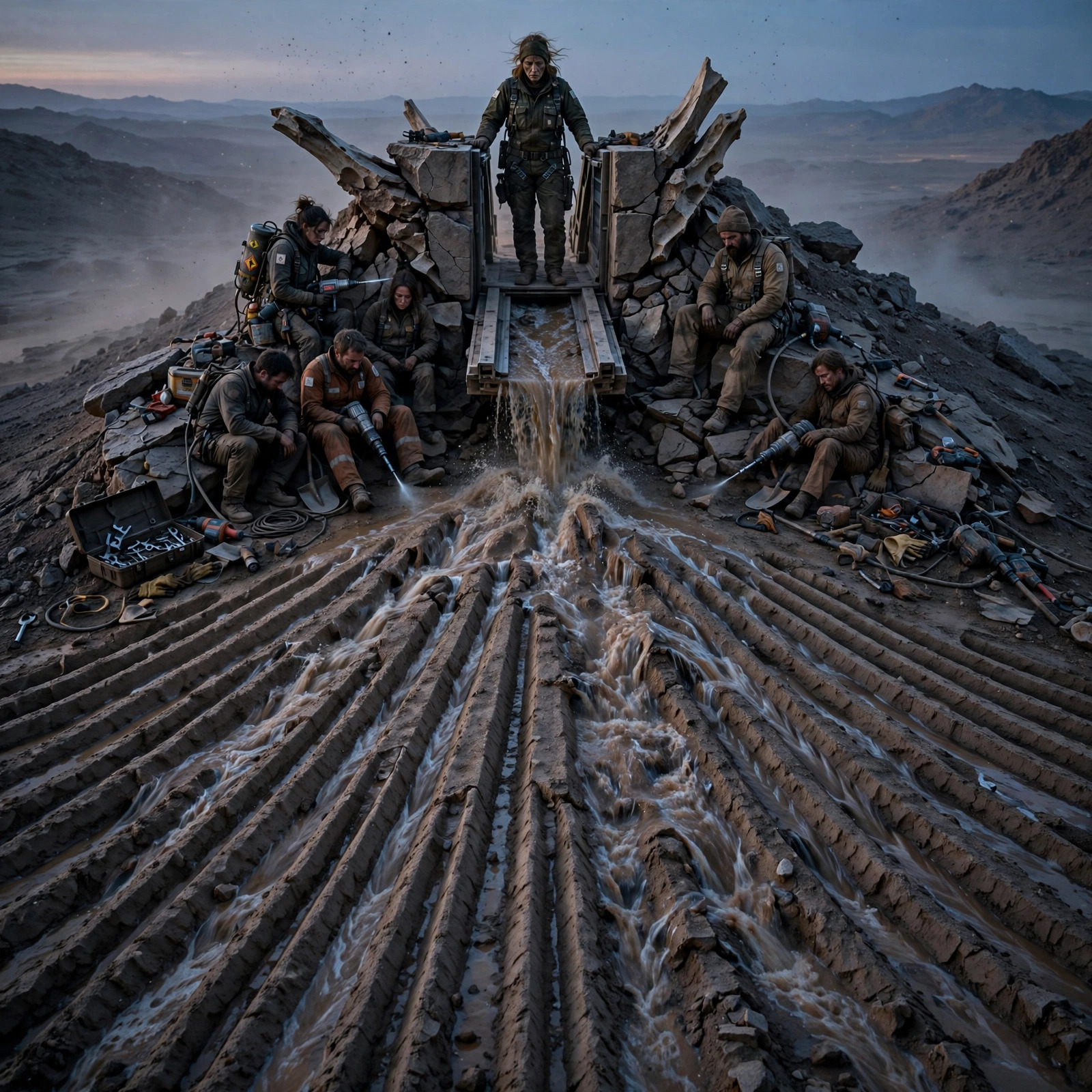
Ilma had lived beside the lower flume for eleven seasons, and she knew its voice the way she knew her own pulse: a low, continuous mutter of melt running down the channel, over the weir plates, out along the forty terrace rows to the wick spans. Now there was nothing. The survey crew had shut the headworks at first light and drained the channels so their seismic lines could be laid dry along the sill, and the hill sat silent under the low sun, forty rows of engineered soil waiting on water that was not coming.
She stood at the flume house with Teo and watched the company's people unspool their geophone cable down the lower cut like black thread across her ground.
"Ruvé ran the numbers at midnight," Teo said. "Top rows are holding at three hundred forty under spec on the week. The wicks can carry that for a while. They can't carry nothing."
"How long can they carry nothing?"
Teo looked at the dry channel, then at the crews working the cut, unhurried, thorough, all morning to lay their lines. "Days. Not four of them."
Ilma put a hand flat on the weir plate. Cold steel, and under it, dry. The channel floor was already showing a skim of frost where the last of the melt had flashed off in the thin air. "So we water from the reserve line again tonight. By hand if we have to."
"That's your drinking water."
"It's my name on the allocation ledger," she said. "It'll be my hand on the valve."
The seismic crew waved from the cut. One of them, a woman in a company shell suit, called up that they'd be running the lines until midday, that the flumes would hold dry until the shooting was done. Ilma waved back. There was nothing to argue with. The audit window was open, the survey had the legal right to the ground, and every hour the channels sat empty was an hour the terraces went without.
She was still standing there, doing that arithmetic in her head, when the cart came grinding up the terrace road from the blasting line, and the man driving it coughed in a way she had known since he was a boy.
Nils Brask climbed down slow. He was a year short of forty and he moved like their father had in the last winters, careful of his own weight, and he kept his respirator mask hanging off one ear instead of seated, and when he got close she saw the mask's seal ring was scored all the way around, a bright, greasy ring of wear and grit where it had been failing against his skin.
"You're supposed to be on filtration at the shot," she said.
"I am on filtration." He coughed again, deeper, and put a fist against his sternum until it finished. "It's the seal. Ventilated air doesn't help if the dirty air comes in around the edges."
Teo had gone very still beside her.
Nils reached into his coveralls and brought out two things. The first was the seal ring itself, popped off its mount, a band of steel the size of his two hands, and the inner face of it was scarred like river ice, fine grit-burn scratches running round and round in the direction of a seat that had never quite been true against his jaw. He held it out. Ilma took it. It weighed nothing and it was the heaviest thing she'd held all week.
The second thing was a print, a scan plate off the med bay's imager, and this he gave to Teo, who read plates for a living and could read a lung.
"Before you say it," Nils said, "I know what it says. The medic ran it last night. I made her run it twice."
Teo tilted the plate into the sun. Ilma watched his face go through it: the gray of healthy tissue, and then, in the upper fields of both lungs, the hatching of scarring where dust-burn had already settled in, fine and white and permanent. He didn't say anything for a moment, and that was worse than any word.
"Upper lobes," Teo said finally. "Both sides. How long have you been coughing like that?"
"Since the spring shots," Nils said. "It's not a secret. I just didn't say."
"Four years on the line," Ilma said. Her voice came out flat, and she let it. "Four years and they issue you a mask with a seal that grinds every time you open your jaw, and nobody checks it."
"They check the drill. They check the shot. Nobody checks the man." Nils shrugged, and the shrug turned into half a cough and he rode it down. "It pays double, Ilma. You know that. I did it for the same reason anybody does anything out here. The house. Mom's oxygen. And now the med bay wants money for treatment that the scan already cost half a season's pay, so I keep going back, because the line that's scarring me is also the only line that pays for the scan that shows it."
"The company plant would fund the bay," Teo said, quietly, not to agree with anything, just to lay the fact on the table where they could all look at it. "That's in the offer. Corin's not lying about that part."
"I know what's in the offer," Ilma said. "I've read every line of it twice. I've read the parts about what it draws out of my hill four times."
Down at the lower cut, a compressor cycled, and the seismic crew walked their lines, and Ilma stood in the dry flume road holding her brother's ruined seal ring in both hands, and she made herself think about the two numbers at once: forty thousand a day against twelve, and a shuttle link and a bay against her hill, and no answer from the charter authority that could possibly arrive before the ninth, because light itself would take three hours each way, and light wasn't the slow part, people were.
Then a company cart came up the road, and Sella Corin got off it before it fully stopped, clipboard first, in the way she had.
"Teo." She'd learned everyone's given name in two years; Ilma would grant her that. "You've seen the shot schedule. I want a crew chief on the blasting detail by the week's end. Meridian scale. It's triple your terrace wage, and it comes with the bay clause, full treatment coverage, off-world specialists, the works. You'd have the authority to fix gear like that seal problem at the source." A small nod toward the ring in Ilma's hands. "You'd be doing something about it, instead of watching it happen."
It was a good offer. That was the thing Ilma always had to make herself remember about Corin: she wasn't a fool and she wasn't a liar, she paid real money for real reasons, and the offer stood there in the road with the sun on it, fair and square, better than fair.
Teo looked at the dry channel. Then at Nils. Then at the ring in Ilma's hands, and last at Ilma, which was the order that told her the answer before he said it.
"No," he said.
Corin's clipboard came up half an inch. "It's triple. In writing. You don't need the council for it and it doesn't conflict with your station post."
"It conflicts with the terraces. The flumes are dry because your lines needed dry ground, and I'm the crew chief on those flumes, and if I take your raise I'm the crew chief on the shot that empties them. You're asking me to hold the shovel and the bucket at the same time." He shook his head, once. "No. My answer's the same in writing or out."
"You'd have coverage. For men like him."
"I'd have a wage," Teo said, "and my hill would have dust in its soil, and he'd still be coughing, because you'd only fix the seals after the scarring's done. I've repaired gear my whole life. You don't buy back wear. You head it off before it starts. Nobody on that line is going to head anything off."
Corin wrote something down, and Ilma couldn't tell what, and Corin got back on her cart and it ground away down toward the cut, and the three of them stood in the dry road with the seal ring still in Ilma's hands.
"You just turned down a bay," Nils said. His voice had an edge of something that wasn't gratitude yet.
"I turned down a title on the thing that's eating her hill," Teo said. "The bay comes with it or it doesn't. Ilma will get the bay some other way. She's stubborn like that."
Ilma turned the steel ring over. The scoring caught the low sun along every scratch, bright thread after bright thread.
"There's more than one ledger," she said. "You've been watching mine for eleven seasons. You should know that by now. What I hold, I hold on paper and in steel, and there's a line on my paper that Corin's people have never read, because they think water is something you pump, not something you promise." She stopped there, because the rest of it was hers alone until she chose otherwise. "Go home. Sleep. And Nils," she said, as he started to protest, "if you go back down that hill today, I can't stop you, and I know why you will. But the mask stays sealed or I come take the drill myself."
"The dig pays double," Nils said, to the ground, to the cart, to nobody. "The medic takes payment up front. The bay takes money I don't have unless I go back down."
Ilma didn't argue with arithmetic. She'd never once won against it.
Nils put the mask back over his ears, this time seated, this time pressed down hard at both sides with a thumb, the way he should have done every morning for four years. Then he got on his cart and turned it down the terrace road toward the blasting line, coughing once before he was out of earshot, a short bark she felt in her own chest.
Teo stayed with her while the company's shooting crew set their charges at the far end of the cut. The sun walked up the sky a hand's width. The flumes lay dry and the terraces waited and the wicks drew what little there was left to draw.
"So," Teo said, at last, eyes on the cut and not on her. "There's a line on your paper."
Ilma closed her hand around the scored ring, hard enough that the scratches bit her palm.
"There is," she said. "And tonight I'm going to show it to you, because you just stood in a dry road and turned down your own bay for my dirt." She put the ring in her jacket's chest pocket, where she'd feel the weight of it all the way home. "Now come on. Hand-watering starts at row forty, and I want to be up there when the frost burns off."
They walked up together, and below them the shot crews worked the lower cut, and the hill held its water in the dark of the sill where no one had counted it yet.
The Sealed Core
Two days after the flumes ran dry, Ilma Brask walked into the council room at Tarrelo Station carrying a drill core under one arm like a fence post. Hett Torvald had the long table swept and the lamps lit. Teo brought up the rear with a crate of sample trays, and behind him came Sella Corin, punctual, in her field kit, with her survey lead on the line and a lawyer's silence already rehearsed.
"This is the counter-audit," Ilma said, and set the core on the table with a crack of stone on wood. "You filed a seismic survey of my hill. I'm filing the sill itself."
The core had come out of The Survey Shed at first light. She had gone down there with Teo in the cold hours, before the crew bells, and found it exactly where the manifest said it wasn't: no label, no tag, no chain of custody, racked in the far corner behind a stack of drill collars. A sealed cylinder of ice and regolith, a meter long and as wide as her two fists, taken on day four from a bore on the lower sill. Someone at Meridian had cored it, capped it, and forgotten it in a shed with no heat. Ilma had carried it uphill herself.
Hett leaned over it. "This is your evidence? A rock?"
"It's Meridian's evidence. I just carried it farther than they did." Ilma took the scoring pick from her kit, set the blade against the cap seal, and looked up. "Field Director Corin. Have you read this core?"
Sella's jaw moved once, the kind of motion that precedes a careful sentence. "Our lab readings are compiled in the survey packet. The lensing structures in the deep sill are noted in the geology annex…"
"Have you read it."
A pause, and in it the whole shape of a woman who had signed a document she had been told was finished. "No," Sella said. "The annex was summarized to me."
"Then watch," Ilma said, and cracked the cap.
The core sheared along a seam, and under the lamps the two halves told it plain: bands of clean ice, and threading through them, gray-white lenses thick as a thumb, layered and continuous, running the whole length of the cylinder. Teo dragged a fingertip along one and touched it to his tongue, then spat against the wall of the room, out of long habit drilled into every terrace hand on this world.
"Salt," he said. "Not dust. That's halite, and it's not one pocket. It's a fabric."
Ilma laid the point of the pick along a lens and lifted a flake onto a sample tray. "The fast-crack plant draws forty thousand cubic meters a day out of this sill. The cap rock holds the pressure. When they crack it fast, the melt goes to brine before it goes to the flumes, and the brine follows the soil paths my wicks already follow, because water doesn't care whose name is on the allocation. Every trace line we've sintered into those rows becomes a delivery pipe for salt." She looked down the table at Hett. "Within a season, rows one through forty are white. Within two, they're dead dirt. Forty-one million cubic meters of ice locked in that sill, and none of it fit to grow in."
Sella had gone very still. The survey lead on her console said something Ilma couldn't hear, and Sella muted it with one thumb, which told Ilma more than any testimony.
"The annex projected localized lensing," Sella said. "Bounded. That was the phrase in my brief. Bounded lenses, manageable with staged extraction."
"Your brief was written by the people who want the dig," Teo said.
"My brief was written by our geology lead, who has never been careless in three years I've worked with her." Sella looked at the split core for a long moment, and then she did something Ilma had not expected from a field director of Meridian Extraction Concern: she put both palms flat on the table, on either side of the two halves, as if steadying herself against a deck. "I won't defend a survey I didn't read. That's the plain fact of it, and you can put it on the record." She looked up at Hett. "But I will say what I came to say, because it was true this morning and it's true now. The shuttle link is real. The med bay is real. Tarrelo has been paying for its own air in installments for twenty years, and the dig is the only offer on my company's table that changes that inside a decade."
"Noted," Hett said. "For the record, noted." The chair's voice was flat and unhurried, the voice of a woman who had run this table for six years and knew which sentences would travel three hours uplink and which ones wouldn't. "Steward Brask. You've shown contamination risk. Show me the counter-plan. The charter audit closes in two days, and your melt line is still a legal question on the authority's docket."
This was the line Ilma had carried uphill in her chest for two days, the one she had not even given Teo in the dark on the terrace road. She put her ledger folio on the table, opened it to the flagged page, and turned it so the lamps caught the columns.
"My appeal is on file with the charter authority. Cap allocation at twelve thousand a day, terraces first. That's the number the soil lives on. But I'm not here to tell you the hill can wait for the authority to answer, because the authority answers in six-hour round trips and the vote on day nine can't be moved." She set her finger on the second column. "So here is what I control outright, as steward, on paper and in steel: the guaranteed crew water reserve. Nine hundred cubic meters, held back of the melt line, for drinking, for wash-down, for filtration failures. It's mine to allocate. I'm pledging it against the audit gap."
Teo's head came around. "Ilma…"
"Full pledge. Nine hundred cubic meters into the terrace flumes, drawn on a schedule, bridging what the ration cut costs us. Because I'm cutting the ration with it. Nine thousand a day to the rows instead of twelve. The top rows run short three thousand a day and the reserve carries the difference while we wait for the authority. Eighteen days of the logged deficit, covered. After that, if the authority hasn't ruled, the reserve is spent and we're on savings and prayer."
"You've got no margin," Teo said. "One filter rupture in the crew loop, one bad membrane, and nine hundred is the difference between a bad week and a closed station. You know that better than anyone standing in this room."
"I know exactly what it is. It's the reason I didn't pledge it on day one." Ilma kept her voice level, because the folio's numbers were level even if her hands were not. "It leaves us naked on the filtration line, and I'm saying that out loud so it's in the record next to the pledge. But the rows are alive today, and dead dirt doesn't come back when a vote goes your way. The soil paths go saline in a season, and then no allocation, no authority, no shuttle link in the universe buys back my hill."
Hett studied the folio. "Chair notes the pledge and the hazard, both." Her eyes came up. "Anyone contest the steward's authority to pledge the reserve?"
Sella had watched the whole exchange the way she had watched the core: like a woman recalibrating. "Meridian doesn't contest it," she said at last. "We contest the premise that our dig is the only road to the shuttle link, and we'll say so in our recommendation. But a pledge like that one costs you something you can't invoice, Steward. I've read enough of this station's paper in two years to know it." She turned the muted console face-down on the table, which was its own kind of testimony. "For what it's worth from me: my annex goes up the line tonight, and it will say the lenses are continuous, not bounded. Written by my hand, read by my eyes, because that core should have been mine to read before anyone's."
It was as close to a concession as Meridian's field office would produce in daylight, and Ilma let it stand without touching it. There would be two days of fighting left in it yet, and a recommendation from Tarrelo's council was only a recommendation until the authority ruled from orbit. Nothing here was won. The lenses could be argued as a deep-sill problem by anyone paid to argue it, and the vote would be close, and she had just promised away the last safe water in the station against the chance that the soil lasted long enough to be saved.
She reached into her jacket's chest pocket and set Nils's scored seal ring on the table beside the two halves of the core, where the lamplight caught the grit ground into the steel.
"Log both," she said. "The core, from Meridian's own rig, showing salt fabric through the sill my flumes feed from. And the seal ring, from Meridian's own blasting line, worn through, with a man's lungs scored the same way behind it. Tag them together for the authority's packet. Ice and what ice buys. Both halves of this company's arithmetic, in one crate, going up the line at the next window."
Hett wrote it into the record in her cramped chair's hand, then set the ring inside the core crate with the two split sections of the cylinder, side by side, salt lenses in one and dust-burn grit in the other. "Packet compiles at 18:00," she said. "The authority sees it three hours after that, whether or not we like what it does with it."
"It'll go," Ilma said. "That's all I ever ask of a signal. Go."
Teo latched the crate and lifted it, and the ring shifted once inside with a small metal knock, the sound of everything she had left to spend already on its way uphill.
Gate To Spec
The counter on the council hall wall clicked to zero at 06:00, and the room did not cheer, because a zero only meant the argument had run out of days, not that anyone had won it yet.
Ilma had slept three hours in a chair outside the hall with her boots on. She stood when the tally screen woke, and her hands, when she pressed them flat on the table, were steady enough, which was all she had left to require of them. Two days of talk sat in the record behind her. The packet had gone up the line at 18:00 on day seven, three hours of lag each way, and the answer from orbit had come back in the small hours of this morning: the authority would review the core and the seal ring and the annex as logged, and it would rule on allocation in its own time, from its own orbit, and not one second sooner. Until it ruled, the recommendation of Tarrelo's council stood as the loudest voice the station had.
Hett called the vote for nine. The hall filled with crew off shift, dust still settling out of the seams of their suits, tool-belts hung on the rail behind the back bench because no one had gone home to drop them. Sella Corin sat at the company's table with her annex in front of her, rewritten in her own hand, and she did not lobby anyone on the way in, which Ilma counted as the first honest thing the field office had done since day one.
The motion was Ruvé's, read aloud by Hett in her dry chair's voice: cap the extraction draw at the soil's own ration, hold the melt paths inviolate, forward the core and the ring as evidence, and petition the authority to bind the cap company-side as well as settlement-side. Seven hands went up. Ilma watched them. Teo's went up early and stayed up. Ruvé's. Two of the hydrology crew's. A mechanic's. Then a long pause while the hall breathed, and then Hett raised her own.
"Five for, two against," the clerk read. "Carried."
Somebody's breath went out somewhere behind Ilma. She didn't turn. Five to two was not a unanimous thing and she would not pretend it was; two of her neighbors had looked at a shuttle link nine years out of reach otherwise, at a med bay the station needed for lungs like her brother's, and had voted for the money, and they were not villains for it. She had stood in the survey shed two nights ago and done the same arithmetic herself.
Sella stood once the tally posted, unhurried. "For the record," she said, "the annex is withdrawn as written and resubmitted as amended. My office will not contest the cap in front of the authority." She looked across the aisle, not at Hett but at Ilma. "I'd have read the core before you cracked it open for me. That's on me. Put it in the record if it helps the packet."
"It helps," Ilma said. Nothing more. A concession extracted in daylight was worth two promised in the dark, and it was not hers to gloat over with the soil still dry.
Then it was done being a hall thing and became a hill thing, and Ilma was already moving.
The gate sat at the head of the lower flume, twelve years old, steel welded by Teo and the crew back when the rows were first cut, and no motor had ever been hung on it because Teo had never trusted a motor with the only valve that stood between the sill and the soil. It opened by hand or not at all. She went up the flume-head path with Teo carrying the shim stock and Ruvé behind with the torque bar and the spec sheet folded in their chest pocket, and the three of them said very little on the climb, because the climb said enough.
From the head she could see all forty rows laid out down the slope, grey-brown and patient, the sintered basalt wick spans running through them like the memory of water. Nine thousand cubic meters a day was what she had rationed them to, nine thousand against a thirst the full spec would measure at twelve, and the difference was the nine hundred cubic meters of crew reserve she had pledged on day seven to bridge the soil through the audit window. No margin left if a filtration plant failed anywhere on the line. That was the paper. Below the paper was the hill.
Teo knelt at the gate and put his palm flat against the housing. "Twelve years and she's walked to spec maybe four hundred times," he said. "Never once on a day anybody voted on." He tapped the housing. "Cold soak's gone deep. She'll want the shims fresh."
"Then we'll give her fresh ones." Ilma pulled her gloves. The shims Teo had cut two nights ago slid into the seat pockets with the filing smell of new steel, and she set each one by feel, thumb on the stem, waiting for the take-up. Ruvé held the light. The light mattered; the gate had been hand-forged to hand tolerance, and its spec was a feel in the wrists, not a number on a panel.
"Second pocket's proud," Ruvé said quietly.
"I know it's proud." She eased it back a quarter, reseated, felt the stem take. "There."
Teo worked the crank socket while she shimmed, his other hand resting on the housing the whole time, reading vibration through twelve years of scarred knuckle. On the far side of the hill, down in the lower cut, she could see the survey rig parked and shut, its mast folded, its lights off. Off, not gone. The authority would rule on the company's standing from orbit, and a cap in Tarrelo's recommendation was a strong voice in that ruling but not the last one. She knew that. She put her back into the shims anyway.
"Nils went to the med bay this morning," Teo said, not looking up from the socket. "Checked himself in under the filtration grant. Before the vote, so no one could say he waited on it."
Ilma's hands went on shimming. She had seen her brother's lungs on the scan four days ago, scored pale in both upper lobes, permanent as the salt in that core, and she had seen the seal ring that had let the grit in through three years of double pay. The grant was council-funded now, voted through with the cap, and her brother was on the med bay's register as of this morning instead of on the blasting line, and none of that would grow his lobes back. It would only mean no more of him wore away.
"Did he say anything?"
"Said the line boss called him a soil romantic." Teo snorted. "Said he's been called worse by family."
That was Nils all the way through, and she laughed once, short, with the second shim seated, because if she didn't laugh she would do something with her eyes that the crew didn't need to see at the flume-head.
Last pocket took. Teo stood back. "She's yours, Brask."
Ilma put her palms on the crank, the same two mitts that had cut and laid eleven seasons of wick spans, and threw her shoulders into it, and the gate came off its seat in one hard turn and then ran smooth, the way good steel does when it has been loved and hated in equal measure for a dozen years.
At full spec the melt came down the long flume as a moving sheet, shallow and fast, metered out of the capstone sill's forty-one million locked cubic meters at the soil's own ration, and she watched it come the whole way down because she had earned the right to watch every meter of it. It reached the distribution headers at the row heads, split forty ways, went thin and went everywhere.
Ruvé walked the first rows with the moisture wand, calling numbers back up the slope. "Row one's wet through. Row four's wet. Row nine through twelve, wet at the seams." A pause. "They're weeping. Ilma, the spans are weeping."
Ilma stayed at the head with her hands still on the crank, dust from the climb settling on her shoulders, crew coming up the path behind her with tools still on their belts, tired and unsung and talking at once. Down the hill, along all forty rows, capillary water climbed the sintered basalt fiber and stood at the seams in beads too small and too numerous to count, catching the morning light the way nothing on this world had for nine dry days.
The counter behind her, down in the hall, read zero. She had spent everything there was to spend on paper and was standing at the top of her own hill with water moving under her hands.
"Leave it at spec," she said. "Leave it exactly at spec."
And it was.
Get notified when new stories drop

Sasha Quill
Sasha writes bold exploration and cosmic wonder with lyrical scale and grounded character work.
Leave a comment
Comments