





The Weave House
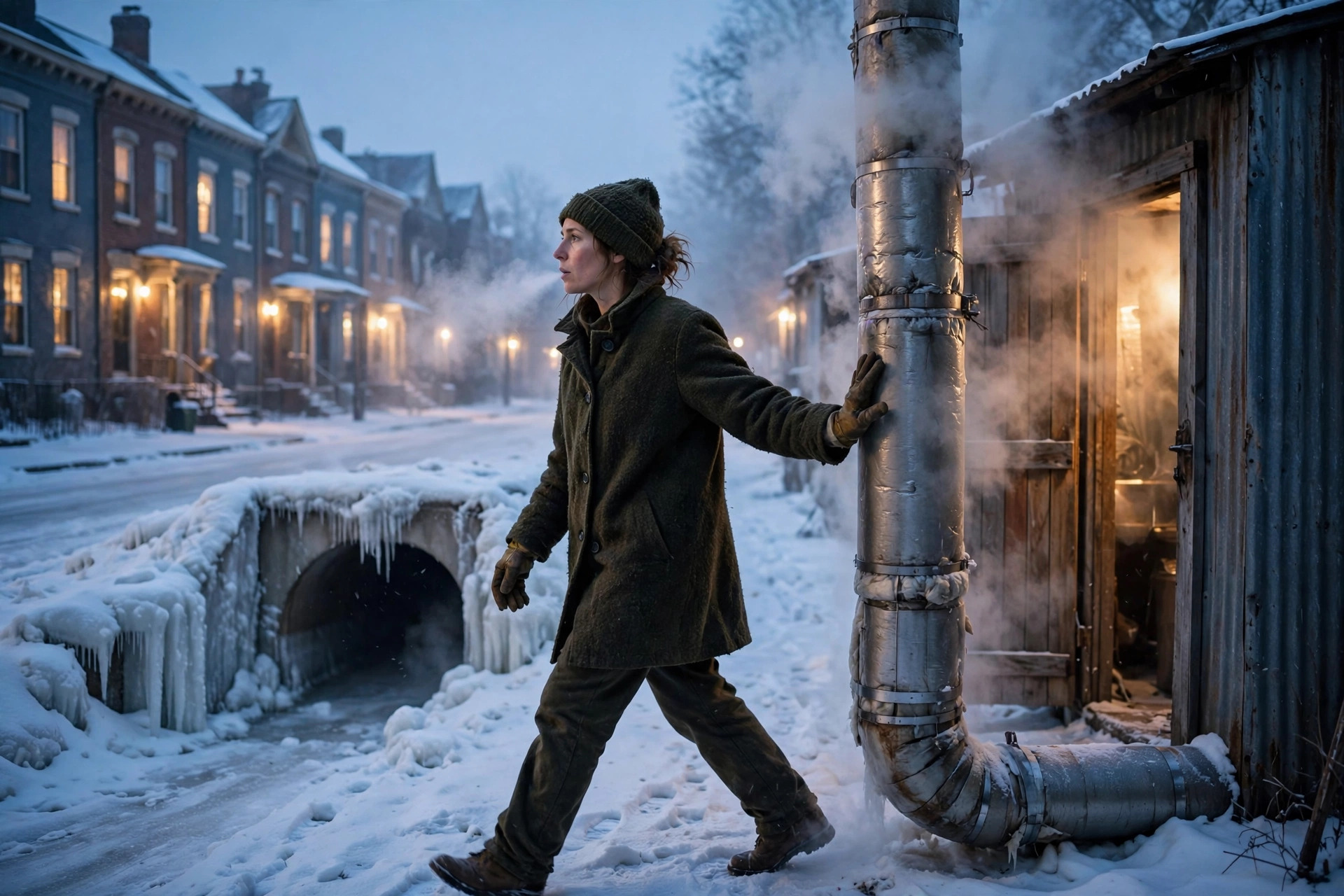
Noor Salhani's round began, as it always did, at the low end of the loop, where the insulated trunk main came down out of the boiler shed and dove under the first frozen culvert of the morning. She walked it south to north, gloved palm flat against the pipe cover, counting the heat the way other people counted sheep. Warm, warm, warm where it ought to be warm. Cool where the ground fell away toward Coriam Bottoms, cool in the stretch every steward before her had also found cool, because the frost came up out of that hollow like something with intent.
Twelve years in this town. Six of them walking this same forty-minute line, and the loop had a language she'd learned the way you learn a neighbor's cough through a shared wall. She knew which balancing station stuck in damp weather. She knew which household ran their floor coil greedy on Sundays because their grandchildren came for dinner. She knew the particular song of a valve seated one flat off, and she could name the station from twenty paces.
She'd walked the loop twice before she climbed the steps of the Weave House and saw the note chalked on the slate by the door: Helix presentation, 10 o'clock, all keepers if free.
Not all hands. All keepers if free. As though the keepers were optional to a conversation about their own loop.
Inside, the common room smelled of coffee and the paper-and-wax smell of the charter framed on the east wall, the one she and Gideon Malt had printed and signed in the first winter, back when the Weave was two hundred forty households agreeing to share one boiler rather than freeze separately. Oren Fitch was already there, perched on the edge of the wood bin with his boots dripping onto the flagstone, and Maya Trask sat by the stove with her balancing key on her belt, running her thumb along the key's notched shoulder the way she did when she was deciding whether to say something.
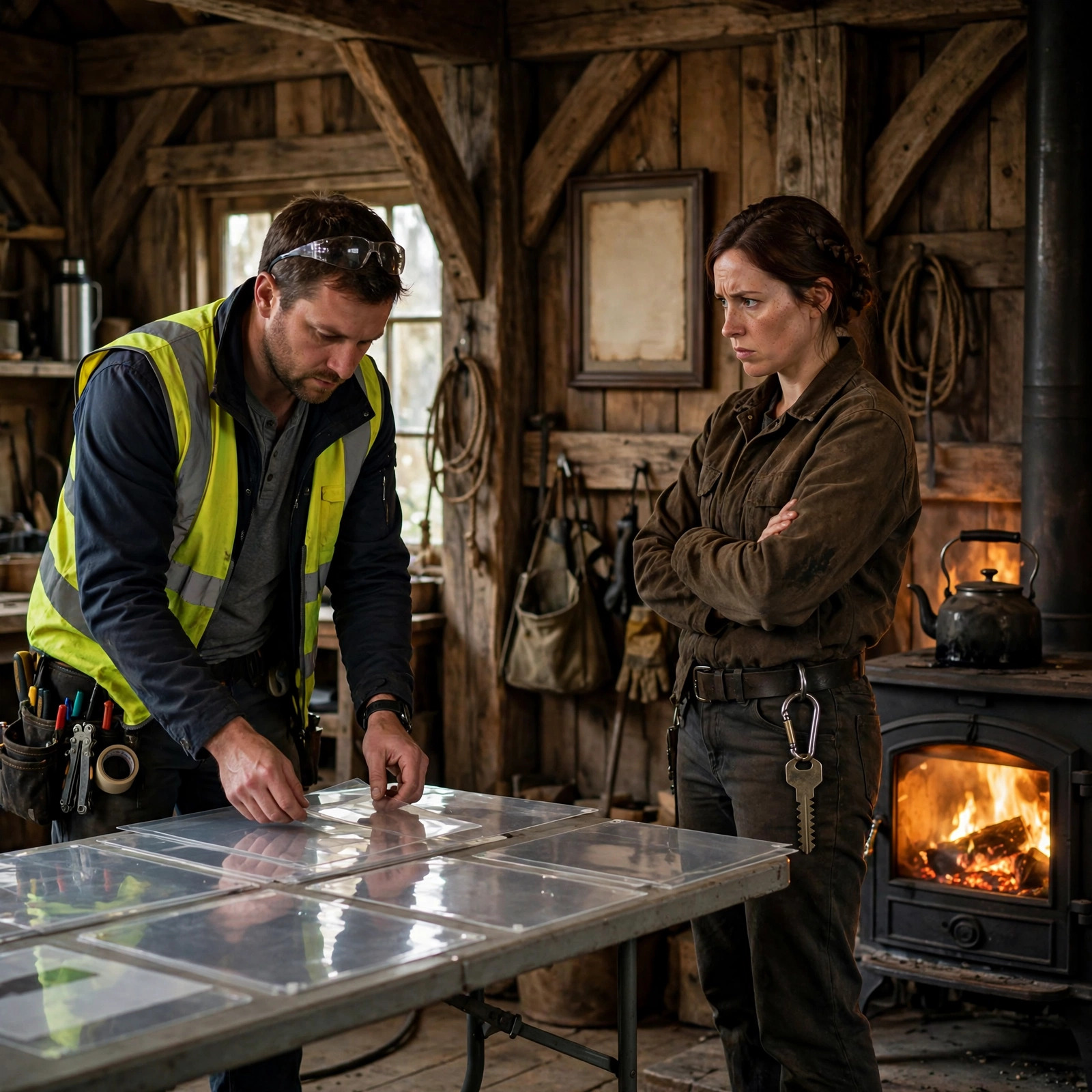
The stranger at the front of the room had a projector, a folding table, and the clean hands of someone whose winter had been spent indoors. He was arranging laminated sheets along the table's edge with the care of a man setting a table for people he intended to feed.
"You must be Noor Salhani," he said. "Prem Desai. Helix Renewals. I've read your flow logs, the public ones. They're good work."
"They're honest work," she said, and hung her coat on the peg.
"That's what I mean." He didn't flinch off it, which she gave him a small point for. "It's why I'm here. Shall we wait for Beatriz? She's coming from the council offices."
Beatriz Ulloa arrived with the frost still melting off her scarf, took a chair near the back rather than the front, which Noor noted, and Prem began.
She had expected a sales pitch. It wasn't one, quite. It was a model. He had the whole loop in it, every household branch, every trunk run, rendered in soft blues and greens, and he turned the pages of it like a man showing family photographs. The automated loop closed its own valves on the model's weather. It trimmed household draw against the model's forecast. It read every meter every minute instead of every meter every week, and when he ran his cold-snap scenario, the numbers bloomed nine percent.
"Nine percent," Oren repeated, leaning forward off the wood bin. "Across the whole loop?"
"Modeled," Maya said, from the stove, not looking up. She said it the way you'd correct a child's spelling.
"Modeled, yes," Prem said, evenly. "I want to be straight with everyone about what that number is and isn't. It's the loop's physics, run against the last six winters of weather data. It isn't a promise. It's a forecast, and forecasts are only as good as their inputs, which is why I'm here on the ground instead of mailing this to the council."
Noor watched Beatriz watching him. The chair of the district council had thirty years in Coriam Bottoms and a face that gave away nothing on principle.
"What does it need from us?" Noor asked.
"The transfer vote, for the commons itself. And then, in the build, the seventeen balancing stations come out. The automated loop does the work the stations do now. That's most of the gain, honestly, the stations are where the loop loses its heat. Every hand valve bleeds a little. Every human decision is a slow decision, no offense meant."
"None taken," Maya said, and this time she did look up.
"The keepers, though," Noor said. "Say it plainly."
Prem turned a page, and there it was, rendered as gently as he could manage: the seventeen stations decommissioned, the keeper households, theirs among them, rehoused within the year, nearer the trunk where the automated loop wouldn't need anyone on the night round. He had a relocation schedule. He had, gods help them, a moving allowance.
"It's a good offer," he said. "I know it doesn't feel like one. But the night shift on this loop is brutal, I've read the incident logs, and no one should have to stand out in a minus-nine night with a wrench because a valve drifted. The machine doesn't get cold. It doesn't get tired. It doesn't get scalded."
"It doesn't get anything," Maya said.
"That's true," Prem said. "It also doesn't get frostbite."
Noor waited for Maya to push, and Maya did what Maya did, which was stand, cross the room, and set her balancing key on the projector table with a sound that stopped the room. It was steel, forged and ground by her own hand in 2029, and its shoulders were notched all along from twelve years of the same grip in the same places, a record of every valve she'd ever muscled back into its seat. She laid one finger on the notches.
"You know what these are?" she asked.
"Wear," Prem said.
"Memory." She turned the key over. "Each one of these is an alley your model's never walked. The stations read the alleys, son. They read where the frost heave pinches the return line, and where the Trask kid's rabbit hutch sits on top of the branch and insulates it better than any wrap your model knows about. They read where the east alley floods and the ground goes soft and the pipe goes out of level, and your model reads a pipe that's level, because nobody ever told it otherwise." She picked the key up and hooked it back on her belt. "Your nine percent is nine percent of a loop I don't recognize."
"Then help me recognize it," Prem said. He wasn't defensive. Noor gave him another point for that, grudgingly. "Seriously. I'd rather correct the model than defend it. If there's data the loop's keeping that isn't in my inputs, I'll take it tonight."
"I'll bring you my round sheets," Maya said. "Twelve years of them. You'll weep."
The room laughed a little, some of the frost gone out of it, and Beatriz stood, and that was the signal that the presentation was over and the arguing was about to begin, except that Beatriz only said, "Twelve days to the vote, everyone. The council meets on the transfer Thursday after next. Read the proposal. Come with questions, not moods." And she was out the door.
They dispersed the way the Weave always dispersed, in knots. Oren went to sweep the stove ash. Prem packed his projector in its padded case, folding the table legs with the brisk neatness of a man who had done this in a hundred rooms like this one. Maya left first, pausing at the door to say to Noor, quietly, "The trunk meters. You've looked at the trunk meters."
It wasn't a question, and she was gone before Noor could make it one.
Noor stayed. She always stayed; the Weave House was her other office. She made a fresh pot and sat with the weekly round sheets, and it was past noon when she thought again about Maya's parting line, and got up, and took the cover plate off the trunk meter in the north wall, the one that metered the whole bottom stretch of the loop, the one whose log card she'd filed every week for six years.
The meter ran smooth. That was the only word she had for it. The needle sat easy, the register clicked along with less of the little hitch she'd long since stopped hearing because it was simply the meter's voice, and the dial spun with the placid evenness of a thing reading a loop that had no stories in it. She watched it for a full minute. Two hundred forty households, and this stretch of the trunk fed the bottom third of them, the oldest branch, the one Gideon had fitted out with his own hands back when a meter fitter could still afford to live in Coriam Bottoms.
She thought about the scald logs. About the frost heave Maya had named. About the east alley that flooded every spring, which the meter was telling her, in its smooth placid way, was not there.
Meters got old. Meters drifted. She had replaced four in six years and recalibrated a dozen more, and it was nothing, probably, a tired register, a lazy spring, six years of her own round sheets averaging over whatever the meter was too polite to mention.
She was twelve days from a vote that would take the loop out of everyone's hands, hers included, and she did not have twelve days to chase a needle that sat too quietly.
She had one.
Noor unclipped the meter's log card from its hook inside the housing, slid it into her breast pocket, and screwed the cover plate back down. She didn't say anything to anyone, because there was no one left in the room to say anything to, and because some part of her, the part that had learned this loop through two shared winters with Gideon Malt before the ground took him, wanted to hold the card close until she knew what she was holding.
Outside, the frost was already coming up out of the hollow by the Bottoms, the way it always did, like something with intent.
Twelve days.
Cold Snap
The cold came down the evening of the second day like a lid settling, and by ten o'clock the radio mesh had gone thick. Noor stood in the Weave House with the round sheets spread across the long table and watched the telemetry board stutter. Each gauge on the wall was supposed to tick every twenty seconds. They were ticking every three minutes, then six, then not at all, because two hundred forty households had all called for heat at once and every smart meter in Coriam Bottoms was trying to shout its little report through the same narrow channel at the same time.
"Mesh is saturated," Oren said from the corner, where he had his jacket half on and his boots already laced. "Has been since nine."
"I can see that." She could see it in the board more plainly than in the numbers, in the way the lights held steady and lied. A gauge that hadn't updated in six minutes was not a reading. It was a memory of one. "Get your key."
Oren did not move for a second, and then he said, "Maya's already out."
Of course she was. Maya had run the night balancing stations for twenty winters and she no longer waited for the mesh to fail before she started walking. Noor pulled her coat on and took the lantern and the spare log book, the paper kind, the kind that did not need a network to hold a number.
Prem Desai was still at the door where he'd been most of the evening, laptop open, breath fogging. "My model has the loop self-balancing through this," he said. "The automated stations would hold differential without any of this. I want you to know that."
"Your model has a lot of things." She regretted the snap before it finished leaving her, because it wasn't his fault the mesh was dying, and because he had spent the day since the presentation doing honest arithmetic on their tables and revising his numbers twice without complaint. "Walk with me," she said, softer. "Come see what your model replaces."
They went out into the minus-nine dark, all four of them, Noor and Oren and Prem and the night itself, and the frost had come up so hard out of the hollow that the cobbles of the Bottoms rang underfoot like struck iron. The lamps along the loop were burning, at least. Power held even when the mesh did not.
At the first balancing station, Oren's station, the pressure gauge read warm and safe and four minutes stale. Oren put his palm on the hand valve, read the true differential off the mechanical dial bolted beside it, and opened a quarter turn. The metal ticked as the load shifted. In the houses up the row, the pipes shuddered on, one after another, the sound traveling down the branch like a word passed along.
"You see the problem," Noor said to Prem. "Your automated stations would work tonight. I'll grant it. The valves don't need the mesh to turn. But the readings you'd act on, at Verell, at your office, wherever your operators sit, those come down this same radio channel. Nine minutes ago that gauge said the loop was warm. Nine minutes ago it was frozen."
Prem typed something, his mittens off, his fingers going stiff. "The latency's a real constraint. I'm noting it. I'll factor a local cutoff into the failover logic."
"Factor it," Noor said. "But you can't factor a hand."
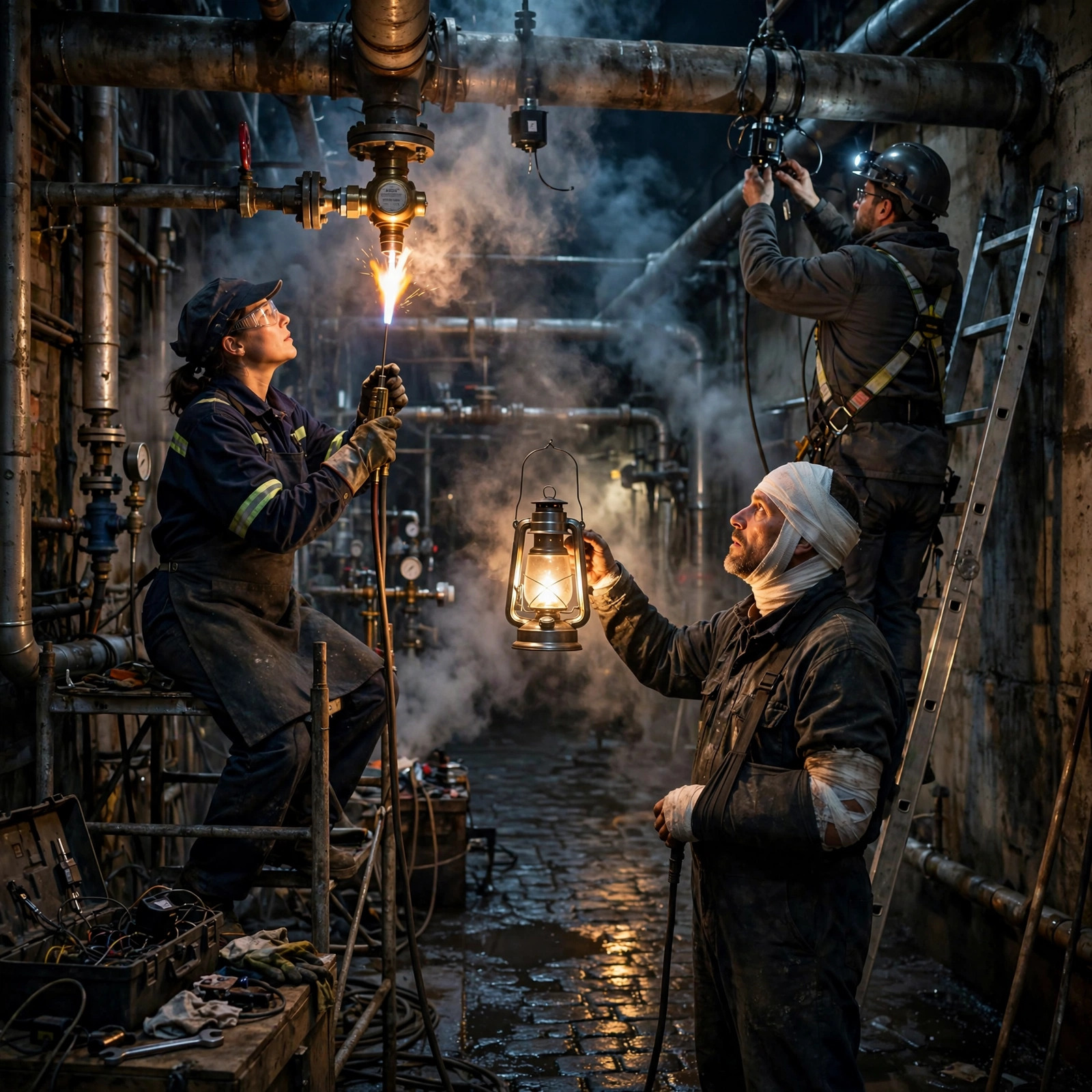
The night went like that for three hours, station to station, four of them walking the loop's spine, opening and closing by feel and by the honest brass dials, while the telemetry board at the Weave House slept its minute-long sleep and dreamt its lagged dreams. At half past one Maya came up out of the south branch with frost in her collar and her key on her belt, and Noor handed her the paper book, and Maya read the last hour of numbers by lantern light and said the thing Noor had been dreading since the frost started.
"East alley's going."
"Going how?"
"Ground's heaving. The trunk outfall's iced and the melt's got nowhere." Maya was already pulling her gloves tighter. "The vents. If the vents don't open on the alley, the water comes back up into the cellars of the whole row."
The gravity flood vents. The seventeen hand-operated stands, worked off a duty list that lived in Maya's head and in the oil of the keepers' habits, opening the low lanes so meltwater could run down and out of the Bottoms instead of standing in people's houses. Noor thought of the Helix schematics she'd studied for two nights running, the pipe inventory, the station list, looking for where the vents appeared in it, and the thought arrived the way it had arrived before, quietly, like a door she kept finding locked.
"Take Oren," Noor said. "Prem, you're with me on the branch line. If the trunk pressure spikes when the vents open, I want it on paper, the real numbers, while it happens."
Maya nodded once and went, and Oren went after her, and Noor watched the lanterns swing away east and thought that whatever else the next weeks decided, Maya Trask at sixty-something walking into a minus-nine night to open vents by hand was not a thing a model priced in.
The spike came at nine minutes past two.
Noor had the pressure gauge on the east trunk under her own lamp, the mechanical one, the one that could not lie about the last three minutes, and Prem had his recorder on it, and the needle climbed off its winter band and stood up straight and kept climbing. She heard the vent gear slam over in the alley, the grate of Maya's key in the stand, and the needle jumped again, and then, some seconds later, the mesh board caught up all at once to a burst of three-minute-old numbers, and for one bad moment nobody knew anything at all.
"Call her," Prem said.
The radio was voice, at least, voice got through when the data didn't. Maya's answer came choppy. "Vents are open, both stands. East trunk's hot, Noor. Hotter than the book says it should ever, I need to bleed the downcomer and I need to bleed it now, the pressure's got to go somewhere before it splits a solder."
"Bleed it. Downcomer first, then the relief." Noor was already moving. "Maya, mind the downcomer cap, it runs near the flash line, mind your, "
The radio said, flatly, "I know the line." Then a noise that was not a word, and then Oren's voice, very fast, saying, "Noor. Noor, the cap kicked. She's burned, her arm, it's bad, we're bringing her to you, can you,"br>
Prem got the east trunk on the recorder and Noor got her coat around her own thoughts, which wanted to scatter, and they ran the two hundred meters down the frosted lane to the alley mouth, where Oren came toward them carrying his lantern high and half carrying Maya, whose left sleeve was soaked and steamed faintly in the lantern light, and whose face was the color of the frost.
"Flash line," Maya said through her teeth. "Cap. Blew the cap. Got my arm." She said it like a round sheet entry. That was Maya, she reported herself like equipment.
"Verell clinic," Noor said. "Oren, the cart behind number four. Prem, your truck, you follow us, drive slow on the ruts."
The clinic took her in under the white lights, and the nurse's voice behind the curtain was calm and said words like second degree and clean and this is a burn, not a break, and Oren sat in the corridor with his boots steaming on the linoleum and his hands shaking, and Noor stood in the doorway of the treatment room and heard Maya say, quietly, before the sedative loosened her, "The pressure, Noor. Pressure like that doesn't come from the vents opening. That trunk was already loaded. Somebody's feeding it from upstream. Go look."
Noor looked. That was the whole rest of the night, and she did it alone, because Oren would not leave the corridor and Maya could not.
She walked the east trunk backward from the alley, gauge to gauge, mechanical dial to mechanical dial, and the pressure did not unwind as it should have, did not fall away upstream toward the plant the way a load falls when you walk toward its source. It stepped. It was low, and then at the next gauge it was high again, as if the trunk were breathing through a held mouth. She wrote each reading in the paper book in her flat steward's hand, and each number sat on the page and declined to be neighbors with the last.
The line walked her home. That was the plain fact of it; the anomaly walked her back street by street, the pressure climbing and dropping in its odd flatfooted rhythm, until the frost-glazed lane bent her by force of geography toward the Weave House, whose windows were dark, whose lamps were out, whose telemetry board inside would be dreaming its minute-old dreams, and she let herself in and did not turn on the overheads because she knew this room in the dark. Six years of round sheets. Two hundred forty households fed off one loop. Seventeen stations that her ledger said drew what they drew.
She took the lantern down the trunk wall, where the household meters hung in their long brass row, the ones Gideon Malt had fitted with his own hands before she ever held the steward's clip. The north trunk meter's cover plate sat flush where she'd screwed it down that morning after lifting its log card. She walked the row anyway. One, two, reading each register by lamplight, comparing each against the paper book, against the true trunk pressure she had measured with her own hands not an hour before. Three, four, low. Five, low.
The sixth meter read wrong in the other direction. That was the thing. It read high against a trunk that the alley gauges had told her was running loaded and strange, and it read low against everything the households beneath it were pulling, and both wrongnesses together made a shape, and the shape had a location, and the location was under her hand, because she had put her palm flat on the sixth meter's brass housing the way she put her palm on every meter every week for six years, to feel the register's tick.
Under the brass, where there should have been the one small voice of a meter counting, there was a hum. A second note. A smooth, unbroken, brazed-in hum of heat moving through a passage that was not the meter, and the warmth of it came up through her palm into the minus-nine dark of the Weave House, steady as a lamp, patient as the frost.
The Sixth Meter
Noor did not sleep in the hours after she lifted her palm off the sixth meter's brass. She sat on the trunk-room bench with the lantern at her boot tops and let the cold of the room come up through the bench slats, and she thought about passages. A meter counts what passes through it. A bypass is a passage that passes around the counting. Whoever had brazed a second channel under that brass housing had built a small road around the toll booth, and heat had been quietly driving on it for years, and the tolls had come up short, and the shortfall had to live somewhere. It lived in the books she had signed every quarter for six years.
At first light Oren Fitch let himself in with the apprentice's key, stamping frost off his boots, and found her still on the bench with the lantern burned down to a thumb of oil.
"Maya's asking for you," he said. "Clinic in Verell. Her arm's wrapped to the elbow, but she's talking."
"Sit down a minute, Oren."
He sat. He was twenty-six and built like the loop itself, all pipe and elbow joints, and he watched her unscrew the sixth meter's cover plate for the second time that night and hold the lantern up to the housing.
"There," she said. "Put your hand there."
He did. She watched his face do the arithmetic she had done at two in the morning. The tick of the register, and under it, steady and smooth, the second note.
"That's a bypass," Oren said. "That's not a fault. That's fitted. Who..."
"Who fitted every meter on that wall?"
Oren took his hand back slowly. "Gideon."
"Gideon."
"Noor, I have to tell you something, and you're not going to like when you hear how long I've been not telling you it." He turned his cap in his hands. "Maya and me, we've suspected the trunk meters were drifting for over a year. Readings that didn't sit with the alley gauges. I kept a side sheet. She kept telling me to bring it to you."
"Why didn't you?"
"Because it was Gideon's work. You don't know what it was like when he was alive. Forty years in this town, twenty-two fitting those meters. My mother called him when the pilot on her cooker died. He walked the whole Bottoms in the rain on the last night of the flood survey year because he said paper numbers kill people. You don't audit a man like that. And then he's gone, and the meters are his monument, and auditing a dead man's monument..." He pressed his cap brim flat. "It felt like grave robbery. Maya felt it too. She'd say, the meters drift, the meters drift, and then she'd stop herself, because where the sentence ended was Gideon."
"So she got scalded instead," Noor said, "bleeding a trunk that wasn't reading true."
The words came out harder than she'd meant them, and Oren took them like a man used to taking things.
"That's fair," he said. "That's fair, and she'd say it's fair."
Noor set the cover plate down on the bench and looked at the row of brass housings going down the dark wall. She did not know yet how many carried the hum. She knew the sixth did. She knew the north trunk's log card was folded in her coat pocket, lifted two mornings ago and never returned, and that the card said one thing and the alley gauges said another, and that she had been carrying that card around like a stone because she had already guessed what it would mean to lay it on the table.
Here was the shape of the thing, as near as she could cut it in the gray light. The Weave's books showed the loop running lean. Household draws under-counted, quarter on quarter, year on year. Against those books, Helix's model showed a nine percent gain, and nine percent was a number with a handle on it, a number a council could grab. If the books were wrong, if the true draws were higher and the meters had been quietly forgiving them, then the honest meters would cost money. Someone would owe the difference back to the district fund. She had done enough rate work to know the order of it: forty thousand dollars, give or take a season's fuel. And she, Noor Salhani, steward for six years, had signed every one of those quarters.
And there was the other road. The quiet road. Cut the bypasses out tonight, one by one, braze the housings honest, let the next quarter's sheets start clean, and no one ever had to know the years in between. The vote was in twelve days. Twelve days was enough to make the meters right and let the Helix model stand against honest numbers, if the honest numbers came out flattering, and she did not know yet whether they would. She only knew that the quiet road would work only if she moved fast and said nothing, and that Maya was in the Verell clinic with a wrapped arm because the trunk had not been read true, and that a steward who fixed the meters in the dark was just one more person deciding for the whole Bottoms what the whole Bottoms was allowed to know.
"Oren," she said. "Your side sheet. The one you kept. I want it."
"It's in my coat at the clinic. I'll fetch it." He stood, then stopped. "Noor, what are you going to do?"
"The honest thing is expensive," she said. "That's all I've got so far."
He nodded once, like a man closing a valve, and went out into the morning.
The district paper came off the mesh printer at the corner depot at eight, and Noor bought a copy on her way to the clinic because the queue at the depot was three deep and everybody was reading the same page. COLD SNAP SCALDS KEEPER, the headline said, above a photograph of the east alley with its hatch standing open and the flood vent's great iron handwheel rimed white. The story was thin and mostly right. It named Maya, named the Weave, noted the loop's automated rival proposal, and closed by reporting that the Coriam district council had moved its transfer vote up, citing public safety, from the twelfth to the ninth.
Six days. Noor stood with the paper in the minus-nine morning and felt the calendar close on her like a door.
The Verell clinic sat on the hill above the Bottoms, a converted brick schoolhouse with the original weathervane still turning on its cupola, and Noor climbed the steps slowly because the ice on them was real and her mind was elsewhere. Prem Desai was on the top step with a paper cup of something steaming, and she was not surprised; he had a field engineer's habit of turning up wherever the loop had bitten someone.
"I heard last night," he said. "How is she?"
"Talking. That's Maya. I'm going up in a minute."
He nodded, and looked out over the rooftops of the Bottoms instead of at her, which she appreciated, because it gave her a moment to look at the same view: the whole district under frost, two hundred and forty chimneys, the loop's insulated spine running down the alley with the steam of its losses feathering white against the gray.
"Prem," she said. "I have to tell you something, and I want you to hear it as a man who builds models, not as a man with a proposal in."
"Those are the same man," he said, "but go on."
"The Weave's books are wrong. I don't know how wrong yet. I found it last night, tracing the pressure step that scalded Maya. Some of our meters don't count true. They've been reading low for years, maybe since before my time, and I've signed the quarterly sheets on top of them, so the error is mine as much as anyone's. When I get the real numbers, your nine percent is going to move. It might shrink. It might vanish. It might grow. I don't know, and that's the honest answer, and I'm going to say all of this at the hearing on the ninth, in front of the council, in front of the paper, in front of your client."
She watched him take it. He turned the paper cup slowly in both hands, and she could see him doing what she'd watched him do at the Weave House on the first night: checking the statement against his model, hunting for the load path.
"You know what you're handing me," he said at last. "If your draws are under-counted, your real baseline is higher, and my gain could look bigger, or your honest numbers could show your loop's worse than anyone believed. Either way, you're giving my side a weapon and you're putting a bill on your own commons. The council could charge the difference back. They could charge you back."
"I've done the arithmetic. It's about forty thousand dollars."
The number sat on the frozen step between them. Down in the Bottoms a chimney crew was working the frost off a flue cap, small figures on a roof, and the sight of them doing their ordinary work in the ordinary cold made her chest ache, because they were the ones who would pay it, in the end, out of the fund they had all built a nickel at a time.
"Why tell me first?" Prem asked. "You could have cut the bad meters out quietly. Nobody would ever know. I'd have modeled against whatever you gave me."
"Maya knew the meters drifted and kept quiet because the man who fitted them was beloved. I've had a log card in my pocket for two days doing the same math. A heat commons runs on the meters, Prem. Not on the pipe. On the count. If the count's crooked, the commons is crooked, and I'd be the steward of a crooked commons, and I'd have kept it crooked for the same reason Gideon's work stayed untouchable. Because it's expensive to say out loud."
Prem drank what was left in his cup and looked at it as if it had answered him.
"For what it's worth," he said, "if your honest baseline moves, my model has to move with it, and I'd rather build on true numbers and lose than build on yours and win. I'll say that at the hearing too, if you want a second voice."
"I want a rival," she said. "Not a second voice."
"Then I'll be your rival," he said, "on true numbers."
Inside, Maya was propped on pillows with her arm wrapped to the elbow and her steel balancing key on the blanket beside her good hand, because Oren had brought it from her belt and she would not be separated from it. She looked older in the clinic light, and Noor sat down in the chair by the bed and took out the district paper and laid it on the blanket, headline up, and then took the north trunk's log card out of her coat and laid it beside the paper.
"I'm going to tell the council the books are wrong," Noor said. "On the ninth. All of it. It'll cost the fund about forty thousand, and it may hand Helix the vote, and I wanted you to hear it from me before you read it."
Maya looked at the card a long moment, then out the window at the frost-bound Bottoms below the hill.
"Six days to get the true readings," she said. "I'll be out of here by tomorrow. Start at the sixth meter. Work outward." She pushed the steel key across the blanket with two fingers until it touched Noor's wrist. "Take mine. Mine opens every hand valve on the trunk. You'll need it, and I can't climb ladders anyway."
Noor closed her hand around the key, still warm from Maya's side, and the notches of twelve years of use pressed their small honest record into her palm.
Council Hearing
The Coriam Bottoms district hall smelled of wet wool and radiator dust, and every seat was full four minutes before the bell. Noor came in last, carrying two objects in her coat that together weighed less than a loaf of bread and had cost the commons twelve years of its own truth. Maya sat in the front row with her sleeve pinned above the bandage, Oren beside her with his hands flat on his knees. Prem sat alone on the visitor side, tablet on his thighs, pen behind his ear.
Beatriz Ulloa called the room to order from the long table on the dais. She had been chair for five years and a Bottoms resident for thirty, and when she rapped the wood she sounded like a woman closing a till. "Transfer of the heat commons to Helix Renewals," she said. "Continued from the twelfth. Moved up. Steward's report first. Salhani."
Noor walked to the table. She laid Maya's steel balancing key on the wood, and beside it the brass bypass shunt Oren had cut out of the sixth meter two nights before, its little flared throat bright where the torch had opened it. Then she put the north trunk's log card beside them, because a confession needed its arithmetic.
"These meters read low," she said. "All seventeen trunk meters, and the household meters downstream of them. Six brass shunts, hand-brazed in 2033, before I was steward. They bleed draw around the counting element. Gideon Malt fitted them." Someone in the third row made a sound, and it traveled. "He did it to keep household rates down in the lean years. It worked. It's been working for eight years. And it means our books under-report what the loop actually carries, by about forty thousand dollars of heat the district took and never paid into the fund."
The hall did not erupt. It went very quiet, which in the Bottoms was worse.
Beatriz looked at the shunt for a long time before she touched it, turning it once in the light with a fingertip, like she was checking a coin for clipping. "You knew," she said. Not a question.
"I found it six days ago," Noor said. "I've spent five days verifying it meter by meter, because I wasn't going to stand here on a guess. I'm telling you now, before the vote, because if we vote on the old readings the vote is on fiction. The fund is owed the money. I'll say that plainly: the commons owes it, my office let it go on, and I'd rather pay it and have clean books than win a vote on crooked ones."
"Forty thousand," Beatriz said. She set the shunt down and put both hands flat on the table. "Do you know what that does to the winter reserve?"
"I do. I've run it. Three years of a supplementary levy, or five, if the households vote to spread it. I'll take either. I won't take silence."
"Your predecessor was a saint in this district," Beatriz said, "and I will not sit here and let him be made a villain by an audit."
"He isn't a villain. He's a man who bent a meter so his neighbors wouldn't freeze in a bad year, and nobody ever bent it back. That's all he is. That's all any of us are." Noor kept her voice level. "The meters have to be honest, chair. Whatever it costs."
Maya stood up in the front row, slowly, using the seat back. "I'll say my part," she said. "Me and Oren suspected drift in the trunk for over a year. We said nothing, because you didn't question Gideon's work, and because I figured any money found would come out of the same households I was keeping warm. I was wrong to keep it in my pocket, and it's half mine, that silence." She sat back down before anyone could answer.
Beatriz's jaw worked once. "Noted," she said. "Steward, you'll be back before this council on the repayment schedule. That item is not settled tonight. Now," and she turned to the visitor side, and some of the iron went out of her voice, "the Helix proposal stands in front of us claiming a nine percent gain over the Weave as measured. Mr. Desai, your model's baseline was our books. The steward has just told you the books are wrong. Does your figure survive that?"
Prem stood. He looked, for a moment, like a man doing long division in his head, which was exactly what he was doing. "Chair, the nine percent was computed against the Weave's recorded draw. If the recorded draw was low, the Weave's real baseline is higher, and my modeled gain against it shrinks. I'd want a week to re-run it properly."
"You don't have a week," Beatriz said. "You have this room."
"Then I have a second thing," Prem said, and turned to Noor. "Steward, you walked my pilot block on the third. You said something to me on the clinic steps that I couldn't shake, so yesterday I went and looked at my own sensors. The pilot's return-line thermometers sit inside the return's own exhaust plume. They've been reading the heat the loop already gave up as if it were ambient. It flatters my capture figure by about the same margin your shunts flattered yours." A soft, unhappy laugh went through the hall. "I know," he said. "I checked it twice. I'll show the raw traces to anyone who wants them. So my nine percent was a good number built on two bad baselines."
"How bad," said Beatriz.
"Best honest case, it's zero," Prem said. "It may be negative."
Someone in the back called out something about snake oil, and Beatriz put the flat of her hand down hard enough to close it. "He came here and told us before we bought it," she said. "In this district we have some experience with people who find their own crooked meters and say so out loud. Sit down, Mr. Desai."
Noor hadn't planned the next part for the room; she'd planned it for the record, and she let it be for both. "There's one more thing the model doesn't carry," she said. "The Helix station inventory has no hand-operated gravity flood vents. None. I checked, because on the cold snap night Maya Trask opened four of them on the east trunk with a steel key, from a ladder, at minus nine, and that's why she's in that bandage instead of a ward bed, and why the east alley is a street tonight instead of a lake. The model's flood survey is the pre-2038 one. It predates the east alley regrading. It thinks the vents are decoration." She picked up Maya's key and held it so the light ran down its notched spine. "Seventeen balancing stations, and every one of them is also a flood station, and every one of them is worked by somebody who lives in the district and knows which ladder rungs are split. The meters I've just cost us forty grand to make honest are the same meters that pay for those people to be on the ladder at minus nine. I'm not asking you to keep a fiction. I'm asking you to count the whole thing."
Beatriz took off her glasses, folded them, and looked at the three objects on the table: the key, the opened shunt, the log card. "Motion," she said. "To refuse the transfer and instead amend the commons charter to require audited true-read meters across the loop, with repayment terms to be set at the next session. Who seconds it."
Hands went up around the hall, more than the vote needed, and she counted them anyway, out loud, all the way through, which Noor understood was her way of making the room own what it had just done.
Carried. Not unanimous, four against, and one of the four stood up to say why, an old man from the hill who said his fuel bill couldn't take a supplementary levy, and Beatriz wrote his name down and said "Finance committee, Tuesday, bring your bill," which was not a refusal, it was arithmetic. That was the whole difference, Noor thought, between a commons and a company: the objection got a line in the book instead of a door.
Prem found her afterward, near the coat rail, with his tablet under his arm and the pen still behind his ear. "The pilot block comes down in the spring," he said. "The sensors are good kit, even if I sited them like a first-year apprentice. Fourteen of them, sealed, rated to the return line. I'd like the commons to have them. Not as a gift with strings. Just because they'll do more work on your loop than in a crate in Verell."
"You understand what they'll measure now," Noor said. "True draw. Full draw. Every under-charged household showing up in the ledger at once, in winter."
"I know what they'll measure," Prem said. "That's why I want them there."
From the front of the hall, Maya called over, "Start at the sixth meter," and Oren laughed, and Noor laughed too, because it was done, all of it, the whole crooked decade, and what was left was only the bill.
She went back to the long table to collect the key. Beatriz had already taken the shunt, holding it up to the ceiling light, reading the maker's file marks on its brass throat with her glasses back on. "Malt," she said. "His hand's still better than the machine shop's." She put it down on the table again, in the row of evidence, square to the edge, as if it were going to be there a long time.
Noor slid Maya's key into her coat pocket, where it had ridden all week, warm steel against her hip, and it was heavier going out than coming in, the way true things usually are.
Open Valve
Three days after the vote, the Weave House smelled of flux and scorched insulation, and Noor Salhani stood at the workbench with a hacksaw in one hand and Gideon Malt's brass lying open in front of her like a confession.
Six shunts. One for each trunk meter, brazed in 2033 by a man everyone quoted and nobody checked, each one a smooth little detour that had let a decade of household draw slip past the books. She'd carried the sixth one home from the council hall in her coat pocket, turning it over at stoplights. Now the other five lay in a row on a clean cloth, and Oren Fitch was already halfway through the second cut.
"Don't rush the vise," Maya Trask said from the doorway. "You'll bell the pipe and I'll have to dress it."
Noor looked up so fast she nearly dropped the saw.
Maya stood in the door of the shop with her hair down and her right forearm wrapped from wrist to elbow in clinic gauze, the burn dressing under it bulky but clean. She had a canvas tool roll over her good shoulder and her coat unbuttoned, and she walked in like the floor belonged to her, which it did.
"They said Thursday," Noor said.
"They said Thursday if I sat still and let people bring me soup. I've had enough soup." Maya set the tool roll on the end of the bench, working the strap one-handed. "Light shift. Doctor's words, not mine. I can stand, I can watch, and I can tell Oren when he's about to ruin something."
"I'm not about to ruin anything," Oren said, and the blade skated off the brass and he caught himself on the bench. "That was on purpose. That was a test cut."
"Mm," Maya said, and pulled a stool over with her boot, and sat down where she could see both their hands.
Noor set the hacksaw on the bench cloth. For six years she had run this loop with Maya on the night stations, and every one of those years had run on top of a lie that had made the books balance and the rates stay low and the commons look lean. It was strange to be glad about a thing and furious about it in the same breath, and to have no time for either, because there was brass to cut.
They worked the morning in a rhythm Noor hadn't known she'd missed. Oren cut and reamed; Noor fit the straight-run meters, the honest ones, machine-shop stock with their certificates still stapled on; Maya called the braze order from her stool and told them when the joint was hot enough and when they were being cowards about it. Her bandaged arm rode in a sling when she wasn't resting it on the bench, and she never once said it hurt, and Noor never once asked.
Prem Desai arrived at noon with a crate on a hand truck and his tablet under his arm, and he stopped in the doorway the way people stop when a room is full of work they're not part of.
"Come in," Noor said. "You're on the roof today."
"Am I." He set the crate down and pried the lid. Fourteen sensors, each in its own sealed sleeve, each smaller than Noor's palm. "Rated to the return line. I pulled the mounting rails too, and the sealant, and a spool of shielded lead. Before anyone asks, yes, I checked the placement math against actual exhaust this time."
"He checked it against our drawings," Oren said. "I sent him the drawings."
"I checked it against your drawings and then I walked the roof myself," Prem said. "Your drawings are good."
"Say that again for the tape," Oren said, and Maya snorted, and Noor handed Prem the roof ladder brackets, and that was the whole ceremony of it: Helix's sensors going up onto a commons loop, one engineer and one apprentice on a cold tar roof in March, screwing down rails.
Beatriz Ulloa came in at two with a folder under her arm and her council glasses pushed up into her hair. She didn't sit. She went to the wall first.
The charter hung there in a plain pine frame, printed 2035, signed by Gideon Malt and by Noor in her own second-year handwriting, which she had never been able to look at without wincing. Beatriz stood in front of it with her hands behind her back, reading it the way she read everything, top to bottom, no skipping.
"The finance committee met Tuesday," she said. "The old man from the hill brought his fuel bill."
"And?"
"And his bill was real, and his levy share was more than he could carry, so we re-split it on the tool-repair fund over nine years instead of five, which costs the fund a season of new pipe and costs him nothing he'll notice." Beatriz turned from the wall. "You wanted to cover it out of the fund outright. That was nine years of the fund in one night, Noor. Nobody in that room would vote for that, including you, if you'd slept first."
"I know."
"Do you."
"I did the arithmetic twice on the clinic steps," Noor said. "I know what it costs. Nine years is a schedule I can hold."
Beatriz nodded once, the way she did when a thing was settled, and opened the folder on the workbench, pushing the flux tin six centimeters to the left to make room. "Then bring it down."
Noor lifted the frame off its hook. The paper came out easily; the pine was heavier than the charter. She laid it flat on the bench between the shunts and the solder, six brass crookednesses beside the document that had licensed them, and it seemed right that they should lie there together for a minute.
The amendment ran a page and a quarter. Beatriz had drafted it in plain words: every meter on the Weave to be straight-run stock, sealed and logged; the repayment schedule for the forty thousand dollars of under-charged draw, carried by the tool-repair fund across nine years, with the hill household's share re-split and the fund's new-pipe season deferred one year, entered into the record; and, in its own paragraph, its own clause, the seventeen manual balancing stations written into the commons as standing infrastructure, keepers named as a duty of the loop and not a habit of it. Noor read that paragraph three times. It was the only part of the amendment she hadn't helped draft.
"You put the stations in," she said.
"The flood vents are hand-operated and the model that said otherwise was built on a survey older than Oren," Beatriz said. "That's not a habit. That's load-bearing. It goes in writing." She uncapped her pen. "You first. You're the steward."
Noor signed. Then Oren, as apprentice keeper, his signature cramped into the margin where the page had run out of room and nobody had wanted to reprint it. Then Maya, one-handed, slow, her bandage brushing the paper, her letters as square as brazing. Prem read the whole amendment before he signed, all of it, top to bottom, no skipping, and when he got to the sensors clause, the one that made the roof data commons property with a Helix maintenance right, he looked up at Noor across the bench.
"You left my name on the maintenance line."
"You'll still be in Verell in spring," Noor said. "You're the only person who knows the sensor stack."
"I'll be in Verell," Prem said, and signed, and Beatriz took the page, and the charter went back up on the wall with four fresh signatures and a paperclip holding the amendment to it, because Beatriz Ulloa did not believe in waiting for the framer when a paperclip would hold.
The light was going long and amber when Maya held out her good hand, palm up, and Noor knew what it was before she moved. She took the steel balancing key out of her coat pocket, where it had ridden for nine days, warm against her hip, and set it in Maya's palm.
Maya closed her fingers over it. Then she turned her hand and offered the key back, handle first, the way you hand someone a tool you intend them to use.
"East trunk," Maya said. "You bled it flooded on the snap night and the cap's still cracked. We open it slow, quarter-turn, and we watch the new meter while we do it. I can't work the valve with this arm. So it's yours."
Noor took the key. It was heavier going back into her hand than it had ever been coming out of her pocket.
Oren walked ahead with a lantern, though the dusk was only thick, not dark. Prem came as far as the yard and stood by the door with his tablet, and Beatriz watched from the Weave House step with her glasses on and her folder closed. The east alley was still wet from the thaw, long shallow sheets of melt lying flat between the cobbles, catching the last of the sky. Down the row, the sixth meter, the first honest one, sat on its new straight run with its seal unbroken and its certificate stapled to the wall plate behind it.
Maya positioned her at the valve with two words and a nod, then stood at her bandaged side and put her good hand just above Noor's on the key, not taking it, only steadying the angle.
"Quarter-turn," Maya said. "Slow. Stop when I say."
Noor set the key into the square of the stem and turned. The valve took its quarter with a small gritty resistance, old packing, and then gave, and the east trunk came alive under the street. On the new meter the needle lifted off its rest and climbed, and climbed, and steadied, reading true, reading everything, the whole east draw of the district flowing past it into the open ledger at last.
Steam rose off the meter housings into the cold air, thin and white against the amber windows of Coriam Bottoms, and Maya's hand stayed above Noor's on the key for one more breath, and then let go.
Get notified when new stories drop

Ren Hollis
Ren writes frontier worlds and terraforming triumphs — habitats, gardens under glass, and the first rain on a new world.
Leave a comment
Comments