




Dark Water

The light came up out of the water an hour after sundown, as it had every night for fourteen months, and Iseult Farrow was already kneeling at the rail with the slate tray open beside her when the first bands began to climb.
Green first, always green, a wide ribbon of it rising through the dark water off the platform's northern leg, and then the finer work began: the short-long rhythm the team had spent a winter learning to read. She kept her eyes on the depth of it rather than the surface. The Chorus sang from the top thirty meters, mostly, though tonight the pattern rose from deeper than she liked, past the last of the floater's shadow, out where the water went from green-black to pure black and the stars began their second sky underneath the hull.
"Late start," Sonam Greye said from the instrument bench. They had the recorder running, one hand flat on the light-meter housing as if they could feel the pattern coming through the metal. "Forty minutes past first dark. That's the third time this week."
"They're busy," Iseult said. "It's the season."
"It's something." Sonam turned the gain down a hair. "We've got the full six hours if we want it."
Six hours of dark water, and not one minute more. Below the platform the water went bright again each morning with the sun and the Chorus's light drowned in it, unreadable, and every word the two species had ever traded had been traded inside this same narrow window. Iseult had stopped thinking of it as an inconvenience a long time ago. It was more like a shared language of its own: everything important, said only in the dark, only slowly.
The pattern resolved. Long-long-short, then a pause of nine counts, then long-long-short again. She found herself mouthing the intervals before she could stop it, an old habit Odetta teased her about, and reached for the tray instead.
The tray held forty-one discs of reclaimed polymer, laser-etched and hand-polished, each one strung on the same salt-scuffed lanyard. Forty-one families of tokens. Two hundred and thirty-eight words of shared meaning, every one of them built the same slow way: a human pattern offered into the water, a Chorus pattern answered, and then the pair repeated identically, three nights running, before Odetta would touch a disc with the etcher. Three nights. No exceptions, not once in fourteen months. It was the only grammar they trusted, and Iseult had come to trust it too, because it meant every word in the lexicon had been said twice before it was written once.
"Warn," she said. "That's warn. Family nine, third token."
Sonam checked the board. "Confirmed on the meter. Same intervals as the etch."
"Then they're asking about something." She leaned over the rail. Below her, forty meters down and then deeper, the pattern repeated itself, patient, exact. Warn. Warn. Whatever the Chorus was warning about, it was not new; the token existed, which meant it had been built together, which meant the warning was general rather than urgent. Urgency had its own family, and its own terrible economy of meaning.
"Answer with the pair from last night," she said. "Warn, then the shoal token. Ask if the warning is about the shoal."
Sonam keyed the emitter array, the one that laid soft bands of blue-green light down through the water column from the platform's belly, and the question went out. It took the better part of a minute to sink to readable depth. Then the answer began to climb.
Warn. Then, after a pause, a new pattern entirely.
"Hold," Iseult said. "Don't log it as noise yet. Give me the intervals."
Sonam read them off, short-short-long, short-short-long, and then the whole shape again, and then again. She watched it repeat four full times before she let herself breathe. It was new. It was not in the lexicon. And it was being offered with the deliberate, unhurried exactness of a pattern that wanted to be learned.
"Warn, and then that," she said. "They're defining something. Warn plus a new thing."
"Stay," Odetta Yu said from the doorway of the etch bench, without looking up from her work. She had the good ear for shape, better than anyone's, and she had learned to call the new patterns before the meter confirmed them. "That's stay. Look at it. Two short and a long, twice. It's the same figure as their hold-position in the navigation family, but slowed down. It's stay."
"You can't call a token from the bench," Sonam said, but without heat. It was an old argument and a friendly one.
"I'm not calling it. I'm saying what it looks like." Odetta set down her cloth. "Warn and stay. That's a sentence, Iseult. That's a whole sentence."
It was. And it was the wrong kind of sentence for a calm night on calm water. Iseult looked down through the black at the repeating light. Warn and stay. If Odetta's ear was right, then something down there wanted the shoal warned and held in place, and she could think of exactly one thing in this ocean that had been moving differently these past weeks.
Fleet traffic.
She had read the relay digest that morning, alone in the shack, and she had not shown it to Sonam or Odetta and had not sung one measure of it into the water. The cutter Anvaro was inbound from the Perimeter Fleet relay at High Anchor, running its full transit schedule, twenty days out. Twenty days, and then it would be over the margin with its towed source array streamed, running the deep-crust mapping survey the Fleet had wanted since before the contact program existed. The digest gave the array's rated level plainly enough, the way Fleet documents always gave the numbers that mattered most in the least emotional type: two hundred thirty-two decibels at the source. She had sat with that figure for an hour before locking the slate away. Two hundred thirty-two. She had once felt a survey array work through a floater's hull from forty kilometers off, felt it in her teeth and the soles of her feet.
And the Chorus had noticed the traffic. Of course they had; they noticed everything that crossed the dark water. Three nights ago a pattern had appeared in the nightly session that they could not translate at all, three sharp repeats, unpaired, offered and repeated and then abandoned, and she had gone to bed with the shape of it still hanging in her mind like a word on the tip of the tongue. She had a guess about what it meant, and the guess was not a comfortable one: that the Chorus believed the humans who came and went with engines over the horizon were a different group than the quiet ones on the platform. A louder faction. And she could not ask, because there was no token for we are the same people, and building one would take the three nights she might not have.
Because here was the trap, and she had turned it over all day until every edge of it was familiar: the standing order was unambiguous. Any unexplained mass concentration near a human asset was presumptively hostile until mapped. The Fleet had flagged several deep mass signatures under the platform's margin, big consolidated bodies hanging forty meters down, and the Anvaro's survey would map them or the survey would stand. Whitlow would see to it; that was why he was coming. And if Iseult sang the survey's true schedule into the water, if she explained the loud faction to the quiet ones before anyone had decided what the loud faction was allowed to know, she would be finished at this station inside a week. Sole signature authority, hers alone over every pattern that left the platform, and it was hers on exactly that condition. The contact program had grown up under that condition like a plant under glass.
So tonight she did not sing the schedule. Tonight she did what she was for.
"Offer it back," she said. "The new shape. Exactly. We'll take the three nights."
Sonam keyed the emitter, and the pattern went down. The answer came back unchanged, measure for measure, and the water under the rail lit and dimmed with the work of two species saying one small word to each other over and over until it was sure.
They ran it twice more before Odetta pronounced herself satisfied and pulled the etcher's hood forward over her bench. The new disc was fresh stock, one of a crate of reclaimed polymer rounds the supply tender had brought up months ago, and Iseult watched the laser walk the intervals into it, short-short-long, short-short-long, fine as script, the light of the work reflecting up off the wet deck. Odetta polished the disc with the same cloth she used on all of them, breathed on it, held it to the lamp.
"Two hundred thirty-nine," Odetta said, and strung it on the lanyard beside its family.
"Two hundred forty," Iseult said. "Warn confirmed last week. This is the second."
"Then we're two hundred forty words rich." Odetta wound the lanyard once around her fist, out of habit, and then unwound it and laid the whole string flat on the tray. "Not bad for something that started with a light we thought was a malfunction."
"It was a malfunction," Sonam said. "Ours."
The Chorus sang on below them, the full nightly session, families of light rising and answering one another far past the platform's margin in water no human instrument had ever mapped. Iseult knelt at the rail a while longer with her hands loose in her lap and did not offer anything more. The dark hours were half spent. In three weeks there would be an engine over this water loud enough to be felt in bone, and tonight the water was quiet, and the word they had just finished building together was stay.
She stood when the cold finally got through the jacket, and gathered the tray. The lanyard went on its hook inside the pattern shack's door, all forty-one discs, the newest at the bottom of the set where the weight of the string held it, and the fresh etching caught the lamp as it swung.
Iseult shut the door, drew the lock, and tested it twice.
The Tender
Seven nights after the second token was etched, the horizon off the Heronsong's south rail grew a light where there had been none. Iseult saw it first from the shack's door, a running light low and white, closing fast, and she knew before the glass came up that it was not the supply skiff. The supply skimmer came up monthly and announced itself on the band an hour out. This thing said nothing at all until it was inside the platform's margin, and then a voice she had only heard on relay traffic, crisp and tired at once, asked for a mooring.
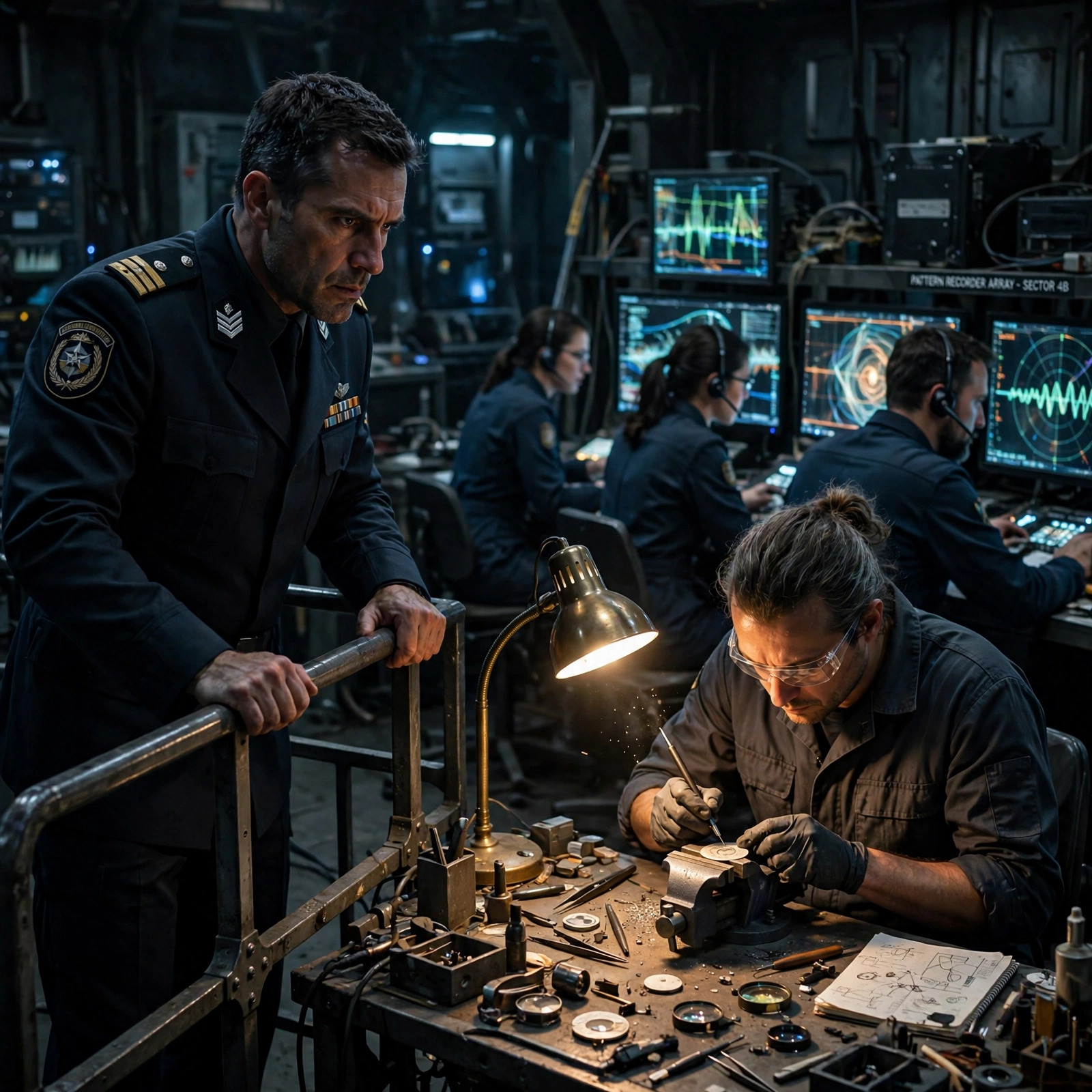
"Perimeter Fleet tender Kestrel, Commander Dax Whitlow aboard. Request to come alongside the contact platform."
Sonam was up on the rail with the slate tray already in hand, night session half prepared. "We're not expecting anyone," they said, as if the platform's manifest were their own ledger. "The cutter's three weeks out. I checked the digest Tuesday."
"So did I." Iseult set the tray back inside the shack, on the bench, away from the door. "Moor him at the aft cleats. Away from the shack." She did not say away from the water, because everything here was over water, but she thought it.
The tender came in without ceremony, a steel hull forty feet of it, and its engine note rolled across the dark surface and down, and down. She felt it in the deck plates before she heard it. Below the south rail the nightly session was in its third hour, families of light rising in their slow columns, and she watched the columns as the engine sound propagated, watched the way you watch a fire when someone opens a door against the wind.
The lights did not flicker. They went out. Not dimmed, not scattered. Out, all of them, across the whole visible margin, inside a minute, and the water under the platform was black in a way it had not been in fourteen months.
"Sonam," she said. "Kill our emitter. Full dark. Now."
Sonam was already reaching. The shack's lamp went to red, the emitter board went dead, and the platform sat on the sea like a dead thing while the tender's crew made fast at the aft cleats and their commander stepped across the gap onto her deck.
He was a broad man, gray at the temples, dressed like a man who had been dressed by an institution, and he looked around the platform with an expression she could not immediately read, which she disliked. "Dr. Farrow." He put out a hand. "Commander Whitlow. I've read your last four quarterly summaries."
"They're monthly," she said.
"Then I've read more than I said. Where's the rest of your team?"
"Odetta Yu is below, on the etching bench. Sonam Greye." Sonam nodded without stepping forward, arms folded, the tray still in reach of their hands. "We keep the complement small. Fewer engines, fewer hulls, fewer reasons for the water to go quiet."
"The water's gone quiet," Whitlow said. It was not a question. He turned and looked over the south rail at the black sea, and she watched him understand it, or half of it. "That's them. That's the contact."
"That was the contact," Iseult said. "For fourteen months. Tonight it's a hole in the ocean, and the hole is your engine, Commander, and if you'd wired ahead I'd have asked you to come in under battery on the last mile, and the session would still be running."
He took that without flinching, which she had not expected. "I'll note that for the cutter. Battery on the final approach. It's a good procedure and I'll adopt it, but you should know it doesn't solve my problem, it only moves it." He unrolled a chart case on the rail, weighted its corners against the wind with two brass fittings from his pocket, and she saw the survey overlay before he spoke again. "You know the Anvaro."
"I know its digest. Mapping survey, deep crustal structure, active source array, towed body. Filed schedule puts it here in twenty days from the date of that digest, which makes thirteen from tonight. I've read everything you sent the relay."
"Then you've read the standing order, or you've read around it. Let me say it plainly, because I'd rather say it once than argue it in pieces later." He put one finger on the overlay, on the shoal margin, on the cluster of mass signatures the Fleet's own sounders had logged from a distance and never resolved. "Fleet order on first contact environments: any unexplained mass concentration near a human asset is presumptively hostile until it is mapped. I don't get to call this benign because it glows prettily. I don't even get to call it benign because you've built two hundred forty words with it. I have to map it, and then I get to decide."
"Forty meters down," Sonam said quietly. "That's where the mass sits. We've had divers' reports, we've had optical drops."
"You've had optical drops from a small platform with a mandate not to disturb anything, which means you've looked without touching, and I commend the discipline, but it's not a survey. The order doesn't say 'glance at it.' It says map it." He straightened. "The array runs at two hundred thirty-two decibels near the bottom. That's the number, that's the capability, and I won't pretend it away to be polite. It's a crustal source. It is also, in the water column, a hammer."
"A hammer," Iseult said. She kept her voice level, and it cost her. "Commander, I've spent two years on this platform and three years in this chair, and I will tell you what that mass is not, because I can prove the negative and the positive is not mine to hand you yet. It is not a platform. It is not ordnance. It is not emplaced. It moves with the season, it changes density with the season, and it has never once changed shape in response to anything we have done in the water, which a weapons emplacement would have done by now, because we have done a great deal in the water."
"You believe that," Whitlow said. "I want to believe it. Belief is not a legal category where I sit. Dr. Farrow, I've spent twenty-two years in the Perimeter Fleet, and I've signed exactly one contact-closure order in my life, and I still think about it, and I did not want this assignment and I did not refuse it. I am here thirteen days ahead of my own cutter because I would rather stand on your deck and hear your argument than read it in a summary after the survey's already run. That's the whole reason for the tender. Now argue me out of my order properly, or tell me you can't, and we'll both know where we stand."
The wind moved the chart's corner against its brass weight. Iseult looked at Sonam, and Sonam looked at the water, and the water had nothing to say to either of them.
"The survey kills the contact," she said. "Not the survey's intent, the survey's physics. The Chorus answers nothing while there's an engine running anywhere above them. You heard that tonight, you watched it, I watched you watch it. Fourteen months of work, and your tender's first mile over the margin ended the session in under a minute. Now park a two-hundred-thirty-two-decibel source over the shoal for a crustal survey and tell me what you expect to find alive and talking afterward."
"I expect to find out what the mass is," Whitlow said. "That's my obligation. If your singers are what you think they are, the map will show it, and the map will stand up in front of Fleet review, and no one will have to take your word for anything. Isn't that the outcome you actually need? A finding that survives you?"
He was not wrong. That was the worst of it. She stood at the rail with the black water below and could not find the crack in his position, because his position was the law of her own institution, and the law had not been written by anyone who had ever watched light rise out of the sea and answer back.
"Then map it quietly," she said. "Low-power passes first. Passive. Give me the dark hours, six a night, every night, and take your soundings in the daylight between them. Let the session run while you work. You'll get your map, I'll get my contact, and nobody signs anything over a dead shoal."
"I'll take that under advisement." He rolled the chart, and his voice was gentler than his words. "I can't commit the cutter's survey plan from your deck on night one, Dr. Farrow. What I can do is file the schedule as it stands with the relay at High Anchor, which I'm required to do within one hour of arrival, and amend it later if the amendments are justified. Which is what I'm about to do, because the hour's nearly spent."
He stepped back to his tender's rail and called the relay up on the band, and she stood where she was and listened to her own program's schedule read back to her in a stranger's flat voice, survey track, source level, dates, the whole of it going out over the water and up to High Anchor and away toward a home that would hear it in four years and change. Filed. Locked. Real.
Sonam came to stand beside her at the south rail while the tender's crew settled their lines for the night. Below the platform the water lay open and black and empty, from the shack's shadow out past the margin, no light rising anywhere in it, not one family, not one word, and the six dark hours she had left were hers and useless together.
"They'll come back when it's quiet," Sonam said.
"I know they will." She kept her hands loose on the rail, the way she had taught herself, the way she taught the juniors. "That's not what I'm afraid of. Thirteen days, Sonam. Count them with me."
Three Cracked Discs
The test pulse came at ten in the morning, and Iseult felt it before anyone said a word. The shack's floor took it up through her boot soles, a single deep shove, and the rack of etched discs chimed against its dowels like a shelf of glasses. Then the room was ordinary again, and Odetta was already on her feet, and Sonam was swearing in a low steady voice at the rack.

"That wasn't two thirty-two," Iseult said. "That wasn't anything like."
"Hundred and ninety-two," Sonam said, reading the tender's open band off the deck repeater. "They ran it forty down. Reduced power. They told us they'd tell us before they fired, and they did tell us, and they fired anyway, and it still rang the whole platform like a bell."
Three discs had cracked. Not shattered; cracked, each one a clean radial split through the etched face, the reclaimed polymer gone opaque along the fracture the way frosted glass goes. They sat in their slots on the rack, whole-looking from a step away and ruined up close. Odetta lifted the first one out with both hands, tilting it to the shack lamp, and the split caught the light and ran the length of the token family etched along its rim.
"Warn," she said. "That's the warn disc. That's the first one we ever got them to answer." She set it down on the felt mat as if it were a patient. "And this one's the pair. Stay and return, both on the one disc, because I ran short of polymer that week and doubled them up. And this third one's -- " she turned it over -- "shoal. The margin word."
Four tokens across three cracked discs. Fourteen months of nightly work, of offering a pattern into black water and waiting an hour for the water to decide whether to answer, and a single morning shove from a towed body a kilometer out had split a tenth of it in a breath.
"If that's forty decibels down," Iseult said, "I want somebody to do the arithmetic on what forty up does at the margin. Not the plan's arithmetic. Ours."
Sonam was already doing it. "You don't need the arithmetic. You just watched it. That was the arithmetic, happening to your discs."
The hatch came open and Whitlow filled it, hatless, his uniform shirt already damp at the collar from the platform heat. He looked at the felt mat, at the three cracked discs laid out in a row, at Odetta's hands hovering over them, and his face did something careful and closed.
"Nobody was below decks," he said. "I made certain of that before we fired. The tender's crew was topside, and I had your deck hands off the south catwalk for the duration. That was the point of the reduced power. I gave you the courtesy of a warning, Dr. Farrow. I'd have thought you'd prefer it to a surprise at full source level."
"You gave the water a surprise at reduced source level," Iseult said. "The water doesn't read notices. It reads what hits it."
"It was one pulse. One. At a level my own survey manual calls inaudible-to-negligible for anything without a swim bladder."
"Then your manual was written for fish that don't talk."
She picked up the shoal disc and held it out to him, split face up, so he had to look at the fracture and not at her. He looked at it for longer than a courtesy required. She watched him do the thing she had watched him do on his first night aboard, which was to take in a fact he had not budgeted for and refuse to let it move his face until he had decided where to put it.
"These are your lexicon," he said. Not quite a question.
"Two hundred and forty confirmed tokens as of two nights ago," she said. "Every one of them built the same way. We offer a pattern. They answer it. We repeat it identically, three nights running, before Odetta etches it and it counts. Fourteen months of that. Four of those tokens are on that mat, and one of them is the oldest word we share, and you cracked it with a test pulse you didn't have to fire inside a kilometer of my platform."
"I fired it," Whitlow said, "because the Anvaro is thirteen days out and I will not bring a cutter and a towed array through your anchorage on the strength of your assurance that the water is empty. I have a standing order older than this program. Any unexplained mass concentration near a human asset is presumptively hostile until it is mapped. You know the order. I've read your file, and you've read mine, or you wouldn't have been so careful with me last night."
"The masses at the margin aren't hostile."
"You believe that. I'd like to be able to write it down. I can't write down what you believe, and I can't amend a filed schedule on it either. Not today."
"Then say what today is, Commander. Say it plainly so we all know what we're counting."
"Today is day one of the survey window," he said. "The schedule stands as filed. The Anvaro arrives in thirteen days, runs her mapping lines in the daylight, passive first, and I have taken your six dark hours under advisement, which is Fleet language for: I have not yet said no. That's what I have. It's everything I have. I know it isn't what you want."
It was so nearly what she wanted that she had to stand there and be angry at him in an ordinary voice, because the alternative was being angry in an extraordinary one, and the shack had thin walls and a young crew and fourteen months of precedent riding on her steadiness.
"Then take your data," she said. "Quietly. And tonight, when the water's dark, stand in this shack and watch what your one pulse cost me."
He came. That surprised her. He stood against the wall by the chart board with his arms folded, and Odetta dimmed the lamps at sundown the way she dimmed them every night, and the six dark hours opened over the platform like a held door.
For the first hour the water said nothing at all. Sonam kept the log. Iseult kept her hands loose on the rail of the observation port, loose, loose, the way she taught the juniors, while inside her chest everything was tight.
Then the margin lit.
Not the slow bloom of a family rising to answer. This came up fast and hard, a band of light laid across forty meters of black water, and it repeated. Sharp. Three times. The same short pattern, three times, with a space between each repeat that was itself part of the pattern, and then dark.
"That's new," Sonam said quietly. "That is not in the lexicon."
"I know it's not in the lexicon. I built the lexicon."
"Three repeats. That's our confirmation structure. Three identical, three nights running. They're using our own grammar on us and I can't -- " Sonam's hands moved over the slate, and stopped. "I can't translate it. It's built out of confirmed tokens, I can see the roots, warn is in there, and stay, but the assembly means nothing I've ever seen."
"They're saying something they've never had words for," Odetta said from the etching bench. "Or something they didn't want to have words for."
Whitlow said, from the wall, "Is that alarm?"
"I don't know what it is," Iseult said. "That's the honest answer, and it's the first time in fourteen months I've had to give it."
The water went dark. They waited. Sonam's log showed the minutes going by, and Iseult counted them the way she had taught herself not to count them, and then the margin lit again.
Warn. A single token, clean, the exact pattern they had offered into the water a year ago and repeated three nights running. Then dark. Then stay, strung last, the way they strung it, the fresh word. Then dark again. Then return.
Three tokens. Offered back, one at a time, in their own order, in the dark, on the night after a pulse had cracked the discs that carried them.
"They're re-confirming," Sonam said. Their voice had gone very quiet. "They're doing it themselves. We lost the discs, and they know something happened, and they're -- Iseult, they're rebuilding the words for us."
"Show me it's them," Whitlow said. "Not an echo. Convince me, because I've had a lot of things in my career turn out to be the ocean giving back what the ocean was given."
Sonam pulled the returns up on the shack's one good display, and the three of them stood in the lamp-glow and looked at what the water had sent up. The bands were soft-edged, layered, dappled along their lengths the way nothing mechanical is dappled, with a fine structure in the light that moved even as each band held its overall shape. Sonam walked the display forward frame by frame.
"No transmitter in the world has this texture," they said. "Look at the edges. A source array gives you a clean wavefront, even a cheap one. This is biological. This is thousands of small emitters, individually imperfect, firing in loose concert. And the returns aren't from one point, they're from a distributed field across the whole margin, forty meters down and half a kilometer wide. Whatever's down there is soft, and it's alive, and it just spent its dark hours doing our work for us."
Whitlow looked at the display for a long time. Iseult watched him look, and did not push, because she had learned in fourteen months that the water taught patience and the Fleet taught pressure and only one of them had ever answered her.
"The schedule stands," he said at last. "I can't amend it on texture. But I'll log tonight as what it is. A cooperative re-confirmation under duress. And I'll be in this shack again tomorrow night, and the night after, and you'll show me the rest of what they do with their dark hours. If the Anvaro's going to run lines over that margin, I'd rather know what I'm running over." He put his hat on, and paused at the hatch. "Two hundred and thirty-eight confirmed tokens, then. Is that the count?"
"That's the count," Iseult said. "They gave us back the pair themselves."
He went out onto the catwalk, and his footsteps faded toward the tender's cleats, and the water lay black and quiet and generous under the stars.
Odetta brought the broom out from behind the bench and began sweeping the cracked polymer into a dust pan, the little frosted shards clicking together as they went in. Iseult took a blank disc from the drawer, sat at the bench, picked up the etching stylus, and began cutting the survey schedule into its face by hand, date by date, source level by source level, so that at least one copy of what was coming would exist in a form that had been made slowly, by a person, for the water to read.
"It's going to be a long thirteen days," Sonam said.
"Then count them with me," Iseult said, and kept etching.
The Sung Schedule
The six dark hours began at 19:04, and by 19:20 the margin was already talking.
Iseult had the shack to herself for the first eleven minutes. Sonam had gone forward for the night log folder, and Odetta had gone home at noon, which left the bench lamp, the pattern rig, and the disc.
The disc sat in her palm where it had sat every night for a week, while she etched it and did not use it. Reclaimed polymer, hand-polished, the survey's whole run of lines cut into its face date by date: where the Anvaro would tow its source, on what nights, at what depth, at two hundred and thirty-two decibels. One honest object. The only copy of the plan that had been made slowly, by a person, instead of filed by a machine with the relay at High Anchor.
She set it on the wet rack, where the singers could read it through the port glass, and she thought about the standing order she was about to break. Any transmission of Fleet movement into the water was presumptive disclosure. Her signature was the only one that mattered in this shack, and it was the one thing she had that Whitlow could not take by rank alone. She was three minutes from putting it on the table.
Sonam came back in with the folder under their arm and stopped dead two steps past the hatch.
"You're going to sing it."
"I'm going to sing it," Iseult said. She keyed the rig to the low-emitter array, the one that put light down through the water instead of across it, and pulled the first date up on the slate. "You can log the objection."
"I'd rather log the answer." Sonam set the folder down and pulled the second stool over. "Objection's cheap. Sing it and I'll watch the margin."
The first pattern went down at 19:31. Date token, then the place token for the shoal margin, then depth, then the source-level token — the one they had built together in the early months, the paired bright-and-hold that meant loud, louder, hurt. She sang four nights of lines, the tow tracks, the rest periods, everything the digest contained, everything Whitlow had filed with the relay. Then she sang the last line: our loud thing, over your soft place, on those nights.
The margin went dark.
Not the slow dimming of a pattern ending. All of it, at once, half a kilometer of distributed emitters going out between two frames of Sonam's capture.
"Give them a minute," Sonam said, but the minute went by, and then another, and the water stayed black.
At 19:49 the sharp pattern came back. Three repeats, staccato, the same one from the night of the test pulse — the one they still could not translate, the one that had begun appearing the day the Kestrel's engine first turned over in the roads. Three repeats, a pause the length of a held breath, three repeats again.
"Still no parse," Sonam said, quietly.
"No." Iseult watched the water. "They know something changed out here. They've known since the tender arrived. I think they're asking who you are."
"Who the tender is."
"Who all of us are. Whether the loud ones and the quiet ones are the same thing." She let the capture run to the end of the sharp pattern and stopped it. "And I've just told them we are. Same faction, one mouth."
Sonam looked at her. "You sang the truth."
"I sang the truth without permission. There's a difference and Whitlow will name it." She closed the slate. "He's coming out tonight. Did the folder say when?"
"Aboard by the last tender run. Twenty-three hundred."
She looked at the disc on the wet rack, its etched face catching the bench lamp, and then she looked at the black water that had heard her and gone quiet, and she said, "Then I'll tell him before he asks."
Whitlow came in at 23:12 with his hat under his arm and the filed digest under the hat, and he was three steps into the shack before he saw her face and stopped.
"Say it," he said.
"I sang the survey into the water tonight. The true run of it. Dates, tracks, source level, all of it. Against the standing order, on my sole signature, without asking you first." She kept her hands flat on the table, where he could see them. "I'm telling you before you rule, because if I tell you after, it's a leak, and if I tell you now, it's a confession, and I need you to hear which one it is."
He set the hat down very slowly. "You put Fleet movement into a first-contact channel."
"I put the truth about what your cutter will do to their breeding ground into the water, so they could hear it from the mouth that has never lied to them. Fourteen months of building that trust, one token at a time, and every token in the lexicon was paid for the same way: we offered, they answered, three nights identical, then it was etched. That's the whole bank I drew against tonight. Yes."
"You understand what you've spent."
"I understand what I'd have spent by staying silent. They already think there's a second, louder human faction out here. I sang the truth to tell them there isn't. If I'd waited for your permission, your cutter would have run its lines first, and everything I'd have sung after would have been a eulogy."
Sonam stood very still by the capture bench, and did not look at either of them, and turned the night's record toward the light.
Whitlow didn't shout. She had expected him to shout, and the not-shouting was worse, because it meant he was working. He pulled the stool out and sat, and put his hand flat on the table, an inch from the digest.
"Show me what they did with it," he said. "You sang four nights of lines into open water. Show me the margin."
Sonam put the capture up. The sharp triple pattern, the black water, the silence. Then the last hour of the window: the warn token, the stay token, the return token, re-confirmed one by one, unhurried, exactly as etched.
"They went dark," Sonam said. "Then they repeated the pattern we can't parse, three and three. Then they re-confirmed three tokens from the confirmed lexicon. Two hundred thirty-eight, all intact. They didn't break anything off. They didn't answer the survey question either. They just... held the line."
"Which is what I'd do," Whitlow said slowly, "if a stranger knocked on my hull at midnight and told me the date they were coming back with a louder knock."
"Yes," Iseult said.
He was quiet long enough that she could hear the Kestrel's generator through the hull, soft as it was, and the water slapping the float rings under the catwalk.
"Now show me what my own tender's been doing with its dark hours," he said. "You said the soft returns. You said it last night and I let it stand on texture. I'm asking now."
Sonam pulled the second file, and this one they had ready: the Kestrel's low-power navigation passes, the returns the tender logged every time it crept in and out of the roads with its engine idled down. Sonam had spent a week stripping them out of the tender's own nav logs.
"Here's the margin at forty meters." The display filled with a soft, mottled field, returns scattered across half a kilometer, none of them hard, none of them edged. "No clean wavefronts. No corners. A source array, a platform, anything built and ballasted, gives you a shadow with a shape. This gives you nothing with a shape. It's distributed, it's soft, and it changes night to night — it's thicker in the lower water this week than it was in the logs from the start of the month."
"Thicker how?""More of it. Growing. Layered." Sonam put the two passes side by side, a fortnight apart. "And here, along the edge, these long faint bands — that's not structure, Commander, that's decay. Attenuation consistent with organic material breaking down in place. You don't get that off a hull. You get that off a mass of eggs and the ones that didn't make it, mats consolidated on the margin, year over year. It's a spawning shoal. The deep signatures your Fleet flagged as platforms are their breeding ground and their dead."
Whitlow looked at the display for a long time. Iseult watched him do the arithmetic she had watched him do every night for a week — tonnage, tow tracks, two hundred and thirty-two decibels across half a kilometer of egg-mats.
"My own tender logged this," he said.
"Every trip in and out of the roads," Sonam said. "It's in your nav files. It's been in your nav files the whole time."
He sat back. He took his hat off the table and put it on the rack instead, which she had never seen him do, and then he pulled the order pad over and uncapped the pen.
"Here's where we are," he said. "You broke a standing order, and I'm not going to pretend you didn't, and what happens to your signature is a separate conversation that I am not having tonight. But you broke it to keep a confidence alive, and the confidence held — they answered you with tokens we built, not with silence. And the thing my Fleet sent a cutter and a source array to map is a nursery." He looked up at her. "I cannot run two hundred and thirty-two decibels over a nursery, and I cannot cancel the survey on my own authority either. The Anvaro is under way and the relay has the filed plan. So I'm doing the one thing that's mine to do."
He wrote. Iseult read the lines as they came off the pen: the source array, craned aboard the Kestrel, secured and locked, tow body physically pinned, no active transmission from any Fleet hull within the roads, effective on his signature, until such time as the contact answered the survey question in its own water and its own light.
"They haven't answered it yet," she said.
"No. They went dark and they held their line and they asked us, three and three, who's out here. So we're going to do what you've done for fourteen months. We're going to wait in the dark water, and we're going to let them finish the sentence." He signed his name at the foot of the page, Commander Dax Whitlow, Perimeter Fleet, and set the pen down across it. "Pending their answer. Not mine. Theirs."
The order lay on the pattern-shack table between them, and beside it, where she had set it down when he came in, the hand-etched disc — the survey's true run of lines, cut date by date into reclaimed polymer by one person over one week, the only copy of what was coming that had ever been made slowly.
Sonam reached over and turned the capture back on, and out past the port glass the margin was still lit, token after confirmed token, holding its line against the dark.
The Ring
Thirteen nights of holding, and on the thirteenth, forty minutes into the dark water, the margin lit with something Iseult had never seen.
Not a token. Not one of the 238 confirmed discs of meaning, not a re-confirmation, not the sharp triple repeat of the unanswered question — who's out here, who's out there, who are you. This was a circle. A closed ring of pale blue-green light, forty meters down at the spawn shoal margin, holding itself unbroken while the whole shallow column around it dimmed. It burned in place for the length of two long breaths, went out, and burned again.
"Sonam." Her own voice sounded cracked to her. "Kill the shack lights. All of them."
Sonam was already reaching. The pattern shack went dark except for the capture boards, and Odetta, at the etching bench with her polishing cloth still around one finger, went still in the doorway. On the bench beside her, the slates lay in their racks, forty-one translucent discs of reclaimed polymer, laser-cut and hand-rubbed over fourteen months, one token family per disc.
"I know that shape," Sonam said slowly. "I've known it for a year. I logged it and I flagged it unconfirmed because it never answered back." They pulled the old capture forward, scrolling by hand. "Night 21 of the second month. Night 30. Night 55. It shows up maybe once every few weeks, always alone, always in a run I can't parse, and then it just... stops. Never joins a sentence. Never repeats three nights running, so it never got etched."
"Describe the runs," Iseult said.
"It's not a run. That's the thing." Sonam turned the board so the light caught the waveform. "It's the only pattern they make that has no start and no end. Every confirmed token has edges. The ring doesn't. It just — is."
A ring. A closed loop. No beginning, no seam, no first word. Fourteen months of building a lexicon one careful exchange at a time — human pattern offered, Chorus pattern answered, repeated identically three nights running before a single disc was cut — and through all of it, they had held one thing back. Not hidden badly. Held. The way you hold the one word you do not say until you know who you are saying it to.
The door behind them opened. Whitlow stood in it with the night air still cold on his coat, and he did not ask what was happening. He had come every dark hour for thirteen nights, as he'd said he would, and he read the water off the port glass faster than any man she'd met who wasn't paid to read it.
"That's new," he said.
"That's old," Sonam said. "That's fourteen months old. They just never sent it to us before."
The ring burned again below the margin. Unbroken. Iseult watched it and felt the whole shape of the thing arrive at once, the way an answer arrives: they think we are two. Two human factions, one quiet, one loud. They had watched the Kestrel come in burning decibels, they had gone dark within a minute of its engine, they had asked three and three who was out here, and for thirteen nights nobody had answered, because answering meant naming the Fleet, and naming the Fleet was the one disclosure that would end her appointment and might end the program.
And so the Chorus had waited too, and on the thirteenth night they had put their last held pattern into the water — the one word they had never trusted anyone with.
"They withheld it," she said. "Sonam, look at the flag history. Fourteen months of captures and they never gave us this one until there were two of us at the rail." She turned. "It means the same thing on both sides of this. Commander — it's their word for whole. Or closed. Or one ring, no seam. It's a closed circle with nothing inside it and nothing outside it, and they've shown it now, to both of us at once, because they think we're two peoples who share a water and they want to know if the two of us together close into one loop."
"That's a lot of grammar from one ring," Whitlow said.
"It's a lot of grammar from the only pattern they never repeated for us."
Odetta had come up beside the glass. "It's not going anywhere," she said quietly. "It's holding. Same depth, same diameter, every pulse. Doc — if it's an offered token, it's sitting out there waiting for the three-night rule, same as every one we ever etched."
The three-night rule. Offered, answered, repeated identically three nights running before it became shared ground. The ring had been offered. It sat in the water waiting to be answered.
And there was only one honest answer.
Iseult looked at Whitlow. The order he'd signed lay in the drawer where he'd filed his own copy — the source array craned aboard the Kestrel, tow body pinned, no active transmission from any Fleet hull within the roads, until the contact answered the survey question in its own water and its own light. He had kept every letter of it for thirteen nights. He had attended the dark hours and logged the margin returns as cooperative behavior, night after night, and sent the logs up to the relay at High Anchor, and the Anvaro had come into the roads and gone to moor with its array still sealed, waiting on the word of a man who had spent twenty-two years learning when not to make a sound.
"You know what answering it costs," she said. "The only answer that closes the loop is a name. Theirs is given. Ours isn't. To answer the ring, I have to put the Fleet's own designation token into the water — the real one, not the pattern-shack callsign. And you're standing here when I say it, so you're in it, and it goes to the Fleet as a disclosure made with your knowledge."
"It goes to the Fleet," Whitlow said, "as the answer to a survey question that my order is written on. I can't cancel the survey, and I can't run it, and I've told you both true things at the same rail for two weeks. So." He took his hat off and set it on the rack. "Sing the Fleet's name, Doctor. I'd rather it come out of this water as an answer than have it stay in mine as a blank."
She had the token ready. She had cut it eleven days ago and never used it, a shallow run of lines etched on the underside of the survey disc where no one would look — the Fleet's true designation, the string every hull answered to, the one pattern in her whole library that had never once gone into the water. She lifted the disc out of the rack, turned it over, and put it into Sonam's hands.
"Log it as sent on my authority," she said, "with his present and consenting."
Sonam set the slate flat on the transducer plate, designation side down, and keyed the light. Below the platform, at the margin, the shack's answer ran out across the surface water in the slow pulse the Chorus could read from below: the Fleet's real name, offered once, in their own grammar, with a human hand and a Fleet officer both at the rail.
The ring went out.
The whole margin went dark. Three minutes of nothing, and Odetta's knuckles white on the bench rail, and Whitlow not moving at all. Then the water at the margin rose in one soft sheet of blue-green, forty meters of it, ring after ring after ring, concentric, unbroken, closing inward — and inside them, beginning at the outermost and running home, the Fleet's designation token, repeated back exactly, pulse for pulse, in their light.
"Three nights," Sonam whispered. "It has to hold three nights and then we etch it — oh, we're etching it."
But the Chorus was not finished. Beneath the answered name, the margin lit again: the ring, whole and single, and inside it, one shape they had never seen — the sharp triple repeat, the question — laid out flat, joined end to end into the circle itself. The question inside the ring. Answered question and closed loop, one body.
"They're telling us it's the same thing," Iseult said. Her eyes were stinging and she didn't wipe them. "Asking and closing are the same thing to them. You ask, you get answered, and then — you're one loop. Both names inside it." She laughed once, not quite steadily. "Fourteen months of grammar and they had a word for us the whole time."
Odetta was already at the rack. "Then they get one." She lifted a disc — the first token family ever confirmed, the oldest etched thing on the platform — and threaded the messenger line through the hole she'd drilled in every disc for exactly a use no one had ever authorized. She held it out to Iseult. "It has to be a gift. Not lowered on a winch, not retrieved. Given."
Iseult took it. The disc was warm from the rack and slick with polish, and the etched lines caught the capture-board light the way they had caught the water every night for fourteen months. She carried it out onto the platform rail, past Sonam's board, past Whitlow, who stepped back exactly far enough to give her the water and no farther, and she knelt and paid the messenger line out over the side by hand until the disc lay flat on the dark surface, its cut faces down, its light lost in the black.
The margin rose. A single singer broke the water thirty meters out — a long body, pale, trailing glow along its flank — and swam a slow, unhurried arc to the platform. It stopped at the line. It did not take the disc at once. It circled it once, twice, with the patience of something that had watched humans build one word at a time for over a year, and then it dipped, and its body slid under the messenger line, and it lifted the disc away from the line on its back the way you carry something that belongs to someone you have finally decided to name.
"Taking it down," Sonam said softly. "Three meters. Ten. They're taking it to the shoal."
Iseult stayed on her knee at the rail, her hand still resting on the slack line. The last of the etched light blinked once as the singer descended — a small square of borrowed shine going down into forty meters of dark, under a long pale body, toward the egg-mats and the remains and the whole fragile nursery that the array would never now pass over — and then the light was gone under the singer's body, and the ring closed above it, unbroken, forty meters down.
Nobody at the rail moved to leave. Whitlow put his hand flat on the rail beside hers, not touching it, and looked down at the closed loop in the water.
"Tomorrow night," he said, "I log it as answered."
"Three nights," Sonam said. "Then I cut the disc."
"Then you cut the disc," Whitlow said. "And I'd take it kindly, both of you, if my name's on the other side of it when you do."
The ring held beneath them, whole, with nothing inside it and nothing outside it, and the four of them stayed at the rail through the dark hours, both parties still cautious, both still present, while the platform lights stayed off and the water did the talking.
Get notified when new stories drop

Sasha Quill
Sasha writes bold exploration and cosmic wonder with lyrical scale and grounded character work.
Leave a comment
Comments