


The Cold Ear
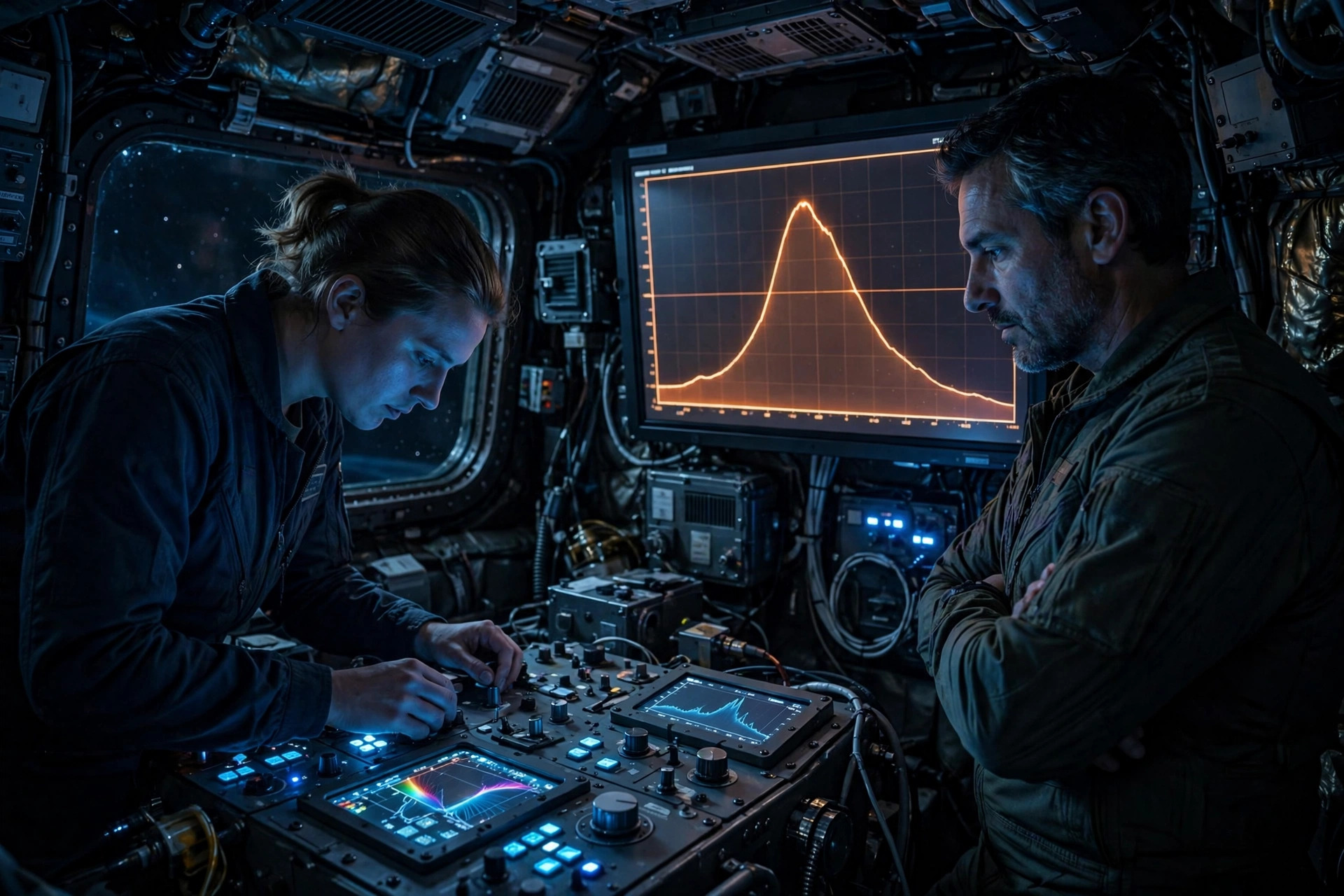
The occultation began four minutes early, which was the first thing Marta Quen said aloud, and the first thing Ilse Verany wrote down.
" ingress at 03:42," Marta said, bent over the photometry console with her chin propped on one fist. "That's not our ephemeris drifting. That's Sarance c with an atmosphere."
"Or a bad clock," Emil Tavro offered from the comms bench, not looking up from the instrument housekeeping feed he was auditing.
"My clock is fine."
"Everyone's clock is fine until it isn't."
p>Ilse let them go on. Ninety seconds into ingress, with the small cold planet sliding across the face of its dim star, there was nothing either of them could add that the instrument was not already saying, and she preferred to watch it arrive in the order the photons delivered it: starlight first, whole and steady, then the slow bite of the disk, then the long flat floor of totality where the interesting things lived.The interesting thing lived there now. She watched it climb out of the noise on the mid-infrared channel, a persistent twelve degrees of brightness temperature above where any airless world at this distance had any business sitting. Sarance c took starlight from a miser of a sun, a rust-colored dwarf that gave less than a thousandth of what home stars poured out, and its night side, the part facing the Tarn now, the part that should have been a blank, should have been radiating back into the dark exactly as much as it had stored and no more, was warm.
Twelve Kelvin. The same twelve as the last occultation. The same twelve as the one before that.
"Tell me the photometry sees it too," Ilse said.
"It sees it." Marta pulled her secondary plot onto the shared display: the same transit, the same floor, the same stubborn offset, rendered in her independent reduction. Two instruments, built by different hands, cooled by different cryostats, agreeing to within a few tenths. "Third time. That's three confirmed occultations with the excess, Surveyor. Same magnitude, same duration, same shape."
"Same shape is the part I don't like," Ilse said. "An artifact doesn't usually keep a shape."
She said it lightly, the way one says a thing to keep it small, and then she opened a new file in the survey ledger and the ship asked her for a title and she typed Anomaly File, Sarance c, Night-Side Thermal Excess and the words looked back at her from the screen and did not look small at all.
Emil rolled his chair over. "You're filing it tonight?"
"I'm opening it tonight. Filing comes after I've killed every boring explanation." She flexed her hands, cracked the knuckle of her left thumb out of habit, and started the list. "Stray light. Off-axis star in the field. Detector persistence from the last calibration run. Cryostat temperature drift. Ephemeris error putting us at the wrong phase. Tell me which of those survives three occultations at three different geometries."
"Stray light dies on geometry two," Marta said, counting on her fingers. "We rotated the field between the second and third. Off-axis source would have moved. It didn't. Persistence dies on the same grounds. There was no bright target before this one."
"Cryostat drift," Emil said.
"That one I can kill myself," Ilse said, "because it's my instrument."
The Cold Ear sat in the instrument bay one frame aft of her station, a gold-coated beryllium eye the size of her two fists together, brazed and machined on Luna half a dozen years before launch, running now at forty Kelvin, cold and stable and hers. She had helped spec it. She had signed for it. If the excess were a lie the Cold Ear was telling, it was a lie she had equipped it to tell, and she would rather find that out in front of Marta and Emil at three in the morning than in front of the directorate four light-hours down the wire.
So she did the thing she had been putting off. She brought up the cryostat control page and began a warm restart.
"Ilse." Emil's voice had gone careful. "That's thirty hours to re-cool if you cycle it."
"I know."
"No mid-infrared for thirty hours. We're in a window."
"We're in a window that just closed for anything useful," she said. "If the detector's got a hot pixel cluster or a bias drift that mimics a warm night side, I need to see it with the optics cold and the electronics warm, and then with everything cold again, and I need to compare. There won't be a better time to check than right now, before I put my name on a file that says a dead world is warm."
Emil was quiet a moment. Then he said, "I'll log it as calibration, authorized under your warrant."
"Log it as what it is. Instrument verification against anomaly." She keyed the sequence. On the engineering display the cryostat's temperature trace began to lift off its long flat line at forty Kelvin, a slow climb toward a warm soak that would take an hour to reach and thirty to undo. The Cold Ear would be blind while it climbed. Somewhere in the survey plan, a scheduled stare at Sarance b's crescent quietly became dead time, and she let it die without a ceremony.
That was the honest shape of it, she thought, watching the trace rise. Checking the instrument cost something real. It always did. The universe charged for certainty in hours and in scheduled observations, and it never told you in advance whether the purchase would be worth it.
Marta had gone back to her own reduction while the cryostat climbed, and now she said, without turning, "You know what the numbers are, if they hold."
"I know what they'd imply."
"Say it out loud once. So I know we're looking at the same animal."
Ilse considered refusing. Marta had three years on survey, junior to her by a decade of practice, and there was a version of command where you kept your read to yourself until the evidence was armored. She had served under a surveyor who did that, and she had promised herself she would not.
"If the night side of an airless body reads twelve Kelvin above its solar equilibrium, three times running, same shape, independent instruments," she said, "then either the body isn't airless, or it isn't dead, or it isn't either. Heat from below. Something in that crust is generating power, and the candidates are short, and every one of them is worth crossing the system for."
Marta turned around in her chair. "Internal heat. Endogenic."
"I'm not saying endogenic. I'm saying the boring explanations are dying one at a time and I intend to attend all the funerals personally before I write a word of interpretation." She nodded at the display, where the cryostat trace had passed eighty Kelvin and was still rising. "That's funeral number four."
They waited out the warm soak. It was near four in the morning, ship's clock, the hour when the Tarn ran quietest, when the refrigeration compressors cycled down between demand peaks and the hull ticked softly as it flexed through the long slow arc of the orbit. Emil finished his housekeeping audit and started a diagnostic on the timing chain, because if the clocks were wrong he wanted to be the one to find it rather than the one to have certified them. Marta ran the occultation forward through a second reduction pipeline she had written herself, stubborn and slow and utterly independent of the flight software.
At the end of the warm soak, with the detector electronics at ambient and the optics still warm, Ilse ran the flat fields. Dark frames, bias frames, a stare at the internal calibration source. Then she brought the cryostat back down, and the long cold began, thirty hours of it, the compressor working in the frame aft of them with a sound like a patient saw.
The warm frames came back clean. No hot cluster. No bias drift. No persistence ghost. Emil's timing chain reported agreement with the ship's master oscillator to well under a millisecond. Marta's pipeline reproduced the flight reduction within error bars that touched.
Which left the excess standing alone in the dark with nothing left to hide behind.
Ilse sat with it for a while. Down in the bay the Cold Ear was cooling toward forty Kelvin, blind and patient, thirty hours from being able to confirm anything again, and the planet itself hung out there in the dark past the hull, small and rust-lit, holding its warmth against every rule she had spent twelve years learning to enforce.
She thought about the wire to Orrery Gate. Four light-hours, one way. Anything she sent tonight would be answered tomorrow, in the ship's afternoon, by a directorate that had never once, in her experience, spent a gram of propellant on the word intriguing. She thought about the burn it would take to keep station for two more occultations, the hold the geometry would demand, the days it would add. She did not write any of that down. That was tomorrow's arithmetic, and tonight she owed the file only what she had.
What she had was three occultations, two instruments, one clean cryostat check, and a number that refused to be embarrassed.
She pulled her authorization fob out of the breast pocket of her ship suit, the steel one, stamped and engraved in the directorate workshops the year they made her survey lead, warm from her own body, and set it on the console beside her hand where she could feel the weight of it while she worked. Then she began to draft.
"Anomaly File, Sarance c," she said aloud, typing. "Night-side brightness temperature exceeds solar equilibrium by twelve Kelvin, confirmed across three occultations. Instrument verification complete. Boring explanations deceased. Details follow."
Marta laughed once, low. "You can't write deceased.
"I can write whatever I can defend." Ilse kept typing. Outside the port, Sarance c turned its warm face away from her, and she wrote toward it.
Four Hours Out
Ilse was asleep when the reply came back, which was its own small insult. She had spent the morning of day 97 arguing with herself over the wording of a follow-up she had not sent, then the afternoon pretending she wasn't waiting, and then she had made the mistake of closing her eyes for forty minutes. Emil found her in the passage outside her rack with the light strip at half and his handset in his hand.
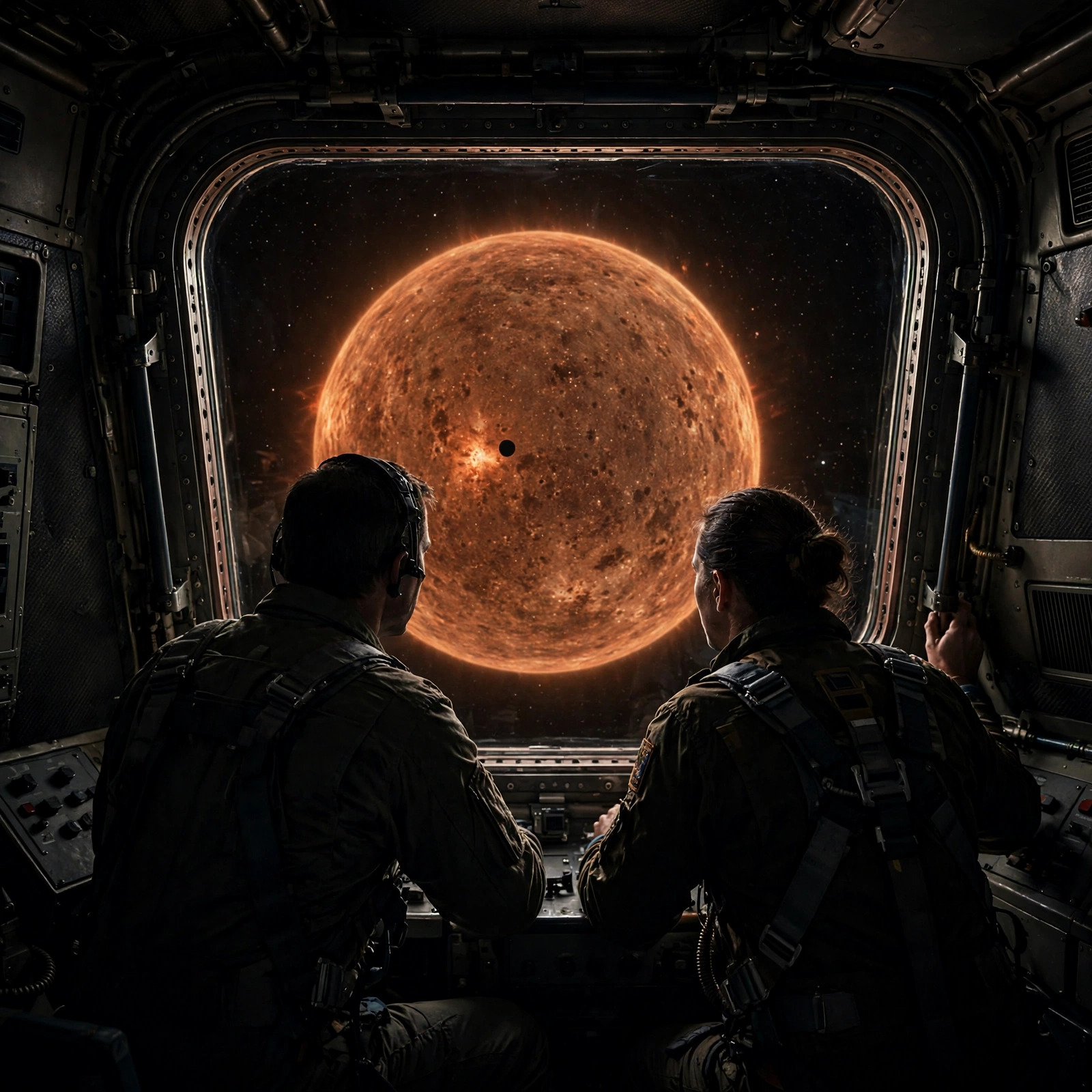
"It's from Keswick," he said. "Came through the relay twenty minutes ago. I haven't opened it. Suri's on the flight deck. She says you'll want the geometry up."
"You did right." She pressed her palm flat against the cold of the passage wall and let it wake her the rest of the way. Four hours out, four hours back. She had done the arithmetic a dozen times since sending the file: even if Bram Keswick had read her report the instant it landed on his desk in the directorate office and dictated his answer before he set down his cup, the soonest anything could arrive was eight hours after she'd keyed the send queue. Which meant his answer had been written while she was still tidying the draft, while the excess was still a curve glowing on the main display, still a stranger's night refusing to be cold. Whatever he said, it had crossed most of the distance before she'd even finished being sure.
She took the handset anyway. On the flight deck, Suri Beltran had the orbital plot thrown wide across the main screen, Sarance c's track and the Tarn's track wound together in their slow braid, and the two future occultation windows marked in amber where the geometry would put the ship's shadow path across the night side if they did nothing at all. Suri didn't look up when Ilse floated in and hooked a foot under the rail.
"He says no," Ilse said.
"You've read it already."
"Emil read me the first line over the handset. 'After review, the directorate declines the hold-station detour.'" She let the rest of it unspool in her own head as she pulled the full text up on her slate. It was longer than she'd expected. He had read the whole file. That was something. He had read it, and then he had done what he always did, which was put the mission's ledger on the table before he put anything else there.
Emil pulled himself up into the comms seat and brought the day's traffic log over to one side of his console, out of the way. "He gives reasons," he offered. "I read far enough to see that. It's not a form letter."
"No. It isn't." She read the reasons out loud, because numbers said aloud in front of witnesses became shared property, and she wanted witnesses. "Oxygen margin stands at twenty-two days above the return requirement. The detour adds nine days to the timeline. The burn is one hundred twenty meters per second of our remaining three hundred ten. He says, and I quote, 'the margin exists to bring the crew home, not to chase a residual the instrument may yet explain away.'" She lowered the slate. "He wrote that last part before the second occultation was even a proposal. Before Marta tightened the footprint. He wrote it four hours after reading a file that ruled out every instrument explanation we could test."
"He wrote it with what we had when we sent it," Suri said. She said it without heat, the way she said most things, which was the most annoying thing about arguing with her. "Three occultations. Twelve Kelvin. All calibration paths closed. That's a real file, Ilse. But a directorate can't spend oxygen margin on a real file. It spends it on a certain one."
"Twelve Kelvin on the night side of a body that should be at equilibrium." Ilse heard her own voice climb and brought it back down. "Do you know what that is, if it's real? Do you know what it does to every habitability model we've built for this system? Every one of them assumes Sarance c is a cold rock with a thin frost cycle. If there's internal heat, the whole model is wrong, and it's wrong in the direction that matters. Warm is interesting. Warm is where the water is."
"Warm is also nine days of oxygen," Suri said, "and a hundred and twenty meters per second we might need for something we haven't met yet. That's his job. He holds the reserve so we don't spend it on the first beautiful thing we see. You'd do the same in his chair."
"In his chair I'd ask for the burn numbers before I refused the burn." Ilse unclipped her slate and set it on the console edge. "I asked you last night to price the hold-station. You said you'd run it in the morning. It's the morning. What does it actually cost us?"
Suri finally turned around. She had the flat look of a pilot who had known this question was coming and had spent the overnight deciding how much of her answer to have ready. "You want it in front of Emil?"
"I want it in front of everyone, eventually. Emil first is fine. Emil's discretion is better than mine and he's already heard Bram's half."
"I was up at 0400 running it," Suri said, "if you must know, and I'll say for the record that I ran it because you asked, not because I've decided anything." She pulled a plot across from her own console. The amber windows brightened and shifted; two new marks appeared along the Tarn's track, a hold-station arc threading the ship through the shadow path twice instead of once. "Two more occultations instead of zero. Total cost, one hundred twenty meters per second, split across two burns, mostly plane alignment. Nine days added to the mission clock. That puts us at a hundred ninety meters per second reserve after, and it puts the oxygen margin at thirteen days instead of twenty-two." She let that sit. "Thirteen is above the return requirement. It's above it by a margin I'd call thin on a good day and insulting on a bad one. If anything goes wrong with the scrubber loop or the radiator between here and the departure window, thirteen days stops being a margin and starts being a countdown."
The flight deck was quiet except for the fans. Somewhere below them the Cold Ear sat in its bay at forty Kelvin, cooled by the same loop of spare coolant that fed the crew's air, and Ilse made herself not think about that particular coupling, because nothing had punctured anything yet, and she refused to live ahead of her instruments. She turned the plot with one finger, watching the two amber marks slide.
"Thirteen days," Emil said slowly, from the comms seat. "And Bram says no. So we're pricing a burn the directorate has already refused."
"We're pricing a burn the directorate refused on numbers he didn't have," Ilse said. "He refused nine days and a hundred twenty meters per second in the abstract. I want to be able to show him what the abstract costs in its parts, and what it buys. When we ask again, and we will ask again, we ask with the full geometry and the full ledger, not a request and a hope." She looked at Suri. "Can you split the burn? Show me which piece buys which occultation, so if we only get one window we only pay for one?"
"I can split it. First burn gets us the alignment; second just holds the station. The alignment is the expensive part, about eighty. The hold is forty, and it's only worth spending if the first window shows something worth confirming." Suri's mouth tightened. "You're building a menu. You're building a menu for a decision that isn't yours to make."
"It's mine to prepare. That's survey lead's warrant. I can transmit under my own authority and I can plan under it. Committing is a different thing. I haven't committed anything."
"No," Suri said. "Not yet."
Ilse pulled up the reply buffer. She wrote three sentences, deleted two of them, wrote them again. Emil watched her do it over her slate's cast on the console mirror, because comms technicians notice everything and are polite about roughly half of it.
"You're not sending that," he said. Not quite a question.
"I'm queueing it," Ilse said. "There's a difference. If I send it tonight, his answer comes back eight hours later, and it comes back to a request that costs him nothing new and says nothing he hasn't already refused. If I hold it until the burn numbers are in his hands, his answer comes back to a different question." She set the draft into the outgoing queue and locked the queue with her code. "It sits there. Unsent. Until we have something worth his eight hours."
"She's very good at this," Emil told Suri, tapping the queue manifest. "Half the traffic in that buffer is hers. Drafts with my initials nowhere on them."
"It keeps you honest," Ilse said, "having a comms man who knows the difference between a queue and a send."
Suri had already turned back to her console. She worked for a while in silence, and Ilse let her, because Suri's silences were where her arithmetic happened, and interrupting one only meant doing it over again later with more stubbornness. The fans cycled. The plot turned slowly on the main screen, the two amber windows drifting toward the terminator as the display clock ran ahead of real time, out past the next nine days, out to where the Tarn could be if someone chose it.
Then Suri pulled a print card from the console slot, the old plastic kind they still stocked for burn plans because paper didn't corrupt and didn't need power to be read aloud in the dark. She folded it once, twice, and held it out without looking up.
"Split burn," she said. "Eighty for the alignment, forty for the hold, second burn optional pending the first window. Departure window recalculated for day nine later than planned, oxygen margin thirteen days at burn complete. Everything on it is real and everything on it is unbought." Her hand stayed out. "That's the whole difference, what's in your hand and what's committed. I'd like it to stay a difference for a while."
Ilse took the card. It was still warm from the printer, and heavier than a card should feel, the way anything is heavier when it's a choice.
"It stays a difference," she said, and put it in her breast pocket, beside the fob, where the two could argue with each other while she slept.
The Radiator
The strike came at 03:11 ship's time, while Sarance c was a crescent in the aft port and the Tarn ran her quietest thermal configuration, the one Ruth called loafing, everything trimmed to radiate as little as a living ship could. Ilse felt nothing. She was asleep in her harness three meters from the forward bulkhead, and what woke her was not the strike but the ship answering it: the hiss of the pressure balance valves opening, the fans kicking up a register, and then Ruth's voice on the ship loop, level as ever, saying, "Forward radiator loop. Everybody stay put. I'm going forward."
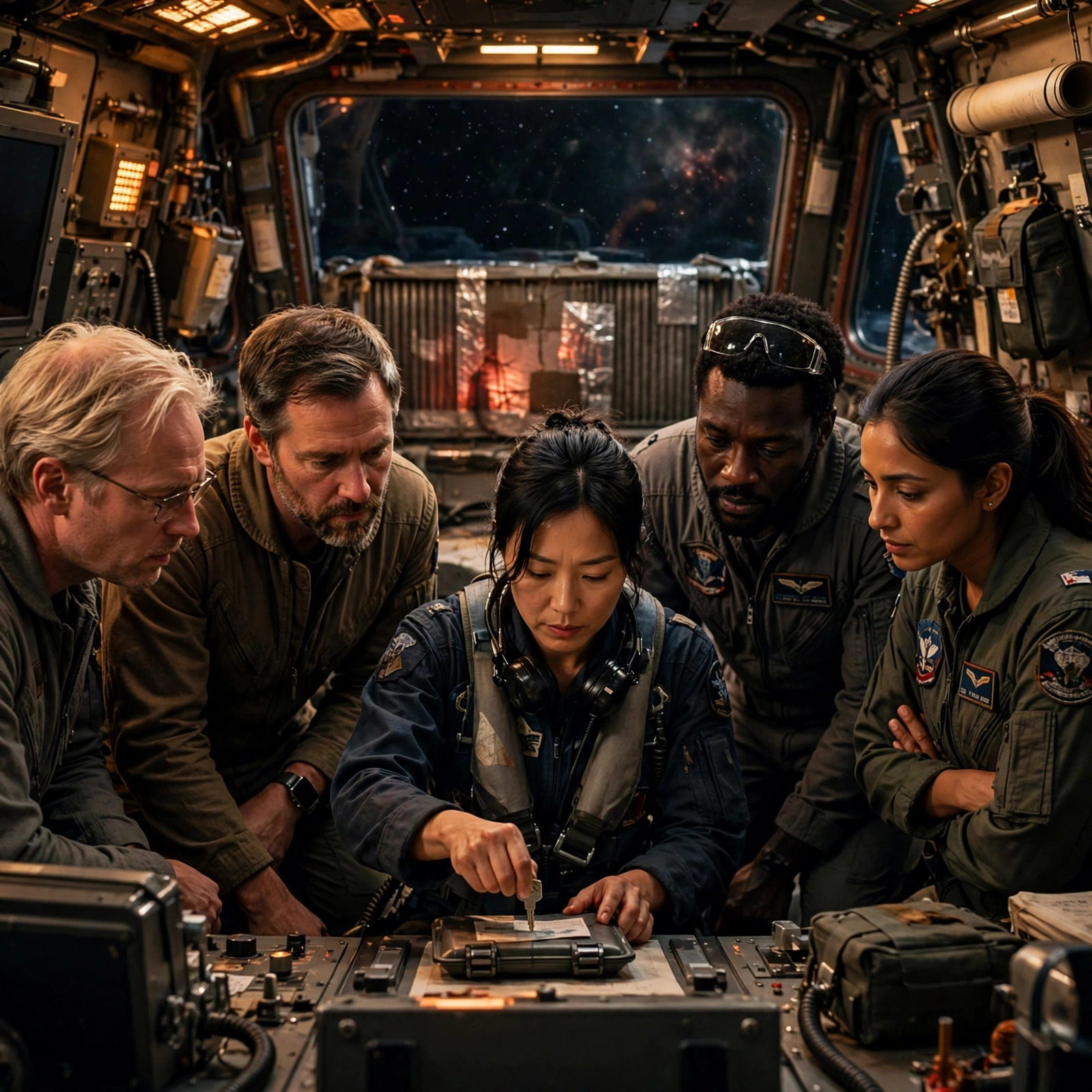
By the time Ilse reached the thermal bay, Ruth already had the loop isolated and the panel off. The puncture was small, a few millimeters, a micrometeoroid that had spent itself on aluminum and passed no further, but it had opened the loop's working fluid to vacuum and the loop had answered by doing what physics made it do: the coolant flashed to gas at the breach and vented as a fine glitter of ice crystals, a cone of frost drifting off the forward radiator like breath in a cold room, growing, thinning, gone. The crystals caught the light of Sarance and scattered it, and then there was nothing left to scatter.
"How much did we lose?" Ilse asked.
"Enough that the loop can't recharge itself." Ruth had her palm flat against the isolation valve, reading the vibration through her glove the way she read everything, by touch first. "The radiator's intact except for the hole. The loop's empty. I can patch the hole, but the fluid has to come out of the spares, and the spares are the spares."
Ilse understood before Ruth finished saying it. There were two systems aboard the Tarn that ran on the same coolant, because the same coolant was the right coolant for both: the life-support loop, which kept five people breathing at a comfortable temperature, and the Cold Ear, her spectrometer, which kept its beryllium heart down at operating cold so it could read the warmth of distant worlds. The spare inventory was sized for losses, not for a puncture and a refill at once. There was one recharge cartridge left in the rack.
Suri came up from the flight deck with her hair still clipped for sleep. "Puncture confirmed forward," she said. "I have the debris run. Nothing else on the track, it was a single body, small, high relative velocity, gone. We're not flying through a stream."
"Small comfort," Ruth said, "but I'll take it. One hole is a job. Two is a debate I don't want to have." She pulled the patch kit from its stowage, an aluminum plate eighteen centimeters across, preformed to the radiator's curve, and set it on the deck between them like a surgeon laying out an instrument. Neither Ilse nor Suri touched it. "I go out, I clean the site, I tack it, I weld it, I come back in. Two hours if nothing argues with me."
"The site's near the terminator edge of the panel," Suri said. "You'll be in particle flux for the second hour. I can bias the attitude, give you shadow, but not all the way. The panel has to stay sun-lit to keep the weld temperature honest."
"Then I'll take the dose and log it," Ruth said. "It's not my first, and it won't be my last, and it's not anybody's decision but mine. I built the loops. I'll weld the loops." She looked at Ilse, and there was nothing in her face asking permission, only the courtesy of telling her survey lead what was about to happen. "Day 98. I'll want it in the log with numbers."
Ilse gave her a short nod. "With numbers."
Ruth suited at the forward lock with the unhurried economy of someone who had done it a thousand times and respected every fastening. Suri flew the ship gently, nudging attitude so the panel came around into full sun and the shadow edge swung away from the work site, and Ilse stood at the thermal bay readouts and watched the loop pressures as her crewmate went out into it.
Ruth worked without narration. The suit's camera gave Ilse the site in gray and silver: the puncture, rimmed in frost subliming off the panel in slow ghosts; the brush passing over it; the tack welds going down one by one, each a brief bloom of light in the camera and no sound at all, because there was nothing out there to carry sound, only Ruth's breathing on the loop and the numbers ticking up on the dosimeter. The first hour was clean. The shadow came as Suri promised, and Ruth's dose climbed in small, ordinary increments.
The second hour the shadow thinned. Suri had said it would, and it did, and Ruth did not come in early. She cleaned the site again, laid the full seam, and worked her way around the plate's circumference while the particle flux found her through the thinned shadow, and the dosimeter logged every minute of it against her career ceiling, the running total that every systems engineer carried like a debt. Ilse watched the number and said nothing, because saying something would have been for Ilse's benefit and not Ruth's, and Ruth had made clear which hours of her life she was spending and on what.
At the end of the second hour Ruth pressed her gloved thumb flat against the plate's center, held it, and keyed the loop. "Seam's closed. Loop holds at test pressure. I'm coming in."
She came through the lock pale in the way that meant dose and effort, not injury, and drank a full bulb of water without sitting down. Then she said what Ilse had been waiting to hear said plainly.
"One cartridge. The rack's got one recharge left. The life-support loop will run degraded for days on what it has, but it won't run forever, and the Cold Ear won't run cold at all until it's recharged and pulled back down. Thirty hours of cooldown after a warm restart, before it sees anything. One cartridge fills one of them."
The thermal bay was quiet. Somewhere aft, in the bay Ilse thought of as her own even though the whole crew used it, the Cold Ear sat warm for the first time since before launch, its gold-coated optics blind, its shutters closed over nothing, waiting on the same rack as everyone's air.
"There's a case for the Ear," Ilse said, because Ruth deserved to hear it made. "If the burn goes and the occultations come, we need eyes. Warm, it sees nothing. It's the survey instrument, it's the reason any of us is out here."
"There's a case," Ruth agreed. "Make it to someone who doesn't know you, and it might even win." She turned the empty cartridge rack so Ilse could see the single remaining one seated in it, the seal intact, the label with both loops' part numbers printed side by side because nobody at the depot had ever imagined choosing between them.
Ilse took the cartridge out of the rack. It was lighter than it looked, and heavier, the way anything is heavier when it's a choice, and she had learned on day 97 exactly how much a thing could weigh in the hand. She crossed to the life-support loop's service port, broke the seal, seated the cartridge, and let the loop drink.
"The Ear can be rebuilt," she said, quietly, so it went to Ruth and not to the whole bay. "It was built once. Verany Instruments Works will build it again, whatever comes back. You can't."
Ruth looked at her for a moment. "You know that's not arithmetic."
"No," Ilse said. "It's the other thing."
Ruth cycled the recharge through the loop, watched the pressures walk back up into the green, and keyed her verification into the maintenance log with her own code. Then she took the scriber from the patch kit, went back to the suit camera's view on the bay screen, and reached through the open service hatch to the panel beyond, where the light of Sarance lay along the aluminum seam of her weld, and scratched her mark into the plate beside it, the small R she put on every repair she meant to outlive her.
The mark went into the log. The dose went into the log. The cartridge went into the loop that breathed for all of them. And aft in the bay, with its coolant gone and its optics blind, the Cold Ear sat warm and waited, patient as any machine, for someone to decide what it was worth.
Hold Station
The burn card sat on Ilse's knee through the first hours of the cold restart. Suri's figures were printed in her small hand, 80 over 40, the optional hold marked with a dotted line, and the fold had worn the ink pale along one crease. Ilse had carried the card for a full day without deciding anything, which was itself a decision, and she knew it. On day 99 the Cold Ear began its thirty hours of cooldown on the shared loop, drawing down the same coolant that had gone to the crew's air, and the whole ship seemed to hold its inventory carefully, the way a household holds the last of the flour.
Emil brought her coffee in the wrong mug, Ruth's mug, the one with the chipped rim, because the galley had reorganized itself around the repair and nobody had put anything back where it lived. "The Ear's at forty-one Kelvin," he said. "Coming down on schedule. Marta's got the first hold-station window refined to the minute, if you want it."
"I want it," Ilse said.
Marta was already at the photometry bench when they came aft. She had the two upcoming occultations laid out as light curves that didn't exist yet, ghost plots, predicted shapes with the times marked along the bottom axis. "Sarance c crosses the disk of its star at day 100, hour six, and again at day 101, hour nineteen," she said. "If we're where Suri's alignment burn puts us. If we're not, we watch it happen from a moving ship and the geometry smears."
"The alignment is eighty meters a second," Ilse said. "The hold is forty more. Holding costs the nine days."
"The nine days everyone's already argued about." Marta turned on her stool. "Bram's refusal is in the log. You'd be flying against a standing order."
"I'd be flying against a refusal," Ilse said. "A standing order is what the directorate issues when it wants to be obeyed in advance. He told me no and told me why. That's a position, not a wall."
Emil had his hands around the borrowed mug. "The reply's still sitting in the outgoing queue," he said. "The one you drafted and locked. It transmits at the next station pass whether you like it or not, unless you pull it. And whatever you answer him, he won't read it for four hours, and he can't answer for eight."
"I know the arithmetic," Ilse said.
"I know you know." He set the mug down on the bench, away from the electronics, a habit older than sense. "I'm saying the eight hours are yours. Nobody at Orrery Gate can reach into this ship inside eight hours. Whatever gets decided in that window gets decided here."
That was the true shape of it, and she had been circling it since day 97. Four hours out, four hours back, the speed of light standing guard over every exchange like a customs officer with no exceptions. Bram Keswick could refuse her, and had, but his refusal traveled at the same crawl as everything else. By the time he read whatever she sent, the burn would either have happened or not.
Ilse took the card out of her breast pocket, next to the steel fob, and unfolded it flat on the bench. "Suri's margins hold," she said. "Reserve drops from three-ten to one-ninety. Oxygen margin goes from twenty-two days to thirteen, because the hold adds nine days to the mission and the scrubbers don't care why. Thirteen is above the return requirement. It's thin, but it's legal."
"Legal and wise are different columns," Marta said.
"They always have been." Ilse looked at the ghost plots, the two curves that would only exist if the ship moved. "Here's what I keep coming back to. We have three confirmed occultations, all showing the same thing, a night side at Sarance c reading twelve Kelvin above what sunlight alone can explain. We've killed every calibration story. Emil checked the Ear against itself until it begged. If it's real, it's heat coming out of the planet, and heat coming out of a planet that far from its star means something inside it is warm, and something inside it being warm means the habitability models for the whole system are written on sand. If it's an artifact, then my spectrometer is lying to me in a way nobody has ever caught one lying, and I'd want to know that too, before I spend my career on it."
"So either answer is worth the propellant," Marta said.
"Either answer is worth the propellant. The refusal assumes the question isn't worth asking twice more. I don't accept that, and I'm the one carrying the warrant." She touched the pocket with the back of two fingers, where the fob lay flat against her ribs. "Suri flies it if I commit it. Ruth signed off on the loop, with words I won't repeat. Emil, can you give me the burn on my authority alone, logged as survey discretion?"
"I can key it that way," Emil said. "The log will show a survey lead committing propulsive reserve against a director refusal. It'll show the oxygen arithmetic too. It'll be honest, in other words."
"Honest is all I ask of a log." She picked up the card, folded it along its worn crease, and put it back in her pocket. "Send my reply tonight, as drafted. Then give Suri the burn. Eighty meters a second for alignment, and forty for hold, all of it. We stay on station for both occultations."
Marta wrote the time into the flight plan and said nothing for a moment, which from her was a kind of applause. Emil pulled the queued reply up on his screen, checked the send time against the station pass, and let it go. Somewhere out in the dark, at the pace of everything, her words began the long crawl toward a man who would read them a third of a day late and could do nothing at all about any of it.
The alignment burn went off on the morning of day 100, clean, Suri's voice counting it down in the flat tone she saved for thrust. The Tarn walked itself sideways along its orbit and settled into the hold, and the ship went quiet in the particular way of a vessel spending its margin on purpose. Ilse spent the hours before the first occultation with the Ear's cooldown curve, watching the temperature walk down through thirty-eight, through thirty-five, through the thirties, until at hour twenty-nine it crossed below the threshold and the shutters cycled ready for the first time since the puncture.
At hour six, Sarance c slid across the face of its star.
The light curve came up live on Marta's bench, and it was not the ghost shape. It was sharper, and deeper, and as the planet's edge broke the stellar disk the drop carried structure in it, a shoulder on the ingress that shouldn't have been there. Marta's hands moved over the plot, marking, fitting. "Signal persists," she said. "Same sign, same south-rise as the other three. Tighter. It's not washing out with better geometry, Ilse. It's getting clearer."
"Artifacts wash out," Emil said from the comms bench. "Real things get rude."
"One more," Ilse said. "We hold for one more."
The second crossing came at hour nineteen on day 101, and by then the whole crew was in the bay, though only Marta's hands were on anything. The Ear stared at the star through the planet's edge, and the curve built itself line by line, and Marta fitted it against the first, and against the three before, and went still.
"One source," she said. "It fits to a single region. Everything we've seen, all five occultations, one warm feature, here." She put a marker on the map she'd built of the planet's surface from the timing, near the terminator, a fracture system along a ridge, and the excess mapped onto it like a signature. "Twelve Kelvin above equilibrium, localized, sitting right where the tidal strain concentrates. That's not my photometer lying. That's heat coming up a crack."
"Which needs a warm interior," Ilse said slowly, watching the marker, "which needs a heat source, and tidal heating is the only one on the table at that orbital distance, and a warm interior with a frozen shell over it means, under that ridge, there's a place where water hasn't frozen."
"An ocean," Marta said. "Maybe. Probably. Not provable from here, but it's the shortest story that fits."
Emil let out a breath. "Bram's going to read about it eight hours after it stops mattering whether he approves."
"He'll read it twice," Ilse said. "Once as the woman who disobeyed him, and once as the person who found an ocean." She was already composing in her head, the discovery packet, the warrant, the cost she'd pay for it, all of that waiting like weather. "One-ninety in reserve. Thirteen days of margin. Five occultations. One warm fracture." She said it the way Suri said numbers, as things with weight.
But that was for the morning. For now she stood at the plot window with the ship holding station around her, and the fracture sat bright on Marta's map, small and definite and lit from below, real, localized, and warmer than the sky around it.
The Sealed Packet
Marta's map hung above the survey bench on day 103, printed and pinned, the warm fracture drawn in her own ink along the terminator ridge. Ilse stood in front of it with the packet drafted and the warrant page open on her slate, and for the first time since the puncture she let herself feel how quiet the ship had gotten. The Tarn held station. The Ear held cold. Everything that could be settled was settled, except the one thing she had left unsettled on purpose, and the morning had come to pay for it.
Ruth came up from the lower deck with a rag over her shoulder and a readout in her hand. "Loop's green," she said. "Thirteen days of air above the return line, and I've stopped flinching every time I check it. That's progress." She set the rag down on the bench and looked at the map, then at Ilse. "You're going to send it."
"I'm going to send it."
Suri was already at her board, the burn sequence loaded and armed behind a cover she would not flip until Ilse said so. She had been quiet through breakfast, and she was quiet now, running her finger down the return leg one more time. "One-ninety in the tanks," she said. "The home burn costs sixty of that with margin to spare. The other one-ninety minus sixty is what we're carrying back for the next crew's options." She looked up. "It closes. I want that on the record before you press anything. The plan closes."
"It's on the record," Emil said from the comms bench, and tapped the log. "Everything's on the record. That's the whole problem."
He said it without any edge, which was its own kind of support. Ilse pulled the fob out of her breast pocket and laid it on the bench between the slate and Marta's map, the steel catching the bay light. Stamped, engraved, issued to her the year they made her survey lead. She had carried it through twelve years of clean transmissions, every packet sent under warrant, every one of them signed by a directorate that had said yes first.
"Say it plainly," she told the room. "Once, before I do it. Because after the laser fires, Bram reads it as his problem, not mine, and I'd rather hear it said out loud while it's still mine."
Marta spoke first, which surprised no one. "It's a discovery packet under your warrant as survey lead. The rules give you that authority specifically so a director at four hours of lag can't sit on a finding. He used his rules. You're using yours." She paused. "And it costs you. Next command, the one after, whatever you wanted next. He'll remember you did it without him."
"He'll remember," Ruth said, "that I welded his ship back together and he didn't have to think about it for eight hours, and that you found an ocean he'd have buried in a review cycle." She folded her arms. "I'll remember that too. For whatever my memory is worth at promotion boards."
Suri didn't look up from her board. "The burn's priced. It always was. What was never priced was what happens to you." She turned the print card over in her other hand, the old one, the folded burn plan she'd handed Ilse on day 97 before any of this was decided. She'd kept it. "I told you I was uncommitted. I'm not anymore. I keyed the sequence last night. It's waiting on you."
Emil held up a hand before Ilse could answer. "One thing first. His reply window." He pulled up the traffic. "You sent your intent notice on day 99, the same hour you committed the burn. Four hours one-way, plus his turnaround. He's had four days to answer. There's nothing in the queue."
"There won't be," Ilse said. "He answers refusals fast. He answers successes when he's ready. I've watched him do it for eleven years." She picked up the fob and turned it over in her fingers. "So we don't wait for it."
She composed the packet standing up, walking the room the way she did when she was thinking, and the crew let her have the silence. The finding went in first, in the dry formal language the directorate required: five occultations, one consistent source, twelve Kelvin above solar equilibrium, localized to a fracture system at the terminator where tidal strain concentrates. Then the interpretation, marked as interpretation, because Marta had been right that it was the shortest story that fit and not a proven thing: endogenic heating, a warm interior, a frozen shell, and under the ridge, water that had never fully frozen. Then the costs, itemized, because Ilse was not going to be a person who hid the price in the appendix. The full 120 meters per second committed on day 99 against a logged refusal. Nine days added to the timeline. Oxygen margin carried down from twenty-two days to thirteen, above the return line, held there by Ruth's patch and Ruth's dose. The reserve at one-ninety, the home burn at sixty, the remainder banked. Every figure checked twice against Suri's board and once against Ruth's loop readout, and Emil sealed the checksums.
"Packet's built," Emil said. "Awaiting your key."
Ilse stood in front of the comms bench with the fob in her hand and found she wanted one more second of it being unsent. Not for doubt. She had watched the fracture resolve with her own eyes across two clean crossings; the thing was real, and she would not trade it back. She wanted the second because afterward she would be a different survey lead than the one who had launched, and that woman deserved a moment of standing still.
"Ilse." Ruth's voice, quiet. "You're not spending yourself. You're spending his patience. There's a difference, and it's his to manage."
Ilse pressed the fob to the reader. The steel rang faintly against the pad, and the seal took, and Emil's board showed the packet locking into the outbound laser with the transmission time counting up. Four hours to Orrery Gate. She watched the progress bar fill and felt the weight leave her hands and settle somewhere in her chest where it would live for a while, and she let it.
"Sent," Emil said. Then, softer: "Sent."
Nobody moved for a moment. Then Marta laughed, one short note of it, and pulled the printed map down off the wall. "He's going to want this at full resolution. I'm formatting the annex now."
"Format the timing tables too," Ilse said. "He'll check Marta's fit before he checks my signature."
"Good," Suri said. "Let him check. Checking takes him four hours to start and four hours to answer, and the burn doesn't." She flipped the cover on her board, and under it the return sequence sat armed, sixty meters per second of the one-ninety, closing the loop home. "We can key it now and let his answer chase us, or we wait the round trip and key it with his hand on top of yours. Your call. It was always your call."
Ilse looked at the armed board, and at the outbound laser counting up its four hours, and did the arithmetic she'd done a hundred times since day 99. Waiting cost nothing but time, and time was the one thing she'd spent nine days of already. But she thought of Bram in his office on Orrery Gate, six years on that station, eleven years directing crews like hers, a man who refused the detour because thirteen days of air frightened him on principle, and who had been right to be frightened until Ruth picked up a welder. He would read the packet twice. She'd told Emil so on day 101, and she still believed it: once as the woman who disobeyed, and once as the person who found an ocean.
"We wait for his answer on the burn," she said. "Not because I need his permission. Because if he grants it, the next crew out here gets a director who knows what his survey leads will do, and plans for it. And if he doesn't, I key it anyway, and he learns the same thing more expensively." She sat down on the bench edge. "Four hours down, four hours back. Everybody eat something."
They ate, and worked, and the hours went the way hours go on a ship holding station over a warm crack in a frozen world. Marta finished the annex. Ruth recertified her patch scribe-mark and logged the loop green twice. Suri ran the return leg against the star field one more time and pronounced it clean. Emil watched the inbound queue.
At hour seven and fifty minutes, he sat up. "Traffic. Directorate seal. It's him."
They crowded the bench. Emil put it on the main display, and Bram Keswick's message ran plain text, no video, which was his way when he'd thought hard.
Verany. Received your packet at 0412 station time. Read it twice, as you predicted I would.
Ilse's breath went out of her slowly.
The finding is accepted into the directorate record as transmitted. I've sent it to the habitability board with my endorsement. The localization is clean and Marta Quen's fit is better than anything we'd have gotten from a flyby geometry. You found an ocean, or the nearest thing to it that this generation is going to get, and you found it by refusing to let a real signal die in a review queue. That is what the warrant exists for. I was wrong to treat the margin as the only number that mattered.
Ruth's hand closed on Ilse's shoulder. Suri had gone very still.
The burn is granted. Key the return leg under my relay authority and your own warrant, jointly, which is how it should have been offered on day 97. The reserve stands at one-ninety, the margin at thirteen days, and I am logging both against my own refusal. Come home with the data. Keswick.
Emil read it twice out loud, the second time slower, and when he finished, nobody said anything for a moment because there was nothing to add.
"Suri," Ilse said, and her voice came out level, which she counted as a small mercy. "Key it."
Suri keyed the sequence. The Tarn's thrusters took up the first pulse of the home burn, and the deck pressed at them, gentle and sustained, sixty meters per second spent out of one-ninety, and the ship swung off station and began the long fall sunward. On the main plot, Marta's map of Sarance c shrank as the range opened, and the fracture held its brightness along the terminator ridge, small and definite, warmer than the sky around it, lit from below by an ocean none of them would live to see.
Ilse pressed the fob to the reader one last time, sealing the transmission log for the outbound laser, and the packet's light went out of the ship and did not come back, and the burn went on, and the warm crack burned steady on the plot screen all the way down to a point of light among points of light.
Get notified when new stories drop

Mira Okoye
Mira writes first contact and mentorship-across-species stories where curiosity beats fear.
Leave a comment
Comments