





Morning Rounds
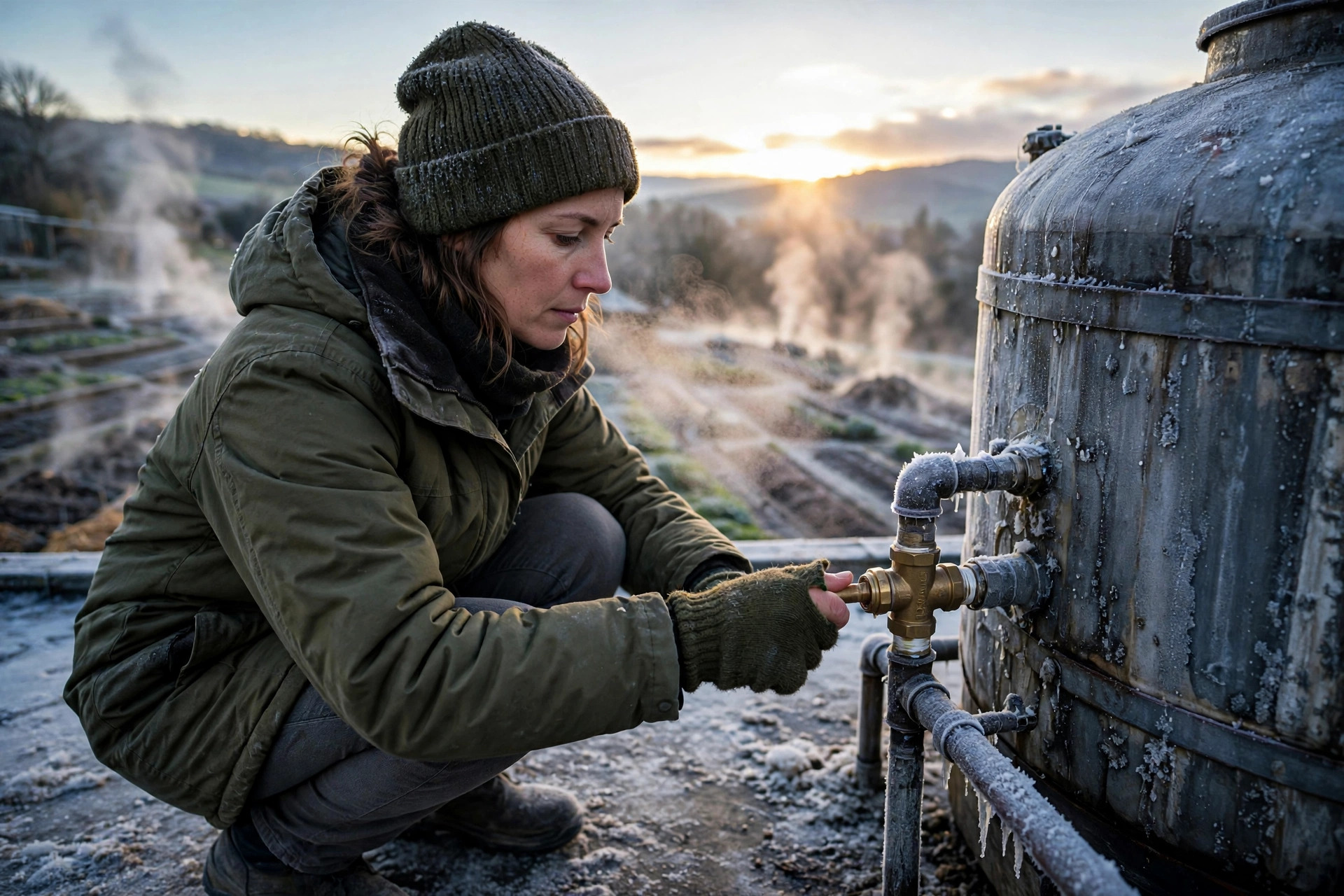
Frost had grown teeth overnight, and Ivet Kolar was on the roof of the drying shed before the sun cleared the ridge, working the first cistern valve of the day with a mitten she had cut the fingertip off of years ago and never replaced. The valve stem turned with the grudging smoothness of brass in the cold. Water moved somewhere below her feet, down the pipe run, toward the low sheds where the winter greens slept under glass.
The Hatchery Green ran on stubbornness and warm compost, and she was its steward, which meant that on mornings like this one she counted things. Three hundred forty rooftop cisterns fed the loop, each one a reclaimed tank or a cast-off dock barrel, each one fitted by hand, each one with a valve that could freeze and split its seam if nobody came around to crack it. She had eleven brass keys on her belt for the locks that mattered, and she had been doing these rounds long enough to know which valves sang and which ones ground.
Number 214 ground. She felt it through the heel of her palm before she heard it, a gritty catch in the quarter-turn, and she stopped, leaned her forehead briefly against the cold tank shell, and sighed at the sky.
"Teo," she said, to nobody, because Teo was four terraces below her and could not possibly hear. Then she finished the quarter-turn anyway, because the water had to move whether the valve complained or not, and she noted the number in the little oilcloth book she kept in her inside pocket, with a sketch of where the grit sat in the turn.
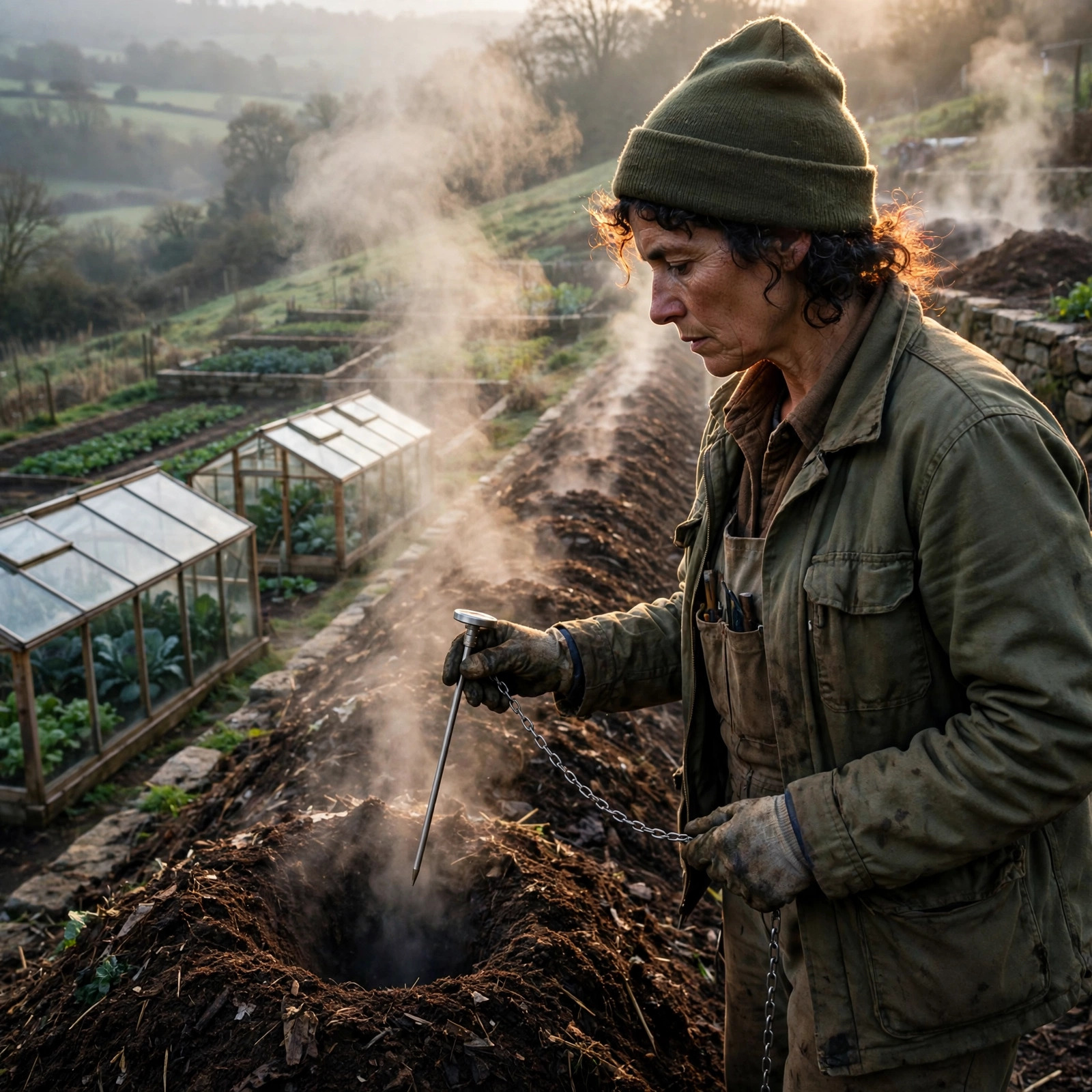
By the time she came down off the shed roof, the sun was up properly and the compost terrace was steaming in the way that meant the pile cores were healthy. She could read a pile the way some people read weather. The big windrows along the north edge threw a low haze that rose straight, no lean to it, which told her the cores were hot and the covers were holding last night's heat. She walked the row with her thermometer on its chain, sinking the probe at the marked stations, waiting the count, pulling it up to read.
Sixty-one. Sixty-two. Sixty-three, near the middle where the dock waste went in. Good. The loop wanted the cores above sixty and below seventy, and the terrace was sitting in the fat of that range, which was the kind of quiet luck she had learned not to trust but also not to interrupt.
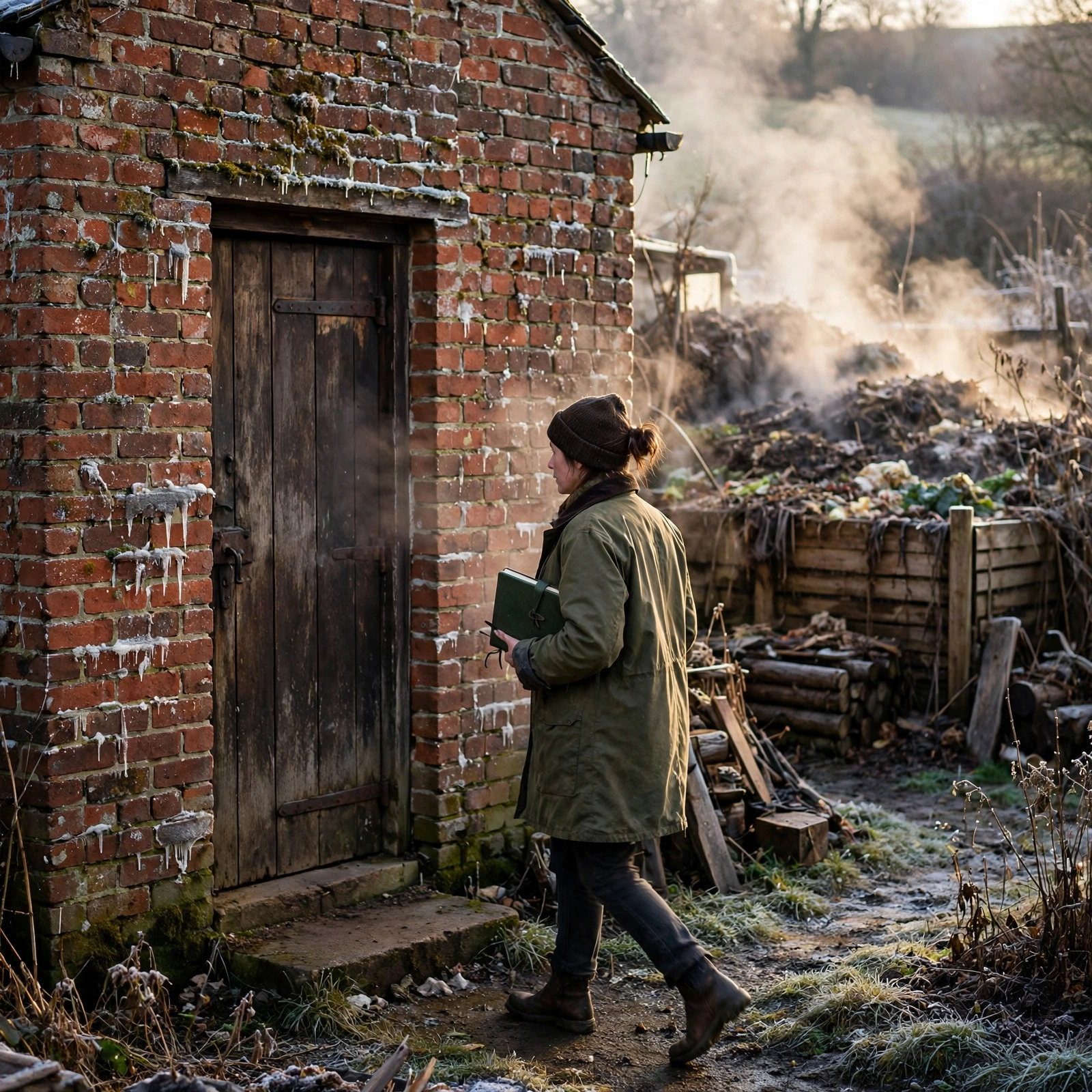
Down the terrace, past the last windrow, the seed house stood in its own small yard, seventy years of masonry with a door that had to be lifted as well as pulled. Ruth Amedei came out of it while Ivet was still twenty paces off, carrying a flat of paper packets in both arms, and she called out before Ivet could say anything.
"Kolar! You look like a woman who owes me a valve count."
"Two and a quarter hours, Ruth. Sixteen stations done, no splits."
"No splits." Ruth set the flat down on the seed house step and straightened with both hands pressed to the small of her back. "You say that like it's nothing. I remember winters when a split cistern meant a morning spent with a torch and a prayer." She tipped her chin toward the door behind her. "I've got your seed order sorted, if you've got the winter greens for me."
Ivet had the winter greens. Two crates of them, cut that morning from the warm tunnel, chard and claytonia and the small bitter lettuces that Ruth liked, grown in the beds the loop kept above freezing all season. The trade had run for years now, greens for seeds, seeds for the tunnel beds, and neither of them had ever once written it down. The seed house kept the terrace's memory in paper and in Ruth's head, and Ivet had learned to trust the second one more.
They made the swap on the step, packets into Ivet's satchel, crates into the seed house's cool dark, and Ruth lingered over the chard the way she always did, thumbing the cut stems.
"The old dock foundry used to cast these valves," Ruth said, apropos of nothing, which was how Ruth said most things. "When I was still hauling lines. They poured small, and they poured honest, but they poured for people who would come around and check on what they'd made. That was the whole difference. Somebody walking the rounds." She looked up. "You still walk the rounds. Don't let anyone make you stop."
"Who's going to make me stop?"
Ruth only shrugged, gathered her flat, and went back inside, and the door dropped into its frame behind her with the sound of something old settling.
Ivet stood a moment in the yard, because that was not nothing. Ruth did not say things for her own comfort; she said them to be remembered later. But the morning was cold, and there was a drip line down on the third terrace that Teo had flagged with a scrap of orange flagging tape, and so Ivet put the seed packets into her satchel and went down the steps.
Teo Brac was already on their knees in the gravel when she got there, palms flat on the black drip line, head tilted in the way that meant they were listening with their hands. Teo could find a blockage in a line faster than any instrument Ivet had ever been offered, and they had been offered several.
"Stem's warm and the line's not," Teo said without looking up. "So the block's between the stem and the first emitter. I'd say scale, but it's not the season for it."
"Frozen plug, then. Where the cover's worn through."
"Where the cover's worn through," Teo agreed, and moved three paces down the line and put their hands on it again. "Here. Cold from here to about my elbow."
The fix was not elegant. They dug down through the gravel with the trenching spade until the line lay bare, and the frozen plug showed itself as a swollen, frosted stretch of black pipe about a hand long. Ivet cut the section out with the shears, spliced in the spare coil Teo carried over one shoulder, and crimped the fittings while Teo held the line steady and packed the fresh cover strip over the repair. It took the better part of an hour, and by the end of it the sun had gone behind a cloud and never come back out, and Ivet's fingers had gone from cold to numb to a warm kind of absent that she knew meant she should not touch anything delicate for a while.
"That's the third cover failure on this terrace this winter," Teo said, standing, brushing gravel off their knees. "If we're going to keep this loop honest, we need to re-lay the cover strip come spring. Whole terrace, not patch by patch."
"Put it on the works list. We'll cost it against the steward hours."
Teo gave her a look at that, quick, gone. "If there's still steward hours to cost it against."
"What's that supposed to mean?"
But Teo was already shouldering the spade, already heading for the tool shed, and the answer came back over their shoulder with the tone of someone who had not meant to say it out loud. "Nothing. Rumors. You know how the terrace is."
Ivet did know how the terrace was, which was why she stood there a moment longer, in the cold, with the repaired line running warm under her hand, and felt the morning change shape around her.
She found out half of it at the notice-board. The board stood at the bottom of the terrace steps, where the greenhouse path met the district lane, and it carried the usual things: a lost cat, a work-share rota, a child's drawing of the seed house in summer that had been up so long the tape had gone yellow. Pinned over all of it, new and crisp, was a printed sheet with a district seal in the corner.
She read the first line, because the first line was impossible not to read, being in the largest type: NOTICE OF PUBLIC HEARING — PROPOSED FRANCHISE, ARCLINE UTILITY.
Around her, the lane went on with its ordinary afternoon. Somebody's cart rattled past below. The cat on the notice-board was still lost. Nothing had changed, except that a sheet of paper had been pinned to a board by somebody who had not walked up the steps to say anything to anyone about it.
She unpinned the notice, folded it twice, and put it inside her jacket, against the pocket where the oilcloth book lived, and did not read further. She had valve counts to finish and a pile to turn before dark, and she had learned in nine years of this work that a notice would keep, but a frost-split cistern would not, and a compost core that fell out of its range would not, and neither would the hour of light she had left.
She finished the counts. She turned the middle windrow with the fork that lived in the tool shed, working the cold edge into the hot core, and the steam that came up off the turned rows smelled of dock waste and summer, which was the small annual miracle that she had never once gotten tired of. She logged the pile temperatures in the oilcloth book. Sixty-two, sixty-four, sixty-one. Held.
By the time she came back down to the tool shed the light had gone long and low, and Teo had gone home, and the terrace was quiet in the way it got in the last cold hour, when the day's work was done and the covers were down and the loop was left to its own heat. She wiped the fork, hung it, wiped the thermometer and put it in its case, and then she stood at the bench with her wrench in her hand for a moment, feeling the weight of it, before she set it into the toolbox and closed the lid.
The paper against her ribs was stiff with cold. She could feel it through her jacket when she moved. Proposed franchise. Whatever it said, it would say it tomorrow just as well, and tomorrow she would have a warm head and a full valve count and Teo beside her when she read it, which was how things on this terrace had always properly been decided: together, out loud, after the rounds were done.
She pulled the grow-tunnel door shut behind her, and the warm air pushed past her ankles into the evening one last time, and then the cold had her. The eleven brass keys rang on her belt as she took the steps down, one hand on the rail, and the sound of them kept time all the way to the bottom.
Aluminum Stakes
The frost wrote the change before anyone said a word about it. Ivet came up the terrace steps at first light with her thermometer in her jacket and her valve book under her arm, and the compost terrace, which she had walked in every weather for nine years, had grown a new crop overnight: a grid of aluminum stakes, pale and regular, standing out of the frozen rye stubble like a field of thin seedlings sown by someone who had never once knelt in soil. They ran in rows from the windrow pads down across the cold frames, through the middle of the terrace where the winter greens overwintered, and up to the base of the seed house wall.
She stopped on the top step and counted the nearest row before she did anything else, because counting was what her hands did while the rest of her caught up. Eleven stakes to the row, flagged at the top with orange tape. The tape snapped small and dry in the wind off the harbor, and the sound of it was the only new sound on the terrace, and she did not like it.
Teo was already down among the rows, wool hat pulled low, breath going out in front of them in short plumes. They had one of the stakes between finger and thumb, not pulling, just testing, the way a person tests a tooth.
"They're driven a hand deep," Teo said without turning around. "Straight, too. Machine-straight. Whoever put them in didn't stand on this ground while they did it."
"Drone survey," Ivet said. "That's the cheap way to lay a grid."
"Cheap." Teo let go of the stake and wiped their palm on their coat. "There's a label on the third row. Arcline Utility. Site array, heat pump retrofit." They looked up at her then, and their face under the hat brim was flat and careful, which was Teo's face for anger. "Ivet. The grid runs through the cold frames."
"I can see where it runs."
"And up to the seed house footing."
She could see that too. She had seen it from the top step, and she had been not-looking at it steadily for the length of the row count, and it had not improved. The seed house stood at the terrace head where it had stood for seventy years, low masonry, thick walls, its door still hung on the hinges the old dock foundry had cast when the district had been a place that made things instead of leasing them. Ruth was inside already; Ivet could see lamplight through the small south window, and a shadow moving across it that could only be Ruth turning her seed trays to the light.
"Read your notice yet?" Teo asked.
"It's in my pocket."
"It's a franchise hearing. Ninth of the month. I read mine twice." Teo turned and put their back against the cold frame, which was a thing they did when they wanted to be a wall instead of a person. "Arcline wants to run a sealed-loop heat pump array. Big one. The paper says it would warm nineteen hundred homes."
"We warm nineteen hundred homes."
"The paper says eight percent better than we do," Teo said. "Modeled. On paper. Which is the only place anything is ever eight percent better than it is."
Before Ivet could answer, the gate at the terrace foot swung, and a man came up the steps two at a time with a clipboard under his arm and a hard case slung across his back. He was younger than the terrace, that was the first thing she noticed, and he was dressed for a construction site in a way that no one on the terrace ever was, boots polished, hi-vis vest clean as a menu. He saw them between the stakes and raised a hand.
"Morning. Anselm Furey, Arcline Utility. You'd be the steward? Kolar?"
"Ivet Kolar. This is Teo Brac, my technician."
"Good, good. I hoped I'd find someone here." He came up the row without knocking over a single plant, which surprised her, and she noted that it surprised her, and hated that she had noted it. "I want to walk the site with you if I can. The grid's laid for the array footing. I know it looks aggressive on the ground, and I'd rather show you the model than have you read the stakes like tea leaves."
"You put stakes through our cold frames," Teo said.
"The frames move, though. Don't they? I checked the site plan against the parcel map, and the frames aren't permanent structures. They're seasonal. The array's a thirty-year installation. I did try to keep the grid off anything rooted." He said it evenly, without heat, and he looked at Teo when he said it, not past them, and Ivet began to understand that she was dealing with a man who was polite the way a level is level: as a property of the instrument, not a courtesy extended to her.
"Walk it with me, then," she said, because a walk was information, and information was what she did not have.
They walked the grid. Furey was good at his job; that became clear within two rows. He knew his bore points from his stake points, he could read his own model off the clipboard without hunting for the numbers, and when he laid the hard case on a stake flat and opened it, the screen inside showed the terrace as a heat-shaded relief, the compost windrows glowing orange-yellow, the cistern-fed loop running down through the rooflines of the district like veins in a leaf.
"Sealed loop, vertical bore, heat pump array on this footprint here," he said, tracing the terrace. "We pull from the compost waste stream, same as you do, but we run it through the pump instead of letting it stratify in the open pads. Modeled gain over the existing hand-tended loop is eight percent, district-wide. That's heat that's currently being lost to sky. Eight percent of nineteen hundred homes."
"And the cisterns," Ivet said.
He didn't flinch, which told her he had known the number before she did. "Three hundred and forty rooftop cisterns come off the loop under the new design. The array runs its own closed feed. Rainwater storage on that scale isn't compatible with a sealed system; you'd get thermal contamination in both directions. It's in the appendix."
"It's in the appendix," she repeated.
"It's in the appendix, and I'm sorry about it, I am. But the district asked us for the best heat-per-crown design we could give them, and this is it. Eight percent is real heat. In a cold winter that's the margin between a held building and an evacuated one."
He said it like a man reading a scale. She watched his finger on the screen, on the rooflines of the district, on the small bright terraces and the grow-tunnels and the tool shed, all of it rendered in the case's light as a heat map, warm things going orange and cold things going blue, and she thought: he has never stood inside one of these buildings in his life.
Ruth came out of the seed house while they were standing at the terrace head, and she came out because Ruth Amedei did not watch anything through a window that she could watch through a door. She had seed trays in her two hands and her sleeves rolled, and she set the trays down on the step wall and looked at the grid of stakes and then at Furey, in that order, for a long moment.
"You're the Arcline man."
"Anselm Furey, yes. You'd be the seed keeper?"
"Ruth Amedei." She wiped her hands on her apron. "Your pilings are wrong for this ground."
"Ma'am?"
"Your bore points. They're wrong for this terrace. You'll find out when you drive your first one."
Furey's face did a small, honest thing: confusion, then recollection, then the flat settling of a man reaching for his data. "We ran the vibration survey last year. Drone-mounted, plus a desk model off the district's geotechnical file. This terrace rates unsuitable for array pilings at the depths we'd want. That's why the footprint moved up-slope, toward the masonry structures, where the survey shows competent ground. The seed house sits on the best bearing soil on the parcel, actually. That's why the array's arrayed where it is."
Ruth looked at him. Ivet knew that look. It was the look Ruth gave a seedling planted at the wrong depth by a well-meaning volunteer: not angry, just certain, and prepared to wait out the certainty of others.
"Your drone flew over this ground after a wet week," Ruth said. "I don't need your file to know that. Everything on this terrace reads soft after a wet week. You've surveyed the mud, young man, not the ground under it."
"The survey's the survey," Furey said, gently, and he was gentle, Ivet gave him that. "I hear you, and I'd honestly like to hear more, but I can't redraw a thirty-year footprint on a conversation. If you've got documentation, bore logs, anything dated, I'll read it tonight and fold it into the model. That's a real offer. But the hearing's on the ninth, and the model as it stands is what goes to the council."
"Ruth," Ivet said, quietly, because Ruth's jaw had set into a shape Ivet knew, the shape that came before forty years of dockside certainty was unloaded onto a stranger all at once, and this was not the morning for it, and this was not the man who needed it. "Let me handle the paperwork side."
Ruth turned and looked at her. There was a beat of silence in which the tape on the stakes snapped and snapped.
"Paperwork," Ruth said.
"If there's a survey, there's a paper trail. If there's a model, there's a file. I want all of it, in writing, before the hearing." She turned to Furey. "The full survey, the desk model, the geotechnical file you pulled, the appendix on the cisterns, and the staffing figures. What happens to the steward hours under the array design. Sixty paid hours a week on this loop, ours. I want that line item."
"That's," Furey said, and stopped, and she watched him be honest against his own schedule. "That's in the appendix too. Under the sealed design, hand-tending drops out. The array's automated. Some of your people would transition to operations, but the steward posts as such, no. They don't carry over."
"Sixty hours," Teo said, from the cold frame, where they had been a wall the whole time. "Say it plainly. Sixty hours a week of paid work on this terrace, gone. You're going to stand there and tell three hundred and forty households that their cisterns drain and their stewards lose their hours, for eight percent on a model."
"Eight percent is real heat," Furey said again. "It's not nothing. I'm not the one who should apologize for eight percent."
"No," Ruth said. "You're the one who should apologize for the stakes in my cold frames." And she picked up her seed trays off the step wall, both of them, one stacked on the other, and walked back into the seed house, and the door went shut behind her harder than the wind could account for, hard enough that the latch rattled and a little sift of mortar dust came off the seventy-year lintel and down onto the step.
Furey stood with his clipboard. Teo pushed off the cold frame and went down the rows toward the tool shed without another word, checking the stakes one by one as if they meant to memorize them.
"I'll send the files to the district office for you by tomorrow," Furey said. "All of it. Survey, model, appendix. And, look, Kolar, for what it's worth, I'd rather build this next to a working terrace than on top of a dead one. If your keeper has dated documentation, I'll read it. I'm on a deadline, but I'm not on rails."
"Then you'll get your paperwork," Ivet said, "and she'll get her say."
He nodded, took his case, and went down the steps the way he had come up, boots ringing, and the gate swung and shut behind him.
Ivet stood alone a moment in the row. Then she took out her valve book and turned past the day's counts to the empty pages at the back, and she walked the grid with the book open and photographed every stake with the camera she used for valve corrosion, eleven to the row, row after row, logging each one by number and position against the terrace features she knew by foot: the cold frames, the windrow pads, the tool shed, the seed house footing. It was not an argument. She had made no argument all morning, and she knew it, and Teo knew it, and Ruth's shut door knew it. But the stakes stood in the frost, and the frost would be gone by noon, and the hearing was on the ninth, and a photograph of a thing, taken the morning after it appeared, with the date printed in the corner, was a kind of paper that did not rattle when a door slammed. She shot the last stake, the one whose flag snapped loudest, up against the seed house wall, and she wrote its number in the book, and then she went in out of the cold to see what Ruth had kept, all these years, in the loft.
The Pulled Grid
The frost had gone hard twice in the night, and Ivet knew before she reached the gate that something on the terrace had changed, because the light came off the rows wrong. The flags were gone. Not folded, not fallen: gone, the whole bright geometry of them, and in their place the gravel stood pocked with two hundred-odd clean little holes like a binder someone had unbuckled in the dark. She stopped at the gate with one hand still on it and counted the stack before she counted anything else. Aluminum, bundled crosswise with twine somebody had brought from a porch, twenty-three stakes laid flat on the capstone with their flags folded under, neat as laundry. Neater than laundry. Somebody had been careful, and somebody had been quick, and it had been more than one somebody, because twenty-three stakes pulled in one night meant hands and meant quiet and meant a plan made over somebody's kitchen table while she slept.
Teo came up the step wall two at a time and stopped beside her without saying anything at first, which from Teo was its own kind of statement. They looked at the stack, then out at the rows, then at the holes.
"That's twenty-three," Teo said.
"I can count."
"I know you can. I'm saying twenty-three, not all of them. They left the rest standing."
That was the part that would sit badly with her all morning, and she knew it at once. Not pulled in anger, not scattered and snapped. Twenty-three, chosen, from the rows nearest the seed house footing, and the other stakes left upright in their lines with their flags still chattering in the low sun as if nothing had happened. Whoever had done it had done it as a message, and the message was aimed at Arcline, and the message would be read by the district as a message from the terrace, from her terrace, from her loop, whether she had sent it or not.
Ruth was already out, wrapped in her seed-house coat, standing over the stack with her hands in her pockets. "I heard them," she said. "Past midnight. I didn't go out."
"You didn't go out," Ivet said.
"I'm sixty-eight years old, and it was ten below on that wall, and I did not go out. If you want that written down, write it down." Ruth toed the twine. "They were quiet, whoever they were. Quiet and quick. Not drunks. That's worse. Drunks you can talk to."
Before Ivet could answer, a car door sounded on the lane, and Furey came through the gate with his case in one hand and his clipboard in the other, and he stopped dead the way she had stopped, and she watched him read the rows. He was good at reading ground; she had to give him that. He walked the nearest line of holes first, crouched at one, put two fingers in it to judge the depth, and then straightened up and looked at the stack on the capstone for a long moment before he looked at either of them.
"Twenty-three," he said.
"You'll forgive us if we don't hold your coat," Ivet said.
"I wasn't going to ask you to." He set his case on the capstone and opened it, and she saw the folder come out, the thick district folder with the wax seal tab on it, and she knew the weight of that kind of folder from nine winters of valve orders. "Here's where we are, Kolar, and I'd rather you heard it from me than read it off the notice-board. Pulling driven survey stakes is property damage under the district franchise code. My office files the complaint today or my office looks negligent on the day of the hearing, and I don't get to choose that, my supervisor does. It goes in as an attachment to the franchise file either way. It will be read at the hearing on the ninth, in front of the council, alongside the bid." He held the folder a moment longer, then laid it flat on the stone, unsealed, which she understood was him being decent about it. "I'm not telling you that as a threat. I'm telling you because you're the steward of record for this ground, and when a complaint names an address, the council asks the address who did it, and the address doesn't get to say nobody."
"Nobody," said Ruth, to the frost.
"That's the answer we have," Ivet said. "You've walked this terrace two days. You know the forty of us out here can't watch forty roofs and a compost loop and a gate all night. You know that, Furey. You've been cold out here with your clipboard."
"I know it. The council will want a name. Complaints like this eat unnamed answers." He closed the case. "There's another thing, and this one's mine, not my supervisor's. I wasn't going to do it standing on a frozen terrace, but I'm not going to have a better moment, and I'm on a deadline in more ways than one." He turned so the three of them could all hear it, which she thought was either clumsy or kind, and with Furey she had begun to believe it was both. "Arcline is staffing an operations manager for the Solmava retrofit if the franchise passes. Field office, district salary grade, the whole sealed loop under one manager once it's built. The post is open now, ahead of the build, so the person who takes it can sit in on the design review. I've put your name in for it. I put it in yesterday, before any of this." He nodded at the stack. "You know the ground better than anyone Arcline could fly in. You know every valve and every roof on this loop, and my model says the loop ends either way, and I'd rather the person who ends it well be somebody who's stood on it in January. It's a real offer. It's a promotion. It's more money than the steward post pays, and it comes with an office that has heat in it."
The terrace went very quiet. A flag on one of the standing stakes ticked against its rod. Teo was three steps behind her at the cold frames with a wrench in one hand, and she could feel them not moving.
And there it was, laid out on the capstone next to twenty-three pulled stakes like it belonged to the same bundle: her salary, the sixty hours a week the loop paid her to walk these rows, the only wage between her and whatever she'd do in Solmava if the sealed loop went in and the cisterns came off the roofs and the steward hours did not carry over. Furey's model said the loop ended. Her own valve book said the loop fed nineteen hundred households and three hundred forty cisterns and a seed house that had stood seventy years on this terrace, and her valve book was not a model, it was a count. But the offer was an office, and an office was a winter without a ladder and a summer without a frost watch, and it was a salary that would not end on the ninth of this month no matter how the council voted.
"You'd have to answer by the hearing," Furey said. "I'm sorry, that's the schedule, not me."
"No," she said. "No, I understand schedules." She turned around so she was facing Teo when she said it, because she'd learned that much about herself in nine years: a refusal said to a stranger was a negotiation, and a refusal said in front of your own second was a fact. "I'm not taking the post. Not now, not if it passes, not after. I'm the steward of this loop, and I'm going to stand at that hearing on the ninth as the steward, not as your hire, and I'm going to fight the complaint and fight the bid, and you can put all of that in your folder too."
Furey looked at her the way a man looks at a sum that won't balance, and then he nodded once and wrote something, and she was fairly sure it was the truth, and she was also fairly sure that the truth in his folder had a way of turning into her problem by Friday. "Then I'll see you at the hearing," he said. "And I'll still read whatever your keeper can date." He took his folder and went down the steps, and the gate swung behind him, and this time nobody's mortar dust came down, and the terrace was theirs again, and the stack of twenty-three stakes lay on the capstone like a question with no name under it.
Teo hadn't said anything. That was the thing. Through all of it, Teo had stood at the cold frames with the wrench and let her say it to Furey's face without a hand on her shoulder or a word at her back, and now Teo walked over, looked at the stack, looked at her, and said, "You know what you just did to your winter."
"I know what I did to my winter."
"Sixty hours a week, gone, if they pass it. That's your bread."
"That's my bread."
Teo nodded slowly, the way they did over a pipe they'd decided to trust. Then they took the ring of keys off their own belt, not Ivet's, the working set from the shop, and pulled the bent one off its loop. The cistern keys were brass, sand-cast at the old dock foundry and recast by Teo five years back, eleven to the ring, and the fourth key, the one for the terrace row, had taken the gate post sideways one thaw and been bending worse every winter since, so that the valve under it needed a quarter-turn of argument before it would give water at all.
"Come on," Teo said. "If you're staying, your keys work. That's the whole of my speech."
The shop behind the tool shed held the small bench, the vise, the torch bottle, and the cast iron pot of the original foundry pour, kept more for habit than need. Teo clamped the bent key in the vise, heated the shank until the brass went the dull red of a bed of coals, and worked it straight with the small hammer in short, patient taps, turning it a little at a time against the original they kept hanging on the wall, checking the length, checking the throat of it, until the bend was gone and the key lay flat on the steel bench plate and did not rock. Then they quenched it, and the hiss went up, and the shop smelled of hot metal and cold water, and Teo filed the burrs off the teeth with four slow strokes and put it back on Ivet's ring in the empty fourth place.
"Recast to the foundry spec," Teo said. "Better than the one you had, even. That one was always a hair off. Now it's true."
Ruth had followed them in and stood in the doorway with the stack of twenty-three stakes under one arm, which she set down inside the door. "I'll keep these in the seed house," she said. "Nobody pulls evidence out of my loft. You'd know that if you'd been up in my loft, which you still haven't, because you went to bed instead."
"I'll come today," Ivet said. "I said I'd come, and I'll come."
"Today's half gone. Come while the light lasts."
Ivet took the ring off her belt and walked out to the terrace row with the light coming low and yellow across the pulled grid, and knelt at the first valve of the row, the one whose stem had frozen in the night the way it froze every third dawn, and she fitted the new-cut fourth key, and it seated true, all the way down, no argument at all. She turned it, and the stem cracked loose with that first hard knock of a frozen valve giving, and she let it run into the gravel channel until the rust-brown first water had gone through and the flow came off clear and cold and clean, running honest over the stones, and she let it run a moment longer than the count called for, just because she could.
"Write it in your book," Ruth called from the seed house door. "True key, clean water, day three. That's paper that doesn't rattle either."
Ivet shut the valve off, wrote it, and put the ring back on her belt. The offer was declined, the complaint was in the folder, and the fourth key sat warm in her hand.
The Paper Roll
The seed house loft smelled of paper and dry seed and seventy years of mice who had lost their arguments with Ruth's cats. She went up the ladder first, quick as anything, and Ivet followed with the valve book slung on her back, and the loft ran the whole length of the building under the low rafters, with boxed seed in ranks along one wall and a long map chest under the north eave.
"You've been keeping this from me for nine years," Ivet said.
"I've been keeping it from everybody for twenty-nine. Sit on the crate. Don't lean on the chest, it leans back." Ruth pulled the second drawer, took out a roll bound with faded cotton tape, and set it on the chest's lid with both hands flat on it for a moment, like a woman resting a bird. "The district surveyed the terrace drainage in 2012. I helped lay the lines, the year before, out of the dock foundry's scrap. I kept the record because the district didn't. Their copies went into the archive purge, and their digitized holdings stop before 2015. I asked. Twice. There is no copy in any drawer I can reach, and I can't reach a scanner through a phone."
She cut the tape with her thumbnail. The roll opened across the chest, crackling, and Ivet pinned one corner down before it could close again.
It was a hand-inked cross-section of the compost terrace, drawn long before either of them had worked it. There was the topsoil, there the made ground, there the old dock fill, and below all of it, drawn in the confident hatch of a surveyor who had actually put a bore down, a flat gray bench of waterlaid gravel with a depth figure beside it.
"Two meters," Ivet read. "The gravel bench sits at two meters."
"Roughly," Ruth said. "It varies. But it's there, under all of it, under the seed house footings too. I laid into it myself, on my knees, for a summer. The foundry sent us down pipe after pipe and I packed every joint." She tapped the section with one finger. "Now. What did Arcline's vibration study say about the terrace under my seed house?"
"That it's unsuitable for pilings. Soft, wet fill. Move the array or move the building." Ivet heard her own voice go flat, the way it did when she read figures back. "Their bore points were a meter and a half. They never reached it."
"A meter and a half," Ruth said, "in a wet week, from a drone. Of course they never reached it. They stopped in the fill and called it the bottom." She rolled the drawing halfway closed, then opened it again. "No. You look longer. If you go into the hearing with this half-known, it's paper that rattles. Know it."
So Ivet looked longer. The bench ran the whole width of the section, unbroken, from the harbor wall to the terrace's inland lip. The 2012 bore points were marked and numbered, and she copied four of their positions into the valve book against Arcline's drone points from the notice, and three of Arcline's points sat within ten meters of a 2012 bore that had gone down through the fill and into something with a refusal number after it.
"That's his own ground truth," she said. "Somebody already drilled it and wrote it down."
"Somebody always has," Ruth said. "The trick is whether you can find her." She rolled the drawing closed and tied it. "Take it tonight. Take my lantern too, the loft one, I have two."
They came down. The twenty-three stakes stood in their stack inside the door, aluminum bright, each one logged in the valve book with its number and its grid position. Teo was waiting at the bench with tea, and they drank it standing while Ivet laid the roll on the seed house table and explained it twice, once for Teo to hear and once, slower, for herself to believe.
"So the array doesn't need the terrace," Teo said. "It needs a redraw. It can sit on pilings into the gravel and leave the seed house standing and leave the compost rows alone."
"If he accepts it. If his model takes the correction." Ivet looked at the stakes. "And none of that answers the other half. The cisterns still come off the loop. Sixty hours still don't carry over. His design is better, Teo, that's the ugly part of it. Eight percent better on paper, and a cleaner loop, and no one on the roofs."
"So don't fight his numbers," Teo said. "Fight for ours. Outbid him in the only coin a commons can mint."
"Which is what?"
Teo set their cup down. "You keep saying it. A commons isn't the pipes, it's the hours. So put the hours in the bid. On paper, where he can read them."
Ivet sat down at the drafting table with the complaint folder pushed to one side and the counter-bid blank in front of her, and Ruth lit the loft lantern and set it beside her, and Teo went home at eleven and came back at six with bread, and Ivet wrote.
She wrote the commons as it actually ran, which no document had ever described: the three hundred forty rooftop cisterns and their hand-tended feeds, the nineteen hundred households on the compost-and-thermal loop, the terrace rows, the seed house, the steward's post, sixty paid hours a week. Then she did the thing that made her hand stop twice before it moved. She struck the steward's post from the budget line. Dissolved it. Wrote in its place a rota of unpaid trust wardens, neighbors signing for two hours at a time, which the roof ledger showed they already gave in every frost and every thaw, and beside it a smaller paid line: an apprenticeship, four hours a week, a trainee under a warden, learn-the-valves money. Fifty-two hours of neighbor time and eight hours of wages where sixty had been.
"You're cutting your own job out of the bid," Teo said from the doorway, at some hour with the lantern burning low.
"I know what I'm cutting out." She wrote the apprenticeship line larger than it needed to be, in the clear hand she used for the valve book. "A bid that buys my salary is a bid that buys me. He offered me one of those already. I said no aloud, and I meant it in the shop, and this is what meaning it looks like on paper."
Ruth came down at dawn with the roll under her arm and read the bid through twice without a word, which was her way of approving, and at the second read she said, "Wardens rotate. Say so, so nobody thinks it's a fief." Ivet added the clause.
They filed it at the district office at nine in the morning on day five, four hours before the hearing, because the counter-bid had to be on the record before the vote was called and there was no extension to be had. The clerk stamped it twice and Ivet watched the second stamp land, and only then did her stomach unclench enough to notice she'd eaten nothing but bread.
Anselm Furey was on the office steps, holding his own folder and, to his credit, looking like a man who had also slept badly. He saw her, then saw the roll under Ruth's arm, and stepped down to meet them.
"You're on the docket," he said. "I read the filing sheet. I didn't expect a counter-bid from the terrace."
"Then you'll want to see this before you sit through two hours of me talking." Ivet set the roll on the flat of the step and opened it, and pinned it with the valve book. "Your study says the terrace under the seed house is unsuitable for pilings. Your bore points were a meter and a half. Here's a drainage survey from 2012 that went deeper. Walk it with me before the hearing, bore to bore, and I'll keep it short."
He crouched, and he read it the way an engineer reads, which is not the way a neighbor reads: corner to corner first, then the legend, then the numbers. He was quiet for a long time. "Who drew the refusal figures?"
"A district surveyor whose name is on the title block, in 2012, from bores you can still find if you walk twenty meters that way," Ruth said. "And I laid the lines into that gravel myself, the year before, and I'll swear to it however your people like."
"Show me," Anselm said. "Bore to bore. Now, while the light's good, and bring the roll."
So the hearing waited twenty minutes for the three of them, and the terrace got its walk. He carried his own level and a short tape, and at each 2012 point he set the level, shot it against his model's figure, and wrote the difference in the margin in pencil. At the fourth point, under the seed house wall, he put his tape down a meter and a half into an old inspection sleeve and hit what his own study had called impossible: refusal, at two meters, gravel.
He stood there with his hand still on the tape.
"My drone points came out of a wet week," he said. "The model weighted the fill as deep because everything I sampled said it was deep." He looked at the seed house wall, at the gravel bench on the roll, at the tape in his hand. "The pilings can be redrawn. They should be redrawn. This is a better footing than anything I gave the array. If I'd had this section in forty hours instead of nine days, my first filing wouldn't have touched your terrace at all."
"It touches it now," Ivet said. "The complaint's an attachment. Twenty-three stakes in my seed house and a hearing in an hour. I didn't order that and I didn't stop it, and I'll answer for it either way. But answer me this one: can you redraw and withdraw the footprint claim before the vote?"
"I can move for amendment at the hearing, with this roll as the record. Whether your neighbors' stake-pulling gets read as vandalism or as a grievance is the council's to decide, not mine, and I won't pretend otherwise." He closed his tape. "You understand I still believe in my loop. Eight percent isn't nothing, and I won't retract the design."
"I'd think less of you if you did. Read the counter-bid. The cisterns stay on the loop and my post doesn't exist. That part I'll defend in there myself."
The hearing room filled the way rooms fill for votes: fast at the back, slow at the front. Teo took a seat near the aisle with the valve book. Ruth sat with the roll across her knees like a scepter. Anselm set his folder and the amended survey notes on the applicant's table, and Ivet sat at the small second table with the stamped counter-bid in front of her and the lantern key ring hanging at her belt, fourth key true.
Hanna Drewjo came in last, unhurried, hung her coat on the chair back, and stood at the head of the table until the room's noise dropped on its own.
"We have two bids and one complaint before us," she said, and called the hearing to order.
Two Meters Down
The vote took eleven minutes. Ivet spent the first four of them watching Hanna Drewjo's pen, which never lifted, and the last seven watching Anselm Furey read her counter-bid a second time, all the way down to the apprenticeship line, his finger moving under the words like a man checking a weld for cracks.
"The amended filing moves the array pilings off the compost terrace," Hanna said, when the tally clerk had finished. "The sealed-loop design stands. The question before the council is the paired commons bid." She looked down the table. "Mr. Furey, you've moved to amend. Speak to the amendment."
Anselm stood. He had his folder open but he didn't read from it. "The original footprint came off a drone survey flown after a wet week, and I'll own that in the record. The terrace stands on a gravel bench at roughly two meters. The drainage roll is dated, it's signed, and I confirmed it myself at an open bore point this afternoon, before this hearing, with my own tape. My pilings can sit on that bench and never touch the seed house. I move to withdraw the footprint claim and redraw the easement to the boundary the trust proposes."
"And the complaint?" Hanna asked. "Twenty-three stakes pulled overnight is an attachment to this hearing, and it's yours to press or pull."
The room went quiet in the way rooms do when everyone turns out to have been listening all along. Ivet stood up from the second table before she had decided to.
"Before he answers that," she said, "I'll answer for the stakes. I'm the steward of this loop. Those were Arcline's stakes on commons ground, and my neighbors pulled them while I slept, and I neither ordered it nor stopped it. That's mine to carry. The pulling was wrong and it was also a letter, and the letter said the terrace matters to people who don't write letters to councils." She kept her hands flat on the table, on the stamped bid. "So here is what I'll put in the record. My hours and Teo's hours, terrace labor, until every one of those twenty-three stakes is re-driven true along the redrawn easement, at no charge to Arcline and no charge to the district. Reparation on the ground, not in a fine."
"That's not nothing," Anselm said. He was looking at her, not at his folder. "Twenty-three aluminum stakes, extruded, driven to spec, that I have to pay my own crew to replace or lose the schedule. You're offering to do the work."
"I'm offering to do it right."
He closed the folder. "Then I withdraw the complaint. I'd rather have the labor than the fine, and I'd rather have the neighbor who does it standing at my easement edge than standing in a docket. The crews start Monday."
Hanna's pen came down once, then again. "The complaint is withdrawn with reparation noted. Council will now vote on the paired commons design as amended: Arcline's pumps on the redrawn easement, all three hundred and forty rooftop cisterns retained in service, the seed house and terrace excluded from the array footprint, stewardship converted to the neighbor trust as filed." She read the tally without ceremony. "Carried. Six to one."
Teo let a breath out through their teeth. Ruth didn't move at all, except to put her hand flat on the drainage roll, like a woman closing a shop drawer at night.
"One thing before we break," Anselm said, and he was standing again, so Ivet stood too. "My model says eight percent. I've said eight percent to every room I've been in for four years, and I believe the number. But I priced the cisterns as if they came off the loop, and they don't come off the loop. Rain-water cisterns lose heat through their walls all winter. The paired design carries that loss. Eight percent gross, two points net after the cistern heat-loss is priced in. I want that on the record while the room is still full, because I'd rather correct my own number than have this council discover it in three years and wonder what else I rounded."
"So noted," Hanna said. "Two points, honest measure. I've watched bigger outfits hide worse." She gathered her coat off the chair back. "The deed needs signatures and a wax seal, and I'd as soon not do that in a room that smells like wet parkas. The seed house, tomorrow morning. Nine o'clock. Bring the trust."
The next morning the seed house was warm from the compost loop before anyone lit the stove, which was the whole argument of her life, Ivet thought, stated in degrees. Frost on the inside of the small windows. Ruth had the long table wiped down and the drainage roll rolled back and tied. Hanna's clerk had come out from the district office with a document case, and the deed lay on the table with its wax block beside it, printed and waiting, the terms drafted on Ivet's own kitchen table two nights ago: the loop held by a neighbor trust of seven wardens, rotating, unpaid, with an eight-hour paid apprenticeship line, the seed house and terrace held out of any array easement forever, the cisterns paired with Arcline's pumps at the boundary.
Seven wardens signed first, one after another, neighbors whose names Ivet had known for twelve years and had never once seen write anything longer than a grocery list. Teo signed and pushed the pen back across the table with two fingers. Ruth signed last of the seven, in a small upright hand, and then put the pen down and looked at Ivet.
"Your post doesn't exist after this," she said. "You know that. You wrote it that way yourself."
"I know it," Ivet said. "The district pays one steward or it pays an apprenticeship line. It couldn't be both, and I'd rather teach the work than hold it."
Hanna signed for the council, and her clerk warmed the wax over a candle and pressed the seal down, and that was that: the loop belonged to the terrace. Ivet unhooked the ring from her belt. Eleven brass keys, sand-cast by the original dock foundry, recast in 2036, and the fourth one re-cut by Teo on the shop bench to the original foundry spec, straight and true, the whole ring cleaned and every key seated. She had oiled them that morning. She had not planned to; her hands had simply done it while she was waiting for the kettle.
She put the ring in Ruth's palm and closed her fingers over it. "The trust keeps these. All eleven. Not me."
Ruth weighed them. "And you keep what?"
"The apprenticeship. Eight paid hours a week, one apprentice at a time, and the first one starts this morning."
"You have an apprentice already?" Anselm asked from the doorway. He had his tape on his belt and a bundle of aluminum stakes under one arm, re-marked flags on them, the trust boundary cut into the tape at his office overnight.
"I have a vote that says I can," Ivet said. "The rest is asking."
Asking took ten minutes. There was a young woman at the gate, a canal-side neighbor Ivet knew by sight, who had come to watch the signing and stayed to lean on the fence, and when Ivet described the line, eight hours, paid, learning valves and bore points and the drainage roll and where the terrace's water went, the woman said, "I can be on this terrace at noon," and that was all the ceremony either of them needed.
The frost was off the south soil by noon, and the terrace smelled of turned earth and warm compost, which was the loop working, four hundred meters of it, under their feet. Anselm set his bundle down at the redrawn line, a hand's width beyond the seed house wall, out where the gravel bench ran deep and honest. Teo carried the mallet. Ruth sat on the seed house step with the deed in her lap, wax side up, not because she was reading it but because she seemed to like holding it.
"First stake," Ivet said, and knelt, and her apprentice knelt beside her, and the cold came up through both knees immediately and would stay there for an hour. "Here's what nobody's drawing tells you. The gravel bench is two meters down. You can't see it. You can't feel it in the top meter, it's all fill and loam and it lies. But it's the reason this terrace can hold a seed house for seventy years and a heat loop for nine, and it's the reason the pumps go out there and not here. So before you drive anything, you learn where the water goes. Come on."
She set the stake at the flagged point, true to the tape, on the boundary Anselm had redrawn. Teo handed her the mallet. She hit the stake twice, and it bit and stood.
"Your turn," she said, and gave the mallet over, and put her hand on the cold aluminum while her apprentice swung, and the stake went down into terrace soil two meters above the bench, first of the twenty-three, driven true along the easement at last. Beyond the wall, out where the pilings would go, Arcline's first pump frame was already rising against the gray of the sky.
"Two meters down," her apprentice said, squinting at the stake like it ought to confess.
"Two meters down," Ivet said. "Everything worth building on is out of sight. You just have to know somebody who dug to it once."
Get notified when new stories drop

Leo Stranek
Leo specializes in solarpunk abundance and near-future progress: livable futures, bright cities, and practical wonder.
Leave a comment
Comments