


The Approach Book
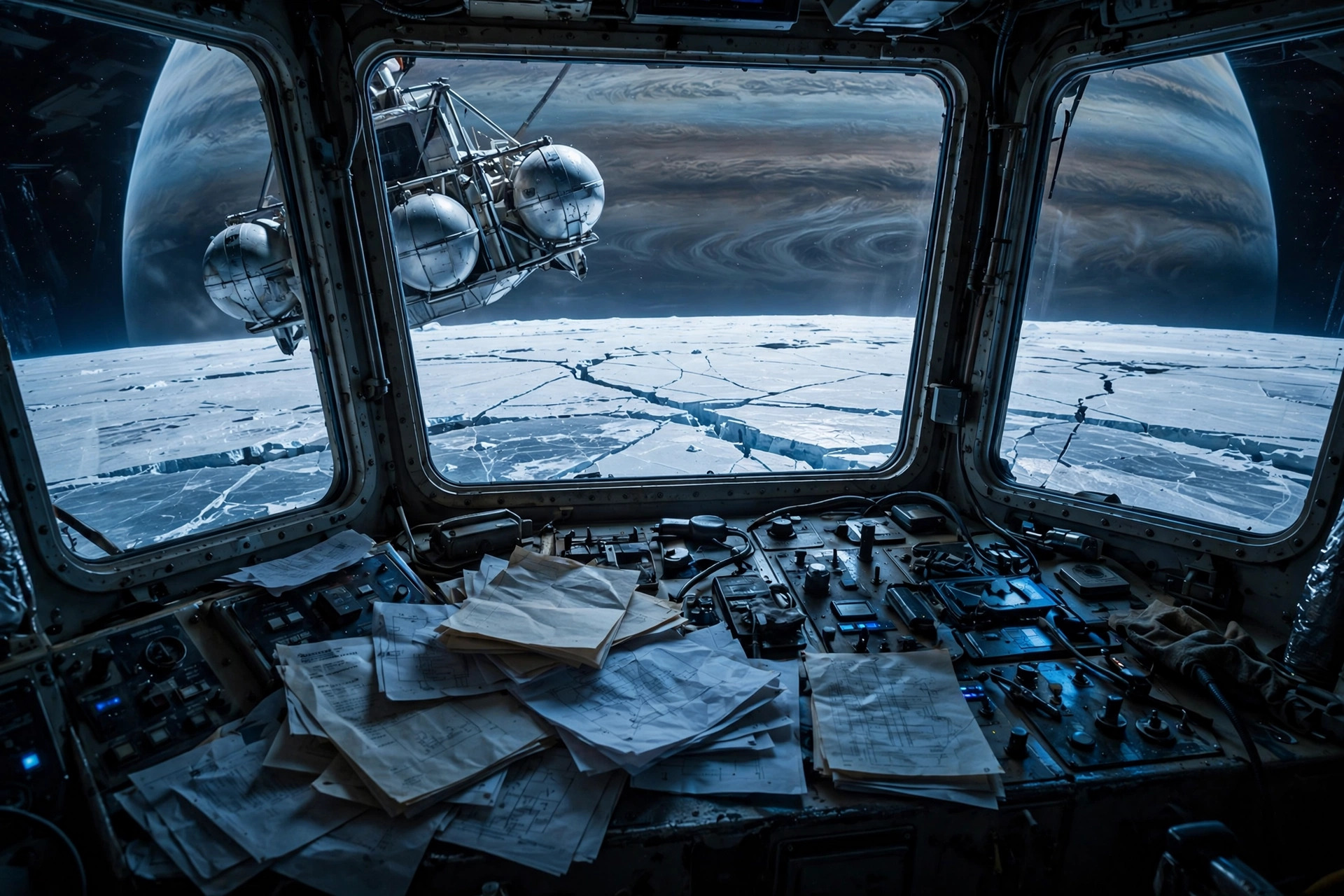
The last burn of the insertion went long by four seconds, and Talitha Vann let the ship settle into it before she uncapped the pen. Vesperine turned beneath them, a white coin stitched with the dark seams of the south polar field, and Halk filled half the aft blister's view with its banded shoulder. Nine hours to an orbit. She had flown insertions she liked better, and none of them into a moon that hissed ice a thousand kilometers up into the dark.
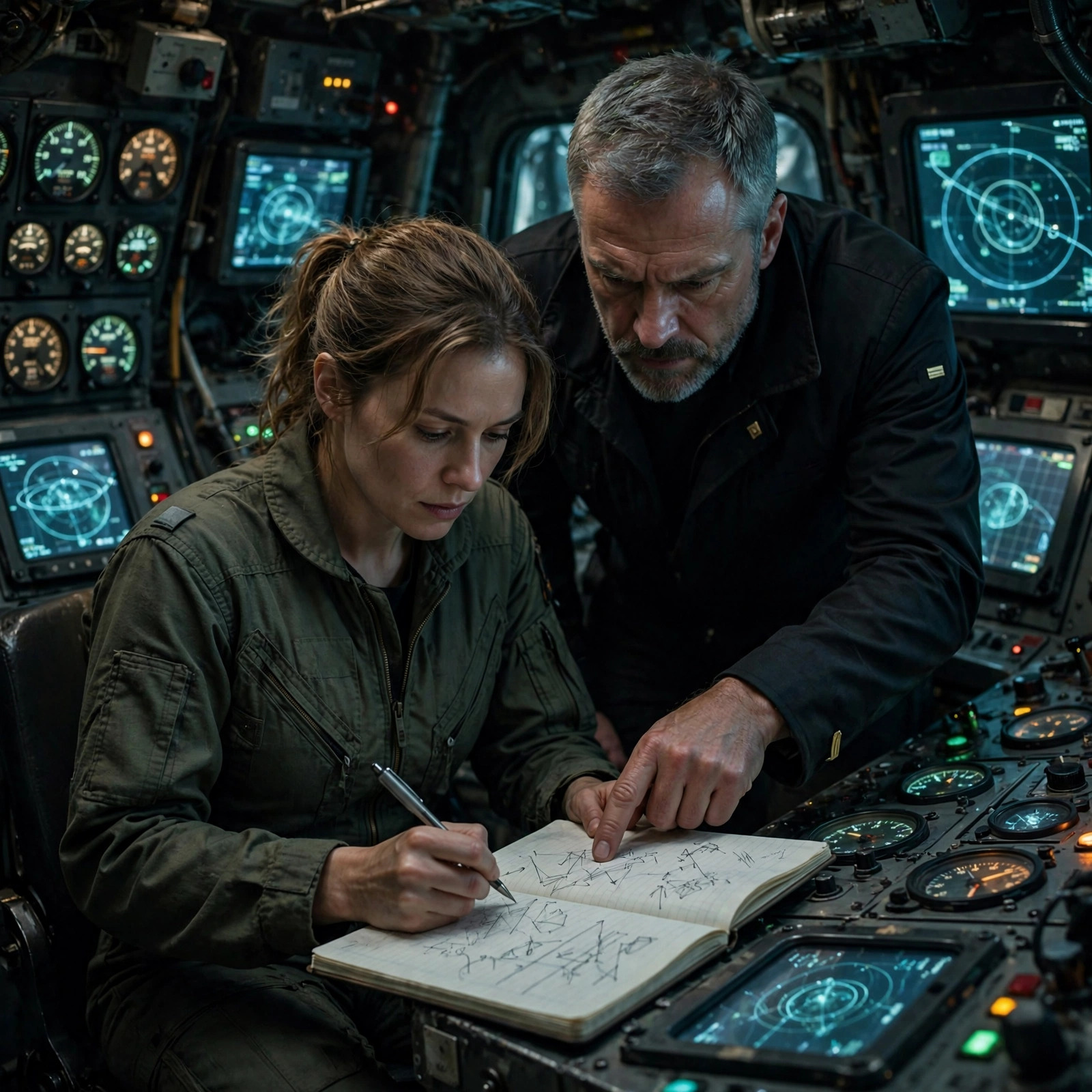
The approach book was paper, because paper did not reboot. She opened it across the bridge console, smoothed the previous page with the flat of her hand, and began the day's entry the way she had begun every entry for nine years: mass, state vector, margin.
Margin first. She wrote the number twice to be sure of it.
Tank two was empty. Patched, cold, and empty, eleven thousand kilograms lighter than the manifest said it should be, all of it blown out as frost two days ago when the micrometeoroid came through the sphere's blind quarter. Tomas had the patch holding. The patch was not the problem. The problem was that the Tramontane burned electrolyzed water for propellant and lined her crew spaces with the same water for shielding, so every kilogram sitting out there in Vesperine's ring of scattered frost was a kilogram of orbit she could not buy and radiation she could not absorb. They could not start the spiral home without gathering it back.
"How bad?" Sigrun Holt stood in the bridge's after hatchway, one shoulder against the frame. She had come up from the charter cabin without being called, which meant she had been watching the tank telemetry from her own desk and doing arithmetic.
"Eleven thousand short," Talitha said. "Full tanks were the departure condition. You know that better than I do."
"I know what the charter says, yes." Sigrun crossed to the console and put one finger on the page, on the shortfall line, as if she could hold the number still. "And I know where we can get it back in one pass."
From the aft blister, faint through the deck, came the tick of Emeric's rig. He had mounted the flicker photometers on the aft rail before insertion, strapping them down like a man who expected the ship to be thrown around, and now they were staring at the Wicks, counting brightness the way he counted everything, in long patient runs. Talitha could hear him talking to the log recorder in his low voice, some aside about grain fall-back rates, and she decided she did not want the aside yet. She wanted the approach laid out first, clean, before anyone's enthusiasm got onto the paper.
She turned to a fresh spread and drew the moon as a circle, then the field: the Wicks, a comb of vents along the south polar cap, each one lofting ice grains nearly a thousand kilometers before they arced over and fell back down. She had watched them for two hours during the approach, silver threads standing off the limb, brightening and dimming on no schedule she could see.
"Two trajectories," she said. "Both start here, both end here." She tapped the insertion orbit. "The difference is what we fly through on the way."
The first line she drew shallow: a corridor at one thousand two hundred and fifty kilometers, above the crowns, where the grains were sparse and slow relative to the ship. The collector could open its throat there and breathe. Two thousand two hundred kilograms a pass, by Tomas's own yield tables, one collection window each orbit, and nine hours to an orbit.
"Five passes," said Tomas Verel from the hatch. He had come up behind Sigrun with a flex wrench still in his hand, knuckles scored from the patch job. "Five passes to eleven thousand. I did the division on the ladder."
"Five passes, five orbits," Talitha said. "Call it a day and a half of collection, plus the phasing between windows." She penciled the corridor in lightly, then drew the second line, and felt Sigrun lean in before the pencil had finished its arc.
The second line went deep. Pericenter at nine hundred kilometers: inside the crowns, down among the dense grain, where the vents were feeding the field faster than it could rain out. One pass. One pass with the throat wide open through the thickest ice the Wicks had.
"That's the one," Sigrun said. "That's the charter pass."
"That's a paper pass," Talitha said. "It's a line I can draw. It is not a line I can guarantee."
"You don't have to guarantee it. You have to fly it." Sigrun pulled the book a little toward herself, and Talitha let her, because the woman had a right to read what she was being asked to pay for. "The charter carries a premium clause, Talitha. Deepest core sample ever logged at Vesperine. You've read it. The owners wrote that clause hoping nobody would ever be in a position to claim it. We are. Nine hundred kilometers through the plume crowns, one collection pass, and we take on enough ice in a single window to make the shortfall disappear. Nine days sooner than your corridor puts us on the spiral home. Nine days of consumables we don't spend."
"Nine days of consumables we do spend, if we go down there and the crowns sand us off the collector," Tomas said. He said it mildly, the way he said everything about the intake, which was the tone of a man who had already had the argument with the hardware and lost once. "The throat's rated for the corridor. Sparse grain, low relative speed. The crowns at nine hundred are a different regime. I can't tell you what the shutters do in that regime because I've never had them in it."
"Then we test," Sigrun said. "A shallow pass first, then lower, then the deep line. That's just sense. I'm not asking her to dive blind."
"No," Talitha said. "You're asking me to dive at all."
Sigrun looked at her for a long moment. Twelve years a ship's master, and it showed in the way she did not fill silence with anything softer than the truth she had. "I'm asking you to price it. That's all I've asked since the tank vented. Price the corridor against the deep line, honestly, and fly the one that closes. The owners will want the premium. I won't pretend they won't. But we're the ones out here, and the owners are three point two light-hours that way." She pointed, unnecessarily, at nothing, at the inner system beyond the bulkhead. "Every message we send them is better than six hours old before it lands, and their answer is six hours coming back. Whatever we decide, we decide it here, in this room, with the numbers we have. Nobody on the far end of that lag is going to hold our hand or share the blame. So we'd better be right."
"We'd better be right," Emeric said from the blister. He had come up as far as the rail, one earpiece pushed back off his ear. "For what it's worth, the photometers are on. Have been since before insertion. If the field has a rhythm to it, I'll have the rhythm. Grain loft heights, fall-back, density. Give me passes and I'll give you numbers."
"You'll give me flicker," Talitha said.
"I'll give you flicker, and flicker is density, if you're patient." He smiled the way he did when the data was already better than he'd hoped. "The Wicks are lively tonight. Livelier than the survey flybys had them. If anything down there is changing, my rig will see it before we do."
Talitha looked at the two lines in the book. The corridor: five passes, five orbits, a day and a half of breathing ice at a height where the crowns could not reach them. The deep line: one pass, nine hundred kilometers, through the crowns themselves, through the grain that was still rising, and the margin that came back if it worked and the margin that did not if it didn't.
Twenty-two days of consumables in the reserve. That was the honest number, and she had written it under the margin rule at the top of the page, where nobody could un-see it.
"The corridor costs nine days against your deep line," she said to Sigrun. "I've priced it. I'll price it again after a shallow pass, with Tomas's yield and Emeric's flicker, before anything goes below twelve fifty that I haven't personally checked. That's what I'll sign." She picked up the pen, and then set it down again, because signing was a different act from drawing, and she was not going to blur them. "The deep line stays in the book. It stays a line. It's not a plan until I know the crowns won't take the throat off us at collection attitude, and I don't know that tonight."
"Then get me the knowing," Sigrun said. "Fast. The owners pay for deepest, and I pay for everything else, and I'd rather pay in ice than in days."
Talitha penciled the corridor line beside the deep one, pressed hard enough that the graphite showed through to the next page, and left both of them unsigned. Below them she wrote the margin, twenty-two, and boxed it, the way she boxed every number that could end the voyage if it reached zero.
The moon turned. Somewhere under the south cap, the Wicks breathed their thousand kilometers of silver into the dark, and on the aft rail Emeric's rig ticked, patient, counting.
The Shallow Trial
Talitha brought the Tramontane down to twelve hundred fifty kilometers on the day-side of the orbit, nose to the moon, collector throat open and pointed into the thin haze of ice that the Wicks lofted and let fall. Halk filled the upper sky, banded and enormous, and Vesperine rolled beneath them like a poor photograph of a planet, all grey and glare, the south cap a smudge of brightness where the vents lived. Nine hours to an orbit. One collection window per orbit. She had said all of that aloud, twice, in the two days since Sigrun first put the deep line on the table, and none of it had changed.
The two days had gone like this: Tomas rebuilding the collector's confidence test on the ventral rack, Emeric calibrating flicker photometers against the survey flyby numbers from a decade before, Talitha re-pricing the corridor against the reserve, Sigrun reading the charter's premium clause out loud at dinner until Tomas could recite it. The message to the owners had gone out on the evening of the first day, tight-beam to the inner-system relay, and the arithmetic of it was its own kind of sentence: three point two hours out, three point two back. Any answer could not arrive before six and a half hours had passed, and any answer that mattered would arrive after the decision had already been made or not made. They were alone with the moon in every way that counted.
"Pericenter in eleven minutes," she said. "Attitude is collection. Throat's open, Tomas says the shutters answer, and the grain density on the photometer road is what Emeric predicted for this altitude. Sparse. Slow relative to us. That's the corridor, and this is the trial of it."
"I know what it's a trial of," Sigrun said. She had her strap done up tight in the master's seat, the charter folio open on her knee, and she was watching the payload gauge rather than the moon. "It's a trial of my patience. Run it."
Tomas's voice came up from the ventral rack on the intercom, tinny and content. "Throat's open. Shutters at sixty percent. If anything comes in faster than we like, they'll close in two seconds, and if they're slow about it, I'll be down here making them fast again. Go get me some water."
"Copy," Talitha said, and flew the pass.
Flying it was mostly watching. She held the nose within a third of a degree of the velocity vector, trimmed the roll so the throat stayed in the grain, and let the orbit do the work. Vesperine's limb slid up the dark of the scope field, then the cap, then the Wicks themselves, a comb of small silver standing glows along a hundred kilometers of fractured ice. At this height they were beautiful and remote, the way a forest fire is remote from a high aircraft. Grains lofted nearly a thousand kilometers on their own schedules and fell back to where they came from, and the Tramontane rode above the crowns, in the thin, cold, sparse remainder.
The intake numbers ticked. Not fast. She had hoped for fast.
"Mass flow," Tomas reported, at minute four, "is running under prediction. Way under. I've got grain coming in but it's the tail of the distribution, fines mostly, nothing like the counts Emeric's model had for twelve fifty."
"The model was for a livelier field," Emeric said. He was aft at the rail with his photometer rack, and his voice had the absent quality it got when he was reading one screen and talking on another. "I'll know more when I've reduced the pass. There's something in the flicker I don't like and I can't say what yet."
"Don't like how?" Sigrun asked.
"Not-quantified how. It's not your problem for six more hours. It's barely mine."
Talitha let that pass, because there was nothing to do with it yet, and because the pass itself needed her. Pericenter came at twelve hundred fifty kilometers exactly, on the number she had drawn and re-drawn and priced, and the payload gauge climbed through the whole four-minute window at a rate that would have embarrassed a garden hose. She watched the mass counter more than the field. The mass counter was the whole argument, today. Grain by grain, the argument was being made.
They came off pericenter climbing, the throat closed by Tomas's hand at the eight-minute mark, and the totals came up on the board when the tally finished.
Six hundred kilograms.
Nobody said anything for a moment. Halk turned slowly overhead, its shadow-line creeping across the banded cloud decks, patient as a wall.
"Six hundred," Talitha said, to put the number into the room where everyone could look at it. "One pass in the corridor. My pricing had the corridor at twenty-two hundred a pass. Tomas, was the throat restricted?"
"Sixty percent shutters by my choice, and no, opening them full wouldn't have bought you a factor of three. There wasn't that much grain up there to catch. The field at twelve fifty is thin. Thinner than the flybys said it should be. The throat worked; the sky was empty."
"Then the flyby numbers were taken during a livelier period, or the field's gone quiet since," she said. "Either way, the number is the number. Six hundred a pass means I need more passes."
She did it on paper, because the paper was where she had been honest all along. Eleven thousand kilograms short. Six hundred gathered. Ten thousand four hundred still owed to the tanks. If the corridor only yielded six hundred a pass, then five passes did not refill them, and neither did eight; it would take seventeen passes, seventeen orbits of nine hours, better than six days of nothing but collection, plus the transits between. Her pen slowed. She drew a second line under the first summary and wrote the margin: twenty-one days remaining. The trial pass had spent better than a full day of consumables, orbit changes and housekeeping and the crew's own water, to buy six hundred kilograms of ice. A day of margin, traded for a tank that was still cold.
"It's not the same pass twice," Emeric said, into the silence. "That's what I keep trying to say from back here. The flicker in the photometry doesn't sit still. The vents brighten and dim, and they do it on the scale of tens of hours, not nine. Whatever this field does, it does it slower than our orbits. We're sampling a moving thing at random moments, and the flyby survey caught it, what, four times?"
"Twice at the south cap," Sigrun said, "and both passes were over the Wicks."
"Then twice, at two moments of its clock. I've got forty hours of my own staring at it now, and the flicker already doesn't match the survey reduction. Something's off, and off in a direction I haven't got a name for. Give me today and tomorrow to chase it down before anybody spends anything else."
"You'll get your days," Talitha said, "as long as they're days I can price. Nothing below twelve fifty. That's still the line."
Sigrun had not spoken since the number came up. She sat with the folio closed now, her thumb along its edge, looking at the board, and Talitha watched her do the same arithmetic in her own head, faster, with money in it where Talitha had water. Eleven thousand kilograms lost. Six gathered back in one orbit at the height Talitha would sign for. Seventeen passes at that yield, six days and more, against a deep line at nine hundred kilometers that promised, if it worked, everything the corridor could only dribble.
"Read me the message again," Sigrun said. "The one to the owners."
"You know what it says. Tank two vented eleven thousand kilograms after the strike. We can't lift the spiral home without it; the water is the shield and the water is the propellant. We're in orbit, we're evaluating collection at the Wicks, we'll report with numbers after the trial. Signed by you, countersigned by me."
"And how long ago did we send it?"
"You watched me send it. Two evenings ago. It's not about the message, Sigrun, and we shouldn't pretend it is."
"It is about the message." Sigrun's voice was level, and level was not the same as calm. "It's about every message. Three point two hours to the relay. Six and a half before an answer comes back, if they answer the first time, and they won't, because owners never do. The premium clause has a clock in it. The deepest core logged at Vesperine by anyone, ever, and the date-stamp on the record decides who pays my crew and refits this ship. If I wait on a signal that takes six hours to ask and six to answer, then the clause isn't mine to exercise anymore. It's theirs. It's whoever at the charter desk reads it after lunch." She tapped the folio against her knee, twice. "I didn't spend nine years getting a master's certificate to let a desk decide my pericenter."
"Then you know what's unanswered," Talitha said. "That's the point of the light-lag. The point is that nobody's coming to tell us anything in time. The decision is aboard or it isn't a decision."
"The decision's aboard." Sigrun stood, unhurried against her straps until she'd freed them, and looked at the board a last time. The mass counter sat at six hundred and change. The requirement beside it was ten thousand four hundred. The gauge under the tank manifold read nearly nothing, and beside it the margin column read twenty-one. "And I'm making it as far as I can see it, which is this: the trial told us the safe corridor doesn't pay. Six hundred a pass doesn't refill a tank, and the clause doesn't wait for patience. Your line, the one you'd sign, spends more days than my deep line, buys less water, and takes the premium off the table entire." She turned to Talitha, and her face had the expression she wore at contract signings, the one that had nothing soft in it. "I want the nine hundred. On the next window. You've priced it; now fly it. Get me under the crowns, where the grain actually lives, and take me the deepest core anyone has ever logged here, while there's still a margin left to trade for it."
Talitha looked at the approach book, lying open on her console with both lines in it, one thin, one deep, neither signed. She looked at the gauge, nearly empty, and at the margin, twenty-one days, boxed in her own handwriting.
"Not until I've priced it again," she said. "With better numbers than these."
"Then get me better numbers," Sigrun said, "and get them today," and went aft to the blister to watch the relay, as if six hours of silence could be glared into an answer.
The Scored Shutter
Talitha had the new line on the board by the fourth hour of Day 4: a shallow ellipse with its pericenter held at 1,050 kilometers, halfway between the corridor and the crowns. A probe pass. Fifty kilometers lower than the trial, still two hundred above where Sigrun wanted to go. She had checked the radius four times before breakfast and twice after, because the numbers she was checking against were stale, and she knew it, and Sigrun knew it, and nobody had better ones yet.
"It's a probe," she said when Sigrun came forward and stood at her shoulder. "Not the pass you want. It's the pass that tells us whether the pass you want is a ship or a debris field."
"Then it's worth a window," Sigrun said. She had the folio under her arm again, the one with the clause in it. She never seemed to put it down anymore. "Ten fifty. And if the grain's thin down there, you'll have priced it with room left to drop. You said yourself the survey reduction was--"
"Wrong, or the field moved. One of those." Talitha pulled the plotted ellipse up on the rail display, turned it so the ventral rack faced the ground track through the Wicks. Nine-hour period, one window an orbit, and the window they wanted was the one that crossed the field's crown line at pericenter. "The trial gathered six hundred kilos where the flyby said two thousand. Either the flyby lied, or the field changed between the flyby and us. I can't sign a nine-hundred line off numbers that do that."
"So sign nothing," Sigrun said. "Fly the probe. That, at least, we agree on."
Emeric came up from the blister with his plates in one hand, forty-one hours of photometry folded into flicker curves, and spread them across the console without a word of greeting. He looked like a man who had been awake most of the night, which he had. Talitha had seen his lamp burning under the aft rail every time she passed the midships ring since the trial.
"The flicker's still off," he said. "Still doesn't reduce. But there's structure in it I don't like. The crowns aren't steady. They--" He stopped, pressed two of the plates flat with his palm, and frowned at them like they'd argued with him. "No. I won't say it until the probe's back. I've been wrong twice already this week and I'd rather be wrong quietly."
"Say it after," Sigrun said. "Say it when the numbers are in."
Tomas had the collector spun up and warm before they ever reached the window. He talked to Talitha through the intercom while she ran the insertion numbers a final time, his voice coming from the ventral rack where he floated half in his harness, hand on the shutter test lever.
"Throat's clean. Shutters answer. If you take us through anything like that trial band but thicker, I'm closing to quarter and letting the ram do the work. Quarter throat's still eleven meters of intake. That's plenty for a probe pass."
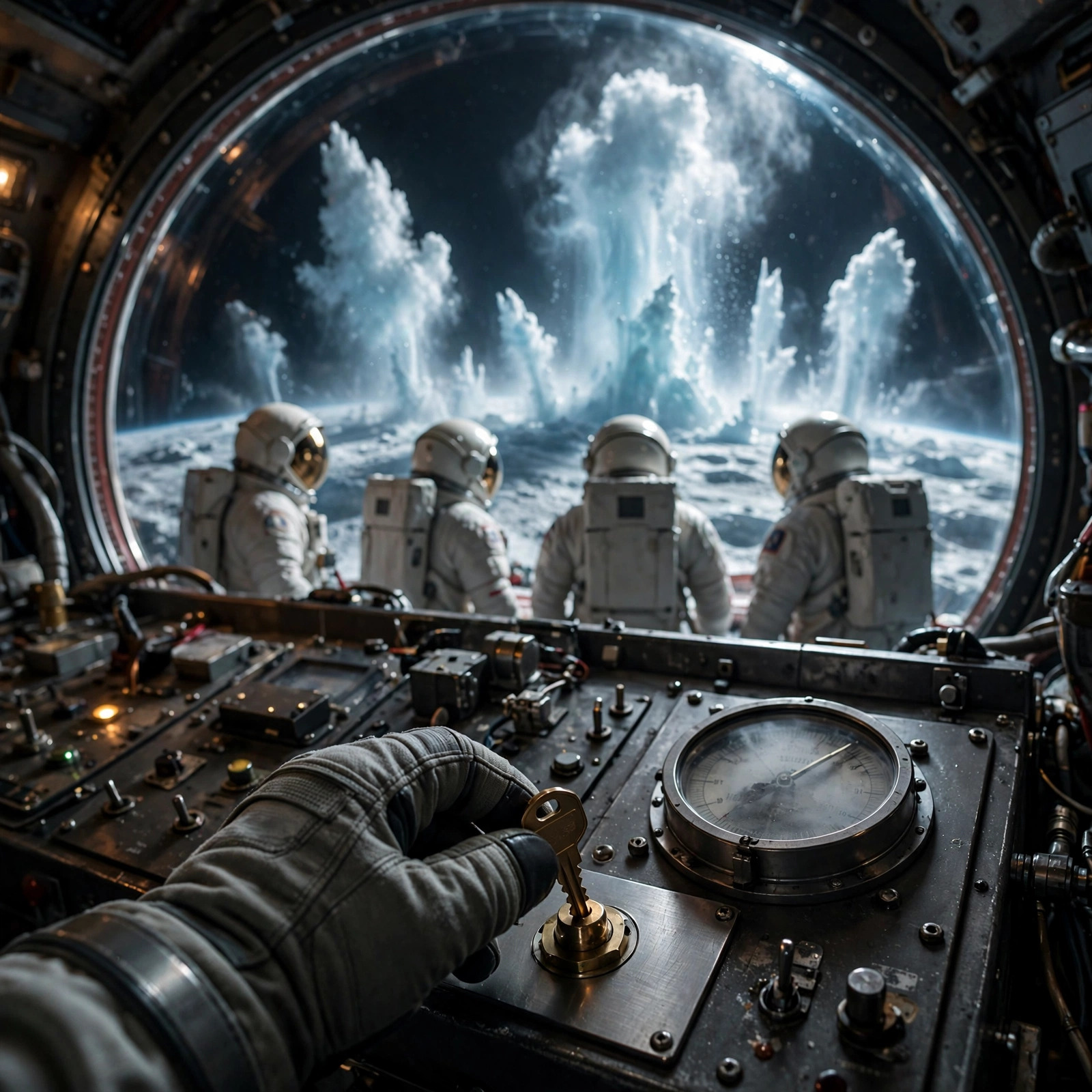
"Copy quarter throat," Talitha said, and put her hand flat on the burn key where it sat in its console keyway, brass and warm from the cabin air, stowed since the last insertion but never far from her reach. "Windows in forty minutes. Everybody soft on their straps."
They burned. It went long four seconds, and she let the ship drift through it, and the stars came back around, and Halk swung up the overhead with its banded face and its small cold escort of moons, Vesperine among them, and under them now, dropping.
The Wicks came up from the south polar cap the way they always did, as a haze first, then a comb of white plumes standing off the ice, lofting their grains nearly a thousand kilometers before the light pressure and the weak field let them fall back. From 1,250 the crowns had looked like weather. From 1,050 they looked like terrain.
"Grain's rising," Emeric said from the blister. "Brightness is climbing faster than the altitude accounts for. Talitha, the density is climbing."
"How fast?"
"Faster than the survey band. Faster than anything in the reduction." A pause, and then the flat sound of a man reading an instrument he didn't trust. "It's tripled since the last orbit and I don't know that I believe the photometer, but the shutter will tell us."
It told them. Pericenter came and the rack came alive with it, the whole ventral spine of the ship ringing faintly through its structure as grains began to strike, and Tomas closed the throat to quarter as promised, and quarter was not enough. Talitha watched the mass counter climb and then stagger, and watched the grain flux readout do something she had only seen in debris drills, and put her hand on the attitude stick because the strikes were coming in a band, a dense lane inside the haze, and the ship was crossing it at orbital speed.
"Tomas, report."
"Shutter's taking hits. Hits are taking the shutter." His voice had gone from conversational to clipped. "I've got scoring on the--hold." There was a sound that came through the intercom not as sound but as a change in his breathing. "Shutter's jammed. Throat's jammed at quarter. Something's bent in the guide."
"Close it," Sigrun said. "Close it all the way and ride it out."
"I'm trying to close it." The clipped voice had gone thin. "It won't travel. There's a grain wedged in the guide channel and the track's scored, the shutter can't clear the score, it's hung. Talitha, I'm going out on the rack."
"No," Talitha said. "Not at this flux."
"Then we take the hits with the throat stuck open and the next band scores it worse, and then we don't have a collector, and then nobody refills anything." He was already off the intercom; she could hear the harness slack through it. "Pericenter's in six minutes. I need four."
She looked at Sigrun. Sigrun looked at the flux readout, and at the mass counter, and at the clock, and Talitha watched her do the arithmetic she was doing herself: four minutes outside on the ventral rack in a rising grain band, against the whole rest of the mission, against eleven thousand kilos of water they could not get home without.
"Hold the attitude flat," Sigrun said, which was not a yes and not a no, and Tomas was already through the ventral lock.
Talitha held the attitude flat. She flew the ship on the stick with her eyes half on the stars and half on the rack camera, and watched Tomas work his way down the collector spine hand over hand, boots locked at the rack's near rail, grain flash around him thin and then not thin. The camera caught most of it. It caught the wedge he drove into the guide channel with three mallet strokes the ship's structure carried up through her chair, and it caught the shutter breaking free and traveling hard to its stops, throat closed, and it caught what the closed shutter threw back.
The channel held a shard of ice forced ahead of the blade, hard and fast along the guide, and Tomas's forearm was across the channel when the shutter moved.
He did not shout, which was the worst of it. He pulled the arm in against his side, said one word into his helmet loop that the intercom caught and Talitha did not repeat, and said, in a voice pressed small and even, "Shutter's free. Throat's shut. Haul me in."
They hauled him in. Sigrun went to the lock herself and Talitha flew the ship while Emeric read the flux off the photometer in a low steady count, because he had asked for the count, said it helped, and none of them argued. Pericenter passed. The band passed. The crowns fell away beneath them, and the haze thinned, and the strikes thinned, and the ship rang down through its spine to silence by the time they had Tomas in the blister and his suit cut off him in pieces on the deck.
The forearm was broken along its length and opened over it, suit fabric and skin and the bone beneath, and the blood moved in the blister's half gravity in slow beads that crept along his wrist and hung at the knuckles. Emeric brought the splint kit; Sigrun, who had a field-medic rating no one had ever asked about before, set the bone with her hands and did not flinch while Tomas watched her do it, jaw set, breathing through his teeth.
The repair cost them the rest of the day. Talitha knew it while it was still happening, knew it while she ran the trim burn that lifted them back toward the corridor line, knew it when she entered the consumables ledger by hand: one day gone for splinting and patched lines and a shutter pulled off its guide and milled, one day gone that the margin column could not give back. Twenty-one days boxed in her handwriting became twenty. She boxed the new number twice.
It was near the end of the ship's evening, with the bandaged arm elevated on a strap and Tomas propped against the blister rail with Halk's light coming up the ports behind him, that anyone asked him what mattered.
"The shutter," Sigrun said. "Tell me the shutter's still a shutter."
Tomas raised the arm experimentally, watched the beads travel, and set it back down. He was gray around the mouth and his voice had lost none of its precision, which Talitha had learned over nine years of working with him was how he sounded when things were worst.
"The shutter's a shutter. The throat still holds." A bead reached his smallest knuckle, trembled, and let go into the strap's weave. "It's what it is after the scoring that I want a night with the guide plates before I say. And Emeric's flicker. I want to know what I'm rating it against before I rate it."
"We may not have a night," Sigrun said.
"You do," Emeric said quietly, from the rail, not looking up from his plates. "Whatever the flicker's doing, it's not doing it tonight. Tonight I'm only sure of one thing: that band wasn't there when the survey flew it, and it wasn't there this morning, and it was there when we were. Something is moving through this field that takes longer than an orbit to move, and I'm going to find its clock, and I don't think any of us wants to sign a line until I have."
Talitha looked at the approach book, open on the console where she'd left it, both lines still unsigned. Then she looked at Tomas, at the blood beading slow along his splinted arm, each bead holding the light of Halk through the blister port.
"The throat still holds," Tomas said again, as if it were the only sentence in the ship worth the breath. "Whatever else I owe you, Talitha, it holds."
The Surge Clock
Talitha found the ship's morning already running when she pulled herself through the blister hatch: Emeric at the rail where he had been for what the logs would show was eleven straight hours, his photometry plates fanned across the console edge, and the brightness of the Wicks coming up the ports behind him in Halk's early light. He had taped a strip of hand-ruled chart to the port frame. It ran the length of a full arm-span, hour marks along the bottom, and above them a line that climbed and fell, climbed and fell, four peaks deep.
"You found it," she said.
"I found a period." He said it the way he said everything that mattered, flatly, as if flatness could keep it from being either better or worse than it was. "Forty hours. Give me the room to be wrong by two either side, but not more."
Sigrun came through the aft passage with her coffee bulb closed in one fist, Tomas behind her moving carefully, the splinted arm strapped high against his chest. He looked gray still, but upright, and he went straight to the chart without a word of greeting.
"Show me," he said.
Emeric set one finger at the first peak. "The vents brighten, the whole field, and then they quiet down. Not with the orbit. The survey reduction has the crowns steady because it averaged over weeks. They're not steady. They breathe." He moved his finger along the base of the line. "Tide. Vesperine flexes under Halk on a slow stretch, and every forty hours the field lofts perhaps three times what it lofts at the slack. I clocked it against the photometry from four vents and they agree with each other to within my error. That's the part that convinced me. Four liars wouldn't tell the same lie on the same clock."
Talitha read the chart twice, top to bottom, because she had learned in nine years of drawing lines through uncertain fields that the first read tells you what you hope and the second tells you what is there. The second read said what the first had said. She put her thumb on the hour mark where Sigrun's fast window sat, the 900 kilometer pericenter, the single deep pass that would fill the tanks in one swallow and put the charter's premium clause in Sigrun's hand.
Her thumb sat on the slope of a peak.
"It's inside the surge," she said.
"It's not near the surge," Emeric said. "It's centered on it. Whoever planned that window from the survey average planned it through a field that doesn't exist. The real field triples at that hour. At 900 kilometers you'd be inside the crowns at the hour they're densest."
Sigrun set her bulb down on the rail. "How dense."
"Yesterday's band," Tomas said, before Emeric could, "was the thin end of it. I've seen the survey plates. The band that took my arm was a third of what his clock says the field does at full surge. At 900, at that hour, the throat doesn't collect water. It collects whatever the crowns are made of, at eight kilometers a second of closing speed, and it does it through me and my shutter and everyone standing in the blister."
Quiet in the blister then, except the tick of the coolant lines behind the panels. Halk's light moved up the port and lay along the chart in a slow bar. Talitha watched Sigrun read it, watched her cross her arms and uncross them, watched her stop on the fourth peak the way a person stops on a stair that isn't there.
"The premium clause is written on core depth," Sigrun said. "Not on survival. I won't pretend otherwise. Nine hundred through the crowns is the deepest core sample ever logged at Vesperine, and the owners pay for depth because depth is what they can print on the manifest." She looked up. "How certain is the clock, Emeric."
"Certain enough that I'd put my name under it, and I don't put my name under things."
"Then the window's dead whether I like it or not." Sigrun turned to Tomas. "The shutter. Rate it for me. All of it."
Tomas worked the strap loose from his chest with his good hand and elevated the splint along the rail, considering, the way he considered alloys and welds and men. "The guide is scored through the anodizing. I stoned it fair by hand at second light and ran the throat through sixty cycles on the bench. It opens. It closes. At quarter throat it wants to hang, and I've shimmed the hang out as far as shimming goes." He looked at Talitha, not at Sigrun. "The crowns loft grains to about a thousand kilometers. Above that, at twelve-fifty, the grains are sparse and they come at us slow, near the ship's own speed, near enough. The shutter I have will live in that. It will not live in a dense band at 900. Nothing I can build aboard in the margin we have will live in that. So I rate it for the high corridor, and I don't rate it for anything under it, and if someone asks me to sign otherwise I will sign my resignation first, with my good hand."
Talitha had the approach book out of the console shelf before he finished. It fell open where the spine had learned to fall, to the two lines she had drawn on the first day in orbit, both unsigned: the deep line at 900, the corridor line at 1250. Five passes along the corridor at the yield the trial had promised once the field was read at its slack, 2,200 kilograms a pass, five orbits of nine hours each, nine days of gathering against the nine days the fast pass would have saved whole. The arithmetic didn't give anyone back their margin. It only kept the margin they had, twenty days boxed in her handwriting, and it kept it on the condition that nothing else went wrong.
She looked at the two lines for a long moment.
"There's a thing I should say before I sign," she said, and heard her own voice run thin, and went on anyway. "I've been flying this approach on nerve since tank two vented. You all know the figures. Eleven thousand kilograms of water gone as frost before we even arrived, and every kilogram of it was shield and drink and propellant, because the engine burns what the collector gathers, and I have been telling myself the whole time that the record would settle it. That if Sigrun's line went and mine didn't, the ledger would show I was right, and being right would be worth the nights I didn't sleep." She turned the pen once in her fingers. "That's not flying. That's just nerve wearing a flight officer's badge. So I'm done with it. I'm choosing the corridor because it's the line my crew can live inside, and Emeric is half of the reason I know where that line is, and I'd rather come home with all four of us at twelve-fifty than come home famous at nine hundred with one of us missing."
Emeric looked up from his plates. He had not looked at her through any of it, and now he did, plainly, without hurry.
"I'd rather have you at twelve-fifty than famous at nine hundred," he said. "I've been watching this field for eleven years, and the most it has ever given me was its clock. Last night it gave me you, telling the truth in front of your master. That's the better sample."
Talitha signed the corridor line. The pen went through the paper with more weight than it needed, and she initialed the date beside it, and then she turned the book and held it out to Sigrun, open, the deep line unsigned above it.
"Your clause dies today," Talitha said. "I'm sorry for that part. I'm not sorry for the rest."
Sigrun took the book. She read the unsigned line above the signed one for a while, long enough that Talitha counted the seconds in Halk's slow crawl across the frame, and then she closed the book on her own thumb and held it against her sternum.
"The owners are three point two light-hours out," Sigrun said. "Six hours to ask and six to hear, and by then the window will have moved through the surge and be gone. So it isn't theirs to sign. It was never really theirs. They write clauses; they don't stand in the blister when a band triples." She set the book down on the console, squarely, on top of Emeric's plates. "I came out here to be the master of a ship, not the representative of a clause. The deep pass would kill the crew I'm responsible for, and the clock says so, and the man who built the throat says so, and my flight officer has signed the line she can defend. I accept the corridor. Log it that way. Log that I had the choice in my hand and I set it down."
"It'll be logged," Talitha said.
She keyed the transmitter herself, because it was hers to send: corridor committed, five passes at 1250, first pass on the next orbit, the deep window declined on the surge clock and the throat's rating, reserve margin held at twenty days. The message went out at the speed of light and was past recall before she had finished standing up from the console, and that, she thought, was the truest picture of the whole approach: everything they sent from Vesperine arrived somewhere as a fait accompli, six hours late and final.
Tomas had drifted to the port with the chart, holding it up against the field itself, the Wicks standing up off the south pole in a white comb of crowns, bright, and by Emeric's clock still two hours from their slack.
"First pass at the next orbit," he said. "I'll want the shutter on the bench once more before then, and both of you to look at my hands while I work, because one of them has opinions of its own now." He smiled with only half his mouth. "But the throat holds. Whatever else this ship owes anyone, the throat holds."
Talitha took the approach book back from the console, opened it to the signed line, and set it in the rack by the rail where the morning watch would find it, closed on her name.
The Burn Key
Talitha sent the burn plan at 0612, ship's time, with Halk's slow crescent riding high in the port frame and the transmitter dish already swung to the inner-system bearing. She read the draft aloud once, changed two words, and let it go. Corridor committed. Five passes at 1250 kilometers, first pass on this orbit, commit burn at 0740. The deep window declined on the surge clock and the throat's rating. Reserve margin after commit, eleven days.
The reply could not arrive before 1232. The burn would be four hours old by then, and the first pass would be running, and nothing any clause said at that distance could reach out and change the altitude of a ship already committed. That was the arithmetic of it, and she had stopped finding the arithmetic cruel. It was simply the shape of working at Vesperine: every decision arrived somewhere as a finished thing. The premium clause, if the owners still wanted to argue for it, would land in the middle of a collection pass and find nothing left to buy. It would die unread in the queue while the crew was busy drinking ice.
Sigrun stood in the blister with her arms folded, watching the transmit lamp burn and go dark. "Eleven days of margin," she said. "You're spending nine of them to buy the corridor."
"I'm spending nine to buy five passes we can all survive," Talitha said. "The deep pass would have saved them. It also would have spent Tomas." She didn't soften it, and Sigrun didn't ask her to.
"I know what I set down," Sigrun said. "Log the burn."
Talitha took the brass key from its box on the aft bench. It was a plain thing, cut from a single blank and stamped with the ship's yard number, nine years old and worn to the shape of her grip. The main engine would not arm without it; that was the whole point of a key a person had to carry. She slipped it into the keyway at the blister bench, under the ventral camera feed, and waited for the orbit to come round.
Tomas sat propped against the starboard rail with his splinted arm strapped across his chest, the good hand resting on the shutter bench remote. He had gone over the throat one more time that morning, both of them watching his one working hand as asked, and had pronounced the guides true. "Quarter throat if a band comes early," he said now. "Full throat over the crowns' slack. I'll drive it from here. Don't let anyone tell you the man with one arm isn't working."
"No one's telling you anything," Emeric said. He had the photometry plates racked beside him, brightness logged against the hour, the surge clock drawn out in his own hand: peaks roughly forty hours apart, the last crest fourteen hours behind them, the next one due on the far side of the first pass. The crowns would stand up off the Wicks while the Tramontane was above them, riding the sparse corridor, and the field's worst temper would arrive where the ship was not.
"That's the whole trick of it," Emeric said. "We don't beat the tide. We just refuse to be home when it knocks."
"I'll take it," Talitha said.
At 0740 the orbit brought the pericenter line onto the burn attitude, and the autopilot handed her the ready lamp. She turned the key. The engine lit somewhere below and behind her, a long flat push in the seat of her chair, and the trim gauges crept as the Tramontane bent its orbit down, out of the high survey path, onto the corridor line: 1250 kilometers at closest approach, a thousand kilometers of the Wicks' loft beneath the keel, and above the crowns where the grains ran thin and slow. The delta-v came off the reserve like water off a measured tank, and she watched it go and did not look away from the meter while it went, because it was right that someone should watch the price being paid in full view of the person paying it.
Forty-one minutes later the engine cut on schedule, and the corridor was theirs. No return line to the deep window anymore. The reserve that could have bought a 900-kilometer pass was spent, and no message at the speed of light would give it back.
"Committed," she said, and pulled the key from the keyway. It was warm from the bench lamp and from her hand.
"Then we work," Sigrun said.
The nine-hour orbit carried them out over Halk's glare and back down toward the pole, and the crew crowded the blister for the run-in: all four of them, which had never happened for a pass before, Sigrun included. "I signed the corridor," she said, as if answering a question no one had asked. "I'll watch what I signed for."
The Wicks came up off the south pole the way they always did, a white comb of crowns standing a thousand kilometers off the ice, bright past brightness, and beneath the ship the field ran sparse and slow, grains wide apart in the corridor, drifting past the ventral rack at walking pace. Tomas opened the shutter by remote, full throat, and the collector began to drink.
Talitha watched the feed. Grains came in as brief pale points on the intake camera, one every few seconds, then closer together as the pass deepened, each one a small thump through the rack's structure and then gone into the throat. The gauge on tank two, the frost-trapped sphere amidships, began to climb. Sixty kilograms. Two hundred. The readout ticked upward with a steadiness the trial pass had never shown, and Emeric called the density against his plates, and it matched, and he laughed once, short, like a man surprised to be right.
"Sparse as surveyed," he said. "The tide's out. We're riding the ebb at altitude."
"Throat's clean," Tomas said. He had the vibration feed in front of him and his good hand hovering over the shutter remote, ready to close to quarter throat if a band came early. Nothing came early. The pass ran deep and quiet, and the gauge went on climbing. A thousand kilograms. Sixteen hundred.
"Two thousand," Emeric read.
The crowns surged beneath them an hour before the ship crossed the field's latitude, the whole comb standing up brighter as the tide came in, exactly on his clock, exactly where the ship was not. Talitha watched it happen on the ventral camera and felt the corridor hold: 1250 kilometers of clean separation, the tripling density arriving a thousand kilometers below her keel, a wall of white noise passing harmlessly under a ship riding above it with its throat open.
"That's the peak," Emeric said quietly. "Right where the fast window sat. Right where we'd have been."
"We weren't going to be," Sigrun said. "That's the log I made."
The gauge passed two thousand two hundred, and Tomas closed the shutter to quarter throat as the pass shallowed, and the readout settled: 2,200 kilograms gathered in one orbit, ice now, melted and metered into tank two, four more passes of the same to close what the strike had vented. Eight thousand two hundred kilograms still to bring aboard, and the field was showing them it knew how to give.
"Clean pass," Tomas said. "Both hands on my verdict, one of them secondhand." He was gray with tiredness and grinning anyway. "Log it clean."
"Logged clean," Sigrun said.
Talitha looked at the transmit queue. The owners' reply was still out in the dark, three light-hours downsystem, six hours of silence with an hour still to run, and the window it might have argued over had already been declined, committed, flown, and survived. Whatever the clause was worth now, it was worth it unread. She let it sit there. She found she had no urge at all to check it twice.
"Four more," she said. "Next window in nine hours."
"I'll be here," Tomas said.
"We'll all be here," Sigrun said.
Talitha put the brass key back in the keyway and left her hand on it, and beneath her, a thousand kilometers down, the crowns stood at their full surge, bright and murderous and far away, while the gauge on tank two climbed through the first 2,200 kilograms and kept its slow crawl toward home.
Get notified when new stories drop

Sasha Quill
Sasha writes bold exploration and cosmic wonder with lyrical scale and grounded character work.
Leave a comment
Comments