





Night Grain Run
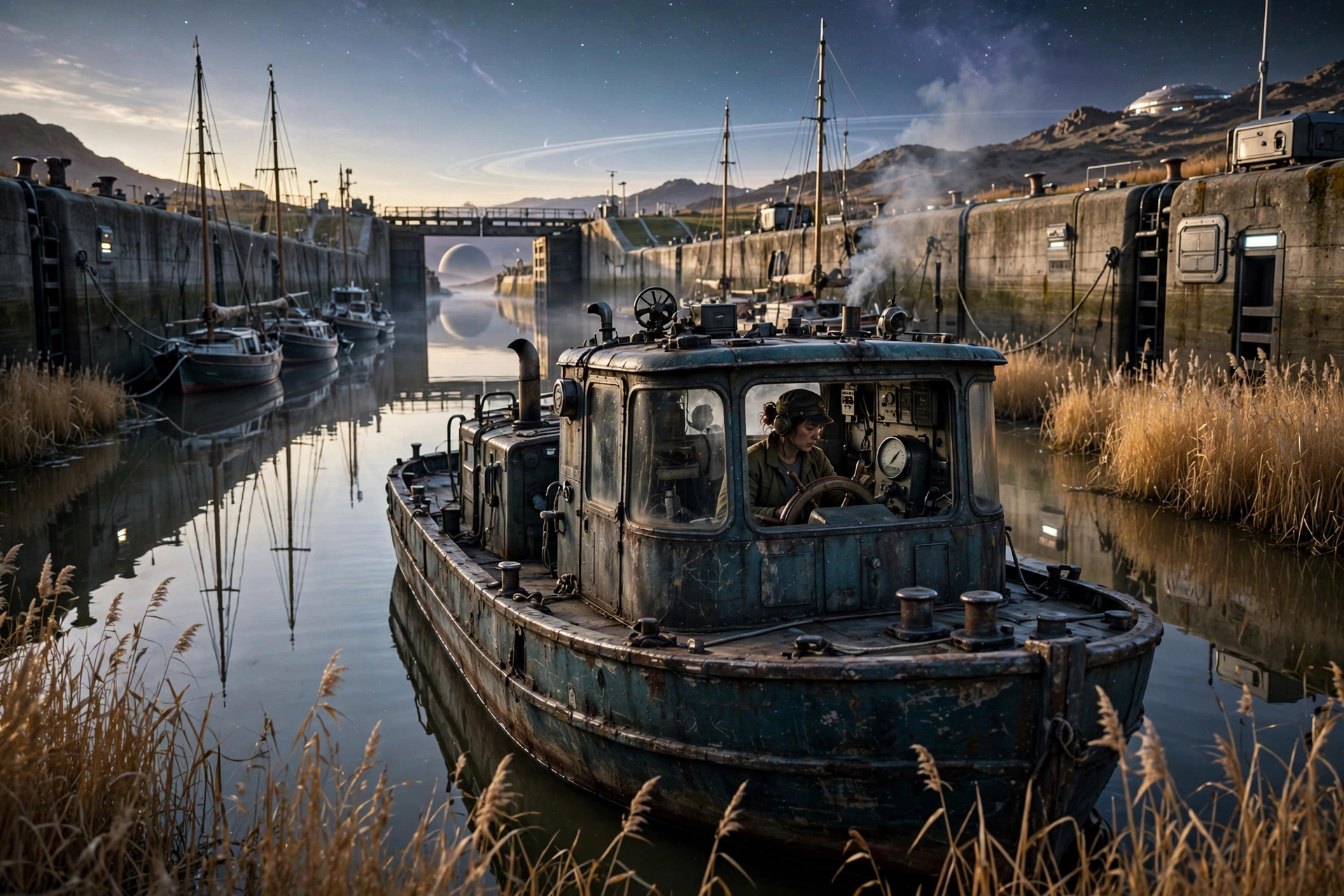
The Dorotea went through the Garrow lock at first light with forty tonnes of scrap in her hold and a wake of diesel smoke that Imogen could smell from the wheelhouse even with the door shut. Thirty-four liters a day, the meter said, ticking upward like a clock that charged by the hour. She nudged the throttle back a fraction, let the bow settle, and watched the towpath fence slide past at a walking pace. Canal freight was a walking-pace business. Anyone in a hurry had left the water years ago.
Wendell was forward on the hatch coaming, gassing down the cover straps, his ledger book open on his knee between pulls. He wrote in it even underway, in that small upright hand their mother had drilled into both of them, ink never smearing because he never hurried the pen.
"Nineteen thousand even," he called back, "if we hold this pace through autumn. Scrap's steady. Steady's not nothing."
"Steady's nineteen thousand," Imogen said.
"Steady's the mortgage on a sound hull." He thumbed the strap home. "I'll take it."
She let it lie. Fourteen years of running the Dorotea together had taught her which sentences were openings and which were doors already shut, and that one was a door. The diesel grumbled under the deck, faithful and expensive, a 2019 unit with good compression and an appetite. The hull was sound. The ledger was sound. That was supposed to be the whole of it.
They delivered the scrap by noon at the reclamation yard above Pollard Reach, took on ballast water to settle her trim, and ran light down the long reach toward Garrow Basin while the afternoon went gold along the reeds. Imogen let Wendell take the wheel and sat on the stern fender with a mug, watching the reflected masts of the moored boats slide by. It was a good day. She would remember that later, the way you remember the last ordinary hour before the phone rings.
They moored at Garrow Basin as the light went. Imogen had the stern lines doubled and was coiling the excess when Gil Okafor came down the quay in his harbormaster's coat, unhurried, a folder under one arm. He didn't wave. He walked straight to the bollard, waited until she'd finished the coil, and only then spoke.
"Imogen. You and your brother got a minute?"
"We've got the whole evening. We're not night people."
"That's the thing." He set the folder on the bollard and put one finger flat on it. "Authority passed the night rule. After day one-twenty, night lockage goes to zero-emission-certified boats only. No exceptions for legacy tonnage. It's signed, it's printed, and it's not a proposal anymore."
Wendell had come aft with the fenders under one arm. He set them down slowly. "One hundred twenty days."
"One hundred twenty days," Gil agreed. "And I'd not be walking down here at dusk to tell you if that was the whole of it."
Imogen looked out past the harbor mouth. The Garrow lock stood open in the dusk, its lamps coming up, and through it, already queueing at the signal light, she could see a grain barge riding high and empty, running lights green at the masthead. Certified boats flew the green masthead lamp. She'd seen a few over the past year and thought nothing of it, the way you think nothing of a new kind of bird until someone tells you the old ones are leaving.
"Stannard Mill put out a night contract," Gil said. "Grain, three years, sixty-one thousand a year. Night runs only, because that's when the lock's free and the mill's intake is open. Zero-emission boats only, because the Authority's rule and the mill's own air permit point the same way." He paused. "Sixty-one thousand a year, Imogen."
"For three years," Wendell said quietly.
"For three years." Gil didn't smile. He was a careful man with other people's hopes; he'd been harbormaster here long enough to know what a number like that did to a working boat. "The mill can't take more trucks. The rail spur was lifted before your mother had her slip here. The grain moves on this canal or it doesn't move at night. And the mill's own air permit points the same way as the lock rule, so the field of boats that can even bid on it is thin tonight."
Imogen did the arithmetic without meaning to. Sixty-one thousand against nineteen. Three years of that against the diesel burning thirty-four liters a day against a night rule that would strand them on the wrong side of the lock at two in the morning. Her hands were still cold from the mooring lines. She flexed them and felt the ache of the day's work arrive all at once.
"How many certified boats are on the canal?" she asked.
"Four, tonight. There'll be more. There's a co-op yard at Pollard Reach doing conversions, and their order book is the busiest thing on this water." Gil lifted the folder, held it out to her rather than setting it on the deck, which was his way of making sure she understood it was hers now. "Day one-twenty is the wall, Imogen. I'm telling you before the notice goes up on the office board, because your mother kept this basin honest for a lot of years and I owed her that. After the wall, if you're not certified, you're a daytime boat in a canal that's about to get very interested in its nights."
"Thank you," she said, and meant it, and hated that her voice came out flat.
He went back up the quay. The green-lamped barge slid into the lock ahead of them, and Imogen stood at the stern rail and watched the gates close on her, and then the water lift, and then the barge rise up into the dark going north, loaded with nothing, going to fetch grain that would pay her sixty-one thousand a year.
Wendell picked up the fenders. He didn't pick up the ledger.
"A retrofit's not a can of paint," he said. "It's a fuel cell, it's tanks, it's pressure plumbing, it's a yard bill bigger than anything we've ever signed. And every boat on this canal is going to be reading the same notice tonight and calling the same yard tomorrow morning."
"I know."
"You're already pricing it in your head. I can see you doing it. You get that look when you're spending money we haven't earned yet."
"I get that look when I'm counting slots." She turned to face him. The harbor lamp lit the gray coming into his beard, and the exhaust ring their mother had cast and bolted to the old stack caught the same light, brass gone dark with soot above the wheelhouse. "Every yard has a backlog, Wendell. Backlogs only get longer after a notice goes up. If the co-op at Pollard Reach has a queue tonight, I want to know how long it is before it's a year."
"And if it's already a year? Then we thank Gil, we keep our nineteen thousand, and we stay a daytime boat in a daytime trade." He said it gently, and he said it like a man who had already decided, which was the part that closed her throat. "There's no shame in that."
"There's no sixty-one thousand in it."
"There's no bankruptcy in it, either." He hoisted the fenders onto the rack and lashed them without looking at her. "Sleep on it. That's all I'm asking. One night."
She gave him the one night. She went up to the wheelhouse and sat with the lamp low and the folder open on the chart table, and she read the notice through twice, and then she read the mill's tender summary, and the words zero-emission certified vessels only sat on the page like a lock gate, closed, with water rising on the far side. Through the window she could see the harbor mouth, and past it the signal light at the Garrow lock, and twice before midnight a green masthead lamp rose through the dark on the water and passed north, quiet as a rowboat, and each time it passed she thought: that could be grain. That could be the run. That could be ours.
The diesel ticked below the deck as it cooled, the sound of money spent. Thirty-four liters a day. Nineteen thousand a year. A sound hull and a sound ledger and a wall coming in one hundred twenty days.
She did sleep, finally, with the folder under her hand. And in the morning she was at the yard office phone before the fog lifted, asking Pollard Reach what a conversion cost, and how long the line ahead of her was, because the slots would not wait for anyone's beauty sleep, least of all hers.
Nine-Week Backlog
Two weeks of fog and daylight scrap was enough to make the number feel real. Imogen walked into Pollard Reach on the fourteenth morning with the tender folder under her arm and her boots leaving prints in the coal dust that hung over the co-op yard like a second weather. The yard sat on the basin's north finger, three travel hoists and a dry-dock slip and a long shed roofed in solar film, and along the quay wall the backlog lay itself out plainly: boats waiting, bow to stern, their hulls chalked with queue numbers.
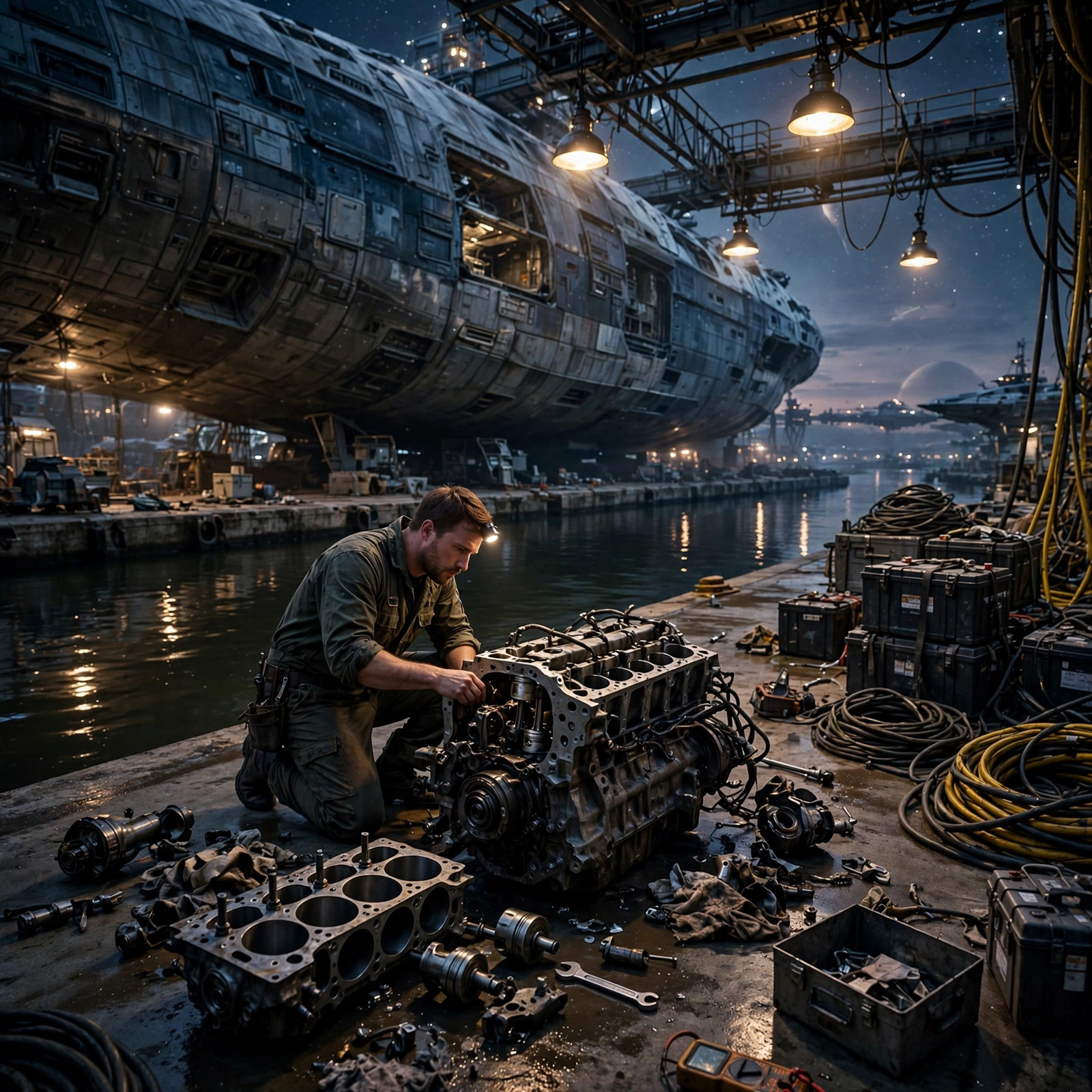
She counted them as she walked. Eleven. She stopped counting when she reached eleven because the twelfth was a dredger that might or might not be in the line, and because knowing whether the line was eleven or twelve did not change anything she could do about it.
Ravi Solano found her at the shed door, wiping his hands on a rag that had stopped being a rag some seasons back. "You're the Dorotea," he said. Not a question. "Gil rang ahead. He does that. He thinks he's subtle."
"He's not," Imogen said.
"He isn't." He hung the rag on a nail and looked at the folder under her arm. "Daytime scrap, sound hull, diesel from nineteen. And you want to know what a conversion costs."
"I want to know what it costs and how long the line is. In that order."
"Then come see what you're buying before I quote you, because the quote means nothing until you've stood in the engine room of a boat that's had it done."
He led her down the quay to a twenty-two-meter freighter tied off at the far end, sleek as a canal boat ever got, with a hull number chalked fresh and a wheelhouse that still smelled of paint. "The Heron," he said. "Same frame as yours. Same shaft, same prop. We pulled her diesel in March and put a fuel cell stack where the block sat. Kept the electric thruster shaft, so the coupling was a bolt job, not a redesign. Three tanks, three hundred fifty bar, in the old fuel bunker where they belong. Range on a full fill, loaded, three hundred eighty kilometers."
Imogen went down the ladder into the engine room and stood where a diesel should have been and wasn't. It was the strangest kind of quiet. Fourteen years of her working life had been spent over engines like the one missing here, and the space where this one had lived was clean, dry, and dark, taken up now by a stack in a steel cage and plumbing in bright new insulation.
"It's louder at the wheel," Ravi said from the ladder. "You'll hear the water and the wind and every rivet in the hull. Then you'll stop hearing it, and then you'll wonder how you ever slept over a diesel. The crew always says that. It's practically liturgy."
"What's the number?" she said. "Installed. On my boat."
"Thirty-eight thousand."
She had done arithmetic in the wheelhouse every night since Gil's phone call, so the number landed on ground already prepared for it. Thirty-eight against twelve thousand four hundred in savings, against nineteen thousand a year of daytime scrap, against sixty-one thousand a year of grain. She did not let her face do any of that where Ravi could see it.
"That's installed," she said. "Parts and labor and certification together."
"Certification runs separate," Ravi said. "But it runs through me, and I don't certify boats I didn't convert. The number holds."
"Then what's the line look like."
"Sixty-three days." He said it without apology, the way a man says a number he has said forty times that month. "That's today's count, and today's count is honest, but it's not tomorrow's. After the canal authority's notice went up I had four calls in one week. Day-boat operators every one, all wanting to be night boats by summer. So if you want the number that matters, it's not sixty-three. It's sixty-three plus however many of those four get ahead of you, and the answer to that is all of them, if you keep standing in my shed doorway holding your folder."
"And if I put down a deposit this afternoon."
"Then you're in the line and the line stops moving without you. The deposit holds the slot. It's twelve thousand four hundred against the install." He glanced at her face and then away. "Which is a number I can see arriving, so I'll say the rest of it plainly, because you strike me as someone who prefers plainly. The Heron's stack came from the same supplier you'd get. Solid-state kits come down the pipe next year, cheaper, no high-pressure plumbing to speak of. Anyone who tells you waiting is crazy is selling something. Waiting is reasonable. The co-op might even be your friend for waiting."
"But."
"But the authority's rule is a hundred and twenty days out, and my calendar says the same as yours. Sixty-three days of backlog plus three weeks of install is not a hundred and six days, because installs don't run clean on fourteen-year-old hulls. It runs long, and everything that runs long runs against your deadline, not mine."
They stood in the engine room and he tapped the regulator shroud with one knuckle, a small housing at the tank manifold, unlovely and painted gray. "One thing I'll warn you about, because I'd rather warn than certify twice. Cold starts. The tanks chill at night when the boat sits, and the regulator sits right against the bunker bulkhead, coldest metal aboard. We've had stacks trip on cold-morning starts and I've spent more nights than I want to admit with a multimeter in my teeth because of it. If your run has to happen at night, at two in the morning, in November, you test at night, at two, in November. I don't pass a boat on a sunny Tuesday. It's a bad way to meet your fuel cell."
"Noted," she said, and she meant it, because it was the first thing all day that had sounded like information instead of arithmetic.
He walked her back up the quay, past the eleven boats, past the twelfth dredger, to the yard office door, and gave her the printed quote with the deposit line blank and the slot line blank. "Twelve thousand four hundred holds it," he said. "That's the whole sentence. The rest is your ledger, not mine."
She took the Dorotea home through the afternoon locks and ate soup with Wendell in the wheelhouse with the lamp lit and the folder between them, same as it had been between them every night for a fortnight, except that now it had numbers.
"Thirty-eight thousand," Wendell said. He said it the way he read tide tables. "Installed. And the line is sixty-three days before they even start."
"Sixty-three days, then the install, then certification. Ravi says it's tight against a hundred twenty."
"Ravi says it's tight. That's a man with a queue outside his door telling you the queue outside his door is long. Imagine that." He pushed the soup away and pulled the folder closer. "Im, listen to me once, before you take this to a place we can't row back from. The solid-state kits land next year. Cheaper, no high-pressure plumbing, and every teething trouble on the Heron and her sisters gets fixed in the second generation, on someone else's dime. We're the first mouse here. First mice get the wall."
"First mice get the grain."
"First mice get the cert and the contract and sixty-one thousand a year, if the wall doesn't come down. And the deposit is twelve thousand four hundred. That is every cent of the winter fund. That's the dry-dock money. The slip is the only asset we hold that isn't the boat, and the boat is the only asset we hold that earns anything. You'd be putting both names our mother left us on a table and shoving them toward a man with a backlog."
He wasn't wrong about any of it. That was the difficulty of Wendell; he came at her with honest arithmetic, always had, since they were kids splitting a paper round. She had no rebuttal to cheaper kits next year. She had no rebuttal to the backlog. All she had was the thing she'd watched go past her window at midnight, green masthead lamps on the water, other people's grain going north in the dark.
"If we wait," she said, "we're a daytime boat forever. The four certified boats already running will take the night trade, and they'll hold it, and the next year's kits will come down the pipe and the backlog for those will be longer than sixty-three days, because everyone who waited will be standing where I stood this morning."
"Better a live daytime boat than a bankrupt night one."
"Better than either is a certified one." She got up and took the deed box down from the shelf above the chart table, opened it on the table between the soup bowls, and lifted out the slip deed with the canal authority's seal embossed at the head. Winter dry-dock at Garrow Basin, deeded, their mother's name crossed to both of theirs, worth exactly what a haul-out cost and nothing else, unless you pledged it.
Wendell looked at the deed, and then at her, and he didn't say anything for a long time, which from Wendell was a whole speech.
"You've already counted it," he said finally.
"This afternoon. Twelve thousand four hundred in savings and the slip behind it if the savings don't clear the balance. It's enough for the deposit."
"It's a deposit, Im. Not the install. You're thirty-eight thousand into a thirty-eight thousand dollar problem with a twelve thousand four hundred dollar answer."
"The install pays out of the run. That's what the run is for. That's what the run has always been for." She squared the deed on the table and put her hand flat on it. "I'm taking the slot, Wendell. Tomorrow morning, first boat through the Garrow lock, I'll be at the yard office before Ravi has his kettle on."
Wendell closed the folder, then opened it again, then left it open, because there was nothing in it left to close. He looked at her the way he had looked at the harbor lamp on the first night, out over the water where the green lights went north.
"Eat your soup," he said. "It's getting cold."
The Slip Deed
The yard office at Pollard Reach smelled of epoxy and wet paper, and the stove in the corner had been lit since before dawn because Ravi Solano kept it lit for the men on the ways, and the kettle on it had gone cold twice already that morning. Imogen came in with the deed box under one arm and the savings book in her coat pocket, and Wendell came in behind her with his hands in his pockets and his cap on, which was how he dressed for arguments he intended to lose slowly.
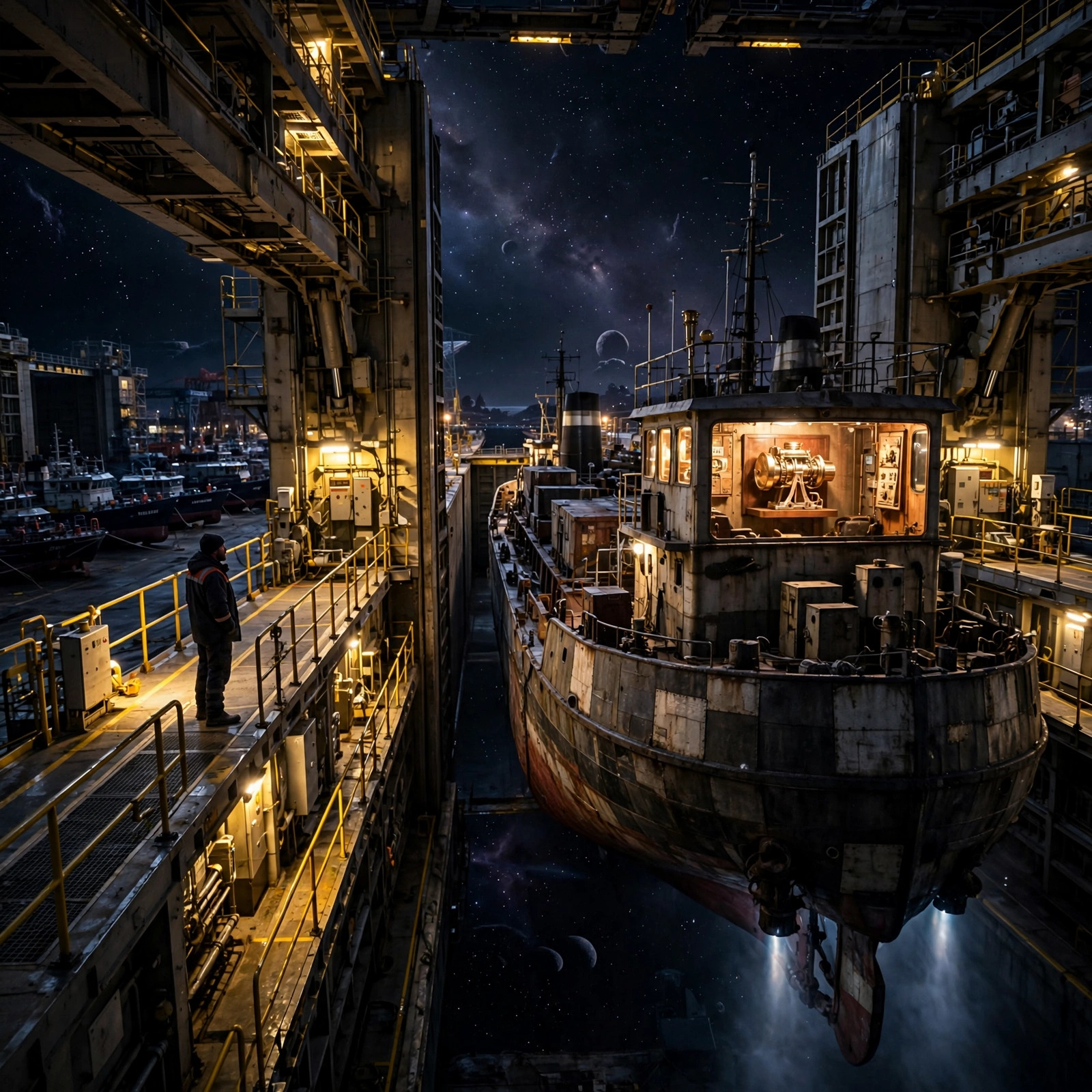
Ravi had the receipt printed and laid flat on the counter, a single sheet with the co-op seal at the top and lines ruled for dates and sums. "Slot's open as of today," he said. "First cancellation in nine weeks, a grain barge out of Harrow going to auction instead of to me. I can hold it against the deposit and nothing else. Board meets Thursday and they'll want the number filled in."
"Then fill it in," Imogen said.
She took the savings book out and set it on the counter, and Ravi wrote the figure from its last line onto the receipt in his own hand, 12,400, and turned the sheet toward her. The pen was a cheap ballpoint off a string, the kind that skipped, and she pressed hard enough to dent the paper under it. Under the sum she signed her full name, Imogen Salk, and under that she printed sole depositor, because Ravi had asked her to, because the yard had learned the hard way not to hold money for partnerships that might not be partnerships by the time the kit arrived.
Wendell hadn't taken his hands out of his pockets. "Refundable until day fifty," he said. It wasn't a question; it was him checking the wording on the sheet, and Ravi let him read it, and the stove ticked while he did.
"Until the kit's ordered," Ravi said. "I order around day fifty, give or take what the tank supplier does. After that the money's steel and plumbing and it isn't coming back, and I'll say so plainly because I'd rather say it now than in November."
"She knows," Wendell said.
"I know," Imogen said. "That's why it's day thirty-eight and not day forty-nine."
Something passed across Ravi's face at that, a small private amusement he was polite enough not to finish, and he blotted the receipt and put it in the folder with the yard's copy. Then he looked at the deed box, which was still under her arm, and then at Wendell, and he said, "I'll step out to the ways for ten minutes. There's tea when you're done, if you're done."
"We're done," Wendell said, before she could speak, and Ravi took his coat off the hook and left them the office and the stove and the ticking of the kettle.
She set the deed box on the counter and opened it. The paper inside was the paper from 2041, embossed seal of the canal authority registry, both their names above their mother's signature, the winter slip at Garrow Basin deeded to the two of them the year before she died. It had been in this box through four haul-outs and one flood, and the box itself was dented at one corner where it had gone into the water off the Harrow cut and come back out again, and Wendell had been the one who waded for it.
"You want me to say it first," she said.
"I want you to say it once, plainly, so I can hear what I'm agreeing to." He took his cap off, which he only did indoors or when he meant something, and he put his hands flat on the counter the way she'd put hers flat on the deed at the wheelhouse table. "Say it, Imogen."
"I'm buying your half of the Dorotea. I'm paying for it with the only thing I have that's worth half a boat, which is my half of the slip. You sign the slip to me, sole holder, and I sign the boat to myself, sole owner, and the slip stands behind the deposit and the kit and everything else this turns into. If it goes wrong, you've lost a winter berth and I've lost everything, and that's the honest shape of it. If it goes right, you've got your price in cash inside the year and I've got a boat that can hold the night grain."
"Sixty-one a year," he said. "Three years."
"That's Nell Prand's number, yes."
"And four certified boats already on the canal, and more coming, and a co-op backlog you just jumped to the front of because you had twelve-four in a book and a deed in a box." He said it without heat, which was worse than heat, and she let him say it because he'd earned the saying of it over fourteen years of keeping her books straight. "You know what I think of the timing. You know I'd have waited for the solid-state kits. You know I think the yard's cold-start problem is real and Ravi said so himself."
"I know all of it."
"Then I'll say my piece once and I'll sign, because you've decided and you're my sister and the boat should be one person's to sink or float." He turned the deed around and read it again, though he'd read it a dozen times, and his finger stopped under the registry line. "The slip was Mum's way of keeping us partners. You understand that. Winter berth at the basin, both names, so neither of us could be iced out by the other in a bad year. That's what this paper is. And you're asking me to take it apart so you can put it up against a fuel cell."
"Yes."
"Say what it costs you, then. Not the money. The money's the easy part, that's just arithmetic. Say the other part."
The stove ticked. Outside, through the office window, she could see the ways and the cradle and the Dorotea's bow, and the water of the basin lying flat and gray, and a heron standing on the far wall of the lock with its shoulders up against the drizzle.
"It costs me you," she said. "Fourteen years, and I don't get to say crew when I mean brother anymore, and come the winter I'll be paying berthage somewhere with money I don't have, because the slip that kept us partners is going to be collateral in a drawer at the bank until this is paid off. That's the cost. I've counted it the way I counted the deposit, line by line, and it's still worth it, and I'd rather you heard me say that than watched me pretend it was nothing."
Wendell looked at her for a long moment, and then he took the pen off its string, and he signed the transfer line on the deed, his full name, and under it he printed sole holder: Imogen Salk, and his hand didn't shake and didn't pause. Then he went into his coat and came out with a small brass key on a loop of tarred twine, the deed box key, the one that had lived in his pocket every winter since 2041, and he set it on the counter beside the box and did not push it toward her. He left it exactly where his fingers had let go of it.
"Lock's at the box," he said. "Not that you don't know. Garrow's taking me on at the lock house, day shifts, starting Monday. Gil put in the word for me." He put his cap back on. "I'll want the cash price by spring. Not because I doubt you. Because a man who's signed his boat away should get to plan like it's signed away."
"By spring," she said. "I'll write it tonight."
"Write it plain, then. You always did leave the ugly numbers to me." He almost smiled at that, the way he had across the engine of the old diesel in better years, and then he was out the door and down the steps and walking the towpath toward Garrow Basin with his collar up, and she watched him the length of the yard wall until the hedge took him, and he did not look back, and she would not have wanted him to.
Ravi came in with the cold kettle and fresh tea in it, and he looked at the signed deed and the key and her face, in that order, and he said nothing about any of the three. "Ways are free after lunch," he said instead. "Cradle's set for your length. You want her up today or tomorrow?"
"Today."
"Then sign the haul sheet and let's get her out of the water before the rain comes back. Windlass is manned. You want to take her up or shall I?"
"I'll take her up." She put the key in her own pocket, where it made a small hard shape against her hip that she would feel for the rest of the day. "She's mine to put on the hard."
They walked out together. The Dorotea lay against the yard wall with her fenders down and her diesel cold for the first time in weeks, and the brass exhaust ring her mother had cast in 2035 sat soot-dark above the wheelhouse, and Imogen stood at the windlass and took the strain of the cradle lines in her two hands the way she'd learned it standing on a bitt at her mother's knee. The winch took. The keel kissed the cradle timbers with a long wooden groan, and the Dorotea came up the ways a meter at a time, shedding basin water from her plates in flat silver sheets that ran back down the incline to the canal, and the men on the lines walked her up, and Ravi stood at the head of the ways with the haul sheet and the kit manifest and the day's date on both.
She went aboard across the gangway to strike the fenders and drop the winter cover over the wheelhouse, and the wheelhouse was empty in a way it had never been in fourteen years, no plate in the basin, no coat on the hook, no ledger open on the chart table where the deed box had lived under it since the winter their mother signed it. She took the brass key out of her pocket once, looked at it, and put it away again.
Below her, on the hard, Ravi's crew were already chalking the hull lines and rolling the first of the scaffold under her bow, and somewhere behind the yard shed, on a flatbed with the co-op's stenciled tarp over it, three 350-bar tanks were waiting to go into the old fuel bunker, and there were eighty-two days left before the canal stopped letting burning diesel through its locks at night.
"Day thirty-eight," Ravi said from the ways, checking his watch against the haul sheet. "She's up. From here on it's mine to build and yours to pay for, and I'd say we'd both better be right."
"We'd both better be," she said, and struck the last fender, and lowered the cover over the wheelhouse, and the Dorotea stood on the cradle high and dry with rain beginning again on her plates, empty of her old crew, waiting for the stack that would make her new.
Cold Start
The Harrow cut swallowed the sky at half past one in the morning. Imogen had the Dorotea dead slow, dead quiet, the new stack idling on its warm-up cycle, and the walls of the cut rose black on both sides until there was nothing overhead but a seam of stars and nothing astern but the wake she was trying to keep flat. The certification route ran down through here because the authority wanted the trial run at night, on the real schedule, on the real water. Two in the morning was the slot. Two in the morning was when the grain would move.
Ravi was sixteen kilometers back up the canal, parked at the repeater mast above the cut with a thermos and his laptop, because below the Harrow cut the shore repeaters dropped out and line-of-sight VHF died in the walls, and the yard's rules said a trial had to be run where the yard could hear it. He'd told her that twice on the drive down. She'd heard him the first time. The trouble was that the route he could monitor from the mast and the route the authority wanted were not the same route, and the compromise had a hole in it, and the hole was six kilometers of cut with no repeater in it, and at two in the morning she was going to be in the hole.
"Harrow mouth in four minutes," she said into the radio. "Going quiet after that. See you on the far side."
"Copy," Ravi said. "Warm the stack full before you open the tanks. Full preheat, Imogen. Not almost."
"Full preheat." She clipped the handset back on its bracket and put her hand on the tank manifold and started the sequence the way she'd run it forty times on the hard, with Ravi's crew leaning on the rail and the yard lights on everything.
The three 350-bar tanks sat in the old fuel bunker where the diesel day-tanks used to be, strapped and vented and plumbed down to the regulator, and the regulator stepped the pressure from tank-pressure down to what the PEM stack could drink, and the PEM stack made the amps that turned the shaft, and the shaft turned the water, and that was the whole animal. No fuel burned. No smoke. That was the point of every dollar of it.
Preheat complete. She opened the manifold.
The regulator hissed, and then it didn't hiss, and then the stack display went from green to amber to a flat red line, and the Dorotea lost her way in the dark and began to slow with the current pushing her bow toward the cut wall.
"No," she said, to nobody, to the red line.
Low-pressure cutout. She knew it before she'd opened the panel. Ravi had said it on the hard, weeks ago, arms folded, watching the first tank go in: cold 350-bar tanks chill the regulator on a cold first start, and a chilled regulator can trip you out on a night run. He'd said it and she'd filed it under the column of things that happened to other boats. The tanks had been bunkered at night. The cut was cold. It was two in the morning. The gas came out of the tanks, expanded across the regulator seat, and the seat gave up its heat to the expansion, and the pressure on the low side fell under the cutout, and the red line meant the certification run was over.
She got the wheel hard over, used the last of her way to lay the bow off the wall, and put a line around a cut mooring ring to hold her while she worked. Then she keyed the radio. Static. She keyed it again. Static, because she was in the hole, because the repeaters didn't reach, because this was the exact thing Ravi had warned about and she had nodded at and gone to the hole anyway, on schedule, at two in the morning, because the schedule was the trial.
She looked at her watch. Two-oh-nine. Twenty-four days until the canal stopped letting burning diesel through its locks at night, and Ravi's provisional review slot with the authority closed in two days, and if she didn't hold a certification by then she'd be a daytime scrap boat with a fuel bill and no brother aboard and a spring buyout due on money she didn't have yet.
She got the torch out of the kits locker and went to work.
The stack had a waste-heat loop. That was the whole joke of it, and it took her an hour in the dark to see the joke. Every watt the fuel cell made, it also made warm water; the coolant came off the stack at sixty-some degrees and ran out to a keel cooler and back. The regulator sat eleven centimeters from that loop, cold as a stone in a river, and she sat on the engine-room step with the panel light on her face and thought: it is cold because nobody ever asked it to be warm, and the warm is right there.
She drained a half-meter of the coolant line, cut it with the pipe cutter, and bent two new runs of soft copper up out of the loop and into the shroud that housed the regulator, a little brass jacket Ravi's crew had left slack-lined for exactly the kind of maintenance nobody had done. The splice took her three tries. The first joint she made cold-soldered and she cut it out herself before it could fail her twice. The second she got hot enough too fast and puckered. The third she let the torch sit on the fitting until the silver braze ran around the shoulder of the joint in one bright ring, and she held it still while it set, listening to the cut, listening to nothing, the only sound the canal ticking against her plates and her own breath inside the engine room.
By the last splice her hands knew the job and she was only supervising them. She filled the loop from the makeup bottle, bled the air off at the high point, and while she was at it she unbolted the brass exhaust ring from the dead diesel stack that still stood against the forward bulkhead, her mother's casting, soot-dark, the one thing aboard older than her command of it, and she welded a bracket to the bulkhead with the little stick rig and hung the ring on it where the panel light would catch it. The diesel could come off the boat whole now. Nothing of her mother's was going with it.
She re-ran the start sequence at ten to five. Preheat. Manifold open. The regulator in its new warm jacket held its low-side pressure like it had been designed that way all along, which, she supposed, it now had. Green. She heard the amps come up on the shaft and she let out the mooring line and the Dorotea began to make way in the dark of the cut, quiet, no smoke, moving on hydrogen and the heat the hydrogen itself had given up.
The sky was going grey-brown at the far mouth of the cut when the repeater caught her again and the radio said, "Dorotea, Dorotea, Solano," flat and fast, "I've got your telemetry at the mast, talk to me, what happened at two?"
She keyed up. "Stack tripped on the low-side cutout at two-oh-five. Cold regulator. I ran a branch of the waste-heat loop through the shroud and brazed it in. I'm running clean now, four knots, holding pressure in the cold. Come look."
Silence on the channel long enough that she could hear him not believing it.
"You brazed a coolant splice into a live certification loop at night, alone, below the cut."
"I did."
"Get up here and don't touch another fitting till I've seen it."
Ravi came down the towpath in the yard's van with the headlamps washing the cut wall, and Gil Okafor came with him, off shift, still in his harbormaster's coat with a paper cup of tea going cold in his fist. They stood on the engine-room plates at first light and Ravi put his hand on the shroud, then his palm flat on the regulator body, then on the coolant branch an inch off it, checking temperatures against each other with his fingers like a man reading braille.
"It's warm," he said, in the tone of a man whose warnings had come true in the worst possible order and been fixed anyway. "It's warm because your stack is heating its own gas. Imogen, do you know what this is worth?"
"A certification, I hope."
"Sixty-three boats on my list," Ravi said. "Every one of them with bunkered tanks and a cold-start problem I had no answer for. I had a paragraph in my spec that said, essentially, start warm, in weather that agrees with you." He took his phone out and photographed the splice from four angles, then the shroud, then the whole loop with the panel lit, working fast while the light was flat and even. "I'm putting this in the backlog spec tonight. Every boat gets this."
Gil had his hands in his pockets, looking at the quiet shaft, at the grey water going astern, at the absence of anything from the funnel because there was no funnel. "Authority boat will want the run logged end to end," he said. "I'll witness from Garrow. You started at two-oh-nine you said? Trip and restart, that reads fine on the record, long as the pass run is clean and witnessed." He looked at her over the rim of his cup. "You'll want it witnessed before the ninth, anyway."
"Why the ninth?"
"Mill's dispatcher filed her notice with the registry on Monday. Stannard's night contract goes to whichever certified boat can hold the two a.m. lockage slot first. Not the biggest operator. Not the oldest." He drained the tea. "First. There's a couple of the certified four sniffing at it, but none of them can be at Garrow twice a night, and you can. If you're certified."
She let that sit, because it was too big to answer out loud at dawn with braze burns on her fingers.
Ravi closed his phone. "Run's clean. Provisional pass, my signature and Gil's witness, registry will confirm on the eighth. That gives you two days of margin before the window I booked closes, and you're in it. Day ninety-six." He said it the way a man crosses a figure off a list.
She took the Dorotea out of the cut and up toward Garrow Basin with the sun coming up over the Aldfleet water and the regulator holding its pressure warm and even, and on the forward bulkhead the brass ring her mother had cast hung on its new steel bracket, catching the light, going with her.
First Fill
The registry's confirmation came through the Garrow repeater on day one-eighteen at 06:40, while Imogen was still scraping dew off the forward glass with the flat of her hand. Ravi read it to her over the VHF in the flat voice he saved for paperwork. Certificate number, hull number, expiry, the words zero-emission propulsion, certified, and the date. She wrote it in the log, then read it back twice, because a thing that large deserved to be handled carefully.
"Two days of margin," Ravi said. "You spent eleven of your twenty-four on me. I know that. The spec boats in the yard will say thanks by spring."
"Tell them to say it in parts."
"I'll tell them nothing. I'll just weld the bracket." A pause of static, then: "Go get your grain, captain."
She spent the two days the way she had learned to spend any gap in a schedule: on maintenance, and on sleep banked against a two a.m. departure. She filled the three tanks to 350 bar at the Pollard Reach hydrogen point, ran the load test loaded with ballast, and slept badly on day one-twenty in her own bunk with the alarm set for 01:15, which was the hour when a person could still be late and fix it, rather than 01:40, which was the hour when being late was simply being late.
At 01:15 the alarm went off and the Dorotea was already awake around her. That was the difference now. The stack ran its warm-up cycle off the shore connection, the shroud held its heat, the coolant loop ticked through the splice she had braised herself, and the needle on the low-pressure line sat where it belonged instead of sagging toward the cutout the way it had on that first cold night below the Harrow cut. She made tea. She ate standing up. At 01:50 she cast off, and the Dorotea went down the Aldfleet water with nothing above her deckline but the mast light and the riding light and a low electric hum that the night carried a long way, because there was no diesel noise to hide it.
Gil Okafor was on the Garrow Basin wall with a lantern, which he did not need and carried anyway, out of twenty-one years of habit. "Certified boat," he said as she came abreast. "First one I've cleared at night under the new rule. Feels different, saying it out loud."
"Good different?"
"Paid different." He held up his clipboard so she could see the page. "You're logged into the 02:00 slot. The Argyle Tide wanted it, but she'd have had to burn forty liters of diesel to be there on time, and the authority's inspector was going to be standing right here to see what came up the cut. She didn't come." He looked down the black water toward the lock, a half kilometer off, its top lights burning over the trees. "Your brother's on tonight."
"I know." She had known since the shift list went up. She had not said it to anyone.
"He does it clean," Gil said. "Best lock keeper the authority's got on nights, and they only moved him to nights because he asked. You want my opinion, a man asks for nights at a lock his sister's certified to run because he'd rather see the boat go through than hear about it." He picked up the lantern. "But you didn't get that from me. Two a.m., captain. Don't be early, the gate sequencing won't thank you."
The lock lights came up at 01:58. She brought the Dorotea in slow, off her own bow thruster and the electric shaft, no lines out, no shouting, and the concrete chamber closed around her grey hull like a held opinion. The gates shut. The water rose. Standing at the top gate on the lock wall, in an authority coat with the collar up, Wendell worked the levers and the sluices and never once looked down at her, which took, she reckoned, more effort than the lockage did.
At 02:19 the top gates opened and the level ahead lay flat and black and empty all the way to the first bend.
"Dorotea," Wendell said, into the portable radio, in the same voice he had used to say good morning to her across a cold engine room for fourteen years. "You're cleared through. Mind the mill dike, they've got a mooring string out at the grain berth."
"Copy, Garrow," she said. "Thank you."
There was a long pause, long enough that she thought he had put the radio down. Then: "You kept the log book in the same place, I see. Through the glass. It's a good place for it." And then the channel went to nothing, and she took the Dorotea out onto the upper water, and she did not look back at the lock wall, because looking back would have been for her benefit and not his, and he had earned better than being a thing she checked on.
Stannard Mill ran its grain berth all night now, floodlights on the silos, the conveyor housing lit along its whole length like something out of a fair. Nell Prand came down the dock steps two at a time with a tablet under one arm and her other hand out, not for shaking but for the mooring line, which she took and snubbed on the bollard herself, because four years of dispatching had taught her that a certified boat that arrives at 02:47 still needs a line ashore.
"Two forty-seven," she said, reading her own screen. "The slot said two a.m., you were through Garrow at two-nineteen, that's your running time and your lockage and your arrival, all logged. There were two certified boats that could have made this berth tonight and neither of them could make it two nights running. You can. That's the whole arithmetic of this contract and I've done it eleven times." She looked up. "Thirty-eight kilometers, loaded, on your stack. That's not a question either."
"It's three-eighty on a full fill," Imogen said. "Loaded. I checked it with ballast and I'll check it again with grain, but Ravi's number and my number agree, and my number came in under."
"Then you're the boat." Nell said it plainly, without ceremony. "Forty tons a night, four nights a week, three years, and the first night is tonight. Come up to the office when the hold's full and I'll have the papers printed."
The grain came aboard for two hours, the conveyor's noise arriving across the water as a shudder she could feel in the deck more than hear, the hold filling in slow measured streams of weight that settled the Dorotea down her lines by a hand's width. Imogen walked the deck twice during the load, checked the pressure line, the shroud, the loop. Everything held warm. The needle did not sag. Somewhere up at the lock, her brother was sluicing the chamber down for the next boat, and the two facts sat side by side in her without merging: the contract, and the split. She had bought the first with the second, and the paper in the mill office would say so, in effect, for three years.
At 05:30 the hold was full and the Dorotea rode low and patient under her new weight. She went up the dock steps to the mill office, a brick room that smelled of paper and dust, and Nell turned the printed contract around on the desk so the signature line faced her. The figure sat in the top block: the year's freight, and the term beside it. She thought, briefly, of the 12,400 she had put in, and of the deed in the box in her pocket, and of what Wendell's half-share was going to require of her by spring, and then she stopped thinking about it, because the arithmetic was done and the pen was not.
"First certified night boat on the Aldfleet," Nell said. "First fill of the contract. Sign."
She signed. Nell countersigned, stamped it, and gave her the carbon copy warm from the printer.
By the time she took the Dorotea back down the water, the sky had gone the grey that comes before color, and the mill floodlights had begun to look old and orange against it. She cleared the grain dike, ran the reach below the trees, and came up on Garrow Basin as the sun put its first real light on the water. Gil was gone off the wall. The lock stood open and empty.
She brought the boat to the Pollard Reach fuel pontoon for the day's business, killed the stack, and let the silence come down over the deck. Then she went into the cabin, and took the brass ring off the steel bracket she had welded to the forward engine-room bulkhead, and carried it up to the pilothouse, where she had already drilled and taped four holes in the bulkhead wood beside the hydrogen fill gauge, the gauge that read full, 350 bar, three tanks, three-eighty kilometers of water under her. She set the screws. She hung the ring on its new bracket, her mother's brass, cast in 2035 for a diesel that no longer existed, hung now beside the number that said what existed instead, and the morning sun came through the port light and caught it, and it burned the way brass burns, warm and steady, like a thing that had been hot all its working life and had not cooled yet.
Then she went out and cast off, and the Dorotea moved off the pontoon under electric power, loaded with forty tons of Stannard Mill grain, silent, certified, first of her kind on the Aldfleet water, and she took her past the yard mouth where the uncertified boats lay waiting, hull against hull, sixty-three of them on Ravi's list, every one of them now going to get the splice she had braised on a cold night with burned fingers, and the Dorotea went by them and out toward the cut, and none of them knew yet that she was the reason.
Get notified when new stories drop

Leo Stranek
Leo specializes in solarpunk abundance and near-future progress: livable futures, bright cities, and practical wonder.
Leave a comment
Comments