



The Fog Nets
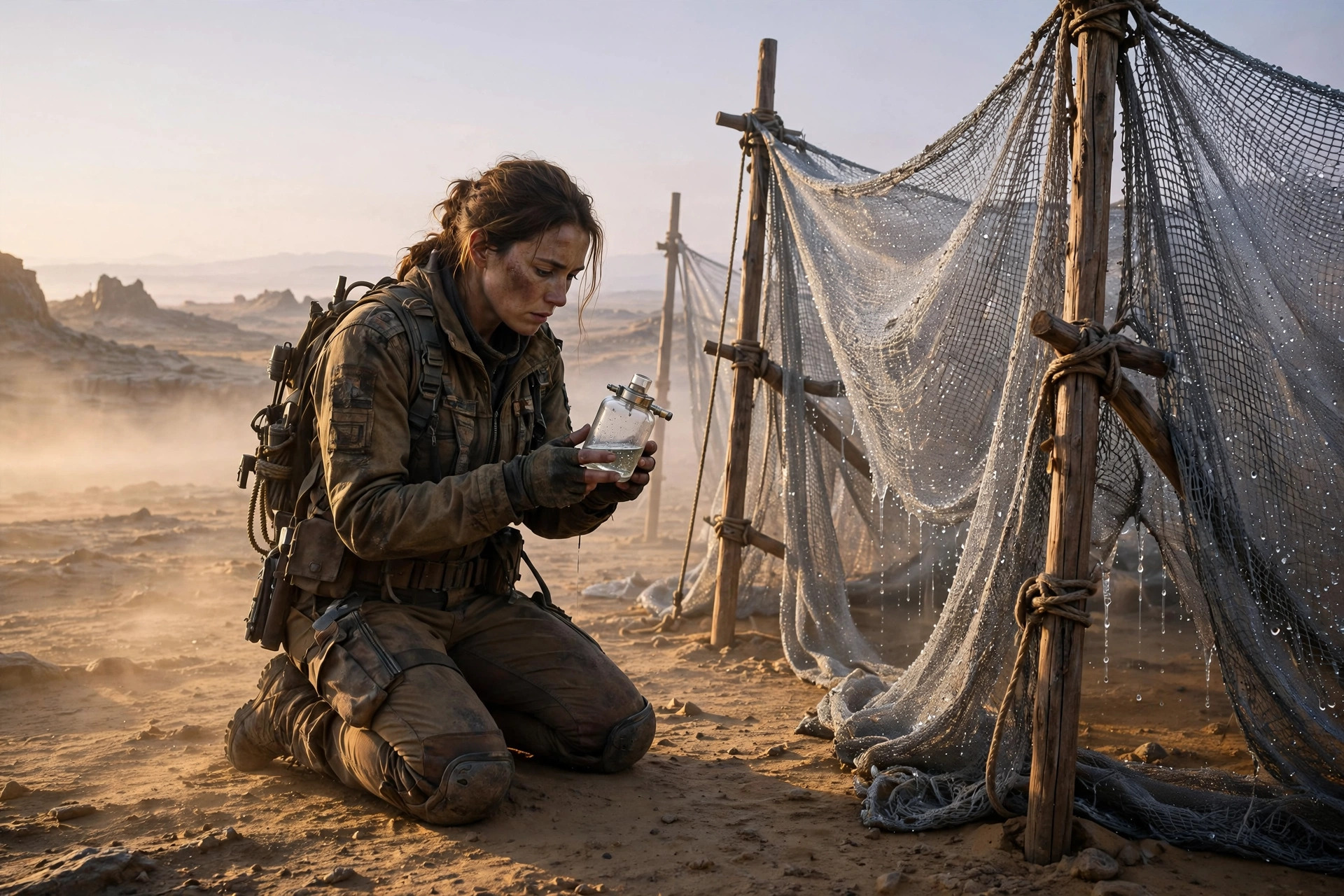
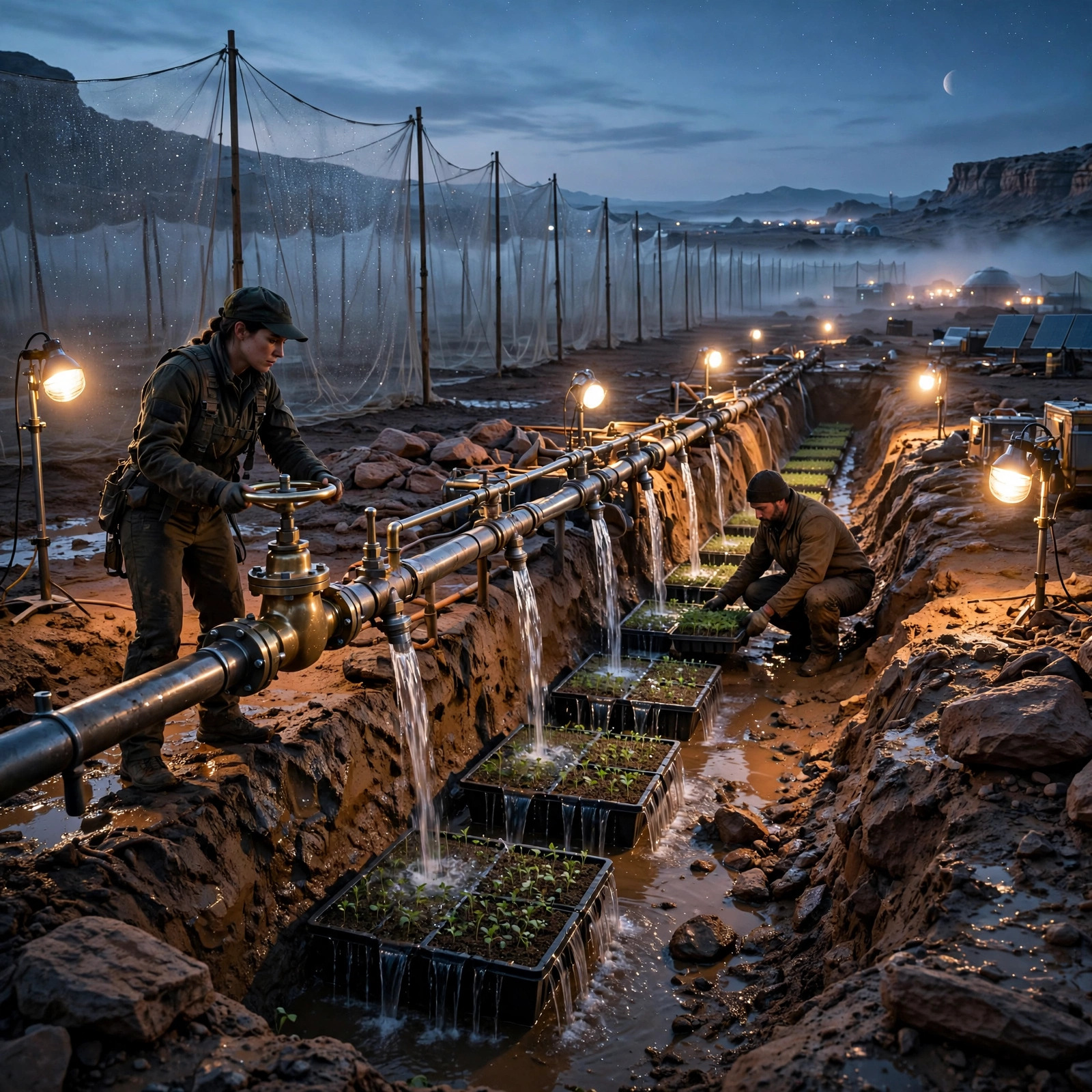
Sabela Reyes was on the north fields before the sun cleared the eastern rim, because the dew would not wait for her. Sixty fog nets stood on their cedar masts along the slope, each one a woven polymer sheet gone silver-grey with a night's catch, and the collection sumps beneath them read low. She knelt at the third mast, thumbed the sight glass, and wrote the number in her field log with a pencil stub she had sharpened that morning: four liters, where eight belonged. The air was too dry for the season. It had been too dry for nine seasons.
Behind her, the plateau came up gold and thin, the color of dust that had not yet learned to hold itself down. She had a name for the thing she was trying to teach that dust. Kettlerose Commons, the charter said. Home, said the people in the domes along the rill, all two hundred and some of them, and it was Sabela's work to make the word true.
"Net eleven's torn," Fik Adeyemi called from halfway down the line. He was up a ladder with a spool of patch cord slung across his shoulder, twenty-nine years old and five of them spent on these masts, so that he moved on the rigging like a man walking a hallway in his own house. "Wind-load rip, low corner. I can mend it before noon."
"Do that, and log it." Sabela capped her pencil and stood. Out past the nets, the horizon shimmered where the sky met the regolith, and above it all the air sat thin and pale, a wisp of what a sky ought to be. She had stopped thinking of pressure as a number years ago. She thought of it as a weight she was owed, and had never been paid.
She walked the line anyway, mast by mast, reading the sumps. Eleven liters, nine, seven. The night's harvest across sixty nets came to something under four hundred liters, and the greenhouse benches would drink twice that by dusk. The ledger in her head ran on its own by now: fog nets in, drip lines out, the cistern behind the seed-vault shed standing between the town and any dry month it could not survive. Twenty-two days of water. That was the whole margin. She had counted it so many times the number had worn a groove.
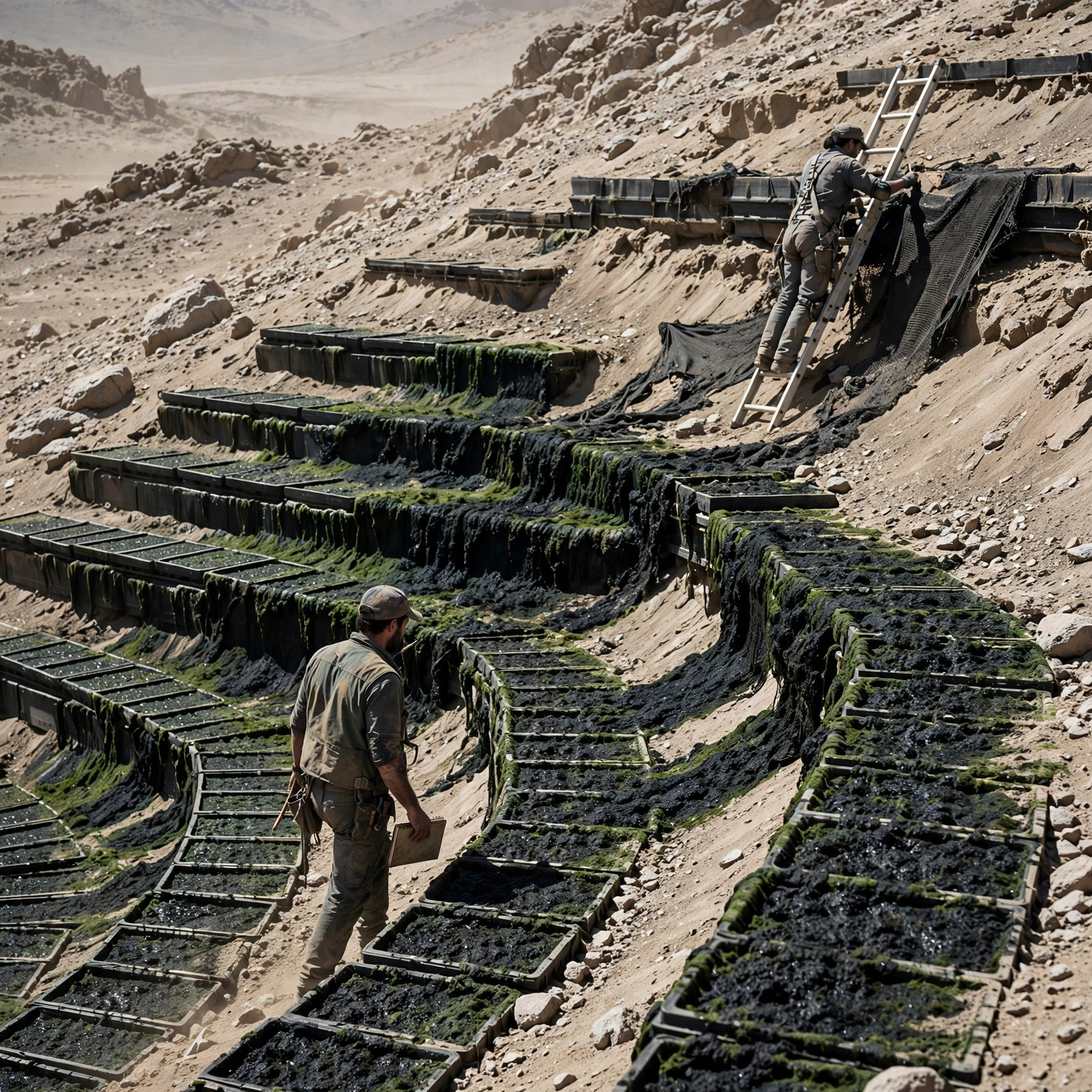
The proof trench lay south and east, down the shallow draw at Rill Eight, where the ground broke into terraces of packed fines and the commons crews had spent nine years laying down trays. She went down the draw with the sun climbing at her back, and the trench opened ahead of her like a long scar that had chosen to heal green-black instead of raw.
Four hundred plates. She walked the rows with her hands clasped behind her, because if she let them hang free she would touch every tray, and the film did not want her hands. It wanted the drip lines, the fog catch, the slow mineral rain the condenser fed it, and above all it wanted to be left alone to do its work. Cryptobiotic film, the engineering papers called it, colonies of engineered crust on trays of recycled ceramic and basalt fiber, and it had taken Sabela and her crews season after season to cast them, seed them, and carry them down into this trench one row at a time.
Under the film, the trays held a root zone. Fog-fed mycorrhizae ran through the fines like a nervous system, stitching the plateau's dust into something with structure, something that shrugged at the wind instead of surrendering to it. Nine years. The oldest trays were dark and dense now, firm underfoot, and the shallow wells the commons had sunk along the rill drew from water that film and roots had caught and kept, water that a bare plateau would have flashed to the sky and lost.
She stopped at row forty and crouched. The drip line nearest her ticked its slow metered feed onto the tray, and the film drank it with a patience that was the whole point of her life's work. This was the argument she had been building for sixteen years, and it fit in a trench: it could be walked, measured, weighed, photographed. It could be shown to an assessor. It could not be rushed, and it could not be faked, and some mornings, like this one, she loved it so plainly it embarrassed her.
"Steward." Fik's voice came down the trench from the gate end, flat in a way she had learned to read. He was not calling about net eleven.
She went to him. The trench gate was a cedar frame with a hand-lettered sign, RILL EIGHT, PROOF TRENCH, NO BOOTS ON TRAYS, and nailed to the post of it, square and fresh, was a printed notice on company stock. Fik stood in front of it with his hands at his sides, not touching it, as if it were hot.
"It was here when I came down," he said. "I didn't bring it."
"I know you didn't." She worked the nail out with the short pry bar she carried for the tray lids, and the paper came free into her hand. The seal across the top was Halyard Deep's, the crossed bit in a circle, and beneath it the heading ran in the plain officialese she had learned to parse the way she parsed mineral assays.
She read it standing in the gate's shadow, and the morning went quiet around her.
FAST-CRACK WITHDRAWAL PERMIT, it said. PROSPECT RIG NINE, TEST PAD, KETTEROSE PLATEAU. THERMAL WITHDRAWAL OF CONFINED CAPROCK ICE. The number sat in the middle of the first paragraph, set out in full, as if the company were proud of it: thirty thousand cubic meters of ice per day, flashed to vapor and vented to the atmosphere.
Thirty thousand. She stood still and let the figure settle against everything she knew. Sixty nets caught four hundred liters on a poor night. A good night, a thousand. The trench drank its metered gallons. The town drank its tons. And Halyard proposed to throw thirty thousand cubic meters of water at the sky every day, to buy a few fractions of a millibar, to make a cloud the orbiting cameras could photograph, and to do it fast, because fast was the only language the company had ever spoken.
"What's caprock ice?" Fik asked, reading over her shoulder. His voice had gone careful.
"The layer under us." She kept her own level. "Below the fines, below the film, below the root zone. Confined ice in the caprock. It's the floor of our wells, Fik. It's been holding the water table under this rill since before anyone dug here, and it's under everything we've built." She turned the page over. The back held the schedule, and the schedule was the part that mattered: posting to review, forty days, with the review to sit on the plateau itself, before a charter assessor, on the question of the commons' air subsidy.
Forty days. She looked down the trench, at four hundred trays of green-black film drinking their slow feed, at nine years of work that had raised the local humidity a whisper and the water table a few honest meters, and she understood with a cold clarity what the notice was for. It was not addressed to her. It was addressed to whoever would sit in the assessor's chair: here is a pressure plan that works in weeks, and there is the commons' plan, which works in decades. Choose.
"They can't vent that much," Fik said. "Not under the plateau. Not under the wells."
"They can if the permit stands and nobody answers it." She folded the notice along its creases. "Who nailed this up?"
"The rig crews run the pad road past the gate. I saw the truck yesterday, going up." He hesitated, and she watched him decide whether to say the rest. "Corin was on it. He had a steel box on his knee, sealed, logged. I asked him what was in it and he said probe cores, and then he said to leave it."
Sabela looked up the draw toward the test pad road, where the dust of yesterday's truck was long since settled. Her brother had come out to this plateau three years ago for the medical credits, because the company's plan would pay for the dust-lung treatment he had started after his first season of unprotected drilling, and she had learned in those three years to take what he gave her and not ask for the rest. A sealed box. Probe cores. She set it aside in her mind, the way she set aside a number she could not yet use.
"Fik." She held out the folded notice. "Read the withdrawal rate again. Thirty thousand a day. Then tell me what our fog catch was this morning."
He read. His mouth moved through the arithmetic. "Four hundred liters."
"So their day is our season." She took the notice back, and her hands were steady, which surprised her, because the rest of her was not. "And their vent sits under our root zone, and our root zone is the only proof we have that a person can live on this plateau without a dome over them. That's what's under those trays, Fik. That's what the assessor is coming to weigh."
"Can we answer it?"
"We can answer it or we can lose the subsidy at the review, and if we lose the subsidy, the condenser and the nets and the trench all get expensive in one season." She said it flatly, because it was flat. The air subsidy was the commons' spine. Without it, every liter she poured became a liter the town could not afford.
She walked back to the gate post, took her field log from her hip pocket, and opened it to the morning's page, where the dew numbers ran in her own cramped hand down one side. Below them she copied the permit off the folded notice: the prospect name, the rig number, the withdrawal rate, thirty thousand cubic meters per day, and the permit number itself, a long string of company digits she transcribed twice to be sure. Then the schedule line: review on the plateau, forty days out.
She wrote nothing else. There was nothing else she could prove yet. What she had was four hundred trays of living crust, a torn net, a thin dew catch, and one brass valve behind the seed-vault shed, freshly brazed, that metered the only reserve the commons owned.
"Mend net eleven," she said, and put the log away. "Log the catch. I'm going to the seed-vault shed."
"To count the cistern?"
"To count the cistern." She was already walking, up out of the trench and onto the open plateau, where the wind moved thin over ground her film was slowly teaching to hold. Twenty-two days of water stood back of that shed door, and she knew before she reached the door what she would find, and she went to count it anyway, because the count was the only card she could see in her hand, and she meant to know it to the liter before she had to play it.
Rig Nine
The pad announced itself before she saw it. Eight days of heavy haulage had printed a new texture onto the plateau, haul roads pressed into the film crust, and this morning the print was gray with drill fines, the first dust Sabela had seen rise off ground her crews had spent nine seasons teaching to stay down. She stood at the boundary stake with Fik beside her and watched the derrick of Rig Nine go vertical against a sky the color of old tin.
"That's a spud," Fik said. "They've actually spud it."
She could hear the rig now, a diesel-thick mutter the thin air carried badly, arriving in strips when the wind shifted. On the pad, men in company orange walked the cellar beams. A crane swung the first casing joint across the skyline and menaced it down into the hole, and somewhere under all that steel, four hundred meters down, the crown of the caprock waited, sealed and cold, full of ice that Halyard Deep proposed to hand to the sky.
Thirty thousand cubic meters a day. She had done that arithmetic every night for eight nights, lying awake, turning it against the fog nets. Sixty nets, taut, catching their dawn condensate. A good morning gave four hundred liters. So their day is our season. It was in her log now, copied twice, and Rhea Ostergaard was in her log too, the name off the permit posting, and here was the woman herself, coming across the stake line on foot with a tablet under one arm, dressed plainly, hard-hat under her elbow rather than on her head, which Sabela supposed was a kind of manners. Company manners. The last mile of atmosphere between the town and the pad belonged to nobody, and Rhea walked it like a landlord.
"Steward Reyes." She offered her hand. Her glove was off. Sabela took the hand because refusing it would have been theater, and theater was expensive. "Rhea Ostergaard. I'd have come to the commons first, but my calendar came with me from the coast."
"So did your rig."
"So did my rig." Rhea looked past her, up the slope toward the town and the north fields, where the nets stood in their guyed ranks, sixty of them, small from here, patient, catching dew in quantities a stranger would laugh at. Something crossed her face that was not quite apology. "It's a good operation. I read your filings. Nine years of film work. I want you to know I read them carefully."
"Then you know what sits above your crown."
"I know what your filing says sits above my crown. A root zone. Biofilm, mycorrhizae, engineered fines." Rhea said the words neutrally, a recital, and Sabela felt her own jaw set. Neutral recitals cost nothing. "I also know what the Meridian Charter Office is asking this year, because I've read the docket and you haven't. The review is on the plateau in thirty-one days. Your subsidy comes up against new benchmarks. Visible pressure gain, steward. Measured, on instruments, by the assessor. Your film raises air pressure by fractions of a percent per decade. Am I wrong?"
"No."
The word came out before she could guard it, and Rhea received it the way you receive change for a bill you knew was exact.
"I didn't think so. Thirty-one days, and your plan can't show the office a number. Mine can. Flash-vent the caprock ice, one season of controlled withdrawal, and the plateau gains measurable millibars inside the review period. Clouds, even. The first clouds this basin has ever held. That's a number the assessor can carry home, and it's a number the town can stand under. If the review finds no pressure gain, the subsidy dies, and then your film, your nets, your trench, all of it runs on town funds that don't exist. That's not company talk. That's arithmetic. You know it better than I do, I think."
She did know it. That was the trouble with Rhea, and Sabela had understood it somewhere around the second night of doing the arithmetic: the woman was not lying. She was not even spinning. The fast-crack plan was a real answer to a real question, the only question that mattered to the Charter Office, and it would work, in the way a tourniquet works. Cut the vein, read the pressure, file the number. What it did to the body above was a footnote the docket would not carry.
"And the root zone sits on your caprock," Sabela said. "Your footnote is my town's crust."
"Your root zone is a meter of dust and fungus on top of four hundred meters of ice that belongs to the charter basin, and the basin is entitled to its pressure budget. That's the law we're all standing under, including you." Rhea paused. Behind her the rig coughed, caught, and settled into its turning. "I'm not your enemy, Steward. I'm the only person on this pad who's read your filings twice. Which is why I came out here instead of waiting for the review."
She turned the tablet toward Sabela. On the screen, columns of probe data, hole designations, depth runs, recovery percentages. The company's season of cores, the whole picture of the ground under the pad, laid out in her sight.
"Joint inspection," Rhea said. "You, me, your technician if you like, my logs open on this screen, walked hole by hole. Whatever you find, you file it or you don't, that's your business. But you'll have seen what we've seen, and if you're going to stand up at the review and tell the assessor our withdrawal is unsafe, you'll say it knowing the ground. I'd rather you knew it."
It was, by any honest measure, fair. It was more than fair. It was a door held open, and Fik shifted beside her, and Sabela felt the pull of it, the pull of data she had no other way to reach, eight days of being blind while a rig ate its hole.
She looked at the tablet. Then past it, across the pad, to where a man in company orange stood at the drill string tally board, chalking numbers, and did not look at her. Corin. Her brother stood with his back half-turned and his helmet down, and he had not come to the stake line once in eight days, and he had been in the town three years and on that pad three years and had not once in those three years failed to find her at a fence.
"Fik," she said quietly, "go walk the low nets while I finish here."
Fik went ten paces and stopped, pretending to check a guy line, and she heard him anyway, low, addressed to the mast: "Half the shareholders are wobbling. Half. Delgado, the Ostermans, the whole east terrace. They've done the same arithmetic she just did, and none of them ever once dug a trench." He spat into the dust. "Money wobbles first. Ground doesn't."
Rhea's eyes followed him. "Your technician thinks we bought the town."
"My technician thinks the shareholders are counting millibars and nobody's counting liters. He's not wrong either." Sabela turned the problem over once more, the way she turned a soil column in her hand, feeling for structure. The logs. Eight days of blindness. There was ground under that pad she would never otherwise see, and the review would come whether she had seen it or not.
And the offer came wrapped in the one thing she trusted least: a person. Filed numbers, posted notices, metered water, that was her country. Data walked through a company tablet with a company manager's finger on the scroll was testimony, and testimony was a thing you cross-examined at a hearing, on the record, with the assessor listening. If the probe logs were clean, they would show it at the review. If they were not clean, then a joint inspection meant she had looked at them early, with Halyard's manager standing over her shoulder, and every question she asked afterward would arrive pre-answered by the fact that she had already had the company's answer.
"No," she said. "I appreciate the offer. I decline it."
Rhea's eyebrows rose, patient, unhurried. "You'd rather be surprised?"
"I'd rather the record stand where I can see it. If your logs matter, file them with the review. Mine are already filed. The trench is metered, the plates are photographed, the catch is logged every dawn to the liter, and it's all public, all of it, every number the commons has." She heard her own voice go flat and let it. "The trench will speak for itself. It's been speaking for nine years. It doesn't need my help, and it doesn't need yours."
For a moment something moved behind Rhea's face, quick and real, and Sabela recognized it because she had felt it herself, at fences, at hearings, on the mornings the dew catch came in thin: the flash of a person watching a door they held open get looked at, and then shut, from the other side.
"Nine years is a long deposition," Rhea said. She closed the tablet. "Thirty-one days is shorter. If you change your mind, my office is the gray trailer by the water tanks, and my door's open until spud-out. After that we're all just standing around a hole, watching." She put her helmet on, plainly, a woman going back to work, and walked onto her pad.
Sabela watched her go, and the rig turned, and off at the tally board her brother chalked his numbers with his back to the boundary, and the wind off the east rim moved the dust of the haul road, her dust, the film's dust, a thin gray breath off ground that nine years of her life had been spent teaching to stay exactly where it was.
"Nine days," she said to Fik, coming up beside him at the guy line. "That's what we have, if the trial is going to say anything the assessor can hear. Nine days to put water in that trench and keep it there, at trench scale, on their instruments, before I file a word of defense. That valve you brazed had better hold every liter I give it."
"The valve will hold," Fik said. "It's the town I'm worried about wobbling."
"The town can wobble. The trench has to stand still." She looked up the slope toward the seed-vault shed, small and pale above the north fields, where twenty-two days of clean water sat metered behind a brass wheel. "That's the whole card, Fik. If the film holds water in front of their instruments, we have a defense. If it lets the water shear the fines, we have a season, and then we have nothing."
"And if it holds?"
"Then I go to the review with a trench full of the town's own water and a crust that's alive and standing, and I say: come weigh us. That's all I've ever had. I mean to have it on the record before they cut the caprock."
Behind them the rig turned, and the casing went down, and the ground under the commons kept its counsel, and Sabela walked up the slope to count what she had.
Salt Rain
The vent went at first light, and by mid-morning the sky over the north fields had a ceiling to it, the first ceiling Sabela had seen over Kettlerose Commons in nine years of mornings. It was not a cloud the way the textbooks meant the word. It was a gray-brown smear with a bright rim, thrown up when Rig Nine cracked its test interval and let a slug of confined brine flash off the caprock into the thin cold air, and the air, which had never been asked to carry anything, carried it anyway, a slow fat feather drifting downwind over her fences with the sun behind it like a badge.
Fik saw it first from the guy lines and called it in plain words, no radio code, just his voice across the yard: "Sabela. It's coming north."
She was at Rill Eight with the morning's drip readings in her hand, and she looked up, and she knew before she finished looking what a plume of flash-vent brine did when it drifted. It did not rain here. There was not enough air to rain. But what the plume carried, it dropped, and what it dropped was salt and fines and hot mineral water in a fine cold mist that fell the last hundred meters like the ghost of rain, and it fell on her north fields, where the fog nets stood, and on the upper rows of her proof trench, where four hundred plates of living crust sat seeded in their trays with their biofilm nine years in the making.
"Covers," she said. "Now. Everything in the top twelve rows, tarps over it, and weight the corners."
They ran. She sent two hands to the shed for the sheeting and took the trench herself at a jog she would pay for by evening, and they got tarps over the northern rows while the ceiling came on, and it was not enough, and she knew it was not enough while she was still pulling the line to tighten a corner. The mist came down with a hiss on the tarps and a silence on everything else, and where the sheeting gapped, where the wind got under a seam, it found the trays.
The burn showed by noon. She knelt in the row with a hand lens and watched the film die in front of her, not in flame, nothing so quick, but in the way cryptobiotic crust dies, the sheen going chalky, the engineered filaments that bound the fines bleaching white and then crumbling at a touch, salt crystallizing in the weave like frost with the sun on it. The brine had come down dilute and cold, mostly water, and that was the cruelty of it: the water was a gift and the salt was a knife, and the plates could not tell them apart.
"How many," Fik said behind her. He had a tally slate in his hand and salt already caking the east rows of his nets behind him, sixty masts of woven polymer gone white-tipped where the mist had reached, and he had not stopped to mourn them yet, which she noted and filed away as one more debt this day was running up.
"Counting now." She walked the rows with the lens and the slate. It took her two hours, because she counted twice, because a number this size deserved a second count and because she did not trust her own eyes to say it once. When she had it she sat back on her heels in the row and said it to the trench, to the film, to the day. "Ninety-six."
"Ninety-six of four hundred."
"Ninety-six that the salt got past the tarps on. Burned through. The film's dead down to the substrate, and the substrate's crusted with salt." She turned a tray over in her hands and the dead crust came off it in gray flakes onto her boots. "You can't reseed onto that. You have to wash it first. Wash it, leach the salt out of the fines, recast, reseed, and then it's weeks before the film knits enough to hold anything."
"Weeks you have," Fik said, and then he heard it himself. "You don't have."
"Twenty-seven days to the review." She had done the arithmetic standing in the row, and it did not improve with saying. "The assessor lands on day forty. If those rows are dead on the day the instruments come out, the trench shows a quarter of its crust gone, and I stand there with a trench that's a quarter of a lie."
He was quiet, working his own arithmetic, and she watched him get to it. "The leach water," he said. "You'd have to take it out of the cistern. The seed vault. That's the town's drinking reserve."
"It's the only metered clean water on the commons, and it's twenty-two days of it, and it's mine to spend or not spend." She stood and brushed the dead film off her knees. "Six days of flow would flush the trays and carry the salt down through the fines. I've run it. Six days at trench volume, metered through your valve."
"Six days off twenty-two."
"Leaves sixteen."
He looked at her the way he had looked at the plume, like a man measuring something that was already falling. "The town drinks from the well fields. The town doesn't drink from the cistern. But if the well fields ever falter, that cistern is the whole margin, and you'd be spending it on trays of moss."
"On the proof," she said. "The trays are the proof."
And that was where they left it for the moment, because there was triage to do, and triage was physical: dead trays out of the northern rows and stacked, burned substrate dumped to a spoil row, live trays shifted south and double-tarped, and the mist still coming down all afternoon in fits as the vent on the pad cycled through its test program, and every time it cycled, a gray feather rose off the east rim and drifted at her, unhurried, like something that had nowhere else to be.
Corin came over the boundary line at the gray end of the afternoon, when the light went long and the mist had thinned to a haze that stung the throat. She heard the cough before she saw him, a dry tearing sound she knew from the pad, from three years of hearing it through the fence on shift changes and pretending it was dust and nothing else. He came up the trench path with a sealed steel box under his arm, the core box, logged and latched, the kind of box that rode in the cab of a foreman's truck and never in the bed, and he stopped at the trench gate and stood there with the box held against his ribs like a man carrying something he had not decided the weight of yet.
"You're burning film," he said. His voice was ground down. "I could smell it from the haul road."
"That's salt, not burning. Ninety-six trays dead, and the east nets caked, and your rig up there making weather at us every ninety minutes." She did not soften it. "What's in the box, Corin."
"Cores." He shifted it against his side. "Probe cores. It's my job to carry them."
"It's your job to carry them where?"
"To the site office." He looked past her down the rows, at the tarps, at the stacked dead. "Sabela, I can't."
"Can't carry it to the site office, or can't tell me what's in it?"
He coughed into his shoulder, long enough that she put a hand out toward him and he waved it off, and when he had his breath he said, "I can't talk about the probe logs. Not with you, not standing here. That's not me choosing Halyard over you. There's things I know I'd lose if I said them, and I'm already paying down one debt I can't shift." He set the box down on the gatepost, carefully, both hands, like it was heavier than steel. "I came to tell you the vent's cycling longer tonight. They're running a pressure series after dark. Your mist is going to keep coming down. Get your covers tight."
He picked the box back up and turned, and she let him get three steps before she said his name, and he stopped but did not turn all the way, half toward the pad, half toward her, the box between them in his arms.
"Third time I've asked about that box," she said. "You get one more before I stop asking and start guessing."
"Guess, then." He said it tiredly, without heat. "You were always better at guessing than I was at lying. But don't make me choose tonight. Please."
And he went, coughing his way up the haul road toward the lights of the pad, and she watched the box go with him, sealed, logged, riding against his ribs where he held it out of the dust, and she thought: he carries that thing like it's a lung.
She did not sleep, and neither did the crews. The pressure series ran until midnight, and the plume came down silvered in the floodlights of the rig, and the tarps snapped and cracked under the mist, and there was a leak in row six they caught at two in the morning by lantern, a seam the wind had worked open, and eleven more trays gone by dawn. She spent the small hours at the seed-vault shed with Fik, cracking the brass valve a quarter turn at a time into the header line, metering leach water onto the burned trays by hand, flushing salt down through the recast fines in the dark, one tray at a time, and the cistern gauge, which she had read every morning for nine years the way other people read a tide table, came down as she watched: twenty-two days, twenty-one, twenty, and by the gray dawn nineteen, eighteen, and the water ran clear off the trays and took the salt with it and went into the ground where the fines swallowed it, and nothing came back.
At dusk on the second day of it, when the pressure series had ended and the plume had thinned and the rig stood quiet and tall against the afterlight, she walked the northern rows alone with the tally slate and counted what was left. Three hundred and four trays alive. Ninety-six recast and reseeded under fresh tarps, flushed with six days of the town's margin run through Fik's valve and into the ground, the film on them no older than a green thought, weeks from knitting, weeks from holding anything, and the assessor twenty-seven days out with instruments that would read exactly what stood in front of them.
She stood in the burned rows at dusk with the dead film still gray on her boots, and she counted the trays one more time by light she could barely see by, and the arithmetic came out the same in the dark as it had at noon. The trench could no longer speak for itself in time. Nothing she had growing would say a word the instruments could hear before day forty. The only mouth she had left with anything to say in it was the cistern, sixteen days of clean metered water behind a brass wheel, and the sentence it could say was the one she had been refusing to say since the permit went up on the gate: spend me, all of me if you have to, and put the proof in the ground by hand.
She looked up the slope at the shed, small and pale above the salt-caked nets, and she took out the slate, and she began, by lantern light, to draw the header lines for a flood she had never budgeted for, row by row, down the length of Rill Eight.
The Core Box
The night after the last of the flush water soaked in, Corin came down off the pad in the gray hour before the second shift, carrying the box.
Sabela saw him first as a shape against the fog line, then as her brother, walking the haul road with the scarf doubled around his face and the steel case hugged against his chest like something that might spill. Fik saw him too, from the shed door where he was metering the condensate line, and set his slate down without a word.
He came into the shed. He put the box on her workbench, between the seed tally and the brazing iron, and stood there with his hands flat on the lid.
"You're off shift," Sabela said.
"I told them I had a cough appointment at the clinic." He pulled the scarf down. He looked thinner than the last time, in the way the sick get thinner, in the wrists. "I do, at noon. This will take less time than the appointment."
"Fik," she said, "give us the shed."
"I can check the east rows--"
"Fik."
He took his slate and went out, and pulled the door to, and the shed went quiet except for the tick of the coil cooling and the slow breath of two people who had not been alone in a room since the spring before their father died.
"Say it," she said.
"Three years ago," Corin said, "when I signed on with Halyard, you asked me why. I told you the wages were good and the commute was short and you'd already taken the commons job so somebody in the family had to be liquid." His hands had not moved off the lid. "The wages were nothing. The medical credits were everything. My lungs were already failing then, Saba. I'd drilled one season without a respirator because the respirators were rationed and I was young enough to be stupid. The inhalation therapy runs four hundred credits a month. The deep plan is the only employer on this world that pays that kind of credit against dust-lung, and they pay it for exactly as long as you're useful to them, and the day I stop being useful, it stops."
She stood very still. Nine years she had run the crust, and for three of them her little brother had been sleeping in a Halyard bunk and drawing a Halyard wage, and she had let herself believe it was pride or stubbornness, and it had been neither. It had been breathing.
"You could have told me."
"You'd have tried to carry it. You'd have found the four hundred somewhere, and I know exactly where, and I wasn't going to let you water down the seed vault to keep my lungs wet." He tapped the lid once, softly, with two fingers. "So now you know what this box costs me. Because of what's inside it, my employment ends the moment they learn I let it out of my hands. Medical credits, position, pension shares, the lot. And you should also know that I thought about that for two full days before I drove down here tonight, and I'm not a better man than I appeared, I'm just out of worse options, so don't make me noble in the record."
"Open it."
He broke the seals with a cockpit key, four turns, and lifted the lid.
Inside, in steel sleeves, lay the probe cores. He laid them out under the bench lamp, one by one, in stratigraphic order, top to bottom: soil, film-line, root zone, caliche, then the caprock itself, the blue-gray ice-bound stone that the whole slow plan sat on. Every sleeve was labeled with a hole number and a date. The dates ran through last season. The holes ran under the commons.
"Every one of these is fractured," he said. "Not jointed, not weathered. Fractured fresh. Look at the faces."
She looked. The core ends showed the breaks plainly, clean planes through the caprock with slight displacement, the kind of failure that comes from loading, not from time. She took one sleeve out and turned it under the lamp, and the light caught a slick of crystal growth along one fracture plane where confined brine had wicked up and frozen out.
"Probing shouldn't do this," she said. "Diamond coring doesn't load the formation."
"Coring doesn't. Frac sampling does. The probe program wasn't surveying, Saba. Not after the first four holes. After the first four they were pressure-testing the caprock on purpose, hydro-testing each hole to see if it would take fluid and give it back. That's the data Rhea's fast-crack model is built on. And it does take fluid, and it does give it back. Through these." He set the last sleeve down with the care of a man laying out evidence in a court, which she realized with a cold turn in her stomach was exactly what he was doing. "Eleven holes, all fractured, all connected, all under the commons. Two of them inside a hundred meters of your Rill Eight well field."
Sabela stood over the cores and did the hydrology in her head without wanting to, the way she had done hydrology in her head for sixteen years, whether she wanted to or not. Confined caprock ice under pressure. Fractures opening it vertically to the well fields above. Thirty thousand cubic meters a day flashed to the sky, and the drawdown would not stay in the caprock; it would come up through the fracture planes into the fines, into the root zone, into the shallow aquifer that the whole town drank from. The brine already in the fracture planes said so. The crystals on the core face said so.
"It wouldn't just stall the crust," she said slowly. "It would drain the wells."
"Inside one season. The numbers are in the probe logs and the logs are signed by Halyard's own crew, which is the only reason I'm allowed to still be standing here sweating. Their survey proves their fault. That's the joke, if you want a joke." He closed his hands over the edge of the bench, and his knuckles went white. "I've carried this box to your gate twice and up the haul road twice more and turned around three times, and tonight you get it because tonight you're doing arithmetic and I know it. Fik told me. The whole trench crew knows you're up here deciding something big. So decide it, Saba. Decide it with all of what's true in front of you."
She looked at the lamp, then at the slate she had been writing on, covered in the columns she had built since dusk: days of reserve, meters of trench, plate counts, the cost of a field-scale flood at Rill Eight versus the cost of walking into the review with a quarter-young crust and a paper argument.
"The relay takes three and a half hours one way," she said. "If I file tonight with the evening pass, the fault survey and a permit amendment land at the Charter Office before midnight their time, and the acknowledgment can't come back before dawn mine. Nothing arrives tonight. Whatever we put in that laser tonight is alone with itself until morning."
"Yes."
"And if I flood the trench at field scale, I put eight days of the seed vault in it. In front of the review, with instruments on it, no second chances, and if the film shears under load and lets the water go, I will have spent eight days of the town's clean water proving our own plan too fragile to defend."
"That's the cost," Corin agreed. "It's also the only way it's a trial instead of a letter. An amendment on paper, they read. A trench full of water holding on forty trays of film under a surveyor's meters, they remember."
She thought about Rhea, whom she could not honestly call a liar, standing at the pad fence with her clean arithmetic and her honest offer, saying: we can show you pressure gain in weeks, they can't show you anything in decades. All of that would still be true tomorrow. All of that would be true at the review, in twenty-four days, whether Sabela filed this survey or not. The core box did not make Rhea wrong about the air. It made her wrong about the water, and the water was the town's, and no one else in this argument was going to say so out loud.
"Fik!" she called, and the door opened before she finished the name, because he had never gone far, and he came in with the same speed he brought to a cracked coil at midnight. "Sound the crews. All of them, tonight. Ninety-six burned trays get re-seeded from vault stock before first light, the whole northern quarter, and I want the trench bunded to full spec, because at dawn we flood at field scale. Meter everything."
Fik looked at the cores laid out under the lamp, then at her, and she watched him understand it the way she had, in one pass, top to bottom.
"Eight days of the reserve," he said. "That leaves eight."
"That leaves eight."
"You'll be spending the greenhouse's whole margin on a trial that half the shareholders have already told you they won't sign."
"They haven't seen this box," she said. "Put the word out that they can, before the relay pass. Anyone who wants to read Halyard's own caprock survey can come up to the shed and read it. But Fik, the relay goes tonight either way."
He was quiet a moment. Then he took his slate, wrote the whole order out in his narrow hand, and left at a run.
She turned back to Corin, who had not moved.
"You understand," she said, "that when I file this, your name goes on the survey as source, and the moment it does, your credits stop."
"I did the hours on that, too." He shrugged one shoulder, a small motion, and coughed into the scarf, twice. "Saba, I have maybe five useful seasons of lungs left on Halyard's plan and maybe three without it, and either way I can still hold a seed tray. I'd rather spend what's left of me on the side that's keeping a water table." He slid the box across the bench to her. "It's yours. Log it, photograph it, chain-of-custody it, whatever the filing needs to survive their lawyers. I'll sign whatever you put in front of me."
She logged the box, sleeve by sleeve, photographed each fracture face with the shed camera under the lamp, and wrote the fault survey in the plain language the Charter Office asked for: observed fracture density in caprock beneath the commons, hydrologic connectivity to Rill Eight well field indicated by brine crystallization on core faces, request amendment suspending confined-ice withdrawal pending review.
By the time she had it written, the crews were coming up the dark slope, a dozen headlamps strung out along the haul road, and past them, more, half the town's shareholders walking up through the cold with their coats over their sleepwear, because Fik had not exaggerated, and the core faces under the lamp did in one minute what she had failed to do in a week of arguing. She watched them bend over the bench. She watched two of the wavering ones turn and say nothing at all, which from some of them was a signature.
She went out past them, down to the seed-vault shed, to the brass valve with the cedar wheel that Fik had brazed and she had held the coil for, and she took the wheel in both hands, and she opened it to the first stop.
The line filled. The trial trench, all four hundred trays of it, two hundred days in the ground and ninety-six of them new that night, began to drink.
Corin came and stood beside her at the headgate, scarf up, hands in his pockets, and together in the lamp-lit dark they watched the water run out along the seed lines, black on black, sound of it coming up off the wet ceramic to where they stood, and the vapor rising off the warm line into the cold. The relay pass went up from the mast at moonrise with the survey and the amendment and eleven photographs, and the acknowledgment, if it came, could not come before morning.
Eight days of clean water went down the trench into the dark, and the trench took it, and the filing flew, and there was nothing to do now but stand and watch, so they stood and watched, the water running, the young film drinking, the town's whole margin committed under the stars, and nobody anywhere in it able to tell them anything at all until daylight.
First Flow
The review convened at Rill Eight at first light, and Sabela had been awake for the last of the dark, which was true of nearly everyone standing along the trench gate. Naledi Quist came up the haul road in a charter crawler dusted gray to the roof line, nine years of reviews written into the creases around her eyes, and she stepped down onto the crumb of the trench path with her instrument case in one hand and no greeting until she had walked the first ten meters of the headgate line and put her palm flat on a wet tray.
"Forty days from posting," she said. "That's the window. Walk me through it while it's still true."
So Sabela walked her through it, and it was still true. The trench ran green-black down its full length, the film riding the trial water up the tray walls the way it had ridden the drip lines all spring, only now at flood depth, and the fines beneath it stayed put. Quist set her moisture sensors at nine stations, logged each one aloud as she went, and at every station the water sat where it had been put, held in the root mat instead of shearing through it. She did not say anything approving. She said the numbers. That was enough.
The core box sat on the evidence rack beside the gate, steel lids squared to the corners, logged exhibit by exhibit on day sixteen, and Quist had read the fault survey on the relay before she had ever landed on this side of the orbit, so she did not gasp over the cores; she only lifted sleeve number seven, turned it to the lamp, and ran a thumbnail along the brine crystal in the fracture face.
"Eleven holes," she said. "All connected. Two inside a hundred meters of the well field."
"Two," Sabela said.
"Your brother's hand on the labeling."
"His hand."
Quist put the sleeve back in its slot the way a person closes a door in a house where children are sleeping. "You understand what this costs him."
"He understood it first."
Rhea Ostergaard stood on her side of the stake line with her site tablet against her hip and her jaw set, and she did not interrupt the instrument pass, which Sabela had not expected, and which she did not trust. When Quist called the first break, Rhea came to the rack with her tablet already open on the withdrawal schedule.
"Before you rule on the permit," Rhea said, "I want something on the record. The fast-crack plan was not a raid. Thirty thousand cubic meters a day of confined ice, flashed to the sky, is a month of visible gain in a review window. That's the arithmetic I was given, and it's the arithmetic I defended, and the fracture survey is the first honest data anyone's shown me since I landed. I'd have pulled the vent plan myself if I'd seen these cores. That's not a defense. It's a grievance, and I want it logged."
"Logged," Quist said, and she wrote it, and Rhea stood there while she wrote it, and her shoulders did not come down until it was finished.
Corin had come up at dawn with the rest of the crews, coughing into his scarf, hands jammed in his pockets against the cold, and he had not once crossed the stake line all morning. Sabela went to him instead, inside the last hour before the ruling, and stood with him at the north end of the trench where nobody could hear them without walking over.
"Whatever she says," Sabela said, "you're done at the rig. You know that. The survey names you, and the survey's filed, and their lawyers read it eleven days ago."
"I know when my badge stops working," Corin said. "It'll stop working the moment she signs."
"The commons has a payroll line," Sabela said. "Drill-log custodian. Caprock monitor. It doesn't pay what theirs paid. It doesn't carry your medical credits."
"I know what it doesn't carry." He looked down the length of the green trench, all four hundred trays of it, and the vapor standing off the warm water into the cold. "Does it carry the therapy?"
"We'll get the therapy onto the town's ledger," Sabela said. "It'll take the winter. I'm not going to stand here and tell you it won't."
"Then I'll take it," he said, and it was the shortest surrender she had ever watched him make, and the only one she had ever seen him make without an argument folded up inside it.
At midday, Naledi Quist stood at the gate with the charter seal box open on the rack and read the ruling aloud, and it was not a rout in either direction, and everyone standing in the cold knew it within the first minute.
"On the permit," Quist said. "The open fast-crack vent is denied. Flash venting confined caprock ice to the atmosphere at the proposed rate is ruled unsafe on the evidence of the fault survey, specifically the demonstrated hydrologic connection between the probe fractures and the Rill Eight well field, which the colony cannot afford to lose. That portion of the application is dead."
Rhea's tablet came up off her hip and went back down.
"However," Quist said. "The applicant is granted a closed-loop withdrawal permit at a capped rate: four thousand cubic meters per day, drawn through sealed bore lines, no flash, no vent, all brine returned to the closed loop for processing. That is a real allocation, and I will hear it argued as one. Halyard Deep asked for thirty thousand a day of atmosphere and is granted four thousand a day of process water. If that is unworkable, the applicant may appeal the cap at the next review cycle."
"It's workable," Rhea said. "It's not what was promised to me. But it's workable, and I'll sign the acceptance, and I'll file the grievance I put on your record this morning."
"You'll file it," Quist said. "It's a fair grievance. That's why it's on the record."
"On the subsidy," Quist went on. "The Kettlerose air allocation is continued, at its current rate, on the strength of the trial data now in evidence. The review notes that the colony's atmospheric gain will be slow, metered, and seasonal, and that the town's own instruments, not projections, will be the proof at every cycle going forward. Nine years of biofilm crust and fog-fed root zone is not nothing. It is four hundred trays that held flood water in front of my instruments this morning. I ran them myself. I would trust them, and I have to say so in writing, so I will."
She turned the page. "On the water reserve. The commons shows eight days of seed-vault water remaining, against a baseline of twenty-two. The review also logs the recovery: sixty fog nets washed and re-rigged, feeding the trench manifold, and the rebuilt condenser rated at three days of cistern yield per day of operation. At that rate the reserve climbs from eight days, and the climb itself is entered into the record. I want the recovery logged at the next cycle. Not the number. The slope."
She closed the seal box. "On personnel. The source of the fault survey, one Corin Reyes, drilling foreman, is named in the record with his consent, and the review notes that his disclosure ended his employment with the applicant." She looked up and found him at the north end of the trench. "The office cannot compel a private employer to keep a man who did the right thing. It can note it did not. The commons payroll line named this morning, drill-log custodian and caprock monitor, is so noted."
Then there was signing, and there was filing, and there was the slow business of everyone discovering that nothing was over, that the winter still had to be gotten through on eight days of water and a climbing slope, that Rhea's crews would be back on the pad within the week sinking sealed bore lines under the new cap, that Quist's crawler would be down the haul road before dark, and that everyone standing in the cold had been standing in the cold for a very long time. Nobody cheered. Sabela had braced herself for cheering and was obscurely glad not to have to pretend it was earned.
Quist came down to the seed-vault shed with her case still in hand before she left. "Show me the recovery," she said. "You have a valve."
"We have a valve."
"I'd rather see the slope than read it."
Sabela put both hands on the cedar wheel. Fik was already at the manifold with the bleed key, and he bled the line first, crack and hiss, a small white breath of vapor off the fitting, then tight again, and he gave her the nod. She hauled the wheel through its full turns to the stop, all the way open, and the line surged and steadied, condensate running bright down the black of it toward the trench, and out on the north fields the washed nets stood beaded with the day's first dew, sixty masts of it, and the manifold took it and ran it down the slope with the rest.
Quist held her sensor to the line, watched it climb, and wrote the number without comment.
"The last tray's not in yet," Sabela said.
"I'll wait," Quist said, and she did.
The last re-seeded tray came up from the shed on a hand truck, one of the ninety-six burned ones, new film on fresh ceramic, and the hands that set it into its slot at the trench's north end had been re-seeding trays since the middle of the night and were gray to the wrist with dust, and they were Corin's hands, and nobody took the tray off him to make it easier. He seated it level, thumbed the drip nozzle clear, and stood back, and the trench ran green and whole in the flat afternoon light, four hundred trays, the count complete.
Quist photographed the tray. She logged it. She said, "Slope's on the record, steward. Keep it steep." Then she went down the haul road with her crawler's dust hanging behind her, and Rhea went down the other way to the pad with her acceptance and her grievance, and the shed was quiet, and the valve was wide open, and the water went on down the hill.
Get notified when new stories drop

Ren Hollis
Ren writes frontier worlds and terraforming triumphs — habitats, gardens under glass, and the first rain on a new world.
Leave a comment
Comments