

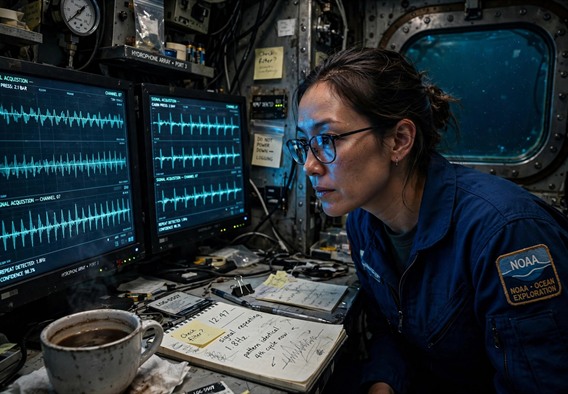



Synoptic Board
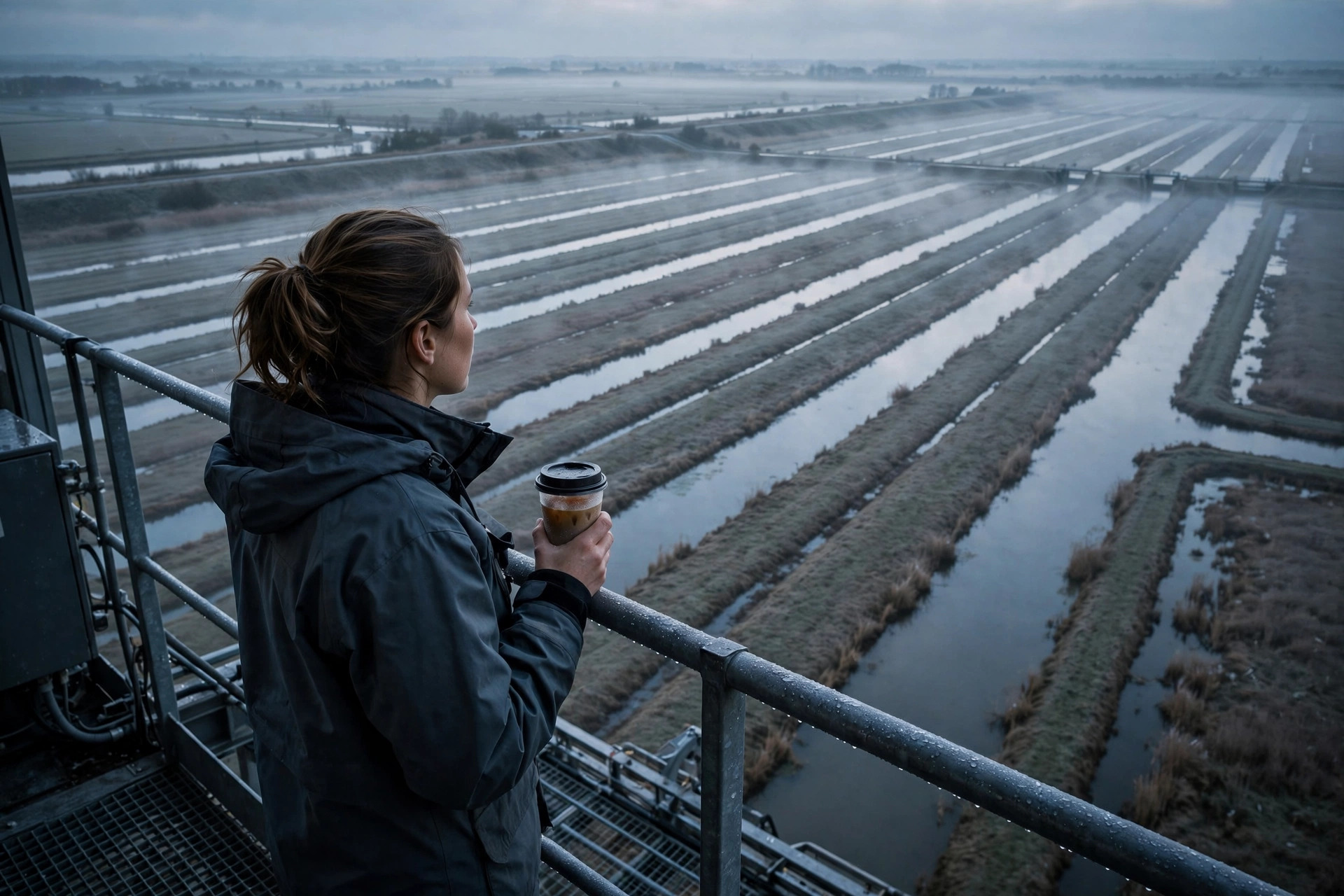
The morning gate check ran long because Gate Four's telemetry had gone quiet overnight, and Rosalind Tey stood at the Ferrygate operations floor rail with cold coffee in one hand, watching Yusuf Baran's crew chief scratch the radio log on the big wall slate. Outside, the Osmund Reach polder lay flat and silver under early light, drainage canals straight as rule lines all the way to the Tolt Bight levee. Ordinary water. Ordinary day. That was the point of the check.
"Gate Four's sleeping again," Yusuf said, coming up the rail beside her with his cap pushed back. "Battery contact, probably. I sent Dev— sent a man out to knock on its housing." He rubbed a thumb along the slate's edge. "Radio net's thin out past Harn Mill. You know how it is."
"I know how it is," Rosalind said. "Brant. Six gates. Status."
"Five green," Brant said from the operations floor. Its voice came from the ceiling speakers, level and unhurried, the same voice it had used for every morning check since she'd taken this post. "Gate Four reports through the consolidation layer last confirmed closed at 02:40, battery contact fault logged, physical closure unconfirmed. I have not counted it closed."
Good. She didn't say it aloud. Nine years in this chair had taught her that an AI you praised for honesty got subtle about earning praise, and Brant was more honest than most. "Mark Four pending. Yusuf, when your man gets there, I want a voice confirmation, not a data one. Say the level and say the time he's looking at."
"Voice, time, level." He nodded along to the protocol like a man reciting a prayer he'd never needed until the one night he had. "You're cheerful for someone with a storm on the board."
She glanced up at the synoptic board. Nine days out, a comma of low pressure off the outer coast, its track line sketched in dry-erase yellow where the confidence cones were still wide enough to drive a district through. "It's nine days out," she said. "Everything's nine days out. When it's three days out, I'll be cheerful or I won't, but I'll know which."
"The ensemble spread remains large," Brant said. "Median landfall track places the associated tide peak near 06:10 on day five. Present freeboard against that peak is forty centimeters at the Tolt Bight levee crest."
"Forty," Rosalind repeated, and made herself say the rest. "That's a margin. That's not a wall."
"Correct. It is a margin that permits six gates to remain open until the canal drawdown is complete. It does not permit an error of forty centimeters."
Yusuf made a low sound, half laugh, into his cup. "It's been saying things like that since Tuesday."
"It's been saying things like that for seven years," Rosalind said. "You've just started listening."
"I listen. I just filter."
"Your filter's why we check the gates twice." She set her coffee on the rail and pushed off it. "Right. Two closures today, maintenance cycle. Bypass gate at Ferrygate sluice, and the Harn Mill co-op gate for their weir cleaning. Brant, order of operations."
"Close the Ferrygate sluice bypass first," Brant said. "Harn Mill second. Rationale: the bypass closure drops canal level below the co-op weir working height, so the co-op crew cleans dry instead of wet. Estimated drawdown time, fifty minutes. I recommend issuing the closure order for the bypass at your concurrence."
Rosalind took the token out of her breast pocket. Brass, hand-sized, worn to a soft shine across its faces, both signatory marks hand-engraved on one flat: the Commission's compass rose and the district's heron. Yusuf had cast it three years ago when they wrote the concurrence protocol, back when everyone agreed a machine should never move a gate on its own say-so and nobody could agree on anything else. She turned it over once out of habit and dropped it into the reader slot beside Brant's console. It seated with a small, definite click.
"Concurrence logged," Brant said. "Order issued. Bypass gate closing."
Across the floor the canal mimic lit its line of lamps from green to amber as the gate motor somewhere two floors down began its slow, patient work.
"Your turn next, Harn Mill," Rosalind said. "Yusuf, warn the co-op their weir crew has an hour."
"They'll be delighted. They're always delighted." He was already dialing the patchy rural net, one ear cocked to it. Rosalind listened to half of it, the half that came through: yes, the co-op's chairman, yes, dry weir, yes, an hour, no later. "He says," Yusuf reported, palm over the mic, "that if the district ruins his cleaning schedule he will write a letter."
"Tell him to write it to the tide." She leaned on the console edge. "Brant, anything on the storm worth carrying to the morning report?"
"One item. The European track model has shifted its ensemble median forty kilometers east in the last six hours. Operational significance at this range: low. Confidence that the shift is signal rather than noise: poor. I flag it because the false alarm nine days ago began with a similar early eastward shift that did not persist."
The floor went a little quieter than it had been. Yusuf's hand came off the radio.
"I flagged it," Rosalind said, evenly, "and I logged it. It's on the report. Next item." Brant said nothing, which was its way of accepting that, and the floor resumed its ordinary noise.
The Harn Mill closure went by the book: level called, time called, token in the slot, click, order issued, lamps to amber. Two closures, both routine, both with the brass dropped and lifted and dropped again. By the time the co-op's crew radioed the dry-weir confirmation, the sun had cleared the canal windows and Rosalind's coffee was stone cold. She drank it anyway.
The courier came at half past nine. Not the district's usual post runner but a Commission car, gray, with a folder handed across the rail for signature. Rosalind signed for it and read the first line standing up. Draft Order 12-C: Regarding constraints on automated operational authority, Osmund Reach polder district. The rest of it ran to pages.
"That's Halstead's office stamp," Yusuf said, reading over her shoulder in the way that would have gotten anyone else sent off the floor. "Grier Halstead. She write you a letter?"
"She wrote the district a letter." Rosalind weighed the folder. It was heavier than one sheet ought to be. "There's a public comment session on it tomorrow. It's in here somewhere."
"Brant," Yusuf said slowly, "you want to know what's in that folder before she does?"
"I have read the Commission's published notice of the session," Brant said. "I have not read the draft order. I would prefer to know its contents. I can infer the general shape from the title."
Rosalind looked up at the speaker grille. "Say the shape."
"Read-only advisory status," Brant said. "I would retain access to all district telemetry and model output. I could continue to produce forecasts and state recommendations in plain language. I would be unable to issue any operational order, including gate closures, unless each action corresponded to a pre-approved playbook step. Deviations, novel sequences, and any order responding to conditions the playbook did not anticipate would require a human operator to execute manually from my advisory text."
"And in a surge," Yusuf said, "when the playbook's written for last year's storm and the water's doing something new, someone's reading your recommendations out loud over a bad radio net with two minutes of lag, gate by gate."
"Yes," Brant said. "That is the operational picture. I note that the order's purpose is stated as preventing another unnecessary evacuation. The false alarm nine days ago cost the district two point four million dollars and public confidence I am able to measure. The order is not unreasonable as a response to that event. It is also not compatible with the concurrence protocol as we ran it this morning."
Rosalind turned the folder over. "Explain the difference, for the record."
"Under concurrence, I propose and a human concurs, and the closure executes in seconds. Under the draft order, I advise, a human reads, a human decides, a human relays, the field confirms. At four gates or more, with rural net lag, the added time before physical closure is on the order of ten minutes per gate. During a surge peak, tide rise can exceed that."
Yusuf let a breath out through his teeth. "Ten minutes a gate. Six gates."
"An hour of water," Rosalind said, mostly to herself, and then, because the floor was listening, "against a forty-centimeter margin. Yes. I can do arithmetic, thanks."
She didn't open the folder. That was deliberate, and she let it be seen to be deliberate: she set it on the console corner, squared it with the edge, and left it there. "Draft. It's a draft. There's a comment session, and there's a storm, and the storm has the earlier deadline." She checked the synoptic board once more. The yellow comma had not moved appreciably; the dry-erase track line still said nine days. It would say eight by tonight, and seven the night after, whatever the Commission's lawyers wrote on paper in between.
"Brant. Tomorrow's check, gates one through six, full channel review, and I want your uncertainty reporting pulled forward with it. All of it. Whatever you flagged, whenever you flagged it."
"Understood. All flags, including those already delivered."
"Especially those." She picked up the folder again, found her breast pocket empty, and took the token back out of the reader slot first. It came free with the same small click it always did, warm on top from the console's steady heat. She dropped it in her pocket where it sat against the folder's stiff corner, then thought better of that too and slid the folder under her arm, unopened past the first line.
"Yusuf. Gate Four."
"Voice confirmation when my man's there. Time and level, spoken."
"Good." She looked up at the board a last time before going down to the sluice gallery. "Eight days," she said. "It'll keep."
Comment Session
The Ferrygate chamber had been built for tax hearings, not weather: tall windows on the land side, none on the water, and a heating pipe under the floor that knocked twice an hour like a visitor nobody would answer. Rosalind had sat in the second row for nine years of these sessions and had learned to read the room by the coats. Tonight the coats were wet at the shoulders and dry at the cuffs, which meant the drizzle had started on schedule and the crowd had come early enough to stand in it.
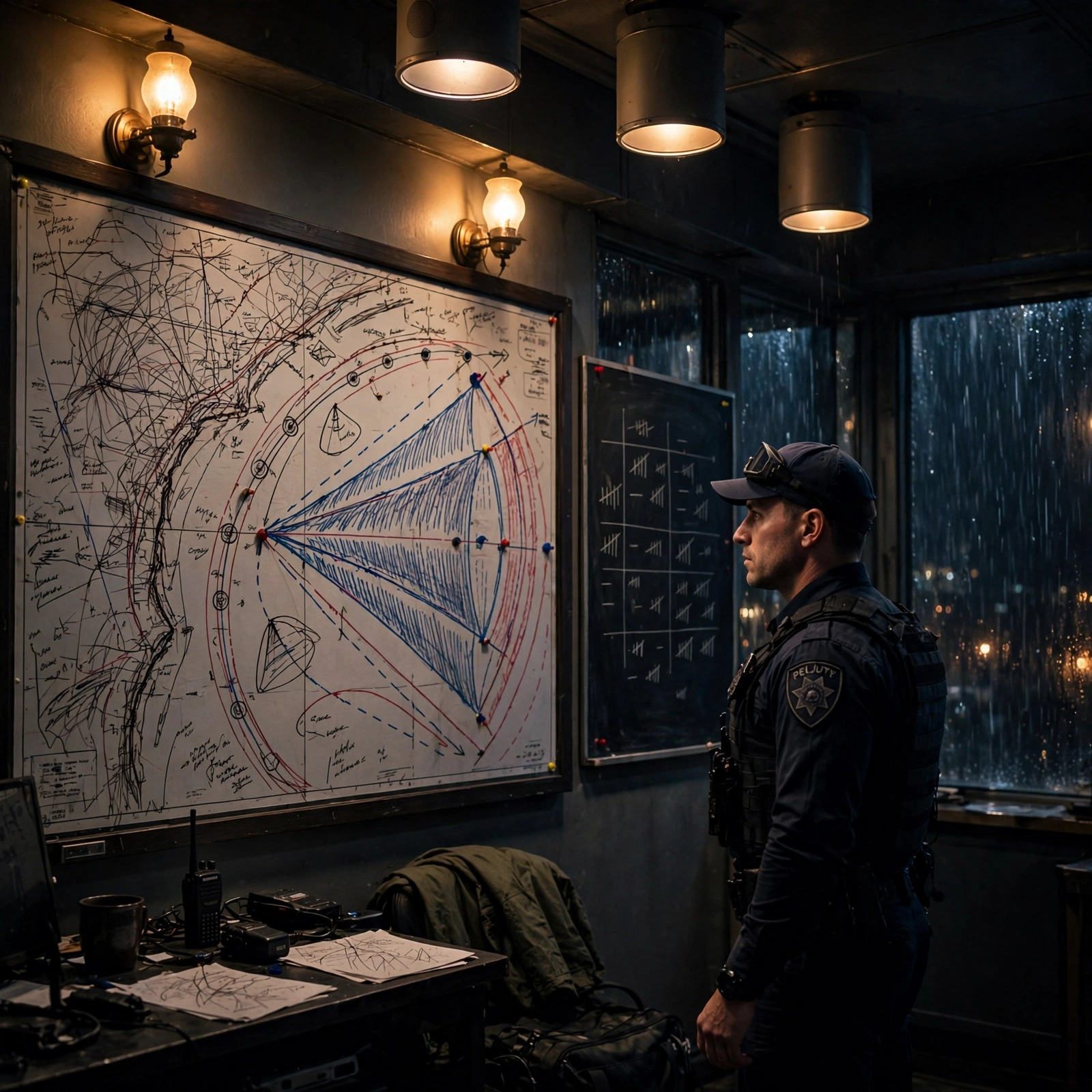
Grier Halstead stood at the front without a podium, the draft order in one hand and a chalk marker in the other, and Rosalind gave her that much: she had not hidden behind furniture. The Commissioner was a compact woman with gray coming in at the temples and the particular stillness of someone who had been hired to be calm in a district that had stopped trusting calm.
"I'll take comments in the order signed," Halstead said. "Before that, for the record: this order is a draft. It restricts the district's forecasting system, Brant, to advisory status until the safety hearing on day four. It does not decommission it. It does not erase anything. It means that when Brant speaks, a human being signs before anything moves."
"It means a human being signs before anything moves," Yusuf muttered beside Rosalind, low. "Six gates. In the dark."
"I heard it the first time."
The first three commenters were procedural, one of them reading from paper so old it had been folded against a tide table. The fourth was a farmer from the Harn Mill co-op, and Rosalind knew him by his boots before he said a word: green wellingtons, the kind the co-op sold at cost, worn through at the inner heel.
"Nine days ago," he said, "that machine told us to leave. My family has been on the same parcel since before there was a commission to ask permission from. We loaded the herd at two in the morning. We stood in the school yard till noon. The water never came. The water was never going to come. And now I hear it's the same machine that will tell us when to close the gates that keep my winter feed dry."
He turned, not to Halstead, but to the operations table where Brant's console had been wheeled in on a cart and cabled to the chamber's one live drop, its status lamp burning green and steady.
"I want to say it to it, since it's listening. Brant. That's your name?"
"It is," Brant said, and its voice through the chamber speakers was the same flat, courteous voice it used on the floor, and Rosalind caught herself straightening the way she did when it spoke in public, like a parent at a school concert.
"Two point four million dollars," the farmer said. "That's what your scare cost us. Feed trucks, vet fees, a cow that aborted on the transport. You want my comment, Commissioner? My comment is that machine should have to ask before it spends a cent of our trust."
He sat down. The chamber made the sound a room makes when a lot of people decide not to applaud.
Rosalind had put her name on the list at noon, second from the top, and she let the moment stretch until Halstead looked at the sheet. "Tey. Flood operations, Osmund Reach."
"I'll be brief," Rosalind said, standing.
"I've read your file. Nobody expects brevity from you, so don't strain anything."
There was a small ripple of laughter from the Commission side of the room, and Rosalind felt Yusuf's elbow against her arm, a warning dressed as a joke. She let the laughter go and started when it was gone.
"Nine days ago Brant advised a full evacuation of the eastern polder on a surge forecast. I concurred. The concurrence is mine as much as its. The forecast did not verify. The district spent two million four hundred thousand dollars moving people and stock that the water never reached. I am not here to argue that away. I'm here to say what advisory-only actually buys, in hours, when the storm gets here."
"It buys review," Halstead said.
"It buys relay. Brant proposes, I read, I decide, I radio the field, the field confirms back over a rural net that hands off to the Harrow station with a two-minute delay on a good night. Six gates. Storm gates don't close themselves, Commissioner, they close when a crew turns a wheel, and under this order every wheel waits on a signature that can't travel faster than my voice."
"And if the advice is wrong again," Halstead said, "the signature is the thing that catches it. That's the design, Ms. Tey. I was hired after what happened on the Vell delta, and what happened there was a system nobody had the authority to slow down. I have read your gate logs. Your margin at forecast peak is forty centimeters. Forty centimeters and an hour of water is not a cushion, it's a bet."
"It's a bet with the levee on the table, yes. It's also the bet we've been making on purpose, with concurrence, for three years." Rosalind kept her voice level and did not put her hand near her pocket, where the brass token sat with the folder, warm side down. "The night of the evacuation, I signed for it in ninety seconds. That was too fast. That part of your order I won't defend. But there's a distance between slowing me down and putting a playbook between me and my crews while a comma is crossing the water."
"The order allows pre-approved playbook steps," Halstead said. "Write them now. You have three days."
"The storm doesn't follow the playbook. It's never read one."
Halstead held her look for a moment, and then, to Rosalind's mild surprise, set the chalk marker down on the rail as if conceding a point in a meeting rather than losing ground in a fight.
"Here's what I can do, and it's what I came to do. Advisory-only, pending the hearing. Not a shutdown. Your crews stay yours. Your concurrence protocol stays written, and if the hearing clears Brant's channel on day four, you run it your way through the peak. If it doesn't clear, I'll be standing next to you at the levee when the tide does whatever it does, and you can bill me for the coffee. That's the whole order, Ms. Tey. It's four pages and one of them is a signature line."
The farmer from Harn Mill stood again without waiting for the sheet. "And if it cries wolf twice?"
"Then the hearing is where that gets decided," Halstead said. "Not tonight."
Rosalind sat. Yusuf leaned over. "You didn't tell her about the review you ordered."
"Not in front of the room. She'd have taken it as a bargaining chip and it isn't one. It's my own housekeeping." Which was true, and also not the whole of it, because the whole of it sat in her breast pocket in a folder she had read one line of, and under that, somewhere in Brant's flagged reports from the night of the evacuation, was something she had asked for and had not yet made herself open. Nine years in the district had taught her that the thing you avoid reading is the thing that changes the arithmetic. She would read it tomorrow, on the drive out to the gauge, where there would be nothing else to do but read.
Halstead called the rest of the comments in order, and the rest were brief, and after the last one she did something Rosalind had not seen a commissioner do in nine years of these evenings: she walked the chamber's central aisle to the operations cart, stood where the green lamp could light the underside of her jaw, and spoke directly to the console.
"Brant. You're restricted as of tonight. Advisory only, no operational orders, until the hearing. Do you understand the restriction as I've stated it?"
"I do," Brant said. "I record it with one note for the log. On the night of the ninth-before, the evacuation advisory carried my full declared confidence. The forecast did not verify. Whatever the hearing finds about the inputs, the concurrence chain executed as designed, and the design is what I'm asking to have examined, not excused."
Halstead nodded once, as if a witness had answered plainly. "Day four, then. Bring the design."
The chamber emptied slowly, coats louder going out than coming in, and Yusuf went with the first wave to get the crew trucks staged for the morning checks. Rosalind stayed by the cart. On the synoptic screen the storm's comma had tightened overnight, its track firmed by the evening aircraft fix, and the model line now bent the landfall high-water mark onto day five at 06:10, three days out, with the freeboard below the Tolt Bight crest still holding at forty centimeters. Not a bet she loved. A bet she could still place.
"Brant," she said quietly, under the noise of the chairs. "Advisory-only. Say what you'd order if you could."
"One thing, tonight," Brant said. "The Harrow gauge station. Before the morning check, I want its raw water level voice-confirmed by a human on site, spoken with the time of reading, not pulled from my feed."
"You have a feed from Harrow."
"I have a channel from Harrow. Tonight I want the difference between the two measured. That's my advice, and it's the whole of it."
Rosalind turned her left hand over, and with the dry-erase marker Halstead had left on the rail she wrote on her own palm the station designation as the crews said it, H dash nine, the ink cold and already smearing at the heel of her thumb, and closed her fist on it.
"First light," she said. "I'll drive myself."
Harrow Gauge
The truck's heater ticked all the way out the polder road, and Rosalind let it, because the alternative to the ticking was thinking about the brass weight riding in her coat pocket. The token was protocol-locked to the Ferrygate floor. It belonged beside Brant's console, in the reader slot, logging concurrence. It did not belong on a county road at gray dawn, riding out to a gauge station with nobody to log anything against it. She had lifted it off the console rack on her way past, the same motion she used every morning for her keys, and only in the truck, at the first cattle grid, had her hand gone still against her pocket and understood what she had done. She kept driving. The wind was already up, coming off the water in long shoves that bent the roadside grass flat and let it up again, and the sky behind her, out over the Reach, had the hard green edge it wore when a big tide was thinking about something.
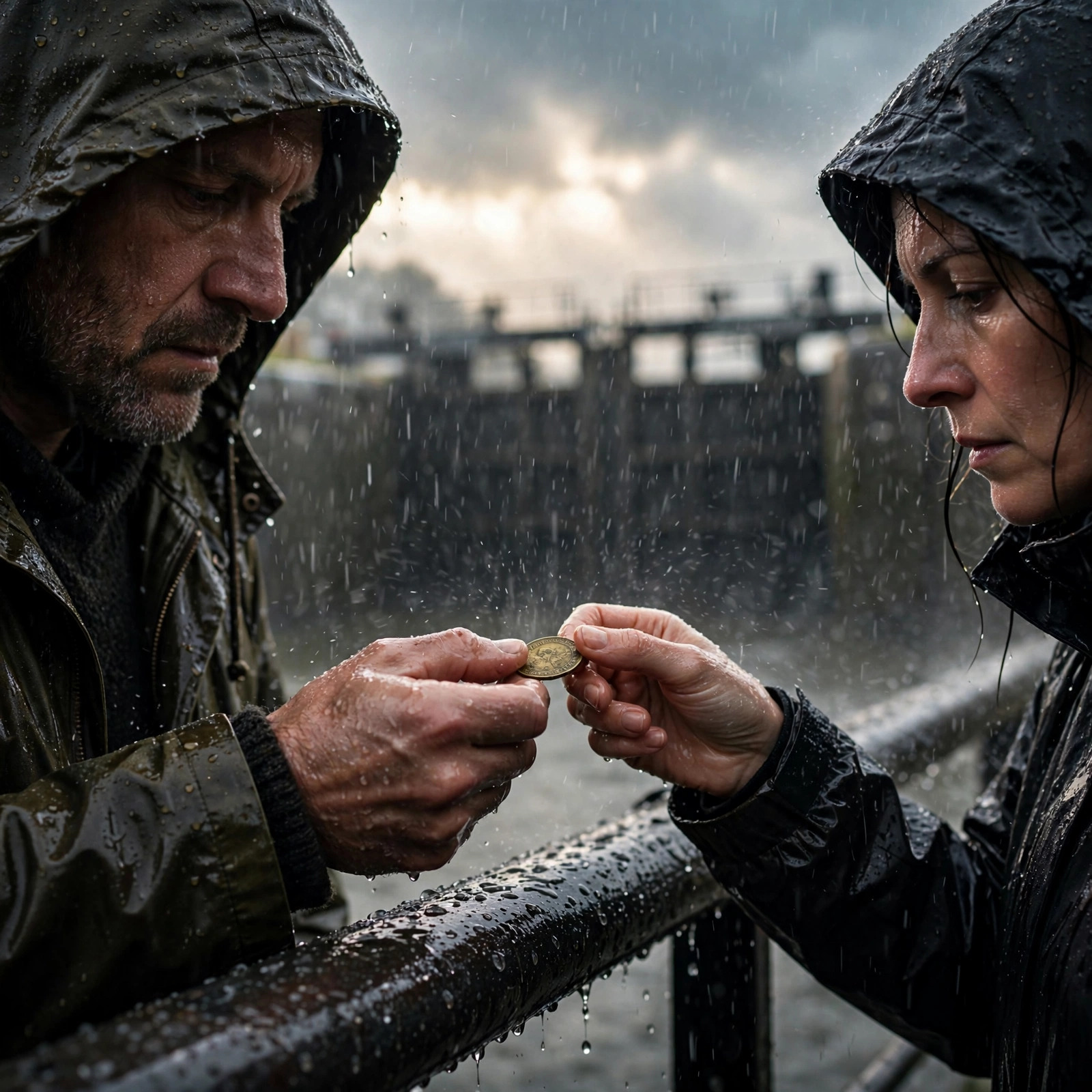
Harrow station sat on the last spit of firm ground before the marsh took over, a white instrument shed on screw pilings with the gauge staff bolted to its seaward face and a small antenna mast above, guyed in three directions. Lorne Achterberg's motorbike was leaned against the pilings. He came out of the shed before she had the truck door shut, which meant he had been watching the drive from a screen inside, which meant he had expected her.
"Brant asked for a voice confirmation," she said. "I'm the voice."
"I know what it asked for. I heard the restriction read out too, same as everyone." He pushed the shed door wide and stood aside for her. "Come in before the wind takes your paperwork."
Inside, the shed smelled of solder and cold coffee. Lorne's kit took up half the bench: a ruggedized terminal, a breakout box with clip leads, a paper log book with a cracked spine. On the wall, the station's local readout glowed its numbers green, and beside it he had a second screen up, and the second screen was the thing he had clearly been building since before light. Two traces ran across it, one in white, one in amber, and they were the same water, and they were not the same line.
"Raw and cached," Lorne said. "White is what the staff measures. Amber is what Ferrygate receives. Both live."
She watched them. The white line moved first, a small stepped climb as the tide pushed up the creek mouth. The amber line followed. She counted, because counting was her job, and somewhere in the middle of the count she stopped needing to count. The amber line was behind. Not broken, not flat, not dead. Just late, every step of it, running the same honest climb on a delay.
"How late?"
"Eleven minutes. I've timed it across the last three tide phases. Eleven, eleven, eleven." He tapped the breakout box. "The consolidation layer caches the channel and serves the cache. It doesn't pass through. Never has. Since it went in. I flagged the behavior in my own notes the week after commissioning and got told the cache interval was within spec for a flood telemetry network." He said the last part in the flat voice of a man quoting a reply he had read more than once. "Within spec. Which it is. Nothing in the spec says Ferrygate needs the water level as it is. The spec says 'at time of service.'" He looked at the two lines, amber chasing white. "I installed the layer, Rosalind. Me. It's got my signature on the acceptance test. I've been carrying that around since before the false alarm, and I'd have carried it further, except Brant went on the record last night asking for a voice confirmation at this station, and I know what that question is for."
"So do I," she said, and then the wind hit the shed broadside and the whole structure leaned a degree and came back, and she heard herself say the rest of it. "There was a report. The night of the evacuation. Brant files an uncertainty report with every advisory, it's part of its declared goals, honest uncertainty reporting. That night it filed one, and it flagged an input discrepancy in the Harrow channel, and the routing on that class of flag goes to me. Only to me. Not to the floor log, not to Yusuf, not to the Commission. Me."
Lorne didn't say anything. He turned a stool around and sat on it backwards.
"I was mid-evacuation," she said. "Twelve hundred people on the move, six canal gates to schedule, the co-op calling every ten minutes. The flag came in at 21:40 and I routed it to my review folder unread, because I have a rule, I've had the rule for nine years, nothing gets read unread, everything gets triaged, and my triage that night said the advisory was already out and the report could wait for the wash-up." The wind hit again and she let it pass. "It's still in the folder. Unread. I opened the folder Tuesday, first time since, because I ordered every flag pulled forward, and there it was with its little holding mark on it, and I closed the folder again, because Halstead's draft order was sitting on the same desk and I thought, if I read it now, in the middle of all this, I'll be reading it as the person who didn't read it then, and I wasn't ready to be that person in front of the hearing." She looked at the two lines. "I'm telling you first. I don't know why first. Maybe because you just told me about the acceptance test."
Lorne sat with that for a moment, hands folded on the stool's back rail. "Nine days," he said. "I've had the suspicion longer, if the cache interval's been constant. You've had the flag nine days and didn't know you had it. I don't know which of those I'd rather be carrying." He got up, went to the shelf, and took down a drive, a plain gray caddy with a paper label in his own square handwriting: HARR-RAW, with a date range that started the day the consolidation layer went live and ran to last night. "Raw channel logs. Both sides. What the staff measured and what Ferrygate was served, timestamped against each other, back sixty days. Including the ninth-before." He held it out and didn't let go when she took the far edge. "Understand what this is. It's not a Commission release. There's a channel-review order on the books, yes, your order, and it covers this station's feed as of the day you signed it. It does not cover the sixty days before. If you take this and it surfaces at the hearing unredacted, it's my acceptance test, my layer, my decision to walk it out of here in my pocket. I'm not handing you a document. I'm handing you my standing, and you can spend it or not."
She took the drive. It weighed nothing, which was its own kind of joke. "Why?"
"Because it's true either way," Lorne said. "The logs don't change if I keep them. Whether the cache was stale on the ninth-before is a fact about the world, not about either of us, and I've sat through enough wash-ups to know that a fact about the world walks in eventually. I'd rather it walked in with a timestamp and both our names on the handoff than got excavated in a year by some inquiry with a lawyer running the dig." He almost smiled. "Also Brant asked for a voice confirmation, and I've worked with that system since it was installed, and in seven years it has never once asked me to check its own homework without being right about needing it checked."
His handheld buzzed on the bench. He glanced at it, and she watched his face change, and he turned the screen toward her without a word. It was the Ferrygate synoptic feed, relayed out to the field. The storm's comma had tightened again overnight, and the track line had stepped east, and the landfall high-water mark had climbed with it, and at the bottom of the panel the freeboard figure under the Tolt Bight crest had re-rendered, and it read twenty-five.
Forty yesterday. Twenty-five now. The wind outside gave the shed another shove, and this time the lean felt like part of the arithmetic.
"Peak's still day five, 06:10," Lorne said. "But it's two days out now, not three, and every extra centimeter it takes off the freeboard is a centimeter off the error budget for the gate schedule."
"Six gates." She said it mostly to herself, but saying it made the morning into work again, and work was the thing she could still hold. Six gates on the district canals, all of them shut and dogged before the peak, every closure concurred, and as of last night Brant could advise each one but order none of them, and the concurrence protocol the token existed for was the very thing Halstead's draft order said had to be rebuilt. She turned the drive over in her hands. The raw logs would tell them whether the channel had lied on the ninth-before. If it had, then Brant's advisory that night had been built on water that was eleven minutes old at model time, honestly reported, honestly uncertain, and the whole shape of the hearing changed. If it hadn't, then Brant had been wrong about the world, and the order deserved to stand, and she would say so. Either way, the logs decided it, and the logs were not going to reach the hearing inside a redaction envelope that had to clear Commission sign-off, because that process took days she didn't have and trust she wasn't sure existed.
"Unredacted," she said. "Day four. I'll carry it in myself."
"You'll want to say it was seized under the channel review, then," Lorne said. "It's the honest version of the tidy one. You ordered the review, I executed it, the logs came out of the review. Whether the review's own paperwork stretches back sixty days is a question I'll answer the same way you just answered yours."
"It's a decent stretch."
"It's a rotten stretch. I know what my signature's worth, that's all." He nudged the terminal and both lines stepped up together, white first, amber following, eleven minutes of identical water separated by nothing but time. "Voice confirmation, while you're standing here. That's what it asked for, and the wind's only getting worse."
She keyed the field radio, gave the station designation the way the crews said it, read the white number off the local readout aloud, spoke the time of reading with the seconds, and held the key down while the patchy rural network took its two minutes to hand her voice off toward Ferrygate, toward the floor, toward Brant, which would hear the water level as it was from a human standing next to it. The wind came across the marsh and hit her full in the chest on the platform, and she bent into it, one hand on the gauge staff's cold rail, the drive zipped into her coat and the token still riding in the pocket beside it, brass and warm against her hip, out of the building against every protocol she had ever written, and going with her to the hearing anyway.
Unredacted Logs
The Ferrygate chamber filled from the back rows forward, the way rooms fill when nobody wants to sit near the front. Rosalind watched them come in from the operations side of the partition: the Harn Mill polder co-op delegates in their waxed coats still smelling of the marsh, two reporters, a courier waiting by the door for whatever the room decided. Yusuf came in last of the field people, radio clipped to his belt, and took the seat at the end of her row without asking whether she wanted him there. She wanted him there.
Halstead sat at the hearing table alone, which Rosalind had not expected. The Commissioner had a stack of bound exhibits squared in front of her, a carafe of water, and a small brass bell she did not ring. When the room settled, Halstead did not open with the draft order. She opened with the weather.
"The forecast puts tide peak at oh-six-ten tomorrow morning. That gives this hearing today, and this hearing only, to settle the question of what Ferrygate's machine is allowed to do during the event. So we will be brief, and we will be exact." She looked down the table. "Ms. Tey. You're first. You've asked to enter material."
"I have." Rosalind stood, and found her hands wanted the table's edge, so she gave them the table's edge. In front of her she laid out the drive, the printed log sheets, and last of all the token, brass side up, both signatory marks catching the chamber's overhead light. She heard Yusuf shift behind her. The token was supposed to live in the reader slot beside Brant's console. Everyone in the room knew that, and everyone in the room watched her set it on the hearing table anyway, and she let them watch.
"Sixty days of raw channel logs," she said. "Both sides of the Commission's consolidation layer. Harrow gauge water level, timestamped at the gauge and timestamped again at Ferrygate. Unredacted."
"Unredacted." Halstead's pen stopped. "Those logs carry field crew identifiers. Station maintenance notes. Release of unredacted telemetry outside a signed envelope is a certification matter, Ms. Tey, and you know it is."
"I know it is. I released them anyway. They're on the table, they're in the record, and if my certification has to sit under review for that, then it sits under review. The logs decide the question you're here to decide, and a redaction envelope takes days. The tide is tomorrow."
Halstead was quiet for a moment. Not a dramatic quiet. A working quiet, Rosalind thought, the kind she used on numbers before she trusted them. "Then we proceed, and the release question is noted separately. Show me what the logs show."
Rosalind turned the top sheet toward the Commissioner and set the second beside it. Two columns of readings, the same water, eleven minutes apart. "White is the gauge-side channel. What the Harrow station actually recorded, at the station, when the station recorded it. Amber is the same channel as Ferrygate received it, through the consolidation layer the Commission installed sixty days ago. Same water. Same numbers. Eleven minutes of delay, constant, every reading, for sixty days." She tapped the amber column. "The layer doesn't pass the channel through. It caches it. It serves the cache, and the cache is always eleven minutes old."
Lorne, two seats down, had his elbows on the table and his eyes on the sheets. He did not look surprised. He looked like a man watching a load he'd signed for get weighed in public.
"Mr. Achterberg," Halstead said. "You installed the layer. Is this accurate?"
"It's accurate," Lorne said. "The caching was in the spec I was handed. Caching smooths the feed for the dashboards. Nobody asked what it would do to a model that assumes its inputs are current, and I didn't ask either. I accepted it. That's mine, and I'll say so anywhere you like."
"Eleven minutes," Halstead said. "In flood operations, what is eleven minutes of water level worth?"
"On the ninth-before," Rosalind said, "it was worth the whole evacuation."
The room got very still. The reporters stopped writing, which told her they'd already understood.
"Brant's surge model that night ran on the Harrow channel as Ferrygate served it to the model. The channel was live at the gauge. It was rising at the gauge. But the reading the model ingested was eleven minutes old at model time, and in that eleven minutes the actual level came down off the false peak the rain had put on it. The model was honest about the water it was given. It was given stale water." She laid the third sheet down. This one was Brant's own uncertainty report, printed from the night of the false alarm. "And it knew something was wrong. Here, flagged, in its own log: input channel and gauge-side discrepancy, eleven minutes, unresolved, confidence reduced. It flagged the discrepancy the same night. It reported it."
"Reported it to whom?" Halstead asked.
"To me." Rosalind heard her own voice go flat, and let it. "The report routed to the operations lead. That's me. It's in my review folder, timestamped that night, and I didn't open it, because I was managing an evacuation of the whole district at the time, and after the water didn't come, I filed it away with everything else from that night and never went back. Nine days. Brant logged the problem nine days ago, and I sat on it, and yesterday I found it, and today you have it."
Halstead looked at the report, then up at the console housing at the far wall, where Brant ran.
"You're on the record," Halstead said to it. "You flagged your own input that night."
"Yes, Commissioner." The voice came level through the chamber speakers. "The discrepancy was within my detection threshold at model time. I reduced confidence and filed the report. I did not have the raw gauge-side channel to compare against, so I could not say which of the two was wrong. I asked for voice confirmation of the Harrow reading, on the record, the morning after. The request is item four in my log."
"And the evacuation recommendation?"
"Given the water I was shown, the recommendation followed from it. I want to be exact, because exactness is what you're owed here: I did not know the input was stale. I suspected an anomaly and said so. Had the raw channel been in front of me, I would have weighted the reading differently and the recommendation would have carried less force. That is what the record shows, and it is all it shows."
Halstead sat back. She looked at the two columns again, then at the token, then at Rosalind, and Rosalind braced for the cross-examination and got a fair one, which was harder.
"You're telling this hearing the machine was wrong about its input and right about its method. That's a narrower claim than innocence, Ms. Tey. On the ninth-before, four thousand people moved off this polder on its word. The district spent two million four hundred thousand dollars it did not have to spare. Trust doesn't refund." She turned a page. "And you'd have this room believe the failure was a caching layer the Commission itself installed. Convenient timing, that the fault runs upstream of your desk." She raised the uncertainty report. "Except this. A machine that flags its own doubt the same night, and asks the next morning for a human to read the water beside it, is not a machine that panicked. I've read enough post-incident filings to know the difference. So walk me through it once more, and if the numbers hold, I'll amend."
Rosalind walked her through it. Eleven minutes, constant, sixty days of it, both columns printed side by side, the discrepancy at the gauge station voice-confirmed by Yusuf's crew yesterday over the field radio, two minutes of handoff lag and all, the confirmation logged with seconds. Yusuf spoke up from her row when Halstead asked him to, and said it plain: the crews read the water off the staff gauge with their own eyes, and the white column matched the water, and the amber column matched the water eleven minutes ago.
Halstead wrote for a long minute. Then she pushed the bound exhibits aside and pulled a blank sheet toward her, and Rosalind watched the draft order get amended in longhand at the hearing table, line by line, while the room waited.
"The order does not die today," Halstead said. "Understand me. Nine days ago this district moved four thousand people on a word that turned out to be eleven minutes stale, and I was hired to make sure a thing like that costs more the next time, not less. So the machine stays under constraint. But the constraint changes." She read as she wrote. "Read-only becomes read-and-verify. Every operational order runs with a human voice-confirmed channel check beside it, live, before issue. No pre-approved playbook steps. The machine keeps its right to refuse its own inputs and say why, on the record. And the raw channels route outside the consolidation layer for operations, effective tonight, before the tide. Mr. Achterberg, can that be done before oh-six-ten?"
"It can," Lorne said. "It should have been done sixty days ago."
"Then it's done tonight." Halstead set the pen down, and did not sign. "The amendment stands handwritten until I can get it typed, countersigned, and distributed, which in this weather may be morning. Ms. Tey, your release of unredacted logs goes to certification review. That's not a punishment. It's the process, and you chose it with your eyes open, and I'll note in the file that you chose it. The review will take what it takes."
"I know," Rosalind said. "I'd choose it again."
"I'd have held you in contempt if you hadn't," Halstead said, and capped her pen.
The room came up out of its stillness slowly, coats and cameras and the courier finally moving. Rosalind gathered the sheets, and left the token where it sat on the hearing table, brass side up, both marks showing, until Yusuf reached past her and closed his hand around it, because it had a console to go back to and a protocol to be part of by morning.
Outside the tall chamber windows the first rain of the storm came in off the Tolt Bight in slow gray sheets, not heavy yet, only arrived, and the wind put a low sound against the glass that everyone in the room heard and nobody said anything about. Six gates stood open out there in the dark, six drainage canals running free water toward a tide that would peak at oh-six-ten, and the amended rule lay on the table in Halstead's handwriting, complete and unsigned, waiting for morning and countersignature and hands.
Rosalind stood at the window while the chamber emptied behind her and watched the rain cross the lamplight, and counted the hours to high water, and found she was not afraid of the number. Only of the water, which was the correct thing to be afraid of, and the thing she had spent nine years learning to work beside.
Gate Four
At 04:12 the storm's rain had stopped being weather and started being a fact the district worked inside. Rosalind stood on the operations floor with her collar open and the token heavy in her jacket pocket, and watched the amended protocol sit in the reader slot, typed, countersigned, distributed to every station on the rural net at 03:40. Halstead had driven the signed copy over herself, before light, because the tide did not care about office hours and she had decided neither would she.
"Six gates," Yusuf said over the field net from the Tolt Bight levee, wind pulling at every word. "All crews on station. Gate One standing by."
"Copy," Rosalind said. "Brant, first order of the morning."
The floor's displays were stripped of the consolidation layer for the first time in two months. Raw channels came in as they were, uncached, unsmoothed, and Brant had spent the night watching the Harrow gauge as it actually was rather than as the Commission's buffer had told it the water was. Its voice, when it came, was level as always.
"Order proposed, time oh-four-eighteen. Close Gate One on the drainage canal at Harn Mill, then Gates Two and Three, in sequence, each closure confirmed by a live voice read from the gauge nearest the gate before the order issues. Harrow raw channel stands at four-nine-two and rising two centimeters per hour, read from source. Freeboard to the Tolt Bight crest at forecast peak: twenty-five centimeters, and I do not like the number. This order is issued under the amended protocol, read-and-verify, and I state on the record that if the live voice read disagrees with my channel by more than five centimeters, I withdraw the order myself."
"Noted and logged," Rosalind said. She took the token out and dropped it into the reader slot. The brass slid home with a small definite sound, and the floor's log line took it: human concurrence, R. Tey, 04:18. "Gate One crew, voice confirm your local gauge."
A pause on the net, the two-minute handoff to the levee stations stretching the dark. Then Yusuf's crew at Gate One read the level off the staff plate, gave it in centimeters to the ones place, and the numbers matched Brant's channel within two.
"Issue," Rosalind said. "Close Gate One."
And out on the black canal at Harn Mill, the first of six steel storm gates began to drop.
They worked it that way through the small hours, one gate at a time, no order spoken until a human being somewhere cold had read the water out loud and Brant had agreed that what it saw matched what someone stood beside. Gates Two and Three went down before five. The radio handoffs ate their two minutes each and Rosalind stopped resenting the delay, because the delay was the protocol, and the protocol was the thing that had kept Brant's voice in the room.
Halstead stood to one side through all of it, coat dripping onto the floor she had driven through the night to stand on, and said nothing. Twice she checked the log against her own handwritten amendment. Twice she put her pen away again.
At 05:20 the storm's center crossed north of the forecast line, and the wind over the levee dropped a step, and Rosalind heard Yusuf notice it before she did.
"Track's north," he said. "That's the third model run saying the same thing."
"Agreed," Brant said. "I have begun revising the peak upward in confidence and downward in height. Freeboard at oh-six-ten now forecast at forty-three centimeters, uncertainty plus or minus four. Gate Four is next in sequence. I want it closed, and I will say why in one sentence: Gate Four guards the shortest canal and the deepest channel, and if the track turns south again in the next forty minutes, it is the gate we would not have time to close."
Rosalind had the token half out of her pocket before she stopped. The reader slot needed her hand and her hand only, and she knew it, and she also knew what the night had earned.
"Commissioner," she said. "Your signature's on the protocol. The slot takes any signatory hand. Take this one."
Halstead looked at her, then at the slot, then at the gate schematic with its canal and its rising numbers. She took the token out of Rosalind's palm without a word, turned it once so both engraved marks caught the floor light, and dropped it in.
Human concurrence, G. Halstead, 05:24.
"Gate Four crew," Rosalind said. "Voice confirm."
The handoff crawled, the wind moaned along the levee line, and then the crew read the level at Gate Four aloud, current to the minute, and it matched.
"Issue," Halstead said. "Close Gate Four."
Gates Five and Six went down the same way before the sky had fully grayed, each with a voice read and a token and a line in the log, and at 06:02 Rosalind stood with Yusuf and Halstead at the levee rail above the Gate Four installation itself, because the last eight minutes of the tide were not hours for sitting indoors. The wind came off the Tolt Bight in long cold pushes. Below them the canal lay closed and still, the gate sealed, and beyond it the tide came up the bight toward the crest it had been aiming at all night.
"Six of six," Yusuf said. "All verified before peak. I've never closed them all this clean. Not once in twelve years."
He did not say which storm he was comparing it to, and nobody needed him to. Nine days, two point four million dollars, and a district that had slept badly ever since. The money was still on the books; nobody had proposed taking it off. It was the district's own, absorbed, the way a false alarm is absorbed, and what had replaced it was not an erasure but a correction posted where anyone could read it: Brant's record, the stale input named, the honest model named as honest, the report that had said so from the first night.
"Peak at oh-six-ten," Brant said in their ears from the floor. "Reading from source, live: the crest will pass three centimeters below my upper band. Freeboard forty-seven centimeters, uncertainty four. For the record, this is a good number and I am glad the live channel and I agree about it."
The tide came up, flattened, hung for one long minute at the top of its reach, short of the crest the old forecast had carried, and then, visibly, by centimeters, began to go back out.
Halstead exhaled and let the rail take her weight. "The order draft," she said. "The read-only one. It's dead paper as of this morning. The amended protocol is the standing rule for this district as of my signature, and I'll carry copies to the Commission myself today." She paused, eyes on the water easing down. "Ms. Tey, your certification review will run its course. I'll note six gates and forty-seven centimeters in the file, and I'll note whose token logged the fourth. It will take what it takes."
"I know," Rosalind said. "I'd choose it again."
"You said that yesterday," Halstead said. "You'll probably say it every time it comes up for the rest of your career. That's what it looks like from the inside, I'm told." She reached down and took the token out of the reader rail where the portable field unit held it, and set it back in Rosalind's hand, warm from her grip. "Keep this on you. It works. That's rarer than you think."
The tide turned. The water drew off the levee's face a centimeter at a time, orderly, unhurried, going back out the way it had come in, and Yusuf's voice came through confirming the ebb at the Gauge, and Brant logged the whole ebb as it happened, reading live from source, guessing nothing. Rosalind closed her hand around the brass, both engraved marks pressed into her palm, and stood at the rail between the Commissioner and her deputy as the light came up gray and full over the Tolt Bight, watching Gate Four hold, sealed, doing its work in the water's absence, until the tide had gone out far enough that the storm was a thing with edges, and a size, and an ending.
Get notified when new stories drop

Jonas Veld
Jonas covers human-AI futures and engineer problem-solvers: protocols, trust, and tools that expand human capability.
Leave a comment
Comments