


Nightly Thermal Dump
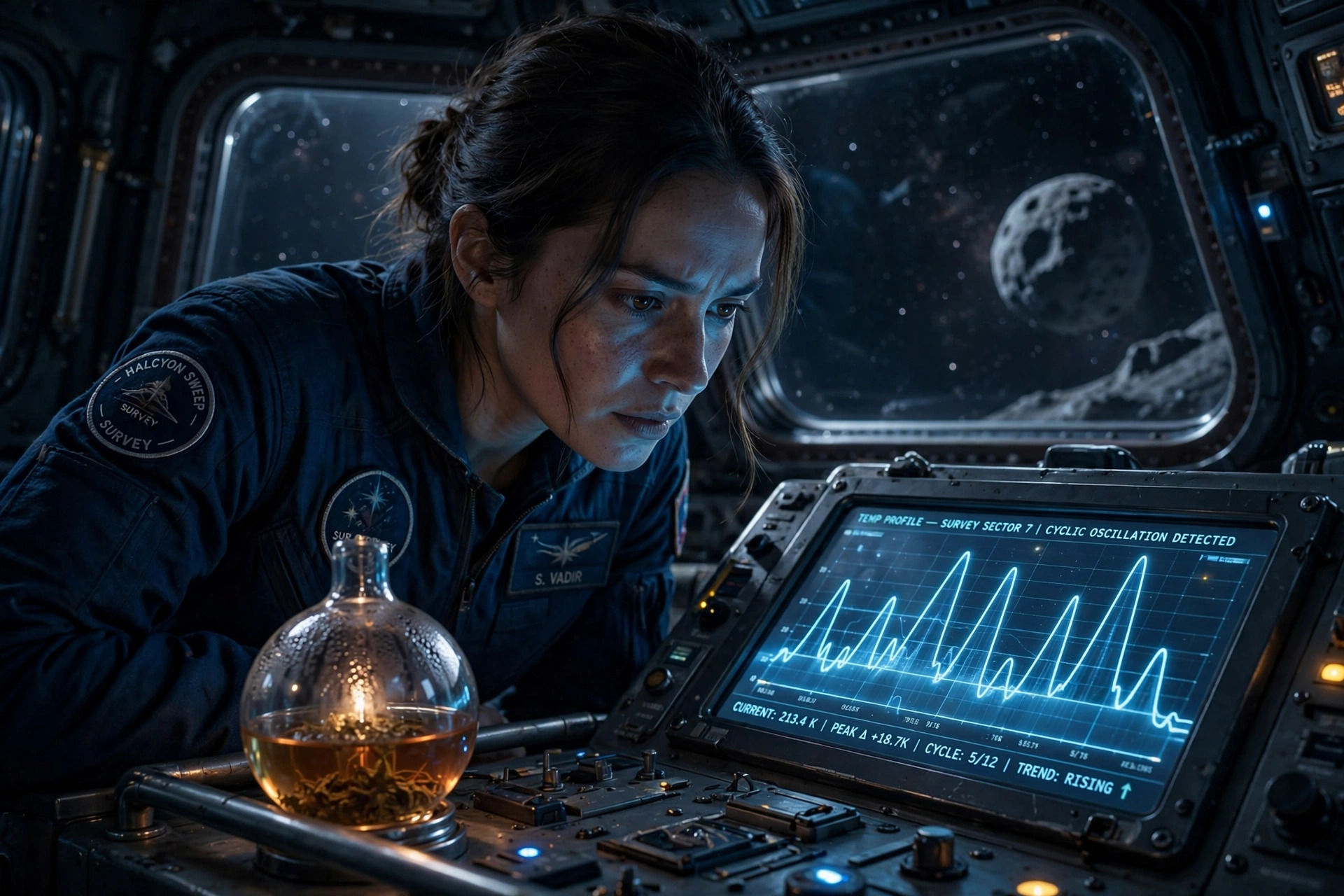
The reduction run always finished at the same hour, and Sena Vadir had stopped fighting the rhythm years ago. At 2200 shipboard the thermal arrays folded their day of Resonance Shelf observations into a single calibrated cube, and her console spent eleven minutes grinding it into numbers a human could read. She had learned to use those minutes well: check the radiometer gains, sign the consumables sheet, drink the last of the tea before it went cold in the bulb.
She pulled the cube apart object by object, the way the charter required. Fourteen of the seventeen Shelf objects were behaving. Cold, dark, unremarkable little worlds, each one a line of temperatures that matched her models to within a tenth of a kelvin. She initialed them and moved on.
Whitlock was the fifteenth.
She initialed it, too. Then she stopped, put the bulb down on the console rail, and pulled the column back up.
The night side of Whitlock was supposed to sit at 61 kelvin. It had sat there for every one of the forty days the Shelf survey had been watching it, a flat gray line in her graphs, colder than anything else in the survey block, exactly what a distant body with no atmosphere and no internal fires ought to look like from a million kilometers out. Tonight the line was not flat. Tonight the line had a shape.
It rose. Nine kelvin above the equilibrium, a smooth climb over twenty minutes, then a slower fall, then another climb. She counted the peaks with her finger against the screen before she trusted the software to do it. Three full cycles inside the dump, and the fourth one starting as the cube ran out of hours.
"Something," she said, and heard how thin her own voice sounded in the quiet of the survey bay.
Anke Perrow looked up from the gravity bench across the aisle. She had her hair tied back with a strip of foil tape, which meant she had been fighting the mass model again and losing. "Something good or something broken?"
"Something that isn't either." Sena turned her console so the graph faced the other woman. "Whitlock's night side is breathing."
Anke came around the bench and stood behind her shoulder. She smelled of the lubricant she used on the bench bearings. She read the graph the way she read everything, top to bottom, twice, without comment, and Sena let her have the silence. That was the deal between them from the first cruise: Anke read, Sena waited, and neither of them said the obvious thing until the numbers had said it first.
"Nine kelvin," Anke said at last. "On the trailing hemisphere."
"Trailing." Sena had missed that. She pulled up the sub-surface map, and there it was: the brightening sat on the aft-facing side of the little world, the hemisphere that looked back along Whitlock's own path. "It's not the sun. The sunlit side is flat as ever."
"Then it's not the sun." Anke pulled a chair over without asking and dropped into it. "Rotation?"
"Whitlock turns once every eleven hours. I've had that number for a month and it's clean." Sena laid the rotation period over the thermal column and let the software reject the match. It rejected it with the quiet finality of a number that had been checked four ways. The peaks kept their own time, something under fifty minutes apart, too short for the spin and too regular for noise.
Down the aisle, the pressure door cycled and Toben Ruiz came in from the flight deck with the evening's position fix folded under his arm. He was halfway through his usual greeting before he saw their faces. "What's on fire?"
"Nothing," Sena said. "That's the problem. Whitlock is warm and nothing we know of is warming it."
Michi Hallard arrived before Toben could answer, drawn by the oldest instinct on any small ship, which was the instinct for two people staring at one console. They came in socked feet, carrying a half-stripped power coupler they had clearly forgotten they were holding. "Warm how? Warm where?"
"Trailing hemisphere, night side, nine kelvin above where it should be, cycling." Sena tapped the peaks. "Regular as a heartbeat."
Michi's first loyalty was to the power budget, and it showed. "Is it us? Could a bad detector channel read high on a cycle? The array timing runs on a forty-minute maintenance interval, it wouldn't be the first time a filter rang its own bell."
"Check it," Sena said, "genuinely, please," and Michi went, still carrying the coupler, to pull the detector timing logs from the engineering side. Sena knew the answer already. The brightening was on Whitlock, not in the array; the sky around it was flat and cold. But she also knew that a survey lead who skipped the boring explanation would someday die of the interesting one, so she waited while Michi worked.
Ezra Quint was last, because Ezra was always last, because the comms console kept him tethered to the downlink schedule. He came in pulling his headset off one ear. "I heard my console mentioned," he said. "Or I heard the word 'cycle' and assumed it was me."
Sena waved him to the fourth chair. "It's a survey item. I'll say nothing official yet. But you should hear it, because you're going to ask me tonight whether we're reporting it, and I want you to know why the answer is complicated."
She laid it out plainly, the way she did at the nightly review: the object, the hemisphere, the amplitude, the fact that no model in the library would produce it. She did not say the part that had been sitting in her chest since the third peak. She kept that in the private log where it belonged, which was the log nobody at Kirkwall Deep Station would read tonight or possibly ever: that a warm spot on a cold little world, out at the edge of the Shelf, might be the most interesting thing she had seen in twelve years of doing this work, and that the charter she had signed put it behind seventeen other objects and a fixed consumables margin.
Michi came back with the timing logs on a slate. "Not us. The array's clean, the filter's clean, and I found the same shape in yesterday's raw feed, just under the noise floor where nobody was looking. It's been doing this for at least two days. We only caught it tonight because the gain stepped up when the survey block rotated."
"Two days," Toben repeated. He set his position fix on the bench, forgotten. "So it's not a one-off."
"It's not a transient. It's a behavior." Anke had not stopped looking at the graph. "Sena, what's your period estimate? The peaks aren't the full story, the rise time matters too."
"Roughly forty-seven minutes, cycle to cycle, but I'd want a clean forty-eight hours of dwell before I'd defend that number in front of a committee." Sena closed the plot and opened her private log instead. "Which is why I'm writing it here first and not in the downlink."
Ezra had gone very still, which was how he looked when he was doing arithmetic he didn't like. "You know what you're about to ask me," he said.
"I know the light lag. Tell the others."
"Four hours, one way, at our current distance from Kirkwall." He said it to the room, not to her, and the room absorbed it. Four hours for a question to crawl out to the station, four hours for the answer to crawl back. "So if we sent a query tonight, flagged it priority, got a duty officer to read it on receipt, we're still looking at eight hours minimum before anyone with authority could tell us anything. And that's if the desk is awake and feeling generous."
"And the survey block doesn't wait eight hours," Toben said. "We're on a fixed track. The next Shelf object comes up in three days, and after that the geometry gets worse for six weeks."
"I wasn't proposing anything," Sena said, and it was true, and it was also true that everyone in the room heard the sentence as a door being held open. She felt Toben look at her and did not look back.
Michi set the stripped coupler on the bench, finally empty-handed. "Whatever this is, it's pretty. But if anyone's already spending reserve days in their head, I'll remind the room we're carrying twenty-two, and the return leg is priced to the floor of what flight rules allow. I count margin for a living. Please don't make me count it twice."
"Nobody's spending anything," Sena said. "Tonight we look. Looking is free."
They stayed another hour. Anke pulled the raw feed apart and found the same trailing-hemisphere shape in three earlier nights, fainter each night they went back, as if Whitlock had been whispering for a while before it decided to speak up. Michi verified the array against a cold calibration star and pronounced it innocent. Toben ran the geometry of a hypothetical close approach in his head and then, when his head ran out, on paper, and said nothing about the result, which said everything. Ezra sat with his hands flat on his knees and watched the rest of them fall in love with a graph, and Sena could see him deciding, quietly, that his job tonight was to be the one who remembered the downlink schedule.
At 0100 she called it. "Log it in my private file, marked for review, no distribution. The nightly packet goes out with the fourteen clean objects and Whitlock initialed as routine, because tonight it is routine: an anomaly on the watch list, nothing flagged."
"That's a defensible reading," Ezra said. "For one night. It's on the record in your private log if anyone ever asks why we didn't shout." He pulled his headset back on. "I'll send the packet. And Sena, when you do decide to ask the desk something, tell me before you tell the engines."
She printed one page before she shut the console down. Just the one: the thermal column, the climbing line, the three peaks and the fourth cut off mid-rise where the day ran out. She carried it aft to the workbench on the aft frame, where the survey spares lived in their racked rows behind their clips, and she pinned the page to the cork strip with a single steel pin, face-down.
Anke passed her in the aisle on the way to her bunk and slowed. "Hiding it from yourself?"
"Hiding it from the packet." Sena pressed the pin flat with her thumb. "Tomorrow I'll want to see it fresh. If it still looks like something in the morning, I'll know it isn't the tea."
Anke's smile was small and real. "It was never the tea."
The lights in the survey bay stepped down to their night setting, one row at a time, and the pinned page hung there blank and warm under the dim strip, holding its nine degrees of secret against the cork.
The 47-Minute Line
The morning found the page still pinned to the cork strip, face-down, exactly where Sena had left it. She turned it over with her coffee held in her other hand, and the peaks were still there. Four of them now, if you counted the cut-off rise. She counted it.
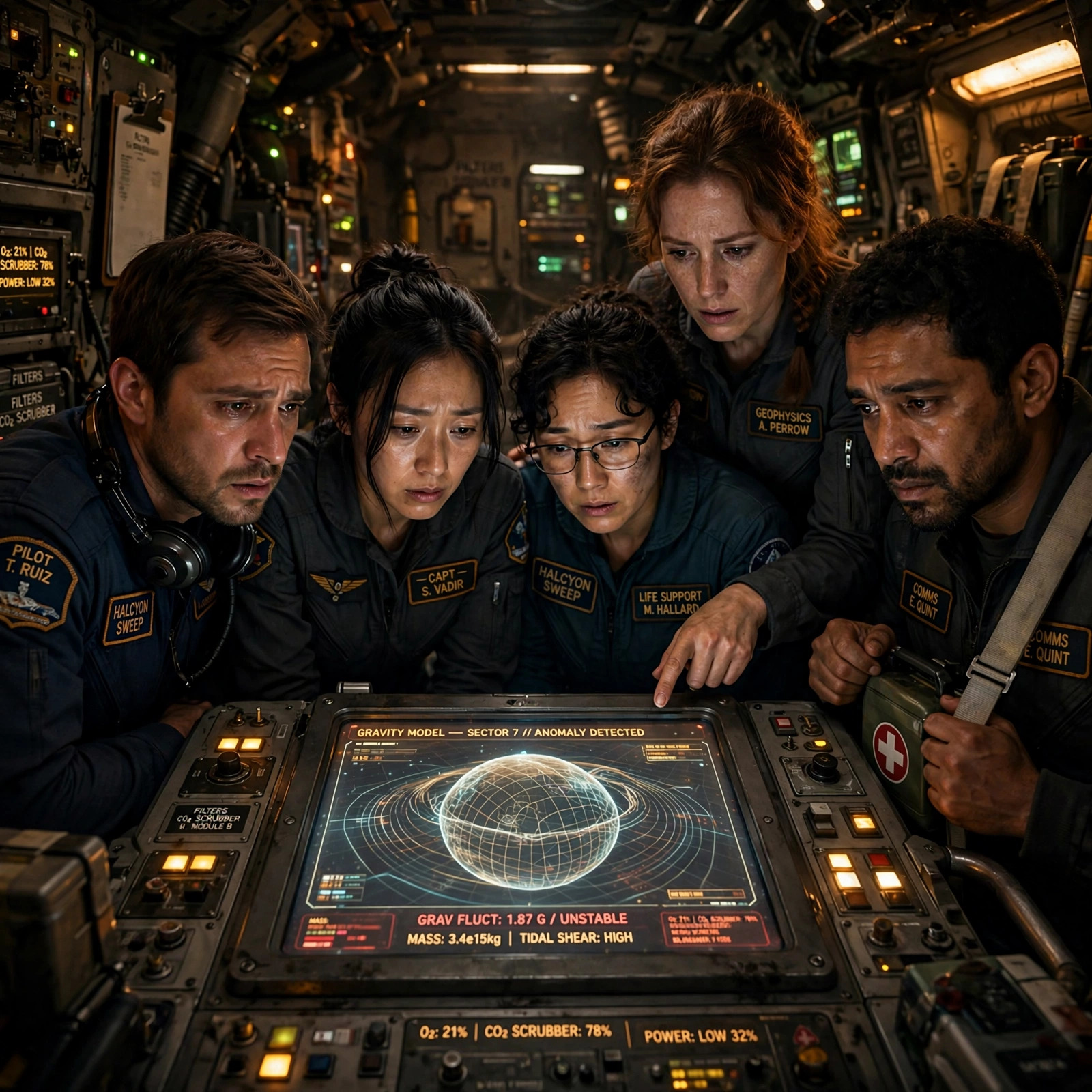
Anke was already at the console when Sena carried the page forward into the survey bay, and she had done the thing Sena had been afraid she would do: she had folded the nights together. Six nights of thermal column, stacked in faint offsets, the trailing hemisphere's warm patch rising and falling on top of itself like a tide line drawn by a patient hand.
"It's not noise," Anke said, without looking up. "I ran it three ways. Stacked, differenced, and against the calibration star Michi gave us. The patch breathes."
"How fast?" Sena asked, though she had already begun to see it, the way the peaks marched at a spacing too even for chaos.
"Forty-seven minutes. Plus or minus less than one." Anke pulled the fitted line up over the stack, and it lay down across the crests like a ruler on fence posts. "Peak to peak. Night after night. Whitlock keeps a clock."
Sena set her coffee down on the bench, away from the electronics, an old habit. Nine kelvin of brightening above the night-side equilibrium, and now a period to hang it on. She sat.
They spent the morning killing the easy answers, which was the only responsible way to love a hard one. Rotation was first. Whitlock turned once every eleven hours, and no alias of an eleven-hour spin gave you forty-seven minutes; Anke folded the period against the spin rate every way the geometry allowed and the line stayed stubborn. Solar heating was second, and it died faster. The sunlit hemisphere sat flat as a griddle across every pass, and the warm patch lived on the trailing side, which the sun had finished with hours before it warmed. A thermal wave driven by daylight would lead, not lag. "Whatever it is," Anke said, "it isn't the sun. The sun isn't in the room."
By midday they had a column of dead models and one live number. Sena wrote the number on the whiteboard strip above the console, large enough to read from the aisle: 47 min, and under it, in smaller print, 9 K, trailing. Michi came through on the aft-frame round at 1300, stopped, and read it twice.
"That's not in the packet," Michi said.
"No," Sena said. "It's in my private file, marked for review. The packet says Whitlock is routine."
"The packet went out this morning. I checked the downlink manifest." Michi's eyes went from the whiteboard to Sena and back. "You're sitting on a periodic signal off a survey target and initialing it as routine. Second night running."
"Second night," Sena agreed. "Because I don't have anything yet. A period without a source is a curiosity, and curiosities don't spend reserve."
"Reserve is exactly what I was coming to talk about." Michi pulled a tablet off the rack and called up the consumables board, and Sena watched the number arrive before Michi said it: twenty-two days of margin, held against the return leg. "That's the whole cushion. Air, water, power overhead, everything folded into one honest figure. And I keep getting asked, in here"—they tapped their own temple—"what a close Whitlock flyby would cost us, and I keep not answering, because nobody with authority has asked me out loud."
Toben had drifted in behind them somewhere in that, and Ezra after, drawn by the gravity of a conversation that had stopped pretending to be about the whiteboard. Five of them in the bay, which was most of the ship's living volume, and the number forty-seven on the strip above the console like a guest at the head of the table.
"Seven days," Sena said. "That's the working figure. A diversion to a close approach, flown clean, costs about seven days of reserve."
"Seven days off twenty-two leaves fifteen," Michi said. "And fifteen is the floor. Flight rules say we don't burn below fifteen held in reserve. So the question isn't whether we can afford seven. It's whether we can afford exactly seven, on the day, with nothing going wrong. And my answer to that is: not without a power case."
"A power case," Toben repeated, flat.
"A power case," Michi said, and turned the tablet around so the pilot could see the load tree. "Everyone talks about the diversion like it's one burn. It's one burn plus a rack. If we go close, we're not flying by with our hands in our pockets; we want volatiles, salt residue, whatever the plume puts up. That means a capture rack, which means mass, and mass means gimbal authority and pump time and heater draws, and I have not been given one watt-hour of margin to pay for any of it. So until someone shows me power, my signature is no. Mass changes without a power case are how ships come home dark."
"Nobody's asked you to sign anything," Sena said.
"You pinned it to the cork strip," Michi said, not unkindly, which somehow made it land harder. "Face-down. That's a woman keeping a page until it's strong enough to argue for her."
Sena let that sit, because it was true, and arguing with true things in front of Anke was a losing sport.
Ezra had his arms folded, headset hanging off one shoulder. He spoke toward the whiteboard rather than at anyone. "Whatever this becomes, I want it said once, in the room: the desk can't help us. Kirkwall is four hours out, each way. A question tonight is an answer tomorrow, and tomorrow night's answer the night after. The return burn window opens on day ninety-two and holds for about a day and a half. If we're going to divert and still make the phasing for the return leg, we decide aboard. All five of us. There's no version where a flight director at Kirkwall Deep Station leans over our shoulders for this one."
"Day ninety-two," Toben said. "That's the pressure nobody's said plain. The return burn isn't a suggestion. The Shelf survey's worth seventeen objects, and the whole charter is built on the phasing we take at the ninety-two window. Miss it and the return leg costs more than seven days; miss it badly and we're rationing on the way home."
"Then we don't miss it," Sena said. "We divert, we fly the approach, we re-capture the return phasing inside the window. Toben ran that geometry two nights ago."
"I ran it," Toben said. "It closes. It closes thin. It closes if the burn goes exactly as filed and nothing in the rack costs more than we said. I can fly it. I want it on the record that 'thin' is the word."
Thin. Sena took her coffee off the bench and drank the cold half of it, because the warm half was gone and the number on the whiteboard was not.
Michi broke the silence with the tablet. "Fine. Then here's what I need instead of promises. If there's going to be a rack, I want it counted, weighed, and built from spares that are already aboard and already mine to account for. Nothing new manifests itself out of my locker without my hand on the tally. Show me the mass list and the heater draw and I'll show you where the power comes from, or I'll show you why it can't. That's the deal."
"That's a fair deal," Sena said.
"It's the only deal."
So the afternoon became a counting. Michi and Anke went aft together and opened the spares locker on the aft frame, and Sena followed with the printed sheet from the cork strip folded in her pocket. The survey spares lived in racked rows behind their retaining clips: strut stock, aerogel foil in rolled bolts, sample cylinders, brazing stock, the small clamps and the long ones. They pulled the clips and laid everything out on the workbench in the aisle light, and Michi kept the tally aloud, piece by piece, the way a quartermaster counts, and Anke wrote each mass into the tablet before anything was allowed to move on.
"Two long struts," Michi said. "Four short. Foil, one bolt, cut to half. Cylinders, six, but two are spoken for by the Shelf core work, so four. Brazing stock, yes, if you're building, that's the only way this gets stiff enough."
"It's enough for a hand-built rack," Anke said, turning a strut in the light. "Ugly, but ugly holds salt."
"Ugly holds mass," Michi said, and wrote it down.
They built nothing that day. That was the discipline of it, and Sena felt the discipline holding like a wire under tension: a page pinned face-down, a number kept off the downlink, a rack counted but not cut, a burn costed but not filed. Everything measured twice, because the whole margin was one cut deep.
At the meal break the five of them ended up around the small table in the bay, trays and tablets and the whiteboard strip in everyone's eyeline, and the argument came back around in the honest, tired way arguments do when the crew has stopped performing. Michi held to the power case: no rack, no mass, no burn below fifteen held. Toben held to the phasing: the window on ninety-two, thin, flyable, unforgiving. Ezra held to the schedule: the packet had gone out this morning with Whitlock initialed routine, and the next honest packet would either say more or say less, and he would not initial a third routine without a room decision behind it. Sena listened, and watched Anke not eating, working her tablet with one thumb in the way she did when a model was misbehaving under her hands.
"Say it," Sena said.
Anke looked up. Then she turned the tablet around, slid it across the table to Sena, and let go of it before their hands could argue over it.
"I've been trying to fit the period since lunch," Anke said. "Not to the spin. Not to the sun. To the body itself. If something is flexing Whitlock on a forty-seven-minute schedule, the only clock that strong is gravity. So I built the pair. Whitlock plus an unseen companion, mutual orbit, tidal flexing at the period we measured." She tapped the table twice, softly, like a knock on a door she hadn't opened. "The model fits. It fits beautifully. The period column is filled in by hand, every peak, every night, and it holds."
Sena looked down at the model. The gravity pair turned on the screen in its slow, patient way, Whitlock flexing along the line of the tide, nine kelvin of work arriving at the trailing surface on a schedule. And in the column beside it, the source body's designation was blank. Not zero. Not pending. Blank, because a model can be shaped around a thing nobody has seen, and Anke had shaped it there and left the name empty rather than guess.
"A fit without a source," Sena said slowly, "is still just a fit."
"It's a fit with an address," Anke said. "We know where to look now. That's not nothing. That's the difference between a curiosity and a target."
Michi was reading over the tablet's shoulder from across the table, and they didn't say no this time. They said, quietly, "Forty-seven minutes. Whatever's doing that is close, and it's doing it every forty-seven minutes, and it's been doing it the whole time we were calling Whitlock routine." Then they took their tray and went aft, past the workbench where the rack spares lay counted out in their rows, struts and foil and four cylinders, waiting for a decision to give them a shape.
Sena slid the tablet back across the table to Anke, period column filled by hand, source line empty. She kept her thumb on the edge of it one second longer than she needed to.
"Tomorrow," she said, "we talk about the wire lock."
Anke just nodded, and turned off the screen, and the forty-seven-minute line went dark with everything it knew still in it.
Cut Wire
Morning came to the Halcyon Sweep as a bell, not a dawn. Sena Vadir was dressed and aft before the second ring, walking the short corridor with the wire cutters in her thigh pocket and the burn plan folded in her jacket, and she did not let herself walk slower past the galley or faster past the engine room. She walked like a woman with an errand, because that was what she had.
Michi was already in the engine room, sitting cross-legged on the deck plate beside the reserve line with a mass ledger open on their knee. They looked up when the door cycled. They had guessed, of course. The whole crew had spent yesterday evening guessing.
"You're up early," Michi said. "For a woman who hasn't filed anything."
"I'm going to file it this morning."
"This morning." They closed the ledger. "Before or after you ask us?"
"After," Sena said. "The desk can't answer inside the light-lag. Four hours out, four hours back, and the window opens tomorrow. I file, then I tell you, then we all decide together. I won't have Kirkwall decide for us over a lag we can't beat."
Michi considered that, thumbs hooked over the ledger's spine. "You know I still need a power case."
"I know."
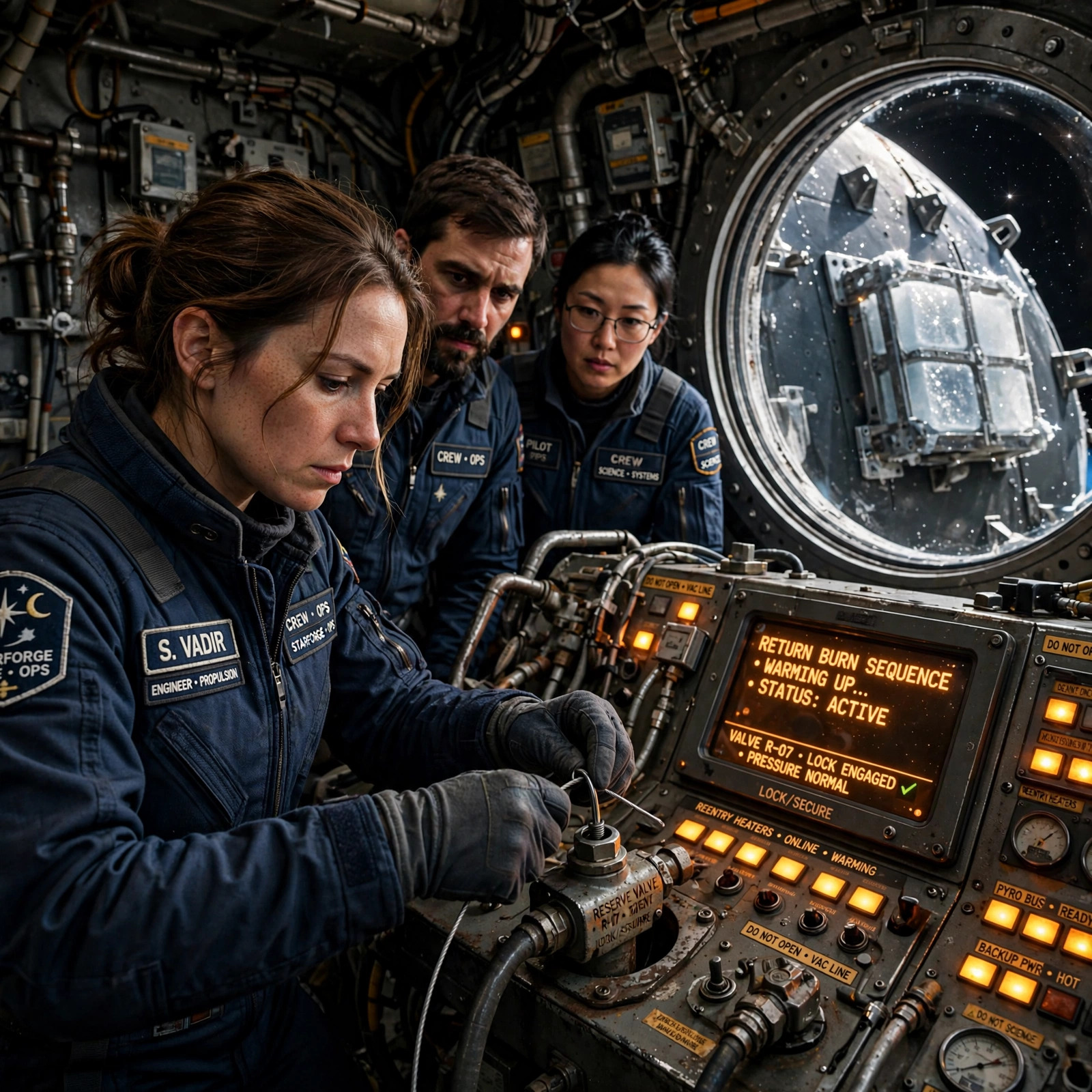
She knelt at the reserve valve. The isolation bar ran vertical along the line, steel, torque-set at the Kirkwall yard during the refit, wire lock threaded through its keeper and twisted off flat so nobody cracked it by accident. The wire was the last word between the reserve and the main engines. Below it, the readout that mattered: twenty-two days of consumable margin, held against the return leg like water against thirst.
The burn plan in her jacket said seven of them.
She took out the cutters. Her hands were steady, which she noted from somewhere slightly outside herself, the way one notes the temperature of a bath. One cut. The wire came free in a bright short curve, and the bar was hers to turn whenever Toben put his hand on it. She did not turn it. She put the wire in her chest pocket, threaded the cutters back through her belt loop, and stood.
"Wire's cut," she said. "Valve's still shut. I'll file the burn plan with the lock open in the log. If we don't fly it, the reserve never moves."
Michi watched her put the cutters away. "You know that's the same as deciding, on a ship."
"No," Sena said. "It's the same as being ready to decide. There's a version of me that cuts this wire and never turns the bar. She exists too. I'm keeping her alive for a few more hours."
Michi's mouth moved through something that was almost a smile and got talked out of it. "Bring it to the table," they said. "All of it. Not just the thermal. The cost."
She brought it to the table.
Ezra had the wardroom set up as it always was for a decision, which was the same way it was set for a meal, because on a survey ship those are the same furniture. He sat at the downlink station's portable terminal with one hand resting on it, not typing. Anke came in with the tablet and the gravity pair still glowing in its corner. Toben came last, drying his hands on his trouser leg, smelling of the wash-up.
"Sena cut the wire this morning," Sena said, because she had promised herself she would say it first, before anyone could carry it in for her. "The isolation lock on the reserve line is open. The valve is shut. I'm filing the diversion plan with the desk after this brief. I wanted you to hear the shape of it before the packet leaves, since none of you will get to argue with Kirkwall either."
Silence, for a moment, that had weight to it.
"Then let's do this properly," Ezra said. He turned his chair so he faced the middle of the table, and he did something Sena had watched him do over medical calls and mourning calls and one very bad cabin-fire call: he took the argument out of the air and put it on the table, one item at a time. "I'm going to run it as a crew question, not a survey question. The desk values the Shelf. All seventeen objects. That's the charter, and I'm not going to pretend the charter doesn't exist, because I'm the one who has to look at it every time we downlink. Sena's asking for a detour to a single object with a thermal anomaly we can't explain from here. Before we vote, I want each of us to say what it costs us. Personally. Not in kilograms. I'll go last."
Anke went first, because Anke always went first once a thing was asked plainly.
"It costs me the period," she said. "I've got a fit with no source in it. If we don't go, I spend the rest of the window staring at a blank line in a model, and then I spend the rest of my career doing it. That's a real cost. It's not the reason to go. The reason to go is that nobody has ever confirmed a warm ocean on a body this class, and I would be the one who had it in her hands and said file it under routine." She pushed the tablet to the middle of the table so they could all see the pair turning, Whitlock flexing along the line of the tide. "So my concession is this: if we fly it and I'm wrong, if the companion isn't there and the fit is coincidence, I'll write the dissent myself. My name on the wrongness. I'm not going to hide behind the desk's charter."
Toben had gone still in the way he did during approach math, when his body was just a place his mind was visiting. He said, "It costs me the window. The burn window opens tomorrow and holds about a day and a half. Fly the diversion and the return-phasing correction moves. I can get us home inside the margin — I've run it, I ran it twice last night after Michi went to bed — but it's a narrow thing. Narrow means I don't get to be tired, and I don't get to be lucky." He spread his hands on the table. "My concession: I'll fly the pattern that spends the correction margin first and my sleep second. If I get sloppy, Ezra benches me, and Ezra's not a kind bench."
"I'm not supposed to be," Ezra said.
"I know."
Michi spoke with their eyes on the mass ledger. "The rack. Spares for it are on the bench, and if we go, the rack gets built by Anke and me, out of the struts and foil we counted yesterday, that were supposed to see the Shelf. That's Shelf science in a bag. And the power case I've been asking for: I can run the capture sequence and the downlink priority together, but not the downlink and full thermal telemetry together, so something gets thinned every pass until we're home." They closed the ledger. "My concession: I'll thin my own margin first. Life-support runs lean through the flyby. I keep the scrubber on the low duty cycle and I don't get to fuss about it. If the margin drops under floor, I'm the one who has to say the word, and I'll say it. That's the job. I've just been avoiding saying it out loud for two days."
It was quiet enough to hear the air system change cycles.
"Sena," Ezra said. "Before me."
Sena looked at the wire in her own chest pocket, then took it out and set it on the table in front of her, a bright short curve of steel, the last thing standing between the reserve and the burn.
"It costs me this," she said. "I've spent twelve years on this survey. The Shelf is what I'm for. And the plan I'm about to file says I'll take the ship off the Shelf's survey line for one object that Kirkwall would call a curiosity, on a hand-fit and a period, with no source confirmed, and spend seven days of reserve we're only allowed to spend once. If it goes wrong, I'm the one who spent it. Not the desk. Not the model. Me." She turned the wire over once with her finger. "My concession: I'll hand the wire lock to the log before we burn. Evidence, first, that I cracked it before anyone told me to. I'm not asking forgiveness. I'm asking you four."
Ezra let it sit for a breath, then nodded, slow, like settling something into a rack.
"My cost is four hours," he said. "Every packet I send to Kirkwall is four hours old when they read it and four hours stale when their answer lands, and I have to look at their replies like they're current. That's my whole job on this ship, and it means the desk will never once be in the room when we decide anything. So my concession is the one I hate: I'll put this in the packet as executed decision, not request. I'll frame it so their answer can't retroactively hang any of you. It lands on me and Sena. Comms has to carry that." He looked around the table. "That's everyone paying. So I'm putting it as a question, and I want words, not nods. Do we fly the diversion to Whitlock, at seven days of reserve, to floor?"
"Yes," Anke said.
"Yes," said Michi.
"Yes," Ezra said, and wrote it down.
Toben hadn't said it yet. Sena looked at him across the table, and then the table didn't matter very much.
"Toben," she said. "Fly it."
He looked at her for a long second, and she watched him arrive at it the way you watch weather arrive — not a decision so much as a pressure that had been building all night finally finding its own level. "Yes," Toben said. "I'll fly it."
Ezra wrote that down too. Then he was up, and the wardroom broke into the small motions of a plan becoming work: Anke pulling the tablet back to mark the pair's predicted position at closest approach, Michi heading aft for the rack struts, Ezra already drafting the packet with his thumb on the terminal keys.
Sena followed Toben out through the short corridor to the engine-room doorway. He stopped there, one hand on the frame, and she stopped beside him, and for a moment neither of them said anything about burns or margins at all.
"For the record," Toben said, quietly, "I cut it loose the night Anke showed us the pair. I was just waiting for you to."
"I know," Sena said. "I cut it anyway."
He turned toward her in the doorway, and she put her hand flat against the front of his jacket, over the pocket where he kept his own copy of the burn card, and he leaned down and kissed her, unhurried, like people with a day and a half of window and a morning still to spend on it. Somewhere aft, metal clinked against metal as Michi pulled the first struts off the bench.
They broke apart when Anke's voice came down the corridor: "If you two are done filing that, I need the pair run again before lunch."
Toben laughed against Sena's forehead, once, and straightened up. Sena walked with him into the engine room, past Michi and the rack spars laid out on the deck, to the workbench bolted at the aft frame. She took the cut wire from her chest pocket, screwed it down flat on the bench where everyone in the compartment could see it — wire lock, cut morning of Day 91, by her hand, before any of them had said yes — and then she took the burn card out of her jacket, the diversion plan with the reserve line reading fifteen days at the bottom, exactly the floor, not a day of it hidden, and put it in Toben's hand.
"File it after the burn brief," she said.
"After," Toben agreed, folding the card into his pocket. He looked at the wire where she'd pinned it to the bench, bright and short and finished with, and then at the four of them standing in the engine room around it. "Burn brief, twenty minutes. Michi, bring the rack mass. Anke, bring the pair. We go tomorrow."
Three Hundred Meters
The burn came at 04:12 on Day 92, and Sena felt it the way you feel a tide, in the floor and the throat at once. Twenty minutes, the brief had said, and Toben flew all twenty of them with his hand loose on the throttle and his eyes on the reserve line, and when the engines cut, the number on the board had gone from twenty-two to fifteen and stopped there, exactly where her burn card had promised it would. Michi read the tank telemetry aloud anyway, twice, the way they did when a number was too important to say once. Fifteen days. The floor. Not a liter past it.
"Clean," Toben said, and unstrapped his hands from the board one finger at a time, like a man putting down something with a temper.
Ezra had the packet shaped before the residual vibration had died out of the hull: burn executed, margin at floor, executed as a crew decision, timestamped, signed by five names. "It goes out on the next high window," he said. "Four hours to Kirkwall, four hours back, and the answer lands long after the flyby's old news. Whatever they say, it says it to a done thing."
"Good," Sena said. "I'd rather ask them to forgive a measurement than to authorize a hope."
Anke had the pair model running before the engines had cooled. She sat with her knees up against the forward frame and the tablet in both hands, and she didn't look at anyone for a long while, and Sena let her not look. The model said the companion would swing Whitlock's near side toward them at closest approach, trailing hemisphere in view, vents sunward-dim, at 300 meters. The model also said, in smaller numbers, that it could be wrong by a fraction of a degree, and a fraction of a degree at that range was the difference between the bright hemisphere and the flat one.
They spent the rest of Day 92 on approach, and Sena slept badly in shifts, and Toben slept worse. Michi moved through the ship like someone carrying a tray of eggs, easing the scrubbers down to their lean setting, logging every watt-hour twice. The rack sat in the aft frame, brazed and hand-fitted, aerogel foil still smelling faintly of the heat gun, and Anke checked its seals on every pass she made to the galley, which was more passes than tea required.
At 06:40 on Day 93, Whitlock filled the forward optics: a gray potato of a moonlet, forty-some kilometers of dirty ice, its sunlit limb flat and dull as old paint.
"Trailing hemisphere comes up in forty minutes," Anke said. "If we come in on the number."
"We come in on the number," Toben said, and brought them in.
They crossed the terminator at 300 meters, close enough that the surface stopped looking like geology and started looking like weather, like a landscape, like a place. Sena had her thermal rig on the nightside before it was fully in view, and the trailing hemisphere bloomed under the false-color the way it had bloomed for five nights from a distance, except now she could see what the brightening was made of.
Vents. Fields of them. Ridge after ridge of parallel cracks, and along the cracks, at intervals too regular to be random, dark patches running warm, four, five kelvin warm, breathing together. On the nightside, where nothing but the body's own heat should have shown, the whole trailing face glowed like embers under ash.
"All of them at once," Sena said. "Look at the time stamps. Anke. They're all breathing on the same clock."
Anke had the period already. "Forty-seven minutes," she said, and her voice had gone quiet and very steady, the voice of someone checking a number she had checked for four days. "Same as the brightening. Same as the model. Sena, it's the pair. The whole shell is flexing. Every vent, the same line, every cycle."
Then the first pass ran long, and the doubt arrived on schedule.
"Hemisphere's wrong," Toben said. Flat, fast. "I've got the drift high. We're coming in on the sunward face; the vent fields roll out of view in nine minutes and I need eleven for the rack run."
"Correction budget?" Sena asked, though she already knew it, because she had written the plan that left none.
"I don't have one," Toben said. "The margin I kept was for error, not for rerouting. If I burn to turn, I'm spending correction I'm not carrying, and I'm doing it with the return date fixed." He had both hands on the board and he wasn't looking at her, and that was the most frightened she'd seen him since the wire came off the valve. "The turn is point-three. I can do it on the thrusters alone, but it costs more than the main, and it costs it out of the same fifteen days."
The ship swung on, and Whitlock turned under them, and the warm fields slid toward the limb.
"Michi," Sena said. "Can life-support carry a seven-hour lean past the floor?"
Michi was already in the numbers. "It carries it badly," they said. "It carries it. If Toben's turn costs less than half a day of reserve equivalent, I can find it in scrubber duty-cycle without touching the return mass. It's coming out of sleep and heat, not out of the tank."
"Then it's coming out of us," Toben said.
"It's coming out of all of us," Ezra said. "That was the vote we already had."
"Do it," Sena said, and it was the second time in three days she'd said those two words to Toben with a door closing behind them.
He flew the turn by hand. No autopilot, no platen; he rolled the Halcyon Sweep thirty degrees over the vent fields with the thrusters coughing in short pairs, and the surface came back around, and the warm patches crossed the centerline of the optics with two minutes on the margin. Sena watched him do it and understood, in a way she hadn't from the plan's pages, what he had spent: the correction he didn't have, the sleep he didn't have, the years of hands that flew this clean. When it was done he let out a breath and put his forehead briefly against the coaming, once, and then sat up like nothing had happened.
Below, in the plume sheen, Whitlock was venting.
The fields breathed out on the 47-minute line, not a geyser but a haze, a slow frost-lift of vapor and entrained grains rising off the warm cracks and falling back in slow arcs, curving to the left, all of them, every plume bending the same way, and Anke said, "They're all bending with the companion's pull. Look at the arc radius. Sena, I can read its mass right off the plumes."
She could. She ran the gravity residuals against the track while Michi ran the rack and Toben held the line at 300 meters, and the residuals didn't argue; they agreed, cycle after cycle, and at the end of the pass Anke turned the tablet around on its tether so they could all see the fit.
"Companion's real," she said. "Fifteen kilometers, in close mutual orbit. Thirty-one-minute period on its own revolution, forty-seven on the flex. It's there. It's been there the whole time, and the flex is the tide, and the tide is what pumps the heat." She stopped. Nobody said anything. "It's an ocean. Under a thin shell. A warm, circulating, briny ocean, on a body the catalog calls inert. First one confirmed in this whole class."
Michi's voice came up the intercom from the aft frame, breathless in a way Michi never was. "Rack's loaded. The sheen ran straight through the foil, salt residue and all, and the seal's holding pressure. I've got salt in the cells. Actual salt."
"Not tea," Sena said, and heard the others laugh, short and stunned, in four different keys.
Ezra started the downlink build. He built it plainly, no advocacy, no poetry: period confirmed at close range, flex synchronized across all observed vent fields, gravity residuals consistent with a 15-kilometer companion in mutual orbit, thermal transport consistent with a subsurface circulating ocean beneath a thin shell, sample captured, reserve at floor. "Four hours to Kirkwall," he said, keying the lock. "Whatever they send back, the companion's orbit is fixed in the record now. Nobody unsays it."
Whitlock fell away behind them, its warm face dimming by degrees as the range grew, still breathing on its own long clock with nobody to watch it. Sena keyed the downlink herself. Behind her, in the aft frame, the capture rack sat sealed and pressurized with its cells of salted ice, and the plume frost shone on the foil like a hoarfrost that had decided to be a receipt.
The Sealed Rack
Day 94 began with a number Sena did not want and could not argue with: fifteen. Fifteen days of consumable margin, held against the return leg, and not one day of it hers to spend. The phasing correction Toben had filed for the overnight burn had gone through clean, twenty seconds of trim, and the ledger showed the reserve exactly where the flight rules drew their hard floor. She read the figure twice at her station, then a third time, and made herself leave it alone.
"Holding at fifteen," she said to the engine room at large. "Anyone who wants to argue with the floor, the floor wins."
"Nobody's arguing," Michi said from the power board, hands flat on the rail. "I did my arguing on Day 90. I lost. I'm at peace with it." They weren't, entirely -- the scrubbers were still running the lean duty-cycle Toben's correction had paid for, and Michi checked the differential pressure readouts the way other people checked a healing cut -- but they said it evenly enough.
Anke came forward with the gravity residuals still drying on her tablet, figuratively speaking; she had not fully put the thing down since the pass. "Phasing's good," she said. "We're on the return track, no second trim needed. The companion's fixed in the fit to the last meter I can claim." She caught Sena's eye. "You know what's still on my mind. The desk. Four hours each way, and we sent the whole record last night. Whatever Kirkwall is, it's had time to read it by now."
"Then we wait for the mail," Ezra said. He was at the comm bench with the medical watch running on the second screen, because he was the only one of them who would admit to checking everyone's pulse and hydration numbers twice a shift. "For the record, I'd like to say I'm calm. I'm not calm. I've drafted six versions of an apology and deleted all of them."
"Good," Sena said. "Keep the seventh. We didn't do anything requiring an apology."
"We spent seven days of margin nobody authorized us to spend."
"We spent seven days of margin on the first confirmed warm ocean body in its entire class," Toben said from the pilot's seat without turning around. He had slept -- badly, in shifts, and it showed in the way he sat, but he had slept, because Anke had stood the watch and made him. "I'll write my own apology if it comes to that. It'll be one sentence long."
The reply came up the link forty minutes into the second hour, and it was Ezra who saw the packet land. He went very still, which was how they all knew, and Sena stood up without deciding to.
"It's addressed to the whole crew," he said. "Not to the survey lead. All five names on the header." He keyed it to the main display before anyone could ask him to.
It was short. Kirkwall Deep Station, Mission Operations, day 94 by ship's count. They had received the full data record: the 47-minute flex period confirmed at close range, the synchronization across every observed vent field, the gravity residuals, the 15-kilometer companion in its 31-minute mutual orbit, the thermal transport model, and the sealed sample. The review board had convened on receipt. Their finding, in the desk's flat house style, was that the diversion was endorsed after the fact -- that the science return constituted a class-first confirmation, that the reserve position at the floor was within flight rules as executed, and that the burn plan filed on Day 91 had been complete, honest, and correctly framed as a crew decision under the comms constraint.
Then a line that was not in the desk's flat house style at all, and Sena suspected someone had fought to put it in: The board notes that the crew's judgment in the absence of reachable instruction is the standard the instruction exists to produce.
Nobody spoke for a moment. Michi's hands came off the rail.
"Endorsed after the fact," Anke said, slowly, tasting it. "That's not forgiveness. That's not even permission. That's them saying we were right."
"It's them saying we were right and they can't reach us in time to matter," Ezra said. "Both things are true and they know it. Read the header again -- all five names. They're not going to hang one of us out."
"They're not going to hang any of us out," Sena said. Her voice came out steadier than she expected. "Because there's nothing hanging. The companion's orbit is in the record. The salt is in the rack. The ocean is under the shell whether anyone at Kirkwall likes it or not." She looked down the length of the ship, toward the aft frame. "Michi, how's our cargo?"
"Sealed and holding," Michi said, and for the first time in three days there was no hedge in it. "Pressure's flat across all cells. The foil took the sheen straight through -- salt residue in the first cell, plume frost in the second, and the seal's rated for the whole return leg plus change. I torqued every fitting on that rack by hand and I'd put my name on each one." They paused. "I did put my name on each one. Anke brazed, I fitted, and the manifest says so."
"Then it says what's true," Sena said.
There was one more thing in the packet, and Ezra read it aloud because it was operational and the desk's operational language was worth hearing in a human voice: the return leg was approved as filed, with 233 days left in the window, reserve floor unchanged at fifteen days, no further discretionary burns authorized without reachable instruction. Bring it home, the packet finished, which was not operational language at all, and Ezra let that sit in the room without comment.
Sena went aft.
The engine room was cold in the way it always was, cooled air moving over steel that had no reason to be warm, and the reserve line ran along the port bulkhead with its isolation bar seated and its wire lock cut. Her cut. Day 91, her own snips, her own hands, while the burn plan was still encrypting on the uplink. The lock was a simple thing, a soft steel wire through the bar's torque collar, twisted and tagged, and its job was not to stop the valve -- the valve did not need stopping -- but to say, to anyone who came after, someone opened this on purpose, and here is who. The tag with her name on it still hung where she had left it, off its broken wire.
She had a fresh lock in her pocket, pulled from the spares drawer that morning along with the snips and the torque wrench. She had not told anyone she was doing it. It was not the kind of thing you announced; it was the kind of thing the others simply noticed, one by one, and drifted aft for.
Toben came first, because he was nearest, and leaned on the bulkhead with his arms folded. Then Anke, tablet still in hand out of pure habit. Michi came from the power board and stood where they could see both the rack's pressure line on the repeater and Sena's hands. Ezra arrived last, carrying the medical watch on his wrist unit, and did not pretend he had come for any reason but this.
"The desk endorsed it," Toben said, quietly. "Doesn't change what we did. Only what it costs us."
"It costs us nothing now," Sena said. She threaded the fresh wire through the collar, through the torque eye, and took up the slack between her fingers. "The cost was paid on Day 92 and it was paid at fifteen, and fifteen is where we still are. That's the whole accounting." She looked up at the four of them, and let herself say the rest, because they had earned the plain version. "I cut this lock before anyone could tell me no. I'd do it again. I want the record to show I closed it with the same hands."
Anke's hand landed briefly on her shoulder and stayed. "It'll show."
Sena twisted the wire. The fresh steel took the torque the way good wire does, with a small resistance that meant it was seating, and she wrapped the tail three turns flat against the collar and set the tag -- her name, the day, reserve line, closed, return leg -- and bent it down out of the way of the next pair of hands, whoever they were, years from now. She ran the wrench over it once more than the procedure asked for. Then she pressed her thumb against the collar, against the cold steel of the line that had carried them to a warm ocean and back to the edge of home, and felt the faint shiver of the return clock already counting under it.
"Burn clock's started," Michi said, reading the repeater. "Return leg. First window's clean."
"Then we're going home," Toben said, "with salt in the hold."
The five of them stood in the cold of the engine room and watched the clock run.
Get notified when new stories drop

Ava Kepler
Ava writes space exploration and cosmic adventure with competent crews, hard problems, and awe that earns its hope.
Leave a comment
Comments