



Forty Beds
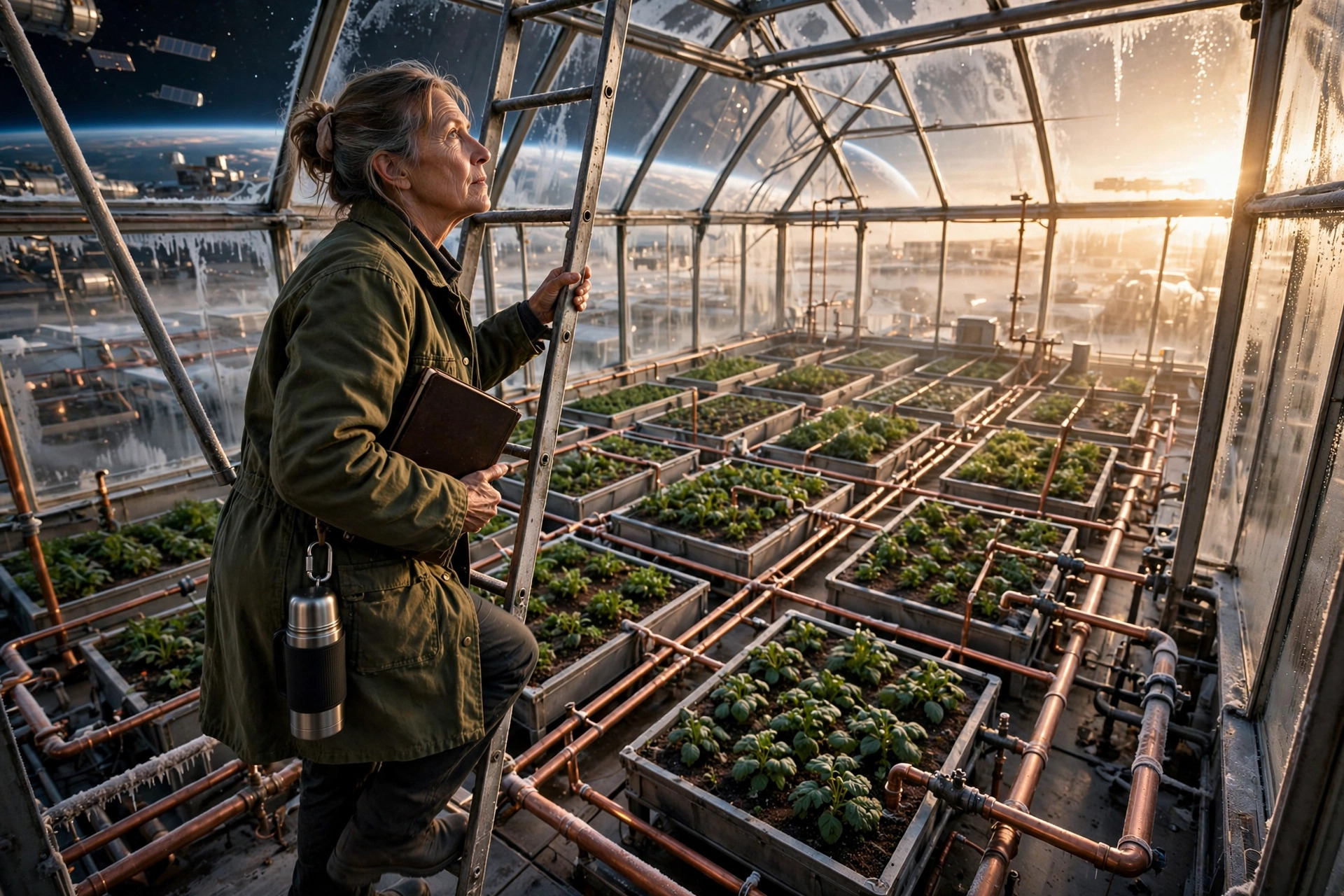
The roof of Verday Rise caught the first sun before the streets did, and Mireille Kessou had learned to read the whole day off it: the frost gone thin on bed 3, the condensate beads on bed 3's glass gone from white to clear, the pipe cradles on the north rail still holding yesterday's heat in a faint shimmer of thawed air. She climbed the last ladder rung with the ledger wedged under one arm and her thermos clipped to her belt, because the ledger always came up with her and the thermos had earned its place over nine winters of mornings exactly like this one.
Forty roof beds. Three kilometers of shared pipe threading through two hundred and fourteen households, and every metre of it answered to somebody she could name. That was the whole design, really. Not the glycol mix, not the coupling tolerances. The answering.
"You're early," Sefu said from bed 7, where he was kneeling with a torque wrench across his knees and a copper name-tag blank between his teeth. He took the blank out. "Even for you."
"The condensate line on 12 was breathing funny last night. I heard it through the wall."
"You hear pipes breathe now."
"I hear my bedroom wall tick. It's a gift." She set the ledger down on the cradle rail, out of the drip line, and flipped it open to yesterday's page. Hand-kept, like all of it: column after column of temperatures in her own small script, night-load figures Sefu's crew called in at midnight, the return temperatures off the grow beds, the draw from the kitchens that ran their waste heat into the loop. Nine years of winters lived in that book's spines. "Return temp on 11 dropped again. Third night running."
Sefu stood, wiped his hands on his thighs, and came over. He read upside down the way he always did, lips moving. "Two tenths?"
"Point four. Cumulative it's nearly two degrees against the November baseline, and November was cold but it wasn't this cold."
"Could be load. Everyone's cooking more."
"Bed 11's the only one drifting. If everyone on the east run were cooking harder, beds 10 and 12 would drift too." She tapped the page. "It's the coupling. It's been ticking since the equinox service."
"I know." He said it quietly, without argument, and she hated that a little, because she had been postponing that repair for a month and they both knew it. A full-pressure test meant shutting the east run down for a day, meant twenty-six stewards re-routing heat by hand through the bypass, meant going door to door on the east side and telling people their showers would run tepid until sundown. It meant arguments. She had scheduled it, unscheduled it, scheduled it again as "next week" three times running, and Sefu had let her, which was its own kind of statement.
"Next week," she said. "For real this time. I'll do the door rounds myself."
"You always say you'll do the door rounds yourself."
"And I always do them."
"Two days late, with apologies." He smiled when he said it, and she let it go, because he was right and because the morning was too pretty for the other conversation, the one they were both circling.
She walked the beds while he went back to his wrench. That was the walk: bed 1 through bed 40, rail to rail, reading glass and pipe and soil with her hands as much as her eyes. The winter lettuces on 14 needed thinning. Bed 22's vent was sticking half a centimeter open; she noted it. Bed 29's trellis twine had snapped in the night wind and a vine lay across the rail like something asleep, and she set it right before writing that down too. This was the ledger's other half, the half that wasn't numbers: a running memory of what the loop did when nobody was watching it.
She was at bed 11 when Amara came up.
You could hear Amara's tread anywhere, a deliberate flat-footed clang of boots on roof steel that she had never once softened in sixteen years of climbing these ladders. She had welded half the cradle joints on this roof with her own hands, back when the Commons was four families arguing in a kitchen about whether a shared heat main was socialism or just sense. She carried a mug of tea she had no intention of drinking, Amara's way of making any walk look casual.
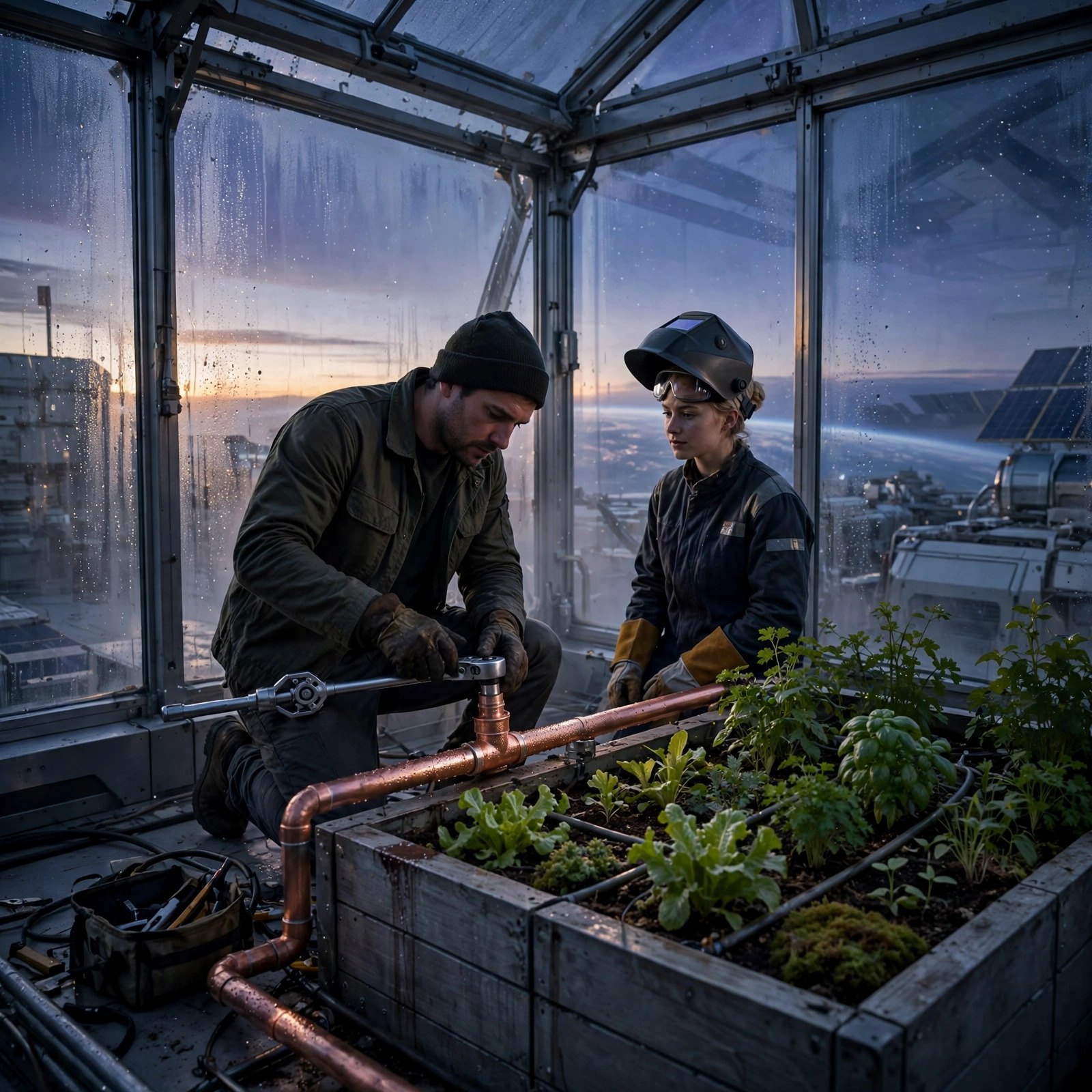
"Eleven again," Amara said, looking exactly where Mireille was looking, at the coupling where bed 11's supply line met the rail manifold. There was a faint bloom there, no wider than a coin: heat tape's adhesive gone dark at the edge, a small seep of glycol residue dried to a crust along the seam. Not a leak yet. A letter of intent.
"You've got the eyes."
"I've got forty years on this hill and I know what dry looks like." Amara crouched, joints cracking like the pipes did at midnight, and pressed two fingers to the crust. "It's weeping under pressure. Not at rest. You'll only see it when the loop's loaded."
"I know," Mireille said. "It's on the book for next week."
Amara looked up at her, and there was a whole speech in the look, and Mireille was saved from receiving it by a voice from the stair head.
"There you both are." It was one of the morning crew, breathless from the climb, a courier bag slung wrong across her jacket. "Sorry. Mireille. There's a packet at the hall. Ward Four Hall, just opened, it's on the dais for public viewing. Clearline Power. It's a bid." The courier hesitated, then said the rest in a rush. "It's a bid for the loop."
Amara's fingers came off the coupling slowly. "For the loop."
"Retrofit. Full closed-loop automation. It says the model shows better efficiency than community operation. Seven percent." The courier said the number like she was apologizing for it. "It went on display this morning. Council votes on it in five days."
The wind came over the north rail and moved the lettuces on 14, and the pipe ticked once, twice, in the way Mireille knew by heart, the sound of heat moving through a body of steel that she thought of, most days, as something almost alive. Not a machine. A load. A living load that everyone on this roof carried a piece of.
Twenty-six stewards. A paid crew, small money, real money, money that let Toma's crew chief keep her mother's flat heated and let three of the young welders learn a trade on these rails. Two hundred and fourteen households whose heat was answered by a neighbor with a key, not by a dispatch queue in some other district. A retrofit meant sensors meant remote valves meant a model meant, at the far end of all that arithmetic, nobody on this roof at six in the morning with a ledger under her arm.
Amara said, "Seven percent of what, measured by whom, over which winters?"
"That," Mireille said, "is the question."
"Their model won't have our winters in it," Sefu said from bed 7, not looking up from his wrench. "I've seen those aerial survey contracts. One flight, one day, one load profile. Our load doesn't even peak until the second week of a real cold snap, and their drone would've flown in October."
"So we go to the briefing tomorrow and we say so," Amara said. "With the ledgers. Forty hands and forty nights of return temps."
"We say so," Mireille agreed, and heard the shape of her own voice go soft around it, the way it did, the way it had done in every meeting where saying so fully would have meant standing in front of somebody and not moving. She heard it and she did not correct it, and Amara heard it too, because Amara heard everything.
"The briefing's at the hall tomorrow," the courier said, retreating backward down the stair, done with her errand and glad of it. "Ten in the morning. Dorian Vance is presenting it himself."
Gone, down the ladder, boots ringing away into the ordinary morning.
Amara straightened with effort and stayed standing, hands wrapped around her cooling mug, looking down the whole length of the roof: forty beds, three kilometers of run beneath and beyond it, smoke rising thin and straight from two hundred kitchens that this loop fed in every sense. "You know what I think of bids," she said. "I was in the kitchen when they drew the first pipe route on a tablecloth. Four families. One welder." She turned the mug in her hands. "Nobody hands you a thing like this and means for you to keep what you already have."
She left it there and went down the ladder, tea untouched.
Mireille stood a while at bed 11, at the small dark bloom on the coupling, and wrote it in the ledger with a steady hand: seep at coupling, full-pressure test required, booked next week, door rounds east run, M.K. Then she closed the book and put it under her arm and took out her phone, and stood on the sun-warmed steel with her thumb hovering over the screen, over Sefu's name, over Amara's, over Nia Tesso's, over the whole list of people she could call right now, this hour, before anyone's position hardened and before tomorrow's briefing gave Clearline's numbers a podium to stand on.
Instead she put the phone away unthumbed, took the brass key off its cord, and ran her thumb along its worn teeth. Amara had cast it the year the loop first fired, filed the bit down by hand, and hung it on Mireille's neck at the cabinet with a sentence about what it meant that Mireille could still recite and would not, not even alone, because it deserved better than a memory recited at a roof rail. The key had opened the control cabinet for every steward crew since there had been a crew. It was warm from her skin.
Five days until the vote. One week until the repair she had already put off a month. Tomorrow, a briefing, and a man with a model.
She could call Nia now. She knew that. She also knew that if she called, Nia would ask her what the Commons offered that Clearline's numbers didn't, and Mireille would have to answer with the thing she had not yet found a way to say out loud without her voice going soft: that the ledgers were proof and the stewards were proof, and proof only counted if you made someone stand still and look at it.
So: not yet. Tonight she would walk the east run and look at bed 11's coupling again under load. Tomorrow she would listen to every number Vance had before she answered any of them. And the next day, or the day after, when she had the shape of it, she would stop being careful.
She said none of this. She dropped the key back against her sternum, took up the ledger, and went up the rail toward bed 12 and the condensate line that had been breathing funny through her bedroom wall, because the loop came first, every day, even the days when the sky was about to fall on it, and there was frost to check and forty beds to walk and the sun was not yet an hour high.
Sefu fell into step beside her without being asked, the way he had for seven years, wrench over his shoulder, and neither of them said anything, and the pipe ticked along under their feet, carrying the morning's heat to two hundred and fourteen homes.
The Sealed Packet
Ward Four Hall smelled of floor wax and cold coffee by the time the third row filled. Mireille took a seat at the end of it, near the aisle, because the aisle meant she could stand without climbing over anyone's knees. The brass key lay against her sternum under her collar, and she caught herself pressing it flat through the fabric, twice, before the dais microphone clicked on.
Nia Tesso stood behind the podium with a paper agenda, which Mireille took as a small mercy: paper meant no slides. "Evening," Nia said. "We're here for the public briefing on the Clearline retrofit bid, which has been on display since yesterday. Council votes in four days. Questions at the end, and I'll hold us to that." She turned the podium over without smiling.
Dorian Vance did not use the microphone stand so much as lean a hip against it, comfortable, like a man who had given this talk in a dozen halls. He was younger than the room expected, Mireille knew, and the room had already decided what to do with that: forgive him for it. He held up the bound packet from the dais table, turned it so the cover faced the rows.
"Everything I'm about to say is in here," he said. "Nothing I say tonight isn't. That's the first thing I'd ask you to hold me to."
It was a good opening. She hated that it was a good opening.
"Clearline's model runs a closed loop, automated, self-balancing, with pressure regulation at every junction instead of at the cabinet." He said it plainly, no flourishes, and behind him the projector fan hummed. "Against the current Verday Commons configuration, the model shows seven percent better delivered efficiency over a heating season. That's the honest number. Not fifteen, not twenty. Seven. It's real, and I won't inflate it."
Someone two rows back whistled low. Mireille did not turn around. She knew the whistle. It belonged to the Okonkwo kitchen, and the Okonkwo kitchen paid its winter bill in installments, and seven percent was a number that would sit in that kitchen all night doing arithmetic.
He walked them through it cleanly. Sensors at each of the forty roof beds. Local flow correction without a crew dispatch. Predictive load-balancing against weather feed. He did not say the word stewards once, and Mireille sat with that absence, the way you sit with a draft you can't find the window for. When he reached the labor line, he did not soften it, either.
"The model assumes no on-parcel crew," Vance said. "The Commons currently pays twenty-six stewards. The retrofit would end those positions as paid roles. I'm not going to pretend that's a footnote. It's the largest line in the model and it's where most of the seven percent comes from."
The room went quiet in a specific way, the way a hall goes when everyone has just done the same subtraction. Mireille felt it happen across her shoulders. Twenty-six people. Twenty-six pay packets. The roof rail crews, the frost walkers, the two teenagers who had learned soldering on bed 22 over a summer and come back as apprentices. Sefu's bench with its stamped copper tags, waiting to be punched for hands that the model had already erased in a spreadsheet cell.
Her hand was up before she had decided to raise it. That was new. Usually she decided first, and decided against.
"Questions," Nia said, "after the overview. Two more slides." Mireille's hand came down. She wrote in her notebook instead: closed loop to whom. Then, because her pen kept moving: aerial survey, which day. Then she underlined it, hard enough to gutter the paper, because that was the question. She knew it was the question. One day of aerial thermal, shot from a drone in October cold, against nine years of handwritten ledger columns. Sefu's walk sheets, Amara's coupling notes, the whole winter-load record that existed nowhere but in their own hands, because their mesh never left the neighborhood. Clearline's model couldn't see any of it. It had never been offered it. And she knew exactly where the survey's assumptions would go soft in a hard February, which was bed 11, where the coupling had been seeping under load for a month while she postponed the test that would prove it.
She had a month of that postponement in her own handwriting, too.
Vance finished. Nia opened the floor.
A man from the market row asked about pipe replacement schedules. Vance answered with page numbers, honestly. A woman asked about winter failures, and Vance said, "The model routes a dispatch within four hours," and the woman said, "Four hours in February," and he said, "Yes. Four hours in February," and did not argue, which was somehow worse than if he had.
Mireille stood.
"Mr. Vance. The Commons loop serves two hundred and fourteen households across three kilometers of shared run. Your model's input, the thermal baseline." She heard her own voice start strong and begin to smooth, the way it did, the way it had at the zoning meeting in the spring and the rates meeting before that. "Was it surveyed... over what period?"
She had meant: one day, wasn't it. One flyover. She had meant to put the whole thing on the table, the ledgers, the hand-kept winter record, the difference between a model of the loop and a memory of it. She had rehearsed it on the walk over. She had the pages folded in her jacket.
"One day of aerial thermal, October ninth," Vance said, into the silence she was making. "It's in the appendix. The model normalizes for seasonal load." He paused, and then he did something that undid her: he answered the question she hadn't asked. "If you've got ground data that contradicts the baseline, I'd genuinely like to see it. I can't model what I'm not given."
He said it fairly. Fairly was the problem. Nia's pen had stopped. The room was waiting, and it was hers, the floor was hers, the ledgers were in her jacket against the key.
"It was one day in October," Mireille said. "The loop in October isn't the loop in February. I'd just... I'd ask the council to weigh the season. That's all." She sat down.
That's all. She heard it leave her mouth and land as nothing, a polite footnote, the kind of objection that gets thanked and filed. Four rows ahead, someone turned around, and she met the eyes of a woman from the east run who had spent last February with her sleeves rolled to the elbow in a roof hatch while Sefu's crew bled a joint. The woman's face asked a question Mireille could not answer from a chair.
Nia's gaze held on her a second longer than procedure required. Then: "Any further questions for the district office?"
Afterward, in the loose crowd by the doors, Vance found her. He did it without hurry, letting the market-row man finish his pipe-schedule questions first, and when he reached her he offered his hand and a card in the same motion, which she took because refusing would have been its own performance.
"Coordinator Kessou. Dorian Vance." He didn't need to say it; she knew. "I meant what I said about ground data. And I'll say one more thing, off the record, which I'm saying to you because someone told me you're the person who actually keeps the record." He glanced at the card in her fingers. "Clearline funds a transition liaison post for the first year of any conversion. Community-side. Paid. It's a real job, not a severance with a title, and I'd want it filled by someone the crews would actually follow." A beat. "I'd want it filled by you."
The number he named was annual, and it was larger than her Commons stipend of eighteen thousand four hundred, and both of them knew it, and neither of them said so.
"You'd be inside the model," he said. "Where the data is. You've spent nine years being the memory of that loop. Come be the memory of this one."
She put the card in her jacket pocket, under the folded ledger pages, where the two things pressed together in a way she did not examine.
"I'll think about it," she said. He nodded, satisfied, as if that were a signature.
The packet stayed on the dais, sealed, its cover still turned toward the emptying rows. She looked at it once from the aisle. One day of aerial thermal. She had let the question die in her throat in front of two hundred people, and the packet would sit there sealed through four more days of exactly that.
In the stairwell, the sound found her before she reached the bottom step. The east-run woman, and the Okonkwo woman, and a third voice she placed as the man from the condensate line, all talking at once, low and fast, not waiting for turns. Seven percent. Four hours in February. Twenty-six jobs. One of them said, "She asked about October," and another said, "That's what she asked," and the first said, "That's all she asked," and the words came up the stairwell after Mireille like water finding a low place.
She stood on the third step with her hand on the rail and listened to her neighbors do, in a concrete stairwell with their coats half on, the thing she had failed to do under a microphone with her own pages in her jacket. She let it wash. She did not go down. On the walk home she would take out the card and the ledgers together, and she would have to look at which one her thumb went to first.
Bed nine
The seep showed itself at first light, the way it always did, only under load. Mireille went up the east stair with the morning walk list in her mitten, and there it was: a grey crust on the snow under bed eleven's coupling, a coin's worth of mineral where yesterday there had been clean white. She crouched. Put her tongue of habit near it, didn't touch, and read the crystals instead. Loop water. Hot loop water, forty degrees if it was anything, escaping as a bright thread of steam that froze the instant it cleared the flange.
"Sefu," she said into the mesh. "Bed nine. It's weeping."
His voice came back tinny and half-asleep. "Weeping or venting?"
"Weeping. For now." She stood and put her palm on the header pipe above the coupling. Warm. Good. The bed was holding heat for all six flats under it. "I'm going to walk it down to load before noon. If it opens, I want your crew here."
A pause with wind in it, from his end of the roof to hers. "You told me Tuesday you wanted to leave it be until after the vote."
"I know what I told you." She was already uncoiling the walk list and writing eleven at the top in pencil, pressing hard enough to score the page beneath. "That was Tuesday. It's Thursday, and it's worse."
What she did not say into the mesh, because the mesh carried and half the loop listened: a month of postponement was sitting under that crust, and she knew whose month it was. She had logged the fatigue flag on the coupling at the autumn inspection and then, week after week, moved the pressure test down the page, past the harvest shuttles, past the ward meetings, past the day the Clearline packet went up on the dais at Ward Four Hall with its sealed cover and its seven percent. A repair before the vote would be a repair under cameras. A failure before the vote would be worse. So she had banked it, quietly, the way she banked other hard things, and the frost had kept the account.
Amara was already at the archive door when Mireille came down, which surprised her, because Amara did not do mornings. The old welder had a thermos and a look on her face like a woman who had been awake since four.
"You're early," Mireille said.
"I'm old. Early is all that's left." Amara held up a ledger box, grey board, string-tied, the kind the Commons had stopped using before Mireille's time. "The founding shelf. I went up for the weld logs and the shelf made me rude." She set the box on the workbench and began, without hurry, to untie knots that had been tied by someone who believed in them. "You walked eleven this morning."
"It's seeping."
"Mm." The knot gave. Amara lifted the lid and the smell of dry paper came off it, warm and dusty, nothing like the cold. "You know what I keep thinking about that man's model."
"Which part," Mireille said, and heard her own voice go flat and diplomatic, the hall voice, the one that had let her question die in her throat two nights ago while two hundred coats went on around her.
Amara looked up at her over the box. "All of it. But mostly that it's a picture of our roof taken by an airplane in October, and he's asking the ward to sign it into our ground." She turned a page, then another, slow, her thumb smooth along the edges. "You know what a charter is, girl. It's not a plan. It's a promise with teeth. When we fired this loop, we wrote down what it was for, and what it owed, and to whom. I helped file it, and I have not looked at it since, because you don't look at your own promises, you keep them." Another page. Then she stopped.
Mireille saw it happen: the older woman's whole face changed, not startled, more like a wall finding a stud.
"Amara?"
"Hm." Amara put one finger flat on the page, did not lift it, did not read aloud. Her mouth set. Then, deliberately, she turned the page face-down, squared the papers, and retied the string, and the knot she tied was harder than the one she'd found. "Nothing you need this morning. You've got a weeping bed."
"Amara. What did it say."
"It said we wrote something in 2032 that I need to read twice before anybody goes shouting it in a stairwell." She stood, tucked the box under her arm like a loaf, and her eyes were bright in a way Mireille had seen only once before, the day the loop first fired. "Tomorrow. Maybe Friday. I want it exact. You go hold your roof together, and when I've got it exact, you and I will go say it in the right room, in the right order, with the right name behind it. Not like your footnotes." A gentleness under that, but the sentence landed anyway. "Go on."
Mireille went, with the flat taste of that in her mouth.
The pressure walk began at ten. Sefu brought four of the crew up to the roof with hand trucks and spare gaskets and the long torque wrenches, and Mireille stood at the cabinet with the brass key warm on its cord against her throat and opened the controller, and they loaded the bed in steps, ten percent, twenty, watching the frost line on the pipe shrink back toward the header. At sixty percent the seep turned from thread to plume. At seventy it vented, a clean white gas hissing out of the coupling seam, loud in the cold, six meters of it, and every crystal of it snowing down glittering while Sefu's people moved fast and calm and got the bed isolated in under four minutes, which Mireille timed, and wrote down, and underlined.
"Eleven's off loop," Sefu said into the mesh. "Six flats on the bypass line. Nobody's cold. Nobody's dropped." Two hundred fourteen households on the count sheet, and after the vent the count sheet read the same, and Mireille read it twice to be sure.
They could have called the district crew. There was a number for that, on the packet's back page, a dispatch queue, four-hour response, November to March. Instead the stewards fixed it themselves, and the fixing took the rest of the day and half the night.
The coupling came off in the last light, with the roof lamps up and the frost already thickening on the parapet behind them. The fatigue crack ran three-quarters around the collar flange, a dark hairline that Sefu traced once with a bare fingertip and then cleaned with solvent, and they all stood looking at it, because a thing like that doesn't argue. It had been a month from flag to failure, and it had chosen a Thursday in November, with a vote in two days, to make itself plain.
"Could've gone in February," Sefu said quietly. "Full load. Minus fifteen out. Everyone's pipes maxed and no bypass headroom."
"It didn't," Mireille said.
"No. It went today." He said it without softening, and she took it, because it was true and because he'd earned the saying of it. He'd asked her twice about the test and twice she'd moved it down the page.
The new collar went on at nine, by lamplight, the crew's breath standing in the lit air above them. Torque to spec, four passes, twenty minutes between passes for the gasket to seat while the cold tried to take the heat back out of everything they touched. Amara came up at the second pass with a second thermos and no box, and poured for everyone, and stayed to hold the lamp where the wind wanted the lamp to swing, and said nothing about paper at all, and her quiet had a weight in it that Mireille could feel against her shoulder like a hand.
At eleven they pressured the bed. Ten, twenty, forty, sixty, seventy. The seam held. At full load, a hundred percent, the coupling sat dry under Sefu's palm for five minutes, ten, while nobody talked, and then Berta from the east run said something rough and joyful and the whole crew laughed at once, and the relief went around like a poured thing.
Mireille's hands were shaking slightly, from cold and from the hours. She flexed them against her thighs. Sefu took the torque wrench back, tagged the work in the log, and then, instead of packing up, he took her hands, both of them, without asking, in front of the whole crew and Amara and the lamp, and chafed them once between his own, which were no warmer.
"I'm fine."
"You're frozen and you're laughing," he said, and it was true, she was, some of it was nerves and some of it was eleven o'clock and a dry seam, and she didn't stop him when he didn't let go. He looked at her for a moment with the lamplight on one side of his face and said, "Nine years I've watched you carry that key like it's hot."
"It's warm," she said. "The cabinet warms the brass."
"Mireille." Her name, alone, and then he kissed her, cold-mouthed, brief, sure, and she let herself be stopped: the vote, the packet, the dispatch queue, the liaison card folded in her jacket, all of it went still for the length of that kiss and didn't come back quite in the same order.
Amara, by the parapet, said only, "About time," and poured the last of the thermos into the cups.
They packed the tools. The crew went down the stair singing something low. And before Sefu followed them, he took from his bench bag a small square of copper, blank, and his punch, and set the blank on the flat parapet stone, and hit it twice, and turned it, and hit it again. She came close to see. A number was coming up out of the metal, 11, and beside it a name, and the name was one of the six flats below the bed they had just saved.
"For the cabinet," he said. "Every bed gets a tag. A person's door on it, so the key goes to a name and not a bed number." The punch rang small and bright against the cold. The repaired bed held warm under their hands, sixty degrees and climbing back to load, dry at the seam, and the first copper tag lay finished on the stone, catching the lamplight, still warm from the work.
The Counted Room
Day five, Nia Tesso's office was a borrowed closet off the hall's kitchen, and the council member had her boots on the desk and the Clearline packet open across her knees when Mireille came in with the photocopy of the charter against her chest.
"You look like a woman delivering a summons," Nia said.
"I'm delivering two things." Mireille set the packet on the desk's one clear corner. Her margin notes ran down every page now, the October survey flagged on page four, the dispatch queue flagged on page nine, the liaison clause flagged and crossed through so hard the pen had gone through to the desk of whoever had drafted it before her. "Read the flags first. Then read this."
The charter photocopy was four pages, the third one dog-eared. Amara had sat up past midnight with the original under a lamp, checking every line of the founding wording against the parish record, and had called at six in the morning to say one word: clean.
Nia read. Mireille watched her eyes go down the page and stop, and go back, and stop again, the way eyes did on a thing that was written plainly and no one had read in years.
"'Access to any heat infrastructure on the parcel shall remain local and answerable to the steward crew of record,'" Nia read aloud. "Signed for the ward, 2032." She looked up. "That's Amara's signature."
"Second from the top. She filed it and then she outlived everyone who remembered it was in the box."
"Mireille." Nia put her boots on the floor. "This voids the remote-control clause. Clearline's whole model sits on that clause. If it's invoked at the vote…"
"It has to be invoked. Aloud. By a named steward, on the record, at the vote. That's the wording. Amara checked it three times."
"Then Amara stands up tomorrow and…"
"Amara's on the crew list, she's fine, but the arithmetic is not fine." Mireille laid the ledger sheet beside the packet. "Count with me. Five seats for the retrofit on the numbers alone, because seven percent is seven percent and the retrofit is real and his emissions math is honest. Four of us. You're the fifth vote you'd need, and you're the fifth vote I need, and you've told me twice you can't vote against a modeled gain on a feeling."
"I can't. I ran on measured outcomes."
"I know what you ran on. I'm not asking you to vote on a feeling. I'm asking you to vote on this." She put her hand flat on the charter page. "Local access is a term of the parcel. It was signed before Clearline existed in this town, and it doesn't expire, and it makes their model seven percent of a thing we can't legally get. But it only becomes real if it's said out loud in the room, and stewards are the ones who have to say it, and stewards have been standing in that hall for two years listening to me go soft at the microphone so nobody gets uncomfortable."
Nia was quiet for a moment. Outside, someone was wheeling the ballot crates in over the bad paving.
"You've done that," Nia said. "I've watched you do it. Day two, you had the survey question in your hand and you footnoted it."
"I footnoted it." It was out of her mouth before she could sand it. "I've done it twice. Three times if you count the budget hearing. And every time I did it, I told myself I was keeping the room warm for the next meeting." She stopped, and made herself not fill the silence, which was the opposite of every habit she had. "I'm done doing that. Tomorrow I'm going to stand up and say the clause out loud myself. I've been a steward of record for nine years, my name's on the crew list, I qualify. And I'm going to do one thing more, because you told me once you can't vote against measured numbers, so I'm going to change what's measured."
She slid the second sheet across. It was the wage fund's arithmetic, rewritten in her own hand, with one line struck and moved.
Nia read it, and read it again, and her shoulders changed. "This is your stipend."
"Eighteen thousand four hundred a year. It goes into the steward wage fund, tonight, in front of the count, so the retrofit numbers and the Commons numbers stop being a comparison between his sheet and mine. Twenty-six stewards and my post closes. The fund stays whole. That's a measured outcome. You can vote on that."
"You'd be working the year for nothing."
"I'd be working the year for wages I can find. They can't. Half of them are sixty and up and Amara taught half of them to weld, and there is no transition line in that packet for a person whose job is knowing where every seam on three kilometers of pipe sits in her feet." She hadn't meant to say three kilometers; it came out the way the numbers had started coming out since the roof, sharp and dry. "Look. If the vote goes the other way tomorrow, the money's in the fund anyway and it buys the crew another season while the retrofit grinds through. If it goes ours, it keeps the wage fund whole through the winter gap when the greenhouse margin is thin. Either way it's spent on hands. I'd rather spend it on hands than on my comfort in a chair, which is what I've been buying with it lately, if I'm honest, and I've had nine years of the chair."
"Dorian's going to offer you something at that meeting," Nia said. "He offered you something already."
The liaison card was still folded in her jacket. She took it out and put it face down on the desk, and Nia turned it over and read the figure and said nothing at all, which in Nia was loud.
"It's more than the stipend," Mireille said. "It's more than the stipend and a season of tomatoes. It's a year of certainty with a company name on it. I've been carrying it around for three days telling myself it's leverage, and really I've been carrying it around because it fits in a pocket and the Commons doesn't." She left it on the desk, face up. "You hold that. Whatever I do tomorrow, I don't want it in my pocket when I do it."
Nia slid the card into the packet with the bid pages, and closed the cover.
The hall filled on day six the way it filled for harvest counts, folding chairs out past the radiators, and the count was read out from the table with the microphone that hummed. Dorian Vance stood in a clean gray field jacket and presented first, as the challenger, and he was good, and Mireille let herself see it plainly because she was done with softening things: his slides were honest, his seven percent was honestly modeled, his emissions line came down where he said it came down, and when someone from the floor shouted about the survey he said, "One day of aerial data, October ninth, and I've said from the first night I'll take ground data if the ward hands it to me. I haven't been given any."
He looked straight at her when he said it. He knew whose ledgers were missing. She stood up.
"You have now," she said, and the room turned, and her pulse went up and she let it. "Nine winters of hand-kept load sheets, roof temperature against return temperature, taken every morning by the crew. October ninth of your survey was a Tuesday. Our sheets say the loop ran six percent under its annual mean that day, because it was warm and the wind was from the south. Your model was drawn on a Tuesday." She heard the hall laugh a little, low, and kept going over it. "Seven percent is a real number, Dorian. I'm not standing here saying your math is wrong. I'm standing here saying it's math on the wrong Tuesday, and you could have had every other Tuesday we own if you'd asked any one of us, and instead you asked for my job."
"I offered you a job," Dorian said, level. "That's not the same thing, and you know it isn't."
"You're right. It isn't." She let that sit. "Here's what else I have." She held the photocopy up. "The founding charter of the Verday Commons, signed for this ward in 2032. Page three. Access to any heat infrastructure on the parcel shall remain local and answerable to the steward crew of record. That's a condition on the parcel, Dorian. Your retrofit's control model is remote-first with no local override. It's not that your system is seven percent better. It's that your system is a thing this parcel is not allowed to buy."
Amara stood in the third row, and the microphone hummed, and the clerk asked for the record whether the clause was invoked by a named steward, and Amara said, "Amara Kpodjo, founding steward," clear as a rivet line, and Mireille said, "Mireille Kessou, steward of record, nine years," and two more crew names followed from the floor before the clerk could stop taking them.
Dorian's people went into their packet fast. Dorian himself did not go into anything; he stood with his hands on the table and read the photocopy the clerk passed him, all of page three, and Mireille watched him read it, and he looked up once at Amara, and he nodded, one slow nod, a man updating a model with better data.
"The clause is binding," he said at last. "I'll say that on the record rather than spend the ward's money finding it out the long way. But the count stands, and the count is the count. Five for the retrofit on the efficiency line, as I read this room."
"Then change what's counted," Mireille said, and she went to the table and put the wage fund sheet down flat, and told the room about the eighteen thousand four hundred, out loud, whole, her own year handed over in front of two hundred people who knew exactly what her year was worth. The fund closed whole. The crew closed at twenty-six. The thin month closed covered.
Nia's hand went up last, and she said, "Then on that basis, my vote is against the retrofit, and I'd note for the record that the steward fund arithmetic was made whole by a named resident tonight, in the room, in cash terms. Motion carries, five to four."
The gavel, the noise, the chairs. Mireille stood in it a moment with her hands empty, and then she found Dorian at the table closing his own packet, squaring the pages, loosening the elastic, snapping the cover shut on the whole of it.
"So it's the wrong Tuesday," he said. Not unkindly—no, plainly, tiredly. "All of it built on the wrong Tuesday."
"Every Tuesday is somebody's," she said.
He picked the packet up under his arm. "Your ledgers are load data, ground-truthed, nine winters. That's not nothing. That's something I'd put in front of my own board." He looked toward the doors. "I've been in this town four years and I've never once been up on that roof. Walk me through the beds tomorrow, if the crew will have me. All forty."
"Thirty-nine," Mireille said. "And one's already had its pressure test. Bed nine. You can put your hand on it, it's holding at load."
"Then show me bed nine," Dorian said, and tucked the packet under his arm for the walk out into the cold.
Two Halves
The cabinet stood where it had stood since 2032, at the head of the roof stair on Verday Rise, a squat green box of sheet steel with a brass keyhole polished by nine years of hands. The morning came in low and yellow across the beds. Forty roofs' worth of pipe lay out there under frost going to vapor, and the frost went first along bed eleven, where the new coupling held its heat like a held note.
Mireille came up the stair with the key in her fist and the saw in her other hand, a small jeweler's saw with a fine blade, borrowed from the bench downstairs. Amara climbed behind her without hurry, one hand on the rail, the charter box under her arm. Sefu was already on the roof, and so was half the crew, and so—this was the part Mireille had not quite believed until she saw him—was Dorian Vance, in a coat with a district badge on it, holding a clipboard instead of a console.
"You're early," she said.
"Your engineer sent the time." He turned a page. "Six-thirty, roof stair, dress warm. It's in my notes."
"He makes lists," Amara said, setting the charter box down on the bench beside the cabinet. "It's his whole character."
Sefu did not look up from the crate at his feet. "It's forty beds. You wanted the walk. Walks have logistics."
The crew came up in ones and twos after that, gloves and thermoses, the tag strings empty at their throats. Twenty-six of them in the end, spaced along the beds the way they spaced themselves every morning, and the roof took on the ordinary sound of a working day: boot grit, pipe wraps peeling back, somebody swearing mildly at a sticking valve on bed nineteen. Two hundred and fourteen households under all of it, most of them still asleep, all of them warm.
Mireille set the saw on the bench and held up the key.
"Amara." The old woman straightened. "You filed this by hand the week the loop first fired. You told me once that a key is not a tool for opening things. It's a tool for remembering who's allowed to."
"I said it better than that," Amara said, "but go on."
"Last night the clause held because a named person said it aloud in the room. That's what the charter asks: a name, a voice, local hands on local heat. But a clause is only as good as the memory of it. So we're going to make the memory a physical thing." She held the brass key up against the light. "I'm going to cut it in half. One half goes in the charter box with the paper, so nobody can invoke the clause without the box, and nobody can open the box without the ward. The other half stays in the cabinet, so nobody can open the pipes without us."
Sefu's head came up from the crate. "You're cutting the master."
"I'm cutting the master."
"It opens every cabinet on the roof."
"It will open half of every cabinet on the roof." She let that sit. "That's the point. Any one of us alone is a person with a key. The ward and the Commons together are the ones who hold the loop. That was true in 2032. Last night it got expensive. I'd rather it stay expensive in brass, where you can see it, than expensive in salaries nobody notices."
Amara put out her hand, palm up, and Mireille laid the key across it. The brass was warm from her pocket. Amara turned it over once, thumbed the file marks she had put in it herself, nine years of weather ago, and passed it back. "Cut it at the shoulder," she said. "Clean line. I don't want to look at a ragged cut every time the box comes out."
The saw bit thin and bright. Brass is soft; the blade went through in maybe twenty strokes, and Mireille caught both halves before the second one could drop to the roof deck, because a scratch on a key that Amara made would be a thing she'd hear about until one of them died. The cut came out clean. She offered the ward half to Amara; Amara took it, held it to the light, and nodded once, satisfied, and put it into the charter box on top of the folded pages, and latched the lid.
"Half," Amara said, "for the paper. Paper can rust too, in its way."
The other half Mireille fitted back into the cabinet lock, and it turned, and the little door swung open on the manifold valves, and the crew made the low respectful noise they always made at the valves, half joke and half not. She took the half-key out again and hung it on the nail inside the door, where the whole key had hung every night of her nine years in the job.
"Sefu," she said. "The tags."
He lifted the crate onto the bench. Inside, on a folded square of burlap, lay twenty-six copper tags, each one punched with a bed number and riveted to a short length of cord, each one stamped along the rim with a household name. He had been at the bench two nights running on them; the last of the stamping had gone past midnight, and she had sat across from him part of that time with the wage fund sheet and her own signature going onto the surrender line, and neither of them had said much, and it hadn't needed saying.
"Bed and household," Sefu said, lifting the crate to carry it along the line of them. "A bed's not a number anymore. It's somebody's kitchen. If you're on a bed, your tag's on it. If your tag's on it, you can open it, with the half in the cabinet and the ward's half in the box. Two names to every opening. Take your own."
They came up one at a time and took them, and it should have been a small thing, tags the size of a thumbnail, but it went on a long while, because each of them read the stamp, and more than one of them said their household name aloud, to the tag, like introducing yourself. The copper rang faintly where it struck the button of a coat, or another tag, and by the end there was a small thin music on the roof, metal on metal, that Mireille had never heard there before and thought she would hear every day now.
Dorian wrote through all of it. Clipboard, pencil, notes in his small straight column. When the last tag was taken he came to the bench and set the board down flat.
"I have a form for this," he said. "Ward liaison, infrastructure. It's a real post. I drafted it on the tram this morning." He turned the clipboard around so they could read it. "I'd be the ward's employee, not Clearline's. My board will survive it; they have other districts. Somebody has to walk the loop every week and sign the ground data into the record, and the charter says local access, and I live…" he tipped his head toward the roof edge, at the towers and the low roofs of Ward Four going gold in the risen sun— "there. Four years now. Apparently that counts as local if nobody better wants the job."
"It pays," Amara said. "That post."
"Less than my district salary. More than nothing." He looked at Mireille. "I'll be honest, since the room's honest this week. My model was a Tuesday in October from the air. Your model is nine winters of ledgers in a hand I've now watched take a saw to its own front door. I'd rather be the man with the clipboard on that roof than the man with the console under it. You'll find the hours in my notes. I've listed them."
"Give him the pen," Amara said, "before he adds an appendix."
Mireille signed the access roll first, the roll that said who could open what, and Amara signed beneath her as witness, founding hand, the same hand that had filed the key. Then Dorian signed the liaison line, and the pen went back into Mireille's pocket, and the form went into the cabinet, and the half-key hung above it on its nail.
"Bed nine," Dorian said, straightening. "You promised me my hand on it."
They walked the beds, and it took as long as it always took, because Amara narrated and Dorian wrote and Sefu opened cabinets with his tag and the half-key and named the household on the stamp every time. Bed eleven lay at the roof's far corner, its new coupling bright and dull by turns where the machining showed, its soil thermometer reading warm and steady at the surface. The seedlings stood down in the crate Sefu had carried: winter greens, sixty cells of them, destined for bed eleven since before the coupling failed.
Dorian put his hand flat on the pipe, on the coupling, and held it there a while, reading the temperature the way he had read page three, with his whole attention. "That's carrying load."
"It carried a seventy percent test," Sefu said. "Same day it failed. Ask me how fast we did it."
"I have your response times. They're in my notes. My board will get them Thursday." He took his hand off the pipe. "It's a good bed."
"It's the Okonkwo kitchen," Mireille said. "Sefu, the seedlings."
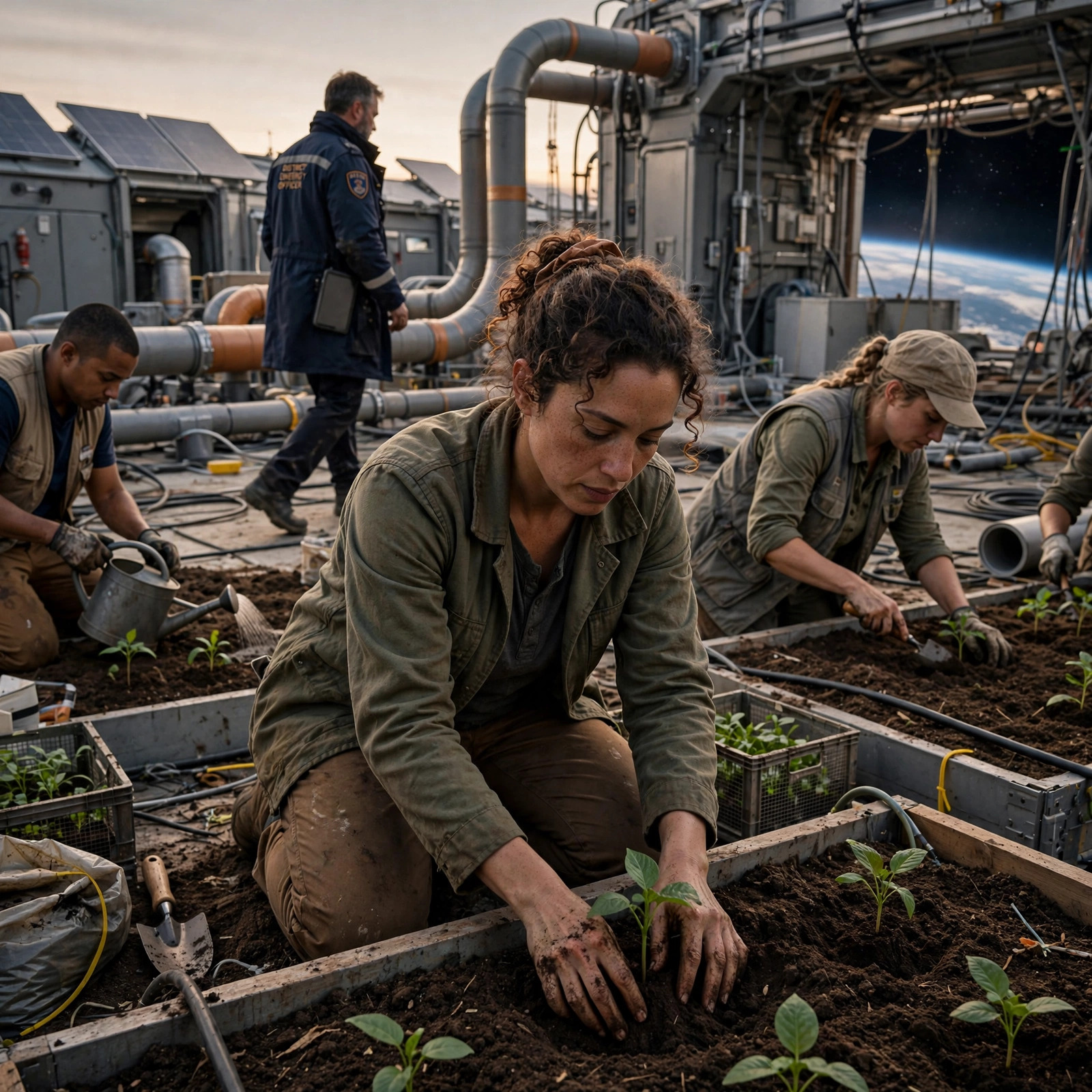
He brought the crate over and set it down in the sun, and the crew drifted in around bed eleven the way crews do when there's planting, because planting is the good kind of work and everyone knows it. Mireille knelt at the open bed, pulled off her gloves, and worked her fingers into the soil. It was warm all the way down, loop-warmed, alive-feeling, smelling of wet mineral and new growth, and her hands were cold and the soil wasn't, and the cold hands went quiet in it.
She set the first seedling into its hole and firmed the soil around the stem, thumb and two fingers, the way she had done on this roof for fifteen years and the way the crew had done since before her. Behind her, along the rail by the stair, the twenty-six tags hung and rang as their people leaned and shifted, copper on copper, small and clear, above the cabinet that now needed two names and a box to open.
Behind her too, and closer, Sefu crouched down with the crate and began handing seedlings along, and his shoulder came to rest against hers, warm through the coat, and stayed.
Mireille pressed the next seedling in, and firmed it, and left her hands in the warm ground.
Get notified when new stories drop

Leo Stranek
Leo specializes in solarpunk abundance and near-future progress: livable futures, bright cities, and practical wonder.
Leave a comment
Comments