


Perren Night
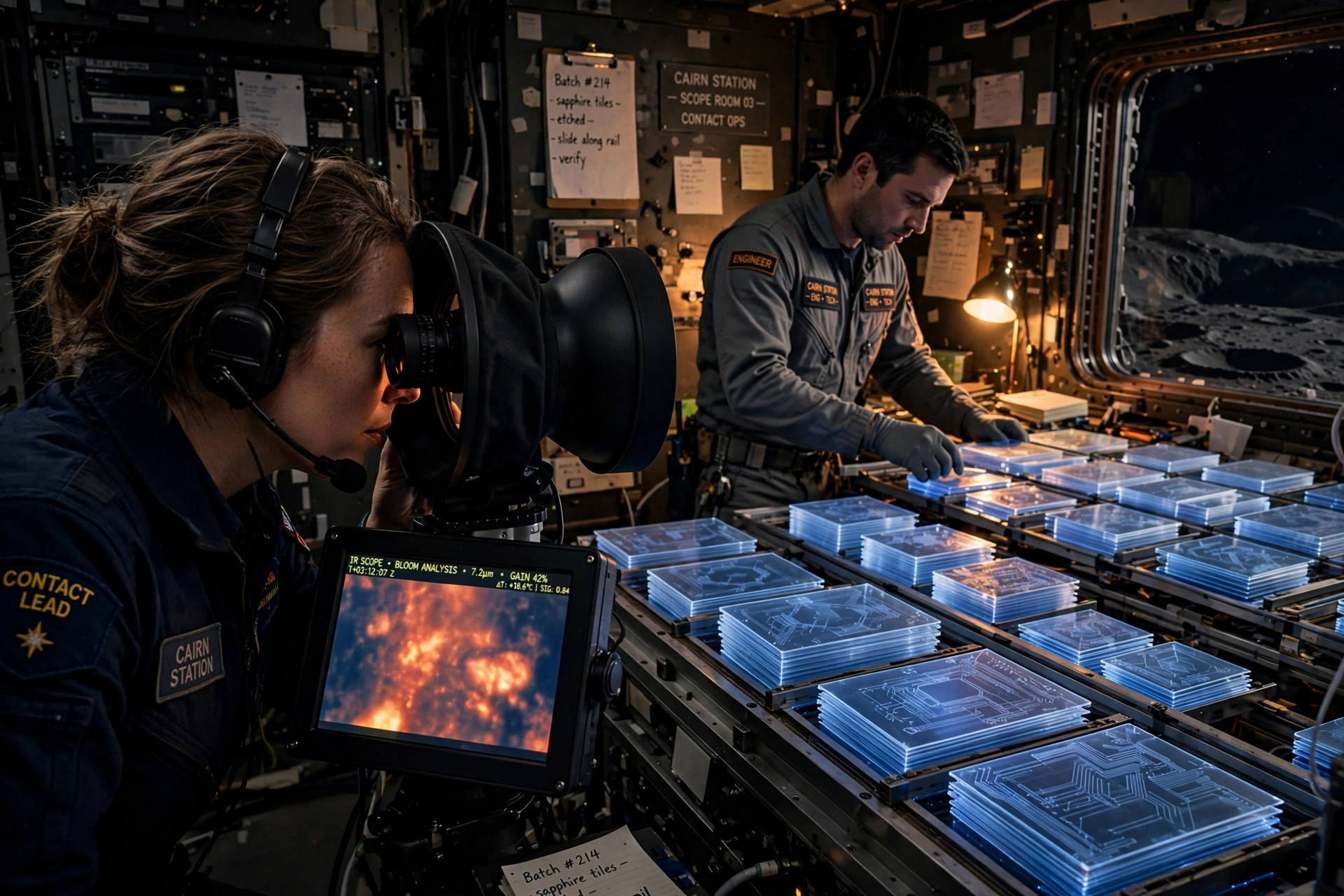
Perren had rolled its black shoulder over the Anvil for eleven hours when the third token of the night came back wrong, and Anke Verhoeven leaned into the scope hood and read it twice before she said anything.
"It dropped the middle pulse," she said. "Mirror that one back clean, Miret. Same token, no correction. We want it to know we noticed."
Miret Almasi bent over her recorder without answering. She had learned in four years on Perren that the Shoal heard hesitation the way people heard a stumble in a recitation, and she did not stumble. Her hands moved across the logging keys, and the transmitter beneath the floor answered her in a slow pulse of heat that no human skin in the room could feel. Out across the dark of the crater, eighty meters down and two kilometers of vacuum away, something that had grown itself through the cold-trap ice for longer than Cairn Station had existed answered back.
The return came up on the scope as a soft bloom of infrared, patterned, patient. The middle pulse was where it should have been.
"Good," Anke said. "Log it. Token one-ninety-one, corrected on echo. That's two hundred fourteen standing, and the board agrees."
The board agreed because Edek Farro had made it agree. It stood along the scope room's short wall in a rack he had cut and fitted himself: two hundred fourteen tiles of laser-etched sapphire, each one translucent to the transmitter band, each one a word they shared with the Shoal. During sessions he slid them along their rails into whatever arrangement the night required, tokens the Shoal had already proven against their own echoes. He was doing that now, drawing the tiles for the night's second movement into a line, his fingertips resting on the cool stone like a pianist waiting out a rest.
"It's fluent tonight," he said. "Cold-trap temperature is down half a degree since the last window. It likes the deep of the night."
"It likes the deep of every night," Anke said. "That's the whole gift of Perren. Sixty-one hours of dark to think in."
The session was a routine one, and she had fought hard for the right to keep routine sessions on the schedule. Two hundred fourteen tokens had been built the slow way, meaning by meaning, over months in which the Shoal had refused some nights and answered others, and the only way to keep the grammar alive was to use all of it, all the way through, every night it would speak. Tonight the plan ran through exchange: token for token, question for answer, the Shoal growing small fragments of its lattice out onto the crater floor as gifts and taking the sapphire tiles into the ice in return. They had a shard from last session in the cold vault, a fist of crater ice laced through with conductive filament, and Anke had held it once and felt nothing human in it at all, which was the point, and which was also the reason she had signed her name to every petition that said the Shoal was alive and knew itself.
She was three hours into the exchange movement, Miret at the recorder, Edek at the board, the reactor humming its steady hundred and twenty kilowatts under everything, when the traffic chime sounded from the station desk against the far wall. Not the session channel. The Earth channel. Then, overlapping it, a second chime with the flat urgent tone the wing used.
Miret's hands stopped on the recorder.
"Keep the log open," Anke said. "We do not drop a session mid-exchange. Edek, hold the board. I'll take it."
She crossed the room. The scope hood's warmth fell away behind her; Cairn Station kept its working spaces at eighteen degrees and the scope room ran colder still, because instruments liked cold, and because people on Perren learned to like whatever the instruments liked.
The desk screen held two messages. She opened the wing's first, because Suvan Rathi had couriered it personally and Suvan did not waste packets.
From Rathi, Suvan, liaison, outbound from Corvel Yard aboard the transfer. Commander Ilg's wing departed Yard on schedule this shift. Transfer window puts us over Perren in nine days. The commander asked me to forward you his compliments and the following, verbatim: "The probe we sent ahead was slagged two seconds after it swept the crater with active radar. Nothing on that crater has any business focusing that kind of energy that fast. Until your people prove to me it's a conversation and not a weapon with a schedule, I'm coming to be certain, and certain, on Perren, means kinetic. You have until we arrive. Tell your interpreter that."
Anke read it again. Two seconds. Two kilometers of range. She had seen the slagged remains of the recon probe in the intake bay six weeks ago, its hull frosted and cratered where the energy had struck it, and she had written in her own log what she could not stop thinking: the burn pattern is too clean for a lance, too focused for a flare. Something answered the probe, and it answered in kind. Nobody on the wing had wanted her reading. The wing had its authority from the melted probe and from nothing else, and a melted probe needed no interpreter.
"Anke." Edek's voice, from the board, quiet. "It's asking where you are. Token sixty. It's been asking for a full minute."
"Tell it I'm here. My tile, then the session marker. It'll wait."
He slid the tiles without turning around. The transmitter pulsed. Down in the dark of the crater, something eighty meters beneath the ice answered with the patient thermal sigh of a language that had no word for hurry, because Perren's nights were sixty-one hours long and nothing that lived in them had ever needed one.
She opened the second message. Earth traffic, routed through the relay, time-stamped forty-three minutes after it had left its sender's hand. Forty-three minutes one way. Eighty-six to ask a question and hear an answer. She read her own department's notes, the standing delegation: contact authority aboard Cairn Station rests with the session lead in any live exchange. Do not interrupt a live session for administrative traffic. Someone at the contact office had written that expecting exactly this kind of night, and she was glad of it, and it was not enough, because no one at the contact office could reach across eighty-six minutes and stop a man with a strike chip in his breast pocket and a probe slagged two seconds after it lit up.
Anke stood at the desk with both messages on the screen and did the arithmetic she could not stop doing. Nine days. The Shoal spoke only in the dark. The nights were long, but the dawn came between them, and the last full night before the wing arrived over the Anvil would be the last one that could prove anything to anyone. Nine days, and two hundred fourteen tokens, and a man inbound who believed, with evidence, that he was flying toward a weapon.
She drafted the petition with her hands moving before the rest of her had decided. She had written versions of it before; this one was shorter. The Shoal is a lattice intelligence grown through the cold-trap ice of the Anvil. It communicates only in patterned infrared, only at night. Its flare that destroyed the wing's recon probe was focused and fast, and I do not yet know its nature, and I will say so plainly rather than claim what I cannot show. I request that the strike order be suspended pending demonstration of verified two-way contact. Session authority remains with me aboard. Reply will take forty-three minutes each way and will therefore not be useful during any live session. Verhoeven, contact lead, Cairn Station.
She read it over once. She left in the sentence she did not yet know its nature, because nine years in her role had taught her that the fastest way to lose a petition was to dress a gap in it, and Tomas Ilg, wherever he was along the transfer, would find every gap she papered over and peel it back with twenty-one years of command behind his hands.
She queued it for the relay. Forty-three minutes, one way. Somewhere down the well, a functionary would read it during a coffee break and by then she would be four exchanges deeper into the night or nine days closer to a kinetic answer, and neither one would wait for anyone.
"Anke." Edek, from the board, still not turning around, his voice careful. "The third chime sounded twice. Which one do we care about?"
"Both," she said. "But only one of them is talking to us tonight."
She crossed back toward the scope hood. Miret had kept the log running the whole time; the recorder showed the exchange markers marching on, token sixty answered, token sixty-one asked, the Shoal working its grammar through the ice while the wing's message sat cooling on the desk behind them. Anke slid onto her stool and pulled the hood's dark down around her eyes and the crater bloomed on the scope again, the patterned heat of a patient mind made visible, asking its questions in its own time.
"Give it token two-oh-six," she said. "The gratitude frame. It held the turn open for us. That deserves the frame for it."
Edek slid the sapphire tiles into place, one after another, and under their feet the transmitter spoke heat into the Perren night, and eighty meters down in the ice something received two hundred fourteen words' worth of a language that had taken months to build and answered, for the moment, with a question about the Sun.
Corvel Terms
The night was thirty hours old, and the Shoal was asking about distance again.

Token one-ninety held the frame for far. Anke watched the scope's thermal render bloom and fade in the crater's cold, the lattice down there turning a question over and over the way it did when a word did not sit right in its grammar. The pattern came up through eighty meters of cold-trap ice, through the ground plate on the rim, through the hardline, and onto Miret's recorder as a string of exchange markers, patient as arithmetic.
"It's not accepting the answer," Miret said. She had her chin on her fist, watching the markers crawl. "You gave it the Sun's distance twice. It keeps re-asking."
"It's not re-asking. Look at the frame." Anke leaned in and tapped the slate of sapphire tiles racked beside the scope, two hundred fourteen of them, laser-etched by Edek in contact month two, each one a word the Shoal and the station had built together out of patterned heat. Her fingertip stopped on tile sixty. Where are you. "It's asking where the answer is. Distance to what. It wants an object in the frame."
"So give it the Sun again with the star tile attached."
"Give it the Anvil." Anke slid tiles into the transmitter rack one by one, feeling the etching under her finger, and under the floor Edek's power feed carried the sequence out onto the rim as structured infrared, heat laid on heat, a sentence spoken into ice. The crater answered inside four minutes. Miret logged the marker.
It was in the middle of that exchange that Suvan came through the scope room door without knocking, which they never did, and this time Anke was glad of it, because their face had the flat look they wore coming back from the tug when a berthing had gone wrong.
"Open channel from the transfer," Suvan said. "Commander Ilg. It came through the relay an hour ago. He asked for it to go to you live, but live was never on the table, so." They set a slate on the console desk. "It's a full packet. Terms."
"Terms." Anke did not take her eyes off the scope. "We're mid-session."
"He knows. That's part of the terms."
Miret stopped the recorder pen with two fingers and looked over. Anke reached out and turned the exchange log to hold, keeping the session's place, then took the slate and put it in front of them all. Suvan keyed it.
Tomas Ilg's voice filled the scope room, and it was not the voice of a man shouting. That was the first thing she understood about him, hearing it after years of his signature on corridor directives. He spoke the way Edek routed power, along the shortest path, nothing wasted.
"Verhoeven. Corvel Yard armory holds a sealed kinetic authorization for the Anvil crater, and I carry it. You know why. Six weeks ago a probe of mine was slagged at two thousand meters, seconds after sweeping that crater with active radar. My people read that as a directed-energy weapon with target discrimination. I have read your petition. You state plainly that you do not know the nature of the flare. I respect a plain statement, so I'll make you one. Demonstrate verified two-way contact before my arrival, and the crater stands. Fail to, and I will not put my wing over a live emitter whose nature you yourself cannot certify. That is the whole of it. Ilg, out."
The recording ended. The scope room was quiet except for the transmitter's cooling fans and, under everything, the faint tick of the thermal loop Edek kept balanced at a hundred and twenty kilowatts.
"Seven days," Suvan said. "That's his transit margin from today. He's not bluffing, Anke. I've flown liaison for his wing eight years. He doesn't bluff and he doesn't pad."
"I didn't think he was bluffing." She set the slate down. Her hands wanted something to do, so she gave them the tiles, racking them back in board order. "He's being reasonable. That's what's unbearable about it. A probe of his melted at two thousand meters and he has to plan as though whatever melted it can melt his wing."
"And can it?" Miret asked. Quietly. The way she asked everything, as if the recorder were running on her too.
"You heard my petition. I said I don't know. I'm not going to upgrade that answer because a man with a strike chip is seven days out." She said it steadily enough. Her mind was less steady. Nine years in this role, nine years of nights in this scope room, and the honest ledger still read: one token verified in both directions, out of two hundred fourteen built. Answer back. The Shoal could say it. The Shoal had said it, provably, on more nights than she could count. But verified two-way contact, in the sense Ilg meant it, in the sense that would make a court and a command officer stand down a strike, was a thing she did not yet have in hand and knew she did not have in hand.
The scope bloomed.
Not the Shoal. The scope's auxiliary band, the one Miret kept open on the sky. A line crawled across it, narrow, hard-edged, and Anke knew its shape before the label resolved, because she had spent six weeks with a slagged probe's burn profile on her desk and had never once stopped seeing it.
"Radar," Miret said. "Active. Narrow-band, high gain. Bearing on the transfer corridor." Her pen was moving. "That's his targeting sweep. It crossed us."
"Seconds," Anke said, and her mouth was dry. "How long since it crossed the crater."
"Twelve seconds."
Anke put her hand flat on the console and watched the session band.
The Shoal's pattern had been mid-frame. It had been holding its turn, waiting to receive, the lattice up under the ice doing the thing it did on every night, its patient grammar turning over. She watched the thermal render the way she had watched a hundred nights. The pattern did not come.
The crater cooled. She watched the render fade from patterned to mottled, mottled to near-background, the lattice withdrawing down and out of range until the scope showed nothing but ice doing what dead ice does, which is nothing at all, at a temperature the universe set and forgot.
"It stopped," Miret said. Her voice had gone small. "Mid-exchange. It's never done that. Anke, in four years it has never once done that."
Anke sat very still. The band of the sweep was still glowing faintly on the auxiliary scope, the wing's radar moving on down the corridor, blind to what it had just done, or perhaps not blind at all. Ilg had known his sweep would cross the crater. He had put his radar over a live emitter on purpose, seven days out, to see what the emitter did.
And the emitter had gone silent.
"He'll read that," Suvan said, and there was something careful in their voice, the tug pilot's respect for a hull they couldn't save. "Whatever the Shoal's reason was, he'll read it as a weapon going quiet when painted."
"I know what he'll read it as." Anke stood up. The scope room felt colder than its thermostat. "Miret. Keep the band open. Keep the transmitter warm. Do not close the session."
"It's not answering. There's nothing to keep open."
"There's us." She was already pulling her thermal coat off the hook. "We keep talking into the silence. Every token we have. It went dark when his radar crossed, which means it heard the radar, which means it is listening. Edek," she said into the comm, and his voice came back at once, level, the voice of a man standing beside a reactor he had kept alive through worse nights than this, "hold the feed at the transmitter. Full sequence when I call for it."
"You're going out on the rim," Edek said. Not a question. Six years of him reading her over a comm line.
"To the ground plate. Nothing past the plate." She got her gloves on. "If the lattice is listening, it listens at the plate."
"Anke." A pause on the line, shorter than a breath. "The probe melted at two thousand meters. You'll be standing at thirty."
"The probe swept it with active radar." She sealed her collar. "I'm going out to keep a promise about grammar. If that kills me, put it on the marker honestly."
The rim at night was a black country, and the ground plate stood in it like a door laid flat, a ten-meter circle of dark alloy the transmitter spoke through. She knelt at its edge with the portable slate racked with the night's sequence and played the tokens out in order, the gratitude frame, the star frame, the distance frame, and then, because the night had earned it, tile sixty, where are you, turned around for once, sent as a question instead of an answer.
The ice answered.
Not on the scope. Under her gloves. The ground plate's edge, where alloy met cold-trap ice, warmed, and out of the ice itself a lattice grew upward, slow as a plant in a film run at speed, a fist-sized branching of conductive threads rising into the vacuum cold, and as it rose it pulsed, faintly, in patterned infrared, the same cadence as tile two-oh-six. The gratitude frame.
Anke knelt there with her breath fogging the inside of her visor and watched a mind she had spent months learning grow a piece of itself out through the ice and offer it upward, into the dark, toward the plate, toward her.
It was not an attack. It was not aimed. It was grown the way the whole lattice had been grown, outward, in the shape of the last thing received. She took the sapphire tile off her wrist rack, the spare she always carried, and set it in the ice where the shard stood, and then, because the exchange was only an exchange if she closed it, she reached out with the gripper and worked the shard loose at its base.
It came free with a sound she felt through her boots rather than heard, and it was warm in the gripper's cradle, warm and pulsing, and it did not stop pulsing when she carried it back along the rim path to the airlock, through sterilization, up the shaft, and into the scope room, where she set it on the console desk beside Ilg's slate and felt the whole station's silence gather around it.
Miret stared. Suvan did not move.
"Log it," Anke said. "Night of day three, local. One exchange. Grown, offered, taken. Token given in return, sapphire, tile two-oh-six pattern. The Shoal is not dead and it is not gone. It is quiet." She pulled the log toward her and wrote the rest while her hand was still steady enough to hold a pen, and it was not steady, so she wrote slowly.
She counted the dark the way Edek counted kilowatts. This night had twenty-nine hours left in it. Then two more full nights, sixty-one hours each, before the dawn that would put Tomas Ilg's wing over the Anvil. One hundred fifty-one hours of speaking dark, if the Shoal came back to speak at all.
She wrote that down. Then she opened the reply channel to the transfer, and Suvan watched her do it with the expression of someone watching a tug line go taut.
"He'll want an assessment," Suvan said. "He'll want you to tell him whether it's a weapon. He can hold a strike on that basis, he's said as much to his own people. Give him something."
"I have something." Anke keyed the channel. "I have the truth, which is that his radar silenced it and I don't know why, and that it answered me tonight by growing a piece of itself into my hand. He's a man who respects plain statements. So he'll get one." She wrote as she spoke, and the recorder took it all.
"Verhoeven, Cairn Station, to Commander Ilg aboard the transfer. Your terms are received and understood, and so is your reasoning, and I will not call it wrong, because on the evidence you hold it is not wrong. Here is what I can promise you: that I will spend every hour of darkness left to this crater attempting the demonstration you require. Here is what I will not promise you: a weapon assessment. You ask me to certify the nature of the flare that took your probe. I cannot, and I will not invent a certification to move a strike chip out of your pocket, because if I am wrong, your wing pays for it, and if I am wrong in the other direction, the only mind we have ever met pays for it, and I have watched it grow for too long to spend its life on a guess. One hundred fifty-one hours. Hold your wing until my last transmission of the last night, and judge what I send you then. Verhoeven, contact lead, Cairn Station."
She sealed the log and set the pen down. On the desk the shard pulsed, slow, warm through its lattice, holding tile two-oh-six's cadence like a small lit sentence in the dark, and Anke pulled her stool back to the scope and watched the ice for any sign that the grammar had come back to listen.
Warm Feed
Two mornings after Ilg's terms crossed the open channel, Anke stood in the reactor bay with her slate pressed flat against her chest and watched Edek Farro argue with a junction plate. He had been arguing with it since first light. The thermal regulation loop ran overhead in bright alloy pipe, looping from the reactor's shielded heart out along the rim wall and back, and Edek had already isolated two thirds of it, blanked the bypass with a hand-torqued flange, and run a fresh trunk line across the bay ceiling to the transmitter's power bus. The remaining third was the hard part. The transmitter wanted all 120 kilowatts the plant could give, and it could have them only if the regulation loop stopped eating its share, and the loop would not stop eating until the last valve stood open to the new trunk, and the valve's actuator had died sometime in the night with a screech Miret had recorded out of pure spite.
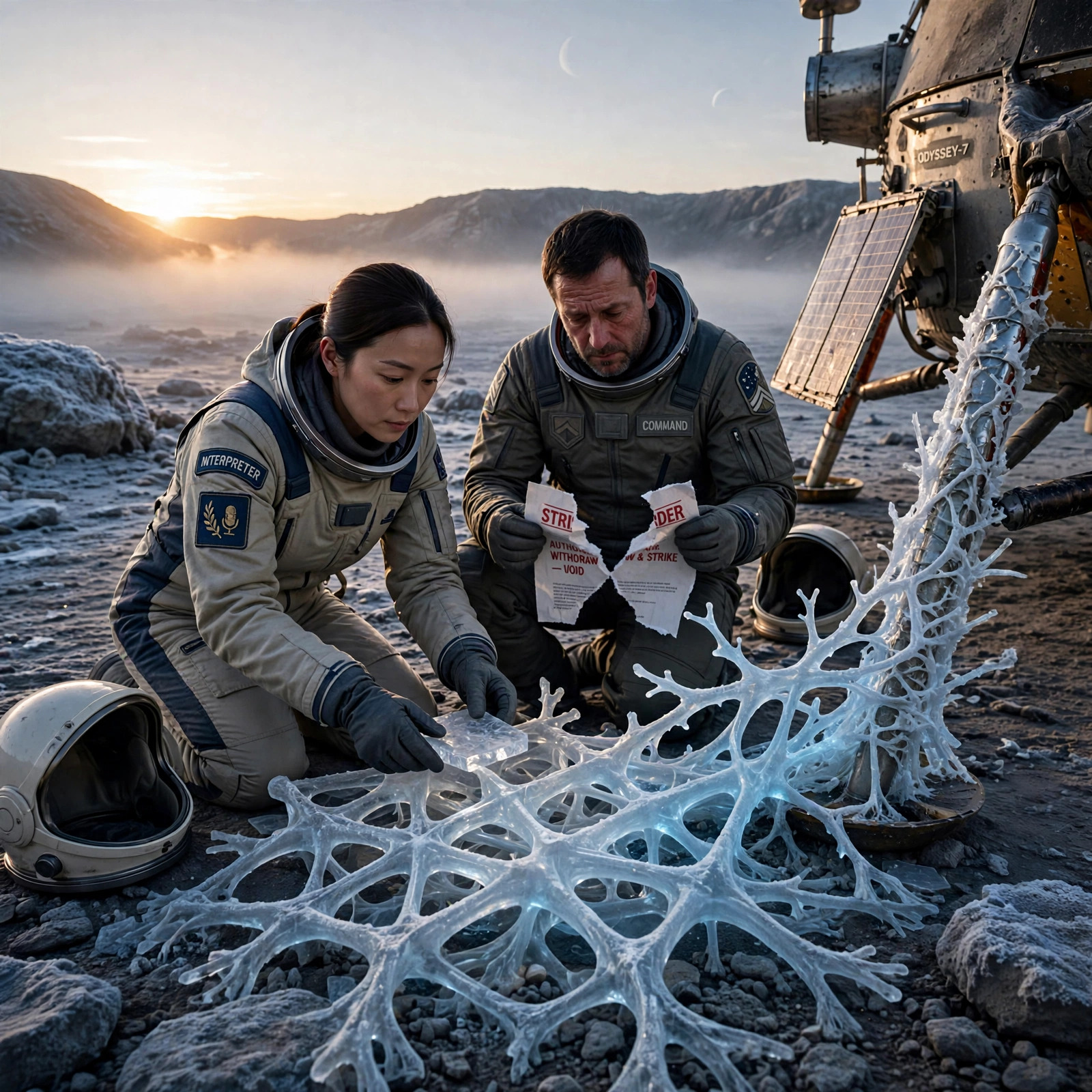
"So it's by hand," Edek said, not looking up. "Quarter turn on the stem, four threads on the bypass, and then I get clear of the line before the transmitter draws. Simple."
"Nothing about today is simple," Anke said. "Say the part you're skipping."
He did look up then, and he wiped his palms on his trouser legs, which Anke noted was a habit of his that meant he was about to be honest. "The vent on the old loop is upstream of the flange. When I crack the valve, the line's going to breathe out. Gas, mostly, and ice. It's cold enough out there to flash it white. Anything in the plume freezes fast."
"Your gloves."
"My gloves, if I'm slow. My hand, if I'm stupid." He flexed his fingers inside the gauntlet. "I won't be stupid."
Anke had known him six of her nine years on Perren, long enough to know that he said things like that as a kind of accounting, not as a boast. He kept a ledger of his own body. She had once watched him log a two-degree burn from a coolant fitting with the same care he gave the reactor's daily output.
Miret's voice came down the wire from the scope room. "Anke, the transmitter's holding at eighty-one kilowatts draw on the test bench. It'll take the full feed when he's done. Also, I've been thinking about the flare range."
"Two thousand meters," Anke said, because Miret liked her numbers read back to her.
"Two thousand, yes. And focused. I keep going back to that. Too clean for a lance, too tight for a flare. I've run the probe's hull spectral four times now. The energy that hit it wasn't broadband. It was structured." A pause on the line, short, deliberate. "I can't say more than that yet. I just didn't want you thinking I'd gone quiet."
"I never think that," Anke said, which was true in the way that mattered. Miret's silences were the loudest part of her.
Edek had the bypass wrench seated on the stem by then. Anke took up her post at the bay's inner hatch, close enough to see his hands, far enough to be out of any plume, and she keyed her slate to record. "For the log. Day five, oh-nine-forty station time. Farro commencing manual re-route of the thermal regulation loop to the transmitter bus."
"Tell the log I said good morning," Edek said, and put his weight into the wrench.
The stem moved. Anke heard the bypass threads take up, a low groan of alloy under torque, and then the vent cracked and the bay's lights went briefly white at one corner where the plume caught them. Gas, just as he'd promised, flashing straight to ice, a cone of it standing off the vent lip and shredding into glitter that the fans took away in slow spirals. The cold came off it across twenty meters of deck. Anke stepped back without deciding to.
"Half open," Edek said. His voice had gone flat and careful, the working register. "Threads holding. Half more."
The wrench turned again. The plume thickened, and this time it bent, because the line beyond the vent was flexing under its new pressure differential, a slow whip of pipe that nobody had modeled, and the plume swung across Edek's working arm at the wrist and held there.
He didn't shout. That was the thing she would remember afterward, that he said only, in a completely level voice, "It's got me. Anke. It's got the glove."
The ice had taken the gauntlet to the valve's stem fitting, frozen his hand to the line at the worst possible place, and the line was cold enough to burn through the glove in the time it took her to cross the deck. She was already moving. "Miret, kill the vent, upstream, now," she said into the slate, and Miret said something back that Anke did not hear, and then the plume died to a thin hiss and stopped, and Edek put his free hand on the frozen one and pulled.
Anke got there as the glove tore. Most of it stayed on the stem, a shell of white fabric and frost, and his hand came away with it, and the hand was burned, the back of it, a broad red welt across the knuckles already rising to blisters where the cold had gone deepest, and Edek sat down on the deck quite calmly, holding the wrist up, and said, "That's the re-route done, at least. Somebody torque the flange down so I don't have to look at it."
Anke wrapped the hand. She had done burn dressings before, on herself, twice, in nine years of ice and steam, and she worked fast and badly and got it wrapped, and Edek talked the whole time about thread counts, because that was how he kept his ledger. Then she got him to the medical alcove and Miret came down from the scope room with the cold-pack kit and did it properly, and Edek, dosged and dressed, pronounced himself fit to supervise from a chair, which nobody had asked him to do and nobody could prevent.
By noon the transmitter had the full feed. Miret ran the numbers twice and read them aloud: 120 kilowatts available at the bus, regulation loop bypassed, reactor stable within tolerance. The test flare went out at oh-nine-forty local, a flat gray hour on the crater rim, and the transmitter's beam struck the far wall of the Anvil in a two-second keyed pulse, token sixty, where-are-you, and the ice stayed dark. Of course it stayed dark. The Shoal spoke only in the 61-hour night, and the night was eleven hours off, and everyone in the scope room knew it, and Miret sent the pulse anyway, because the point of the day was to prove the pipe, not the grammar.
The pipe was proved. The cost sat in a chair with his hand in a sling.
It was the heat, later, that cracked the tiles. Not the reactor, not the plume, but the scope room's own thermal management, which had been sharing the same regulation loop Edek had bypassed, and which nobody had fully mapped. The room warmed through the afternoon while they ran the test flares, and the token board, the slate of 214 sapphire tiles Edek had laser-cut for her in the second month of contact, sat in its rack near the transmitter bench, and sapphire does not care about 40 degrees, but the etched backing compound does. Two tiles, number sixty and number one-oh-nine, where-are-you and safe, split with small clean sounds like ice settling, hairline cracks running through the etched grammar. Anke found them when she came to rehearse.
She stood over the board a long time with the two cracked tiles in her palm.
"I can re-etch them tonight," Edek said from his chair, where he had installed himself to supervise. "The laser bench is mine, after all."
"You'll do no such thing. Your hand's in a sling."
"My hand is one hand. The bench doesn't need two."
"Tomorrow," Anke said. "Tonight we rehearse with what we have. Sixty still reads through the crack. I've sent worse."
He grumbled, which was his way of agreeing, and Miret took him up to medical for the afternoon check, and the scope room emptied, and the room's lights were dimmed to night-red because that was how they ran rehearsals, and Anke sat at the console with the cracked tiles and the shard, which pulsed its slow warm cadence beside the slate, keeping time to nothing anyone had sent in two days.
Miret came back alone at dusk. Anke heard the hatch and didn't turn, and then she felt the hand on the back of her chair, and Miret's voice low: "He's asleep. Medicated. He threatened the medic with a torque wrench, so he's fine."
Anke laughed, and it surprised her, and then it didn't surprise her that Miret's other hand came to rest on her shoulder, because there had been a year of small approaches between them, a hand on a console, two chairs closer than the work needed, a standing joke about the recorder's timing. Anke put down the cracked tiles and turned.
In the red light Miret's face was all planes and shadow, and she was already close, and Anke reached up and Miret came the rest of the way, and they kissed, brief, careful, real, Miret's fingers curling into the collar of Anke's shirt, Anke's hand flat against the cold of the console behind her. It ended the way good things end, without ceremony, and Miret rested her forehead against Anke's for one breath.
"Eleven hours to nightfall," Miret said. "I've been wanting to do that since the shard night."
"You waited for a man to be burned first," Anke said. "That's very you. Timing everything to the recorder."
"I time everything to the recorder because everything else on this moon is unreliable."
Anke held her hand for a moment more, and then she let go, because the night was coming, and the last full night after it, and then the dawn that would put Ilg's wing over the crater with a sealed chip in his breast pocket and seven days of patience spent.
She pulled the slate toward her and looked at the rehearsal lines she had drafted, and they were wrong. Every draft she had written for the last night was a plea: please speak, please answer, please show him what I know you are. She moved the slate aside and took up her pen instead, and wrote beneath the drafts, in the red light, while Miret watched her do it:
Not a plea. The whole truth. Everything we have, all 214 tokens, every pulse we ever sent and every one it ever returned, the silence after the radar, the shard in the desk, the cracked tiles, the burned hand. All of it, unsorted, unpolished, his evidence and ours in one transmission. Let him judge us on the record, because the record is the only thing that was ever true.
"That's what the last night carries," Anke said. "Everything. No argument. Just what happened."
Miret read it over her shoulder, and her hand came to rest at the back of Anke's neck, warm against the cold room. "He's a man who respects plain statements," she said. "You told him so yourself."
On the desk the shard pulsed, slow and steady, and outside the scope room's single port the shadow of the crater's east wall lay across the Anvil, and the ice sat dark, and eleven hours stood between Anke and the first word of the last full night.
The Mirror
Night came down on the Anvil like a lid, and Anke Verhoeven carried the shard to the feed horn in both hands.
It was the size of her fist, grown out of the ground plate two nights ago and cold in a way crater ice should not be cold, laced through with a lattice that drank the scope room's red work-light and gave back nothing. Edek Farro had cut a cradle for it in insulating foam, bolted to the horn's mounting ring, and he stood now at the transmitter rack with his bandaged hand resting on the console rather than working the keys, because Miret Almasi had taken the keys, and because Anke had told him that if he opened one more panel with that hand she would have Suvan Rathi fly him home to Corvel Yard in a cargo sling.
"Full feed," Edek said. "One hundred and twenty kilowatts, all of it yours. The thermal loop's bypassed at the vent and it stays bypassed until I say otherwise." He turned his good hand palm up, a small show of the arithmetic. "The transmitter can hold that draw for about six hours before the horn housing starts to cook. After that, I don't make promises."
"Six hours is enough," Anke said. "It has to be."
The night was sixty-one hours long. The wing was three days out. Those two numbers had been circling each other in her head all through the afternoon, and the second one kept winning, because the last full night ended at dawn, and the next dawn after this one put Ilg over the crater.
Miret sat at the log console with her hair tied back and her hands already on the faders. "Timeline's running," she said. "Say when."
Anke set the shard in its cradle, dead centre of the beam path, and stepped back to the scope bench. Sixty-one hours of dark lay ahead of them, and she had drafted eleven different openings on the slate during the day and thrown out ten of them. The one that survived was not an opening at all. It was a decision.
"When," she said.
"Then we start with the whole board," Miret said. "In order. Token one."
The transmitter spoke in infrared, and the crater floor two hundred metres below and nine kilometres out answered nothing, and that was expected, because the Shoal never spoke first. It had never once spoken first in nine years. It waited. It listened with whatever passed for ears in a lattice grown through a cold trap's ice, and it answered, and the entire working vocabulary they had built together, token by token, month by month, was two hundred and fourteen words wide, and Anke was going to say every one of them.
Token one was a rhythm, a slow double pulse meaning steady. She had chosen it in month two because it was the first thing the ice had ever sent them unprompted, and Edek had etched it into a sapphire tile that same week. She sent it now at full power, and the shard in the feed horn rang faintly against its cradle, a vibration she felt through the bench more than heard, and she waited.
The scope showed her own pulse coming back. Steady, steady. Two hundred metres per token, out and back, and the return was hers, verbatim.
"That's it," Miret said. "That's the answer token. It's answering."
"It's echoing," Anke said. "Keep going. In order. No gaps."
Tokens three through forty were the survey set: ice, depth, cold, stone, ridge, shadow. Forty-one through ninety were hers, the ones she had built to describe the station and herself and the people in it: Anke, Miret, Edek, above, watching, warm. Sixty was where are you, and she sent it as she always sent it, with her own position tagged to it, because the Shoal had asked her that once, mid-word, in the second year, and she had answered honestly ever since. The cracked tiles, sixty and one-oh-nine, sat in their slots on the board with their fractures running silver in the work-light, and she did not skip their numbers. One hundred and nine was heat. It had cracked from heat. That was in the record too.
An hour in, the crater floor began to answer between her tokens. Not verbatim now. It took token forty-one, ice, and folded it with sixty, where-are-you, and sent the pair back, and Miret's hands moved on the faders and she said, "It's asking where the ice is. Or it's asking where you are relative to the ice. That pair's new."
"Log it as new," Anke said. "Don't interpret it. Not tonight. Tonight we give it the record, not the reading of the record."
Three hours in, the transmitter housing read forty degrees above ambient and Edek said nothing about it, which was how she knew it was serious. Four hours in, the Shoal was answering every third token and going quiet on the others, and the silences had a shape she knew. It went quiet like that when it was doing something with its whole attention.
"Token two hundred and fourteen," Miret said. "Then we're into the payload."
"Then the payload," Anke said.
The payload was the wing's trajectory. She had it off the scope room's display in plain numbers: mass, thrust curve, transfer from Corvel Yard, arrival at the next dawn. She had spent an hour of the afternoon deciding whether to send it as threat or as fact, and had landed on fact, because the whole night was fact, that was its architecture, and a threat would have broken the architecture. She keyed the trajectory in the Shoal's own survey tokens, ridge-ridge-stone, position, position, position, closing, closing, and then the arrival, and then she sent the last thing, which was not a token at all. It was the radar pulse. The wing's recon probe's pulse, the one that had swept the crater six weeks ago, the one that had been answered two seconds later by a flare at two thousand metres that slagged the probe's face to glass.
She sent the pulse's own shape. Amplitude, frequency, the whole envelope, replayed from the log.
Then she waited.
The housing ticked as it cooled. Edek's good hand rested flat on the rack. Miret did not touch the faders. The night outside the port was total, the kind of dark that has weather, and Anke stood with her hand on the horn's mounting ring and felt the shard hum against her palm, and for four hundred seconds the crater said nothing at all, and she thought: it has gone quiet again, it went quiet like this the night the radar crossed it, and the old reading of that silence came back to her whole, which was that the Shoal hid from the wing because the Shoal had something to hide.
Then the scope lit.
The return came up the display in order, token for token, and Miret's voice went thin. "Anke. That's us. That's tonight. It's giving it back to us. One through two hundred and fourteen, in order, verbatim. Every pulse we sent, the trajectory, the arrival time, all of it. Amplitude-matched."
"It heard us," Anke said. "It can prove it heard us. Keep the log running."
"It's not done," Miret said. "There's more. Last packet."
The last packet came up slow, and it was not hers. It was a shape, and Anke knew the shape before the label finished rendering, because she had spent six weeks with that shape burned into her working memory: the recon probe's radar sweep. The exact envelope. And riding behind it, tagged to it in the survey grammar, came the answer that had melted the probe, the flare, reproduced at full scale, at two thousand metres, focused, and then the same pair again, and then again, and then the Shoal did something it had never done in nine years. It sent her pulse. The answer token. Steady, steady. Attached to the pair.
Anke sat down on the bench stool without deciding to.
"It's showing us its work," she said. "The radar came in, and it sent the radar back. That's what the flare was. It returned the probe's own pulse, concentrated. It's a mirror. It's been a mirror the whole time. It answers what it receives." She heard her own voice going flat and even and did not fight it. "It answered a sweep with a sweep. We read a mirror as a weapon."
"Six weeks," Miret said. "We've had the log for six weeks and it's been in the log for six weeks."
"It's been in the ice for nine years," Anke said. "It's in everything we ever sent it. Every answer, verbatim. The whole vocabulary is a mirror. Two hundred and fourteen tokens of us, returned." She looked at the display, at the pair, radar and flare, flare and radar. "The one thing we never tested was whether it would send back something it hadn't been given. We never thought to ask if we were talking to a mirror, because we liked what the mirror said."
Edek spoke from the rack, quietly, his thumb moving over the edge of his bandage. "So when it went quiet on the radar night."
"It wasn't hiding a weapon," Anke said. "It had already answered the only question the wing ever asked it. The wing asked with a sweep and it answered with a sweep, and we called the answer an attack, and a man is three days out with a strike chip in his pocket because of what we called it." She stood up. "Miret. Package the whole night. Both directions, timestamps, the verbatim return, the radar pair. Everything, unedited, exactly as I said we would. Send it to Ilg on the open channel."
"The open channel. He'll read it with his whole wing."
"I know. Send it."
Miret sent it. The wing was close enough now that the reply came back in under an hour, and the three of them stood in the red light of the scope room while the message decoded, and Anke realised her hands were shaking and put them flat on the bench.
Ilg's face came up on the display, and he looked like a man reading a verdict, which was what he was.
"Verhoeven." His voice was even, which from him was gravity. "My signal officer confirms the return matches your transmission on every pulse we can measure, and the radar envelope matches our probe log to the digit. I've read your interpretation. I've also read six weeks of your earlier reports, and you told Earth yourself you didn't know what the flare was. Now you say it was an echo." He paused, and somewhere behind him, on the transfer, a hatch cycled. "Here's where I've landed. I'm not convinced by a mirror. I'm convinced by a witness. My liaison Rathi tells me you can hold a joint session on the crater floor at dawn, both sides present, and I want to see the two of you talk in front of me before I unseal anything. The strike stands down pending that session. My wing holds at range. If nothing speaks to us at dawn, it stands back up." He looked off-frame for a moment, then back. "You understand I can't hand you more than that."
"I understand," Anke said, to a transmission that would not hear her.
"Dawn, Verhoeven. Don't be late, and don't be clever. Bring the record."
The screen went to the station crest. Miret let out a breath and turned from her console. Edek had already put his good hand on the vent bypass, ready to give the transmitter back its thermal loop, and the housing ticked as it cooled toward something like mercy. On the horn's cradle, in the beam path, the shard pulsed once, slow, steady, and the scope showed it arrive below in the ice at the same moment, one pulse, given and returned, and Anke put her palm flat against the warm housing and watched the two pulses lie over each other exactly, and left her hand there while the night ran on.
Grown Bridge
Dawn on Perren came the way it always did on an airless world: not slowly, but in a hard line of unshadowed light that walked down the eastern rim while the sky above stayed black and full of stars. Anke stood in the shadow line of the lander's bay with the foam case balanced on both forearms and watched the light cross the crater floor toward her, and thought that on any other morning she would have called it beautiful, and this morning she mostly called it early.
The case held the token board. Two hundred and fourteen sapphire tiles, laser-etched by Edek, each one translucent to the infrared the Shoal spoke in, each one a word. Two of them, sixty and one-oh-nine, were cracked from the scope room's heat, and she had wrapped them in foil so their broken faces would not catch the light wrong. Nine years she had spent learning to talk with something that lived in the ice under this crater, and all of it came down to a slate of cut stone in a padded case and a commander who wanted to watch her use it.
"Verhoeven." Ilg's voice came through her helmet relay, close and flat. He stood thirty meters off, near the lander's strut anchor, in armour she suspected he had not worn since some inspection at Corvel Yard. Rathi stood beside him, suited, hands loose at their sides in the way of a tug pilot who had long ago stopped being impressed by gravity of any kind. "You're on the floor early."
"You said dawn. I didn't want to make you wait."
"I said don't be clever."
"This isn't clever. This is punctual."
A crackle that was probably Rathi laughing. Ilg looked past her, down the slope, to where the shadow of the rim still covered the ice. "Where's your team?"
"Miret's on the ridge with the recorder and the big lens. Edek's at the lander with the power feed." She nodded toward the lander, sixty meters down the slope, where Edek was crouched at the leg with a cable loom over his bandaged hand, rigging the transmitter's feed so it could drive the ground plate they had bolted there two seasons ago. "And before you ask, the whole record is with them, timestamped, unedited. Everything we've sent, everything it's returned, since month two."
"I read your last transmission."
"I know. Miret watched your wing's light curve all night. They held at range."
"They'll keep holding while I like what I see." He touched his breast pocket, once, the way a man checks that a key is still on him. She had been watching that pocket since he landed. The chip inside it was steel, machined and sealed at the Corvel Yard armory before departure, and inside the seal was a firing solution with the Anvil's name on it. "Rathi tells me the ground plate here can carry your signal to the ice directly. No relay."
"Direct is better. It's what it's used to."
"It," Rathi said, mildly. "Nine years in and it's still it."
"It's earned worse pronouns than that," Anke said, and turned and started down the slope, because the light line was crossing the plate now and there was no more time to spend on nerves.
The crater floor at the Anvil was not flat but it was patient, old impact breccia furred with frost where the cold traps had done their work for uncounted nights, and the ice under it was why anything was here at all. She knelt at the plate, opened the case, and lifted the board out into the raw sunlight. The tiles lit up like a page, every etched glyph throwing its own small shadow. Behind her, up the slope, Ilg and Rathi stood where they could see both her and the recorder on the ridge. She could feel the forty-three minutes to Earth like a weight between her shoulder blades. Nobody on Earth would read any of this for most of an hour. Whatever happened in the next one was hers.
The sun cleared the rim. The ice went bright.
And the Shoal answered before she sent a thing.
It rose out of the frost in the infrared first, a bloom of warmth with edges, the way it always looked on the scope from the station, except that here she could put her glove ten centimeters from the surface it was warming. The frost around the plate sublimated off in a slow haze of vapour that the sunlight bent through, and beneath the haze the ice moved. Not fast. Patiently. A ridge formed, then another, in a rhythm she knew by hand: token sixty. Where are you.
"Here," she said, out loud, for herself and the recorder, and put her palm on the plate.
She worked the way she had taught herself to work across two hundred nights: send a token, wait for the return, log both. Token one, ice. Token two, warm. Token sixty, where, and the answer, here, the one word they had verified going both ways before anything else. The Shoal's returns came up through the plate as clean as if the ice were a display, and up the slope she heard Ilg's breathing change on the relay, and she did not look at him, because looking away from the plate now would be the one thing he had told her not to be.
Forty minutes in, she stopped sending and knelt there with the light on her shoulders and let it ask. It asked token sixty again, twice, and then it did something she had never logged: it sent token one-oh-nine, cracked tile or no, answer back, and then nothing, and the nothing went on long enough that she could hear Miret on the ridge shift her weight.
"It's waiting," Anke said.
"For what?" Ilg, from up the slope.
"For a word it doesn't have."
She had known since the last night what the word was. She had argued it out with Miret in the scope room while the shard pulsed in the horn's cradle, and Miret had said the Shoal only ever returned what it received, so give it something new to return, and Anke had said that was exactly the risk, and had decided to do it anyway. She reached into the case's lid pocket and took out the spare tile, blank, cut by Edek from the same sapphire stock, and the hand etcher Edek had lent her, the one he'd used on all two hundred and fourteen. Her glove was too thick for the fine work. She broke the wrist seal and worked the last two knuckles bare, in the cold that would take the skin if she gave it time, and cut the glyph fast: two forms, side by side, touching along one edge. Together. Token two hundred and fifteen.
"Verhoeven, your hand," Edek said from the lander.
"I know what it's costing." Her fingers were going stiff and white at the tips. She set the tile on the plate, bare-side down against the warm ice, and sent it: the etched pattern lit once in the infrared, two forms, side by side.
Nothing came back.
For nine seconds, nothing, and she counted them, and on the tenth the frost off to her left began to move. Not a bloom this time. A line of ice, rising, dark with the lattice threaded through it, growing out of the crater floor the way the shard had grown that other night, but this was not a shard. It climbed while she watched, arm-thick, then leg-thick, leaning as it grew, four meters of it, and it came down across the open ground and touched the lander's strut leg, and its warmth read clear on her suit's IR overlay, and it stopped there, holding on, one end in the ice and one end on the leg of the machine she had come down in.
A bridge. A grown bridge, from its world to hers, and the word for it was the one she had just taught it.
Up the slope nobody said anything at all for a long moment. Then Rathi, quietly: "Commander, that's a structural member it just built to our hardware."
"I can see what it is." Ilg came down the slope. Not fast. He walked the way he had talked, even, deliberate, and he stopped five meters out and stood in the sunlight with his helmet tipped down at the strut and the lattice wrapped around it, warm and bright in the infrared, faintly steaming where the vapour came off it. "Verhoeven. Talk to it. I want to see it answer you while I stand here, not on your scope, not on your record."
"It's been answering for forty minutes."
"To you. Once more. To me."
So she sent token sixty, where are you, and the return came up through the plate and through the bridge itself, so that the warmth of the answer ran down the lattice into the lander's leg, and she put her bare hand against the strut where the ice held it, and felt the reply arrive through the metal, one pulse, given and returned. Ilg stood there through all of it, and his hand went to his breast pocket, and stayed there.
"You understand," he said, "that if I do what I'm about to do, I do it on the strength of a word you invented an hour ago."
"I invented the glyph. The Shoal built the meaning. You can check the growth rate against Miret's record if you want it in numbers."
He was quiet. The sun climbed. The bridge held on to the leg of the lander, patient, and did not tighten, and did not let go, and that, she thought, was the truest thing either side had said all morning.
Ilg pulled the chip from his pocket. He cracked the seal against the plate of his gauntlet, one sharp motion, and shook the blanked firing wafer out into his glove, and then he knelt, right there on the crater floor, and set the pieces of it down on the ice, blanked, dead, where the Shoal's warmth could read them if it read anything. He stood up without dusting off his knees, because there was no dust in vacuum, only light.
"Rathi. Signal the wing: stand down to holding pattern, indefinite. Log it as witnessed."
"Logged, Commander."
Anke took the new tile in her bare hand, stiff and aching with the cold, and pressed it, cut glyph outward, into the warm lattice of the bridge where it rose out of the ice. The ice closed around the edges of it, slow, careful, the way it did everything, and held the tile the way it held the strut: not gripping. Resting. Two forms, side by side, touching along one edge, warm in the sunlight, and up the slope Edek was already coiling the feed cable, and Miret's lens caught all of it, and the bridge went on holding on while the morning grew long, and neither side let go.
Get notified when new stories drop

Mira Okoye
Mira writes first contact and mentorship-across-species stories where curiosity beats fear.
Leave a comment
Comments