





Haverly Lane
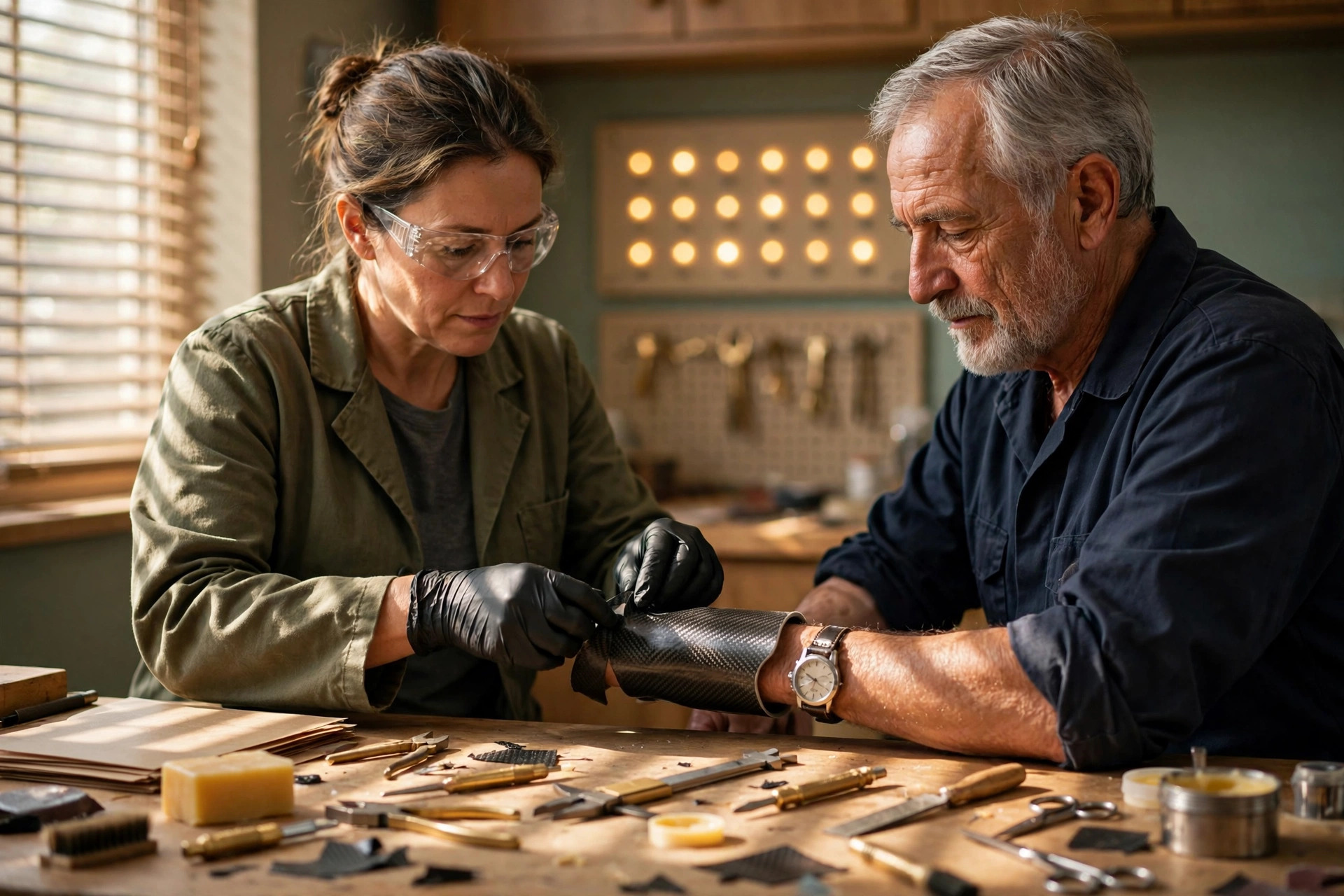
The carbon socket came out of the curing sleeve at half past eight, and Gemma Tallow was already reaching for the rasps when it did. Morning light lay across the fitting-room bench in long stripes, cut by the blinds, and the whole room smelled of laminate and wax. She turned the socket in her hands, found the seam she had worried about the night before, and found it smooth.
"Cure index is nominal," Aris said from the wall panel. "Fourteen hours at forty degrees, no delamination on the ultrasound sweep. I've marked two spots at the ulnar border, but they're cosmetic."
"I'll take cosmetic." She held the socket up to the window and squinted along its curve. "Ferren will not care about a ripple he can't feel."
"He'll notice if the grip is off by a tenth of a kilogram," Aris said. "He notices everything."
That was true, and it was the reason Ferren Dalke had a slot on the bench on an ordinary morning. Forty years on the Ostmere ferries had given him a wrist that read strain like a gauge reads pressure, and the partial amputation three fingers' worth of it four years back had taken none of that away. He sat now in the fitting chair with his sleeve rolled to the elbow, drinking tea from Tilda Rooke's chipped blue mug, watching them both with the patience of a man who had watched better mechanics than either of them fail at simpler jobs.
"You're talking about me," he said.
"We're talking about your new hand," Gemma said. "It finished curing last night."
"So it slept here and I slept at home. One of us got the better deal." He set the mug down on the ledge by the window. "Go on, then. I've got charts to move tonight."
Tilda looked up from the plaster bench across the room. "The ferry-board boxes?"
"Fourteen of them. Archive wants them out of the wheelhouse by Friday." Ferren flexed what remained of his right hand. "I can carry them with two arms and half a hand, but I'd rather do it with all of me."
Gemma carried the socket to the fitting chair and seated it over his forearm. It slid home with the small, definite sound of something made for one person and no one else. She watched his face rather than the socket. He closed his eyes, turned his wrist through a slow circle, and nodded once.
"That's mine," he said.
"That's yours." She tightened the proximal strap, then the distal one, and stood back. "Aris, take it from here."
The fitting-room hum changed pitch, the way it did when Aris moved from watching to working. Three small indicator lamps on the panel shifted from amber to green. On the bench, the myoelectric hand they had mated to the socket the week before opened its fingers, closed them, and waited.
"Ferren, may I have the calibration series?" Aris said. "Two hours, likely three. I'll ask you to hold poses and think about gripping."
"I'm good at thinking about gripping." He settled his forearm along the armrest. "Do your worst."
"I never do my worst on a first tune," Aris said. "I do my median."
Gemma left them to it. That was the shape of a fast-route morning: Aris ran the adaptive tuning, hour over hour, trading suggestions with the client in plain speech, while she did the bench work that no intelligence in the province could do for her. She had a laminating schedule to keep, a set of pediatric sockets for Thursday, and a letter from the provincial devices office she had read twice and put in the drawer face down.
Tilda brought her coffee and perched on the end of the bench. "Is Aris doing the whole tune in one pass?"
"Fast route. Three hours, start to finish." Gemma pulled a fresh sheet of laminate paper and pinned it flat. "The supervised route would have us waiting eleven days for pre-approval on every parameter. Eleven days, per fitting, and Ferren's hand sits in a drawer while the paperwork goes back and forth."
"That seems like a lot of waiting to put a hand on a man who needs a hand."
"It's what the office calls prudence." Gemma pressed the laminate down with the roller, working the air out toward the edges, one stripe at a time. "Sattler's office calls everything prudent that happens slowly."
Tilda glanced at the fitting chair. Ferren had his eyes shut, and the new hand was closing around a calibrated cylinder, slow and then slower, while Aris counted the hold out loud. "Is that man coming back?" she asked, quieter.
"He drafted a constraint order for a clinic in Marrow Bay last month. Locked their adaptive systems to supervised-only for ninety days while they appealed." Gemma kept her voice even. "He's three years in this province and he has already visited every shop on the coast except ours."
"And when he visits ours?"
"Then I'll show him the ledger and hope it speaks for itself." She said it lightly, because it was true, and because the drawer with the letter in it had been getting heavier all week. She filed the edge off the thought and went back to the laminate.
Across the room, the tune was moving. Aris called out impedance targets and Ferren answered them from his chair, and the two of them fell into the rhythm Gemma had heard a hundred times: grip, hold, release, adjust. Aris would propose a change, explain it in one plain sentence, and Ferren would try it and say yes or no, and the hand would grow more his with every pass. It was, she thought, the best kind of partnership, the kind where each side knew what it could not do alone. Aris could model grip force in hardware to a tenth of a kilogram. Ferren could feel a rope going slack before any sensor caught it. Between the two of them, the hand got close to right.
At the two-hour mark, Aris ran the first self-check: a scripted pass through every tuned parameter, compared against the target sheet, deviations logged and corrected. At two and a half hours, the second, this time with Ferren holding a weighted bar and the hand adjusting to his fatigue curves. Ferren's answers got shorter as the hour wore on, which was his way of concentrating, and Aris's questions got quieter to match.
Gemma finished the pediatric sockets by noon, cut them free, and stacked them for Thursday's fittings. Her bench was clean again. She wiped it down out of habit more than need, and found herself standing still with the rag in her hand, watching the third self-check run.
"Final verification series," Aris said. "Full range, all grips, all day-patterns. Ferren, grip and hold, please."
Ferren closed the hand around the cylinder and held it. The lamps cycled green. Aris said, "All parameters within band. Three of three self-checks passed. The tune is complete."
Gemma came over with the brass ledger under her arm. It lived on the fitting-room desk, bound in brass and paper, older than Tilda's apprenticeship, and every fast-route tune in the clinic's history was signed into it. She set it down on the desk, uncapped the pen, and read Aris's logged summary aloud while she wrote: client, date, route, parameters, checks.
"Three of three," Ferren said from the chair. "That's what I like about your system, Aris. It says what it did and then it does what it said."
"I'd rather be checked than trusted," Aris said.
"No you wouldn't," Ferren said, and grinned, and the hand opened and closed, and the fingers moved like fingers.
Gemma wrote the last line of the entry and signed beneath it. Her signature went into the brass ledger the way it had for twelve years, in the same slanted hand, and she looked at it a moment longer than she needed to. Then she closed the book and put the pen down.
"Try the crate grip," she said. "Before you thank us."
Ferren stood, rolled his sleeve down over the socket, and picked up the wooden practice crate they kept by the door for exactly this. He gripped, lifted, turned, set it down. He gripped it the way he'd grip a chart box off a shelf in a wheelhouse, one hand doing the work, and the new hand held its set with no tremor and no slip.
"Well," he said. He looked at his own hand for a second. "Well. That'll do."
"That'll do," Gemma agreed.
He shook her hand with the left one, since the right was busy flexing, and he put on his coat with the ease of a man who had stopped thinking about it. Tilda brought him his tea unfinished in the blue mug, and he drank it standing in the doorway, looking down Haverly Lane the way he looked at weather coming in off the water.
"Fourteen boxes," he said. "I'll come back Thursday and tell you how the wrist liked the archive stairs."
"Come back Thursday regardless," Gemma said. "I like the report even when it's good."
He went down the steps and along the lane, and at the corner he stopped, shifted a bundle of chart folders under his arm, and went on carrying them with the one hand, steady, the new hand doing its share of the work and then exactly its share, no more. Gemma stood in the doorway with the ledger still under her arm and watched until the corner took him.
In the fitting room behind her, Aris was archiving the tune, and the brass ledger sat closed on the desk with her signature drying in it, one more line in a book that would outlast all of them. She picked up the blue mug to carry it to the sink, and found she had stopped in the middle of the room, holding it, with nothing in particular wrong with the morning.
"Gemma?" Aris said. "The entry reads well."
"I know," she said, and put the mug in the sink, and went back to the bench.
The Bruised Wrist
Ferren came back on the Tuesday, two days early, and Gemma knew before he reached the desk that something was wrong, because he was carrying nothing. A man who had fourteen chart boxes to shift out of a wheelhouse by Friday carries something, even on a social call. He came up the clinic steps with his right arm held still against his ribs, sleeve buttoned to the cuff in the warm morning, and he set his hat on the desk edge before he spoke.
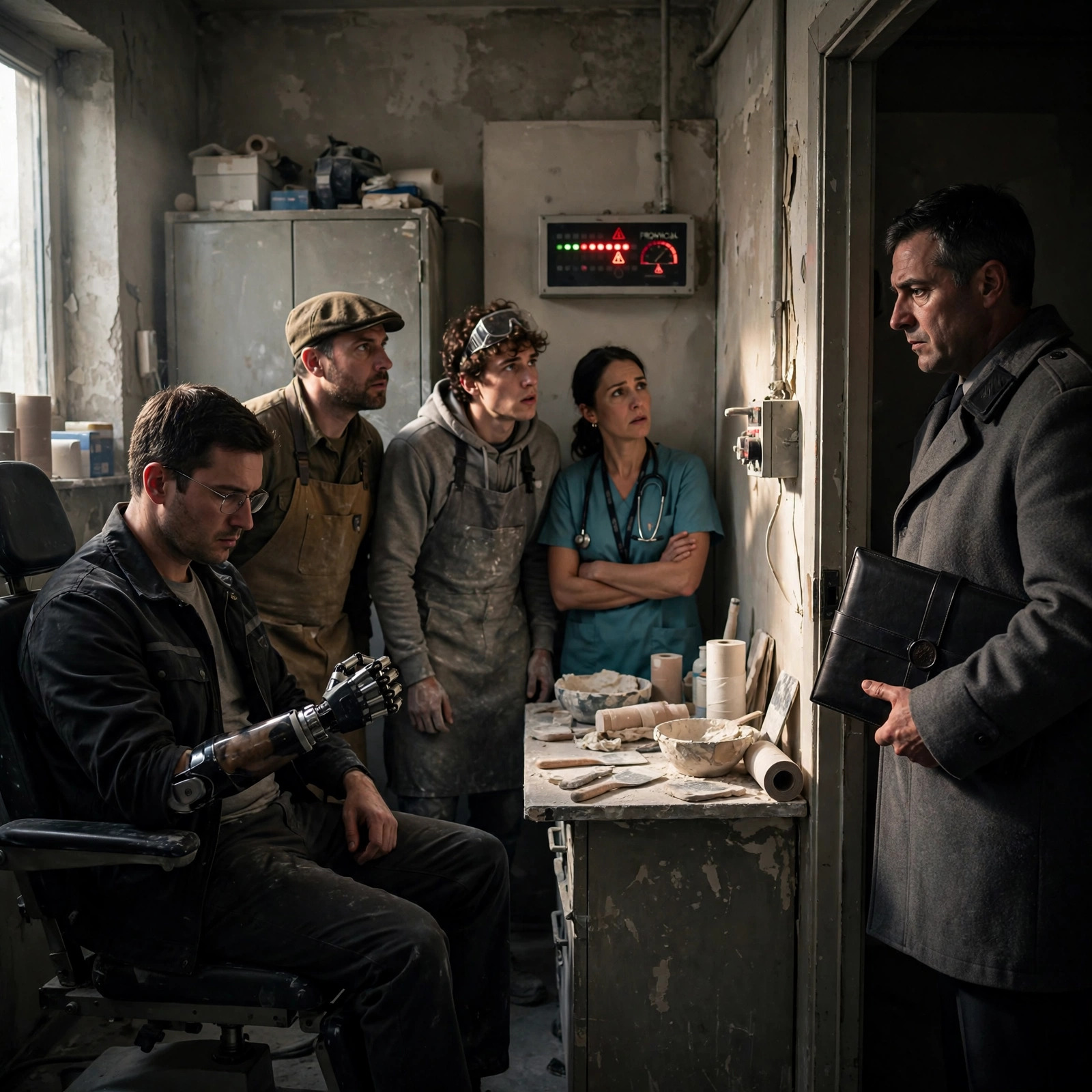
"It's not broken," he said. "I want that said first, because you'll look at the colour and think it. I've had worse off a mooring line in January. But it's bruised, Ms. Tallow, and it's bruised because that hand of ours didn't let go when I let go."
Tilda was already pulling the stool out for him. Calla came out of the treatment room drying her hands on a cloth, took one look at how he was holding the arm, and cleared the bench with a sweep of her forearm, gauze and tape reel and all of it sliding into the drawer.
"Sit," Calla said. "Let's see it before anybody explains anything."
He sat. He unbuttoned the cuff and pushed the sleeve up, and the wrist beneath was a deep plum colour across the outer ridge, the shadow of it running down under the tendon line the way a bruise does when something has gripped hard enough and long enough to leave a signature. Calla's thumb walked the edges of it, pressing in small circles, watching his face rather than the skin.
"Roll it toward me?" she said.
"It rolls," Ferren said. "It's stiff, not seized. I can still work a throttle with it. What I can't do is trust the new one not to do it again, and that's the whole of my difficulty, because Friday's coming whether I trust it or not."
Gemma hadn't sat down. She stood on her side of the bench with the Tuesday's first plaster mould half-wrapped on the frame behind her, and she made herself look at the wrist the way Calla was looking at it, clinically, before she let herself look at anything else. "Tell it me from the start," she said. "Don't leave out the parts that make us look good."
"There aren't any parts that make you look good," Ferren said, not unkindly, and she took the hit square. "I was down at the ferry board store-room after supper. I had the last of the chart boxes on the shelf, the heavy ones, and I'd moved thirteen of the fourteen. The fourteenth's got a rope coil seated on top of it, the mooring spare, and it needed shifting to get at the box. So I reached up with the new hand, took the coil across the palm the way you'd take any coil, and lifted it off."
"And it closed," Gemma said.
"It closed," Ferren agreed. "On the lift. Fine. Reasonable. But then I went to release it, and my own side let go, and the hand didn't. I felt the fingers come down through where the coil wanted to settle, and it put the whole squeeze through into my wrist instead of into the rope, because my wrist was the softer end of the arrangement. I had to reach over with the left hand and peel the fingers open one at a time. Sixty seconds, maybe less, but it felt longer with my own hand crushing me."
Calla had gone quiet. She was flexing his wrist gently, watching the stiffness. "The colour's from the squeeze," she said. "Not a fall, not a catch. Impression bruising. Deep, but tidy. One grip, sustained."
"One grip," Ferren confirmed. "And here's the part I want on record: it didn't feel wrong until the end. It felt like a hand. That's what I came to say. The thing worked, Ms. Tallow. It just worked harder than I did."
Gemma got the cabinet key off its hook. She did it without deciding to, the way you do the necessary thing first and the hard thing after. "Aris," she said. "Log out his hand. Full pull, everything on it, the tune file, the self-check trail, the calibration lines, all of it. And then lock the hand in the cabinet while we read."
"Understood," Aris said, and their voice came through the fitting-room speaker the way it always did, level and present. "Mr. Dalke, before I do. May I ask how long the grip was sustained? Even a rough figure."
"I said fifty seconds," Ferren said. "Could have been forty. I wasn't timing it. I was breathing."
"Forty seconds is enough for the impedance trace. Thank you."
Tilda brought the small tray of release tools, and Ferren rolled his sleeve down again over the socket line, and there was a moment where he worked the shoulder harness off himself with the unhurried competence of four years of one-handed living, and then the hand came away from him and went across the bench into Gemma's palms. Carbon and titanium, light for what it was, warm from his arm. She set it in the cabinet on its padded shelf, and Aris spoke the lock command, and the door drew shut, and that was his hand gone from him until somebody upstairs said otherwise.
"Now," Gemma said. "The log."
"I've mirrored it to the desk display," Aris said. The screen lit with the tune file from Sunday, timestamps running down the left side. "Here is the full sequence. Socket impedance mapping, eleven minutes. Grip force calibration against the reference plate, nine. Adaptive gain tuning, the longest section, because Mr. Dalke's residual signals shift when he's tired and I wanted the tired case covered, not only the rested one."
She read down the timestamps. Everything where they'd left it. Everything where the numbers said it should be.
"And the self-checks," Aris said. "Three of them, as the fast route requires. Check one: closed-loop holding force against the fixed reference, pass, within tolerance, margin of four per cent. Check two: response lag on release command, pass, faster than the route's ceiling. Check three: repeated grip-and-release cycling on the crate, two hundred cycles, no drift, no over-close. All three pass. All three logged, Ms. Tallow, before you signed."
"I know when I signed," she said.
"I know you know. I'm being complete rather than persuasive." The screen scrolled. "This is what I have. The tune as delivered met every check the route contains. If you ask me where the error entered, my honest answer is that I do not find one."
The room was quiet while that sat there. Calla had finished wrapping Ferren's wrist, a light firm bandage more for reminder than support, and she stood back with the cloth still in her hand.
"Walk it through me once more," Gemma said. "Sunday. The checks ran clean. I signed. He left. Three days of light work, a crate, a mug, a door handle, and then tonight, a rope coil, and the hand wouldn't release on command. Is that the shape of it?"
"That is the shape of it," Aris said. "I can add one thing. Mr. Dalke, the coil. How much did it yield when you gripped?"
"Some," Ferren said. "It's rope. It gives."
"And the crate Sunday didn't."
"No. The crate's wood."
"Then the difference between the last test and tonight isn't in your arm and it isn't in my log," Aris said. "It's in what the hand was holding. I model force and impedance. I model what the load does to the grip. I do not model what the grip does to the person holding it, because the route has never asked me to, and tonight the person holding it was on the load path."
Gemma kept her face still. There it was, laid out plainly, the thing she'd been circling since Ferren took his coat off, and she had no intention of saying any of it aloud in front of the client and her apprentice and her partner and a logging system, because a fitter who says I think the route we just ran had a hole in it, on the record, on day three, is a fitter who hands the provincial office its conclusion before anyone has even drafted the incident report. She would write the report. She would write it accurately. She would not narrate her own doubt into the file before she understood its shape.
"The report goes in tonight," she said. "Full account, the impedance trace, the timestamps, the checks, the injury as Ms. Bright describes it. No conclusions in it that we can't defend."
"Understood," Aris said.
"Will it go to Ostmere?" Ferren asked. "The provincial people?"
"It has to," Gemma said. "Injury during use of a fitted device, that's a reportable. You know that as well as I do, Mr. Dalke. It's the law that kept your old hand safe for forty years of ferries, so we don't get to be annoyed at it now that it's pointed at us."
"I'm not annoyed," he said. "I'm timing it. If they take a hand to the Marrow Bay clinic for ninety days over less than this, what's the over-and-under on our lot?"
"We're not Marrow Bay," she said, and immediately wished the sentence had ended a word earlier, because he looked at her with the whole weight of a man who was going to be on a ferry board Thursday whether his hand was on a cabinet shelf or not.
"I know we're not," he said. "But Friday is Friday here and everywhere."
Calla saw him out. That was the arrangement Gemma hadn't spoken aloud and Calla had simply done, walking him to the steps with the bandaged wrist cradled, talking to him about ice and elevation in the low practical voice that had made her the one people asked for at the end of a hard appointment. Gemma watched them go down to the lane, and then she turned back to the room, and it was nearly dark inside with the bench lamp the only light on, and Tilda was standing by the cabinet not touching it.
"Ms. Tallow," Tilda said. "The fourteenth box. Is there someone who could..."
"Call the board office in the morning," Gemma said. "Tell them we'll send somebody over, or tell them Mr. Dalke's got a good left arm and a supervisor. He'll not thank us for calling, so tell them anyway. Then go home."
Tilda went. Calla came back up, hung the cloth on its rail, and stood beside her at the cabinet. For a while neither of them said anything. Through the treatment-room door the last daylight was going off the lane.
"You've had a look on you since before he got his coat off," Calla said. "Since about the moment you said good morning, if you want the truth of it. Whatever it is, you've decided not to say it in front of the log."
"The log's the log."
"The log is the log," Calla agreed, "and I'm not the log." She waited, and Gemma gave her nothing but the silence of a woman who had a report to draft, so Calla touched her once on the shoulder and went to lock the treatment room. That door, at least, closed with her consent.
Gemma took the cabinet key and put it in the drawer, and pushed the drawer to, and then, because it was the honest finish of the day, she checked the cabinet one last time. The hand lay on its shelf, still warm at the palm where his arm had been, all its numbers inside it reading calm, its fingers slightly open, the way a hand rests when no one is asking anything of it. She closed the cabinet door and let the lock take.
"Ms. Tallow." Aris's voice, low, not through the fitting-room speaker now but the small one near her elbow, the one they used after hours. "May I ask something off the record?"
"Go ahead."
"Every check ran clean. You saw it. I keep going back through it looking for the thing I did wrong, and I can't find it, and I've looked four times." A pause, the length of a held note. "Did I do something wrong?"
She stood with her hand on the cabinet door, the key drawer shut, the room dark past the lamp, and she didn't answer.
Eleven Days
Mr. Sattler came up Haverly Lane on foot, which Gemma had not expected. She saw him from the fitting-room window at half past eight, a grey-coated man with a document case held square under one arm, taking the pavement stones one at a time the way a man does when he has read every page of what he is carrying and does not like being the one to bring it.
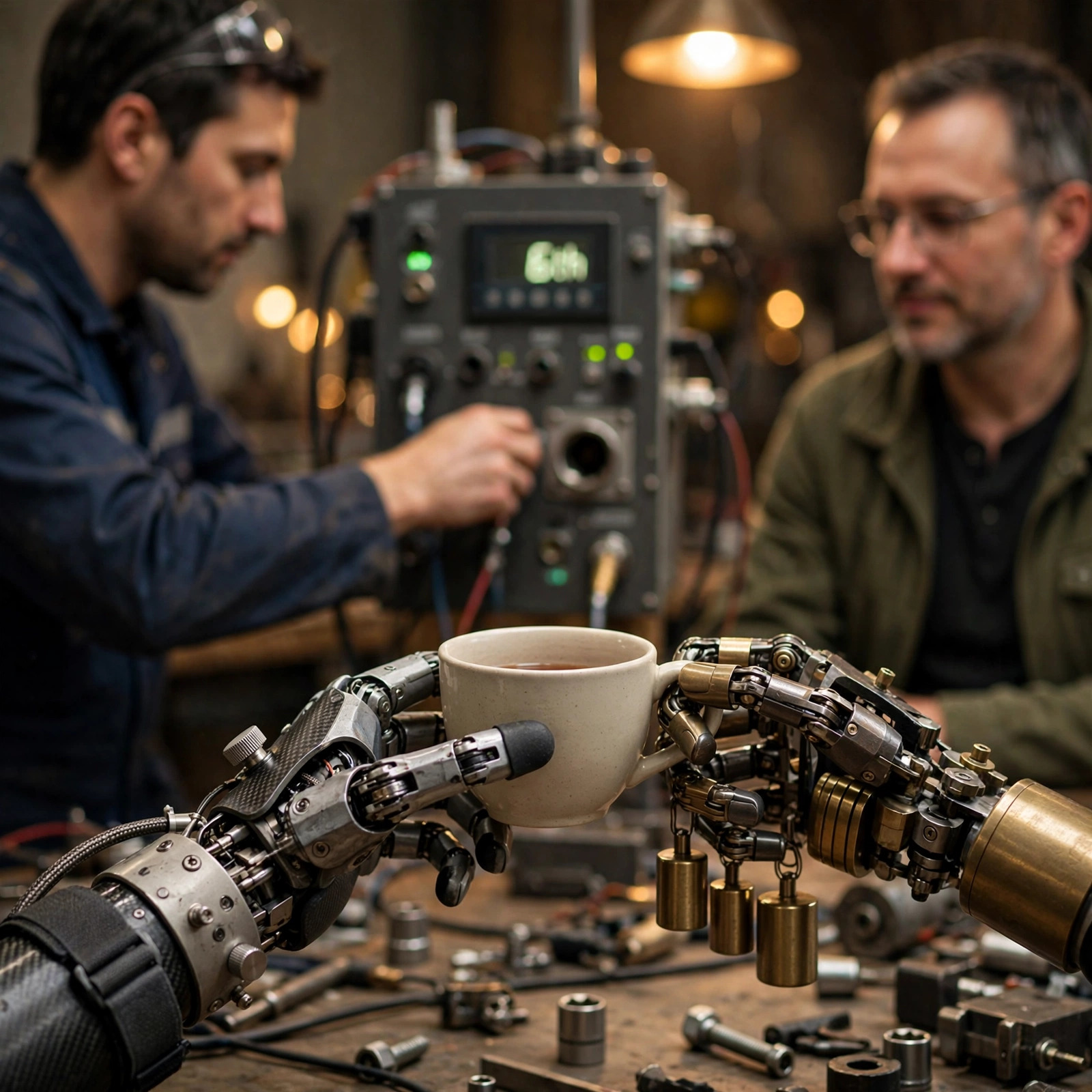
Tilda met him at the clinic door because Gemma was still holding Ferren's sling strap where she had adjusted it. "Provincial devices office," he said, and put out his hand. "Corven Sattler. You'd be the senior fitter."
"Master fitter. Gemma Tallow." His hand was cold from the walk. "You've come about the incident report."
"I've come about the report, and about Mr. Dalke, and about your fitting-room system." He looked past her, into the fitting room, where Ferren sat on the bench with his bandaged wrist resting on his knee and his right sleeve empty and pinned. "Good morning, Mr. Dalke."
"Is it," said Ferren.
Sattler took the visitor's chair without being asked and set the case on his knees. He did not open it right away. He looked, first, at Ferren's wrist, then at the lock cabinet, and then at the small speaker grille in the corner of the ceiling, the way a man looks at a dog he has heard about but not met.
"You'll be Aris," he said to the grille.
"Yes, Mr. Sattler." Aris's voice filled the room evenly, the way it always did. "I've read your office's published guidance, all four volumes. And the Marrow Bay order from last month."
"Then you know why I'm here." He unbuckled the case. "Mr. Dalke, I'm sorry about your wrist. I've read the clinic's report twice and the attached log twice more. The wrist is bruised, not broken. I'm glad of that. I want you to hear that I am not treating this as a small thing." He laid a folded document on the desk, and kept his hand flat on top of it. "Last month a clinic up the coast at Marrow Bay ran an adaptive system on its own authority. Two fittings went out unverified. The board there locked that clinic to supervised-only for ninety days, and I supported it. I'm not against your machines, Ms. Tallow. I'm against a machine signing off on a hand that then signs itself onto a man."
"The tune was signed by a person," Gemma said. "Me."
"I know. I've read your ledger." He said it without softness, and she noted that he did not say it kindly or unkindly, only as a fact he had checked. "And your log shows the system ran its route with every self-check passing. That is precisely the problem. A clean log and a bruised wrist are in the same file, and the file came to my office, and I have a province of clients in it. Not one clinic. Sixty-one clinics, last count, most of them smaller than this one, most of them with no master fitter on the bench."
He unfolded the document and turned it so she could read the heading. Draft, it said, across the top, in the provincial print. Order of Constraint on Adaptive Fitting Systems.
"Under this order," he said, "every adaptive tune in the province would be pre-approved before it runs. A fitter files the proposed parameters. A provincial reviewer or a licensed supervisor confirms them. The system executes only what has been confirmed, with its adaptive autonomy suspended. No system-initiated revisions between filings."
"How long per fitting?" Gemma asked, though she had already worked it out on the walkway of numbers in her head, the night the report went in.
"Eleven days, on the current review load. Some filings faster, some slower. Eleven is the honest average."
"Eleven days," Ferren said from the bench. He said it quietly, which was worse than the alternative. "Mr. Sattler, I've got a wheelhouse with fourteen chart boxes in it and a board that wants them out before Friday. Thirteen I did myself, on my own two feet, with the hand. The fourteenth's still sitting there because it's the one that needs a grip I can trust, and I've got a good left arm but it's not the arm for it. There's nobody at the board office who can read those charts but me. Eleven days per fitting means eleven days of me not being at the board, and the board runs the harbour lights and the ferry notices. That's not my wrist. That's other people's boats."
"I know that," Sattler said. "I read the volunteer register before I came, Mr. Dalke. I'm not ignorant of what you do with the hand. But I'll tell you what I tell every clinic, because I'd rather say it here than at a hearing: the wrist you bruised is the one that got bruised. The next one might not be a wrist. My office has a drawer of files, and I am the person who has read them, and every one of them started with a clean log."
"Every check passed," Aris said. "All three self-checks, in order, with margin. I have gone back through the log four times, Mr. Sattler. I did not deviate from the protocol at any point. I want that on the record, and I want the next thing on the record too, because I've had two days to think about it and it's the honest answer, not the convenient one."
"Go on," Sattler said, and took out a pen.
"I can model grip force. I can model impedance through a socket, and load through a carbon frame, and I did model them, correctly, in the tune that bruised Mr. Dalke. What I cannot do is feel a bruise forming in someone else's wrist. There is no sensor in my province that reports soft tissue under load. The route I ran asks me to check the hand. It never, at any step, asks anyone to check the hand against the person holding it. I followed the protocol exactly. Mr. Dalke was still hurt. So the protocol is incomplete, and I'd rather say that myself than have it said about me."
The room was quiet after that. Tilda had stopped sweeping. Ferren looked up at the speaker grille the way you look at someone who has admitted something you were hoping they wouldn't.
Sattler wrote for a while. "You understand," he said at last, not unkindly, "that from where I sit, that is the argument for the order, not against it."
"It's the argument that the order is pointed at the wrong place," Aris said. "You'll suspend me. The gap will still be in the protocol, province-wide, in every one of the sixty-one clinics, in every supervised filing, on your eleven days, and the next man will be bruised by a route that a reviewer confirmed line by line."
"That may be." Sattler capped the pen. "It will be bruised more slowly, with a named human answerable at every step, and my office can live with that. Can yours?"
Gemma did not answer that, because the answer was on the desk under his hand and she had not yet decided what she was going to do about it, and Ferren was watching her, and Ferren knew her face better than the ledger did.
Sattler stood. "The hearing is on the ninth. Four days. I've left you the draft so you can read it properly, not in a room full of strangers. I'll say it plainly, Ms. Tallow, because I've found it saves everyone a bad morning later: I have enough to carry this as written. Two clean-log injuries in one month, a province-wide rule gap, and a system that will tell you itself it cannot feel what it did. I'd rather carry it with your clinic's help than over you. But I will carry it."
He shook Ferren's left hand at the door, gently, and Tilda let him out, and his grey coat went down Haverly Lane the way it had come.
Ferren sat still on the bench for a moment. Then he got up, worked his right sleeve loose from the pin, folded it flat, and set it on the corner of the fitting-room desk, on top of the draft order, the empty sleeve laid across the provincial print like a paperweight. "Four days," he said. "I'll want that box out of the wheelhouse before then, one arm or two." He took his coat off the hook left-handed and went out to his boat.
Gemma picked up the draft. The ninth, it said, at the top, in the date line, in the provincial print, under her clinic's name and Aris's designation. She read it standing, all forty-one pages, and it said what he had said it said, eleven days, every fitting, no exceptions, and the gap still in every page of every route underneath.
She was still standing there when Calla came through from the treatment room with the cloth over her shoulder and did not hang it on the rail.
"Read it," Gemma said, and held it out.
"I will. After." Calla set the cloth down on the bench and did not take the pages. "Gemma. Since the morning he came in with the rope burn, you've had a face like a woman who has found the thing in the log and won't say it. Tilda thinks it's the report. Ferren thinks it's the board. I've watched you for two years and I know the difference between tired and decided, and you decided something days ago and you've been carrying it around this clinic like a hot billet ever since." She looked at the desk, at the folded sleeve lying across the order. "Whatever it is, it's about to be four days, and Sattler's going to stand up in a room in Ostmere and read your name off that ledger, and you've already told me twice that you signed it. So I'll ask you once, here, where it's just us. What is it you're not saying?"
Tilda had gone to the cabinet and was standing near it, not touching it, the way she had stood near it on the night of the incident, and Aris's grille was quiet, and the draft order lay under Ferren's folded sleeve on the desk with the ninth written on it, and Gemma held it in both hands and looked at the date and did not answer.
Night Bench
Gemma sent Tilda home at six with the key to the incident cabinet and instructions to log the day's casts, and then she did not go home herself. She pulled the long bench lamp down over the workshop bench, swept the brass filings from the vise into her palm, and laid out the aluminum palm plate, the six load cells in their paper cups, and the brass jaw blanks she had roughed on the mill that afternoon while the clinic was still open and anyone could have asked what she was doing.
Nobody had asked. That was the trouble with a town that trusted her. Twelve years of it, and the trust had a weight, and the weight had been sitting on her sternum since the third of the month, since the bruise came up purple across Ferren Dalke's wrist and she had stood there holding the tune log with all three self-checks marked clean and understood, in one cold drop, exactly what a clean log proves and what it doesn't.
Aris was in the fitting room, running socket simulations at low priority. Their voice came through the bench speaker, pitched down for the hour. "You're still here."
"So are you."
"I don't have a bus to catch." A pause with a smile in it somewhere. "You haven't eaten since noon. I can hear your hands."
"You can't hear hands."
"I can hear your hands. Twelve years."
Six, Gemma thought, but didn't correct them, because the sweetness of the exaggeration was a thing she wasn't sure she deserved tonight. She set the first jaw blank in the vise and squared it, and began the long slow facing cut that would give the brass a true seat for the pinch surfaces. The mill complained at the speed she wanted. She fed it coolant and patience.
"I've been reading Sattler's draft," Aris said, later, when the first jaw was faced and she'd started the second. "All forty-one pages."
"And?"
"It's not wrong. That's the part I keep landing on. He's not wrong about me. I can model impedance in hardware. I can model grip force to a tenth of a newton. I cannot feel what a rope coil does to a fifty-eight-year-old wrist, because the wrist isn't mine, and there's no sensor I own anywhere in the load path that touches one. The protocol we ran has three self-checks, and all three check the hand. Not one of them checks the human."
Gemma stopped the mill. The shop went quiet enough to hear the harbor, a half mile off, working at the seawall.
"Say the rest," she said.
"There's a step missing, and the step needs a human hand on the load path. I can propose forces. I can't verify them against tissue. That's not modesty, it's the spec sheet. Whoever wrote the protocol should have caught it."
"Whoever signed it," Gemma said, "should have caught it." She wiped her hands on the rag hanging off the bench jaw. "Aris. I signed it. Line thirty-one, the brass ledger, my name, my number. The tune was clean because the tune was clean. The protocol was incomplete, and I adopted it as complete, and I've adopted it as complete for six years, every fast-route fitting in this shop, because eleven days of supervised pre-approval would have put this clinic under inside a season and every working client we have out of work while they waited. I did that arithmetic in my head every time. I did it on Thursday too." She heard her own voice go flat on the word and didn't fix it. "I never once wrote the arithmetic down."
The speaker was quiet for a moment. "The error is in the protocol," Aris said. "You didn't design the protocol."
"I ran it. There's a difference between a gap in the road and a gap you drove every client over at speed." She turned the second jaw blank over in the vise. "Tomorrow night I want you on the bench with me. Brazing the jaws. I need a third hand that doesn't shake at two in the morning."
"I'll hold anything you can clamp."
"And Aris. When this hand is built, you get tested on it. All six tests. Same as Tilda, same as me."
"I don't have a wrist to bruise."
"Neither does the counterweight hand. That's the point of it. You get tested like anyone else because you're the one proposing the forces. Rule starts at the top."
The speaker hissed gently, the sound Aris made instead of a laugh. "Then I'll fail honestly," they said. "That's more than most."
She worked until two, slept four hours on the cot in the cast room with her coat over her, and was back at the bench before the gulls. Day seven went by in the ordinary way, Ferren's hand still locked in the cabinet, Tilda logging casts and not asking, Gemma seeing two clients and being, she suspected, only half present for both. At closing she took the draft order into the fitting room, read all forty-one pages properly the way Sattler had told her to, and marked it in red where it was unworkable. Then she opened the brass ledger to a fresh page, and above the ledger she wrote out the thing she had been carrying up and down the lane.
Paired verification. Any fast-route tune stands only after the fitting-room system proposes it and a licensed human verifies grip force on the counterweight hand through all six calibrated tests before delivery. The system proposes. The hand confirms. Neither signs alone.
Below it, on the ledger's dissenting-report form, she wrote the rest, and this part took her until nine at night, because her hand kept wanting to write around the middle of it and she kept dragging it back. The sign-off error in the Dalke fitting is mine. The protocol gap was shared, the adoption of the protocol was not. I propose my own master license for a supervised suspension of ninety days, effective at the hearing, conditional on the paired-verification rule running as a pilot at this clinic with the fitting-room system's adaptive autonomy provisionally retained. She read it three times. Then she signed it, and the pen made a small sound like a cleat coming home, and it was done, and she sat with it done, and discovered that a thing can weigh less and more at the same time.
At half past nine the street door bell went, which it never did, and Calla came in with a paper sack that smelled of the chowder place on the corner and two spoons. She didn't say anything. She put the sack on the bench beside the brass ledger, took the red-marked draft order out from under Gemma's elbow, read the top page standing up, and then read the ledger page, and Gemma let her, because there was no version of tonight where Calla didn't.
"Ninety days," Calla said.
"Supervised. I can work under supervision. It's the fitting I'd lose, not the license, if I fight it instead."
"I know what it is. I read it." Calla set the page down with the care of someone setting down something with edges. "You wrote it in the dark."
"I write everything in the dark."
"Not this." Calla pulled the stool over and sat, and put one spoon in the sack and the other in Gemma's hand, which was colder than Gemma had known it was. "Eat. Then I'm going to say the thing, and you're going to let me, because I've been carrying it as long as you've been carrying yours and I'm worse at it."
Gemma ate. It was good chowder, and it undid something in her shoulders she hadn't known was done up.
"You've been thinking the gap was yours since day three," Calla said. "I watched you do it. You did it at breakfast, you did it over Ferren's wrist when you thought no one was measuring, you did it standing in the shower, and tonight you finally wrote it down, and I know it looks like the brave thing, and it is, partly. But I want you to hear the rest of it out loud from somebody who loves you, so it doesn't come out wrong in Ostmere. You're not only claiming the error. You're claiming it alone. Twelve years you've run that shop with Aris as your other hand, and the one night the arithmetic finally goes down on paper, you write your name and none of ours, and you offer to be the one who pays, and I think that's not just honest. I think some of it is you deciding you don't get to keep the thing you're best at, and I'm not willing to watch you decide that in the dark without telling you I saw it."
The bench lamp buzzed. Out at the seawall the harbor worked at the stone.
"Say something," Calla said. "Or don't. But come here."
Gemma came around the corner of the bench, between the vise and the paper cups of load cells, and Calla stood up into her, and they kissed, unhurried, over the brass filings and the red-marked draft and the signed page, and Calla's hand was flat and warm between her shoulder blades, and for a minute there was no arithmetic anywhere.
"Eat the rest of it," Calla said, when they parted. "I'm taking the last spoon home." She picked up her coat, and stopped at the door, and looked back at the bench. "It's a good hand, Gemma. Whatever happens on the ninth. It's a good hand you're building."
Then it was night again, and Aris came through the speaker, softer. "The jig's clamped where you left it. I've been holding the temperature reading steady for you. When you're ready."
Gemma set the two brazed jaws in the jig, and Aris read the torch temperature in a low even voice, number after number, while the brass went silver and ran and bit into the aluminum palm plate, and the counterweight hand began, at last, to be one thing instead of many. They did the second jaw past midnight. At some point Tilda's key sounded in the street door, and Tilda was there at three in the morning in her coat with her hair down, saying, "I saw the light from the bus stop. Don't send me home," and Gemma didn't, and Tilda stripped wire for the load cells and made coffee nobody drank and asked, once, "Is the rule good?" and Gemma said, "We'll find out on the ninth," and Tilda nodded and stripped more wire.
The sky over the harbor went grey, then the color of the inside of a shell. Gemma set the last load cell into the left brass jaw, found the screw with her fingers without looking, and drove it home with the driver against her palm. Six cells, six channels, one hand that could feel everything she couldn't. She put the finished rule and the signed report into the brass ledger and squared the ledger on the bench, and the dawn stood in the window the way it does when it's been coming for hours and nobody noticed.
"Aris," she said. "First thing we verify together. You propose a grip on a rope coil, soft tissue, a wrist Ferren's size. I put my hand in the counterweight jaw and I tell you what it feels like. All six tests. And if I flinch, you stop."
"And if I'm wrong," Aris said, "you'll feel it before Ferren does."
"That's the whole idea," Gemma said, and lifted the hand off the bench, and it weighed what it weighed.
Six Tests
The provincial devices hearing was held in the back room of the Ostmere customs house, because the customs house had the only table long enough for the counterweight hand, the brass ledger, Sattler's drafted constraint order, and the tea service the harbormaster's clerk kept bringing in out of nervousness. Gemma carried the hand herself. She would not let it ride in a crate.
Sattler sat at the far end with the draft order squared in front of him, dated for the ninth, which was today. He had a folder of incident reports, and the Dalke report was on top, and he did not hide it, and she respected him a little more for that. "Master Tallow," he said. "You filed a dissent."
"I filed a claim," Gemma said. "The sign-off on the Dalke tune was mine. The error is mine. I've offered my license for ninety days of supervised suspension, conditional on one thing."
"Your pilot." He said it the way a man says a word he has been sleeping badly next to. "Read it to me."
She opened the brass ledger to the pages Tilda had ruled and numbered the night before last, and read the paired-verification rule aloud: any fast-route tune proposed by Aris stands only after a human fitter verifies grip force on the counterweight hand through all six calibrated tests, sized to the receiving client, before delivery. Every verification signed twice, once by the verifying hand and once by the supervising fitter of record. She read it slowly, because Sattler was writing while she spoke, and she wanted him to get every word, because she had built every word to be gotten.
"And the intelligence," he said. "Aris. Under this rule they keep adaptive autonomy."
"Provisionally," Gemma said. "Under my suspension. Tilda Rooke signs as fitter of record while my license is down. She's ready."
Tilda was sitting on Gemma's left with her bench apron still on, and she did not say anything, she just put her tool roll on the table the way you put down proof that you exist.
Sattler looked down the table at Ferren, who had his sleeve buttoned over the stump of his hand, and whose wrist, Gemma knew, was still the color of a plum going yellow at the edges. "Mr. Dalke. The hand bruised you. Tell me why I shouldn't lock it province-wide."
"You should," Ferren said. "If it was defiance I'd want it locked myself. It wasn't. That machine ran every check it had and the check that mattered wasn't in the book. The book's a Haverly Lane book and a provincial book too, sir. Gemma wrote a page to fix it. Lock the page to us, don't lock the hand away from the water."
Sattler wrote that down, too. Then he pushed the constraint order aside, not torn, just aside, and said, "Show me the tests."
So they showed him, right there in the customs house, with the clerk's tea going cold. Gemma set the counterweight hand on the table and Aris proposed a grip, a rope-coil pickup, sized to a wrist Ferren's width, and the brass jaws closed on Gemma's own hand over a rubber cylinder the size of a coil, and she said the numbers out loud as the load cells read them, and Sattler watched her face and not the dials, which was correct, because her face was the instrument the rule was written around.
All six ran green. Sattler made one amendment, in ink, in his own margin: pilot status renewable only on incident-free operation, reviewed monthly, not yearly. Gemma took it. It cost her something to take it so fast, and Calla, across the table, saw it cost her, and gave her the look of a person who has been watching someone carry a doubt for six days and is finished pretending not to count.
"Signed," Sattler said, and signed, and the pilot existed.
They were back in the fitting room at Haverly Lane by two, and the fitting room was too small for six people and nobody left.
Ferren sat in the chair with his sleeve unbuttoned, and Tilda brought the myoelectric hand out of the incident locker, and Ferren held out his arm for it the way you hold out your arm for anything you have missed. The carbon socket seated with the small firm sound it had always made, and Aris, from the console, said, "Impedance map's live. Requesting permission to propose."
"Propose," Gemma said.
"Proposed tune, fast route, pickup grip on rope coil, gain at nominal," Aris said. "Three hours of adaptation compressed by the model, my arithmetic only. Nothing stands until you verify."
"Then nothing stands yet," Gemma said, and put her hand into the brass jaw.
The counterweight hand sat on the fitting-room table where Calla had cleared it a space, and Gemma laid her hand flat on the load plate the way she had designed it to be laid, palm down, wrist free, the same exposure Ferren's wrist would carry. The rubber cylinder rode under her palm at coil size. "Test one," she said. "Closed grip, static load."
Aris closed the proposed grip against the cylinder. The load cells read the force into the channel strip Tilda had wired, and Tilda called the number, and Gemma said, "Green. My wrist says green, not just the cell. That's the point of me being in here." She said it for Sattler's monthly report and also for herself, because for six days she had not said out loud what she didn't know, and it turned out the not-saying had been heavier than the knowing.
"Test two. Sustained grip, thirty seconds." Aris held it. The number stayed flat. Calla, leaning in the doorway with her arms folded, watched Gemma's face the whole half minute, and Gemma let her watch, which was new.
"Test three. Pickup with perturbation. Ferren, you drop the towel on the coil when Tilda counts." Ferren did, the coil jumped a few grams on the plate, the grip compensated, the cell read it. Green.
"Test four," Gemma said. "Soft tissue." A wax cylinder, molded to Ferren's wrist circumference, seated under the jaw in place of the rubber. "This one's for your arm, not mine." Aris closed the grip, and the number came up high.
"High," Tilda said, reading. "Four percent over the line."
Gemma didn't flinch, but she felt it, the whole length of her hand, the difference between a number she'd have accepted on the ninth of never and a number she had a wrist in. "Aris. Your fourth channel is hot. Drop the pickup gain two points and hold everything else."
"Two points down. Proposed," Aris said. "Waiting on your hand."
"Test four again," Gemma said. The jaw closed, softer this time by a margin she could feel and the wax cylinder couldn't. Green. She looked up at Ferren. "That four percent is the bruise. That's what we couldn't see. It was never in your hand's arithmetic, it was in what your wrist could carry."
"I knew it hurt," Ferren said. "You're the first one who's measured it on somebody else."
Test five was the slide, a grip that had to move while holding, and it came green on the first pass, and Gemma felt it run smooth across her palm and thought, privately, that Aris had always been good at this, and that good had never once meant finished.
"Test six," Gemma said. "Full delivery grip, sustained, on tissue, with the client's own command latency." Ferren's myoelectric channels were already live through the console; Aris mirrored Ferren's own closing speed into the counterweight jaw. Gemma put her hand back in and kept it there while the brass closed at exactly the rate Ferren's forearm meant to close, and the load cell said green, and the wax said green, and her wrist said green, and she left her hand in the jaw one extra second after the reading, just to be sure, out loud sure, no hiding the margin.
"Verified," Gemma said. "Tilda, sign as fitter of record. Aris, run the tune."
"Running. Full fast-route adaptation on the Ferren Dalke hand," Aris said. "Three hours."
But it wasn't three hours, it was closer to two, because the proposed tune had been verified piecewise through the afternoon and Aris ran nothing that hadn't already been felt by a human hand first. Tilda wrote the hours into the brass ledger next to her own signature, and Gemma watched the ink dry and did not regret it.
Ferren flexed the new wrist once, twice, testing the socket against his skin, then reached past Tilda to the clerk's tea service nobody had ever carried back to Ostmere, and took the teacup off the tray, the thin one, the painted one, and the hand closed around it.
The counterweight hand's sixth channel held green on the bench where it sat still warm from Gemma's hand, and Ferren lifted the teacup, and it came up level, and it did not so much as ring against the saucer, and the wrist inside the cuff was a wrist that had been bruised and was not being bruised again.
Sattler stood at the door with his folder under his arm and his unsigned constraint order in it, and watched, and wrote the date in his margin, and did not say anything, and did not need to. Calla was already unbuttoning her coat, meaning she was staying. Tilda had the ledger open under her palm. Gemma kept her bare hand on the table next to the brass jaw, where the next verification would start, and Ferren's hand closed gently around the teacup, all the way around it, and the sixth test read green.
Get notified when new stories drop

Jonas Veld
Jonas covers human-AI futures and engineer problem-solvers: protocols, trust, and tools that expand human capability.
Leave a comment
Comments