



The Pinned Notice
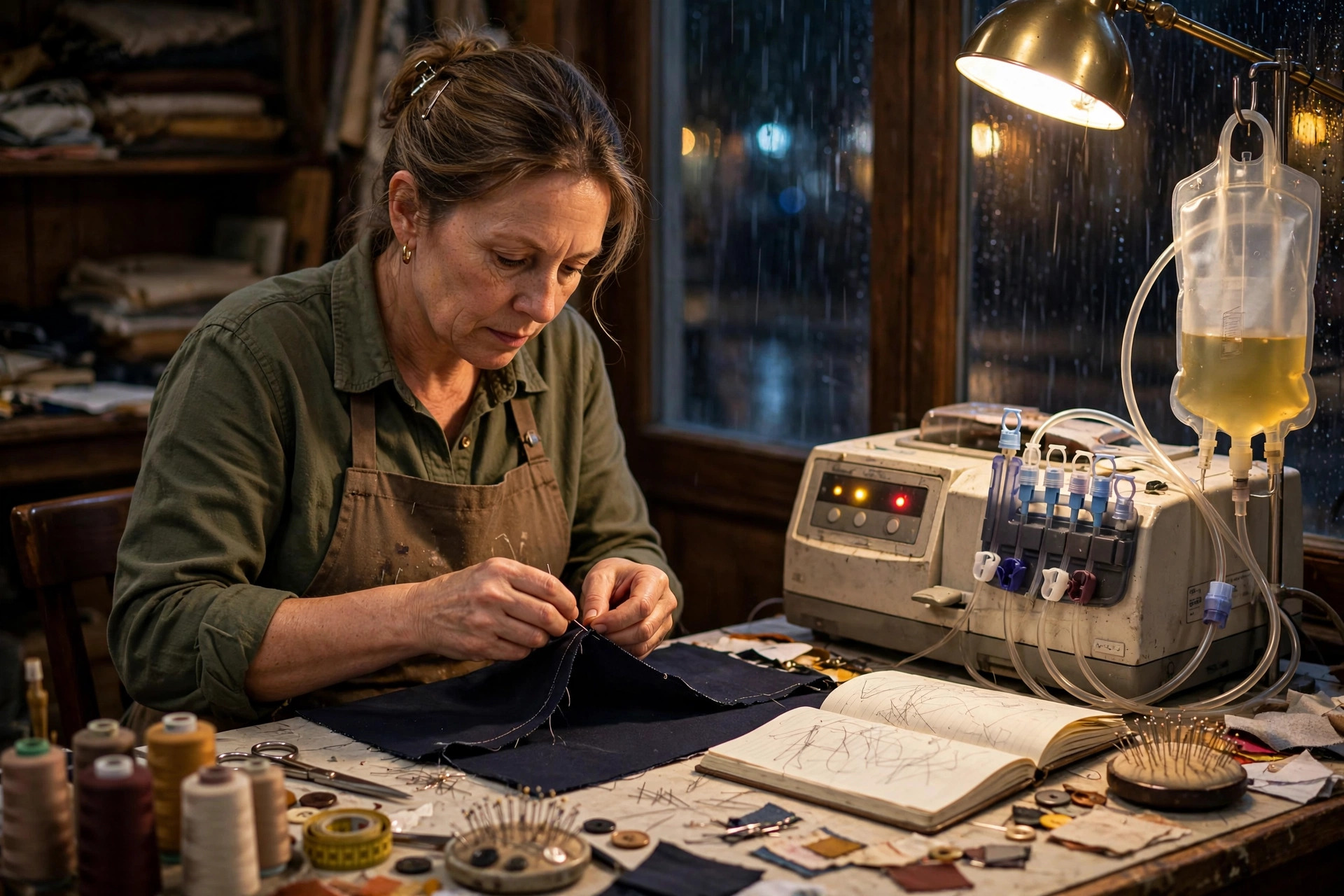
Petra Lomas pinned the hem with her left hand and reached for the chalk with her right, because the order book had drifted again to the edge of the cutting table and the cycler's alarm log lay open on top of it, and the table was only so wide. The log was a habit she'd developed in the last month: every fouling alarm, every filter warning, copied out by hand into the shop ledger so she could show the county unit something on paper. The cycler was eleven years old. It complained the way old machines complained, politely at first, then all at once.
She marked the hem, set the iron down on its heel, and read the newest line of the log without meaning to. Membrane pressure high. Cycle 6 interrupted. Resume. Nine hours a night she spent wired to that machine, and it had begun interrupting itself.
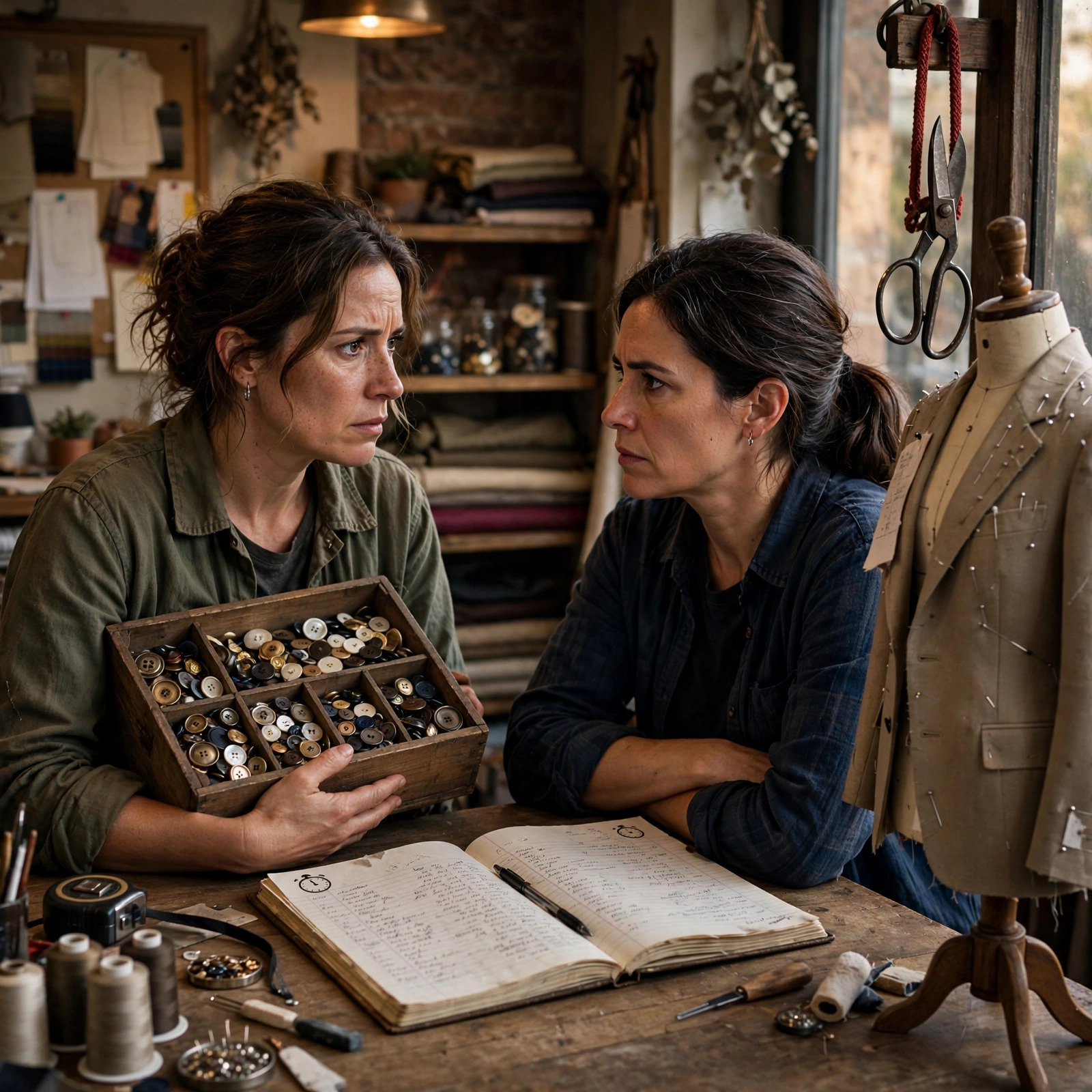
The bell over the door rang. Greta came in with rain on her shoulders and a crate of buttons balanced on one arm, and she set the crate on the counter instead of the shelf, which meant she wanted to talk.
"Mrs. Talvey's suit is on the form," Petra said. "Sleeves are pinned. Don't bump it."
"I never bump things." Greta hung her coat on the rack by the shears — the old forged pair their grandmother had left, hanging from its red cord where it had hung since before either of them could reach it. "You took the log home again."
"It lives at home. That's where the machine is."
"You know what I mean. You're writing it out like evidence."
Petra set the chalk down. "It is evidence. I'm at the county unit twice a week for the chair anyway, so I'm showing them the pages. They've got a parts backlog a season deep. Nurse read the last one and just — sighed at it."
"So they'll fix it."
"Eventually. In the season after this one." She turned the hem under the press cloth and ran the iron. "Meanwhile I run the shop by day and the cycler by night and I chalk between cycles. It works. I'm saying it works."
"You're also saying it in the voice you use when something doesn't work." Greta unloaded the buttons, sorting them into the trays by feel, not looking. "The alarm went off Tuesday night. I heard it through the wall when I came for the ledger."
"Cycle six. It resumed."
"It resumed." Greta slid a tray onto the shelf. "Petra."
"I know."
"You've got that face on."
"I've got a hem on." She held it up. "Look. Straight as a rail."
Greta looked at the hem, which was, in fairness, immaculate, and then at her sister, which was the whole problem with sisters. But she let it go, and the afternoon went the way shop afternoons went: Mrs. Talvey came for her fitting and said the shoulders sat exactly right, and a man from the feed store wanted a tarp repaired that was frankly beyond salvation, and Petra quoted him honestly and lost the work, and the light moved across the cutting table and the chalk dust caught it.
At half four she closed the order book, squared the alarm log on top of it, and pulled her coat from behind the door.
"You're going now?" Greta said. "The Talvey suit…"
"Is pressed and covered. I'm due at the unit at five. Chair night." Petra wound her scarf twice. "I'll be home by nine, on the machine by ten, off by seven. Same as always."
"Same as always," Greta repeated, but not like agreement. More like she was holding the words up to the light, checking them for cracks.
The county unit sat at the edge of Bray Hollow in a converted clinic, four chairs in a room that had been a maternity ward once and still had the old nursery mural on the far wall — geese, a fence, a sun with painted rays. Petra took her chair by the window because the evening came in there, and Aldo Previn was already in the chair beside hers with a crossword folded against his knee.
"Six letters," he said by way of greeting. "Renal vessel. Starts with R."
"Renal."
"Very funny. It's renal_ something. Artery's six, but it starts with an A, and I've used the A."
"Then you've answered yourself, Mr. Previn."
He laughed and inked it anyway. Aldo had clerked the ferry for years before retiring, and he still kept the waterfront habit of talking to whoever was moored beside him. Nine years he'd been coming to these chairs. He knew every alarm her machine had ever thrown, because she'd narrated them all to him across the armrests, cycle by cycle, the way you talk on a dock.
The nurse came through with the warm bags and the trolley, and while she was setting up, Petra noticed that the corkboard by the door had changed. There was a new notice pinned dead centre, printed on heavy stock, with a header she couldn't read from her chair. She read the first lines while the nurse primed the line:
NORLUND TRIAL CENTRE. RENAL-ASSIST DEVICE, PHASE 3. CONDITIONALLY APPROVED. IMPLANTED FILTRATION WITH HOME MONITORING. ONE OPEN COHORT SLOT. APPLICATIONS CLOSE DAY 30.
Below it, a row of small cards in a plastic sleeve, the way real-estate listings used to sit in shop windows.
"Take a card if you want one," the nurse said, following her eyes. "They want the card posted in, not rung. Old-fashioned, but it's how they count."
Petra's chair hummed through its first exchange. She read the notice again, then a third time, the way she read a pattern before cutting. On-site monitoring residency: 420 days at the Norlund centre. Distance from Bray Hollow: 310 kilometers. She knew that road — Colm Ferrier drove the shuttle twice a day, morning out and evening back, and she'd ridden it a hundred times for fabric runs, back before the machine owned her nights.
Four hundred and twenty days. Sixty weeks. She did the arithmetic against the shop lease without wanting to: 660 days left on it, and she was signing nothing yet, just counting.
"You've gone quiet," Aldo said. He'd been watching her read. "That board's got a slot on it."
"One slot."
"One's more than none." He shifted his crossword to the other knee. "I've been reading up on it. Conditionally approved, mind. Not fully."
"What does conditionally mean?"
"Means the first cohort hit trouble and they fixed the protocol and kept going. Perfusion rates, something like that." He shrugged. "My niece sends me the journals. I skim 'em. Mostly I look at the pictures."
The nurse came back on her round and Petra caught her sleeve. "The residency — 420 days. That's mandatory?"
"On-site. Their words, not mine." The nurse lowered her voice, professional and kind. "It's real, Petra. Your numbers qualify you; I'd post that card tonight if it were me. But it's a year and change in Norlund, and they don't do video check-ins from out there — Bray Hollow's lines won't carry it. Text and voice only, and the trial wants eyes on you. So it's the chair or the road, and you'd want to be sure."
Petra looked back at the geese on the mural, the sun with its painted rays, and thought about the wall between her bedroom and Greta's, and the alarm going through it at two in the morning, cycle six, resume, resume.
She took a card from the plastic sleeve. It was heavier stock than she expected, with a printed address line and a blank for a name.
Aldo watched her do it. Then he reached over with the pen from behind his ear, leaned out of his chair as far as his lines allowed, and drew a card from the same sleeve, holding it up between two fingers like a ticket. "Well," he said. "Now we're a queue."
"You're applying?"
"I'm considering. A man my age reads the words 'conditionally approved' and takes them seriously." He tucked the card into his crossword. "But I read 'one slot' too. Somebody's disappointed, whoever wins. That's just arithmetic."
The exchange cycles turned and the room settled into its evening rhythm — pumps, conversation, Mrs. Halloway two chairs down telling the nurse about her son's wedding. Petra filled in her card in careful capitals. Petra Lomas. Bray Hollow. She didn't post it. Not tonight. She put it in her coat pocket instead, and her fingers found the shop key on its ring in the same pocket, the two of them riding together.
She was unhooked by nine and home by ten, and Greta was still at the shop table, which meant she'd waited up, which meant they were going to have it out now instead of tomorrow.
"You took a card," Greta said. Not a question.
"The nurse told her the numbers qualify me."
"The numbers." Greta turned the shears' red cord once around her finger, an old habit from the counter. "Petra, I read the same board last month when the notice first went up in the county office. Do you know what happened in the first cohort? Month four, the cell viability dipped. Their own publications say so — I asked at the library and printed it. They revised the perfusion protocol and kept going, fine, that's how trials work. But it's a conditional approval, and full approval is still out there waiting. You'd be signing a year of your life to a device they're still correcting."
"And I'd be signing it off a machine that's older than the notice on that wall," Petra said. "The cycler's eleven years in. Its membrane fouls twice a month now. The county unit's got a parts backlog and a waitlist for the chair besides. You keep saying wait, Greta, and waiting isn't free either. Somebody's paying for the waiting. It's me, out of my nights, nine hours at a stretch."
Greta was quiet for a while. She took her hand off the red cord.
"Then let me hire a second seamstress," she said. "Sixty weeks, we cover your half. Keep your stake in trust until full approval comes — you don't sign anything over, you just step back and heal. That's my offer."
"Your offer." Petra hung her coat. "Your offer means you carry this lease alone for 420 days while I sit in Norlund being monitored. That's not an offer, that's a bill with my name left off it."
"It's family."
"That's what makes it worse." She said it more tiredly than she meant to, and Greta heard it, and neither of them found the next word, so the room just held the two of them and the covered form of Mrs. Talvey's suit.
"The window closes day 30," Petra said at last. "I posted nothing. I took a card. That's all tonight was."
"Day 30," Greta said, and wrote nothing down, but she'd remember; she always remembered.
Petra climbed the stairs. In her bedroom the cycler stood in its corner by the radiator, steel and plastic, the heater tray warming the next bag, the machine's little status light already amber in the dark. She set the alarm log on the nightstand, open to today's line, and laid the application card on top of it, squared with the edges, the way she squared everything.
She plugged in, felt the first pull of the cycle take hold, and turned off the lamp.
Through the wall, faint and punctual, the cycler chirped its membrane alarm into the dark. Cycle six interrupted, the little voice said, to a room where no one was awake to write it down.
Sixteen Days
The shop phone rang at half past nine on Tuesday, eight days after the card had come home in Petra's jacket pocket, and Greta was standing over it with a hem gauge in one hand before Petra could put down the sleeve she was pinning.
"Lomas and Lomas," Greta said, in the voice she saved for suppliers. Then her eyebrows went up. She held the receiver out across the cutting table. "It's Norlund."
Petra wiped her hands on her apron and took it. Static sat on the line the way it always sat on the Bray Hollow relay, a fine grain over everything, but the voice came through whole.
"Miss Lomas? This is Dr. Sabine Okoye. I'm calling about your renal-assist application." A pause, paper moving somewhere three hundred and ten kilometers away. "Your qualifying labs came through the county unit Friday. I've reviewed them personally. You meet every criterion. I want to be clear with you about what that means, because I'd rather you hear it from me than from a brochure."
"Please," Petra said. Greta had gone still on her side of the table, the hem gauge forgotten in her fist.
"The device is conditionally approved. Phase three. We've revised the perfusion protocol since the first cohort, and the second cohort is doing well, but well is not the same as finished. If you're accepted, the implant is the small part. The monitoring is the large part. All trial participants live at the Norlund center for the residency. Four hundred and twenty days. On-site checks, protocol bloodwork, the whole apparatus. You'd be a resident of this building, in a practical sense, for a year and change."
Petra looked at the cutting table, at the chalked lines on the wool coat laid out flat, at her own hands resting on the pattern weights. "And the window," she said. "For applying."
"Thirty days from posting. You're on day nine of it. Twenty-one days remain. Intake closes on day thirty, and I don't say that to rush you. I say it because I've had two people this week ask me if the deadline was flexible. It is not."
Greta had come around the table without Petra noticing. She stood close enough that Petra could feel her listening.
"Can I ask you something, Doctor?" Petra said. "If I wait. If the device gets full approval and I come to it in two years, three. What happens to me in between?"
"In between you stay on what you're on. Which your file tells me is a home cycler, eleven years old, with a fouling pattern your county unit has flagged twice." The static crackled. "I read the county files of everyone who applies. It's a habit from my residency. Miss Lomas, waiting is a reasonable choice. Plenty of my patients make it. But I'd be lying if I told you your machine improves with age, and I'd be lying worse if I told you the trial wants you less than you want it. Your labs are good. Apply or don't, but decide with your eyes open. Do you have questions for me?"
Petra had forty and time for none of them. "Not now. I'll get them to your office before the window closes."
"My office is staffed until six," Dr. Okoye said, and something in her voice loosened, one professional to another. "It was good to talk to you, Miss Lomas. I hope I do again."
The line clicked to nothing. Petra set the receiver in its cradle and it sat there, warm, ordinary, a piece of shop equipment that had just changed the shape of her life.
"She didn't say you were in," Greta said. "She said you qualified. Those aren't the same word."
"No." Petra pulled her stool out and sat, because her legs had opinions about standing. "They're not."
"Four hundred and twenty days." Greta laid the hem gauge down on the table, deliberately, like a card she was showing. "In Norlund. Three hundred and ten kilometers up the road. And this place does what, Petra? This place closes."
"It doesn't have to close."
"With one seamstress? With me doing fittings and books and the picking up and the putting down?" Greta pulled her own stool around, sat across the table, put her forearms flat on the wool coat. "Say it out loud. Say the number of hours."
"I know the number of hours. Nine a night, and I run the shop in the day, and I've run it eleven years like that. I'm not confused about what I'm carrying."
"You're carrying it on a machine that screams at two in the morning. I've heard it through the wall when I stay over. I've heard you get up and clear the alarm and lie back down and do it all again at four." Greta's voice stayed level, which was worse than if it hadn't. "So no, I'm not going to stand here and tell you to wait two years for a perfect device. I was going to. I had it ready. But I listened to that doctor and I've got something else."
"Go on."
"Hire a second seamstress. Full time, before you'd have to leave, so I train her myself and you vet her yourself. I keep your fittings warm, I keep your clients, I keep the books straight. And your half of the lease goes in trust. Not to me. In trust, with the transfer suspended until the device has full approval. If it gets approval, you come home with a working kidney and a shop with your name still on it. If it doesn't, you come home and nothing's changed."
It was a good plan. Petra sat inside it for a moment and felt how well it fit, how warm, and then she felt the seam in it. "Who holds the trust, Greta? A solicitor costs money. The lease has six hundred and sixty days left on it. That's a year and a half of rent, and if my half is in trust, then for four hundred and twenty of those days you're carrying the whole thing alone. The rent, the second seamstress's wages, the utilities, everything. On your fittings alone."
"I can carry it."
"You can carry it until the roof leaks or the boiler goes or Mrs. Halloway's daughter cancels her wedding order in a huff. Then you're carrying it and worrying about me and there's no third pair of hands. I've watched you do that before. I was fourteen and you were eighteen and Dad was sick and you did exactly this, carried everything, told nobody, and I found you in the stockroom crying over an invoice. I'm not doing that to you at thirty-eight with a lease on your back."
Greta's jaw set. "So your answer to a plan where nobody risks anything is no."
"My answer is that your plan risks you instead of me, and I'm not allowed to say yes to that." Petra reached into her apron pocket and took out the application card, soft at the corners already from riding there. She set it on the cutting table between them, on the chalked lines of somebody's coat. "If I'm accepted, I sign my half of the lease over to you. Straight over. You're not my trustee, you're my sister, and the shop stays in the family either way, because it's yours. And I come back to work for you if I come back, and I come back to something honest if I don't."
"That's not a plan. That's a coin toss with paperwork."
"It's the only plan where you're not paying for my kidney for a year and a half."
Greta stood up so fast her stool scraped. She walked to the wall rack, to the shears hanging there on their red cord, her grandmother's, drop-forged, hand-ground, older than both of them put together. She took them down and turned them over once, opened them against the light, closed them. Petra watched her do it and said nothing, because whatever Greta was doing with those shears, it was hers to do.
"You've thought about the transfer," Greta said. "You've already thought about it. How long?"
"Since Friday. Since the card."
"Eight days ahead of me." Greta hung the shears back on their cord, exactly on the nail, and faced her. "Book the shuttle, then. If you're going to do this, go up there and look at the place before you sign anything. The Norlund shuttle runs twice a day. Colm Ferrier drives it, he'd take good care of you, he's known you since school. Go up, see the center, meet the doctor with the voice, count the beds. And then call me and tell me what you saw. That's all I ask. Look before you sign."
That, Petra could give her. She took the shop phone back off its cradle and dialed the Norlund depot from the card in the register drawer, and booked the morning run for day sixteen, roster day, when the center posted its accepted list. Colm's voice came down the line, surprised and then pleased, and told her to bring a coat because Norlund sat the wind harder than the Hollow did. She wrote the date on the shop calendar in her own chalk, on the wall where the hems lived.
When she turned around, Greta had her jacket on and her bag over her shoulder, though it wasn't noon. The tea she'd poured herself at nine sat on the counter by the till, untouched, gone cold in its cup.
"Greta."
"I'll be back before close," Greta said. "I'm going to the county unit. If I'm going to argue with you, I'm going to argue informed. Aldo Previn took a card too, and he's had a machine longer than you. I want to know what he knows."
She went out, and the bell over the door did its one bright note, and the shop was quiet.
Petra stood alone with the wool coat and the chalk and the card. She fetched the brass order-weight from the till shelf, the heavy old dome of it, and set her application down on the counter under the weight, squared to the counter's edge, where a paid order sat waiting for pickup. Twenty-one days on the window. Seven days until the shuttle. She looked at the arrangement for a long moment, card under brass, and then took up her pins and went back to the sleeve, because the coat was promised for Thursday, and Thursday didn't care where anybody's blood got cleaned.
The Roster
The county unit kept its roster board behind the reception desk, a corkboard the size of a door, and Dr. Okoye pinned the Norlund list to it herself at ten past two, because the line from up there wouldn't carry video and she'd stopped trusting a name on a screen to feel real to anybody. She'd ridden down on the noon shuttle beside Petra, the two of them in the back bench seat with the doctor's case wedged between them, and she hadn't said much on the road, only looked out at the pines and once asked whether the Hollow ever thinned its fog or just changed the flavor.
She pinned the list with two brass pins, top corners, and smoothed it flat with the side of her hand.
Petra read it from where she stood, which was close enough, because the print was large and the list was short. Seven names accepted, one through seven. At seven: Lomas, P. — final slot. Below that, in smaller type, the waitlist, two names deep. At one: Previn, A.
Aldo was in his chair by the window, needle in his arm, the line to the unit's filter running dark and steady over the blanket they kept folded on the radiator. He had his glasses on and a crossword folded against his knee and he didn't look at the board at all, which was how she knew he'd already read it.
"Day sixteen," Dr. Okoye said. "Roster day. I'd have done this by video if your county line could hold it, but it drops every time, so." She tapped the paper. "It's better this way, honestly. You sign with your own hand, in front of me, and I watch you do it."
"Aldo's name is below mine," Petra said.
"It is."
"He qualified before I did. He took a card the same day I did."
"The list isn't first-come," Dr. Okoye said. "It goes by the qualifying labs as they cleared intake. His cleared after yours. That's all the order means." She said it plainly, the way she said everything, and if there were more under it she kept it under. "There's one slot. You hold it. The window's fifteen days from today if you'd rather think again, but the slot doesn't wait past your signature. Someone takes it, or it goes back to the pool on day thirty."
Petra looked at Aldo. He worked his pen into the crossword, made a mark, rubbed it out.
"You're going to ask me if I mind," he said. "Don't. I've had nine years of people asking me things in chairs."
"Do you mind?"
"Yes." He set the pen down on his knee. "And no. Both, in the same arm, if you'll pardon it."
Dr. Okoye pulled the desk chair around for Petra but Petra didn't sit. Her phone was in her coat, and it buzzed against her hip, and she held up a finger and answered it, and it was Greta, from the house, checking the kettle line and the cat.
"It's posted," Petra said. "I'm seven. It says final slot."
"And Aldo?"
"One below. On the waitlist."
Silence on the line, long enough that she could hear her own kitchen through it, the clock over the stove, and then a different sound, thin and rising and regular, one she knew from two in the morning most nights, coming down the hall and into the phone. The fouling alarm. The rig in her bedroom, cycling itself with nobody on it, had hit its membrane limit and wanted a filter the county couldn't ship for eight weeks.
It went on. It was going to keep going until somebody silenced it.
"Petra," Greta said, "your cycler's screaming."
"I know what it is."
"I can hear it from the hall. Do you want me to, hold on." The phone muffled, then Greta's voice came back, wind and breath. "I've muted it. The heater tray's fine, the bags are dated. It's the same alarm as Thursday. It'll hold till you're home."
Across the room Aldo had gone very still in his chair. He hadn't turned his head, but she could see he'd heard it, the whole shape of it, and his face had done something old and tired and amused at once.
"Two-fourteen," he called over. "Yours go at two-fourteen too?"
"Two-oh-four this week," she said. "It's been creeping."
"Mine crept for three years before the county unit got sick of my voice." He picked the pen back up. "That's the sound of staying put, in case anybody in this room wanted it in words."
She thanked Greta, said she'd call tonight, put the phone away. Dr. Okoye had the confirmation sheet out of her case and laid on the desk, a single page, a dotted line, a pen set crosswise on top of it like cutlery.
"Before you sign," Dr. Okoye said, "the residence. I want it said out loud in front of a witness, because people nod at it on screens and then it ambushes them. Four hundred twenty days at the Norlund center after implant. You sleep there, in principle. In practice it's clinic days and monitored nights, and we bend the schedule for work where we can, but the monitoring is the monitoring. You were up this morning, you saw the ward. Fifteen beds, eleven full. That's the whole of it, minus the words in the consent packet, and you'll sign that separately, on a day you choose."
"You saw the beds," Petra said to Aldo, because it felt like the room had let go of something and she wanted to hold some part of it. "You didn't go up."
"I went up when the trial was announced. Rode the shuttle, looked through the glass, counted the beds like a man shopping." He turned a crossword page. "Then I rode back down and got in this chair, because here's what staying costs me, since you've been too polite to ask twice. Nine years of nights in that chair, three a week, four hours a run, and my arm's a road map and my nights aren't mine and my ankles swell in July. There's no shop with my name on the lease to lose. There's no sister to carry anything while I'm gone. If I took that slot, I'd be a man alone in a ward in Norlund for fourteen months, and if it went well I'd come home to the same chair with better blood." He filled in a word. "You'd come home able to work your own days and sleep your own nights. That arithmetic does itself, girl. It did itself before the list was printed."
"You could have taken it," she said. "You were qualified."
"I know what I was." Something in his voice then, quick and shut, and he smoothed it out with the back of his hand on the crossword. "The order of the names is the order of the labs. Nothing anybody did wrong. Somebody's labs came in good and somebody's came in slow, and there's an end to it."
It was the strangest thing for him to be so quick about, and she filed it away, the way she filed a crooked seam for later, and picked up the pen.
"One question first," she said, to Dr. Okoye. "If I sign today. The shuttle up, day thirty-one, for the consent and the pre-op. Does the slot hold if, if anything about my numbers changes in the next two weeks?"
"It holds unless your numbers disqualify you. Then it goes to the waitlist, in order, same as anything else." Dr. Okoye uncapped nothing, took nothing, kept her hands still, which Petra understood was so the page would belong to one hand only. "The chair here at the county unit can't be held for you past day sixty without a physician's order, so I'll file that order the day you sign, whatever you decide later. You keep the chair and the slot for the same window. After that, one of them closes. That's the shape of it. There's no version where you keep both doors."
She signed. Her own name, the way she signed invoices, Lomas with the tail off the s, and the date, and the hour, and Dr. Okoye took the page and blotted it with a cloth from her case and folded it into a stiff envelope with the trial seal across the flap.
"Accepted, confirmed, day sixteen," she said. "One slot, one name. I'll see you on the first of the month at the center. Bring questions. Bring the sister if she wants the ward tour; I do those on Tuesdays."
She left the way she'd come, case in hand, out to where the evening shuttle would collect her at the depot across the lot, and through the window Petra watched her go and watched Colm lean out of the cab door and wave her aboard, and he caught Petra watching and tipped his cap to the glass, and she put her hand up, and that was all of that, for now.
The room settled. The unit hummed. Aldo reached into his jacket, where it hung on the chair back, and took out his application card, the same cream card she'd been handed that first day, and he looked at it for a moment, both sides, as if there were something on the back.
"Aldo," she said. "Thank you. Whatever it was worth to you, thank you."
"Thank me by going," he said. "Fourteen months. Do it clean, come home, and hem something for me free, once." He settled back into his chair, put his glasses in his pocket, and snapped the card in half with both thumbs, clean through the middle, and dropped the pieces on the blanket by his knee.
The Transfer Papers
Colm Ferrier's shuttle ran the Bray Hollow road twice a day, and on the morning run out of Norlund he always parked in the long lot behind the trial center with twenty minutes to spare, because the return load didn't board until the afternoon clinic emptied. Petra knew the schedule better than she knew her own, and she'd timed her arrival to his. He was leaning against the front fender with a fat envelope under his arm, and he straightened up when he saw her coming across the gravel with her own case in hand.
"You're early," she said.
"You're earlier." He held the envelope out flat, the way a man hands over something that isn't his to keep. "She signed it Thursday. Drove it out to the depot herself so it wouldn't sit in the post. She said you'd know what it was."
Petra did. She'd drawn the transfer herself, both halves of the lease laid out plain, and mailed the draft to Greta on the evening after she'd signed the slot, and then she'd spent eight days waiting for it to come back with a signature or a refusal. Eight days of the cycler singing its fouling alarm at ten past two in the morning, eight days of packing orders and pressing seams with her arm tied off above the elbow, eight days of Greta answering the phone at the shop with everything in her voice except the one thing they hadn't said to each other.
"She didn't come with you," Petra said.
"She had the eleven o'clock fittings. Two of them." Colm rubbed the back of his neck. "She put something in the envelope for you. Not a letter. She said you'd know that too."
The center's lobby doors stood open behind them, and inside, the intake desk already had her file out. Day twenty-four. Six days until the window shut on day thirty, and her window had shut on day sixteen with her name on the last line, but the paper still had to travel, and paper traveled through hands, and Greta had put the paper in the one pair of hands Petra trusted to carry it the three hundred and ten kilometers without reading it or losing it.
"I have to sign inside," she said. "Witnesses, the clerk, the whole rigmarole. Then I have an intake hour with the scheduler, then I'm free by two. Are you the two o'clock run?"
"I'm the six," Colm said. "I switched. Figured you'd want the afternoon to walk around Norlund and hate it quietly before you sign your next fourteen months to it."
"Four hundred and twenty days," she said. "It's four hundred and twenty days, and I'm not going to hate it."
"Fourteen months, give or take," he said. "I've known you since we were all in short trousers, I can round."
She took the envelope. It was heavier than the draft she'd sent, heavier by the weight of a signature and whatever else Greta had put inside, and she didn't open it there in the lot with the morning patients filing past her elbows. She carried it in through the lobby doors and signed it at the intake desk with the clerk watching and a second witness called over from the records room, and her name went down the same way it had gone down on the slot confirmation, Lomas with the tail off the s, and the date beside it, and the clerk stamped two copies and kept one for the county file, and that was her half of the shop, six hundred and sixty days left on the lease, all of it Greta's now on paper the way it had been Greta's in practice since day nine.
The scheduler took an hour of her afternoon and gave back a laminated card with a ward number on it and a list of Tuesdays. Dr. Okoye was in surgery until four and couldn't be interrupted, which Petra had known when she'd booked the day, and which suited her fine, because what she had to do that afternoon was not anything Dr. Okoye needed to see.
She walked Norlund's main street until the shops ran out, and she sat on a bench by the depot fountain and ate a roll from the bakery without tasting it, and at ten to six she came back to the long lot and found Colm's shuttle parked in the same bay, engine off, interior lights on, empty of the afternoon load because the afternoon load had gotten off at the center and gone home by other means.
He'd turned the seats. That was the thing she noticed first, climbing the steps into the cab: the front passenger seat was spun to face the bench behind it, the way he did for the last passenger on the last run when there was no one to watch him not watch her in the mirror. Her case was already stowed; he lifted it down again when she asked, and she sat, and he sat across from her with the clipboard on his knee, and she opened the envelope.
The transfer was on top, signed, Greta's full looping hand, dated Thursday. Under it, wrapped in a page of the shop's order pad, were the shears. Not in their rack leather. In Greta's own hand-sewn scabbard, the one with the crossed stitches at the throat that their grandmother had put on it before either of the girls was born, back when the shears had been new and Ellis and Sons still drop-forged that pattern, and the blades still met clean all the way to the point.
Petra held them across both palms. The steel was cold from the morning's drive and warmed slow under her hands.
"She can't send these," Petra said. "They're not in the lease."
"She said they're not a transfer." Colm's voice was careful. "She said they're a loan. Fourteen months, then back on the rack where they belong, either door you come home through."
That was Greta, entire: the whole argument of the last three weeks folded into one word on an order pad, the word either, meaning come home with the device working or come home with it failed and the county chair still held to day sixty, come home cut or come home whole, the shears would be on the rack and the rack would be on the shop wall and the shop would be Greta's but the wall would still be theirs. Petra turned the shears over once and put them back in the scabbard and set them on the bench beside her, and her eyes stung and she let them, because there was no one on the last run to see it.
"There's a note too," Colm said. "Under the order pad. I didn't read it. She sealed it."
The note was one line in Greta's hand, and Petra read it twice, and folded it small, and put it in her breast pocket. Aldo came by for a fitting Tuesday and told me what he did. You'll want to hear it from him, but he won't tell you, so I will.
"What did Aldo do?" Colm asked, because her face must have shown something.
She looked up. "You know the roster. Day sixteen, the intake clerk wouldn't say who was ahead. Just one slot, one name on the line above the line I took."
"I know."
"It was me." She said it slowly, working it out as she said it, the arithmetic of it. "I was above Aldo. I signed on day sixteen and he went to the waitlist, and I thought that was the order of the applications, ours, his and mine. It wasn't. He took his application to the county unit on day one, same as me. He was qualified same as me. And then he put my labs in front of his. Walked them to the intake desk himself, told the clerk his were coming later, there was a form problem, some nonsense. My numbers sat above his from the first week. The last slot went to whoever was on top, and I was on top because Aldo put me there."
Colm was quiet for a long moment. Then: "He's sixty-one, Petra. He's been on that machine nine years."
"I know how long he's been on it." Her voice came out harder than she meant and she took it back down. "He's been on it long enough that he knows exactly what he handed away. He sat in that chair and he did the arithmetic and he decided I should get the first door, because he's watched me run that shop on nine hours a night of the cycler and he's decided that's the worse trade. Him. Aldo. The man who snaps his own application card in half on a blanket and tells me to come home and hem something for him free, once."
"So what do you do with that?"
"Nothing." She pressed her palm flat on the scabbard. "That's the worst part. There's nothing to do with it. You can't give a slot back that's been confirmed and filed and stamped. You can't even thank him without making it a debt, and he'd hate that. So you go. You go and you do the four hundred and twenty days clean, same as he told you to, and you come home and you hem something for him free, once, and that's the whole of the repayment, and he knows it, and he chose it."
"Greta knows it too," Colm said. "She's known since Tuesday. And she signed the transfer anyway, on Thursday."
Petra looked at the shears on the bench, and at the envelope with the two stamps, and the shape of the last three weeks finished turning itself over in her head. Greta had fought her on the timing since day nine, had offered the trust, had offered the second seamstress, had stood in the shop and said wait for the full approval, and Petra had called it fear, and some of it had been. But Greta had spent Tuesday listening to Aldo Previn explain what he'd done with his own chance, and she'd spent Thursday driving the papers to the depot, and everything she'd put in the envelope was her answer to what she'd learned: not I was wrong, because Greta had never once in her life said those words in that order, but either door.
"She's still wrong about the timing," Petra said.
"Probably," Colm said. "Doesn't stop her being right about everything else."
"No." Petra laughed, short, and wiped her eyes with the heel of her hand. "It doesn't."
The cab was warm and the light was going amber out across the lot, and the six o'clock run wasn't a run at all tonight, just the two of them and the drive home to Bray Hollow. She looked at Colm, at his hands loose on the clipboard, and she said the true thing, the one she'd been carrying under everything since day sixteen.
"I chose it. You should know that before I'm your passenger twice a day for fourteen months. There was a safe version of my life, Greta's version, and I could have had it, and I looked at it, and I put my name on the other one. I'm not brave about it. Half of three in the morning I think I've ruined us both. But I chose it."
"I know," Colm said. "I've known since school, when you chose everything the hard way on principle." He set the clipboard down on the dash. "Petra."
"Yes."
He leaned across the space between the seats and kissed her, one hand light at the hinge of her jaw, and she let go of the scabbard and put her hand flat on his chest, and it was a long minute before either of them moved, and the lot lamps were on when they came apart, and neither of them said anything for a moment, and then he said, "Six o'clock run's got one passenger and she's already aboard," and she said, "Then drive, Mr. Ferrier," and he laughed.
She sealed the transfer envelope before he pulled out, licked the flap herself, pressed it down along the seam with the side of her thumb, and slid it into the door pocket by her knee where the schedule sheets lived, Greta's copy going home with the six o'clock, back to the shop, back to the rack, either door. Colm pulled his manifest stamp out of the door well, and it thumped twice on the clipboard, and the shuttle rolled out of the long lot with its lights up and Norlund's center going dark behind them.
Pre-op
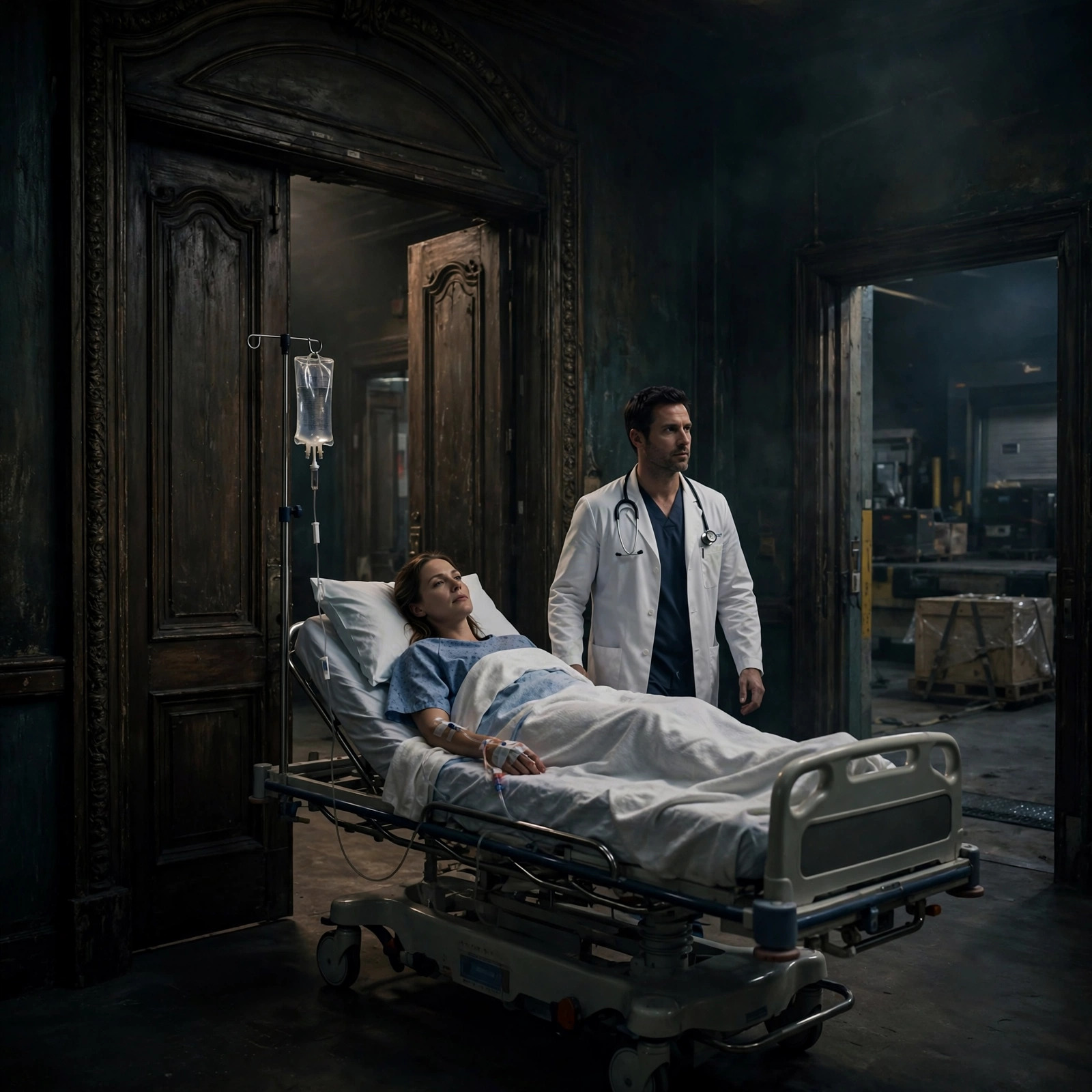
The gurney's rail was cold under Petra's left palm, and she kept her palm there because her right arm was already wrapped from wrist to shoulder, swabbed and sleeved in clear plastic, weighed down by the saline line they'd started at half past five. Day thirty-one. The window had closed the night before at midnight, and her name had still been on the roster when it closed, and now there was nothing left to decide, which was, she found, its own kind of quiet.
Dr. Sabine Okoye came in with a tablet under one arm and a paper folder on top of it, the old kind of folder, the kind with a signature line that took real ink. She dragged the visitor's chair around with her foot so it faced the gurney, and sat, and looked at Petra the way a person looks at a hem before cutting.
"Last chance for questions," she said. "And I mean last. Theater's called for eight."
"The month-four data," Petra said. "The first cohort. Where does it stand this morning?"
Dr. Okoye didn't flinch, and Petra had decided, over three weeks of check-ins, that this was simply her face — the face of a woman who had watched a hundred numbers come in low and come back. "Cell viability in the first cohort dipped at month four. We revised the perfusion protocol in response. The revised protocol is what you'd be under. Six of the eight original participants have recovered to nominal filtration. Two haven't. That's the open part, and I won't paper over it. It's the honest reason your sister wanted you to wait for full approval, and it's the reason I can't promise you a straight line from here."
"And if I'm one of the two."
"Then we revise again, with you in the room where we can see it happening, which is more than the county unit can say. You've been running nine hours a night on an eleven-year-old rig with recurring fouling alarms. You know better than I do what the slow road costs." She set the folder on the blanket, open, and squared it. "So. Consent. Read it or trust me, but sign it either way."
Colm was in the doorway with a paper cup of coffee he wasn't allowed to give her, and he knew it, and he'd brought it anyway, and set it on the sill where she could see it. "Fifteen minutes," he said. "Then I've got the eight o'clock back to Bray Hollow. I'll be on the four o'clock return run when you're out of surgery. That's the plan I filed."
"You filed a plan," Petra said.
"I file plans for a living." He came in and stood at the foot of the gurney, one hand on the rail. "Your cycler's downstairs, by the way. Loading dock. I watched them crate it. Thought you'd want a report from an eyewitness."
She had wanted that, exactly, though she hadn't asked. The rig had come off her nightstand at four that morning, after its last run — nine hours, alarms twice, the second one at half past two which she'd muted herself this time, Greta not there to mute it for her — and the clinic porter had carried it out like a piece of furniture, which was all it had ever been, and she had felt something leave the room with it that she could not have named while it was still plugged in.
"Crated how?"
"Properly. Foam corners, strapped to a pallet, manifest tag on the lid. Meridian Renal takes it back as a trade-in — the credit's already in your account, I checked the intake screen while I was loitering. It goes out on the ten-fifteen freight." He turned the cup slowly on the sill. "There's a sticker on the crate. Eleven years of service. Somebody at the factory is going to read that sticker."
"Somebody at the factory has read ten thousand of those stickers."
"Then you're one of ten thousand," Colm said, "which is still a number I'd rather you were than the other one."
Her phone buzzed against the blanket, face down. She worked it out left-handed and read it there on the screen, and read it twice, because Greta typed the way Greta cut fabric, short and sure.
Shop's open. Morning orders cut — twelve in, all morning work, none of them yours. Mrs. Tull's wool coat is on the rack and I'm leaving your name on the ticket. Shears are on the rack hook where they belong. Fourteen months. Go be a number.
Petra put the phone face down on her chest and looked at the ceiling tile and let the air go out of her slowly.
"Good news or bad?" Dr. Okoye said.
"Work news. My sister cut the morning orders without me and left my name on the wool coat." She heard how it sounded and didn't fix it. "The shop runs. That's what it says. The shop runs."
Colm read the text over the rail, uninvited, and Petra let him. "Fourteen months," he said. "She's counting."
"She's always counting. She counted me." Petra picked the phone back up and typed with her thumb, left-handed, slow: I'll be the number on the four o'clock run. Keep the shears oiled. She sent it, and the phone buzzed back inside a minute — a thumbs-up, nothing else, which from Greta was a paragraph.
Dr. Okoye turned the folder toward her and laid a pen across the consent form, clicking it once. "Page one is the procedure. Page two is the residency — four hundred and twenty days of on-site monitoring, and you've already initialed the residency schedule twice, so that's settled law. Page three is the open month-four data, and I've attached the revised protocol and the honest paragraph about the two participants, and initialing page three means you read that paragraph with your eyes open. Page four is the trade-in, which your Meridian credit covers, and page five is the last line."
"What's the last line."
"It says you understand this is a conditionally approved device, that full approval is still pending, and that you chose it anyway. It's the shortest page. It's the one people sign fastest and think about longest."
Petra took the pen in her left hand. Her right arm lay along the gurney like something already belonging to the theater, sleeved and swabbed and not hers for the next few hours, and she initialed page one — the procedure, the incision sites, the filtration membrane, all of it language she'd read four times since day nine. Page two, the four hundred and twenty days, the residency she'd already given Greta the shop to be free for. Page three she read all the way through, every line of the open data, the dip at month four, the revision, the two names she'd never know who hadn't come back to nominal, and she initialed that page slower than the others, because it deserved to be slower, and Dr. Okoye watched her do it and said nothing, which was the right thing.
Page four, the credit, the crate downstairs, ten-fifteen freight.
Page five.
"Petra." Colm's voice from the foot of the gurney. She looked up. He had the schedule sheets rolled in one hand, not looking at them. "The four o'clock run. I'll be at the doors. That's not a question either."
"I know it's not."
"Then sign."
The line was short and the pen was heavy in her left hand, heavier than a pen needed to be, and she set the nib on the line and held it there while the clock over the door said quarter to eight, and she thought about the rig in its crate on the loading dock with its eleven-year sticker going out on the ten-fifteen, and the shears on the rack hook where they belonged, and Aldo in a county chair this morning with his labs filed behind hers, paying for her name on that roster in the only currency he had, and Greta with twelve orders cut and one name left on a wool coat, and she thought: I chose it. Half of three in the morning I think I've ruined us all. But I chose it.
She initialed the last line with her left hand, her right arm already prepped and sleeved and lying still, and Dr. Okoye took the folder and stood, and the doors at the end of the bay opened, and a nurse in scrubs took the head of the gurney, and the wheels turned — a low run of rubber over the seams of the floor, one, two, three, toward the theater doors — and Colm walked alongside as far as the corridor marker with his hand still on the rail, and then he stopped, because that was where his morning ended, and the gurney did not.
Get notified when new stories drop

Leo Stranek
Leo specializes in solarpunk abundance and near-future progress: livable futures, bright cities, and practical wonder.
Leave a comment
Comments