





The Vault Drawers
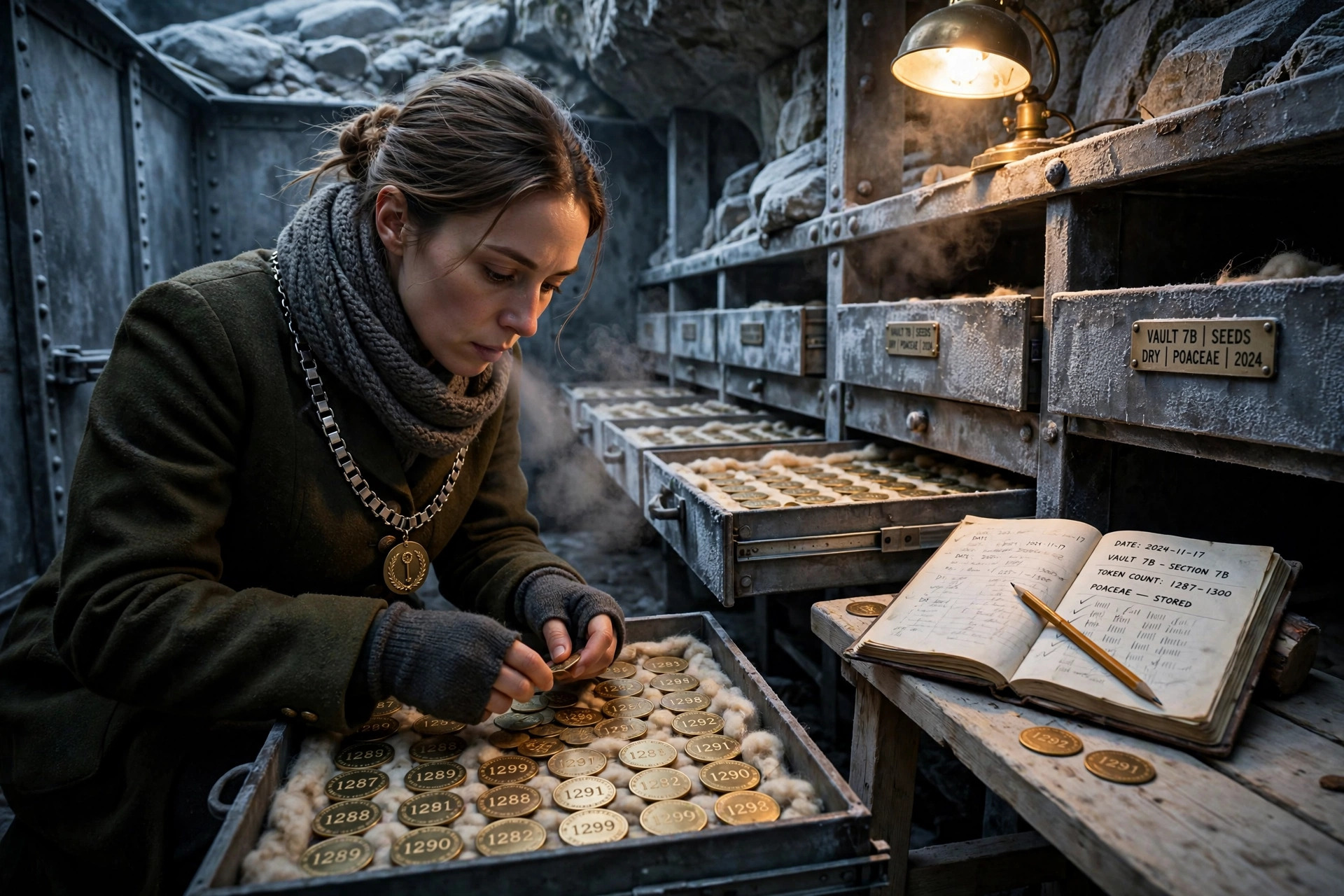
Petra Haldane counted the vault drawers the way she counted everything in Dunmarrow Vale, twice, with a pencil that worked in the cold.
The seed vault lay beneath Founders' Rise, cut into the hill's grey rock and lined with steel that had outlasted three generations of arguments about what to keep in it. Nine drawers ran the length of the north wall, and the top two were the ones that mattered: the brass tokens, the founders' lexicon, two hundred and forty palm-sized pieces of etched brass that nobody living had read all the way through. She slid the first drawer out on its runners and looked at the rows of tokens nested in wool, each stamped with a grain-mark and a small numeral. The numerals were bore indexes. She had worked that out six years ago, when the steward's chain had first been put in her hands, and she had never had the nerve or the season to finish the job.
She had the season now. That was the trouble.
Her logbook lay open on the vault's single bench. The morning's entry sat half-finished above the token count: Cisterns at eleven percent. Millpond down to the clay. No rain in the gauge since the month turned. Eleven percent was a number that would frighten the council if she read it aloud at the evening table, so she would read it aloud. Somebody had to.
Footsteps came down the stair, unhurried, heavy in the heel. Gillis Ferrow had walked down those steps the same way for longer than Petra had been alive, and she knew his tread before she saw the lamp swing around the turn.
"You're down early," he said.
"I'm down on time. You're down early."
"Gallery day." He set his pack on the bench and began going through it by feel: lamp, hammer, the listening bar, the coil of chalk. "I want to be down the old drill gallery and back before the afternoon wind gets up on the ridge. The radio mast's no use to anyone when the ridge is howling, so if the Ford crew's coming, I'd rather see the road myself."
"You think they're coming."
"I think a crawler on the ridge road doesn't come up here for the view." He cinched the pack. "Ondrey Kest's been on the radio twice this week asking after charter dates. A hydro-broker doesn't ask after dates unless he's carrying paper."
Petra set her pencil down. "Then I need to tell you what I'm doing down here."
"I know what you're doing. You're counting drawers."
"I'm going to read the lexicon. All two hundred and forty tokens, in bore order, through the indexer, onto the tape." She put her hand flat on the drawer's edge. "The betrothal charter seals at equinox. Nine days. It names me as the vale's party, Gillis, and the vale's senior water claim rides with it, but only if the founders' lexicon is read into the record before it seals. That's the condition. Besse made me say it back to her twice last night so I'd stop saying 'I think.'"
Gillis was quiet for a moment, sorting his chalk by color, which Petra understood was his way of buying time. "You've read pieces."
"Twelve tokens' worth, three winters ago, before the flood year ate everything. Fragments. Depth marks. A bore index that runs further than any well we've ever drilled." She had kept the scrap of tape in the logbook's back pocket ever since, a thumb-length of waxed paper with three faint pressed lines on it, and she had stared at those lines often enough that she could see them with her eyes shut. "If the rest of it is a survey, if the founders actually mapped the confined water under the caprock, then the vale's claim isn't a story the elders tell. It's a document. It just happens to be written on two hundred and forty pieces of brass."
"And if it's a seed inventory with pretty numbers on it?"
"Then I'll have spent nine days I don't have." She picked the pencil back up. "But the grain-marks aren't any grain we grow. Besse says her grandmother said the same, and her grandmother was here when the first crew was still breathing. The marks aren't seeds. They're survey signs. Somebody decided to store the vale's water claim in a form that couldn't burn, couldn't mildew, and couldn't be read by anybody who didn't already know how."
Gillis shouldered his pack. "Or they were economical with brass and bad with labels."
"That's why the indexer has a crank," she said. "The drum seats the tokens in sequence and presses the survey onto tape. It doesn't need the mill's charge. It doesn't need anything but somebody sitting here turning a handle and reading wax paper for nine days. That part I can do."
"And the gallery seals?"
"That part I can't. That's yours."
He nodded, satisfied with the division, which was the oldest division in the vale: she kept the record, he kept the ground. At the stair door he stopped with one hand on the frame.
"Petra. If the Ford house is coming with paper, and their paper's about water, then whatever's on your tape matters twice as much as you think it does. Read slow. Don't skip a token because you recognize the mark."
"Read slow," she agreed. "Nine days."
"Eight, by the time I've walked down and back." The lamp swung away up the stair, and his tread faded into the sound of the hill.
Petra worked alone for an hour, and it was the best hour of her month. She logged each drawer: token counts by row, the condition of the wool packing, two tokens in the fourth drawer with verdigris at the rim that she cleaned with oil and a soft brush until the numerals came back sharp. Bore index one-oh-six and one-oh-seven. She laid them back the way she'd found them, grain-mark up, and made a note to check them again before they went through the drum.
Then Besse came down, because Besse came down every morning at the second bell whether there was news or not, and today there was news.
"The ridge road," Besse said, before she'd reached the bottom step. "Marta's boy ran up with word. A crawler, big one, Ford plates, stopped at the second switchback taking on water. Heading this way, not hurrying."
Petra's stomach did what it always did at the word 'Ford': dropped a half-second ahead of the rest of her. "How many aboard?"
"Two seen in the cab. That's all anybody could say." Besse Ferrow was thin as a seed-token herself, and she came across the vault floor with the deliberate slowness that meant she had already thought about everything she was about to say. She sat on the bench's end, folded her hands, and looked at the open drawer. "You've started."
"I've started counting. I haven't started reading."
"Then let me say the terms at you once more, while the road's still empty, because you'll be saying them at a council table by tomorrow and I want them exact." Besse's voice was the voice of thirty-one years of grain-hall arithmetic, and it did not rush. "The betrothal charter seals at equinox, at the ninth day from last night's bell. It binds Dunmarrow Vale and Kestrel Ford house in water and in trade. It names you, Petra Haldane, water-steward, as the vale's party and the vale's voice. And it carries the vale's senior claim on all water under the vale, the deep water included, only so long as the founders' lexicon is read into the record before the seal. If it is not read, the charter seals anyway, and the senior claim is not carried. It is left where the last arbitration left it, which is nowhere, which is a coin toss."
"I know the terms," Petra said, quietly.
"You know them. I want you to feel the one that has your name in it." Besse turned her folded hands over, studying them. "A coin toss with your name on the face of it. If the lexicon reads and it says what we hope it says, the vale holds the deep water and everyone takes their leave from us. If it doesn't read in time, the Ford house can put their own wells and their own papers down before anyone reads ours, and their paper will be newer, and newer paper wins. That's what you're carrying, child. Not a drawer of brass. Nine days of the vale's future."
"Besse."
"I'm allowed one speech a year. That was it." The old woman's mouth bent. "Now tell me the honest part. How ready are you?"
Petra looked at the drawer. Two hundred and forty tokens. The indexer stood at the vault's far end, a steel drum on a crank shaft with a waxed-tape reel and a guide channel worn bright by the hands of people long turned to clay. She had oiled it every season. She had never run more than a dozen tokens through it in a day, and never in order.
"Honest part: I know the tokens are in bore order. I know the drum seats them and the tape takes the impression. I know the first twelve indexes give depth marks and a fragment I can't finish." She heard her own voice speed up and made it slow down. "I don't know how long two hundred and forty takes. I don't know what the survey says past the fragment. And I don't know what paper Ondrey Kest is carrying up that road."
"Then you know more than most of us," Besse said. "Start."
She didn't have to say it twice.
Petra carried the first drawer to the indexer, set it in the cradle beside the drum, and lifted token one out of the wool. Palm-sized, brass gone the color of old honey, the grain-mark stamped small and the numeral struck hard below it. She seated it in the drum's channel, felt the click of the pin finding its notch, and took the crank handle in both hands.
The drum turned with a dry, even resistance, pressing the token's face against the waxed tape, advancing the reel one notch. She turned it back. Lifted the token out. Set it back in the drawer, numeral up, and took up token two.
By the twelfth turn her shoulders had found the rhythm and the tape had crept out of the reel a hand-span. She cut it free with the trim knife and carried it to the lamp.
Pressed lines, faint as watermarks. A depth figure she recognized, four hundred and twenty, in the founders' cramped numeral style. Then a fragment, a word half-struck, then nothing but the grain-marks of thirteen and fourteen waiting in the channel.
Two hundred and forty tokens. Nine days, eight after this one. One hundred and sixty hours if she slept badly and not at all if she slept worse.
Besse was watching her from the bench. "Well?"
"It's a survey," Petra said. Her heart was going quicker than the arithmetic justified. "Or the start of one. Four hundred twenty's in it, and something after that I can't read yet." She wound the tape scrap into the logbook's back pocket, next to the old one, and went back to the drum. "Tell Marta's boy to watch the road. Tell the council nothing until I've run the next hundred tokens."
"And tell yourself?"
Petra set token thirteen into the channel and put her hands on the crank.
"Read slow," she said, and turned.
The drum pressed, the reel advanced, and the tape crept out one notch further into the light, carrying its faint pressed lines, twelve tokens read and two hundred twenty-eight still in the wool.
Ridge Road
The crawler came up the ridge road at midmorning on the fourth day, and Petra watched it from the vault stair with a token in each hand and tape dust on her sleeves.
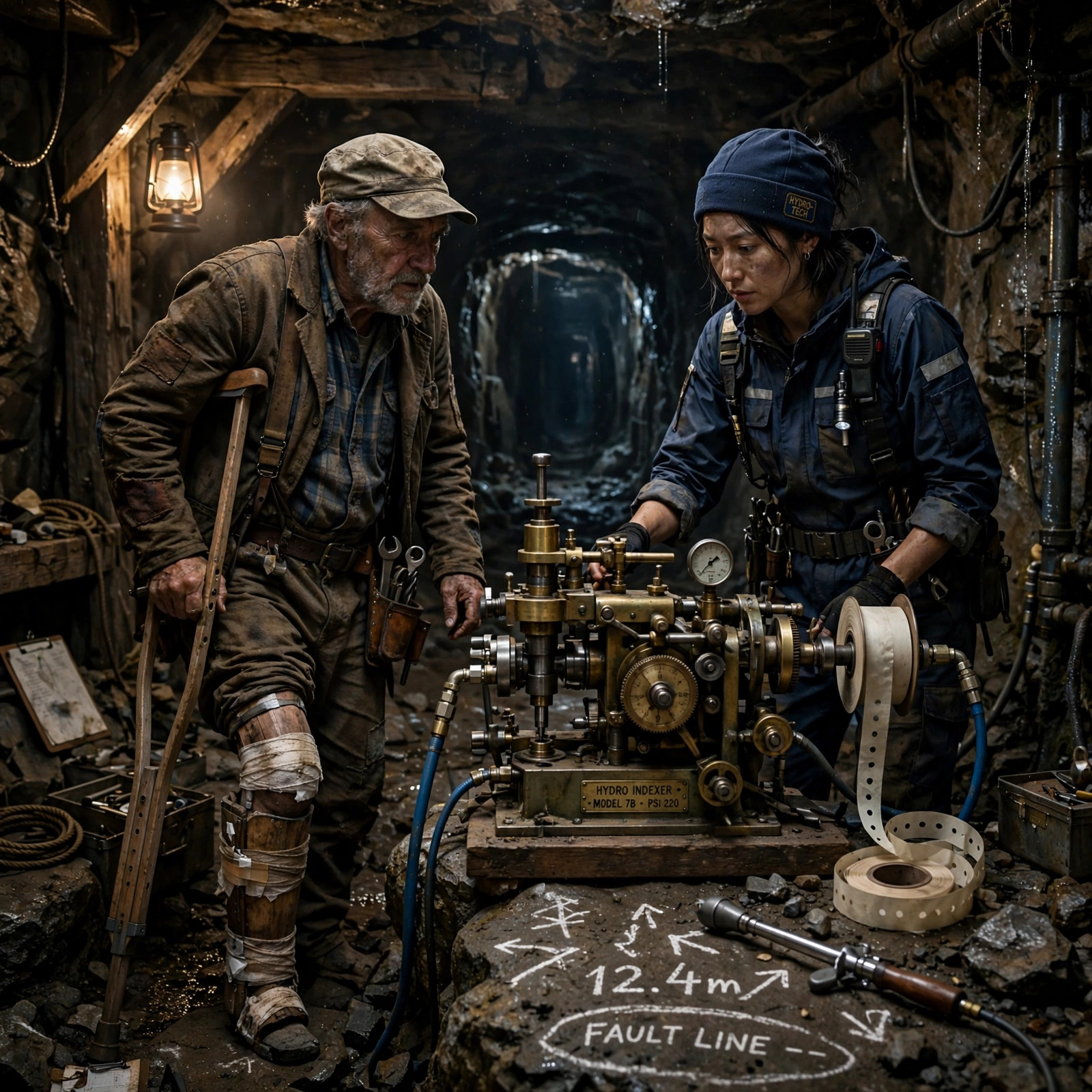
She had run tokens through the night. Ninety-one by the count in the logbook, ninety-one pressed lines of the founders' survey wound onto the reel, and her palms had gone the color of the brass. Besse had brought her bread at midnight and taken the tape scraps away at dawn to dry by the stove. What the tape said so far, Petra could sum in a sentence: the founders had drilled, the founders had measured, and at four hundred twenty meters they had found something worth two hundred forty tokens to describe. The rest was still in the wool.
Now the crawler was grinding up the last switchback, dust hanging behind it in the still air, and Gillis was already limping down from the gallery track to meet it, and Besse was ringing the hall bell to pull the council off the terraces.
"You could have slept," Gillis said when Petra caught him at the yard gate.
"You could have slept too."
"I slept in the gallery." He shifted his pack off his shoulder and held it against his chest, both arms around it, the way he carried things when his knees were bad. "I've got the log. It's not all for reading aloud."
"I know."
"You don't. Not all of it." He looked at the crawler, then at her, and his mouth did the thing it did before he said something a Ferrow would rather not say. "We'll get one chance to say it. Let me pick which half."
The crawler stopped in the yard and let itself down off its wheels with a long hydraulic sigh. Ondrey Kest came out of it first, then a woman Petra knew by reputation and by the Ford hydro-office's terse acknowledgments on the mast: Tulla Marsh, vent-crew lead, seven seasons on Ford's wells. Ondrey carried a document case. Tulla carried nothing at all, which Petra noted, and filed.
"Steward Haldane," Ondrey said. He had a broker's voice, even and warm, pitched for rooms rather than ridges. Four years in the valley and he still dressed like the coast, collar open, boots too clean. "You look like you've been up all night."
"I have."
"Then let's keep this short." He offered his hand, and she took it, and he held it half a beat past greeting. "My house sent me to put a question to your council. Your elder called the table. I'd rather stand at it."
The hall filled fast. There were eleven on the vale council, terracers and cistern-keepers and two of Besse's grain-hall women, and they sat on the long benches with their hands in their laps and waited. Besse sat at the head with her stick across her knees. Petra stood, because her part was evidence, not office.
Ondrey laid the case open on the table and took out the permit, and Petra saw at once it was printed and countersigned, seal on seal, Ford's hydro-office over the house mark.
"This is a fast-vent permit," he said. "Lawful under our charter. It stands on one condition, and the condition is time. If no demonstrated flow is logged from our new well before your betrothal charter seals at equinox, our wells lose standing on the aquifer. Every well Ford has drilled goes junior to every claim the vale cares to make, forever, with no leave required from you and none you'd ever be obliged to give."
"That's not a threat," Tulla said. She said it plainly, without heat, from the bench behind him. "That's the arithmetic of the paper. We'd rather not spend nine days finding out what your senior claim says we can't touch."
"Nine days," Besse said. "Five now."
"Five, elder. Which is why the vent is fast." Ondrey set his palm flat on the permit. "The plan is simple. We punch the confined zone at four hundred twenty, open the headwall under pressure, log the flow, and close it. A day's work. Two with bad luck. Your charter seals with both houses wet, both houses standing, and nobody junior to anybody."
Somebody on the terracer bench said, "Both houses wet," and it went around the room like a struck bell.
Petra looked at Besse. Besse was watching Ondrey the way she watched weather, and Petra understood, with a cold sliding feeling, that the room was already leaning.
"You don't know what's down there," Petra said.
She hadn't meant to start with that. But it was out, and Ondrey turned to her with the pleasant, ready attention of a man who had come prepared for her.
"Four hundred twenty meters, steward. We do know that. Our own survey found the caprock."
"You found the caprock. You didn't find what the founders found when they drilled it." She put the tape scraps on the table, the two of them, last night's and the night before's. "This is pressed off two hundred forty brass tokens in our vault. It's the founders' aquifer survey. It's the lexicon the charter requires read into the record before the seal, and it is the basis of every water claim this vale has ever made, and I have read ninety-one tokens of it."
"In how many days?" Tulla asked. Not unkindly, but she asked it, and the question did its own work in the room.
"Three."
"And five remain. To read a hundred and forty-nine, prove the claim, log it, and still let us demonstrate flow before the seal." Tulla leaned forward, elbows on knees. "Steward, I've run vents for seven seasons. A confined zone at that depth, that's a pressure head you don't open casually and you don't schedule politely. If your tokens are right and there's water down there under that caprock, then a fast vent is the only vent that finishes inside your charter. A needle bleed would take longer than five days just to prove a flow worth logging."
"A needle bleed takes what it takes," Petra said. "Thirty-eight liters a minute is a logged flow. It's demonstrable. It's in the founders' numbers or I wouldn't say it."
"Is it in the tokens you've read?" one of the cistern-keepers asked.
And there it was. "It's in the survey," she said. "I haven't reached it yet."
The room moved a half inch away from her, all together, the way a field of grain leans.
"Then we hear the gallery log," Besse said. "Gillis. You walked it day before last. Read your findings."
Gillis stood with the pack still against his chest. He was fifty-four years old and had walked that gallery for twenty-six of them, and Petra watched him choose the half.
"Gallery's sound," he said. "Headwall sound. Track sound. Collar at the second bend is sound enough." He paused, and the pause was a Ferrow's whole inheritance. "The lower seals I'd want re-packed before anyone puts a pressure head behind that wall. That's craft talk. It's in the log."
"Re-packed how long?" Ondrey asked.
"Two days. Three if the mortar's slow."
"Which leaves us one day to punch, vent, log, and close," Ondrey said. "It's tight. It's not impossible. And I'll say plainly, my house won't wait past the seal. It can't. The permit is lawful now, and it dies with your charter if no flow is logged. That's not my choice. That's the paper."
"It's a reasonable paper," Besse said quietly.
Petra stood in the middle of the hall with her palms still brass-colored and heard the council go over her, item by item. The terracers wanted the water. The cistern-keepers wanted the water. Besse wanted the two houses standing, and could see no way the lexicon got read in time to make the senior claim safe against a delay. And every one of them was right about something.
"I'll say my objection for the record," Petra said. "The lexicon is the vale's claim. If we let Ford vent before it's read, we let them act on an aquifer none of us has finished understanding. If the survey says the bleed is narrow, then the fast vent is wrong, not just fast. I object."
"Noted and logged," Besse said. "Now the hand."
It went eight to three against her, and the three were Petra, Gillis, and the youngest terracer, who had watched the tape come off the indexer all night and believed his eyes over the arithmetic of the paper.
"Then this council agrees a controlled trial," Besse said. "Day six. Small charge, gallery vent, headwall logged, your crew running it and our people standing off. Gillis re-packs what he's named. And steward Haldane keeps reading, and whatever she has by day six comes to this table before anything opens wide. That's the compromise. Everyone pays something."
Nobody liked it. Everyone nodded. That was how Besse had run the hall for thirty-one years and how she won every table she ever sat at.
Afterward, the benches emptied, and Tulla went out to radio Ford on the mast while the ridge wind was down, and Gillis took his pack up toward the gallery without another word to anyone. Ondrey stayed to fold his case, and Petra stayed because she was too tired to move, and for a moment the hall held just the two of them and the permit lying printed on the wood.
"You counted the votes before you walked in," she said.
"I counted a tie." He snapped the case shut. "Your elder tipped it. She's good."
"She's terrified of losing your house."
"She should be." He said it without any broker's warmth at all, and then he picked up the case and looked at her, and there was something underneath the look that she did not want to name in a room where the charter's terms were hanging. "One thing, steward. You said the lexicon carries the vale's claim. Did your elder read you the whole charter? The betrothal clause?"
"The terms were read."
"Then read them again tonight. The vale's party in that charter isn't the hall. It isn't the council. It's a name." He tapped the case once, lightly, like a man setting a token in a drum. "You. Whatever your two hundred forty tokens say, they say it about your water, and you're the one whose standing changes when the seal closes. I'd have thought you'd have checked that before you spent three nights' sleep on it."
He left her with the tape scraps still lying on the table and the permit's shadow across them, and Petra stood alone in the empty hall, picked up last night's tape, and turned it over to the pressed numerals of the founders, unread.
She went back to the vault and sat down at the indexer with token ninety-two in her hand.
Spalled Collar
The gallery swallowed the daylight forty meters in, and after that there was only the lamp-line strung along the old haulage sets and the sound of their boots in water that had been seeping down from the ridge for longer than anyone in Dunmarrow Vale had been alive. Petra walked behind Gillis and ahead of the Ford crew, carrying the log-book because she was the steward and the logging was hers, and because if she carried nothing she would have carried it badly, her hands wanted something to do.
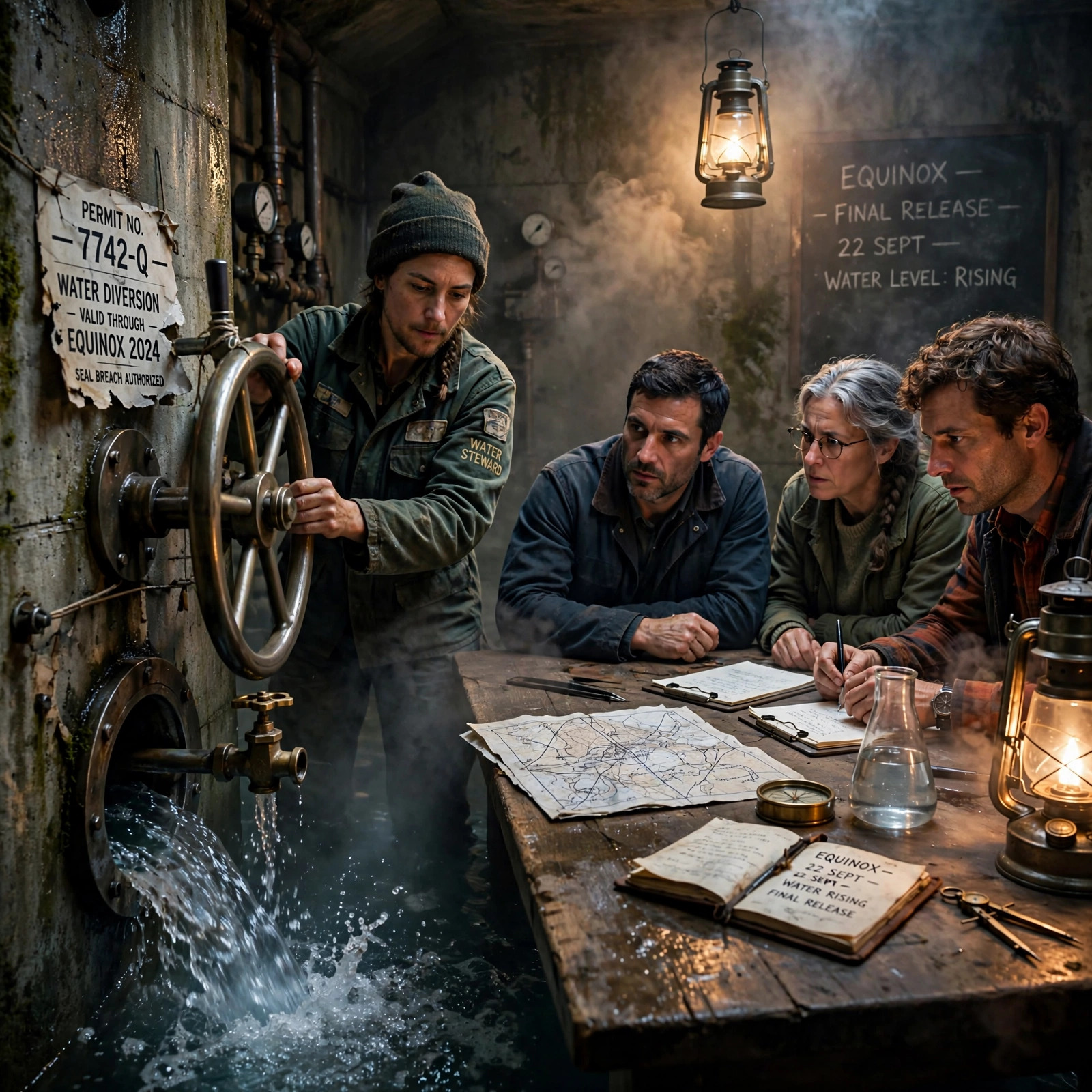
Gillis had been down the gallery twice since the council table. He had re-packed the lower seals with clay and hemp and the black wax the vale boiled from ridge tallow, and he had written his figures in Petra's book in his square hand: collar sound at sets three through nine, collar spalled at set eleven, packed, packed, packed, and then, at set fourteen, spalled through, packed twice, watching it. She had read those figures on the evening of day five and again that morning, and she had not liked the shape of them either time.
"Say it plain, Gillis," she said now, because saying it plain was the only thing that had ever worked on him.
"Plain," he said, "is that fourteen's a bad set and I've told everyone who'd listen that it's a bad set, and your council voted eight to three to put a charge behind a headwall two sets below it." He didn't turn around. The lamp on his hat threw his shadow long ahead of him along the wet rail. "Plain is we do it small or we don't do it."
"Small is what the permit runs on," Tulla said. She was walking beside her crate of charge, one hand flat on the lid the whole way down, the way a person steadies something they don't trust. "A tenth-kilo strand. One collar. If the aquifer answers at four hundred twenty, we log flow, we close the standpipe, we're on the crawler by noon."
"If it answers," Gillis said.
"That's the trial, isn't it?"
It was. Petra had turned the logic over for two days and it held: the Ford permit wanted a demonstrated flow before the charter sealed, the vale wanted to know what a tap would actually do, and the only way to know both was to ask the rock. Small charge, headwall logged, crew running it, vale people standing off. Everyone had paid something to get to this morning.
Ondrey had come down with them, which had surprised her. He walked at the rear with the second lamp and said almost nothing, which surprised her more. She had expected the broker all the way to the face — the arithmetic of days, the pressure of a house four ridges away that had been hauling water by crawler all through a dry year. Instead he watched the seals as they passed them, each packed collar, each chalked set number, like a man reading a contract he had signed without reading first.
"Your man's thorough," he said once, quietly, nodding at Gillis's back.
"He's not mine. He's the vale's."
"Same thing, from where I stand."
It wasn't, but she let it go. Four days to equinox, and she had learned in six years of stewardship which arguments were worth their breath in a wet gallery and which were not.
They reached the face at the ninth hour by her watch. The headwall stood new-cut against the old rock, the standpipe collared into it with a wheel valve and a pressure glass, and below it, two sets down, set fourteen waited with its twice-packed clay and its hairline of rust-colored seep that had been there, Gillis said, since before her grandfather. Tulla's crew — two Ford hands who kept to the far rail — set the strand, wired the lead to the box, and withdrew up the gallery to set eleven. It went exactly as far as set eleven. Nobody argued the point with Gillis about set fourteen. That told Petra more about Ford's respect for him than anything in the permit's fine print.
Tulla read her charge sheet aloud for the log, and Petra wrote it: tenth-kilo, single collar, standpipe shut, crew at eleven. Then she said, "Fire when you're ready, steward. Your gallery."
"It's nobody's gallery," Gillis said. "But log it hers if you like. Fire."
The charge went off with a thump Petra felt through her boot-soles before she heard it, and for three seconds the gallery was exactly what it had been all morning — wet, dark, lamplit, ordinary.
Then the pressure glass climbed. Tulla saw it first, because Tulla had her eyes on the glass and everyone else had their eyes on the face. "It's answering," she said, and there was a lift in it, a month of dry ridges' worth of lift. "Four hundred twenty, right on your survey. Steward, log flow, that's a demonstrated…"
The glass went past its scale and kept climbing.
"Close it," Gillis said.
Tulla was already on the wheel. "It's barely cracked, that's a tenth-turn, that's…"
"Close it."
And then set fourteen spoke. Petra heard it before she understood it — a knock, deep and flat, like a door slammed somewhere below the floor — and the packed collar at fourteen let go in a single sheet of rust-dark water and rock flour that burst across the gallery floor and up the far wall. The jet didn't rise like a fountain; it came out under pressure like a hose driven by the whole weight of an aquifer, and it swung as the collar crumbled wider, and the slurry behind it was the color of the caprock itself.
Tulla was nearest. She was still on the wheel with both hands, cranking the standpipe toward shut, and the jet swung across the rail toward her side of the gallery with the collared weight of the broken rock riding it.
Gillis moved. Petra saw it whole and would see it whole for the rest of her life: he crossed the set, took Tulla around the shoulder with his forearm, and threw her back along the rail toward set thirteen, and the jet took him across the arm and then the shoulder and put him into the wall under the collar. The lamp on his hat went out. The gallery went dark at his end.
"Turn it!" Petra was shouting and didn't remember starting. "Tulla, turn it, I've got him…"
"I'm turning it…" The wheel shrieked and gave, and gave, and the jet's voice dropped from a roar to a hard hiss to a stubborn mutter, the aquifer throttled down through the cracked tenth-turn to something the packed remainder of the collar could almost hold. Almost. Water still ran out of fourteen, dark and steady, ankle-deep across the floor and rising, but it ran, it didn't burst.
Petra went to Gillis on her hands and knees through it, with the cold coming up through her trousers and the mud slicking the rail. He was conscious. She could hear him breathing, long and even, which was a discipline and not comfort — he had taught half the vale's drill-hands that breath, slow and even no matter what. She got a lamp off the line and got it to him. His right arm hung wrong from the elbow and there was a tear across the shoulder of his coat she didn't want to look into yet.
"Don't," he said, when she reached for it. "Log first. Flow's throttled. Log it."
"I'll log it when you're out."
"Steward." It came out with the last of his wind. "Out is a fact. Log facts."
She wrote it in the book with wet fingers, kneeling in the water: flow demonstrated, 420 confirmed, collar fourteen failed, vent throttled, G. Ferrow injured arm and shoulder, T. Marsh unhurt. Then she got her shoulder under his good one.
It was three sets to the crawler and they made two of them before Ondrey was there, lamp up, wading past her without a word about her rank or his coat, and took the other side of Gillis's weight. Tulla went ahead, dragging the winch line off the crawler's drum down the gallery to meet them, and between the four of them they got Gillis onto the line and the crawler took the strain.
The light at the gallery mouth was white and hard after two hours underground. They laid him on the crawler's deck, and Petra fetched from her kit the slat of seasoned token-wood she had brought from the vault drawers two nights ago to true the indexer's drum — she had meant it for the drum, and she gave it up for his arm, and bound the splint with strips of her own coat hem while Tulla held the limb and Ondrey held the lamp. Gillis's eyes were open the whole time, watching the mud on the gallery floor run out of the mouth in a dark rope and lose itself in the track ballast.
"Four hundred twenty," Tulla said. She was sitting on the crawler's step with her elbows on her knees and her hands still shaking, and she looked at the collar she had watched crack with her own eyes and then at the man it had cost. "It answered. That's the flow. That's the demonstration. That's everything my house sent me for." She stopped. "Log it if you want. I won't press it."
"You'll log it," Gillis said, "because your permit's lawful and hiding today makes liars of all of us. But it logs with what happened at fourteen."
Ondrey stood apart with the permit case under his arm, and Petra watched him do the arithmetic she was doing: four days to equinox, five burned getting to this morning, an aquifer that had answered like a struck match, and a gallery that would not survive asking it twice. He didn't say the fast vent was dead. He looked at the mud rope running out of the mouth of the hill, and at Gillis's splinted arm lying along the deck, and something went out of his shoulders that she had watched him carry since the council table.
"I'll radio the house tonight, in the wind window," he said. "They'll want to hear it from me before they hear it from the ridge." He paused. "Steward. Your elder's compromise. Small charge, headwall logged, everyone pays something." He looked at the splint. "I'd counted the payments different."
"So had I," Petra said.
The crawler took the grade slow, with Gillis lashed to the deck and the winch line coiled wet beside him, and behind them the old gallery breathed its throttled mutter into the hill, and the mud lay where it had fallen, across the floor and out the mouth, and nobody who had walked down that morning wanted anything wide opened ever again.
The Narrow Path
Petra slept three hours in the chair beside Gillis's cot and woke with the ledger open on her knees and the arithmetic still unfinished, because the arithmetic was not the hard part. The hard part was the line she had not yet written.
By the second morning bell she had written it. She carried the single sheet up the mill stairs and laid it on the long table where the charter would seal at equinox, and she asked Besse to ring the hall, and when the table filled she did not sit.
"Yesterday we proved the water," she said. "Four hundred twenty meters, live, answering. That's ours. Nobody in this room doubts it now." She put her finger on the sheet. "Here's what it costs us to keep it. I'm asking the hall to let me stake the narrow bleed. Thirty-eight liters a minute through a needle tap, drawn slow, into the cisterns. Not the full breach. Not a survey that makes the ridge papers. The needle."
Besse's hands were folded on the table. She had not spoken yet, and she did not speak now, which was its own kind of answer: the elder had counted the votes before Petra had counted them herself.
"The narrow bleed waters the vale," Petra went on. "It waters it this season, and every season after, because a needle tap doesn't spall the caprock and doesn't fill the gallery with nine thousand cubic meters of slurry. It also means Kestrel Ford's wells stand junior to ours, with our leave, not under our boot." She looked down the table. "That's the trade. A headline, or a river that runs in June."
Harld of the north terraces — no, she corrected herself, no names, only faces; Harld was four years gone — the north terrace man said what half of them were thinking: "The full breach makes Ford crawl. The needle makes them partners. Why pay their ferry twice?"
"Because their permit is lawful," Petra said, "and because their crew bled for our water same as ours did. Gillis's arm is the receipt." She heard the door at the back of the hall open and did not turn. She knew the weight of that particular step on the boards.
Ondrey Kest came down the aisle with the permit case under his arm and stopped at the foot of the table. He looked thinner than the ridge road had made him, four days of it showing in the set of his mouth.
"Say the trade again," he said. "Slow."
Petra said it again, slow. The needle. The cisterns. Junior standing with the vale's leave — leave, not lease, not tribute — and the betrothal charter sealed at equinox exactly as written, with the lexicon read into the record first, because Besse had been plain that the senior claim carried only on the founders' words and Petra had burned too many nights to let the claim float loose.
"And if we refuse?" Ondrey said. "The permit stands. We vent fast, we log the flow ourselves, we're senior by demonstration."
"Then your crew opens a gallery that Tulla Marsh watched crack at the collar," Petra said, "with Gillis Ferrow's arm in a splint made of my indexer wood as the second log entry. And when the caprock goes, the slurry runs downhill, and downhill is my vale, my terraces, my planting. You'd be lawful the whole way down."
He stood there a long moment. Then he set the case on the table and opened it, and the printed permit lay inside with the hydro-office seal on it, lawful as anything in the district.
"You want to know why we pressed so hard," he said. Not to her. To the table. "Four years my house has held ground in this district. Four years listening to your innkeepers talk about how the vale will read its founders' book someday and shut every Ford well on the ridge." He turned the permit a quarter-turn, squaring it, a man tidying something he had already decided to give up. "My aunt sealed the founding charter on the Ford side. She told me before she died that Haldane's survey named us junior and that the vale's book would say so out loud one day. I've spent nine years in the water trade waiting for you to read it and cut us off. So we pressed. Fast, first, lawful, before the reading." He looked up. "That's the whole of it. Not greed. Fear of the door closing."
"The door was never going to close," Besse said, and it was the first thing she had said. "We kept water from no one who asked with clean hands. But you'll forgive us, boy, for wanting it in writing."
Ondrey laughed once, short, and it cracked something in the room open. He lifted the permit out of the case and held it up so the table could see the seal, then laid it flat on the wood, face down — withdrawn, its body left whole for the record.
"Withdrawn," he said. "Logged, if someone will take the entry." Tulla would have; Tulla was on the ridge with the winch and the crew. Petra took the entry herself, in the hall book, and her hand was steadier than she expected. "Now," he said, "does the vale own a lathe that will cut a needle valve in two days, or do I stand here while you all decide that too?"
"The hall lathe runs off the mill's stored charge," Petra said. "One job a day. The charge is up."
"Then we're late," said Gillis, from the bench by the door, where he had been sitting the whole time with the splinted arm across his chest like a sash. "Because I've had the stock on the bench since the fourth bell and nobody's cranked the drum."
They machined it that afternoon. Gillis could not hold the tool, so he sat on a stool beside the lathe and told Petra's hands where to go — the taper, the seat, the needle's fine last third — and Ondrey worked the crank that fed the mill charge down, and the bronze came off the tool in bright curls and the hall smelled of oil and metal all evening. Gillis was hard on her about the seat, and harder about the needle's finish, and when she had it within his gauge he grunted, which from him was a festival.
"Test it by hand before it goes in the wall," he said. "A valve that isn't tested is a promise you haven't read."
They tested it on the bench, water from the cistern line, and the needle shut off a full flow at half a turn and wept not at all at the seat. Besse came down at dusk and put her thumb under the outlet and pronounced it dry.
Day eight they walked it up to the gallery headwall, the two of them carrying the valve crated in straw, Gillis riding the seat of the winch sled because he would not be left at the hall and his arm would not let him walk the grade. The headwall stood where the founders had left it, and the old tap hole was there, threaded, waiting, the way the founders had left most things — as if they had expected someone to come back and finish.
They seated the valve at noon. Ondrey turned the needle closed and stood back, and Petra looked at the wall, and at the man, and at the afternoon light in the doorway of the mill shed where the headwall tools were racked, and she thought: he tore a lawful paper for me. He told a table of strangers his house was afraid. That is not a small thing a man gives, and he gave it standing up.
She caught his sleeve in the doorway of the shed, and he stopped, and she kissed him once — brief, deliberate, her hand still cold from the crate straw and his jaw rough with two days of ridge road — and when she stepped back he was looking at her the way he had looked at the arithmetic on the table, like a man re-running numbers he had gotten wrong for years.
"The charter names me," she said. "You told me. Day four, the ridge road."
"It names you," he said. "It always did."
"Then you know what I'm staking on the needle," she said. "My own name. In the record, at the seal."
"I know," he said. "I did the same arithmetic on the walk up."
She put her hand over his and set it on the needle's handle, and turned it under his hand, a quarter, a half, until the test port at the seat began to give. A thread of water rose clean through the port, unbroken, catching the light — thirty-eight liters a minute, if the founders' figures held, and the founders' figures had held every test they had ever been given.
They watched it rise together. Below the gallery mouth the vale lay green at the terraces' edge and brown where the planting waited, and two days remained before the seal.
"Two days," Gillis said from the sled, watching the thread. "Enough. Barely. The founders cut it close, too, I expect. They always did everything the narrow way."
"The narrow way is the way that's still running," Petra said, and left her hand on Ondrey's, on the needle, while the water rose.
Equinox Tape
They came down the vault stair while the morning was still cold enough to show breath: both houses, in their good wool, Besse Ferrow first with the charter satchel and the seal-wax in her fist, the Kestrel Ford delegation behind her with Ondrey at its head and Tulla Marsh carrying the Ford hydro-office's ledger under one arm the way a person carries something they no longer believe in. Gillis came last, splinted, taking the stair on his own feet with a blackthorn stick, refusing every arm offered him at the turns. He had insisted on walking the grade. He had won that argument the way he won all of them, by starting to walk while it was still being held.
Petra had the drawers open before anyone reached the bottom. Two hundred and forty brass seed-tokens, each the size of a flattened plum, each etched with its grain-mark and its bore-index numeral, laid out in their felt channels in the dark of the vault where the founders had left them in the founding year. She had read ninety-one of them in the slow evenings of the drought, one at a time by lamp, and the ninety-one had told her the shape of the thing: the confined water at 420 meters, the caprock like a held palm, the figure of thirty-eight liters a minute that the founders had called safe and had written small, as though embarrassed by how little it was. The rest she had not had the weeks to read. Today the record would take all of them or none.
"Equinox holds from noon," Besse said, setting the satchel on the reading table. "The charter reads at the seal hour, or it doesn't read at all."
"Then we have the morning," Petra said.
"You have the morning," said Ondrey. He stood at the foot of the indexer with his hands loose at his sides, and she could see that he had slept badly on the ridge road, or not slept, and that he had shaved anyway, for the Ford, the way a man dresses a wound before showing it. Tulla stood at his shoulder with the ledger closed and her thumb still marking a page she had kept open for six days.
"You'll want to log the failure while it's fresh," Petra said to her.
"It's already drafted." Tulla's voice was flat and quick. "Set fourteen, cracked collar, jet across a man's arm, aquifer confirmed at four-twenty, flow demonstrated, vent abandoned. My office will hate every word of it and sign every word of it."
"Good," said Petra. "A record nobody likes is usually the true one."
Gillis lowered himself onto the bench by the crank housing, breathing carefully around the arm, and held out the crank handle across his good hand. It was steel, machined and pinned, older than everyone in the room except Besse, and it had been out of its socket exactly as many times as there had been readings, which Besse said was fourteen and which Besse, being Besse, had written down. "You're the reader," he said. "You crank it. I'll turn the tokens as they seat. I've only got the one arm but it's the one that knows the drum."
Petra took the handle. It was heavier than it looked, the way true things usually were.
The indexer was a steel drum in a frame, hand-cranked, needing nothing from the mill or the grid — the founders had built it that way on purpose, she had always supposed, so that a drought could not stop the record and a flood could not either. Each token seated into a numbered slot on the drum; each full turn pressed the seated token against an inked roller and printed its grain-mark and numeral onto a waxed tape that fed out of the housing through a brass jaw. Slow work. Two hundred and forty seats, two hundred and forty turns, two hundred and forty marks on the tape.
She put the handle on the crank spigot and looked around the vault once — at Besse with the satchel, at Tulla with the ledger, at Ondrey, at Gillis on the bench with his splinted arm resting on the drum housing — and then she cranked.
The drum turned. Token one seated. The jaw took the tape and the first mark came out dark and clean.
They fell into a rhythm inside the first twenty marks. Petra cranked; Gillis turned each token in its slot with his one hand, quick, certain, a motion he had learned from his mother and she from hers; the tape crept out of the jaw a finger's width at a time and coiled, printed, into the tray. Nobody spoke for a long while. The room was cold and the drum was warm where their hands worked it, and the tape said in its small printed marks what the founders had seen when the vale was bare ground and the water was a guess: bore one, bore two, the grain of the rock changing, the marks tightening as the caprock came down toward the confined water.
"There," Gillis said at token sixty-two. "That's the caprock. Same mark as the collar we burst."
"You know it by eye," Ondrey said.
"Fifty-four years of looking at the same rock, you'd know it too."
The tape reached the ninety-first mark, the last one Petra had read alone, and went on past it into ground she had never read, and she found her own heart going faster with each seat, which surprised her, because she had not thought of herself as a person whose heart moved for records. Token one hundred. One hundred and twenty. Besse turned pages in the charter to the place where the survey would bind in, and waited, and said nothing, and the light through the vault grate moved a hand's width across the floor.
At one hundred and forty the marks changed. Petra felt it in the crank before she saw it on the tape — the drum taking each seat a little differently, Gillis's hand pausing — and the printed figures came out in the founders' tight survey hand: the confined aquifer, its depth, its extent, and then, plainly, the number. Thirty-eight. Liters, minute, safe, the word safe etched into brass and printed onto waxed cloth by people forty years dead who had never met her and had built the whole machine so that this one figure would reach this one morning.
"Read it out," Besse said. "For the record."
Petra read it out. The vault was quiet enough that her voice carried without lifting.
Then the tape ran on, past the survey, into what she had not expected: a final block of marks, dense, not bore-index at all, and Gillis turned token two hundred and forty with a small grunt and said, "That's not survey. That's the founders' hand. That's a note."
Petra cranked the last seat and the jaw printed the last mark, and she took the tape up in both hands and read it by the grate light, and read it a second time.
"They rejected it," she said. "The full breach. They had the tools for it, they had the depth, they could have vented the whole aquifer through the gallery and flooded every terrace in one season and been rich in a year. They ran the same figures we ran." She looked up at the two houses standing in her vault, the vale's wool and the Ford's wool, twelve people breathing cold air. "They chose the needle. Thirty-eight liters a minute. They wrote that a full breach would spend in days what the vale would need for a hundred years. And then…" her eye ran down the tape again, "—then they did the other thing. The clause. Any well of the Ford settlement tapping the confined water does so junior to the vale, and with the vale's leave, and the leave is not to be withheld without cause."
The word withheld sat in the vault like a dropped tool.
"With the leave," Ondrey said slowly. "Not 'never.' With the leave."
"With the leave," Petra said. "They wrote your house in, Ondrey. A hundred years before your house was afraid of being shut out, somebody dug this vault and wrote your house in anyway. Junior, and lawful, and standing at this table." She put the tape down on the reading table, its full length of it, two hundred and forty marks, and set the charter beside it. "Besse. The survey reads into the record before the seal. Here it is. All of it."
Besse read the tape the way she read everything, twice, touching each block of figures with one finger. Then she opened the satchel and brought out the seal-wax, and the two houses stood while the equinox bell up at the hall rang noon, and the wax took the vale's mark and the Ford's mark side by side, and the betrothal charter closed with the founders' figures printed into it and the junior-standing clause standing in it in the founders' own hand.
"Then it's done," Ondrey said, and his voice was not quite level. "That's my house's fear buried. I'll write it so tonight."
"One thing first," Petra said.
She crossed to the headwall, where the bronze needle valve sat in the founders' threaded tap hole, machined on the hall lathe two days ago, seated and hand-tested, closed. Tulla came and stood at the port with her ledger open at last, pen up. Gillis rose from the bench on his stick to see. Everyone she had spent nine days protecting was in the room, and she took the needle's handle in her bare hand.
"The founders bled this aquifer at thirty-eight," she said. "We'll bleed it the same."
She turned the handle a quarter, a half, and the port took up its thread of water, clean, unbroken, rising through the seat and running away down the channel toward the cisterns, thirty-eight liters a minute, the figure off the tape running in the wall for everyone to see.
Tulla wrote the demonstrated flow into the ledger and signed it. Then she took out the fast-vent permit — torn once, marked closed in the hall book, carried all this way in her coat — and laid it on the reading table. "It's yours to finish," she said. "You're the reader."
Petra picked up the crank handle, laid the permit flat, and cut it in half with the handle's steel edge, one clean stroke, and then again, and fed the pieces one at a time into the indexer's waste tray, where the tape was still running out its slow printed length, coiling down over the paper scraps as the drum turned.
The water rose at the port, steady, and the tape ran on, and nobody in the vault moved to stop either.
Get notified when new stories drop

Sasha Quill
Sasha writes bold exploration and cosmic wonder with lyrical scale and grounded character work.
Leave a comment
Comments