


The Long Bench
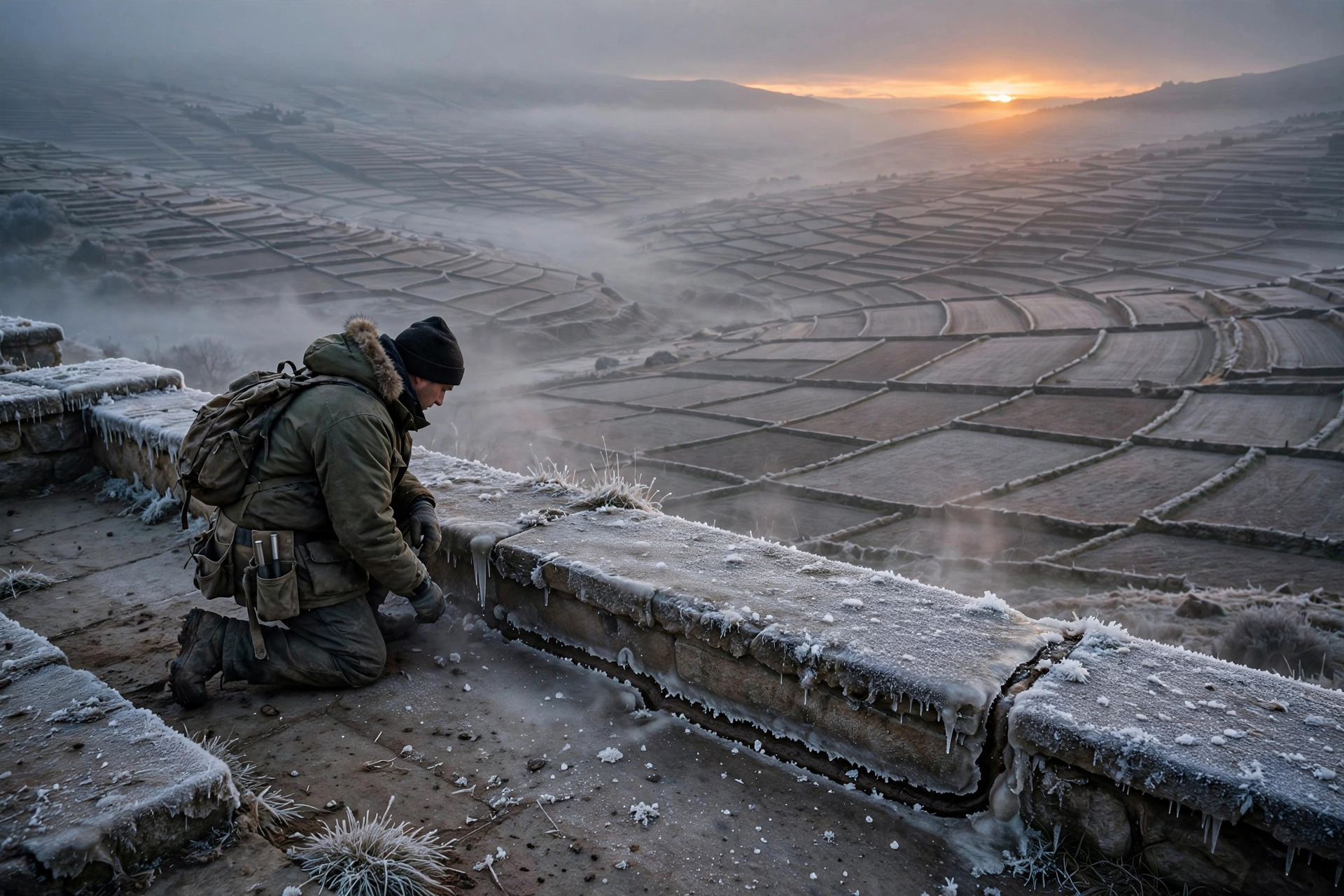
Petra Yulaw was on the third terrace before the sun cleared the basin rim, and the cold had gotten into her gloves again, the way it did every morning she forgot to leave them inside the coat overnight. She walked the Long Bench the way she had for eleven years: down the top stair, along the head channel, then bench by bench, forty hectares of built ground in forty counted strides a terrace, counting without meaning to.
The wick-line at the head of terrace four was seeping. She saw it before she reached it, a dark thread of frost where the line ducked under the cap, darker than the rime on everything else. New coupling, that was the problem. She'd replaced the old one in the fall and the replacement had come from consortium salvage, standard thread instead of the fine pitch, and it had worked loose through the winter the way borrowed parts always did.
She knelt, thumbed the frost off the collar, and felt the give. Quarter turn, maybe less. She took the stub wrench off her belt, ran it around, and leaned her weight into it until the collar bit and stopped. The seep would already have shut itself off; the wick only carried what the cap let it. Still, she packed the joint with a twist of sealing cord and pressed a tab of cap soil over it, tamped flat with the heel of her hand. Tomorrow there would be ice holding it, and the day after, the ice would be part of the ground.
That was the whole craft, if anyone asked her, and nobody did ask her anymore. Hold water where it belonged. Move it slow. Let the ground do the keeping.
Ilya Fenner was coming up the stair from the seed house, two buckets in one hand, his breath coming out in slow flags. He didn't say good morning. He said, "There's paper on the yard board."
"I know. I saw it last night."
"Did you read it?"
"I read the stamp." She stood, knees popping, and looked down the length of the Bench. From up here the terraces ran in clean shelves to the far wall of the basin, every bed under its twenty-two centimeters of built cap, the cap under its dusting of frost, the frost already going grey where the light touched it. Eleven years of that ground. Her ground, in the way the charter meant it: hers to keep.
"The stamp is the Semar Development Consortium," she said. "It's a vent permit. For subsurface works."
Ilya set the buckets down. They were empty; he carried them out of habit the way she carried the wrench. "Under the terraces?"
"Forty meters under the terraces."
The yard board stood at the head of the stair, where everyone coming up from the settlement passed it, and the permit had been nailed to it square and centered, the consortium's green header across the top. Petra read it standing, hands in her armpits. Ilya read it over her shoulder, which she permitted because he was the only one who would read it the same way she did, top to bottom, number by number.
The permit named a body: an ice lens, saturated regolith and massive ice, forty meters down, mapped by the consortium's survey crews across the whole basin floor. It named a method: flash venting, drilled charge wells, a controlled blow to fracture the lens and harvest the released water and pressure in one season. It named a schedule. The first test was posted for tomorrow.
"They didn't come to us first," Ilya said.
"They didn't have to. Subsurface works are site business until they touch the terraces. That's the crack they're stepping through." She read the number in the yield column twice, because it was a good number, and she wanted to be sure it was honestly arrived at before she believed it. It was. That was the worst of it.
Ellery Sandove was waiting at the foot of the stair when they came down, and she had known he would be, because the man posted permits in the evening and walked the ground at dawn, and he had done both.
"Steward." He offered his hand and she took it, because eleven years in the same town buys a man a handshake even on a bad morning. "Sandove. We haven't spoken properly."
"We haven't. You've spoken at two board meetings and I've listened."
"Then let me do better than that." He had a flat board under his arm, survey paper, and he laid it on a boulder and weighted the corners with stones. "You know what's down there."
"I know what your drill crews think is down there. There's a difference, and you know I know the difference, or you wouldn't be here at first light."
He took that fairly, she'd give him that. "The lens is big. Forty meters down, and thick, and it's been sitting there since before anything grew in this basin. My crews cored it twice. Clean ice, clean sediment, no brine in the returns." He tapped the yield column without looking at it, the way a man does with a number he trusts. "Flash-vented, it gives us pressure and water both, one harvest, inside one season. The settlement's reserve is thin, Steward. You know the count as well as I do. The consortium can put a sealed water supply behind this town that outlasts any of us."
"And the terraces?"
"The terraces sit on top of it and keep sitting on top of it. The vent is forty meters down. The charge wells are drilled from the basin floor, east of your head channel. Nothing crosses your ground."
"Nothing crosses it," Petra said. "It moves all of it."
She crouched at the foot of the stair and put her palm flat on the cap, on the top step of terrace one, where the frost had gone and the built ground was already warming under the sun.
"Twenty-two centimeters," she said. "That's the cap, and every centimeter of it is load-bearing. It's not a lid, it's a skin. It holds the bed moisture down, it carries the wick-lines, it breathes at a rate I can measure with a cup and a clock. Your vent puts a shock through the ground under it. Forty meters isn't far, Mr. Sandove, not for a basin this size. The whole floor of it is one connected body, and when your charge goes off, the floor will shudder, and the shudder will come up, and my cap will take it."
"The modeling says the shudder is under threshold for built ground. The test tomorrow is small. A single well, a partial breach, measured returns. If the ground moves more than the model says it should, we stop."
"And if it doesn't move more, you go on to the full vent. Yes. I read the schedule." She stood and brushed the grit from her gloves. "Where do the returns go, in the test? The water you breach out of the lens. Where does it go in the ground?"
"Into the charge well and up it, into tankage. It's a closed string."
"At the wellhead. Before the wellhead. In the ground, between the lens and the well, where your casing ends and the native rock begins. Where does it go there, Mr. Sandove, when there's forty meters of it and it's under pressure?" She watched him, and he was a man doing honest arithmetic in his head, and the arithmetic had a hole in it, and she watched him see the hole.
"Into the fracture network," he said slowly. "It goes where the ground already lets it."
"And your crews cored it twice. Two holes, forty meters, in a lens that runs the length of the basin. You're reading a book through two pinholes and you're about to strike it." She turned her hand over, palm up, an offer, not a demand. "Delay the test. Drill me one more string, off the terrace line, deep returns, full core, and I'll stand at the board and read your yield column out loud myself. One season for the survey, Mr. Sandove. You've promised the town relief in one season. Spend the season making sure the relief doesn't come out of my ground."
He was quiet long enough that she thought she had him. Then he looked down the Bench, all forty hectares of it, the way a man looks at a thing he has priced.
"The reserve count doesn't wait a season, Steward. I've got families on ration weight right now, today, and a number in a ledger that says I can fix it by winter. You're asking me to trade a certainty for a survey." He picked up his board. "The test goes tomorrow. It goes small and it goes measured, and I'll stand on your terrace and feel the ground with you when it does. If your cap cracks so much as one step, I'll stop the string myself and hand you my drill schedule. That's what I can offer, and it's real."
And it was real, and she knew it, and that was the second-worst part of the morning. He wasn't a man to be argued out of a good number. He was a man who would have to see a better one.
"Then I'll register against it," Petra said.
"The charter gives you that," he said. "Margin objection, on record. You know it doesn't stop the test."
"I know what it does." She took the seal from inside her coat, the steward's stamp she'd carried eleven years, brass gone smooth at the edges, and pressed it hard into the permit's margin, into the soft paper where the print ran out and the blank began. The mark came up clean: her number, her ground, her refusal, dated in ink she carried for nothing else.
The first shot of a process, she thought, walking back up the stair. Processes were slow. That had always suited her fine. She looked at the frost going off the terraces row by row, and for the first time in eleven years she wondered whether slow would be fast enough.
Vent Test
The drill string went into the ground at second light, and Petra was on the terrace head to watch it happen, because the alternative was not watching, and a steward who didn't look at what was done to her ground had no right to the seal in her coat. The consortium's rig stood down on the basin floor a kilometer off the Bench, a lattice of mast and counterweight that caught the sunrise along its upper chords. Ellery had kept his word about the shape of the day: the test was small, measured, instrumented. Two strings, a partial tap, a pressure reading. In theory the ground under her feet would shrug once and settle.
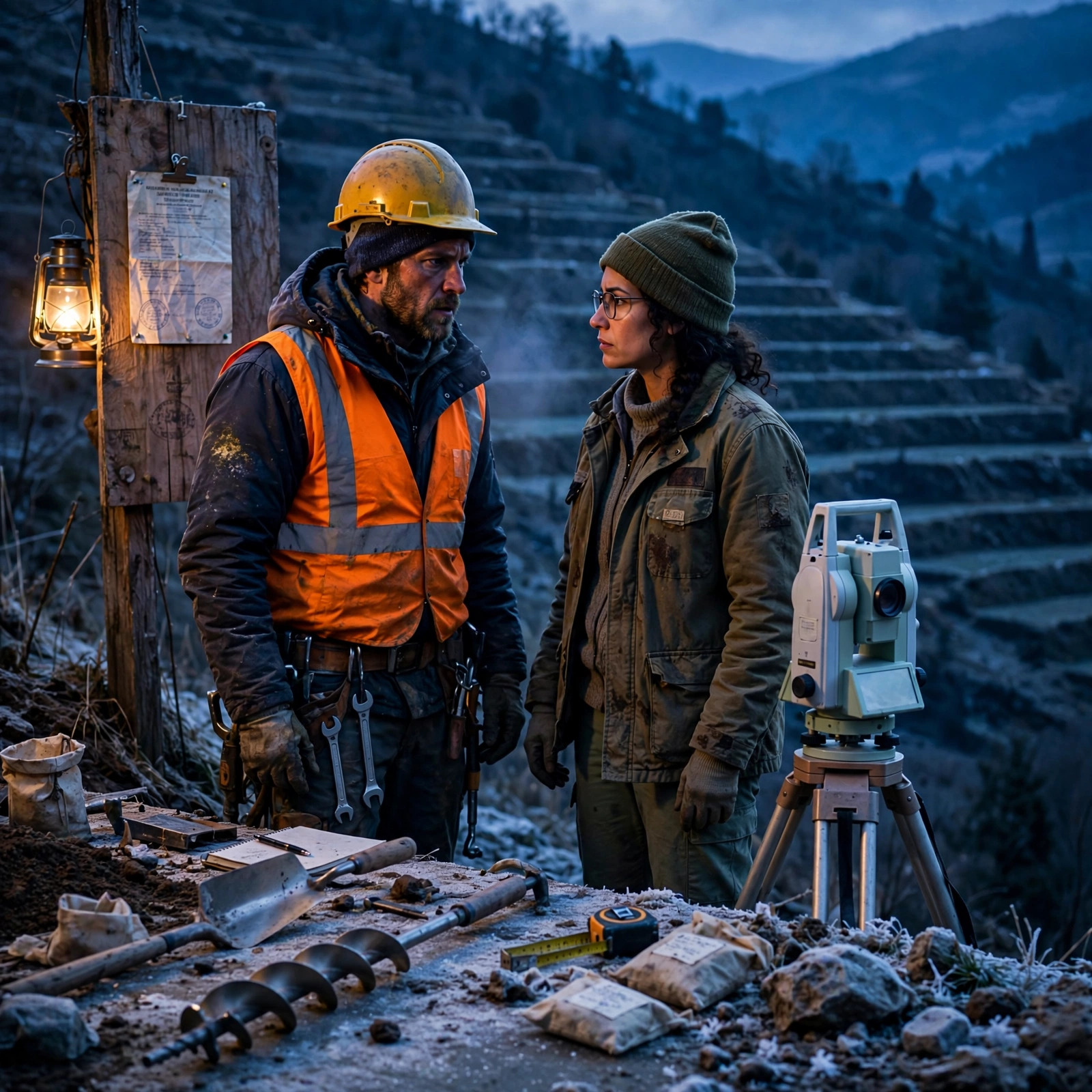
In theory. She stood at the head of terrace one with the frost still burning off the cap below her in long grey ribbons, and did the arithmetic she'd been doing since midnight. Forty meters of overburden between the basin floor and the ice lens. Her cap was twenty-two centimeters of built soil, alive down through its grain, load-bearing from the top of its crust to the wick-lines buried at its base. A shudder that had crossed forty meters of rock would not stop politely at her property line. She had written that in her margin objection, stamped it, and slept three hours anyway.
Ilya came up the stair with his seed ledger under one arm and his respirator hanging loose at his throat. He didn't say good morning. He looked down the Bench with her, the way he did his rows at transplant, patient and complete.
"Frost's off early," he said. "Ground's warm for the season. The cap will be dry at the joints by midday."
"That's what I'm afraid of," Petra said. "Dry cap doesn't flex. It splits."
"Your objection says flexion tolerances."
"My objection says a lot of things." She pulled her gloves tighter. "It says them in ink and it stops nothing. Ellery's within his permit."
Juna was already at the rig. Petra had picked her out on the basin floor an hour ago by her walk, that rolling rig-wide stride her sister used on pipe decks, arms out for balance over the scree, faster than anyone had a right to be on rubble. The mesh radio on the terrace head crackled and settled into working chatter, mostly the drill crew calling meter counts. Petra kept the channel open on the rail beside her, half an ear on it, the way she kept one ear on the Bench itself.
Ellery's voice came up out of it mid-morning. "Steward, you reading us?"
"I'm reading you."
"First string at thirty-eight meters. Sample's coming up clean, cold, dense. We're going to set the tap at midlens and ease it open. You'll feel it before you hear it. Tell me what your cap does."
"Tell me what your modeling says it'll do first."
A pause on the channel, long enough to have a shrug in it. "Modeling says you feel a heavy truck roll past at speed. Nothing your crust hasn't taken from weather."
"Weather comes down from above," Petra said. "This comes up from below. Go ahead, Mr. Sandove. You have your permit."
The tap opened at noon, basin-clock. Petra felt it before the radio carried anything, felt it through her boots first, a long low push that had no direction until it arrived and then had all of them, the stair humming under her feet, the rail buzzing against her palms. It was not a truck. It was a slow deliberate shove from underneath, four seconds of it, and she watched the Bench take it the way a hull takes a sea, row by row, the frost-wet crust flexing, holding, flexing further.
Then, on terrace seven, the cap broke its joint.
She heard it more than saw it, a dry tearing report like a sail letting go, and a seam opened across the terrace floor twenty meters out from the stair, a black line in the grey-brown crust, straight for six meters and then ragged. Dust stood up off it in a soft column. Ilya was already down the steps two at a time with his respirator off his throat and on his face, and Petra was on the radio.
"Mr. Sandove. I have cap fracture on terrace seven. Close the tap."
"Copy fracture. Tap's at seven percent, we're inside tolerance, hold…" The ground shoved again, harder, and the tearing went on somewhere she couldn't see, terrace eight maybe, or nine, and dust rose off the whole middle Bench in a wave. The wind took it sideways, north along the rows. Petra got the respirator over her own mouth in the middle of it, and through the haze she saw the terrace-four wick-line coupling, the one they'd reseated with cord only yesterday, lift right out of its trench and whip.
"Close it," she said into the radio, and then the channel filled with a sound she'd never heard on a drill deck: a rig crewman's voice flattened out by hurry, calling a parted line, and under it a siren she recognized as Juna's crew evac tone.
The shaker line had parted at the third anchor, rig-side. Petra knew the geometry of it before anyone said it: a tensioned line loose at one end, at forty meters, with people working under it. The radio gave her the rest in fragments. Line down. Rigger downwind of it. Dust column moving north, dust column moving fast.
Juna had been standing anchor watch, twenty meters downwind, vent-side. The dust wall came off the basin floor where the parted line had ploughed it up, and it came at her height, head height, airway height, and the cap fragments came inside it, grit off the new-cracked terraces lifted by the wind of the venting itself. Her respirator was on her belt. She'd had eleven seconds, and she'd used ten of them dragging a crewman clear by his harness, which was the kind of arithmetic her sister did without ever once writing it down.
They brought her up to the terrace head on a stretcher the rig crew improvised from pipe and tarp, and the dust had gotten in before the mask went on. She coughed like a woman trying to clear her own lungs out of her body, and she was talking between the coughs, which Petra hated, because it meant there was enough air moving to waste on words.
"Pet. Pet. The anchor was good. I checked the anchor this morning, I want that written down. The line was…" A cough broke it in half. "Line was flagged for service. That's mine. I flagged it."
"You flagged it to Ellery's crew for maintenance," Petra said, "and the test went ahead over a standing objection, and I'm going to say all of that out loud until it's written down in somebody's ledger besides yours. Stop talking."
"You stop talking," Juna said, and coughed, and managed a grin under the dust grey on her face. "You're worse than me."
The rig's medic was a compact woman who moved like she'd done this in gravity she'd rather not discuss, and she had Juna on bottled air before the stretcher reached the med bay door, mask fogging and clearing, fogging and clearing. Bottled air for days, she said. Airway scoured, watch for heat and swelling, no dust work, no rig work, nothing but lying still and breathing filtered while a lung did its slow trade. Juna would rather have lost an arm. She said so, muffled through the mask, twice.
Petra came back out of the med bay into afternoon light gone strange with haze, and stood at the terrace head with her sister's helmet in one hand, the rig helmet she'd carried up herself because no one else was going to carry it carefully. The vent plume still stood over the basin, a white feather climbing off the tap, lit gold at its edges, in no hurry to disperse. It hung there like a flag somebody had planted. Forty meters under her feet, an ice lens half a kilometer wide had felt the tap and pushed back, and Ellery's crew was out on the floor in hard suits reading their instruments, and their numbers were going to look good. That was the part she'd have to fight with. The test had worked. The test always worked. Small, measured, pressure confirmed, yield confirmed. Seven percent of one tap had put vapor and dust into the air of everyone she loved and cracked her cap and put her sister in the med bay, and it had also, she had no doubt, produced a yield column any manager in the system would sign.
Ellery came up the stair alone, hard suit stripped to the waist, dust grey across his face like the whole basin had been handled by everyone in it too roughly. He stopped at the terrace rail and looked at the seam on terrace seven, and then at the farther terraces, where his own people were already walking the rows with spray rigs, wetting down the cracks. Three hectares, their count would say by evening. Petra's count already did.
"My surveyor's calling it three cracked," he said. "Two of them maybe are just joint-spread. I'm not going to argue your count, Steward. My tap was inside tolerance and it broke your ground. That's a sentence I have to carry up the mesh to my board tonight, along with your objection and my yield numbers, and they're going to ask me what I recommend." He put both hands flat on the rail. "Tell me what your slow plan costs them. Not in ink. In days. They'll ask me that too."
She could have told him about the reserve, how the test itself had drawn on the common cistern for rig cooling, nine days of sealed water gone between breakfast and mid-afternoon, a number she'd watched drop on the terrace-head gauge like sand in a glass. She could have told him the crack would need re-laying by hand, hers and Ilya's, hours on the rows with plate and tamper, and that the town would see her doing it and know whose permit it had come from. She said none of it, because he hadn't asked for the speech. He'd asked for a number.
"Come to the rows tomorrow," she said. "Walk terrace seven with me. Bring your yield sheet and I'll bring mine, and I'll show you the same ground twice." She hefted the helmet. "And send your medic's report up the mesh tonight with the rest of it. My sister's airway belongs in your board's ledger next to my cracked cap. All of it happened inside your tolerance, Mr. Sandove. I want them reading the whole page."
He looked at the helmet, and at the plume, and at the dust still settling grey-brown over the middle Bench, softening the black seams in her cap like snow over scars. "I'll send the whole page," he said.
Ilya was out on terrace four by then, knee-deep in the blown trench where the wick-line had whipped loose, resetting the coupling by hand under the settling dust, patient and complete. The plume hung over the basin. Petra stood at the head of her ground with her sister's helmet in one hand and the seal in her coat and three broken hectares to lay again, and began, without deciding to, to count the days.
Bottled Air
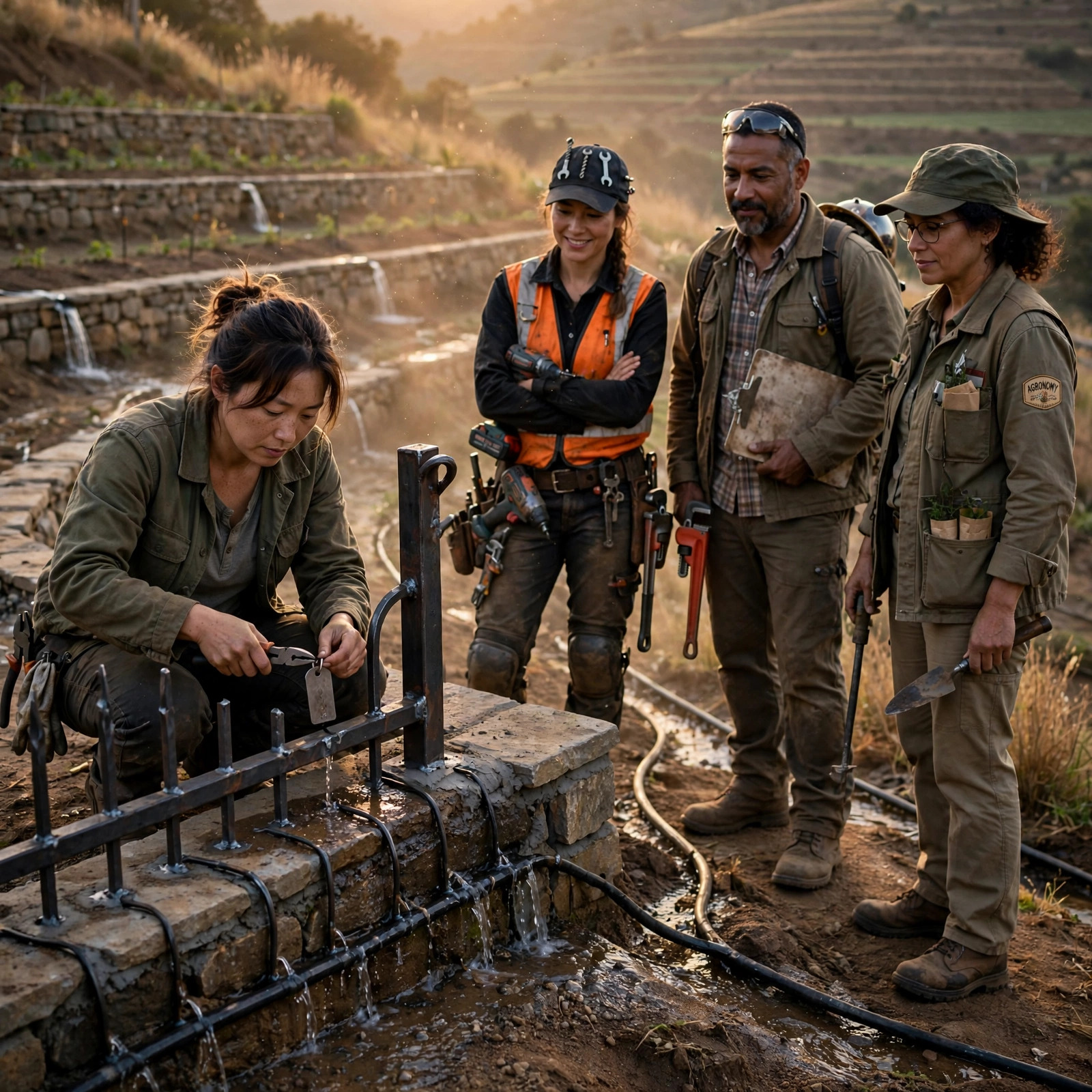
Two days of storm had shut the basin down, and Petra had spent both of them sealing rows under a sky the colour of wet felt. Dust sealing meant the suit air ran twice as fast through its filters, and the bottled-air stores ran twice as fast behind it, and by the morning of the fourth day the terrace-head gauge read 106 where it had read 111 before the test. Five days of sealed water, spent in two. She had stood at the head with the shaduf key in her fist and turned it exactly once, just to feel the seats, just to be sure the gate she had welded three years ago out of survey-salvage pipe still held its own weight and the cistern's behind it. It held. She locked it again and walked down through the settling grey to the med bay with her hood up and her mouth covered, because everything in Ternwick that week was covered.
Juna was propped in the second bay with a bottle rack beside the cot and a line running from it to a mask that fogged and cleared, fogged and cleared, with her breathing. Her eyes were red-rimmed and furious. When Petra came in she pulled the mask down off her chin with one hand, which the medic had told her not to do, and Petra had been told not to argue about.
"Don't," Juna said. "Don't look at me like I'm made of the same stuff as the cap."
"You're not," Petra said. "The cap cracked in three places. You only cracked in one."
Juna laughed, and the laugh turned into a cough that bent her forward over the rack, and Petra put a hand flat on her back and felt the shaking go through it, and did not say any of the things she was thinking. The medic's note on the slate at the foot of the cot said fragments and dust, airway, bottled air, four days minimum, and Petra had read it four times already from the mesh without going near the words.
"It was the third anchor," Juna said, when she had her wind back. She pulled the mask up, took two breaths off the bottle, pulled it down again. "I told Sandove's riggers the shaker line was seating wrong. I told them at the pre-walk. They wrote it in the margin and ran it anyway because the margin's where stewards' complaints go to die."
"I know. I read the margin. My seal's in it."
"Your seal and my anchor, and his tolerance." Juna's hand found the mask strap and worried it. "Pet. The deep stack."
Petra had been waiting for that and had still hoped not to hear it. "What about it?"
"I pulled it before the test. Full returns, forty meters down to the lens, the whole shoot, saved local to the rig slate because the mesh was jammed with permit traffic." Juna's eyes went to the locker at the foot of the cot, then back. "The shallow lines didn't match the drillers' model. They never matched. I wanted a clean copy before his crew wrote theirs down over ours. It's in my kit. It's yours."
"You pulled a survey copy on test day." Petra kept her voice level. "That's grounds, Juna. That's a letter to the consortium board."
"Then write the letter." Juna pulled the mask up, breathed, pulled it down. Her voice had gone thin at the edges. "I'm a rigger. I know what a bad model smells like. Their model said that lens was sitting in till. Their own returns said it wasn't, and nobody wanted to read the ones that weren't." She coughed again, shorter this time. "Take the slate. Read it somewhere I can't watch your face do it. And Pet--" she caught Petra's sleeve, and her grip had no strength in it, which was worse than the cough. "Whatever it says, it happened on my rig. Whatever you do with it, my name's on the pull. I know that. I did it anyway. Think about which of us you're angry at before you decide."
Petra took the slate out of the locker. It was a rig slate, scuffed and stickered, heavier than a field one, and Juna's kit tag was riveted to the corner of it. She put it inside her coat, against the shirt, where it wouldn't take the dust.
"I'm not angry at you," she said.
"No," Juna said. "You're angry at everything, and I'm the only thing in this room with a face."
Petra stayed another hour, until the medic came through on rounds and Juna's eyes had gone heavy and her answers had gone short. She fixed the mask so it sat right, and turned the bottle rack so the line wouldn't kink when Juna rolled in her sleep, and then she stood in the corridor outside the bay door with the slate's weight hanging off her like a second coat, and did not leave.
She read it there. She told herself she'd take it to the yard office, and then she unlocked it against the wall where the light was, standing, one shoulder against the corridor panelling, scrolling with her thumb. Juna's pull was clean and complete: forty meters of returns, every shot, time-stamped, the whole lens in slices. Petra had walked that lens in her head for eleven years, a buried plate of ice under the Bench, the thing her whole slow plan was built around, the thermal bank that kept the terraces' roots from freezing and the wick-lines fed through every dry month. She knew its shape the way she knew the shape of the gate at the terrace head.
She did not know this shape.
The deep shots showed a floor under the ice that returned wrong. Not till, not the packed fine grain the consortium's model had promised the board and the permit had printed. Something denser, something that carried the return bright and flat and moved, shot to shot, a hair's width, the way a layer moves when it has salt in it and nowhere to go. She scrolled back and read it again, and a third time, and then she sat down on the corridor bench without deciding to, because the lens was not buried in till. It was perched. It lay on a skin of brine, a wet lens under a cold one, and every gram of pressure the consortium's flash-vent put down that shaft was going to come back up through that brine and into the cap. Salt water. Rising into twenty-two centimetres of built soil that thirty-seven hectares of terrace depended on, that she had laid by hand with Ilya and with Juna and with half of Ternwick across eleven seasons. The vent wouldn't hand the colony a season of water. It would hand the terraces a salt funeral, and the fast plan and the slow plan would both be standing on the same ruined ground.
She looked up and Ilya was at the end of the corridor with a foil seed packet in his hand, watching her, and she understood that her face had done the whole reading out loud.
"Bad," he said. Not a question.
"Worse than the cracks." She locked the slate. "I need the board, Ilya. I need it today."
He came down the corridor, unhurried the way he always was, boots quiet on the panelling, and sat beside her, and did not ask. He turned the foil packet over in his hands once, and then he pressed it into hers, warm from his pocket. Winter cress, the label said, in his small careful hand, and the seed count, and terrace seven in the provenance line. "From the rows that didn't crack," he said. "I stripped them this morning before the wind came back. I'll strip the standing ones on terrace two tomorrow if the storm holds off, but seven's the best seed I've taken off the Bench since I came here. I wanted it out of the ground before anybody's plan touches it. Whatever's on that slate."
"Ilya."
"I know. You can't say." His shoulder was against hers on the bench. Eight years of rows together, eight years of seed counts and cap levels and thermos coffee at the terrace head before sun-up cleared the basin rim, and never once this. "Your sister's in there breathing off a bottle because a margin note wasn't enough for anybody. And you're sitting out here with a slate you've gone grey over and can't hand me. I can count, Petra. I'm an agronomist."
"I'm not going to lose the ground," she said. "I'm not going to lose her either. I need you to hear that I've decided that, before I know how."
"Then decide how." He looked at her. "You don't have to do it alone this time. That's the whole of what I came to say, and I've been standing at the end of that corridor for ten minutes saying it to myself."
She kissed him. It was brief, and it tasted of dust, because everything in Ternwick that week tasted of dust, and of the salt off her own face, which she hadn't known was there. He didn't move away. His hand came up and rested flat against the side of her collar, careful, the way he was with seed. Then the medic's door hissed at the far end and they broke apart, and Petra stood, and put the foil packet in her coat with the slate, where the day's whole cargo rode: one clean seed count off terrace seven, one rig pull with her sister's name riveted to it, one reading she was going to make the board see whether they wanted to or not.
"The yard board," she said. "Now, before the storm comes back and seals us all in."
"I'll walk down after I've seen her bottle change," he said. "Go. Whatever it is, Petra, make them read it standing up."
She went out into the grey with the slate against her chest, past the terrace head where the gate sat closed and holding, down toward the yard board and the permit that was still pinned to it.
The Veto
The board met in the yard hall at the hour the second mirror came over the rim, because that was the hour Ellery could attend without losing his drill crew to shadow, and because Petra had asked for the hour and Ellery had agreed to it, which had cost her something to accept. She stood at the front with her slate flat on the long table and her seal in her pocket and the ink copy folded once against her ribs.
The hall smelled of dust and warm plastic. Fourteen seats, eleven filled. Ilya sat at the far end with his hands folded on the table, and Juna was in the doorway, not in a seat, on light-duty clearance with a breather clipped at her belt and a cough she was rationing. Two days off the bottles. Her voice still came out sanded. She had argued her way into the doorway and not one step further, and the medic stood behind her with arms crossed like a gate.
"Order of business," Petra said. "The permit on the yard board, the flash-vent of the ice lens under the Long Bench, forty meters down. I've stamped my objection in the margin. Today I mean to do more than that."
"Petra." Ellery came in from the side door with his own slate under his arm and the dust still on his cuffs from the drill line. He took his seat without sitting down into it, one hand on its back. "Before you do. I've read your objection twice. It says the cap is load-bearing and the vent will crack it. The test cracked it. Three hectares, you counted, and my count agrees. I'm not going to stand here and tell you your ground didn't move. But I've got a colony behind me that's counting sealed water in days, and you've got a reserve count too. So let me put my numbers on the table first, and then you can put whatever you've got on top of them."
"You've read my objection," she said. "You haven't read what I read two nights ago."
"Then put it on the table."
She turned the slate to face the seats and brought the deep stack up whole. She had copied it from Juna's slate in ink, page by page, and ordered it off the mesh, and for two days it had lived against her ribs like a coal. "This is the full survey from the lens drilling. Deep returns. Not the summary your office was sent. The full stack."
"The summary was complete," Ellery said.
"The summary was cut at the lens floor. The deep returns go past it. Here." She put her finger on the layer line, the flat bright band under the ice. "Under the lens, there's a wet salt layer. Brine, lying flat, perched under the ice like water under a lifted plank. Your vent plan drops a shaft through the lens and flash-boils the whole body for one harvest. One season of pressure and water. My numbers say your numbers are right about that part, Ellery. You'd get your season."
He had come around the table without his slate. He stood at her shoulder and read, and the hall let him read, and the second mirror crawled its slow bright line across the wall.
"And then," Petra said, "the lens is gone, and the plank comes down. The brine moves up into the space the ice held. Forty meters of salt water perched under thirty-seven hectares of my cap. The cap is twenty-two centimeters of built soil and it's the only thing between your brine and every bed on the Bench. You don't get one cracked season. You get all of it, salted, both uses, mine and yours, and no crew and no season and no second try, because you can't un-perch a brine layer."
"That's one reading of the returns," Ellery said. But he said it with his finger already on the layer line, moving along it, checking the depth marks the way she had checked them at two in the morning with her sister's breath rasping in the next room. "Who else has read this stack?"
"Me. Juna. Her crew's rigger slate carried the raw file. Nobody on the mesh."
"You kept it off the mesh for two days." He said it flat, and she let it lie flat, because it was true and because the answer was standing in the doorway.
"My sister was in the med bay on bottled air," Petra said. "Cap fragments and dust, from your test, from a shaker anchor that parted. Her slate, her file, her call. She gave me the copy when she could talk. I wasn't going to put her raw returns on the open mesh with her name on them while she couldn't stand up to answer for them. The ink copy's in my hand. It's yours now if you want it."
Juna coughed once, short, and got her voice under it. "The third anchor parted because the ground under it wasn't what the permit said it was. That's in the returns too. Bottom of the stack."
"I know where it is," Ellery said, without turning. He read to the end of the stack. Then he straightened, and he rubbed the dust off his fingers onto his cuffs, which put more dust on than it took off, and Petra watched him do it and waited, because there was nothing left on her table to add.
"All right," he said. "The brine's real. The perch is real. The vent kills the lens and salts the ground and I'd be standing here in four seasons explaining a dead Bench to the same eleven seats." He pulled his own slate out and set it beside hers, and the two slates lay on the table with their edges touching. "So. Your wick plan. Say it out loud for the record, because I've only had it in pieces."
Petra took the ink copy from inside her coat and unfolded it on the table. "The lens stays. Buried, intact, sealed over. It becomes the thermal bank and the reservoir both. We tap it slow, through wick-lines buried under the cap, fed from the cistern at a measured rate, capillary, not pumped. The cap keeps the lens water it loses nothing of. The terraces get decades instead of one season. The first full feed runs through the shaduf gate at the terrace head, and the gate is under my key, welded three years ago from survey-salvage, and I've turned the key once to check the seats. The cracked hectares get re-laid with vetch under the plate while the cap sets. That's the whole of it."
"Decades," said one of the seats near the back.
"Decades at the measured rate," Petra said. "Not seasons at any rate you like. That's the difference and it's the whole difference."
Ellery had his stylus out. "The consortium re-crews to the wick plan. My rig line converts to tap and wick duty. That's my order to sign, mine, tonight, before I leave this hall, because my office can't be seen dragging on it a day. But Petra." He looked up from the slate. "You know what your veto does to you. The charter's plain. One-time veto over subsurface works on the terraces, and when you use it, your personal water allocation goes to the common reserve. Yours. Not the Bench's. Yours, out of your own cistern count, for the term."
"I've read the charter. I helped write that clause."
"I know you did. I'm asking anyway." He set the stylus down. "There's a way to do this without the veto. You put the returns on the record, I re-crew on my own signature, the consortium eats the change order, and you keep your allocation. Nobody has to pay anything personal tonight."
"And next season," Petra said, "when your office has a new site manager with your same honest numbers and a different lens, there's no veto standing. The clause is one-time. One-time means you spend it where it counts, and it counts under thirty-seven hectares of my ground with a brine under it. I'm not saving it for a rainier day. There isn't one coming."
She took the seal from her pocket. It was hers, eleven years in her hand, and it went onto the ink page the way it had gone onto a hundred pages of bed counts and seed counts and water counts, and this was the first time she had ever felt its weight while she used it. The hall was quiet except for the tick of the wall clock and the small dry sound of Juna's breather cycling in the doorway.
"Veto on subsurface works under the Long Bench terraces," Petra said, for the record, in her own voice, which held. "My personal allocation to the common reserve, effective tonight, for the term."
Ilya wrote it into the minute book without a word. He didn't look up. He had counted the seed already, and he knew what she had just counted, and the not-looking was the whole of what he had to say about it where the seats could hear.
Ellery picked the stylus back up. "Re-crew order," he said. "Consortium line to terrace wick duty, effective first light. Rig cooling draws from the common cistern stop today." He signed, and turned the slate so the hall could see the name, and then slid it across the table until the two signatures lay on the two pages, side by side, hers in ink and his on the slate, veto and re-crew, one sheet apart and touching at the edges.
"You'll want the gate opened under your key," he said. "Not under mine."
"Under mine. First full feed when the wick-lines are seated and I've walked every joint."
He nodded once, and that was the whole of his concession, and it was enough, because he had changed course standing up, on numbers, the way a man does when the numbers are honestly his and honestly wrong. From the doorway Juna said, "Petra," and Petra looked, and Juna had one hand raised, not waving, just raised, the way a rigger signals a line that's seated and true, and her breath came even through the breather, and the medic had uncrossed his arms.
Ellery capped his stylus. "First light, then. Show me the gate on your way out."
First Water
Petra walked the last wick joint in the dark, three hours before first light, because a steward who signs a veto with her own water walks the line herself or not at all. The joint on terrace four held. Cord wound tight over the coupling, dry cord over dry steel, and her lamp found no weep at the collar. She put her palm flat on the cap and felt the Bench under her hand the way she had felt it every morning for eleven years, forty meters of dust and stone and, under all of it, ice lying flat and whole on its salt.
By the time the basin rim went grey, the crew was up the terraces.
They came in ones and twos, riggers off the drill line with their rig gloves still creased from the mast, and they stood at the head of the Long Bench not knowing where to put themselves, because for five years their work had gone down and this morning it was going sideways. Ellery came last, on foot from the yard, his slate under his arm and his coat unzipped against the cold.
"Walked it?" he said.
"Every joint. Twice on four. Reseated and corded. You can pull the survey if you want my say in writing."
"I'll take the walk." He looked down the stair of beds, thirty-seven hectares of engineered crust stacked against the basin wall, three of them still dark with the cracks the test had left. "I paid for those cracks once. I'd as soon know what I'm looking at."
So they walked. He was quiet through terraces one and two, and at the third bed, where the cap had split along a shaker line, he crouched and put two fingers into the crack the way a man tests a bad tooth. Twenty-two centimeters of built cap, laid a decade before either of them had stood on this ground, and split to the bed beneath.
"That deep, all of them?"
"That deep, all three hectares."
He stood. He looked at the crack a moment longer than he needed to, and she let him have the moment, because she had watched her own numbers honestly for five years and she knew what it was to find the seam in them. "The feed won't cross a crack," he said. "It'll vent at the split and take your bed with it."
"It'll vent at the split," she agreed. "So we don't feed across it. We re-lay first."
Juna came up the stair while they stood there, and Petra heard her before she saw her, the slow even hiss of a breather two days off the bottled air, light duty and a paper mask and a voice behind it like someone speaking through a screen door. She had the survey mast over her shoulder, collapsed, and she planted its foot on the fourth riser and looked down at them with the flat professional patience of a rigger waiting on a decision.
"Medic says one more day of this and I get my mask back," she said. "I told him I'd take it out on the mast."
"You'll take it out on the mast," Petra said. "As-built. Every joint on the wick, mapped, before noon."
"Before noon." Juna glanced at Ellery, quick and sideways, an old habit from the drill line, checking the site manager the way she had checked him for six years. "That's the whole point of today, right? Somebody writes down what we actually built, so nobody has to guess later."
"That's the whole point," Ellery said. He said it plainly, without defending it, and Petra thought that was the most she had ever liked the man.
Ilya was already down at the far end of the third bed when they reached it, kneeling on a sack with his foil packets fanned out on the cap like a hand of cards. Winter vetch, terracotta packets with the seed lot inked on the fold, enough to dress three hectares twice over if the beds took it. He had a hand fork and a bucket of fines and he did not look up when they came.
"Cap comes off in tiles," he said. "Bed gets the fines worked in, seed goes down on the dressing, tile goes back. Crack by crack. It's slow and it's the only way, because nobody's machine-laying this and I don't want a machine in my beds ever again." He did look up then, at Ellery, and it was not entirely friendly. "Your machine made these cracks."
"My machine did." Ellery crouched and took a packet off the sack, turned it over, read the lot number. "How many hands does three hectares want?"
"Eight. I have four that know cap work."
Ellery straightened and counted the riggers loafing at the terrace head with his eyes, one by one, unhurried. "You'll have nine by noon. Consortium line's on wick duty, which today means whatever the soil people say it means."
"It means tiles," Ilya said.
"Then it means tiles."
They went to work.
The cap came up in flat squares, cut with a mason's edge along the crack and lifted two-handed, and the bed beneath was pale and loose and smelled like cold cellars. Petra took her turn with the fork like everyone else, because a steward who will not put her hands in the bed does not get to hold the gate key either, and her palms went hard-edged and brown with the fines. The riggers learned fast, which surprised her and then didn't; a person who can keep a shaker anchor true through forty meters of overburden can certainly learn to lay a cap tile square, and by midday the fourth riser was re-dressed and seeded and the tiles were going back down like a pavement being re-laid, seed by seed, foil packet by foil packet.
Juna walked the mast down every wick-line on the upper terraces and called the joints in to the yard board over the mesh, seconds, line of sight, the whole basin one hop. "Wick one through six seated, corded, true. Seven's the gate leg, held for the key." A pause, and her voice came back flatter. "Reserve count still reads one hundred and six days at the cistern glass, if anybody's watching the glass."
Petra was watching the glass. One hundred and six days, and not one of her own in it anymore, her allocation gone into the common since the night of the veto, and the count had not dropped since Ellery stopped the rig cooling. The water that fed today was the water that stayed. That was the whole arithmetic of the slow plan, and she had done that arithmetic in the yard hall with two signatures under it, and she would do it again.
The sun came over the basin rim at noon and by late afternoon three hectares were re-laid, and the light went long and low and the dust on the crew stood up off them in the work glow, and they were all of them still on the terraces at last light because nobody had said to go and nobody wanted to.
The gate stood at the terrace head. Steel, salvaged survey pipe and plate welded into a stem and a shoe three years ago in her own shop, with a lead tag on the stem collar that read, stamped deep, HOLD FOR KEY: P. YULAW. She had stamped it herself the night she built it, the same night she had decided that the day the tag broke would be a good day or a day she'd never let come. She had expected never.
Ellery stood back from it. Ilya stood back from it. The crew, tiles done, gathered loose along the riser with their gloves off.
Petra took the tag in her fist and bent it back and forth until the lead tore, and dropped the halves in her coat pocket, and put her key in the collar and turned it, and the lock came over with a sound like a period at the end of ten years of argument.
"Half-turn opens the shoe," she said. "Half-turn meters it. Watch the wick, not the gate."
She put her hands on the stem and turned, and the stem came over half a turn, and nothing anywhere went flash or thundered. What happened was small, which was the entire point of it. Down the fourth riser, under the new-laid tiles, under thirty-seven hectares of re-dressed cap and whole ice and unbroken ground, the wick-lines darkened. She could see it where the line ran shallow near the head, a grey shadow crawling out along the buried cord of it, joint by seated joint, unhurried, water going where it was put at a rate a person could count on and plan a decade of harvests against. The first seep reached the cracked heel of the third bed and did not vent. It soaked. The dust around the crew's boots darkened and settled and lay still.
Nobody cheered. Riggers don't cheer at a seated line, and this whole morning had been rigging, the oldest kind: something built to hold what it holds.
Juna pulled her mask down off her nose, which the medic would have words about tomorrow, and said, "Wick seven, gate leg, open under key, feed holding. That's the as-built and it's beautiful."
"Log it," Petra said.
"Already logged."
Ellery looked down the darkening line of it, out to where it ran under his own crew's fresh tiles, and he took his stylus out and put it away again without writing anything, which Petra understood. There was a time for writing, and this one was full.
"Rate holds the count," he said. "Season by season."
"Season by season. And the lens stays where it is, cold and whole, doing thermal work under my beds for every harvest after yours and mine."
"Mine's yours now," he said. "I re-crewed, didn't I."
He put out his hand and she took it, glove to glove, both of them grimy to the wrist, and the grip was short and strong and done.
Ilya was already two beds down, on his knees, with his palm flat on a fresh tile the way she'd had hers on the cap that morning, feeling for the wet under it. He looked back up the stair once, at her, at the gate, at the shadow crawling out along the wick, and didn't say anything, and didn't have to.
Petra turned the stem another half-turn, and the water walked on.
Get notified when new stories drop

Ren Hollis
Ren writes frontier worlds and terraforming triumphs — habitats, gardens under glass, and the first rain on a new world.
Leave a comment
Comments