




The Crate
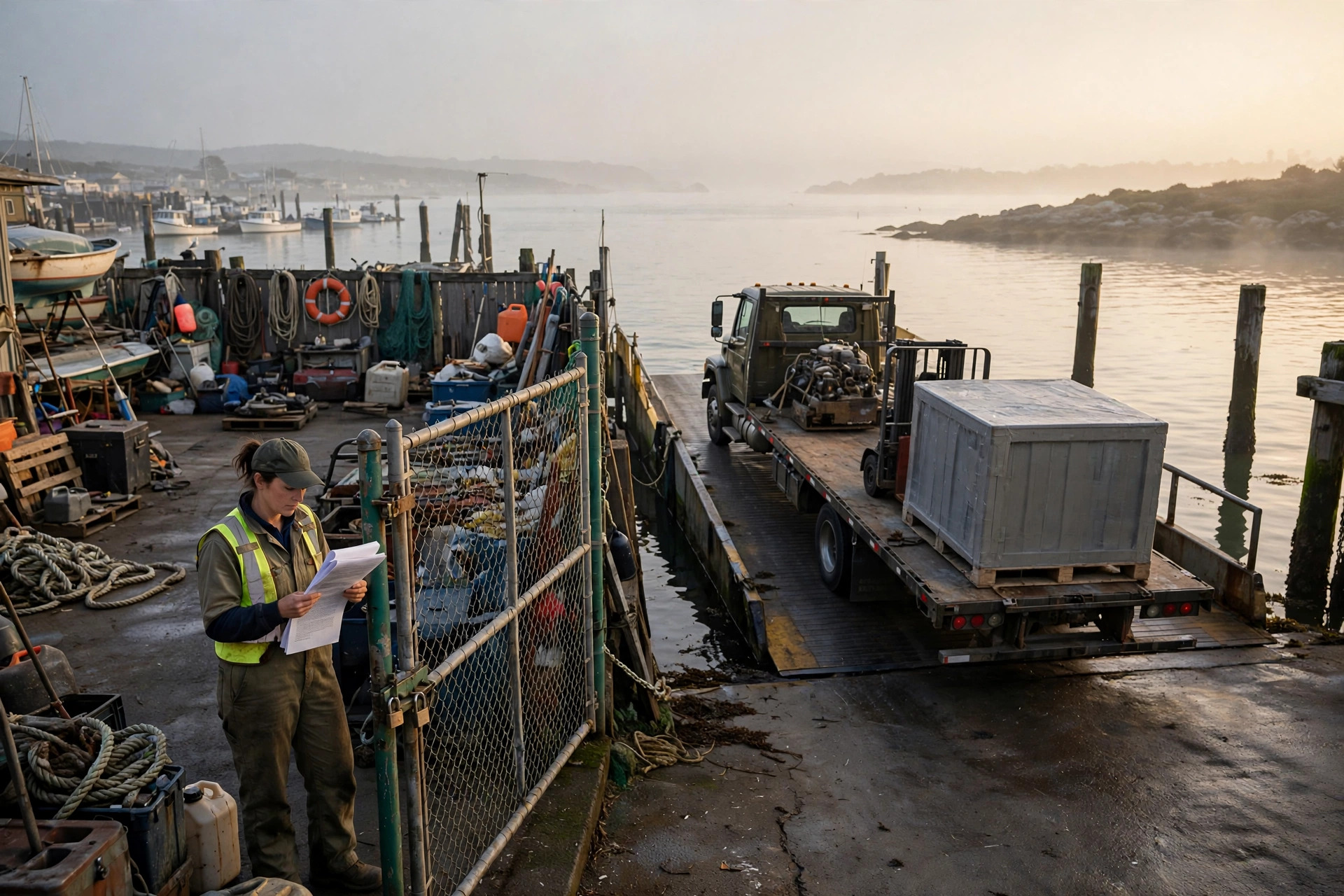
The flatbed backed down Ferry Slip before the gulls had finished arguing over the night's catch, and Yara Delling stood in the yard gate with her coffee going cold in her fist and counted the straps. Six over the crate, two over the pallet, a customs sticker gone soft with salt spray. The driver leaned out and shouted something about a signature, and Minta was already there with the clipboard before Yara had finished swallowing.
"Clearwake Marine Systems," Minta read off the manifest. "One hybrid drive unit, factory-sealed. Consignee, the Delling repair yard. That's us, boss."
"That's us." Yara set the cup on the gatepost. The crate was bigger than she'd pictured from the drawings, composite over steel, the size of a coffin built for two, and it sat on the slip boards like it had every intention of staying. The grant letter had come in the same pouch as the manifest, a fat envelope with the estuary authority's crest, and she'd carried it around unopened in her jacket for two days rather than read it standing in the post office with Bev Ostrander reading over her shoulder. Now she had no excuse left. "Get the pallet jack. And put chocks down, I don't care if it's rated for a gale."
Minta went for the jack. Yara worked her thumb under the flap of the envelope and walked while she read, which was how she nearly put her boot through a coil of line coiled wrong on the dock edge. She stopped. She read the middle paragraph three times.
"Boss?"
"Grant's eighteen thousand six hundred," she said. "That part's real."
"That's the good part. I can hear the good part in your voice."
"The rest of it's conditions." She folded the letter along its creases and put it back in her jacket, because reading it out loud on the slip would make it true faster than she was ready for. "Surrender of both port and starboard engines. Certified scrapping. Photographed, witnessed, cut up so they can't be rebuilt. Plus a pilot refit inspection signed off by day ninety."
Minta had the pallet jack's handle in both hands and her chin on top of them. "Both. The old girl's got nothing under her covers but those two."
"I know what she's got under her covers." Yara's voice came out flatter than she meant, and Minta had been around her long enough to hear the grain in it and not push. They got the crate up on its chocks, and the slip boards took the weight with a groan that settled, and that was when Dov Landry's truck came down the yard road with its co-op decals catching the low sun.
He got out with a folder under his arm and his other hand already raised, which meant he'd rehearsed the walk from the truck. "Yara. Minta."
"You're early," Yara said. "Renewals aren't due till month's end."
"Renewal's not what I brought." He set the folder on the crate itself, which she disliked before he'd even done it, and she disliked it more after. "Co-op's asking for a one-season extension on the service franchise. Sign it, and we're all still standing here next spring, arguing about the same things."
"The estuary authority isn't extending anything. You've seen the notice. Ninety days on the mooring-service permit, then no uncertified diesel works the bar. That's not my notice, Dov. That's the bar."
"Ninety days is a long time in a yard." He said it gently, which was worse. He had that way of standing on her slip like he was already half owner of it, boots planted, weight back, a man who'd been coming down this road for thirty-one years and knew where all the soft boards were. "One more diesel season banks you cash. You've got boats stacked three deep for injector work right now. I've got the schedule in that folder to prove it."
"I know my own book."
"You know your book." He tapped the folder once. "My people know your book too. Half the fleet takes their engines to you because you're the warranty station, and because your pump man was the best this coast ever produced, and I'll say that even if you won't. You refit to that thing in the crate, and every one of those boats has to decide whether a hybrid yard is a yard they trust with a bar crossing. That's not a small question for men who drown if the answer's wrong."
She looked at the crate. She looked at the folder sitting on it. "You want me to hold, is what you're saying."
"I want you to have the option. That's all a piece of paper is."
Minta had gone quiet over by the pallet jack, the way she did when the two of them got going, and Yara was aware of her watching, and aware of what Minta was probably watching for, and that made her jaw tight. There had been a winter supper at the co-op hall two years back where Dov had pulled her chair out for her and the whole room had pretended not to see, and nothing had been said since, by either of them, which was its own kind of answer that neither of them accepted.
"Minta," she said. "Crowbar and the wrecking bar. And my father's pin punch, the long one, off the bench."
Dov's brows went up. "You're opening it now."
"It's on my slip. It's mine to open." She took the folder off the crate top and held it out to him. He didn't take it right away. He looked at it, then at her, and something passed over his face that she almost called hurt before he put it away.
"Yara."
"You can stand there and watch, if you want. You can even help. You're good with your hands when you're not holding paper."
He took the folder. He didn't leave, which she'd half expected and entirely noted.
The crate lid came off in strips, the crowbar biting composite with a sound like a big door giving up. Minta peeled the packing back in neat folds, the way she'd been taught, and underneath was the stack: the fuel-cell unit in its steel cradle, the hybrid controller beside it in its own sealed bag, and the coupling assembly bolted to a display board with its torque curve printed right there on the card. Yara got her glasses on her nose and went over the coupling the way she went over everything, twice, hands and eyes disagreeing until they didn't.
"That's a 140 millimeter flange," she said.
Minta leaned in. "The winch gear takes 160. I measured it twice last week."
"You measured it right." Yara crouched, held the coupling's bolt pattern up against the drawing on the card, then against the memory of the Kittiwake's winch mount, which she could draw in her sleep. "The card's honest. It's a 140. They've shipped us a drive that will not bolt to our gear without an adapter, and there's no adapter in this crate, and the grant letter says the inspection is on us by day ninety."
"So we call Clearwake and they ship the adapter," Dov said from behind her, reasonable as tide tables. "Problem solved by Thursday."
"And if the adapter doesn't exist, because the winch gear on a fourteen-meter tug built before any of us were born isn't a catalog line to them?" She stood. Her knees made themselves known. "Then someone machines one, in this yard, in the hours I don't have, out of steel I'd have to buy, and the torque curve voids the winch warranty the day it turns over. That's in the letter too. Page four. I read it while you were driving down."
"Then that's the argument for one more diesel season, isn't it." He said it softly, and he was right enough that it landed, and she hated that it landed. "The old gear works. The old engines work. Your father's pump works. I watched him lap that pump on this bench, Yara. I'd just taken the manager's post and I was green as snot and he let me hold the light. Eleven years gone and that pump still pulls every boat on this coast through the bar. You're being asked to hand that over to a scrap certificate."
She hadn't told him about the surrender clause. He'd said pump and her stomach had dropped anyway, because Dov Landry knew her yard the way he knew his own fuel dock, which was to say completely and without permission.
Minta's voice came small from the crate. "Boss. The port engine. This means the pump comes out."
"It means a lot of things come out." Yara took the letter out of her jacket and unfolded it, and the wind off the estuary tried it, and she let it flap. "It means if I sign, the pump Aldous Delling hand-lapped on this bench goes to a certified scrapper, and I get a receipt saying it did. And if I don't sign, in ninety days this yard is a slip with a nice view, because there won't be a diesel left that's allowed to work the bar and nobody's crossing on faith."
Dov was quiet a while. The gulls had found something at the far end of the slip. "I'm not your enemy in this," he said finally.
"I know that."
"I'd like it if you acted like you knew it."
She looked at him then, and he looked back, and neither of them said the thing that would have been true and easy, and then he did what he did, which was turn practical. He set his folder on the workbench, squared it against the edge, and put a shackle on top of it, one of the yard's own shackles off the pin board, to weight the pages against the wind.
"Extension's good for a season whether you sign it today or next week. Read it when the letter's not shouting at you." He nodded at the crate. "And get the adapter question answered before you decide anything about the pump. That's all I'm asking. Sequence, not surrender."
He walked to his truck. Minta watched him go and said, "He could've just left the folder."
"He knows I throw folders away." Yara looked at the bench. The letter, the folder, the shackle off her own pin board holding down his paper like a handshake she hadn't agreed to. She set the grant letter on the workbench, then, because she wasn't ready for it to be in her jacket against her heart anymore, and she laid the long pin punch across it to hold it down too, the punch that had been her father's, the one that had driven the pins into that pump eleven years ago on this same bench under this same light.
"Boss," Minta said. "The coupling. Do we call Clearwake first thing, or do we pull the pump?"
Outside the yard gate, Dov's truck sat idling, going nowhere yet, like maybe he was waiting for something, and like maybe she knew what.
"Neither," Yara said. "First we measure the winch gear. Third time. If we're going to build a bridge, we start with our own numbers."
Storm Watch
Bev Ostrander's notice went up on the harbormaster's board at half past seven, and by eight the wind had already found the loose corner of it and was working the pin loose, so that the whole sheet clacked against the plywood in a rhythm you could hear from the fuel dock. Yara read it standing in the yard gate with a mug of tea going cold in her hand. EQUINOX BLOW, the notice said. SURGE FORECAST 1.4 M. BAR AT 3.2 M. SMALL CRAFT SECURE. TUGS: STANDBY FOR MOORING SERVICE.
"That's a serious sheet of paper," Minta said, coming up behind her with a torque wrench in one hand and half a biscuit in the other. "1.4 on top of a 3.2 bar. That's working water."
"That's what it is." Yara drank the cold tea anyway. Five days since the crate had come down the slip, five days since Dov's folder had gone under the shackle on her bench, and the wind had blown from the southeast every one of them, patient and unhurried, like a tide that had somewhere to be.
Bev crossed the slip road with her board pins rattling in her jacket pocket. She was a woman who posted notices the way other people planted fence posts, and she stopped in front of Yara with both boots set and her hands in her pockets, which was how you could tell the news was for her and not for the wind.
"Eighty-four days on the clock," Bev said. "You're counting. I can see you counting."
"I count for a living."
"Then count this. The equinox blow lands day after next week, and if the bar goes to four and a half with the surge on it, the moorings outside the channel will need a tug with certified working gear on them. Two boats, probably. Three if the Fenn lightbuoy drags." Bev took one hand out of her pocket long enough to tap the notice. "And here's the arithmetic that keeps me up, Yara. If your diesel permit lapses, there is no tug on this bar with certified gear, because the Kittiwake is the only one that works moorings in weather, and you are the only yard that keeps her certified. No tug, no mooring service. No mooring service, I've got boats loose in the harbor on the worst night of the year, and I've got a harbormaster writing letters to the district about why."
The gulls had come down the slip again, the same ones, working the low tide line for whatever the tide had left. Yara watched them a moment before she answered.
"The permit's not lapsed yet."
"No. It's got eighty-four days on it. And every one of those days, either you've got a refit on that boat or you don't, and if you don't, then on day eighty-five I'm posting a different notice, and it says no mooring service, and this town reads it and does its arithmetic too. Yara." Bev's voice came down off the posting register, down to the register she used at funerals. "Your trade isn't just your trade. It's the trade of every boat that ties up inside this bar. I know what that grant asks of you. I read the terms same as you. I'm not telling you to sign it."
"You're telling me something."
"I'm telling you the water doesn't wait for us to feel ready. That blow comes when it comes. So does day ninety."
She went back across the road to her office, and the wind kept working the pin loose on the notice, and Minta stood beside Yara eating the rest of her biscuit in silence, which for Minta was a kind of ceremony.
"She's not wrong," Minta said finally. "You know that."
"I know it. That's the trouble with Bev." Yara set the mug on the gatepost. "Get your coveralls on. Starboard diesel. We're pulling it today."
"Pulling it. Pulling it to look at, or pulling it to scrap?"
"To look at. You can't inventory what you can't see."
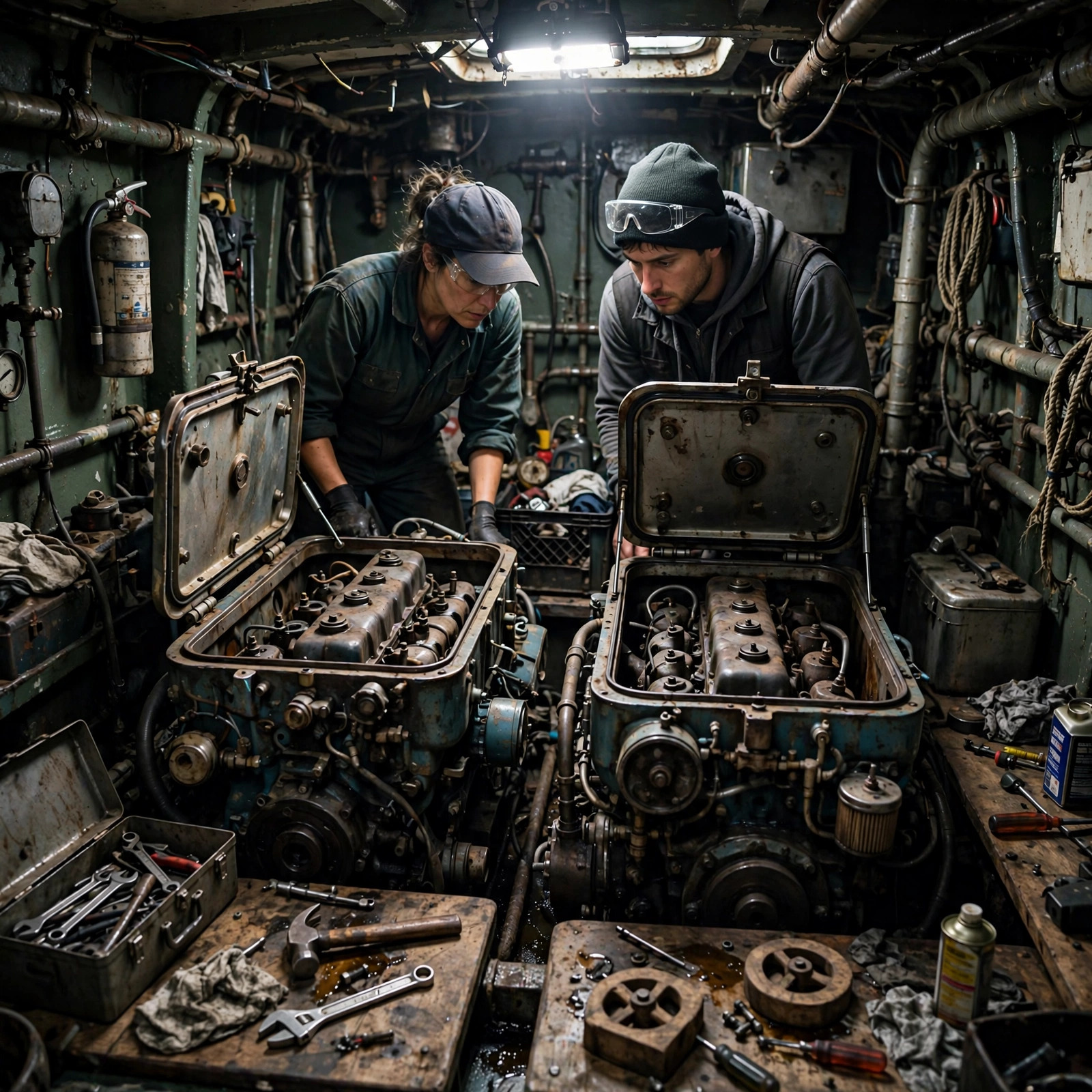
The Kittiwake sat on the hard by the shed, fourteen meters of workboat with her winch gear racked aft and both engine covers off, waiting. She'd been waiting her whole life, in a way; boats like that were built to wait between weather. Yara got the starboard cover clear while Minta broke the cooling lines and capped them, and the morning went to the sound of wrenches and salt-rusted bolts that had to be heated and persuaded, and by eleven the engine was loose on its mounts and Minta was up on the block with a boroscope, and then Minta went quiet in a way that Yara had learned to read over two years.
"Boss. You'd better come look at this."
Yara climbed the ladder. The borescope screen showed the liner wall of the number two cylinder, lit ghost-white, and the wall was not a wall. It was a landscape. Salt scour ran the length of it in long pale scars, and where the scour crossed the old hone marks the metal had gone matte, dead, finished.
"How far up?"
"All of them. I did one through four while you were getting the cover free. It's not just number two." Minta passed the scope down. "Boss, this block is done. It was done before we pulled it. Somebody's been running her raw through the winter and not telling us, or the cooler's been seeping for a season, and either way, that scour didn't happen last week."
Yara took the screen and walked the cylinders herself, one to four, slow, and the salt scour was in all of them, and in the back of her mind a small ledger closed a column and opened another. A block like that had no resale. No rebore, no sleeve, nothing a second-hand buyer would pay for. It was a runner turned into a weight of cast iron, and the only thing left that it could be was scrap, certified or otherwise.
She sat down on the engine cover with the scope in her lap and looked down the length of the boat to the shed, where the Clearwake crate stood on the slip with its paperwork still stapled to the strapping, factory seals unbroken, five days on the slip and unopened.
"Starboard block's salt-scoured through," she said. "Beyond resale. Write it on the inventory as nil value and date it."
"So if we don't take the grant, we're rebuilding a block that's worth nothing to anybody but us." Minta climbed down and stood with her hands on her hips, studying the yard's other problem, the crate, the way she studied a bolt before deciding on heat. "And if we do take the grant, we're scrapping two engines and buying a drive we haven't ever seen run."
"That's the size of it."
"What's the port one like? The one your dad rebuilt the pump on?"
"Port's sound. Port's always been the good one." Yara stood, and her knees told her about it, and she put the scope back in its case with the care she put into everything that belonged to the shed. "The port engine is not the question this morning. The question this morning is whether a fuel cell that size can hold a winch load, and nobody in this town knows that, including me, including Clearwake's own literature, which is a catalog of promises stapled to a crate."
"So we bench it," Minta said. "We've got the coupling measured three times. We know the flange's wrong and the gear's right. We could rig the stack on the bench stand, load bank on it, and see what it does before we cut anything off this boat that we can't put back."
"Bench stand's got no capacity on its own. It needs a buffer. We pull amps faster than the grid feed into the shed can give it, it'll brown the whole yard and trip the main."
"The loaner bank." Minta nodded toward the shed's far corner. "The big one on the trolley. Two thousand amp-hours. It'll soak a bench test easy, you could run the stack into that all day and it wouldn't blink."
Yara looked across the shed at the bank on its trolley, the loaner the district had floated the yard for grid-outage backup, thick cable coiled on its hook, and she stood there a moment longer than the look needed. The bank had a job it already had. When the grid went down, and it went down most every winter blow, that trolley went up the hill to Alma's, and it ran her mother's concentrator, and at nine hours on a full charge it was the difference between Alma breathing easy through an outage and Alma going onto a cylinder, and then going into the district hospital if the outage ran long.
"Charge is low on it," she said. "It's been sitting since the last outage."
"Then we top it up first," Minta said. "Full charge, run the test, top it back up after. Same day, boss. Your mum's not on it till the grid fails, and the grid's not failing before the equinox. Probably."
"Probably."
"You want me to book it out in the shed log?"
"Book it out to me, bench test, Clearwake stack, one day." Yara picked up the engine cover and set it over the dead block, and the sound it made closing was a flat kind of sound. "And Minta. Dov doesn't hear about the bench test from you. Not from me either, but I'm telling you plainly, not from you. He asks what we're doing, we're inventorying the starboard engine, which is true, and which is nil value, and which he can read in the log whenever he likes."
Minta looked at her, and Minta had been in town six years, long enough to know exactly what she was being asked to carry and how much it weighed. "He's going to find out. He finds out everything on this dock."
"He'll find out from me. On my day, at my bench, in my words." Yara rolled the trolley out of the corner and set the brake. "Get the charge cables. We top the bank now, run the bench test tomorrow with a full buffer behind it, and I'll know before I sign anything whether that stack is a drive or a very expensive decoration."
They worked the cables together, and outside the wind kept on at the loose pin on the storm watch, and at some point that morning the pin gave and the notice swung free at one corner and clacked alone against the board, and nobody came to fix it.
Nine Hours
The grid went down at ten past six in the evening, while the rain came on the shed roof like gravel poured from a bag, and Yara was standing in front of the bench test with the charge cables still warm in her hand.
The lamps died, the compressor sighed off, and the shed went dark except for the green standby dot on the Clearwake stack's controller, which ran on its own internal cell and sat there blinking at her like it had an opinion.
"There it is," Minta said from the door. She had her slicker half on, one arm out. "Harbor's dark too. Whole feeder."
Yara got the torch off the nail and put its beam on the trolley. The bank read full. Fourteen hours on the charger since morning, topped off by noon, and it had sat there all afternoon doing nothing but hold its charge, the way it had held its charge through every outage since the last one, waiting for the trip up the hill to Alma's.
She stood in front of it and did the arithmetic she had already done a dozen times, out loud this time so Minta could hear the reasoning and not just the decision.
"These feeder drops run two hours, maybe three. Substation crews are on the island side of the causeway tonight with this rain. Two hours of outage, and the bank holds nine. I put four into the bench test and I still have five behind it, plus whatever's left of the run." She set the torch on the bench so its light lay across the stack's terminal board. "Mum's got her wall unit and a full cylinder in the cupboard. Two hours, she never even opens the cupboard."
"And if it runs long?"
"Then I pull the bank off the test and run it up the hill with three hours of margin. It's twenty minutes each way with the trolley on the truck." She was already pulling the interconnects from their sleeves. "The test is the thing, Minta. Eighty-one days on that permit and I still don't know if this stack will drive a winch or drive me to sign my yard over to a bench ornament. Tonight I find out."
Minta held the light while Yara landed the cables, bank to inverter, inverter to the dummy load rig, rig to the stack. Everything about the Clearwake unit was clean and new and foreign on her bench: composite housing, factory seals, a torque spec plate that read like a hospital chart. The coupling problem was still there, the 140 flange against the 160 gear, an adapter still somewhere in a shipping queue on the mainland, but a bench test didn't need the coupling. A bench test needed load, and load was watts, and watts were watts.
She closed the main contactor at half past six. The stack came up its own curve, humming under the audible floor of the rain, and the dummy load bank lit its first row of resistors, and Yara watched the meters and did not watch the clock.
That was the mistake, and she knew it was the mistake while she was making it. A bench test of a hybrid drive is not a light. You can't switch a stack on, see that it shines, and go home. The controller wanted a full duty profile: cold start, warm idle, thirty percent load, sixty, a held peak, a thermal recycle, a shutdown, and a second cold start to prove the seals. Clearwake's own acceptance sheet, folded into the crate lid, said the profile was not to be interrupted or it counted for nothing with their certifiers. She had read that sheet twice and had noted the word continuous and had filed it somewhere in her head under things that would be true on a day when the grid was up.
At forty minutes she called the substation's outage line from the shed doorway, rain running off the eaves onto her boots. Recorded voice, feeder 12, crews dispatched, no restoration estimate.
"No estimate," she repeated to Minta. "That's not two hours."
"Your mum's still on wall power?"
"Wall power's dead, Minta. Whole feeder. She's on the cylinder by now, and she's got the big one, the J-size, and she hates it because the valve wheel sticks and it makes her feel like a patient." Yara put the phone in her pocket and looked at the bank's monitor. The test was drawing hard and steady. "Cylinder's good for hours yet. Hours. And I've got five in reserve behind this."
At two hours the profile was at sixty percent load and the shed was a cave of torchlight and instrument glow. Minta had gone up the hill once, unprompted, with the spare cylinder from the truck bed, and come back soaked and reporting: Alma in her chair by the cold stove, oxygen tube over her ears, shawl over her knees, telling her granddaughter's apprentice to stop fussing, she'd run through the war with less light than this. The valve wheel had stuck, and Minta had cracked it for her with the wrench from the truck, and Alma had said thank you in the voice she used for strangers.
At four hours the profile was in its thermal recycle and the bank monitor read sixty-one percent.
Yara stood looking at that number for a long time. Sixty-one. She had planned on four hours of draw and three of margin, and the recycle was eating deeper than the sheet had promised, and the rain had not slackened, and the outage line still said no estimate.
"Pull the test," Minta said from the doorway. She'd been watching the same monitor over Yara's shoulder. "Boss. Pull it, load the trolley, run it up."
"If I pull it, it doesn't count. I'm back to knowing nothing, on day nine of eighty-one, with an adapter on a boat and an inspection to sign."
"And if you don't pull it, your mum's on a stuck valve and a gauge."
"The gauge has hours on it. Hours plural." Yara heard her own voice go flat, the voice she used on spec sheets. "The recycle ends at five and a quarter. Then a shutdown, then a second start, then it's done and the bank's got the rest of its nine. I've run it in my head six ways."
"You've run it with the grid coming back."
Yara didn't answer that, because it was true, and because answering it would have meant admitting she'd been running it that way since ten past six.
She called Alma instead. The line was up, the copper to the hill didn't care about the feeder. Alma answered on the fourth ring, slow, and her voice came thin and even, no strain in it, which was the lie Alma told on the phone.
"I'm fine, girl. Minta left the little cylinder as well. I've got the kettle on the camp stove and I'm watching the rain eat the garden. You do your test."
"Mum."
"I was on a cylinder through the equinox blow in '09 and I sang through it," Alma said. "Go mind your meters."
At six hours the second cold start was running and the bank read twenty-two percent, and Yara was sitting on the crate edge with the phone in her hand when it rang. Minta, from the hill, where she had gone a second time with the truck and the trolley's spare interconnect, because the spare cylinder's regulator had been hissing at the seat and Alma had refused to fuss anyone about it.
"Boss." Minta's voice was wrong. Level, careful, pitched for a stranger. "The big cylinder's at the last of its ring. The little one Minta left, that's me, that one's got maybe an hour. The regulator's hissing worse. Her lips."
A pause that Yara could hear the rain through.
"They're gray, boss. She's gray. I've called the ambulance."
The district ambulance came over the causeway with its lights making the rain sheets flash white, and it was twenty-five minutes behind its own estimate because the causeway was running with water at the crown, and by the time it turned up the hill road Yara was standing in the yard with the truck already backed to the shed door and the trolley half loaded, the bank cables still landed on the stack, the profile at its final stage, ninety-one percent of acceptance done.
She stood there with her hands on the trolley rail and looked at the bank monitor reading nine percent, then at the ambulance's lights coming down the wet hill, and she made the choice, and it was not a fast one. She pulled the interconnects off the stack, threw them in the truck bed, and left the profile to die at ninety-one percent, worth nothing with Clearwake's certifiers, and drove up the hill with the bank still warm from the drive and nine percent showing and her mother's window lit by the ambulance crew's torches.
They brought Alma out under the awning of the ambulance, tube in her nose now from their own tank, a crew woman walking backward holding the mask steady and saying easy, easy, in a voice pitched for frightened animals. Alma's lips were gray and her eyes found Yara over the crew woman's shoulder and stayed there, and she did not say anything proud or anything brave. She looked at her daughter like a woman filing a complaint she expected to be heard.
"She's stable," the crew woman said. "Saturation's coming back. We take her in, district hospital, overnight at least. Who rides along?"
"I do." Yara's voice came out whole and flat and she was grateful for that.
"Then you're not driving that truck behind us on the causeway in this, you're ahead of us or you're behind a half mile with your lights on. Your call."
"Behind. Half mile."
It was Dov's headlights that came up the hill road then, Dov's truck, Dov climbing out into the rain with his slicker unbuckled, because Minta had called him from the hill the same minute she'd called the ambulance, and Yara had not asked her to, and Minta had done it anyway, which Yara would thank her for later and never say so.
Dov did not ask what happened to the bank. He did not look at the trolley in the truck bed, or at the stack's dark shed behind it, or at anything that had an argument in it. He looked at the ambulance, and at Alma through the rear window, gray-lipped and stable, and he said, "I'll run ahead of you to the causeway with my hazards on, and I've got the inverter in the bed if the hospital's on the same feeder and they need light in that bay. Go pack her bag."
Yara's hands would not work the zip on the bag. The shawl was on the chair back, her mother's shawl, the gray one with the fringe she'd net-mended herself a hundred times, and Yara got it folded and could not get it into the bag, her fingers jumping on the zip pull, once, twice, and Dov's hand came down over both of hers, not taking the bag, just steadying, his palm dry and warm on her cold knuckles, and he said nothing at all, which was the first thing he'd managed to not say in eleven years of managing the co-op and the last thing she'd expected of him tonight.
The zip ran. The bag closed.
In the dark of the shed doorway, with the ambulance idling and the rain coming down its light in sheets, she turned and kissed him, quick, on the mouth, once, both of them knowing it changed nothing about the franchise or the dock or the eighty-one days, and Dov stood very still and let her, and when she pulled back he said only, "Half mile, lights on."
She rode behind the ambulance with her mother's shawl folded on the seat beside her, and the causeway water sheeted silver across the crown, and the bank in the truck bed read nine percent and falling, and the stack sat dark on the bench behind her, unfinished, uncertified, and worth nothing until she ran it again.
The Ledger
Bev Ostrander's counter at the harbor office smelled of wet rope and toner, and the radiator under the window knocked twice for every minute the clock over the forms rack ticked off. Yara stood at that counter four days after the ambulance, four days after the kiss she had not mentioned and Dov had not mentioned and the whole of Merrow Fenn had somehow not mentioned either, and she laid the Clearwake grant letter flat on the wood between them.
"I need the bar schedule," she said. "Whatever you've got for the equinox window. And I need to know who else on the Fenn has paper with the co-op, because I'm about to make half the fuel dock hate me and I'd rather know the count first."
Bev looked at her over the reading glasses she wore on a chain of braided fishing line. "You're not making anyone hate you, Yara. You're the only warranty station left on this estuary. Sit down."
"I stand at my bench ten hours a day. I can stand here."
"Then stand." Bev pulled a folder from under the counter, a board-green folder with a co-op crest stamped in faded gold, and she did not open it right away. She set her hand flat on top of it the way a person sets a hand on a dog that might move. "Before I give you the schedule, I'm going to show you something, and you're going to understand that I'm showing you because Dov should have shown you in the spring, and didn't, and I found out he didn't."
"Show me what."
"The minutes." Bev opened the folder and turned it toward Yara. "Board minutes, since March. You read these, and then you tell me what you think his asking you to wait was really about."
Yara read. The radiator knocked. The clock ticked. The pages were cheap copies, carbon-shadowed, and the numbers in them were worse than cheap.
The diesel margin was gone. It had been going for two seasons, and it was gone. Berth fees had fallen with the herring quota. Two of the long-line boats had gone electric upriver at the marina with the shore chargers. The co-op's fuel contract with the ferry consortium had been let go in the spring to a distributor out of the county seat, underbid by eleven percent, and the board had voted not to match it because matching it would have spent the last of the reserve. The only lines in the ledger that were green were the inland ones, the biofuel contracts for the farm co-ops past the causeway, the ones that had nothing to do with diesel or with the bar or with the Delling yard at all.
And in the back, in the appendices, on a page headed Service Franchises and Encumbrances, there was a line for the Delling yard. She read it three times.
"Nine thousand four hundred," she said.
"Buyout value," Bev said. "The old franchise carries a buyout clause. It's been dormant since the year Dov took the manager's post. The co-op can buy the franchise out, pay your family the nine thousand four, and end the diesel anchor contract. Or the franchise holder can trigger it. That's you now, since your dad."
"He never told me. Eleven years he's brought me renewal papers, and the clause was back here the whole time, and he never told me."
"No," Bev said. "He didn't tell me he hadn't told you, either, until the week after he left those extension papers on your bench. I asked him if you'd signed and he went gray. That's when I knew."
Yara put her finger on the line. Nine thousand four hundred dollars. Not enough to save the co-op. Enough to matter. And exercising it would end the diesel anchor contract, which meant the co-op's fuel margin on her own dock, the last diesel margin it had anywhere, died with the signature. Dov had known that. Dov had known that in March, in April, in June, on the day he drove down Ferry Slip with the renewal papers weighted under a shackle and asked her to hold one more season.
"He wasn't asking me to hold," she said slowly. "He was asking me not to look."
"He was asking you for time," Bev said. "It's not the same thing, but I won't tell you it's different, either. Go on down to the dock. He's at the pump now. It's Tuesday."
It was Tuesday. Yara walked the seawall with the folder under her arm, the wind at her back, the tide low and brown over the bar. Seventy-eight days left on the permit clock, and she had spent four of them on a bench test that had died at ninety-one percent and a night in a hospital corridor with her mother's shawl across her knees.
Dov stood at the fuel dock with the nozzle in his hand, filling a gill-netter's tank, his slicker rolled to the elbows because the morning had come up mild. He saw her coming and he finished the fill first, hung the nozzle, wiped his hands on the rag that lived on the bollard, and did not pick the rag up again, as if he needed something to do with them and there was nothing.
"Your mother," he said. "How is she."
"Home. On the concentrator. The loaner bank's back on my floor fully charged, and it stays there." She set the folder on the pump housing. "You want to open it or should I."
He looked at the folder and she watched him know. She had watched men read bad news on the water for twenty-two years, and there was a particular way the shoulders went, a settling, like a boat taking a wave she'd rather not name. Dov's shoulders did it.
"March," she said. "Bev gave me March. The ferry contract went in the spring. The diesel margin's been dead since before the crate came down the slip. You knew. You stood in my shed and you told me the refit was unproven, and the winch warranty, and one more diesel season to bank cash, and you knew your own dock was already under water."
"The cash wasn't a lie," he said. "One more season is a real season. It's half a margin. It's pallets of parts I can't buy in the red."
"It's not the refit you were afraid of." She opened the folder herself and put her finger on the clause. "It's this. Nine thousand four hundred. Because if I take the grant and I surrender those engines, this yard stops being your diesel anchor, and if I trigger the clause, the anchor contract ends today, and your board books the last of it. You didn't ask me to wait to save my yard. You asked me to wait to pay your people out. One last good season, my hands doing the work, your books getting the margin, and then the whole thing goes over the side and you never had to say the word."
The wind came up off the bar and moved the fuel line where it hung. Dov looked at the water a long time.
"Thirty-one years I've been on this Fenn," he said. "You know how many of those men I've buried or helped bury. Fourteen. I've got the list. The diesel dock is the last thing I run that has a wage attached to it for anybody but me. The biofuel contracts pay the lights and nothing else. Yes. I wanted one more season. Yes. I let you think it was about your yard because it was easier than saying my dock is dying and I'm the one holding it under." He looked at her, finally. "I never once thought you wouldn't find out. I just wanted it to be after the payroll."
"My mother rode an ambulance up that causeway four nights ago on a cylinder because I spent the bank on a bench test that didn't certify. Don't talk to me about who's holding what under."
"I know it. Minta called me before she called anybody, and I got there and I didn't argue about the bank, because I'd have spent it too. That's the whole of it, Yara. I'm not on the other side of this. I'm just standing in a different spot of the same sinking deck."
She almost laughed, and it came out as half of one, wrong-sounding. The pump ticked behind them, cooling. Somewhere up the harbor a winch was running and she couldn't tell whose.
"You should have brought me the clause in March," she said. "Nine thousand four hundred, Dov. I'd have found a way to split it with your board. I'd have staged the refit around your season instead of against it. I'd have run the numbers with you at my table, the way my dad ran them with the old manager, on paper, out loud, both of us looking at the same page. Instead you weighted it under a shackle and left me to guess."
"I know what I did."
"Do you. Because I'll tell you what you did. You made me spend four days thinking I was fighting you, when the whole time I was fighting a dead thing you were too proud to bury in front of me. That's not protection. I've been widowed once. I know what being protected costs the person it's done to."
He took the rag off the bollard then, and folded it, and folded it again, smaller, which accomplished nothing and seemed to help.
"What happens now," he said.
She took the ledger page out of the folder, the countersigned one, the one with the clause and both signatures, Bev's stamp fresh in blue at the corner, and she folded it once and put it in the inside pocket of her coat, over her heart, which was not where she meant to put it, it was just the pocket that was there.
"I sign the grant acceptance in the morning. Eight o'clock, Bev's window. The refit proceeds. The engines get surrendered and scrapped, all of it, including the pump." She said it plainly, because there was no way to say it that didn't take something out of her, and she had learned four nights ago what it was to have her hands not work when they needed to. "You can be there or not. But I'm keeping the clause. I'm not triggering it this month and I'm not dropping it either. If your board wants a partner on the other side of that nine thousand four hundred, they know where my bench is. And you, Dov Landry, know where my door is, and you've known for years, and if you ever leave something weighted on my bench again instead of saying it out loud, I will throw it in the Fenn and you can wade for it."
He stood there with the folded rag in both hands. She turned and walked up the fuel dock, the planks giving their old hollow sound under her boots, the tide pulling long and brown below them, and she did not look back, because if she looked back she would stop, and if she stopped she would say the other thing, the one with no numbers in it, and that one was going to have to wait for a day when nobody's dock was dying and nobody's mother was on a hose at night.
The ledger page rode flat against her chest. Seventy-eight days. She'd sign at eight.
Running the Bar
Bev's window opened at eight, and Yara was there before it, standing on the wet boards of the harbor office walk with the grant letter in one hand and the countersigned ledger page in the other, and the rain coming down the color of the river. Sixteen days had burned since the crate came down the slip. Seventy-four were left on the estuary's clock, and she had stopped thinking of that number as a threat sometime in the night and started thinking of it as a runway.
"You're early," Bev said through the slide.
"Tide is. I'm just standing where it put me."
Bev unlatched the glass and looked at the two papers, then at her, longer than the papers took. Behind Bev, on the wall, the storm board carried the numbers Yara already knew: surge one point four meters over the equinox high, small craft closed out of the bar, harbor watch doubled. "You understand," Bev said, "that if you sign the pilot inspection today, the Kittiwake goes on the books as the port's first certified hybrid mooring tug, and if that stack fails on the bar this afternoon with a ketch out there, it fails with my signature under yours."
"I know what I'm handing you."
"And the buyout." Bev tapped the ledger page. "Nine thousand four hundred. This ends the Delling service franchise with the co-op. Diesel warranty station, gone. Eleven years of renewals, gone. You're not just refitting a tug, Yara. You're refitting the whole slip."
"I've counted it," Yara said. "I've been counting it since I was tall enough to see over that bench."
Bev slid the forms through, a pen after them, and while Yara signed, the harbormaster watched the water over her shoulder, where the bar was already standing up green and ugly at the mouth. "Your mother came off the ward list this morning," Bev said, quieter. "Discharge papers are sitting unsigned. She told the nurse she'd only sign them if the person driving her home had a working boat and a working temper."
"She'll wait until I've earned at least one of those."
Bev stamped both forms. Blue ink, the same stamp as the ledger page, and Yara felt the strange lightness of a door that has finally swung and can no longer be stood in.
Then the VHF on the sill crackled, and it went out of ceremony and into work.
The ketch was a thirty-foot wood-hulled thing belonging to a mussel farmer from up the coast, driven in ahead of the surge and caught on the bar when the ebb turned against the swell. Bev read the position off the board twice, and Minta wrote it on the whiteboard in grease pencil, and Dov was already on the slip when Yara came down to it, in oilskins, saying nothing, holding the Kittiwake's spring line off the cleat.
"You don't have to be on this boat," Yara said.
"I know."
"The winch gear is shimmed to take the 160 millimeter drive, and the shim is two days old, and if it walks under load I'll be standing next to the payout drum when it does."
"I know that too." He dropped the eye over the cleat and made it fast. "I brought the inverter and a spare coupling plate in my truck. And I called the district hospital. She's breathing room air since four this morning. They want her out by the ward shift tonight."
Yara looked at him across the line, rain running off the peak of his hood.
"Minta!" she called up the slip. "Cast off stern. We're going to run the bar on the new drive, and if the shims sing, I want to hear about it before I feel it."
The Kittiwake was fourteen meters of black-hulled tug with her name flaking at the bow, and under the engine cover where two two-strokes had coughed and rattled for forty seasons there was now one silent composite-and-steel stack in the stern well, factory-sealed, drawing its hydrogen from deck bottles, feeding the electric winch motor and the shaft. Yara brought her out into the harbor mouth with the throttle answering like a spoken word instead of an argument, and the strangeness of it caught in her chest, how quiet the power was when it came, how instantly it was there.
The bar was as bad as the board said. One point four meters of surge stacked on the equinox high, and the ketch beyond it, lying ahull with her sails down and a figure in oilskins waving from the coachroof. The ebb pulled against the swell and the water stood up in rows, breaking white and hard.
"Two engines used to take this together," Dov said from the winch, low.
"One engine's about to," Yara said, and took her in.
The first set came and the Kittiwake rose through it and put her bow down into the trough without slamming, and the stack never hesitated, and Minta, braced in the stern door with her hand flat on the casing, shouted back over the sea, "It's holding! The shims aren't singing!" which was four words Yara had been carrying around unsaid for two days.
They came alongside the ketch on the second pass, Dov working the winch with the new torque curve under his palms, and it was different, he said so, faster to the drum than the old diesel ever answered, but it answered, and the towline came taut with a low hum instead of the old bark. The mussel farmer took the line aft and made it fast, and then they were both of them turning for home across the bar with a following sea and a flood tide starting to make, and the Kittiwake walked the ketch through the worst of it the way a hand walks a child across a road, one set at a time, waiting for the gap.
On the last gap, the second one, the one that mattered, the motor drew hard and the lights on the panel dimmed for half a second and came back, and Yara's stomach dropped with them, and then the deck rose and they were through, into the flat brown water inside the point, and Minta said a word she'd learned on the ferry across and Yara pretended not to hear.
The ketch farmer came alongside at the co-op fuel dock to take on oil and tie up for the blow, and Dov stood on his own boards, on the dock his margin had been mortgaged to for eleven years, and watched the Kittiwake come in quiet against them, and Yara watched him watch it, and neither of them said the thing about spring.
Afterward there was the cage.
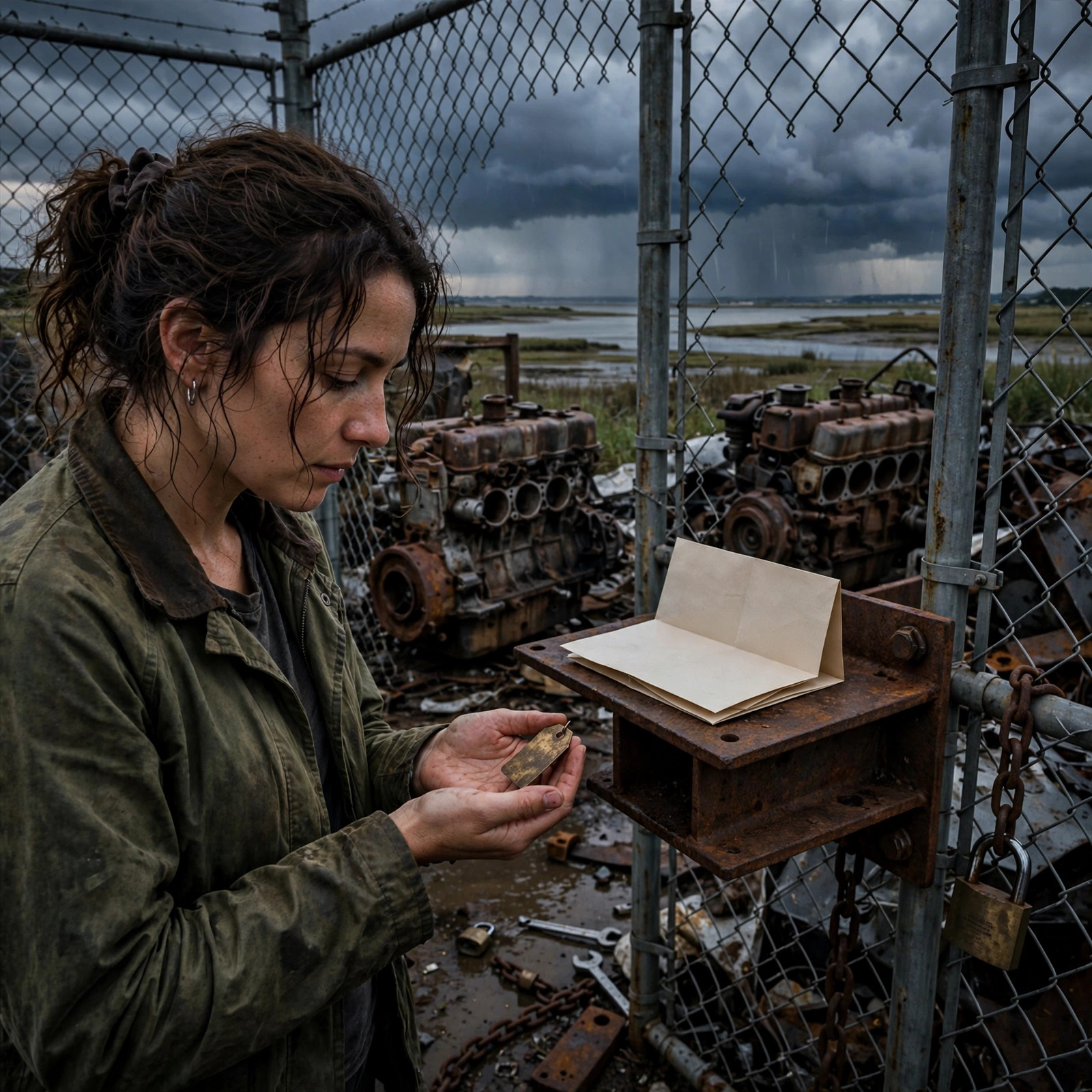
It stood at the far end of the scrap yard, chain-link, padlocked, the estuary authority's placard wired to it: CERTIFIED SURRENDER, DIESEL, NO SALVAGE. Minta drove the yard forklift with both engines slung, the starboard one salt-scoured through all four liners and worth nothing to anyone, which Yara had known for a month and had still somehow hoped otherwise, and the port one whole and greasy and forty seasons warm.
The injector pump came off the port engine on the bench, because it had to come off before the engine went over the wall, and it came off into Yara's own two hands, steel and brass, hand-lapped and pinned by her father on that same bench eleven years ago, a thing that had never in its life given a rough injection, and she unscrewed the little brass name tag from its casing, ALDOUS DELLING, MERROW FENN, and put it in her breast pocket where the ledger page had ridden the day before. Then she set the pump on the forklift tines herself, and Minta carried it to the cage, and Yara walked beside it with her hand on the brass, and did not take her hand off until the tines tipped.
"Say something," Dov said, behind her.
"He'd have charged the co-op double for the service call." Her voice came out rough and she let it. "He'd have loved this stack. He'd have had the coupling plate drawn up in a morning."
She signed the surrender manifest on Minta's clipboard, and the padlock went through the cage, and that was the end of forty years of Delling diesel, and the beginning of whatever the next forty were going to be called.
By four the surge had done its worst and moved up the coast, and the light came low and sideways through the rain into the shed, and on the bench the stack's first permanent mounting bracket lay in its bed of shims, waiting, the torque wrench on the bench where Minta had left it. Not the pilot mount. The real one, the one the inspection covered, the one that would hold for twenty seasons if she set it right tonight.
Dov took hold of the wrench body without asking, steadying it against the casing, and Yara set the socket, and the tag pressed small and hard against her chest wall as she leaned in.
"Seventy-four days," she said. "That's not the time we have left. That's the time we have."
"I'll be here for most of it," he said. "If that's agreeable."
"It's agreeable."
She pulled the wrench to the mark. It clicked. Behind them, on the sill under the shed window, her mother's discharge papers lay where Minta had set them, unsigned, the pen beside them, waiting on a woman who would only sign her way out of a hospital into a family that was still, at that moment, being built.
"Second bracket," Yara said, and put out her hand for the shim pack, and Dov was already opening it.
Get notified when new stories drop

Jonas Veld
Jonas covers human-AI futures and engineer problem-solvers: protocols, trust, and tools that expand human capability.
Leave a comment
Comments