





Ridge Gully
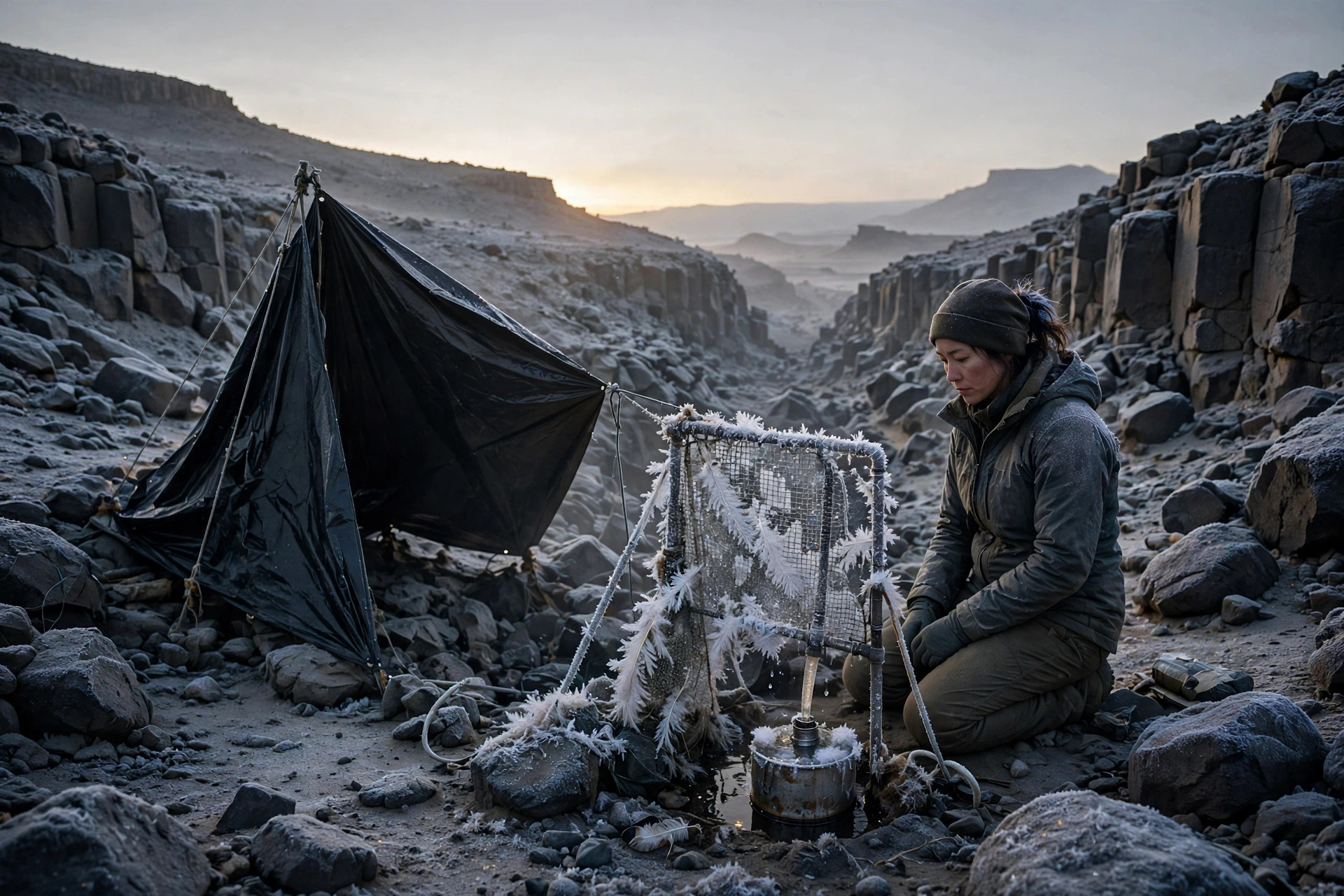
The pump was running dry again by the time Ivet reached it, and that was fine, because she liked the rig best when it was working and nobody could hear it working. The gully folded around the little machine like a cupped hand. From the ridge line, three hundred meters up, there was nothing to see but basalt and the black polyfilm edge of the sail, pinned low against the ground, sweating.
She knelt on the service plate and put her palm against the intake manifold. Cold, but not cold enough. The night frost had come down thin, and the sail had gathered what it could: a skin of ice feathers across the lower third, gone to melt in the insulated tank below. The tally gauge read 118 liters at last night's draw. Two short. Two liters under what she owed the basin.
She said a quiet word to the pump that it didn't deserve, unclipped the manifold cover, and scraped the ice build off the mesh with the back of her tungsten stylus. The mesh was the expensive part, the part she couldn't replace out here. Five years ago she had cut it from the heat shield of a scrapped lander, brazed the frame herself, and twice since then she had rebuilt the whole folding assembly when the seasonal cold cracked the joints. It ran on wind and patience. It ran on her, mostly.
One hundred and twenty liters a sol. That was the rig's honest number, the one she kept in her head and in no ledger anywhere. Under the colony's charter, every drop of frost caught in the Gritstone Basin belonged to the basin's common tanks, drawn out by allotment, counted on the record. Her rig had no allotment. It had no line in any book. It pulled water out of the air that the charter had already promised to somebody else, and for most of the last years Ivet had fed that shortfall back into the sick-bay tanks at night, a hundred and twenty liters at a time, so the numbers would close and nobody would ever have to know the rig existed.
She checked the pump seals, resealed the manifold, and keyed the wind vane loose so the sail could swing with the morning turn. The sail unfolded another half meter, film rippling, and caught the first grey light coming down the ridge.
The gauge settled. She tapped it once. One twenty, and the two liters from the night before still in the catch line, melting down.
Good enough.
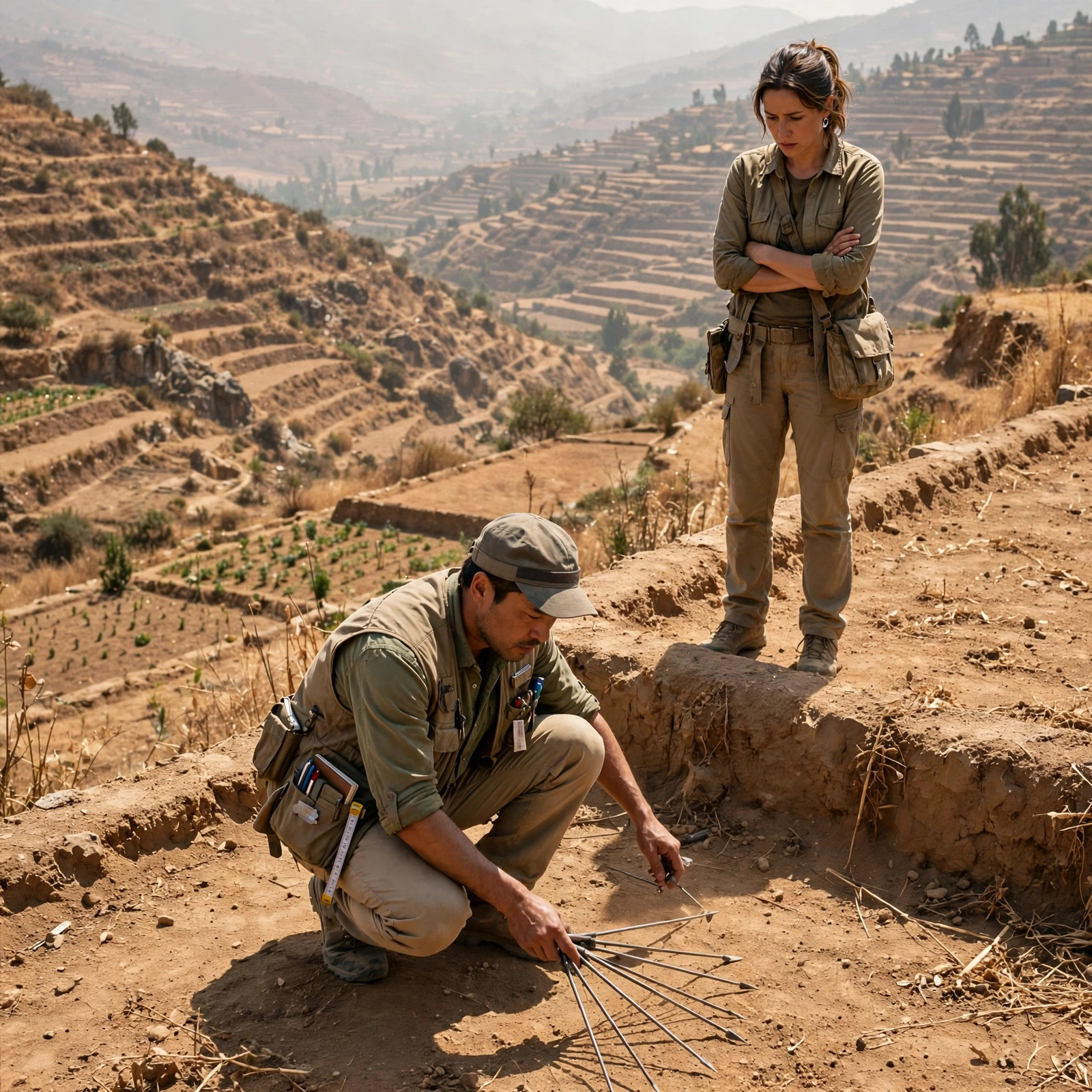
By full light she was up on the terraces, and Ebbe Koltar was already there, on his knees in row nine with his ground probes laid out in a fan across the grit like a dead metal flower.
"You're early," she said.
"You're later than me, which is the only comparison that matters." He didn't look up. He was easing a probe into the packed basalt at the row's edge, turning it a quarter-turn at a time. "Your film's darkening well on rows four through eight. One through three are thin."
"One through three get the least shade. It darkens slower."
"Or it's dying."
"It's not dying. I sprayed those rows myself."
"I know you did." He pulled the probe, read it, pulled the next. He kept his little field slate open beside his knee, and the numbers crawled across it as he worked. Ebbe had been surveying ground in this basin four years, longer than most, and he had a surveyor's flat way of saying bad news, the way a man reads out a distance. "Moisture at depth is holding. That's your film doing its work, drawing the frost down through the grit instead of letting it burn off at noon. In a few more years these rows won't need the frames."
"Thirty-eight more years," she said. "Give or take."
"Give or take." He moved down the row. "Assuming anyone lets the work finish."
She didn't answer that. She didn't have to. The whole terrace crew had been chewing on the same thing since the consortium's advance team walked into the basin with their sampler cases and their bright jackets, and their bright jackets were what most people remembered, because nobody out here wore anything you couldn't patch.
The Meld Terraces ran in long framed steps down the shoulder of the ridge, eleven rows of welded steel and basalt grit, each row darkened with the engineered film that the founding charter had committed them to: seed the dust, hold the soil, sweat the water downward, and in forty years have a basin that held its own. Ivet had been a steward on these terraces for six years. She had watched the films go from pale grey scum to this deep crust that drank the night frost and let nothing go at noon. Forty years was the honest figure, and the charter was signed in that honesty, seventy-four households' names cut into the plates by hand, most of those hands still living here, all of them patient.
Ebbe stopped. He set the probe down and turned his slate toward her, and she saw the two columns of figures he'd been keeping, his on the left, the consortium's on the right.
"Their published summary came down from the site office last night," he said. "Flash-vent the caprock, harvest the pressure and the water in one season, workable basin inside six years instead of forty. That's their claim."
"I heard the claim."
"Look at the two columns."
She looked. His figures came from his own probes, run over eleven months at his own expense, on the consortium's own dime for the access and nobody's for the interpretation. The left column showed a basin whose soil carried a deep night humidity, a frost catch that half the outlying households drew their lives from, well by shallow well. The right column, the consortium's, showed the same ground with sums that wouldn't reconcile against his. Not contradicted outright.
"That's not a rounding difference," she said.
"No."
"Did they mis-copy it? Off your feed?"
"Their site manager's own second survey has the numbers in it. I've seen the raw file. Haldus Frey's people ran the same probes I did. Deeper ones, better ones. Their summary just doesn't carry it." He closed the slate. He was quiet a moment, and then, in the flat voice: "I'll say it in the public meeting. When there is one."
"There'll be one."
"Today, there will be one. It was posted at the co-op hall before first light. Council's calling it a basin hearing, day five, full attendance asked, sealed record kept. All households invited." He paused on the word the way a man steps over a loose stone. "All chartered households invited."
She kept her hands moving, checking the frame welds on row nine, because if she stopped moving them they would have nowhere sensible to go. Chartered households. She knew the shape of that word as well as anyone in the basin, better than most. She knew that the co-op's book of advanced credit had a line in it with her name at the top, four thousand two hundred dollars drawn over three months of oxygen bottles and filtered water for Petar's lungs, and she knew the rule that came stitched to every line of that book: a debtor could not stand in a charter hearing, could not speak on the record, could not sign. The founders had written the rule to keep the water allotments from being voted away by people who'd been bought with their own credit. It had never once occurred to them that it would gag a woman standing exactly where the basin needed her, over her own brother's ruined air.
Eleven days. Petar had run the consortium's dry pilot shaft eleven days before the silica got into his airways far enough that no filter could reach it. She had the number by heart. The consortium had it in a different book, under a column called incidental exposure, with a settlement figure next to it that would have covered her debt twice over, and Petar had refused to sign the release, which meant nobody had signed it, which meant the credit line was still hers and the gag rule still stood.
"You've gone somewhere," Ebbe said.
"Day five. I'll be there."
He looked at her, really looked, and she thought he understood exactly which attendance she meant and which one she couldn't have, and that he was too decent to say it in the open air. He picked up his probes instead. "I'll want your terrace readings for the record. Yours, not the crew's. You count the night catch."
"I count the night catch," she said, which was truer than he knew, and not the kind of true she could put on any record.
She worked the terraces until the light went long and the shadows of the frames lay down across the rows like rungs of a ladder. She hauled grit, packed two of the nine empty frames, and sprayed nothing, because there was no film to spare for empty frames until the council freed the next batch, which the council would not do before the hearing.
At dusk she went down the ridge with two tank slung over her shoulder, walked past the co-op hall where the meeting notice hung bright on the board, DAY FIVE, SUNSET, ALL HOUSEHOLDS, and did not go in. She walked to the sick bay instead.
The feed tank on the bay's outer wall stood at three-quarters, which meant the day's draw had been heavy. Through the observation port she could see Petar's bed, second from the window, the oxygen line running from the ceiling, his chest going up and down with a slow, worked rhythm that no number in any book had ever captured.
She uncapped the feed port, set her own tank against it, and opened both valves. The water went over quiet, no splash, just the slow settling of one tank into another, her share into the common line, a hundred and twenty liters minus nothing. The gauge on the feed tank eased up toward full.
Through the port, Petar turned his head, and she thought he might be looking at her, and she found she didn't mind if he was. Let him think the co-op was generous. Let him think the numbers balanced by themselves. It was the one decent thing about a lie nobody had to hear: it worked in silence, in the cold, at the end of the day, and it asked nothing back.
She capped her empty tank, shouldered it, and walked out past the frost line.
Behind her, up in the fold of the gully, the sail stood open for the night, and the ice feathers were already starting on the mesh.
Co-op Hall
The hall filled from the doors inward, the way water fills a crack, and Ivet took the last bench against the back wall where a debtor could sit and listen and keep her mouth shut. Two days ago the notice had hung on the board. Now the board stood at the front beside a folding easel, and on the easel a projection plate threw Haldus Frey's cross-section of the basin against the whitewash: the caprock ice in pale blue, the boreholes as straight black lines, the basin reserve as a green wedge underneath it all.
"Good evening," Frey said. He said it without a microphone and made it carry. He was a big man gone soft across the shoulders, dressed in a site manager's plain coveralls, and he had the easy stillness of someone who had given this talk many times to many rooms that did not want to hear it. "I'll take forty minutes if you let me. Then I'll take questions until you're tired of asking them. Fair?"
Nobody said it wasn't fair. Ona Fetter sat at the clerk's table with the bound record plates in front of her, and when the room grumbled she rapped her stylus once against the table edge, and the grumble settled.
"You all know the argument," Frey said. "I'll make it anyway, because you deserve to hear it from me and not from a summary sheet." He tapped the plate, and the cross-section rotated. "Your charter commits this basin to a biofilm dust-seeding plan. Forty years. I've read your charter. It's a careful document. Forty years is what it costs to make this soil hold water on its own, and there are people in this room who will be dead before it's done. That's not a criticism. It's arithmetic."
Ivet watched the faces along the front rows. Some of them had come to be angry, and the anger was already having trouble finding a place to stand.
"The consortium proposes one harvest," Frey said. "We flash-vent the caprock. We crack it along the natural seams, we open it to the sky for a single season of warm days, and we collect what comes off as pressure and as water. It goes into tanks, it goes into turbines, it goes into your cisterns. After that the basin is a workable basin. Not a garden. Workable. Six years, with equipment and credit the consortium brings in at its own expense, and at the end of it you have wells instead of a waiting list."
"And the reserve," someone said from the middle rows. A terraceman, one of the Meld crews. "The green wedge. What happens to the green wedge?"
"Some of it goes down the boreholes. That's the honest answer." Frey didn't flinch off it. He let the plate hold still. "The flash-vent drops the pressure across the caprock, and the reserve seeks the low points, which is the bores. We estimate the draw over the harvest season and we've budgeted your charter's reserve figure against it. Your cisterns stay whole. The reserve thins. The reserve thins and then it stabilizes, because after the vent the frost catch rebuilds against open bedrock instead of sealed ice. You lose years off the slow plan. You keep the basin."
Ivet's hands were flat on her knees. She thought of the ice feathers on her mesh, thinning and thickening with the night humidity, and she did not raise her hand. She was not permitted to raise it. A debtor in this hall could speak in the public comment or not at all, and the public comment had been scheduled before the notice went up, which meant it had been scheduled without her.
Ebbe Koltar sat two rows ahead of her, on the aisle, with his probe folio on his knees. He had a way of listening with his chin down that made him look asleep until his fingers moved. His fingers moved now, tracing a figure against the folio's strap.
"Six years," Ona said from the clerk's table, "requires an amendment."
"It does," Frey said. "I know what it requires. I've read the charter and I've sat in rooms like this one on four worlds. I'm not here to route around it. I'm here to ask for it properly, on the record, in front of the keeper of the record." He nodded to Ona, and the nod had a weight of ceremony in it, and Ivet thought: he does this part sincerely. That was the worst of it. He was going to be reasonable all the way down.
Ona unclamped the canvas binding. The plates rang faintly as she turned them, anodized aluminum, scribed by hand, and she found the page she wanted by feel. "Founding consent," she read. "Seventy-four households, signatures in tungsten. Amendment clause." She ran the stylus down the scribed lines. "Any amendment to the plan of works requires the consent of two-thirds of the living signatory households, entered on the record plates by day's end of the council day. Fifty households. That's the number. Fifty of the seventy-four, living, on the record, or nothing changes."
"Which is why we've petitioned for a vote," Frey said, "and which is why the council set it for day nine, and which is why I'm standing here tonight instead of sending a summary sheet around with the freight. Two-thirds is a high bar. It should be. You built it high on purpose. I'm asking you to use it, not to trust me."
A woman stood near the front, one of the outlying homesteaders from past the frost line. "Question. The vent season. Three hundred days of open bores, you said at the last posting. What does the night air do while the bores are open? Our catch depends on the night air."
"The night air stays loaded," Frey said. "That's in the published summary, section four, humidity tables. The caprock doesn't drink the sky. It releases what it holds. Your frost catch keeps its baseline through the season. The numbers are in the summary and I'll sit with anyone after the hearing and walk through them line by line."
Ivet looked at the back of Ebbe's head. He didn't move. But his fingers had stopped on the folio strap, and she saw the small muscle along his jaw set, and she knew that face. She'd seen it two nights ago on the ridge, over the probe readings, when he'd said his figures disagreed with the summary and hadn't said how far.
The questions went on. An hour of them, then another half. Frey answered straight, every one, even the ones asked badly, even the one from the back row about whether the consortium would simply take the water and the pressure and leave, and Frey said, "We would. Contract terms bind us or they don't, and you should assume they don't unless the amendment writes them in. Write them in. I'd tell you to if I were sitting where you're sitting." That got a laugh out of the room, a low one, surprised at itself.
He was good. That was the thing she kept circling back to. He was good, and the plan was real, six years against forty, and forty was a number you could love and never live to spend. Her brother was thirty-four years old and on bottled air because eleven days of dry drilling had scarred him from the inside, and the consortium had offered him a settlement to sign away the word silica, and he had refused it, and the treatment credit had run against her future water allotment until it stood at four thousand two hundred dollars, and every dollar of it was a reason she could not stand up in this hall and say the one thing she knew that no one else had said yet.
The council called it. Three stewards at the long table, and the eldest of them stood and put the question of the freeze. "Pending the day-nine vote, all charter works in the Meld Terraces halt. Frames stand as they are. No film, no grit, no seeding. If the amendment fails, work resumes day nine with the backlog intact. If it carries, the terraces come down to make way for the wells." He looked along the rows. "Anyone who wants that different should have spoken in the public comment."
It carried on voices, mostly ayes, some noes, one abstention from the frost-line benches. Ona entered it on the plates, and the stylus scratched, and that was the sound of two years of her crew's work put on hold: nine frames empty of the eleven, the grit packed by hand, the film sprayed in rows, all of it waiting on a number, fifty of seventy-four.
The hall broke into knots of talk. Frey was surrounded at once, hands out, questions, and he took them one at a time, patient, and Ivet watched him be patient and thought about his raw file, the second survey, sitting in Ebbe's folio two rows ahead, and thought about what it might hold that a published summary did not.
Ebbe came back down the aisle instead of joining the knot. He sat down beside her without asking, which surprised her, and she didn't move over, which surprised her more.
"You counted," he said.
"I counted."
"Section four. The humidity tables." He kept his voice under the room's noise. "He said the night air stays loaded. That's a claim about a table. The table's in the summary. It's in the summary because the raw file's in my folio, and the raw file is forty days of readings, and the readings don't all say what the summary says." He looked at the plate glow on the whitewash, at the straight black boreholes. "I'm not calling him a liar. He may believe it. But the numbers I've got disagree with the numbers he handed out tonight, and I don't yet know which set survives daylight."
"Then don't say it in a hallway," she said.
"No. On the record. Day nine, if the council will seat me." He paused. "They'll seat you before me, you know. You're a charter steward."
"No," she said, and it came out level, which cost her. "I'm not. Not for this."
He looked at her properly then. She watched him work it, the way he worked a probe line, and she watched him decide not to ask, and she was grateful and a little sorry for it at the same time.
"Then you'd better read these before day nine," he said, and lifted the folio strap, and slid the folded survey sheets out, the raw second-survey printout, the numbers that disagreed, and put them in her hands. "Not the summary. Mine. Tell me if I'm crazy."
The paper was warm from his knee. She folded it once and put it inside her jacket, against her ribs.
Outside, the sunset was long and low across the basin floor, and the frost line was already silvering. A crewman from the council was nailing the freeze notice to the shed door beside the hall, four tacks, one at each corner, the sheet cracking in the windless air as he squared it. WORKS SUSPENDED, it said. PENDING THE DAY-NINE VOTE. The tacks went in with small bright sounds.
Ivet stood in the last of the light with the survey sheets against her ribs and watched the notice go up on the shed door, and did not go back inside, because inside there was a man answering every question well, and a table where a record was kept, and no seat at either for a woman four thousand two hundred dollars deep in her brother's breathing.
She walked home along the frost line. Behind her the hall's windows went yellow with lamplight and talk. Ahead of her, up in the fold of the gully, her unlicensed sail stood open for the night, and it would make its hundred and twenty liters in the dark without anyone's permission, and in the morning she would take Ebbe's numbers apart line by line and find out whether the basin's whole bright six-year promise had a hole in it that a careful man had failed to mention, or that a careful woman had.
Sick Bay Tanks
The cart came up the track before first light, and Ivet heard it before she saw it, the wheels knocking on the frozen ruts. She was at the sick bay door by the time it turned in, because a cart before dawn on the basin floor meant one thing, and she had been waiting eleven days for it to mean that thing.
Two drill hands she knew by sight carried the litter between them, and between them, on it, lay Petar. He had his mask on, the wide filter housing pressed to his face, and his eyes were open, and he turned his head to find her in the doorway light before the hands had even set the litter down.
“Don’t look so gray,” he said through the mask, and his voice came through flattened, tinny, the voice of a man talking from inside a tin can. “I made the whole ride.”
“You made the whole ride,” she said. “Sit him up gradual. His lungs don’t like lying flat.”
The nurse on shift was already turning the bed up. They moved him onto it with the practiced awkwardness of people who do it twice a year, and Petar gripped the rail himself and hauled the last of the way, which she noted, and was glad of, and did not say. His forearms were thinner. There was grit worked into the creases of his knuckles that would never wash out now, silica in the skin the way it was in the airways, a permanent record of the dry shaft he had run for eleven days with the company’s mask rated for dust, not for crystalline particulate at the concentrations the pilot bore produced. He had signed nothing. She remembered that with some pride at six in the morning in a sick bay doorway: he had signed nothing.
The oxygen lines came off the wall manifold, and the nurse opened the valve, and Petar took a long deliberate breath, and another, and his shoulders came down from around his ears.
“Better,” he said.
“Don’t talk yet,” said Ivet.
“Then stop asking me questions.”
The filtration rack in the corner coughed and started its cycle. That was the other sound the room made, besides him: the slow chuff of the rack that scrubbed the room air and, once it had scrubbed it, condensed what it pulled, because nothing in the basin was allowed to be wasted, not even a sick man’s breath. The condensate line ran out through the wall to the cisterns. Ivet knew the route the way she knew the route of every pipe in the settlement, better than she knew some people’s faces, and she watched the rack cycle and thought, not for the first time, that her brother’s breathing had a plumbing diagram now, and that she was four thousand two hundred dollars into it.
Ona Fetter came in at seven with the tally board under her arm.
“They told me at the hall,” she said. “How is he?”
“Breathing,” said Ivet.
“Good. That’s the whole of my job this morning, then.” Ona set the board down on the instrument table, flipped the cover, and began the day’s read the way she did every sixth morning, aloud, into the room, because the settlement’s rule was that water numbers belonged to everyone. “Basin cisterns at draw. Households on the slow plan, including this one now drawing for filtration and oxygen service. Sixty days off the reserve in the last tally week.” She said it flat and then she said it again, because it was the kind of number you said twice. “Sixty. That takes us to one hundred and fifty days of reserve. We were at two hundred and ten on Monday.”
The nurse stopped what she was doing with the rack. The drill hands, still in the doorway, looked at each other.
“That’s the shaft draw and the filtration together,” said Ona. “The pilot bore’s been pulling service water without a care in the world, and now the sick bay’s pulling too, and the cisterns can’t tell the difference between a drill string and a pair of lungs. Both of them just say give me more.” She penciled the figure. “I’ll post it at the hall by noon. People should see it next to what they signed up for.”
Petar pulled his mask aside a finger’s width, against the nurse’s policy, and said, “Post my name next to it if you like. It’s my draw. Sixty days for the town, I’ll take my two liters of it and owe the rest.”
“You’ll owe nothing,” said Ivet.
“You already owe it for me,” he said, and put the mask back, and looked at the ceiling, and that was the end of it, because he was right and both of them knew it, and arguing with a man on bottled air was a cruelty she wasn’t prepared to spend on.
The hall filled that evening in a way it hadn’t for any posted meeting in years. Word of the cart had gone around the settlement by midday, and word of the sixty days, and people came to the hall because they wanted to stand in a room with the numbers and see if the numbers flinched.
The founding record lay open on the long table, the plate stack turned to the petition leaves at the back, where a household could scribe itself onto a demand for a hearing. Ona kept the styli in a canvas roll and handed them out one at a time and took them back one at a time, and marked each plate as it was signed, in the tallies she kept in the margin.
Ivet stood at the side of the room, where the debtors stood, near the door, because the rule about who could stand and speak at a formal hearing did not prevent anyone from standing in a public hall, and this was a petition signing, not a hearing. She had checked that with Ona at noon, quietly, and Ona had said, “Petition’s open to anyone with a household mark. Even debtors. The founders wanted the angry ones able to write things down.”
So the families came. A woman who kept the east terraces came with her two grown sons and all three signed. The families from the outlying catchments came in a group, six of them, frost-catch people whose water came off the night air and not off the cisterns, and they signed, and one of them, an older man with a white stubble beard, said to the room at large, “We heard the company man say the night air stays as it is. We’d like that on a record somewhere, with figures under it, before anyone votes.”
“That’s what the petition asks,” said Ona. “A full hearing on the moisture figures. All of them, not the page four ones.” She did not look at Ivet when she said it, but Ivet felt the words go past her like a draft from an open flue.
By lamplight the count stood at nineteen new plates signed. Nineteen households in a single evening, which Ona said was more than the record had taken in any year since the founding. Seventy-four had signed the original plan. The petition leaves carried the marks of households who had watched a man come up the track on a litter with a tin voice, and had done their arithmetic.
Ivet carried one petition plate home herself, the last of the nineteen, signed by a family out past the north catchment fence who had asked her, as she left, whether the terraces would open again if the vote went the slow way. She said she believed so. She had the plate wrapped in a dry cloth under her arm, and she walked up the fold of the gully in the last blue of the evening, because the rig needed its evening check and she had not missed one in five years.
The sail stood open against the dark, polyfilm slack, already silvered along its lower third where the night frost was beginning to take. The tanks read low but honest. And there, crouched at the pump housing with a work lamp clipped to the frame, was Ebbe Koltar, with his sleeve rolled back and a driver in his hand, and the pump’s cover plate off beside his knee.
“You,” she said.
“Me,” he said. “Third bearing’s singing. It’s been singing for eleven days, I’d guess, which is a rude thing to say to a load that never stops. I packed it. Sit down, I’m nearly done.”
“You didn’t come up here to pack a bearing.”
“No,” he said. “I came up here to tell you I sent the retainer back.”
She stood still. The pump ticked over, quieter now. “The survey retainer. Theirs.”
“Their retainer. Signed it back to them this afternoon, unsigned by me, with a note saying my continued independent status was a matter of record. Frey took it well, in the way of a man taking it well, which is to say he thanked me and then said the door would stay open, and I said that was generous, and we both drank the coffee and nobody drank anything else.” He set the cover plate back and ran the bolts in with his fingers first, then the driver, and the pump note dropped to a low idle hum, and he sat back on his heels and looked up at her. “I can’t carry their figures and mine in the same head. They don’t fit. Something doesn’t balance in what’s been read to this town, and I’d rather be a poor surveyor who says so than a well-paid one who doesn’t.”
“It’s a living, Ebbe. A retainer is a living.”
“So’s this.” He nodded at the rig, at the sail, at the whole unlicensed arrangement of it, brazed salvage and handwire and frost. “Apparently.”
She laughed, and sat down on the tank plating beside him, and for a while neither of them said anything, and the frost built up the sail in the dark, and the pump turned, and the night came on cold and clear the way basin nights came, with the stars hard overhead and the settlement’s lamps small down the floor of the valley.
“Your numbers,” she said. “The ones you gave me. I went through them line by line last night.”
“And?”
“They’re right. I ran them twice. Whoever wrote the tables that got read out in the hall left things out. I don’t know yet whether it’s carelessness or a decision, but I know which one I’d bet on, and I know what day I intend to say it on.”
“Day nine,” he said.
“Day nine. If they’ll hear me. If they won’t hear me, then on the floor, in front of the plates, whether they will or not.”
“It’ll cost you,” he said. Not asking. A statement of arithmetic, like the water tallies. “Standing up out here, telling the truth about where your liters come from. You know what it costs to be heard in that hall.”
“I know to the dollar,” she said.
He put his hand over hers on the cold plating. Then, still looking at the sail and not at her, as if it were easier to do sideways, he leaned in and kissed her, and she let him, and after a moment she turned her hand under his so their palms met, rough to rough, two people with the same callus map.
When they drew apart the frost line had climbed the sail another handspan, silent, and the pump hummed under it all, working.
“You’ll want the rig running, then,” he said. “Whatever you decide to do with yourself.”
“I’ll want it running.” She took the wrapped plate out from under her arm, unwrapped the cloth, and looked at the last signature on the leaf in the lamplight, a name she could read upside down, and then she slid the plate into her jacket’s inner pocket, flat against her ribs where the survey sheets already lay, numbers against numbers. She tipped her head back and looked up the whole height of the open sail, silver and black against the stars, taking its hundred and twenty liters a night from an air that somebody in a hall had promised would never change, and she stayed looking at it while she did the sum of what it would take to make herself heard.
Council Floor
The trailer came down off the ridge in the dark before dawn on the eighth day, riding low on its springs, and Ivet walked beside it the whole way because there was no room to ride on top. She had stripped the condenser sail off its mast the night before and folded it flat, and the tanks rode empty and open, vent caps pulled, so nobody could say she was hauling water she hadn't paid for. One hundred and twenty liters a night for five years, give or take, minus what she had fed back through the sick-bay lines on the nights nobody was watching the meters. She had done that arithmetic at the kitchen table until the lamp burned low, and it had come out the way sums come out when you leave nothing out: she was short.
The co-op fuel dock sat at the edge of the settlement yard, and the duty attendant was a young man she knew by face and not by name, and he came out of the shack with his clipboard before her trailer cleared the gate.
"You can't leave that here," he said. "Dock's for fuel and co-op vehicles."
"It's not staying," Ivet said. "It's turning itself in."
He looked at the folded sail, the bare mast, the tanks with their caps off, and then at her, and she watched him arrive at it the way everyone in the settlement arrived at things, sideways, without wanting to say it. "You're the one out past the ridge. The night catch."
"I'm the one. Is Mrs. Fetter in the hall yet?"
"She's always in the hall before anybody. Go on. I'll mind the trailer."
"Don't mind it," she said. "Look at it. Write down what you see. Somebody's going to want it counted."
The hall was warm from the stove and empty except for Ona Fetter, who sat at the long table with the bound record in front of her, plates fanned, checking each leaf against a tally sheet, and she did not look up when the door swung, only when it latched. Then she did look up, and her face went through a short weather of its own.
"You're early," Ona said. "The hearing doesn't convene until evening."
"I'm not early for what I came for." Ivet put a folded paper on the table, and under it, flat, the wrapped plate she had carried for two days against her ribs. "I owe the co-op four thousand two hundred dollars in treatment credit. Advanced for my brother's lungs, drawn on my future water allotment. I'm here to pay it."
Ona unfolded the paper. It was a bill of transfer, hand-ruled, and it listed the condenser sail and its mast, the insulated tanks, the wind-driven pump with its new bearing, and the salvage stock beneath the dock tarp: braze rod, polyfilm offcuts, two drums of steel offcut, a spool of mesh wire. At the bottom, in Ivet's scribed hand, it said full and final.
"You built that rig out of a dead lander," Ona said. "Five years of nights."
"Five years of nights I didn't have leave to run. Price it fair and take it. I want the debt line zeroed before the hearing convenes, and I want it on the record, because a debtor can't stand on that floor and I intend to stand on that floor."
Ona set the paper down and squared its edges against the table, twice, the way she did when she was buying seconds. Then she said, "Sit down, Ivet."
"I'd rather…"
"Sit."
Ivet sat. Ona got up, walked the length of the stove room, came back, and stood over the record plates with both hands flat on the canvas binding.
"Two years ago," Ona said, "your draw started showing in the catch tallies. A hundred and twenty liters a night out of the frost line, no allotment on the books for it. I knew what it was. I'd walked the ridge myself, before your brother ever took that shaft job. I knew that rig better than you think."
"Then why didn't you…" Ivet stopped.
"Because I under-read it," Ona said. "In the ledgers. I carried your draw as line loss and pump drift, split across the outlying accounts, so the founding figures would balance at year-end. Two years of quarter-days, I signed those pages." She turned the record toward Ivet, to the tally leaves at the back, and there they were in her small even script: loss, drift, loss, drift. "If I put your true draw in, the shortfall comes out of the sick-bay reserve, and the sick-bay reserve was keeping your brother breathing. I chose. It wasn't mine to choose. When this is read out tonight, I'll hand the clerk's seal to the council and let them decide what I am."
Ivet looked at the leaves a long time. The stove ticked. Somewhere behind the wall, the settlement's day pumps came on.
"You cooked the books to keep my brother on bottled air," Ivet said. "I stole the water you cooked them over. We're a matched set, Mrs. Fetter."
"We're a poor set," Ona said. "But the plates are true where it counts, and tonight that has to be enough." She pulled a fresh leaf from the drawer, wrote the transfer in full, and pushed it across with a stylus. "Sign. Then it's zero, and you can stand."
Ivet signed. Ona stamped it, and the debt line in the co-op book ran a line through four thousand two hundred and wrote, beneath it, nothing at all.
By evening the hall was full past the benches, and the stove ran hot, and Petar sat propped near the door on a camp chair with a filter line over his ears and a hand-held tally plate he kept thumbing, wanting to count the vote himself. He had refused to stay home. Frey sat at the guest table with the company's published tables stacked and squared, and he looked, Ivet thought, less like a man selling something than a man waiting for a delivery he already knew the weight of.
The amendment was read first, all of it, the flash-vent of the caprock ice, the single harvest of pressure and water, the promise of a workable basin in six years. Then the clerk's office read the founding record: seventy-four plates, seventy-four names, forty years for the biofilm to hold the soil on its own. Then Ona Fetter stood, and instead of reading the tally she said, plainly, what she had done for two years and what it had cost, and set her seal on the table in front of the council, and the hall got very quiet, and a few people looked at Ivet, and Ivet stood up and said, "The rig's on the dock, stripped, and the shortfall's been fed back through the sick-bay lines since it started. Price my salvage against my debt. It's paid tonight."
The chair let her have the floor after that, and she gave most of it away immediately. "Ebbe Koltar has the figures. Independent probe, company retainer returned. He's read the raw survey. I'd rather you heard it from him than from me, because I'm a debtor who paid tonight and he's a surveyor with nothing in it either way."
Ebbe came up with the raw file loose in one hand and his own probe sheets in the other, and he didn't read from his own work first. He read from Frey's.
"Second survey, section three, night humidity over the frost catch," Ebbe said. "It's in your own file, Mr. Frey. Three seasons of draw down the boreholes after the vent, before the cap reseals. Your published tables, the ones read out in this hall on day five, carry the humidity column at baseline. It isn't baseline. Your own instruments wrote it down and your own pages left it out."
Frey sat still for a moment. Then he pulled the top stack toward himself and turned pages, unhurried, until he found the place, and read it silently, and Ivet watched him read it, and what crossed his face was not guilt. It was arithmetic.
"The humidity column," Frey said at last, "was outside the scope I was paid to certify."
"It's inside the scope of the frost catch," Ebbe said. "Half the outlying families drink out of that catch. You know that, because your surveyors bunked with two of them."
The hall began to talk all at once, and the chair let it run, and Petar thumbed his tally plate and watched the benches. It took two hours to get through the speaking, and eleven o'clock had gone by before the chair called the plates forward.
The founding rule needed fifty of the seventy-four living names, and the amendment had carried forty-five of them by petition before the hearing ever opened. Ivet counted the crossings as they came, because counting was what she was good at. A family from the east terraces, whose plate had been signed to the fast plan at the co-op's table on day five, walked up and asked Ona, formally, to strike their mark from the amendment and re-enter it on the counter: funding the terraces, holding the caprock sealed, the reserve kept whole. Then a second. Then a third from out along the frost line who had been drinking, Ivet knew, off the catch the humidity column would have taken. By the fifth crossing, Frey had risen and stood at the back with his jacket on. By the eighth, the amendment was dead past any petition, and the counter carried ninety-one, and then a hundred and one, read out plate by plate, each name said aloud, the hall answering each one with its weight of voices.
The chair called it past midnight. Defeated, the fast plan; carried, the counter. Terraces to reopen at first light, the freeze lifted, the array to be extended over the frames that had stood half-built since day five.
People came up to the guest table while the plates were being re-bound. Petar reached Ivet first and put his forehead against her shoulder, filter line and all, and said nothing, which from him was a great deal. Ona was already gone from the clerk's bench; someone else had the tally.
Frey came last. He put out his hand, and Ivet took it, callus to callus.
"You paid four thousand two hundred dollars and a rig to stand on that floor," he said. "I'd want to know what it bought you, if it were me."
"A hearing where the humidity column got read out loud," she said. "That's all it bought. The rest of it you watched."
He nodded, and looked past her to the door, where through the glass the dock lamps burned over her stripped trailer with its folded sail, the mast lying lashed along the tongue, the whole night's catch of it waiting to be priced and carried off.
"I've got nine rigs on the manifest and a crew of drill hands who need lungs that hold," Frey said. "The company folds the basin file in the morning. So tell me, Mrs. Sarno. What are my rigs good for now?"
Ivet looked at him, and then out at the trailer, and did the sum standing, the way she did all her sums.
"Come to the terraces at first light," she said. "Bring the drill hands. We're mounting frames, and everything out there is lifted and packed by hand."
Twenty Rows
First light on day ten came up the basin the way it always did, thin and sideways, and Ivet was on the terraces before it finished arriving. The frost was still on the frames, gray-white and even, and she put her palm against the steel of row one and felt the cold bite in and knew the night had been a good one for catching. Behind her, down the haul road, she heard the compressor trucks before she saw them, and then she saw them: four of Frey's machines, washed and flagged with co-op tape at the fenders, rolling up under the renegotiated terms that Ebbe had drafted twice and the council had stamped once, at some hour she had slept through.
Petar came up the road on foot, slow, with his mask hung loose around his neck instead of sealed to his face. He carried the bolt pail in both hands, and he stopped every thirty meters or so to stand and breathe, and she let him set the pace and did not go to him, because he had asked her not to, twice, at breakfast. He could do an hour now without the bottle. An hour, unassisted, breathing basin air that eleven days of dry shaft had nearly taken from him for good. He walked and he breathed and he carried the pail, and that was the whole morning's argument against the fast-crack, walking upright in front of her.
Ona was already at the frames of row six when Ivet reached the working spread. She had no seal and no stand now, and she had shown up at dawn with work gloves and a stool and taken a place in the grit line without asking anyone for one. Her hands moved through the basalt dust the same way they had moved through ledgers, quick and exact, packing the beds flat. She did not look up when Ivet came near. She looked at the bed instead.
"You're crowding the film rows," Ona said. "Sloppy."
"You're packing them like you're balancing me," Ivet said. "Leave a hand's width."
"A hand's width." Ona did it, and left the gap, and then, after a moment, still not looking up: "The new plates need a keeper. The chair asked me to keep them, and I told her I'd do it, but I told her I'd do it from the benches and the dirt, not from behind a stand. She'll have to decide if that counts." She pressed a line of grit flat with the edge of her palm. "Two years of soft numbers, and the fix is forty years of hard ones. I did the arithmetic on the walk up. I'll be dead before row twenty holds on its own."
"You'll be dead before it holds on its own," Ivet agreed, "and the film will still be there."
"That's the whole trade, isn't it." Ona pressed the last of her section flat and moved down the bed. "All right."
By mid-morning the terraces had their full crew, and the terraces were loud with it, in the way the basin was loud, which was to say the sound carried flat and dry over the grit and the machines. Frey's compressor crew had set their machines at the terrace head and were pushing chilled lines down between the rows, under the new terms: their power, their hands, their borehole discipline pointed at holding water in instead of tearing it out. Frey himself worked the line head in a collarless coat, directing the drops, and twice Ivet watched him stop his own people and make them re-seat a coupling because the seat was proud of its mark by half a millimeter. She went over on the second one.
"You're checking them like they're going into your own ground," she said.
"They're going into my ground now," Frey said. He didn't look up from the coupling. "Renegotiated. My people eat while your film grows, and in six years, when the beds start holding, we're the ones who get to say we built the thing that made this basin worth keeping. My reading of that is better than the reading I'd have taken home." He straightened and wiped his hands down his coat. "Where's my condenser, rogue?"
"Co-op property now," she said. "Boarded at the fuel dock since day eight."
"Then where's the co-op's condenser, steward?"
"Tarp side of the dock. Come on."
The rig came up the haul road on the flatbed at noon, and half the terrace crew stopped working to watch it arrive, which annoyed the forewoman and which nobody paid attention to. Five years of quiet nights in the ridge gully, and now the thing was coming home in daylight with a ribbon of co-op tape across the sail, out in the open where the whole basin could see what it was and what it had cost. Ebbe rode the flatbed with it, one hand on the tank strap, and jumped down before the wheels stopped turning.
"Pump bearing's holding," he said as he came to her. "I packed it again last night. She'll run sweet."
"You packed it twice in four days."
"I like that pump." He said it plainly, and she laughed for the first time since the vote, a short cracked sound, and he grinned at it like he'd earned something.
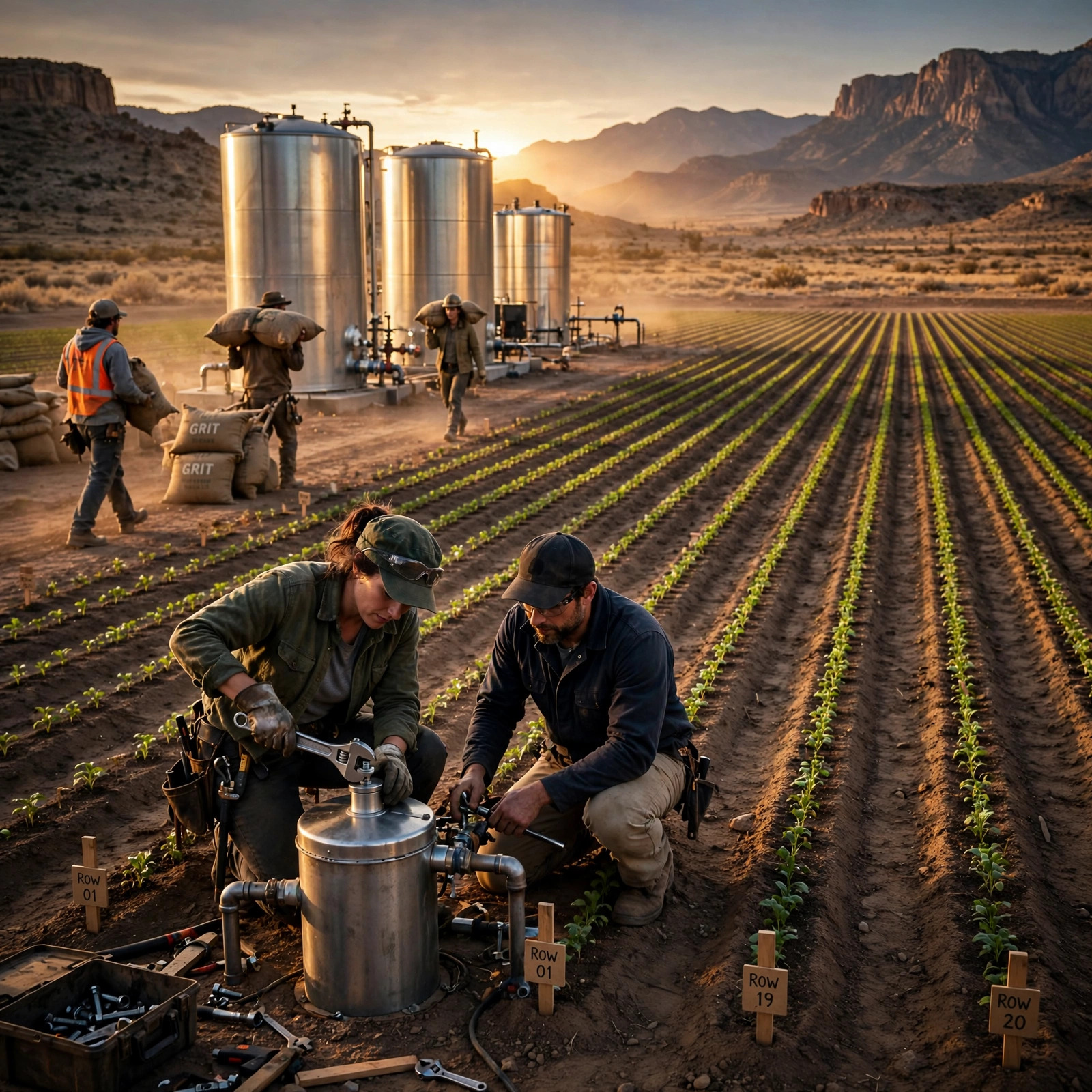
The mount went at the head of the array, over rows one through twenty, and it was Petar's hour off the bottle, and he was there for it. He couldn't hold the sail frame overhead, so they gave him the bolts and the driver and a stool at the mast flange, and he handed up, and Ebbe and one of Frey's compressor hands took the weight, and Ivet set the fittings. The sail went up folding and locking, the polyfilm snapping flat and pale against a sky that had no weather in it, only light. From below it looked like it had always looked to her at night, a wide patient hand held open to the dark, except that now it stood over the beds it would feed, catching the night's thin freight of water and sweating it downward into twenty rows of engineered crust instead of hauling it into tanks for the sick bay.
"She used to steal for you," Petar said, handing up the next bolt. He was breathing in short pulls, and he kept his eyes on the flange. "Now she's going to work for everybody. That's a promotion."
"Don't let the co-op hear you call it stealing," Ivet said. "They've got a whole hearing's worth of paperwork that says it was a donation."
"It was a donation. I was the donation." He found the next bolt by feel in the pail. "Eleven days at that shaft bought my lungs a place in the ledger. Yours bought the rig into the light. We're both on the record now." He passed the bolt up, and then he steadied himself with one hand flat on the frame, breathing, and nobody reached for him and nobody made a move toward the bottle on the cart, and after eight pulls of air he was all right, and he went on handing up.
The afternoon went long, and the light went long with it, the way basin light did, stretching shadows out from the frames until every row had its own thin fence of shade. The crew seeded by hand through the dust hours, row after row, the film sprayed in dark lines and covered against the dry wind with grit, and the grit pressed flat by palms and plates, and the compressor lines bled cold into the beds between the rows. Ebbe walked the array twice with his level and once with his notebook, and came back and told Ivet that rows one through eleven were holding grade and twelve through twenty were close enough to be honest about.
"Honest how?" Frey asked. He'd come over with a wrench in his back pocket and his coat off, folded over the frame of row fifteen.
"Half a degree of fall to the east," Ebbe said. "The film doesn't care. The water will find it."
"Then we'll re-grade in the second season," Frey said, and wrote it in his own book, in the same careful hand he'd used for eleven years of company reports, and Ivet watched him do it and said nothing, because there was nothing left to say that the writing didn't already say.
The tally came at dusk. Ona read it, standing in the open, from a slate she'd carried up herself, because she had decided she would keep reading numbers to people even if no stand would hold her.
"Reserve stands at one hundred and ninety days," she read out, "and climbing. The condenser cap added forty days to the tally in its first day of work, and the sick bay drew less than it added, which I have not been able to say in two years." She lowered the slate. People on the terraces did not cheer. They did what the hall had done at midnight, took one long breath together and went back to work.
Ivet worked on into the dark with the last tie-downs, because the cap had to be screwed home before the cold came down, and the crew had thinned to a dozen and Petar was back on the bottle, sitting wrapped on a crate at the head of row one, and Ebbe held the light for her. The screws went in hard, the way everything on the terraces went, by hand and against resistance. Her arms ached from the day and grit had worked in under her gloves at the wrists and made a paste of sweat and dust in the creases of her fingers, and she drove the last tie-down at the cap's north corner and felt it bite and hold.
Then she sat back on her heels and looked down the array.
Twenty rows ran away from her under the low light, dark lines of sprayed film between flat-packed beds of grit, and at the corners of row twenty, where the cold came first, the film had gone dark green. Not the black-green of the mature beds from the old country reels, but green, real green, working green, the color of a crust that had decided to live where it stood. She looked at it a long time. Around her people were still coughing, the basin cough, the dust cough, every one of them, and still working, and Petar on his crate was laughing at something one of the compressor hands had said, and Ona was down the rows with a lamp re-checking the grade on twelve, and Frey's trucks ticked as they cooled at the head, and the cap above her was open to the night, and the first of the night's cold was already forming on the polyfilm, fine and even, waiting to be caught.
Ivet put her palm flat on the last tie-down, testing it, and left her hand there, and the green at the corners of row twenty went on going green, and she let it.
Get notified when new stories drop

Ren Hollis
Ren writes frontier worlds and terraforming triumphs — habitats, gardens under glass, and the first rain on a new world.
Leave a comment
Comments