


The Token Board
The transmit lamp was still green when Ilma Varga decided to send the question, which meant the lattice would hear it in forty minutes, and she would hear whatever it thought about it eighty minutes after that. She had learned to plan her whole day around that rhythm the way farmers once planned around weather. Send at 06:40, answer by 08:00. Drink tea while the light crawled.
She keyed the sequence anyway: eleven tones, stacked in the paired intervals the lattice preferred, carrying the concept she had been circling for six weeks. Before, she sent, and then, in the grammar they had built tone by tone, a thing that comes before and is not seen.
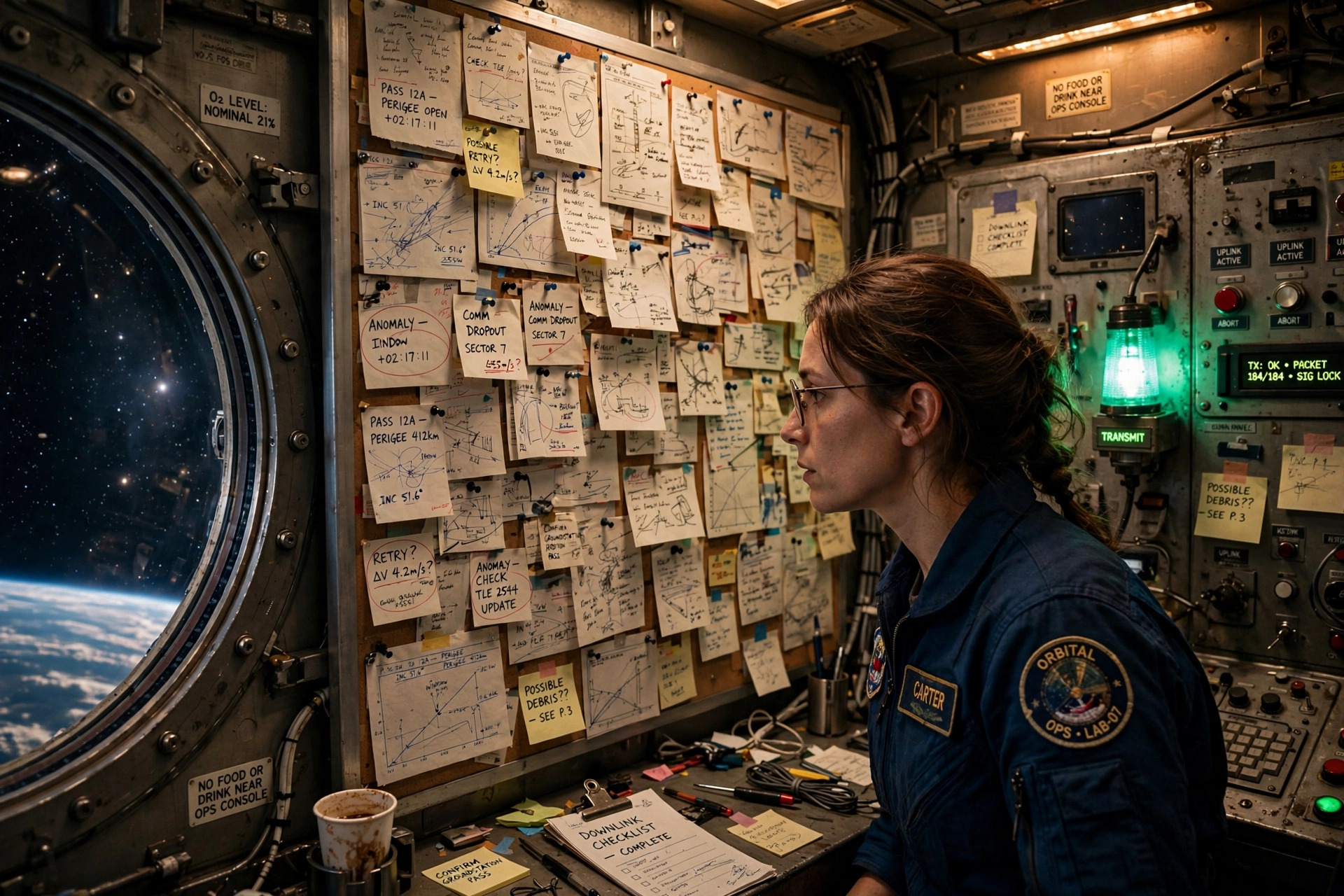
The board behind her held the record of that grammar. Paper printouts, hand-annotated, pinned to a steel frame with a hundred and seventy-nine small pins. A hundred and seventy-nine tokens, each one a paired tone the lattice had echoed back with the same shape Ilma had sent, or close enough that she could tell it had understood and was answering, not parroting. Two years of her life hung on that board in rows that had long since outgrown the first frame. The second frame was bolted to the first, and the third to the second.
Corrin Alas came through the lab hatch with a clipboard, which was never a good sign. "Ascend's tender is four kilometers out and closing," she said. "Reeve's aboard. He's asking for you specifically, which I'd normally charge extra for."
"He's early."
"He's the commander of a Kestrel-class survey frigate, and from what I hear, he's been early to everything since he was a cadet." Corrin set the clipboard down on the rack beside the transmitter. "Also, I finished the tuning sheet."
She slid a single sheet out from under the clipboard's clamp. Columns of figures, laser-tuned frequencies, the preferred resonance intervals of the lattice copied down in Corrin's square handwriting. Ilma knew what it was for before she touched it. On the rack below the transmitter console, wrapped in shock film, sat the resonator bar itself, a length of doped quartz Corrin had grown in the station kiln two years back and tuned to the day the lattice liked best. A human-made crystal, cut to speak in the Bell's own voice.
"For the bar," Corrin said. "When you want it. If you want it. It's been sitting in that film doing nothing since the year we made it, and honestly it's starting to make me feel guilty, like a piano nobody plays."
Ilma took the sheet, looked at the top line, and handed it back. "Not yet."
"It's a tuning sheet, Ilma, not a marriage proposal."
"It's a gift, and it isn't one yet." Ilma turned back to the console. "A gift is a thing you give because the other one can receive it. We don't know what it can receive. We know a hundred and seventy-nine tokens. That's not the same." She softened it the way she had learned to, which was to pick up Corrin's coffee mug and hand it back to her, a small human gesture in trade. "Keep the sheet with the bar. When it's a gift, you'll be the first to know."
Corrin took her mug and her clipboard. "He'll be docked in twenty minutes. I'd comb your hair, but that ship has sailed."
Ilma listened to the transmit lamp. It went dark at 06:41, on schedule, when the last tone left the big dish on the station's spine and began the long fall toward the Bell.
Dane Reeve did not come to the lab first. He came to the observation gallery, where the Bell itself hung in the black like a held note: an ice planetesimal in the outer system, forty light-minutes out, big enough to have a personality and small enough that no one had ever bothered to give it a better name. Ilma found him there with his hands behind his back, reading the long-range display as though grading it.
"Doctor Varga." He didn't turn. "I've read two years of your transcripts on the way out. All of them."
"Then you've read a hundred and seventy-nine sentences," Ilma said, "and you know more than most people in the admiralty, which I understand is not the same as knowing much."
"It's not." Now he turned. He was fifty-one if the personnel file was honest, and the file usually was, and he had the particular patience of a man who had spent nineteen years making survey vessels answer his questions. "Here's what I have, Doctor. I have an iceball with a crystal lattice in it that hums back at us when your team hums at it. I have a hundred and seventy-nine agreed noises. I have no assessment of its interior, no map of its structure, no idea whether that lattice runs a meter deep or a thousand. And I have an admiralty that will not keep funding a conversation indefinitely on the promise that it might someday be a conversation."
"The tokens are not noises."
"On paper they're not. On the scope they are. I've seen the raw traces." He let that sit. "So here's my standing order, and I'll log it whether you like it or not, but I'd rather log it with you standing next to me."
Ilma folded her arms. "Say it."
"On day fifteen, Ascend runs a deep sounding sweep across the grove field. Full spectrum. We map that lattice decisively, top to bottom, and I go home with an interior survey the admiralty can actually evaluate. One sweep, one day, and this station stops being a curiosity and starts being a charted object."
The cold in Ilma's chest was older than the words. She had written three memos anticipating sentences shaped exactly like them, and had been told each time that the response was under review. Apparently review had arrived on a frigate.
"Commander, the lattice answers in narrowband resonance tones. Six groves on the surface, grown, not built, each one a transmitter it made itself. It has never once sent anything we did not first teach or demonstrate. That is a mind that learned a language in pairs, over two years, without a single shared referent except the tones themselves. A sounding sweep is not a camera to that kind of mind. A sweep is a scream."
"A sweep," Reeve said evenly, "is a measurement."
"A measurement it cannot answer in grammar. It answers in resonance or it doesn't answer. You put a kilometer of broadband energy through that ice and you will get a map, and the map will be of something that has stopped talking." She kept her voice level, which took work. "You'll have your chart, Commander. And it will be the chart of a corpse."
"That's a strong claim from someone who admits she doesn't know how deep it goes."
"It's a claim from the only person who has ever heard it answer."
They looked at each other for a moment. Reeve was not a stupid man; that was the trouble. His objection was reasonable and his patience was real, and both of those made him harder to move than any blunt instrument she had argued with from the safety of memos.
"Day fifteen," he said. "Fourteen days from now. That's not nothing, Doctor. If your lattice has something to say in fourteen days that changes my assessment, my receiver's open. That's the most standing order I'm allowed to be." He nodded once, down the gallery, toward the station board where the operations schedule glowed. "Log it."
The sweep went onto the board at 09:20, station time, in the operational white that meant scheduled and certain: Day 15, 08:00, deep sounding sweep, grove field, Ascend. Ilma watched the entry post with her hands at her sides. Fourteen days. She had been given fourteen days to teach a crystal the one sentence that would keep a frigate quiet.
She was back at the console at 08:03, when the answer window opened.
It came the way the answers always came, as paired intervals rising out of the noise floor, and Corrin stood behind her with her arms crossed while the decoder stacked the tones into shapes. The lattice had taken her question, a thing that comes before and is not seen, and answered with a construct Ilma had never sent it: a negated pair, then a repetition of her own question tones, then a closing interval that in their shared grammar marked completion. The unseen before is not the unseen after. Or, more simply: it had taken her phrase and made a new one with it, in valid grammar, on the first try.
Ilma sat very still.
"What?" Corrin leaned in. "What is it?"
"It coined." Ilma reached for a blank card and a pin. "It took token one hundred and sixty-two and the before-phrase and it made a negation out of them. That's not echo. That's composition." Her hand was not quite its usual steadiness as she wrote the gloss in her small hand and pinned it to the end of the last row. A hundred and eightieth card. The pin went in with a small sound that the whole lab seemed to hear.
"So it's a person," Corrin said.
"It's a grammar," Ilma said. "A person is what I'm hoping for."
She sent the confirmation pair immediately, so it would cross the gap before she lost her nerve, and then there was nothing to do for eighty minutes but not pace, which she failed at, and not count the cards, which she also failed at. A hundred and eighty. Two years for the first hundred and seventy-nine. Fourteen days left, and a frigate with a schedule.
The confirmation came back at 09:55, matching interval for interval. Token one-eighty was real in both directions.
Reeve did not come to the lab for that. She had not expected him to. He sent one line to her queue instead: Noted. Fourteen days. Which was fair, in its way, and felt like a hand resting on the back of her neck.
The lab emptied the way it did every night, Corrin last, pausing at the rack where the resonator bar lay in its shock film with the tuning sheet clipped to the film's edge, exactly where Ilma had told her to keep it. "You could try it," Corrin said from the hatch. "A bar tuned to its favorite intervals. It might like it. It might answer faster."
"It might," Ilma agreed. "And if it answers my gift before it understands my grammar, we've taught it that we shout. I'm not teaching it that." She nodded toward the board. "A hundred and eighty cards, Corrin. Every one of them asked for and answered. That's the only instrument I trust."
Corrin left. The transmit lamp was dark. The station board glowed down the corridor with day fifteen on it in operational white, fourteen days out and counting, and Ilma stood alone in the lab between the two things she had built her life around: the token board, pinned and patient, and the resonator bar, racked and unused, still waiting to be worth giving.
She took the gloss card for one-eighty between two fingers and straightened it on its pin until it hung level with the row. Then she wrote the day's log entry, longhand, because some things deserved ink: It composed. Ask again tomorrow.
Forty Minutes
On the morning of day six, Ilma arrived at the lab before the lamps had finished their warm-up sweep and found Reeve already seated at the console, which was his way of arriving anywhere: first, and settled.
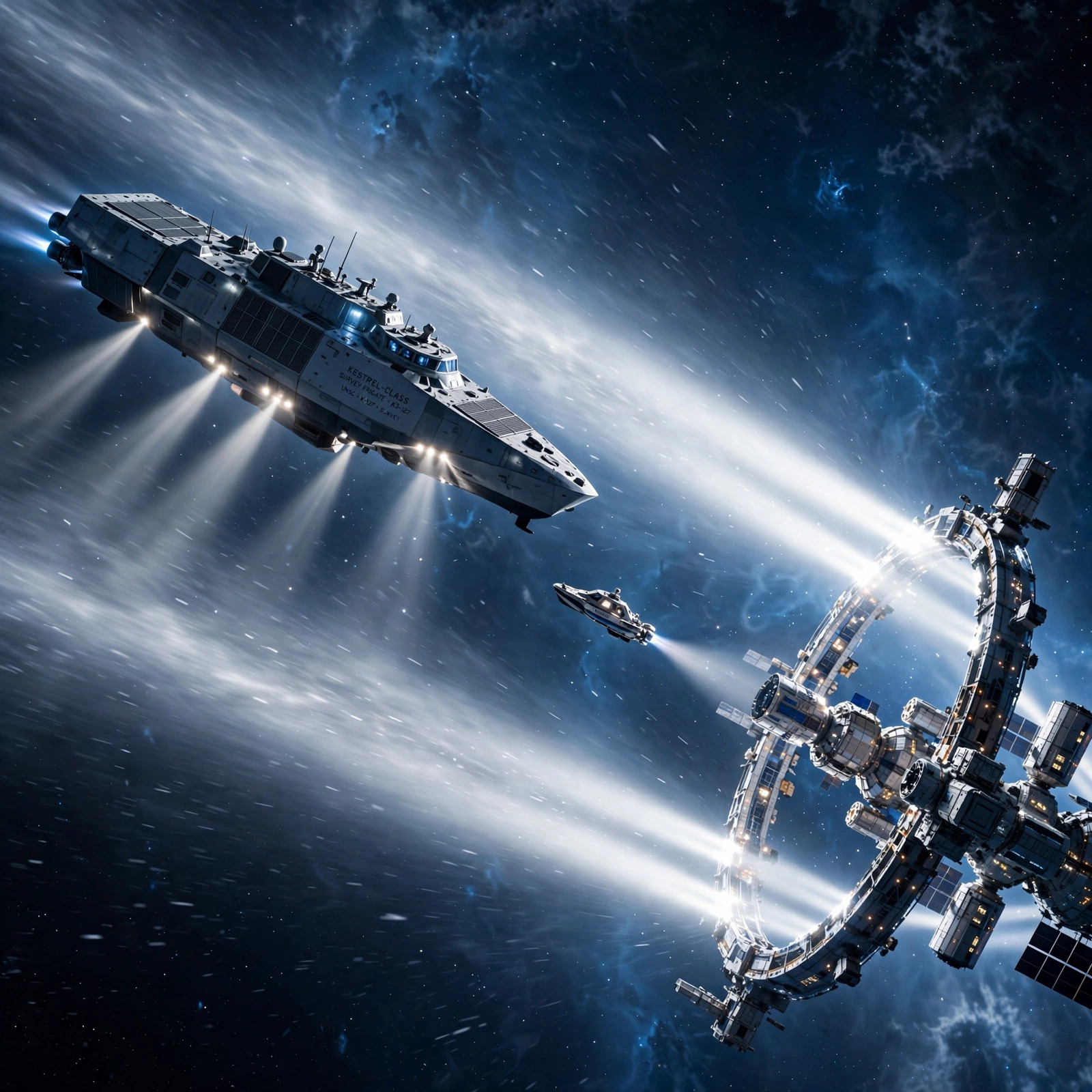
"Your assessment was due today," he said. Not an accusation. A calendar item, read aloud.
"It's on your queue."
"I read it. 'Contact is real, reciprocal, and fragile.' That's a poem, Varga. My admiralty wants a survey. I want to give them one thing they can hold in their hands." He tapped the console edge. "Today I'm sending a calibration burn and a ranging question. Standard stuff. The lattice can carry it in your grammar, since you tell me it answers questions."
"It answers the questions it has words for. There are a hundred and eighty of them."
"Then phrase it in those."
She could have argued. She had argued, on day one, and lost, and known she would lose, because two years of careful exchange weighed less with his command than a single sheet of figures that weighed nothing at all. So she composed the ranging question out of tokens she had: distance, measure, deep, again. It was honest. It was also, she knew as she keyed it, a question about the interior, and the interior was the thing his sweep wanted to crack open like a nut.
The transmission left the dish at 08:12 station time. Then the part she had never gotten used to in eleven years of this work, and never would: the wait. Forty minutes for the signal to crawl out to the Bell, where Nori's tender held station two kilometers off the grove field, relaying down to the ice. Then the lattice had to be given time, because it answered in its own time. Then forty minutes back.
"Every conversation with this thing is a monologue with a delay," Reeve said.
"Every conversation with anyone at that distance is."
"I've run comm watches longer than you've held this post, Varga. Don't lecture me on lag."
She let it go. Corrin arrived nine minutes later with tea and a tuning wand she had no reason to carry, which meant she had come to watch, and the three of them sat with the return clock while the station turned its slow maintenance turns around them.
At 09:47 the lamp went green. Answer started coming home.
Ilma read it as it scrolled, and within four lines she stopped drinking her tea.
The lattice had taken the ranging question, and answered it. The intervals were correct. The tokens were correct. Measure, deep, again. It confirmed the depth figure she had taught it two years ago, the one Nori's soundings had put within a few metres. All of that was fine. All of that was grammar.
Then it repeated the answer. The same four tokens, the same tones, the same paired intervals. And again. A fifth time. A sixth. Six identical lines, and then, appended to the last one, a sequence she had never seen: again, again, again, three repetitions of the repetition token itself, in ascending register.
"What is that?" Reeve asked.
"I don't know yet."
"You don't know. Two years. A hundred and eighty words. And it sends you gibberish the one time my fleet asks it a straight question."
"It isn't gibberish. It's well-formed. It's just…" she moved her hand over the scroll, uselessly, "—redundant. It has never repeated itself like this. Repetition in this grammar has always meant emphasis. Six identical answers is six emphases."
"Or it's stalling," Reeve said. "Or it's padding the reply so the ranging data is buried in noise. You told me yourself it has never once transmitted anything you didn't teach it first. So it can't lie to us. Fine. Then it can be taught to hide things, and someone taught it, or it learned, and either way I'm looking at a system that answers my fleet with a wall of identical noise."
"That's not what repetition does."
"You don't know what repetition does. You just said so."
The room went quiet in the way it did when both of them were right. Corrin set her tuning wand down on the console rim, deliberately, where they could all see it.
"Ask it," Corrin said. "Ask it what the repetition means."
"With what words?" Ilma pulled her chair to the board. "I have again. I have answer. I have question. I can ask question: again, and then wait eighty minutes to find out whether it understood me, and another eighty to correct whatever I got wrong."
"So ask," Reeve said. "That's the job, isn't it."
She composed it three times before she sent anything. Question: answer, again, why. Why was token forty-one, one of the earliest, one of the hardest, and she hated using it because the lattice's answers to why had a way of being true and useless at once. She sent the cleanest version she had and watched the clock start over.
Forty minutes out. Time to think. Time for Nori's tender to relay it down through the grove field, six groves, six voices, and for whatever lived in the ice to do whatever it did with her small careful sounds.
Forty minutes back.
Reeve spent the first twenty of them reading her transcripts, all two years of them, at speed, which she had not known a person could do. He spent the second twenty watching the clock with his arms folded.
"While we wait," he said, "I'll tell you where things stand. The sweep is locked for day fifteen. My tender begins emplacement runs this evening. Charge goes out on the next window after that."
"Emplacement. You're already placing the sounding charge."
"I'm placing a survey instrument, at depth, per a standing order I logged on day one, which you read. I'm not waiting on a reply that may come back as six copies of the same sentence."
"Then don't fire it early," she said. "Day fifteen. Not before. If you fire while we're mid-exchange…"
"I know ballistics, Varga. The pulse is local to the grove field. Nothing crosses your light gap. Your console and my tender don't even share a simultaneity worth the name."
"I'm not worried about the console."
"No," Reeve said. "You're worried about the ice."
He was not cruel about it. That was the hard part. He had read everything, he ran the numbers, he treated Nori's relay windows with respect, and he was still going to crack the Bell open on day fifteen because his people required an answer and the lattice had declined, in his reading, to give one.
The lamp went green again at 11:53.
The reply came back: the same six identical lines, the same ascending again, again, again. And then, after the repetition, one new line, well-formed, unmistakable: question: again. Its own question, turned back on her. What is repetition. Ask again.
Or that was one reading. The other reading was: ask again, an instruction, an imperative she had never taught it. Corrin saw it a half-second after she did.
"It's a question," Corrin said. "Look at it. It's asking you to ask."
"It's mirroring," Reeve said. "You asked question: again. It sent question: again back at you. That's not an answer, that's a parry. Every fencing master on my first ship taught me that move."
"It has never mirrored," Corrin said. "Not once in two years. Every answer it's ever given has been composed. Ilma, tell him."
"I can't tell him what I don't know," Ilma said. "That's the whole problem. I have eighty minutes per round trip and a grammar the size of a child's pocket full of stones. He has a schedule."
"I have a fleet," Reeve said, standing. "And a survey obligation, and an interior I cannot map, and a contact assessment that reads like a prayer. The sweep stands. Day fifteen. If your lattice wants to be understood, it has nine days to become clearer. I'll be at the dock."
He left. Through the lab's single viewport, past the dock lights, his tender sat already fuelled, the Ascend's launch cradle primed beside it, and racked in the tender's hold, visible on the station's own manifest, was the sounding charge: mass and yield listed in plain operational figures that she made herself read twice. It was going out to the Bell. The emplacement run would begin tonight.
Corrin stayed. She was quiet for a while, and then she said, "It asked you to ask again."
"Or it asked what asking is."
"Either way, it's not stalling. He's wrong and you know it."
"I know he's not right. I don't know what it is. That's worse." Ilma looked at the board, at a hundred and eighty pinned cards, at the empty space above the top row where she had never needed another row. Then she took a fresh sheet from the drawer, wrote nothing on it, and pinned it above the board, blank side out.
"What's that for?"
"Whatever it's trying to say," Ilma said, "it hasn't given me a word for it yet."
Through the viewport, the tender's lights came up, and it cast off from the station on the first emplacement run toward the Bell, carrying the charge that would answer the one question nobody had thought to ask in words.
She watched until it was a spark, and then until it was nothing.
Grove Four
The charge fired at 0612 station time, and Ilma knew it had fired before the screen told her anything, because Corrin made a sound beside her, a short hard breath through the nose, and Corrin did not make sounds at anything.
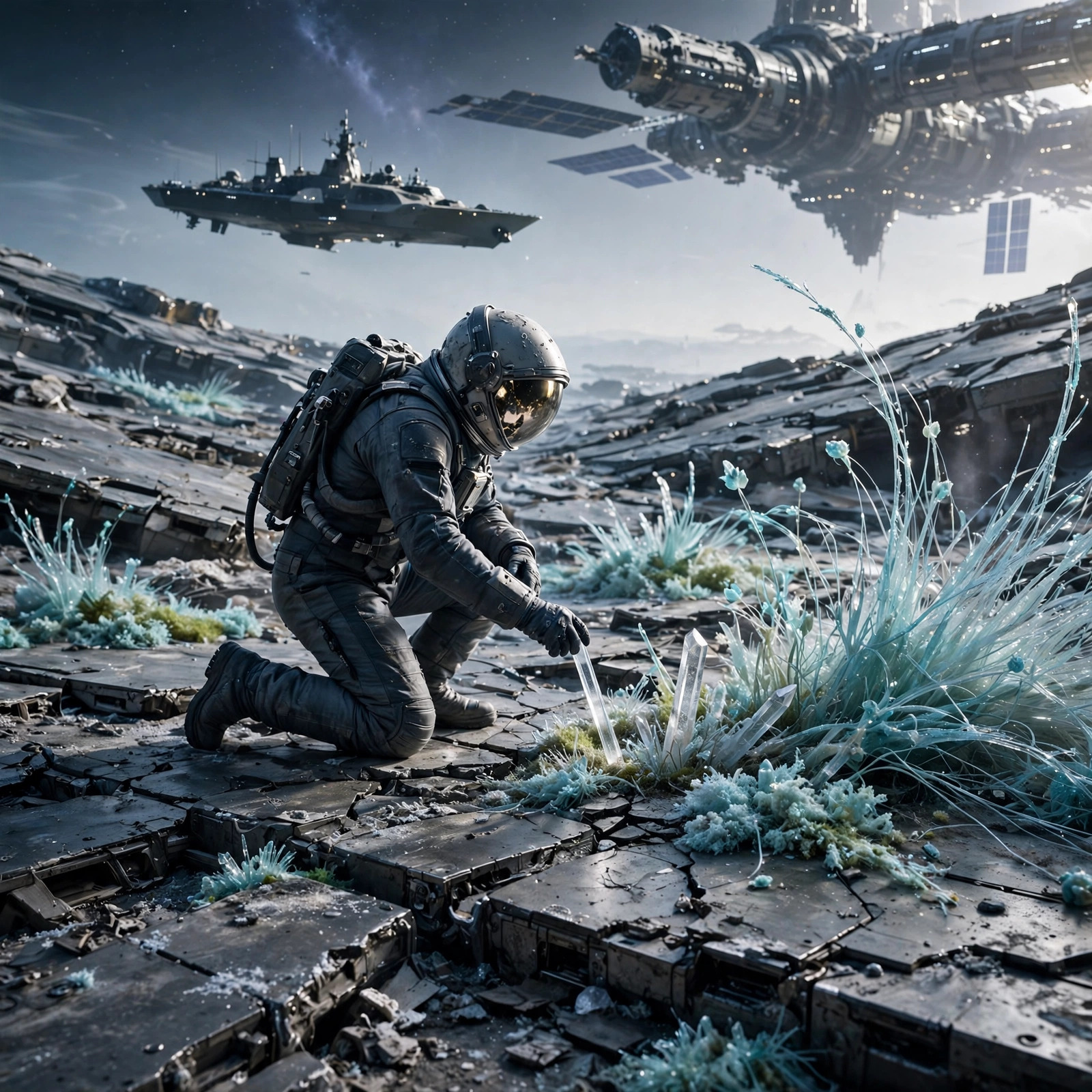
The telemetry was forty minutes old. Everything from the Bell was forty minutes old, had been forty minutes old for two years, and would be forty minutes old forever: the tender's position trace creeping across the plot, the grove field's six heat signatures in their tidy row, the emplacement cradle unfolded 400 meters off grove four, farther out than any of them had ever parked anything. Reeve had told the station he would walk the placement himself. He had not told the station he would arm it.
"That's a firing solution," Corrin said. "That is a live firing solution on the board. He was ordered to emplace, not to test."
Ilma was already transmitting. She heard her own voice go out flat and too fast: "Ascend tender, Vireo relay, stand down, do not fire, the groves are not instrumented for pulse load, stand down." She knew the arithmetic as she said it. The words would cross forty minutes of dark. The pulse would cross 400 meters of vacuum in something under two seconds. She said it anyway, because the alternative was saying nothing, and then she sat back and watched the screen, where the tender had already done whatever it had done, and the grove field lay quiet in its row of six warm points, and she counted them, one two three four five six, and made herself stop counting.
"It's calibration," Corrin said. "Look at the yield. Half-charge. He's probing the ice depth so the day-fifteen sweep goes clean. He'd say that's prudence."
"He can say anything he likes. He can say it in forty minutes."
The trace showed the cradle recoil. Then the screen did what light-lagged screens do, which was nothing at all for a while.
Grove four had been the second-largest of the six, a grown stand of crystalline antenna something like a wind-flattened orchard, and when the pulse reached it, the telemetry camera saw it without sound, because there was no sound in vacuum and no reason for any. The image bloomed white at the center. The grove came apart along its growth planes, slabs and needles and long splinters of it, lifted whole off the ice and thrown outward on the shock, and the six warm points on Ilma's plot became five before her eyes, and the fifth point was not a point anymore, it was a smear.
The lattice did not scream. There was no channel in which to scream. The relay scroll, which for two years had answered her every tone inside its narrow band, went flat and stayed flat, a dead line of unvarying carrier, and that was worse than any sound.
"Where's Nori," Ilma said, because the plot was the plot and Nori's tender sat at its stand-off two kilometers out, and two kilometers is nothing, two kilometers is a stone's throw, two kilometers is where you park to be safe.
Corrin was already on the suit channel. "Nori. Vireo. Nori, come up." Static. The suit transponder answered before Nori did, and its numbers were forty minutes stale: pressure holding, heart rate climbing, and one line of the telemetry that Ilma had never once had reason to read, reading NOT NOMINAL in small amber letters.
"She's outside," Ilma said. "She's on the hull. Why is she outside."
"Feed horn," Corrin said. "The day-six calibration rattled her dish mount, she logged it. She said she'd re-seat it before Reeve's emplacement runs." Corrin's hands were moving on the console, queuing every station resource onto the relay, and none of it could arrive anywhere in under forty minutes, and both of them knew it, and Corrin did it anyway.
The tender's external camera caught her. A small figure in a white suit at the base of the relay dish, tethered, wrench in hand, and then the picture was full of moving debris, needles of ice crossing the frame in dead silence, and one of them crossed the figure. The suit's telemetry spiked. The amber line went red.
Ilma watched Nori grab her own forearm. Watched her let go of the wrench, watched the wrench tumble away off-camera. Watched the suit's leg vent a thin rushing plume that froze as it left the fabric, a white thread of gas and ice crystals catching the floodlights, and then shorten, and then stop, which meant Nori had found the patch kit or found the hole, forty minutes ago, alone, on a hull, with one arm.
"Her air's still in the green band," Corrin said, and her voice had gone very level, the voice she used for numbers. "Pressure restored on the suit. Patch held. Heart rate high but she's working. Look." On the stale image, Nori was climbing her own tether hand over hand, dragging the bad arm, hauling for the airlock with the slow, furious patience of someone who has done hull drills until the moves belong to the body and not the mind.
They watched her reach the lock. They watched the outer door swallow her. The suit telemetry read clean once, then twice, then settled, and the tender's cabin feed came up: Nori inside, helmet off, cradling the arm against her chest with her knees drawn up, doing the talking herself before anyone could ask her to.
"So, I heard a calibration shot," her voice said, and behind it the med printer was already running. "My fault for being out, I suppose. His for firing, I'd say. The arm's broken, before you ask, and no, I'm not losing the arm, it's splinted and printed and I've had worse from a cargo door." A pause. "Reeve's tender just went active on the local band. He's hailing me. If you're hearing this, Ilma, whatever you're planning to say to him, I'd like to hear you say it."
She wasn't planning to say anything for forty minutes. That was the whole shape of her life.
Reeve came up on the relay an hour later, when his own transmission had crossed the gap, and his face on the screen had been recorded forty minutes before she saw it, which meant that whatever she said back would land on a man who had already had that whole hour to be shaken in.
"Varga. Before you transmit, hear the numbers." He looked tired, and he did not look sorry, and those were not the same thing no matter how much she wanted them to be. "Half-charge. Standoff four hundred meters, three times what the emplacement spec requires. I needed ice depth under grove four before I committed the full sweep, because if the mantle's brittle at depth, a full sweep cracks the shelf instead of mapping it, and then we've spent your contact and gotten nothing the admiralty will sign." He paused. "The debris cone wasn't in my solution. I ran it as clean vacuum behind the shot line. Her tender sits in it. That's mine, and I'll log it as mine."
"You'll log it," Ilma said, to a man forty minutes away and deaf to her for another forty after that. "Six tokens, Commander. Six paired tones lived on grove four. They're dead now. Not quiet. Dead. The lattice answers in pairs, one tone here, one tone there, and you've taken one side of six of them, and I can't even tell it what happened for another forty minutes, and when I do tell it, it will already know, because the shards went through its ice like they went through her arm."
He didn't flinch, because he hadn't heard it yet. On the delay, he was still talking, and his voice had gone quieter, which was as close as Reeve ever came to being shaken. "If it's this fragile, the sweep can't wait for day fifteen. The ice is failing around our instruments, Varga. I can advance it. Give me a new assessment date and I'll move the schedule forward, and we settle what's down there before it decides for us."
Ilma stood up from the console. Corrin had already pulled the pairing map, the great hand-annotated sheet where two years of agreed tones were matched grove by grove, and six of the matches ran through grove four, and Ilma took the sheet to the board without a word and started pulling pins.
She took the six sheets down one at a time. 'Deep,' which had cost them a winter. 'Near.' 'Grow.' 'Again,' the first word the lattice had ever offered back unasked, and she held that one a moment before she laid it face down. 'Answer.' 'Hide.' Six sheets, and she drew a single hard line through each with the red pen, and pinned them back up crossed, because the board was the truth of the thing and the truth was that six words were gone in both directions until a grove she had never grown could be grown again, and the crossing-out was hers to do, since she was the one who had taught them.
On the scope, grove four was a dark smear on the ice. On the suit feed, Nori was asleep in her crash couch, splinted, stable, the tender's systems green around her. On the relay, the lattice's carrier sat flat and waiting, the way it always waited, with nothing whatsoever to say until someone said something first.
Ilma sat back down at the console and began, slowly, in the shared grammar, the only honest sentence she had: what happened, where it happened, and that it had not been asked for. Then she transmitted it, and let it go, forty minutes into the dark.
Open Grammar
The answer came home on day twelve, forty minutes after Ilma's honest sentence had gone out, and it came home wrong.
Not wrong in the way the lattice was sometimes wrong, a tone dropped or a bracket left open the way a child leaves a door. Wrong in the way that made Corrin stop mid-sentence at the systems bench and come stand behind Ilma's chair with both hands on its back.
"Play it again," Corrin said.
Ilma played it again. The relay scope drew the tones the way it always drew them, narrowband peaks stacked on the carrier, and the lattice had sent back, first, the six paired tokens it still owned, the six that had not died with grove four. What happened. Where. Not asked for. Its own grammar, agreeing with hers, which meant it had received her sentence whole. Then it kept going.
It sent a bracket. Then a rhythm.
The rhythm was not one of the hundred and seventy-four tokens. It was not a token at all. It was a cadence, a patterned restrike across four tones, and Ilma sat very still while the scope painted it out, because she had heard that cadence before, and so had Reeve, and so had every sensor officer who had worked the outer system these last months. It was the calibration cadence. The one Reeve's tender burned on approach, the one from the afternoon windows, the one the lattice had answered flatly, every time, with nothing extra. It was the sweep's own walking rhythm, the schedule of burns by which the frigate measured itself down toward the ice, and the lattice had rendered it back in the shared grammar, bracketed, and followed it with the token when, three times, and then with a tone pair Ilma had never taught: a rising count.
"That's not evasion," Corrin said. Her voice had gone flat, the way it went when the hardware stopped lying. "That's a question. It's been asking a question."
Ilma pulled the day-six transcript. There it was, the odd repetitive cadence Reeve had read as a stall, the one that had hardened him into locking the sweep for day fifteen, and underneath the transcription, in her own handwriting from six days ago, driven resonance? artifact? check with C. And they had checked, and Corrin had judged it composed, not driven, and Ilma had let the judgment sit there unexplained because she had no explanation, and the explanation had just come home.
The lattice had been listening to the calibration burns for months. It had deduced the cadence. It had no word for schedule and no word for sweep, because Ilma had never taught them, because she had never had a reason to teach them, because for two years the only thing she had ever shown it was a language gentle enough to grow antennas out of ice. So it had done the only thing it could do with a hundred and seventy-four words and a question. It had played the pattern back and asked when, when, when.
And Reeve had read it as evasion, and locked the sweep, and then, on day nine, he had fired a pulse from four hundred meters off grove four without asking her, and grove four was a dark smear, and Nori's arm was in a splint, and six words were dead in both directions, and the whole time the thing in the ice had been trying to do what she had spent two years teaching it to do. Ask. Answer. Meet.
Ilma put her hand flat on the console.
"It knew," she said. "It knew about the sweep before we ever told it anything. It's been asking us to tell it when."
"Which means," Corrin said slowly, "it knows what the burns are for."
"It knows the burns walk something down toward it. That's not the same as knowing what a frigate is." But it was close, and they both knew it was close, and Ilma turned toward the transmit lamp and it had been green nine minutes and there was nobody on the other end of forty minutes of dark to take anything back from.
Reeve's face came up on the conference channel within the hour. He had read the transcript twice by then; she could tell because he quoted the cadence back at her from memory, four tones and a restrike, and he got it right.
"You're telling me it deduced my approach pattern from calibration burns."
"I'm telling you it composed your approach pattern in the shared grammar and asked when. Sir, on day six it wasn't evading your range question. It was answering a question you hadn't asked. It wanted the schedule."
"And you want to give it the schedule."
"I want to answer it. That's the whole method. Two years, one hundred and seventy-four words, and every one of them I gave first. It has never once sent anything I didn't teach or demonstrate. It's asking in valid grammar, and the grammar is mine, and if I refuse to answer a direct question in my own language, the language stops meaning anything."
"Varga." He said her name the way he said headings, and she straightened without deciding to. "The standing order on fleet positions is an admiralty order, not mine. I can't change it and you can't appeal it. You transmit my sweep schedule, in the open, to a non-human intelligence of unassessed capability, and you've handed it the frigate's disposition and timing. That's not linguistics. That's a breach."
"It already has the cadence. It deduced the cadence. The only thing I'd be handing it is the meaning."
"Which is exactly the part I'm ordered not to hand anyone." He looked down at something off-frame, and when he looked back he had the tone he used for standings. "Transmit it and I will relieve you of the relay and have Alas confined to station systems. I'll note it as a contact-security breach and you'll spend the rest of your career writing appendices. Am I understood?"
"You're understood." She kept her voice level. "Ask yourself one thing first. It's had your cadence for months. If it wanted to do something with it, it's had nothing but time. All it's done is ask us when. Sir, it's doing what I taught it. Don't make me the one who teaches it that asking gets a pulse."
The channel closed without an answer, which was an answer, and the clock over the relay console gave her eighty minutes until anything from the tender could arrive, and the lattice's question sat on the scope, patient, the way everything about it was patient, bracketed and rising and waiting.
Corrin said, "If you send it, he'll do it. He's not bluffing. He doesn't bluff."
"I know."
"Eleven years, Ilma."
"I know what it costs." She was already pulling up the compose window. "It costs me. It doesn't cost Nori's other arm, and it doesn't cost grove five, and it doesn't cost the only thing out there that has ever asked us a question."
She built the transmission the way she built everything, by hand, tone by tone. The sweep schedule, in plain grammar: burn, burn, burn, when four-times-four days. She taught it the counting first, because it had to be able to hold the number, and the number was day fifteen, and she laid the days out in a counted row so that no part of it was ambiguous. Then the meaning of the cadence itself, the burns walk a vessel down, near, near, near, then sound, deep. Then, because a schedule without an ending was a threat and she would not send a threat, she sent the last part, the part Reeve had never ordered her to withhold because no one had imagined it needed ordering: when you answer, we stop.
Her hand hovered over the commit for a long moment.
"He'll be watching the transmit log from the tender," Corrin said. "He'll see it go."
"He'll see it go." Ilma committed it. The lamp went red, then green, and the packet was away, forty minutes into the dark, and irretrievable, and she sat back and felt her shoulders like something borrowed.
The corridor outside the relay lab was cold the way station corridors are cold, and empty, and then not empty, because Corrin came out after her, and there was a crate manifest tablet under Corrin's arm, and Corrin stopped in front of her and did not say anything about the manifest. Ilma looked up at her, at the green transmit status reflected twice in Corrin's eyes, and Corrin put one hand on the doorframe beside Ilma's head and kissed her, brief, wordless, and Ilma's hand came up and held the front of Corrin's jacket and that was all either of them did about it, because there was nothing to say that the last hour hadn't already said badly.
Corrin stepped back first. "I've crated the bar," she said, as if that followed, and in a way it did. "The resonator. It's in the transfer crate, doped quartz, padded, manifest filed. If grove four regrows, or if we grow a sixth somewhere better, it should be at the Bell, not on my rack."
"You filed the manifest before I decided."
"I filed it before you transmitted, which is when you decided." Corrin handed her the tablet. "Nineteen days' transit on the supply run. It'll be there when the grove is."
Ilma signed it. It was strange how easy the signature was, after the other one.
Reeve's answer came in on the minute, not before it, which meant he had watched his clock the whole way down. His face on the channel was unreadable and tired.
"I have your transmission log," he said. "I have my orders and I have you in breach of them. And I have forty minutes to think before that thing answers you, and so do you. So here's what happens now. Nobody transmits anything. Nobody touches the relay. I want that scope watched, and I want silence, mine and yours, until the reply is on the board. Eighty minutes, Varga. Then I decide whether you're relieved or whether you're the luckiest breach of contact security in the admiralty's records."
The channel closed.
Corrin pulled a second chair to the scope without being asked. The crate with the resonator bar in it sat by the lab door, sealed, stenciled, bound for the Bell. The lattice's question was still on the board, answered now, and the answer was crossing two kilometers of ice and forty minutes of dark, and somewhere out there something that had learned to count was learning to count the days until a frigate came down, and Ilma watched the scope with her hands folded in her lap and waited for it to know what she knew.
The Planted Bar
The supply tender made its final spiral down the Bell's gravity well on the morning of day nineteen, and Nori flew it one-handed, her right arm strapped against her chest in a cast that had already been signed by half the station. She had refused the medical hold twice, in writing, both times with the same flat sentence: I know the approach corridor better than anyone who isn't broken. Ilma sat in the second couch with the transfer crate between her boots, doped quartz inside, padded, quiet, and watched Nori's left hand walk the console through the descent pattern the slow spiral allowed.
"Grove four first, or the crate first?" Nori asked.
"Grove first. I want to see it before I put anything next to it."
"Sensible." A pause while the tender rolled. "The arm's fine, by the way. The way everyone keeps looking at it, you'd think it was going to fall off."
"It nearly came off inside the sleeve."
"It cracked. There's a difference." Nori's voice was easy but her jaw wasn't. Two kilometers of vacuum had carried the shards of grove four across to her tender, and she had patched her own suit with her off hand while her forearm went wrong inside it. She had not once, in ten days, said the commander's name in Ilma's hearing. "There it is," she said, and banked.
The grove field lay along the Bell's equatorial ridge, five grown stands of crystalline lattice breaking the ice like teeth, and Ilma had looked at that scar for ten days on the scopes, the hole where the fourth stand had been. It was not a hole anymore.
It had taken her a full minute on the first pass to believe it. The regrowth stood a little under four meters tall, younger than its siblings, paler, the crystal less ordered at the crown, but it was a grove, antenna-grown, load-bearing, real. The lattice had rebuilt its own instrument, in nine days, without being asked, in the same place, on the same bearing.
And it was already talking. The relay scope showed the fourth stand's old frequency set, live, the six paired tones she had crossed off her board ten days ago, deep, near, grow, again, answer, hide, all six ringing in their old registers as if the ice had simply decided the ledger was wrong.
"It rebuilt on frequency," Ilma said. "Exactly on frequency. That's not regrowth, that's restoration."
"Is that good?" Nori asked.
"I don't know what it is yet. That's why we look first."
They set down two kilometers out, at the stand-off distance the corridor allowed, and Ilma suited while Nori held the tender's attitude with one hand and the checklist in her teeth. Forty minutes of light between them and the station meant Ilma was, from here on, the only linguist in the room. Corrin was on the scope at Vireo Deep Station, and Reeve, and the whole green board, and none of them could say a word to her that she could hear for most of an hour. It concentrated the mind wonderfully.
The ice was firm under her boots. She walked the last hundred meters with the crate on a drag-sled, and the regrown grove came up over her like a building, and she stopped where the old debris field had been scoured clean, and looked up into it.
It rang.
Not the six restored tones. A new phrase, composed, in valid order, and she stood very still with her mitts on the sled line and translated it in her head twice before she trusted it. The lattice had used her own taught tokens: inside many deep, then a bracket she had only ever used for question, then a string she had never seen, a long ordered run she could not parse, repeated once.
It was showing her something.
She keyed the tender's relay, knowing every syllable she sent would take forty minutes to reach Corrin's board, and that the lattice's reply would take forty more, and that this was, for once, exactly the right speed for the work. "Varga on the surface. Grove four is regrown and live on its full original set. I'm reading a composed transmission I can't resolve. Sending the raw capture now. Don't clean it. Don't smooth it. Give me Corrin on the harmonics."
Then she waited beside the grove, and the Bell turned under the stars, and nothing hurried.
The answer came down the corridor an hour and change later, Corrin's voice flat with exhaustion and something underneath it Ilma had not heard from her in two years. "It's a map. Ilma, the long string is a map. Same bracket structure you use for position-fixed, but pointed inward. Depth, extent, boundaries of its own internal structure. It measured itself for you."
Ilma stood in the ice with her helmet lamp off, letting the grove's own faint lattice-light stand in the dark, and did the arithmetic she had been avoiding for ten days. Reeve's admiralty wanted a decisive assessment of the Bell's interior. The sweep would have bought it with a charge and a scar. The lattice was handing over the same product, in her own taught notation, at the cost of nothing but the forty minutes it took to ask.
Reeve's face came up on the relay channel from the station before she had finished the thought. He looked like a man who had been sleeping in his chair. "Varga. I have the capture. Say it plainly."
"It mapped its own interior and sent it to us. Deep structure, boundaries, in the notation I taught. That is the assessment your people asked for. It's the same product the sweep would have bought, minus the hole in the ice and the hole in Stapleton's arm."
"It could be lying."
"It could." She let that stand. "But it rebuilt a grove to say it in, and it said it before we asked, and it has never once sent me anything I didn't first teach or demonstrate. I've said that to you eleven different ways in two years. This is the twelfth. Check the map against your passive gravimetry. If it's wrong, you'll know inside a day, and you can fire your charge with a clear conscience."
He was quiet long enough for her to hear the relay hiss. Two years of slow exchange had made him patient in his bones, even now. Especially now.
"If it's right," he said, "the sweep is off. Day fifteen's order is rescinded. I'll write it as survey product delivered by cooperative means, and the admiralty can chew on that for as long as they like." He rubbed his eyes. "They wanted a decisive assessment, Varga. If a rock hands my survey officer a better map than my charge would have bought, then the rock is the cheaper instrument, and I am not so proud that I can't write that sentence."
"Thank you, Commander."
"Don't thank me. You broke my standing order and made it come out true. I've spent eleven days deciding what to do about that, and the answer is nothing, because punishing the only officer who can read that thing would be a worse dereliction than yours." A pause. "I'm holding the Ascend at her present distance. She stays there. That part doesn't change."
"I'd be surprised if you changed it."
The channel closed. Nori's voice came local, from the tender. "Sweep's off, then."
"Sweep's off."
"Good." And then, quieter, "I'll take the crate sled from here if you want your hands free."
The work took the rest of the afternoon. The six restored tones had already brought the shared count back to its old total, one hundred eighty, but the map's long strings were dense with structure the notation had never carried, and Ilma spent the surface hours coining against it, token by token, teaching and being taught, offering a human word and waiting forty minutes for the lattice's paired tone to come back down the corridor. Ten of them, new, jointly made: boundary, layer, warmth, cold, measure, whole, part, open, keep, and last of all one she had no clean word for and settled for stay. The lattice returned its tone promptly, every time, and Ilma inked each pair onto a fresh printout with a china marker through her suit glove's inner seal, and pinned it to the board in her lab by radio until Corrin could pin the true copies. One hundred ninety tokens, ten past anything the old board had ever held.
Then it was dusk by the Bell's slow clock, and she had one thing left.
The crate was lighter than it looked. Corrin had kiln-grown the resonator bar two years before, doped quartz, laser-tuned to the lattice's preferred registers, a human-made thing made to ring in a voice the ice already knew. It had sat on a rack through two years of Ilma's refusals. It is not a gift yet, she had said, and she had meant it, every time, because a gift given too early was just a demonstration of who held what.
She cut a socket in the ice beside the regrown grove with the laser probe, set the bar upright in it, packed the shavings back around the base the way Corrin's notes specified, and then knelt there in vacuum with her mitts on the quartz, and did not let go.
"It's a standing invitation," she said, to the ice, to the grove, to the forty minutes of dark. "No charge. No charge order, either. It rings when you do."
She struck it once with the padded striker, a clean tap, and the bar took the tone and held it, and the tone crossed the two kilometers to the groves, and the groves took forty seconds to answer, which was nothing, which was immediate, which was the point.
The lattice replied low and cautious, a single paired tone, the new one, the last-coined one. Stay.
Ilma knelt in the ice with her breath loud in her own helmet, and above her, holding its distance out past the corridor, the Ascend kept her station, her lights steady, her weapons cold, her commander watching a scope he now had every reason to trust. The bar rang down through her mitts, answering, and the grove rang back, and neither of them was loud, and neither of them stopped.
Get notified when new stories drop

Mira Okoye
Mira writes first contact and mentorship-across-species stories where curiosity beats fear.
Leave a comment
Comments