




The Eight-Node Tether
Beneath the floor plates of the Acoustic Lab, the basal ice groaned in a slow, grinding fifth, and Zora Lindqvist adjusted her bone-conduction calipers until the glacier’s complaint dropped out of the mix. What remained in her headset was the chime of the deep brine. Nearly two kilometers straight down the Borehole Shaft, where the melt-water gave way to the pressurized ocean floor and the boiling plumes of The Silicate Chimney, something was plucking the water column like a harp string. A triad of low-frequency clicks rose through the dark: root, minor third, and a slightly flat sixth that lingered in the salt before vanishing.
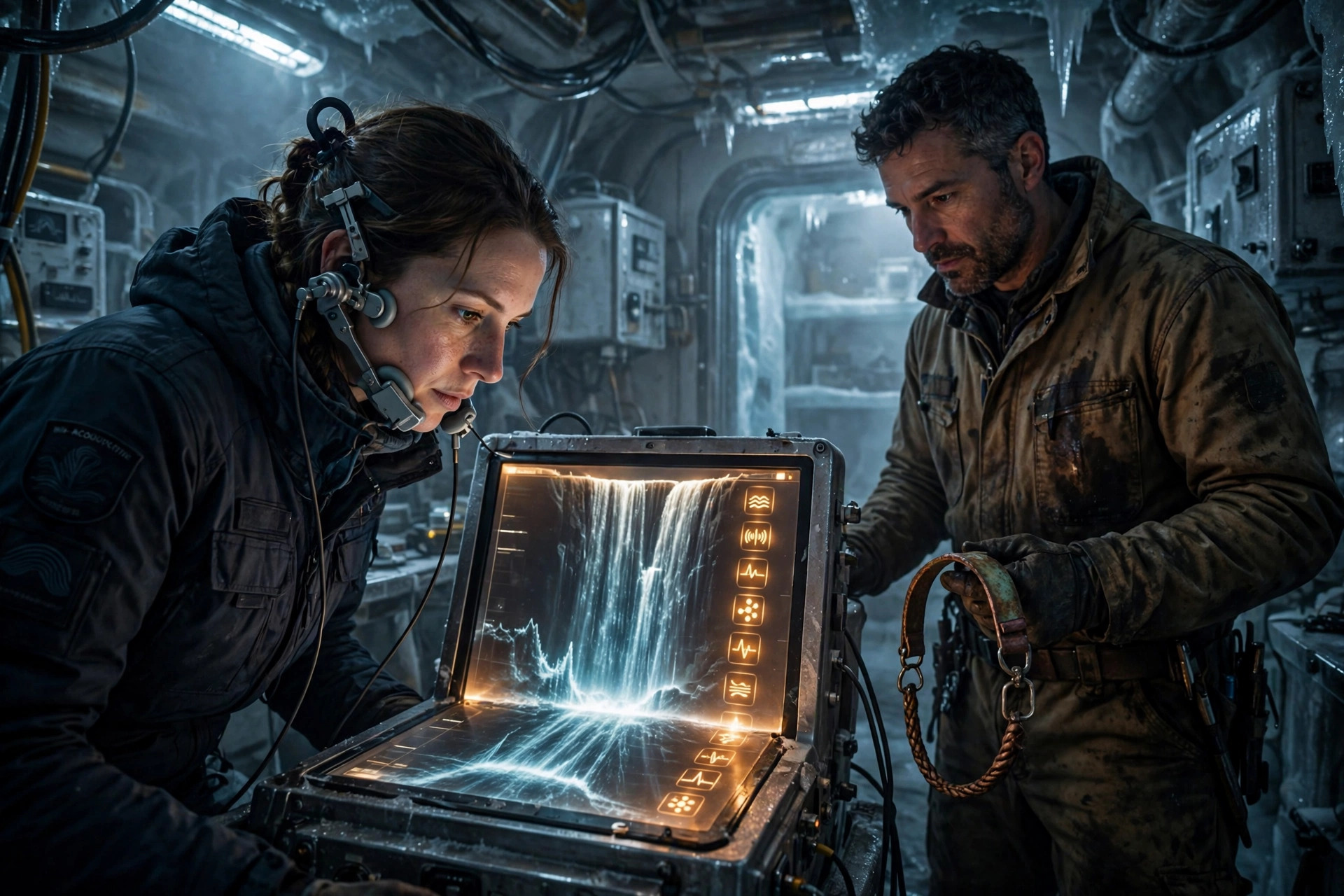
Zora leaned over the primary spectrometer, her fingers hovering above the gain faders. Along the vertical schematic on the bulkhead screen, eight amber icons glowed in a neat, plumb line. Eight acoustic repeater nodes hung along the armored fiber-optic tether, spaced down the nineteen-hundred-meter shaft where ordinary radio waves died within a few paces of the hull. Through that heavy, conductive slush, only light inside glass threads and sound through the brine itself could carry a message.
"Node eight is picking up a secondary harmonic," Zora murmured, tapping the lowest amber icon on the glass. "Listen to the tail on that sixth, Bram. It isn't scattering off the basalt wall anymore. The lattice is catching the wave and holding the pitch."
From the belly of the main routing console, a wrench clinked against cast aluminum. Bram Vester slid out on his padded creeper, boots first, smelling of flux paste and cold machine oil. He held a braided strip of green-crusted metal between two gloved fingers. "Your signal was bleeding into the hull frame," he said, tossing the corroded copper grounding strap into the scrap tray beside her stool. It landed with a dry rattle of flaking salt. "The brine mist from the moon-pool vents eats standard copper in six months down here. I crimped a tinned busbar into the main junction instead. Check your noise floor now."
Zora watched the baseline on the waterfall display. The fuzzy gray snow at the bottom of the kilohertz band dropped away, leaving the crystalline triads of the Brine Choir standing sharp and silver against the black grid. "Three decibels cleaner. Thank you."
"Don't thank me yet. I still had to rebuild your toy." Bram stood up, wiping his knuckles on his coveralls, and reached for the workbench behind him. He picked up the portable transducer slate he had milled and hand-soldered during their first year at Skovgaard Basal Station. Its etched titanium casing still bore the spiral tool-marks of the lathe, and a fresh bead of silver solder gleamed along the quartz sensor housing. He unplugged the heavy umbilical cable that had tethered the slate to the console bench for the past week, snapped a high-density battery pack into the grip, and handed it across to her. "Recalibrated the quartz pickup and freed it from the bench lead. You can carry it down to the shaft collar now without dragging forty meters of coax behind you."
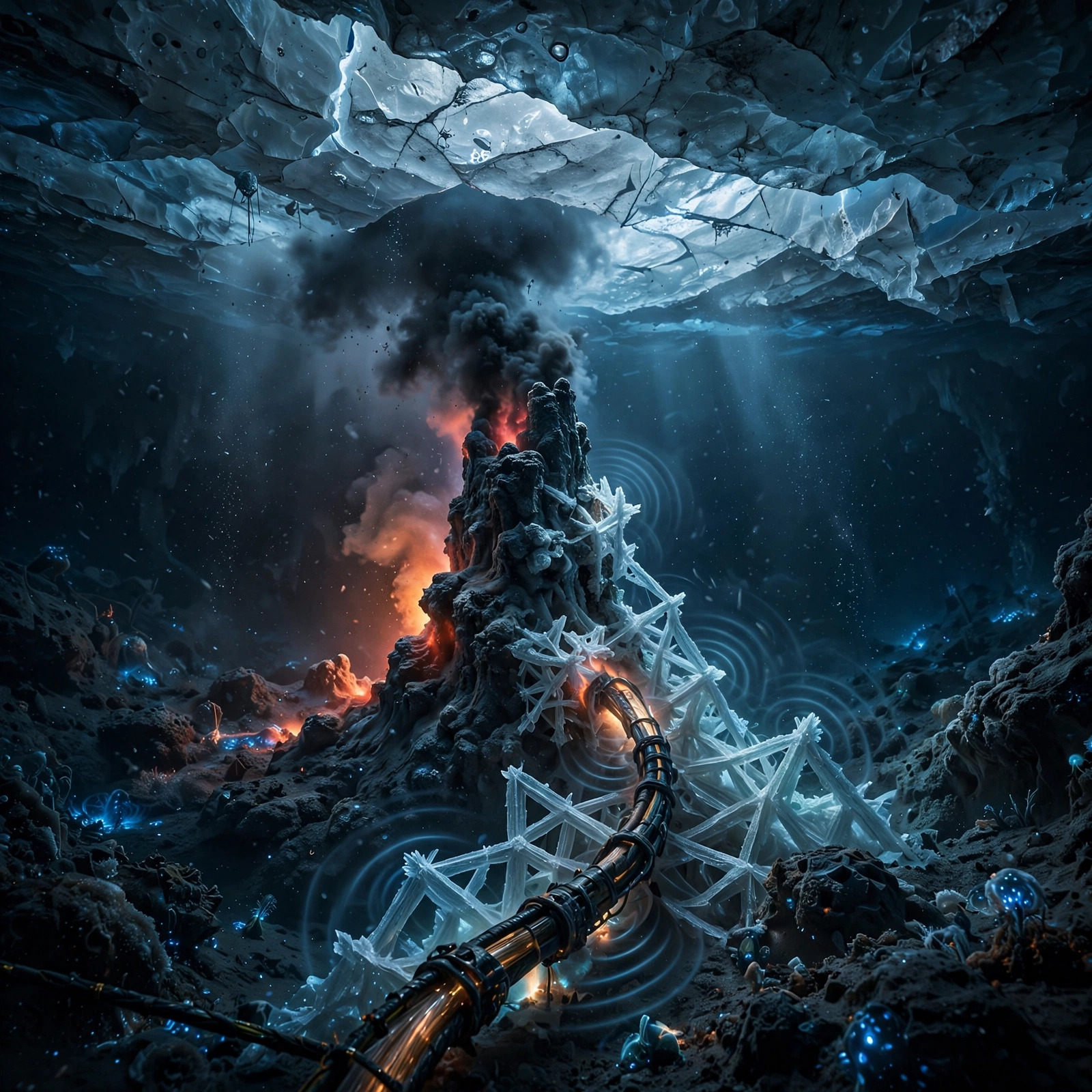
Zora took the piezo slate, feeling the dense, cold weight of the titanium settle into her palms. Thumb-worn grooves flanked the frequency wheel. As she powered it on, the small display linked with the console via optical relay, mirroring the eight-node chain and the delicate, branching acoustic map she had spent months assembling. On the screen, The Silicate Chimney looked like a fluted organ pipe of porous stone, forty meters tall, wrapped in a web of piezo-crystalline lattices that grew where the hot mineral vents met the freezing abyssal current.
"Look at the phase shift between yesterday's log and this morning's," Zora said, tilting the titanium slate so Bram could see the overlaid waveforms. "When the hydrothermal plume surges, the crystals flex. That mechanical stress generates a tiny voltage, and the whole colony clicks in unison. Yesterday, they were repeating a simple four-pulse cadence. Today, they're leaving a gap right in the middle of the measure. Twelve hundred milliseconds of dead quiet, right where our lower pump harmonics usually bleed through the ice."
Bram leaned a hip against the console, squinting at the amber trace. "Maybe the vent throat is just clogging with anhydrite. Chimneys choke themselves off all the time."
"Clogged vents hiss," Zora said. She dialed the playback speed down by half, letting the deep, resonant clicks thrum through the lab's near-field monitors. "They don't wait for the exact gap between our heat-exchanger strokes to answer. It's a colonial lattice, Bram. Every crystal node in that crust is linked by acoustic phase-shifts. They're listening to Skovgaard Station, and they're nervous because our drills and pumps sound erratic to them."
"Everything sounds erratic when you're trying to squeeze a budget report out of a rock," Bram muttered, glancing up at the digital chronometer bolted above the hatch. The red numerals read thirty-six hours, twelve minutes. "Kael was down in the Winch Bay an hour ago checking the nitrogen accumulators on the seismic thumper. When the sun slips behind Jupiter's magnetotail and cuts the inner-system relay, the board in Geneva wants their deep-crust survey sitting in the buffer. Thirty-six hours until conjunction blackout, Zora. If you want to prove your crystals are talking, they need to talk louder."
"If we shout at them, we'll shatter the lattice," Zora said, her thumb tightening on the beveled edge of the slate. She pointed to the red ceiling line she had programmed into the safety limiter: 135 decibels. "One hundred and thirty-five decibels at the bottom node is the absolute limit before acoustic cavitation starts tearing their delicate crystal bridges apart. Kael's broadband thumper fires at two hundred and ten. That isn't a survey tool, it's a depth charge."
"It's standard seismic tomography," Bram said, though his voice lacked conviction. He rubbed the back of his neck, looking at the newly installed grounding strap gleaming beneath the open console panel. "Kael isn't trying to cook your choir. You saw the consortium dispatch last month. The orbital relay leases are doubling next cycle. Without a complete three-dimensional density map of the chimney's mineral core before the conjunction blackout, Geneva marks Skovgaard for mothballing on the next supply window. Three hundred and twenty liters of primary coolant in the reserve tanks won't mean much if they shut off the reactor and ship us back to Ceres."
"We don't need to blast the chimney to map it," Zora insisted. She tapped the waveform on the piezo slate, bringing up a secondary synthesis channel. "The Choir is already mapping the water column for us. Every time they send a triad, the reflections off the surrounding basalt come back through nodes six, seven, and eight. They're just holding back their full resonance because they don't know what we are. We're an unnatural, metallic roar sitting on their roof. If I send a clean, unshielded calibration sweep down the tether—something that carries the actual, steady rhythm of our life-support pumps and turbine bearings without the baffle filters—they'll hear that we're a stable, rhythmic system too. A living structure, not a collapsing ice shelf."
Bram raised an eyebrow. "You want to pipe raw station noise down the transducer line? We spent two years insulating the hull so we wouldn't pollute the basin."
"Not noise. Heartbeat," Zora said, adjusting the equalizer curves on her slate. "Low-amplitude, well below the one-thirty-five-decibel ceiling. Once they recognize our circulating loops as a steady metabolic rhythm, they'll stop bracing against us. They'll open the lattice, and their own acoustic reflections will give Kael a higher-resolution map of the chimney interior than his thumper ever could."
The heavy pressure door at the end of the lab hissed, its rubber seal peeling away from the frosted bulkhead before the wheel spun fully open. Lina Okafor stepped over the coaming, her insulated gaiters still crusted with gray slush from the wet-lab sample lock. She carried two pressurized titanium sample cylinders clipped to a polymer rack, and her cheeks were flushed from the cold air of the shaft access tunnel.
"You haven't fired a test pulse in the last twenty minutes, have you?" Lina asked, bypassing the drying rack to set the cylinders directly onto the chemical bench. Her breath plumed faintly in the chilled air near the deck.
"No," Zora said, looking up from the slate. "We've been passive since zero-four-hundred while Bram replaced the console ground. Why?"
Lina unclipped a data wafer from her wrist pad and slotted it into the main console's auxiliary port. A fresh set of spectrographic bars climbed across the right-hand monitor, stained in sharp blues and violets. "Because I just pulled the zero-six-hundred sipper bottle from the hydro-wire at nineteen hundred meters. The dissolved silica and magnesium carbonate levels right around the bottom of the tether have dropped by forty percent since yesterday morning."
Bram frowned, stepping closer to the screen. "The vent is cooling off?"
"The vent temperature is steady at three hundred and ten Celsius at the nozzle," Lina said, tapping the violet spike on the graph. "The minerals aren't failing to vent, Bram. They're precipitating out of the brine way faster than the thermal gradient accounts for. Something is pulling dissolved silicates out of solution and locking them into solid phase right at the base of the Borehole Shaft."
Zora looked down at the piezo slate in her hands, then back at the eight amber icons on the wall display. She zoomed in on the telemetry for node eight, hanging twenty meters above the chimney crown. The impedance gauge on the node's outer hydrophone casing wasn't reading open water anymore; the resistance had crept upward over the last six hours, as if the sensor were being wrapped in spun glass.
"They aren't just listening to node eight," Zora said softly, tracing the rising impedance curve with her fingertip. "They're growing toward it."
"Up the cable?" Bram asked, his eyes widening. "That's braided Kevlar and polymer jacketing. Nothing anchors to that in a two-knot convection current."
"Silicate-brucite lattices can anchor to anything if there's an electrical bias to seed the crystal," Lina said. She picked up one of the sample cylinders and held its sapphire sight-glass toward the overhead lamp. Inside the clear, high-pressure brine, tiny, needle-like geometric flecks drifted in slow spirals, catching the light like suspended mica. "Every time your repeater node relays a packet up the fiber, the piezoelectric transducer in the housing flexes. The Choir is seeding new lattice spires directly onto the bottom cable weight. They're building an acoustic bridge straight up the Borehole Shaft."
A thrill, sharp and cold, ran down Zora's spine. If the lattice bridged the gap to node eight, the attenuation of the open water would vanish; she would be coupled directly to the Choir's nervous system. "How fast is the deposition rate?"
"Fast enough that node eight's hydrophone will be completely encased in resonant quartz within ten hours," Lina said. "And look at the trace elements. Strontium and iron sulfide aligned in sheer planes. It's a directional waveguide, Zora. They're focusing their acoustic array straight up our melt-hole."
Before Zora could bring up the deep-camera feed, the brass intercom box beside the pressure hatch crackled with a sharp, metallic pop. Director Henrik Kael's voice filled the small room, clipped and dry over the blower hum.
"Lindqvist, Vester, Okafor. Leave the spectrographs and get down to the Winch Bay. We're running the pre-fire tension check on the main cable now."
Zora's stomach tightened. She reached across the console and hit the talk-back toggle. "Henrik, Lina just brought up the morning chemistry from the lower shaft. The lattice is actively accreting onto node eight. If you drop the seismic thumper down the guide wire now, the shockwave won't just bounce off the chimney—it'll travel straight down a rigid crystal bridge and shatter the primary spire."
For three seconds, the speaker gave back only the heavy, rhythmic clank of the hydraulic accumulators from the bay below. Then Kael spoke again. "The conjunction clock is at thirty-six hours, Zora, and the orbital relay window doesn't wait for crystal growth. Bring your slate if you have hard numbers. Kael out."
The intercom clicked dead. Zora looked down at the recalibrated piezo slate in her hands, the new solder joint gleaming beside the thumb-wheel, then disconnected the optical sync lead and tucked the titanium casing firmly under her arm.
The Thumper Sled
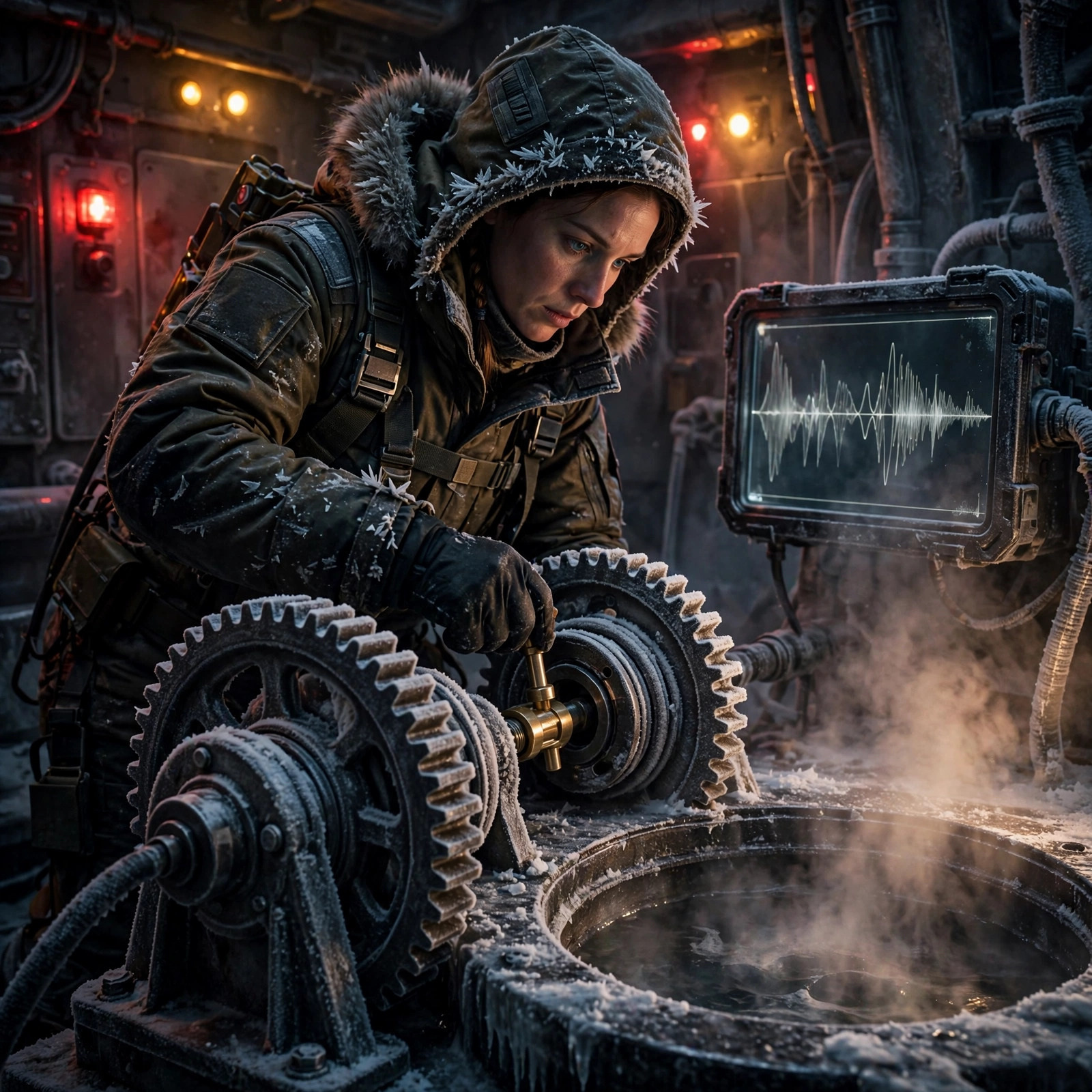
The chain hoist in the Winch Bay clanked once and locked, suspending the six-hundred-kilogram brass and maraging-steel cylinder four centimeters above the grated deck. Frost immediately began to feather across the machined casing where the cold updraft from the Borehole Shaft met the warmer air of the work deck. Zora stopped at the bottom of the companionway ladder, her fingers tightening around the etched titanium edge of the piezo slate. Ten hours of alignment checks and tether-load modeling in the upper passage had eaten the morning away, and during those ten hours Director Henrik Kael had not been waiting on her spectrographs; he and the deck crew had stripped the passive coring rig off the main gantry and bolted the broadband seismic thumper into the guide cradle.
Bram came down the iron rungs behind her, his rubberized boots thudding onto the frost-rimed checker plate. He took one look at the massive accumulator pistons strapped to the sled's spine and let out a low whistle through his teeth. "You pulled the nitrogen bladders from the secondary drill," he said, walking over to the massive maraging-steel winch arc-welded into the basal ice anchors at the center of the bay. "Henrik, those bladders are rated for bedrock fracturing. If you vent them at the bottom of the shaft, the overpressure in the water column will blow the seals out of my lower junction boxes."
"The junction boxes are triple-potted in urethane, Bram," Kael said. He stood beside the narrow steel briefing table bolted to the bulkhead, wiping hydraulic grease from his knuckles with a gray shop rag. He looked tired; the deep creases around his mouth were shadowed blue under the sodium work lamps, and his wool collar was dark with melted rime. "And we aren't firing at the shaft wall. The sled stops fifty meters clear of the bottom weight, fires a single two-hundred-and-ten-decibel broadband sweep, and rides the winch straight back into the collar."
"Two hundred and ten decibels," Zora said, stepping around the perimeter of the moon-pool grating. Below the steel mesh, the black water of the melt-shaft breathed out a slow, continuous curl of vapor that smelled of brine and reduced sulfur. "Henrik, the safe ceiling for the silicate lattice is one hundred and thirty-five. Every ten decibels is an order of magnitude in acoustic energy. You aren't taking a picture of The Silicate Chimney with that thing. You're hitting a cathedral window with a wrecking ball."
Kael tossed the stained rag onto the corner of the briefing table and tapped the ruggedized display terminal mounted beside the winch brake. A pale green orbital plot rotated on the screen, showing the inner-system relay geometry shrinking toward a sharp crimson wedge. "Look at the clock, Zora. We are down to twenty-six hours before solar conjunction puts the sun directly between Jupiter and the inner relay. Twenty-six hours until thirty-six hours of total telemetry blackout. And two hours after that blackout lifts, the Geneva Appropriations Board votes on the five-year deep-crust allocation."
"They have six months of Zora's passive acoustic logs," Bram said, resting a scarred hand on the cold steel drum of the borehole winch. Nine hundred and fifty turns of armored optical-acoustic cable sat wound on the spool, feeding down through the grease-packed stuffing box into nineteen hundred meters of basal ice. "They know there's a structured matrix down there."
"They know there is an anomalous mineral formation producing rhythmic piezoelectric clicks under thermal stress," Kael replied, his voice dropping into the patient, measured cadence he used when walking junior engineers through a failed pressure test. "I spent two hours on the high-gain link with the board's geophysics panel while you were running Lina's water samples. Because electromagnetic radio dies within three meters in this brine, we have zero radar imagery. We have zero optical confirmation beyond ten meters because of the sulfur flocculent. All we have are low-frequency sound waves coming up eight repeater nodes."
Zora set the piezo slate down on the steel briefing table. The milled titanium housing clicked sharply against the metal surface. "Those sound waves are triads, Henrik. Phase-locked harmonic intervals that shift pitch in anticipation of our drill-head thermal cycles. An abiotic mineral formation doesn't anticipate a heat pulse before the water temperature rises."
"The panel in Geneva calls it a nonlinear hydrothermal feedback loop," Kael said. He leaned both palms on the table opposite her, looking down at the slate's dark quartz screen. "Zora, I am not your enemy here. Why do you think I fought the directorate for two years to keep Skovgaard Basal Station off the mothball list? I want that structure to be alive just as badly as you do. Wait—no, listen to me." He raised a hand as she opened her mouth. "If I transmit another batch of passive audio files before the conjunction blackout, the board will classify the chimney as a standard serpentinization vent. They will cut our reactor fuel allocation on the autumn supply ship, seal the borehole, and reassign this crew to surface ice-core logging. The station dies."
The bay went quiet except for the steady, deep thrum of the primary circulation pumps behind the starboard bulkhead and the faint ping of cooling metal from the thumper sled. Three hundred and twenty liters of potassium-formate coolant coursed through those wall pipes, keeping the habitat ring from freezing solid against the surrounding glacier. Zora stared at the crimson wedge on Kael's terminal. Twenty-six hours.
"And if you fire a two-hundred-and-ten-decibel shockwave?" she asked quietly. "What does that buy you?"
"A full internal density tomogram," Kael said. "The broadband pulse penetrates the silicate crust, reflects off the internal chambers, and comes back up the eight tether nodes. One clean three-dimensional map showing hollow, non-random vascular geometry inside the chimney. With that map in their hands before the blackout starts, the board cannot legally classify the site as abiotic. We get our five-year renewal, and you get three summers to talk to your crystals at whatever volume you like."
"There won't be anything left to talk to," Zora said. She tapped the activation stud on the piezo slate and brought up Lina's micro-crystallography model from the morning's haul. "Look at the deposition data from node eight. Since yesterday, the Choir has been growing a silicate-brucite lattice directly onto the lower cable weight. By tonight, the bottom hydrophone will be completely encased in resonant quartz. The water buffer is gone, Henrik. If you fire that sled, the acoustic shockwave couples directly into the crystal bridge. You'll shear the piezoelectric needles away from the central spire. It will be like firing a shotgun into a spiderweb."
Kael studied the glowing blue wireframe on her slate for a long moment. He reached out, his thumb calloused and dry, and scrolled through the strontium-alignment figures Lina had flagged. A muscle worked in his jaw. "The outer silicate chimney is forty meters tall and two meters thick at the base, Zora. Even if the fragile peripheral needles on node eight shatter, the core structure will survive a single acoustic impulse. It will regenerate."
"You don't know that! You're treating a distributed nervous system like a limestone reef." Zora pulled the slate back an inch, her heart hammering against her ribs. "They built that bridge onto node eight because they're trying to reduce the signal attenuation between us. They are reaching up the shaft."
"Then make them say hello in a way a geophysicist in Geneva can't dismiss as boiling mud," Kael said. He straightened up and looked toward the heavy steel cylinder hanging over the shaft collar. "I need sixty minutes to lower the sled to firing depth and four hours to compile and transmit the tomography packets before the solar corona swamps the carrier wave. That gives me a launch deadline fourteen hours from now."
"Give me twelve," Zora said instantly.
Bram looked sharply at her from beside the winch drum. "Zora, twelve hours barely lets the quartz bridge finish hardening on node eight."
"It's enough," she said, her mind racing through the harmonic logs she had cataloged over the past week. "Every time we ran the thermal drill or cycled the ballast tanks, the Choir backed away from the harsh mechanical transients. We've only ever spoken to them with industrial noise or sterile sine-wave pings. If I send a structured, non-threatening signature straight down the new crystal bridge—something complex, rhythmic, and unmistakably biological—they'll respond with an active acoustic projection of their own."
"Biological?" Kael frowned. "You want to play heartbeats down the hole?"
"Not just heartbeats. The station itself," Zora said. She turned toward the starboard bulkhead, where the insulated return manifold of the primary life-support loop hummed at a steady, twin-rotor cadence. "Skovgaard's circulation pumps, the CO2 scrubbers, the thermal exchange valves, and our own pulse rates in the lab. It's a closed metabolic system. It's peaceful, continuous, and mathematically distinct from ice-quake shear or hydrothermal boiling. If I wire an unshielded calibration sweep of our life-support harmonics straight into the piezo slate and transmit it down node eight at a safe one hundred andtwenty decibels, the Choir will recognize an organized living system."
Bram rubbed the back of his neck, his gaze dropping to the slate on the briefing table. "I milled that casing to isolate noise, Zora, not broadcast it. If you want to feed raw pump harmonics into the optical modulator, we'll have to bypass the low-pass filter I soldered in this morning and patch a pickup lead straight onto the primary coolant return valve."
"Do it," Zora said. She looked back at Kael. "Twelve hours, Henrik. If the Choir answers the station's rhythm with a coherent structural projection before your fourteen-hour deadline, you scrub the thumper drop and send my phase-array data to Geneva instead."
Kael looked from her tight face to the frost-coated cylinder hanging over the dark water, then back to the conjunction clock ticking down from twenty-six hours. Slowly, he nodded once. "Twelve hours. Not a minute more. And the sled goes onto the main cable shackle right now, ready to drop the second your window expires."
"Fair," Zora said, though the word tasted like cold brass in her mouth.
She didn't wait for Kael to call the deck hands. Taking a small flathead driver from her pocket, she knelt beside the starboard manifold housing while Bram fetched a spool of shielded twin-lead copper wire from the tool locker. Working quickly, Zora unlatched the inspection plate over the primary coolant pipe. The heavy steel conduit was warm to the touch, vibrating with the complex, overlapping polyrhythm of the triple-impeller pumps pushing three hundred and twenty liters of fluid through the habitat's veins. To her ears, trained by seven years of deep-ice listening, the sound was the purest definition of sanctuary: steady, tireless, keeping the crushing dark at bay. Surely an organism that lived by clustering around a warm hydrothermal vent in the freezing abyss would understand the song of a machine that kept the cold out.
She clamped a magnetic contact microphone directly onto the valve flange and ran the trailing wire across the deck plates to the briefing table. Bram was already there, his soldering iron hot, a thin curl of rosin smoke rising toward the extractor vent as he bridged the input jack on the side of the piezo slate. He worked with swift, silent precision, though a furrow remained between his brows.
"You're coupling the raw high-frequency impeller whine straight into the quartz driver," Bram murmured, blowing on the cooling solder joint before handing the titanium slate back to her. "The fundamentals are warm and slow, forty hertz and eighty hertz, just like a resting pulse. But the cavitation harmonics off the pump blades spike up around twelve kilohertz. Normally the ice damps that out. Through the new crystal bridge on node eight, they're going to hear every bit of that high-end edge."
"That high-end edge is what proves it's an engineered life-support loop and not a magma harmonic," Zora said, plugging the copper pickup lead into the slate's newly modified port. Immediately, the quartz screen lit with a dense, braided waveform—the deep, rhythmic Lub-Dub of the main pressure regulators wrapped in a shimmering, high-frequency halo of spinning turbine blades. "It's honest, Bram. We're letting them listen to us breathe."
Behind them, the chain hoist whined. Kael stood at the edge of the moon-pool collar, guiding the heavy seismic thumper sled down the last four centimeters until its top clevis slid between the jaws of the borehole winch's main maraging-steel shackle. With a ringing clank that echoed down the nineteen-hundred-meter shaft, Kael drove the two-inch locking pin home through the shackle ears, snapped the cotter ring shut, and punched a fourteen-hour countdown into the winch-release timer on the gantry post.
Pressure Spike
Zora’s thumb hovered over the transmit toggle on the piezo slate, her eyes fixed on the red digital numerals counting down on the gantry post beside the borehole winch. Ten hours had bled away while they balanced the impedance matching across the nineteen-hundred-meter fiber-optic tether, and another two had vanished into final gain staging. Now the station clock showed fourteen hours until the thirty-six-hour solar conjunction blackout severed their link to the inner-system relay. On the winch’s separate release timer, a scant two hours remained before Kael’s automated shackle would drop the seismic sled.
Across the narrow deck of the Winch Bay, Bram leaned over the junction box on the maraging-steel winch frame, his gloved fingers resting lightly on the armored tether cable where it vanished through the grease-seal into the Borehole Shaft. Lina stood beside him with her portable inline spectrometer hooked into the brine sample bleed-valve, while Director Henrik Kael watched from the bulkhead doorway, his arms folded over his heavy parka.
“Impedance on node eight is holding at four-point-two ohms,” Bram said, his voice tight over the low thrum of the floor plates. “The silicate-brucite bridge they grew over the housing is acting like a direct mechanical coupler. Whatever you push down the fiber to that bottom transponder is going straight into the Silicate Chimney lattice with zero water-column attenuation. Are you sure you don’t want me to clip the twelve-kilohertz impeller band? I can solder a capacitor across the bridge in three minutes.”
“If we filter it, it looks like a synthetic test tone,” Zora said, shifting her weight on the cold grating to ease the stiffness in her knees. The titanium casing of the piezo slate felt warm from its internal battery pack, vibrating faintly against her palms with the bypassed feed from the primary coolant conduit behind her. “They’ve spent weeks listening to our stray vibrations through nearly two kilometers of basal ice. Giving them the clean, unshielded acoustic signature of the pump loop—the forty-hertz circulating pulse right alongside the high-frequency turbine spin—shows them the whole machine that keeps us alive. It’s an open hand, Bram.”
“It’s a ninety-decibel broadband hum injected directly into a brittle piezo-crystalline matrix,” Lina murmured, her eyes tracking the green phosphorus trace on her chemical analyzer. “The dissolved silica concentration at the shaft base has crept up four percent since yesterday. They’re under tension down there, Zora. The lattice is stiffening.”
“Wait any longer and the point is moot,” Kael said, stepping down onto the main grating. He tapped the polycarbonate cover of the gantry timer. “In one hundred and twenty minutes, the consortium’s protocol takes over and the two-hundred-and-ten-decibel thumper goes down the hole. If your Choir is going to hand us a structural profile of that vent before the blackout, they need to start singing now.”
Zora looked down at the quartz screen. The braided waveform of Skovgaard Basal Station’s heart—the slow, surging push of three hundred and twenty liters of coolant paired with the razor-sharp shimmer of the triple-impeller blades—scrolled smoothly across the glass. One hundred and thirty-five decibels was the safe ceiling she had calculated for the Choir’s delicate phase-shifts, and she had locked her output limiter forty-five decibels below that threshold. How could anything that lived by huddling around warmth in the dark mistake the steady rhythm of a habitat’s heater for a weapon?
She pressed the toggle.
For the first six seconds, the repeater indicators along the console climbed in a neat, amber stair-step as the optical packet raced down the tether and converted to acoustic vibrations at node eight. Through her bone-conduction headset, Zora heard the familiar, comforting chug-whir of the station’s pumps echoing back from the abyss. On the quartz screen, the ambient triad intervals of the Brine Choir—those low, glass-clear chords that usually drifted around the vent—abruptly vanished.
“They stopped,” Lina said, leaning closer to her display. “Total acoustic flatline across nodes six, seven, and eight.”
“They’re listening,” Zora whispered, her chest tightening with a sudden, fierce hope. “They’re parsing the polyrhythm.”
Then the amber light for node eight flared crimson. In her headset, the twelve-kilohertz turbine whine didn’t fade into the brine; it doubled in amplitude, caught in a sudden, vicious feedback loop inside the crystal bridge.
“Zora, that’s not absorption,” Bram said sharply, his hand jerking back from the armored cable. “The twelve-kilohertz harmonic just hit the resonant frequency of their silicate needles. It’s ringing the lattice like a tuning fork…”
A shrill, metallic screech tore through Zora’s headset before the safety circuit popped, throwing a shower of blue sparks from the piezo slate’s bypassed input jack. On the main bulkhead board, the status readout for node eight went black. Half a second later, node seven’s pressure transducer spiked to four hundred atmospheres and died.
“Cut the feed!” Bram shouted, lunging toward the main breaker.
Zora yanked the copper pickup lead out of the slate, scorching her fingers on the hot solder joint, just as a deep, subterranean hammer-blow struck the bottom of the ice sheet. It wasn’t an acoustic chord. It was the unmistakable, terrifying roar of a superheated hydrothermal blowout venting straight up the nineteen-hundred-meter Borehole Shaft.
“Thermal surge in the column!” Lina yelled, bracing herself against the chemical rack as the steel deck plates bucked beneath their boots. “Pressure wave moving up at fourteen hundred meters per second! They didn’t read the pump whine as a heartbeat, Zora—it grated right across their shear planes! They’re flushing the shaft!”
“Six nodes left!” Kael barked, grabbing the gantry rail as the overhead work lights swung wildly on their chains. “Nodes seven and eight are gone—sheared clean off the bottom of the line!”
Down in the melt-shaft beneath the moon-pool collar, the column of dark brine surged upward like a piston in a cylinder. A geyser of freezing slush and scalding, mineral-choked vapor erupted through the rubber wiper-seals around the cable housing, hissing as it hit the cold air of the Winch Bay. Instantly, the chamber filled with the acrid stench of hydrogen sulfide and scorched grease.
With the bottom two hundred meters of the tether whipped upward by the rising brine jet, the tension on the borehole winch vanished—and then slammed back in reverse as the heavy steel loop belly-flopped in the turbulent shaft. The massive maraging-steel drum screamed, spinning backward against its pawl. The slack armored cable whipped out of the guide sheaves like a striking serpent, lashing across the deck plates with enough force to shear the bolts off the sample manifold.
“The thumper sled!” Kael roared. Above the collar, the two-ton seismic payload swung violently on its main shackle, threatening to tear the gantry off its basal ice anchors if the runaway drum fouled the primary line.
“Auto-brake’s pin is sheared!” Bram didn’t hesitate. While Kael was still three strides away, the engineer threw his weight across the bucking winch frame, reaching past the flailing loop of armored cable to seize the manual cam-lever of the secondary drum brake.
“Bram, get back!” Zora scrambled around the table, clutching the piezo slate to her ribs, just as a secondary pressure pulse slammed up the shaft.
The winch drum violently reversed direction. The five-foot steel handle of the manual brake kicked back out of its notch before Bram could lock the ratchet. It caught him squarely across the left forearm with a dull, sickening crack that Zora heard even over the shriek of the machinery. The impact flung Bram sideways into Zora. They went down together on the steel grating in a tangle of limbs and trailing copper wire. The corner of the piezo slate struck an anchor bolt as Zora hit the deck, splitting the etched titanium casing and sending a jagged fracture across the lower quarter of the quartz screen.
Above them, Kael reached the winch frame, planted one heavy boot against the housing, and hauled the manual brake lever down with both hands until the sintered-iron shoes locked onto the spinning drum. Acrid gray smoke poured from the brake housing, smelling of burning metal and fried grease, as the cable gave one final, shuddering twang and went taut. Six repeater lights remained lit on the bulkhead board; below node six, four hundred meters of shredded optical fiber hung dead in the boiling dark.
For ten seconds, nobody spoke. The only sounds were the hiss of escaping steam from the collar seals and the rapid, ragged rhythm of Bram’s breathing against the grating.
“Bram.” Zora pushed herself up on bruised knees, shoving the damaged slate aside to reach for him. The engineer was sitting up against the base of the briefing table, his face draining to the color of tallow as he cradled his left arm against his stomach. Even through the thick sleeve of his thermal coverall, the radius bone below the wrist sat at a sharp, wrong angle.
“I got the cam started,” Bram muttered through clenched teeth, sweat beading on his forehead despite the sub-zero draft rising from the floor plates. “Didn’t clear the second tooth. Stupid.”
“Don’t move it,” Lina said, dropping to her knees beside him with the heavy orange trauma kit she had wrenched off the bulkhead wall. She slit the sleeve of his coverall up to the elbow with medical shears, exposing the rapidly swelling flesh, and pulled a pneumatic air-splint from the pack. “Clean closed fracture of the distal radius, maybe the ulna too. Hold his shoulder, Zora. This is going to bite when I inflate the cuff.”
Zora gripped Bram’s good shoulder with both hands, feeling the violent tremor running through his frame as Lina slid the clear plastic sleeve over his forearm and triggered the CO2 cartridge. Bram let out a muffled groan, his head dropping back against the steel table leg as the splint hissed rigid. Over the next several hours, as the brine column slowly settled back into the shaft and they worked to stabilize the shattered array and bind Bram’s arm with thermal wraps and an analgesic patch, the clock on the bulkhead bled away the rest of the morning. By the time Lina finished securing the sling around Bram’s neck, twelve hours had gone since they first wired the coolant pipe. The conjunction counter stood at fourteen hours.
Kael stood over the winch console, wiping black grease from his palms with a shop rag. His face was set like grey granite, devoid of anger, which somehow made the tightness around his eyes harder to bear.
“That was your peaceful handshake, Doctor Lindqvist,” Kael said evenly. “Your raw pump harmonics drove the lattice into mechanical resonance, provoked a two-hundred-degree brine jet, cost us nodes seven and eight, and put my chief array engineer in a sling.”
“The twelve-kilohertz turbine whine matched the shear frequency of their new silicate bridge,” Zora said, her voice hoarse. Her fingers trembled as she picked up the piezo slate from the deck. The titanium corner Bram had milled in year one of the deployment was split open, though the remaining three-quarters of the quartz display still flickered with a faint, distorted waveform from the six surviving nodes. “I was wrong to bypass the low-pass filter. I thought showing them the whole machine would prove we weren’t a threat. I didn’t realize a high-frequency impeller sounds like a drill bit to a crystal lattice.”
“What you realized or didn’t realize no longer matters,” Kael said. He walked to the gantry post, flipped up the safety guard on the borehole winch controller, and keyed a manual override into the keypad. The two-hour delay vanished from the display, replaced by a blinking ten-minute pre-drop purge sequence. “In fourteen hours, the sun cuts off our relay for thirty-six hours. If the board doesn’t have a full acoustic density map of that chimney in their inbox before the blackout hits, Skovgaard Station gets mothballed on the next supply window. Nine years of deep-ice drilling ends in a padlock.”
“If you drop a two-hundred-and-ten-decibel thumper down that shaft while the lattice is already stressed from a thermal blowout, you won’t map it,” Zora said, rising to face him. “You’ll shatter the entire structure. We’re forty-five decibels below the one-hundred-and-thirty-five-decibel safe ceiling right now, and a single resonant harmonic nearly collapsed the lower wall!”
“Even dead stone reflects a seismic wave, Zora,” Kael said quietly. “And a map of a shattered hydrothermal vent will still keep this station funded until the next conjunction. A blank drive sends us all home.” He looked down at Lina and Bram. “Lina, get him up to the infirmary pod and run an X-ray before the main bus draws down for the winch hoist. I’m going to the generator room to route auxiliary power to the thumper capacitors. When the ten-minute purge finishes, that sled goes down to node six’s depth and fires.”
“Henrik, listen to me…” Zora started.
“Do not touch the winch controls, Zora,” Kael said, already turning toward the corridor hatch. “You had your twelve hours.”
Lina helped Bram to his feet, supporting his right side as he favored the splinted arm strapped across his chest. At the doorway, Bram paused, looking back at Zora with pain-darkened eyes.
“Check the buffer log on node six before the surge cut it,” Bram whispered, nodding toward the cracked piezo slate in her hands. “Right before node seven died, the phase angle on your forty-hertz pump fundamental didn’t bounce back. It inverted.”
“Come on, Bram,” Lina urged gently, guiding him out into the corridor before the analgesic wore thin.
The heavy hatch clanged shut behind them, leaving Zora alone in the Winch Bay. Wisps of acrid smoke still curled upward from the maraging-steel drum brake of the borehole winch, drifting past the red numerals of the purge timer as the heavy seismic sled hung poised over the dark mouth of the shaft.
The Freeze Collar
Zora lunged across the greased deck of the Winch Bay before the corridor hatch had even finished latching behind Lina and Bram. With four minutes left on the purge countdown, she didn't touch the keypad Henrik Kael had locked; instead, she dropped to her knees beside the maraging-steel frame of the borehole winch and yanked the rubberized inspection boot off the secondary optical junction box. Her fingers, still stinging from the brine mist that had blown up the Borehole Shaft, found the fiber-optic diagnostic pigtail Bram had spliced in during year one of their deployment. She jammed the lead into the cracked corner port of her portable transducer slate and bridged the optical ground with the blade of her pocketknife, flooding the winch controller's logic board with a false high-pressure fault from the lower melt-seal.
Above her head, the heavy contactors clunked open. The red purge numerals blinked, stalled at three minutes and twelve seconds, and switched to an amber hold code: SHAFT OVERPRESSURE — THERMAL WAIT.
It was a software stall, not a mechanical lock, and it would only hold until the borehole pressure sensors equalized or Kael finished clearing the auxiliary generator relays, whichever took longer. It ended up buying them ten agonizing hours of cat-and-mouse across the sub-floor conduits of Skovgaard Basal Station.
Every forty minutes, as the upwelling hydrothermal plume in the shaft settled and the pressure transducers threatened to drop back into the green, Zora had to bleed a fractional pulse of warm glycol through the collar heater lines to trick the array into logging another thermal spike. Kael had stationed himself in the upper generator room, systematically isolating the automated safety interlocks one circuit at a time to force a hard-wired drop, while Zora kept the Winch Bay hatch dogged from the inside with a steel pry-bar wedged under the wheel.
When the hatch dogs finally clicked from the outside—Lina's three-tap rhythmic knock against the steel panel—the station's master chronometer above the shaft mouth read four hours to solar conjunction. Thirty-six hours of complete inner-system blackout waited on the other side of that four-hour cliff.
Zora pulled the pry-bar free, let Lina slip through with a canvas tool roll tucked under her arm, and immediately shoved the bar back under the latch wheel.
"How is Bram?" Zora asked, dropping back onto the upturned cable spool beside the winch frame. Her voice was raw from breathing the scorched phenolic fumes of the drum brake.
"Radius is cracked clean through, four centimeters above the wrist," Lina said, kneeling on the grated decking and unrolling a strip of copper jumper leads. "I set it in a fiberglass cast and gave him a twelve-hour nerve block. He tried to climb out of the infirmary cot twice to come down here before the sedative pinned him. Kael's in the main switchgear vault right now with an insulated wrench. He stopped trying to clear your software fault through the network ten minutes ago. He's bolting a direct bus-tie between the turbine reserves and the winch motor." Lina looked up, her dark eyes tight with exhaustion. "In about six minutes, that drum is going to unspool on pure amperage whether the board clears the shaft or not. Show me what Bram saw on node six."
Zora lifted the portable transducer slate onto her knees. A spiderweb fracture ran across the upper right quadrant of the quartz display where it had struck the deck grating, and the etched metal casing was still gritty with dried salt. She tapped the buffer file captured from node six—the lowest surviving repeater on the six-node remnant of their nineteen-hundred-meter ice tether—just milliseconds before the hydrothermal blowout had sheared nodes seven and eight from the bottom of the line.
"I've been staring at the waterfall plot for two hours while cycling the heater spoofs," Zora said, zooming in on the final three seconds of acoustic telemetry from The Silicate Chimney. "Here is the opening of my transmission. The forty-hertz fundamental from the primary circulation pump."
On the cracked glass, a clean, sinusoidal wave rolled downward into the high-pressure brine. Zora slid her stylus two hundred milliseconds to the right.
"Bram was right," Zora whispered. "Look at the return trace on the hydrophone."
Lina leaned in, bracing a hand on the cold maraging steel of the winch housing. "There's no echo. The forty-hertz band just flattens to zero."
"It's not zero. Expand the phase-angle track underneath." Zora split the display into dual channels, laying the outgoing station hum directly over the returning acoustic pressure wave from the mineral spire. "The Brine Choir didn't reflect the forty-hertz wave, Lina. Those piezo-crystalline walls absorbed the compression pulse, measured its exact amplitude and frequency, and flexed back at a hundred-and-eighty-degree phase offset. Peak to trough. Trough to peak."
Lina's breath caught. "Active harmonic damping. They canceled the wave."
"Not to erase it," Zora said, her chest tightening as the geometry of the alien mind finally clicked into focus. "To hold it. Think about how they live down there. They're a fragile colonial growth clinging to a roaring hydrothermal vent inside nineteen hundred meters of basal ice and brine. In a closed acoustic cavity, uncontrolled resonance shatters brittle mineral walls. If an unknown vibration enters their water, echoing it back doubles the standing wave pressure. Instead, the Choir maps a partner by generating its exact inverse—creating a pocket of phase-inverted silence shaped precisely like the incoming voice. It's a structural embrace. They were proving they could cradle our fundamental rhythm without breaking."
Lina traced the next half-second of the log, where the ragged, unshielded twelve-kilohertz whine of the secondary turbine bearing had ridden down the bypassed lead. "And then the high-frequency bearing harmonic hit them."
"At twelve kilohertz, the wavelength is too short and jagged for their mineral plates to damp," Zora said bitterly. "It bypassed their phase-inversion lattice and drove their outer brucite bridges straight into mechanical resonance. Remember our safe ceiling—one hundred and thirty-five decibels. Even at ninety decibels, that unshielded turbine screech felt like a drill bit against their teeth. They didn't attack us out of malice; they flexed the vent cap to blow the resonator off their skin." She looked up at the two-meter steel cylinder hanging from the main shackle over the dark water of the melt-shaft. "And in five minutes, Kael is going to drop a two-hundred-and-ten-decibel broadband seismic charge into the middle of their recovery and fire it."
In the corridor outside, heavy boots rang against the deck plates. The hatch wheel shuddered as someone tested it from the outer passageway, hitting the wedged pry-bar with a dull clang.
"Zora!" Director Henrik Kael's voice came through the steel door, muffled but steady. "Open the bay. I've routed the auxiliary bus directly to the hoist contactors. When I throw the breaker at the junction box out here, the brake releases on gravity drop."
Zora stood up, keeping the cracked slate clutched against her ribs. "Henrik, don't throw that breaker! We pulled the phase log from node six! The Choir wasn't rejecting our signal—they damped the forty-hertz wave by exact phase inversion! That's how they map and communicate!"
Outside, the clang of a metal cabinet door opening echoed from the corridor utility alcove. "Then your phase log will make a fascinating appendix to the structural survey," Kael called back. There was no anger in his voice, only the flat, methodical cadence of a man who had spent nine years keeping an underfunded deep-ice station alive through budget freezes. "We have four hours until the solar corona blocks the inner-system relay for thirty-six hours, Zora. A half-second phase anomaly on one broken node will not stop the board from shutting Skovgaard down. They require a three-dimensional density profile of the vent structure before the blackout, or our next supply ship arrives with decommissioning crates."
"If that two-hundred-and-ten-decibel charge detonates at node six's depth, there won't be a living mind left in that chimney when the thirty-six hours are up!" Zora shouted at the hatch. "You'll blow every piezo-electric bridge off the rock!"
"And if the station is mothballed in six months, the heater ring shuts off, the shaft freezes solid for good, and nobody ever speaks to them again!" Kael answered. Through the bulkhead wall, the heavy clack of a manual knife-switch echoed from the corridor alcove. "Step back from the cable drum, Zora. Auxiliary bus is hot. Brake release in thirty seconds."
Inside the Winch Bay, the main junction cabinet bolted to the maraging-steel winch leg began to hum—a deep, sixty-hertz electrical growl as three hundred amps of raw turbine current bypassed the logic controller and began charging the magnetic brake coils. On the drum, the grease-blackened armored cable gave a tiny, metallic tick as the tension shifted.
Lina backed away from the shaft rim, looking wildly from the humming cabinet to the heavy seismic sled suspended two meters above the black water. "We can't pull the main shackle pin under load. The sled weighs four hundred kilos."
"We don't unhook the sled," Zora said. Her eyes fixed on the insulated red wheel of the emergency manifold mounted beside the shaft lip, and the thick braided power trunk running from the floor conduit into the base of the borehole winch. "We freeze the throat before the cable pays out, and we cut the power bus before the winch can force it through."
Lina stared at her. "That's the primary loop emergency dump. We have three hundred and twenty liters of supercooled potassium-formate coolant in the station reservoir. If you open the collar vent into the upper shaft, it'll flash-slush the top thirty meters of the borehole in ten seconds, sure—but you'll drain two hundred and forty liters out of the primary loop!"
"Leaving eighty liters in the header tank," Zora said, already setting the transducer slate down on the cable spool and reaching for the long-handled steel felling axe strapped to the fire-control board. "Eighty liters is enough to keep the life-support scrubbers and the Acoustic Lab consoles running on half-power winter rations until the conjunction blackout clears."
"And it's willful destruction of primary station infrastructure!" Lina grabbed Zora's elbow as Zora stepped toward the red valve wheel. "Kael won't have a choice—the consortium charter makes venting primary coolant an automatic court-martial offense. You'll lose your department chair, your clearance, your inner-system promotion track—they'll ship you back to Earth in a steerage bunk!"
"Let them," Zora said. She pulled her arm free, gripped the frosty red wheel of the freeze-collar manifold with both hands, and threw her weight counter-clockwise against the lead safety wire.
The wire snapped. With a deafening hiss, the valve seat parted. Inside the double-walled casing of the upper Borehole Shaft, two hundred and forty liters of sub-zero potassium-formate coolant blasted out of the reserve loop at forty bars of pressure, venting directly into the thermal jacket surrounding the top thirty meters of the melt-hole.
Instantly, a cloud of dense white fog erupted from the shaft mouth. Beneath the grating, the dark water at the top of the borehole stopped lapping against the ice walls; needles of opaque white frazil ice shot inward from the perimeter, knitting into a dense, rocky slush that climbed the lower nose-cone of the hanging seismic sled.
At the same second, the magnetic brake on the borehole winch clanked open.
Driven by Kael's corridor override, the electric hoist motor whined into reverse, paying out cable to force the four-hundred-kilogram sled downward through the thickening ice choke. The steel nose-cone rammed three meters down into the freezing throat, crushing the nascent slush before the rapidly hardening ice collar gripped the sled's stabilizing fins. Above the shaft, the slackening cable began to pile onto the sled, while the high-torque winch motor switched to active power-down mode, driving the drum flanges to ram the payload through the obstruction. Along the side of the shaft, the tether status board shrieked: the expanding ice plug inside the thirty-meter freeze collar was crushing the upper umbilical bundle. Node one went dark on the display. A second later, as the slush compacted under hydraulic pressure, nodes two and three sheared off the optical bus, dropping the surviving tether count from six active repeaters down to three deep nodes below the ice plug.
"The motor's going to strip the tether completely if it keeps turning!" Lina yelled over the roar of the coolant dump, grabbing the copper wire leads of Zora's portable transducer slate and clipping them frantically onto the exposed optical-acoustic tail of the lower cable below the drum before the upper splice could tear loose. "Three nodes left—four, five, and six are still live on the deep battery loop, and I've got your slate wired straight into the manual drop-cable! Cut the bus!"
Zora raised the insulated fiberglass handle of the fire axe above her shoulders and brought the heavy steel blade down onto the braided primary power bus feeding the base of the borehole winch.
The first blow bit through the neoprene armor and grounded a phase line against the maraging-steel frame in a blinding shower of blue-white sparks that smelled of ozone and vaporized copper. In the corridor outside, the auxiliary breaker tripped with a sound like a rifle shot. Zora wrenched the notched axe blade free and struck the cable a second time, severing the thick copper core completely against the basal ice anchor plate.
The winch motor died mid-groan. Down in the fog-choked throat of the Borehole Shaft, the expansion of the two hundred and forty liters of spent coolant finished its work: with a deep, crystalline creak that vibrated through the soles of Zora's boots, the top thirty meters of the shaft slushed and locked solid around the waist of the seismic sled, trapping the heavy cylinder twenty-seven meters above the open ocean interface.
Zora let the axe head rest against the scorched deck grating, her chest heaving in the sudden, ringing quiet. On the bulkhead gauge beside the empty manifold, the primary coolant reservoir needle settled at eighty liters, blinking yellow as the station's automated power management dropped the overhead bay lights to fifty percent emergency current.
Behind her, the pry-bar wedged under the corridor hatch was knocked aside by an emergency external release key. The heavy steel door swung inward, and Director Henrik Kael stepped into the half-lit bay, an insulated bus-wrench still in his gloved hand. He looked once at the severed, smoking stump of the winch power bus, once at the yellow eighty-liter warning on the coolant gauge, and finally down into the shaft, where the upper half of his seismic sled protruded at a rigid angle from a solid plug of blue-white ice.
When Kael looked back at Zora, his face was pale in the emergency LEDs. Slowly, he reached to his belt, unclipped the master command keycard, and held out his other hand, palm up.
"Your department badge, Dr. Lindqvist," Kael said, his voice shaking slightly beneath its forced calm. "Effective immediately, you are relieved of duty as Chief Bio-Acoustic Interpreter of Skovgaard Station, pending formal consortium charges for sabotage of life-support reserves."
Zora unclipped the laminated credential from her collar and laid it flat in his palm, while behind her back, hidden by the shadow of the frozen winch drum, the cracked screen of her portable slate pulsed with a steady green link from the three surviving nodes in the deep brine below.
Phase Zero
Kael closed his gloved fingers around Zora’s laminated badge and slipped it into his parka pocket. The half-lit Winch Bay was already dropping in temperature, the air biting at the skin around Zora’s cheekbones as the main heat exchangers throttled down to preserve the remaining eighty liters of primary loop coolant. Above the Borehole Shaft, the amber countdown clock read four hours and two minutes until the sun’s corona swallowed the inner-system relay.
"Dr. Okafor," Kael said, his breath pluming white under the dimmed emergency LEDs. "Step away from the secondary reel. You’re not going down on the sabotage log with her."
Lina did not move from the auxiliary stanchion. Her fingertips were purple with cold where she held the bare copper leads of the thin manual drop-wire. Behind the maraging-steel drum of the ruined winch, the portable transducer slate rested on an overturned tool crate, its cracked quartz face glowing with the green telemetry of nodes four, five, and six deep in the water column below the ice plug.
"If I step away, Henrik, you go into a thirty-six-hour solar conjunction with an empty telemetry buffer," Lina said. She tapped the narrow brass collar of the condensate thaw-tube set into the floor plate sixty centimeters outside the main shaft’s freeze ring. "The five-centimeter plumbing bypass is still open past the thirty-meter ice plug. The thin drop-wire runs right through it into the open ocean."
Kael looked down at the frozen cylinder of his acoustic sled wedged in the blue-white glaze of the main shaft, then at the severed copper stump of the power bus. "The sled is dead. A hand-held calibration unit cannot generate the amplitude required to penetrate the mineral walls of The Silicate Chimney. Even if it could, the consortium’s automated review filters require a full three-dimensional internal density tomogram before the relay closes."
"Then let the Choir draw the map for us," Zora said.
She stepped around the frozen drum and picked up the heavy transducer slate. The metal casing was icy even through her liner gloves, and the hairline fracture across the display split her reflection in two. From the corridor hatchway came the heavy scrape of boots on the grated deck. Bram Vester leaned against the doorframe, his left forearm immobilized in a gray fiberglass cast slung across his chest, his right hand gripping a heavy iron hand-crank from the machine shop.
"Heard the breaker blow all the way down in medical," Bram said, his voice hoarse from painkillers and the chill. He walked into the bay and held the iron handle out toward the auxiliary gear spindle on the side of the winch frame. "Figured you’d need the manual lever if the main bus was cooked. Don’t tell me I walked up two decks for nothing, Director."
Kael’s jaw tightened. He looked at Bram’s cast, then at the yellow warning light blinking steadily over the eighty-liter mark on the manifold gauge. "Four hours, Zora," he said quietly. "After that, the solar corona blinds the dish. When the link returns in thirty-six hours, the board’s automated budget algorithm will execute the mothball order for Skovgaard Basal Station unless a verified structural file is sitting in the uplink queue. We will spend the winter on half-power rations just to wait for a transport ship to haul us home in disgrace."
"I know what it costs," Zora said. "Help me get the slate into the thaw-tube."
Kael stood still for three seconds, then shoved the insulated bus-wrench into his belt loop and knelt beside the brass collar of the condensate pipe. With his gloved thumb, he flipped open the spring-loaded inspection cap. A faint puff of salty mist rose from the narrow five-centimeter bore where warm return water from the deep heat-sink still kept a pencil-thin channel open past the thirty-meter freeze plug.
Zora knelt opposite him and held the cracked slate steady while Lina worked with a pair of crimping pliers and a roll of self-vulcanizing silicone tape. Instead of wiring the heavy coaxial lead to the output amplifier, Lina spliced the three surviving deep-node fibers and the copper pair from the auxiliary drop-wire directly into the slate’s active feedback bus. Bram leaned his good shoulder against the maraging-steel frame and slid the square socket of the iron hand-crank onto the auxiliary gear shaft, testing the pawl until it clicked home.
It took them forty minutes to seal the housing with hydrophobic grease and rig a narrow harness from braided kevlar line so the oblong slate could hang vertically and slip down the narrow thaw-tube. By the time Zora rewrote the DSP firmware on the cracked touchscreen, the bay temperature had fallen below freezing, and frost was furring the eyebrows of everyone around the shaft. The amber clock on the wall ticked down past two hours and forty minutes.
"Check the ceiling limit," Bram said, his breath hitching slightly as he shifted the weight of his cast. "If that thing spikes again, we only have three nodes left on the line."
"I’m capping the output limiter at ninety decibels, well below the one-hundred-and-thirty-five-decibel safe threshold," Zora said, her stiff thumbs tapping the final compile command into the quartz interface. "And we aren’t projecting a tone. We’re running a real-time phase-inversion loop off node six’s hydrophone. Whatever turbulent roar is coming off the hydrothermal plume right now, the slate’s quartz plates will push the exact opposite wave back into the water."
"Active silence," Lina murmured, testing the silicone wrap over the splice with her thumbnail. "Like noise-canceling headphones for the chimney."
"Lower away," Zora said.
She lifted the slate by its braided harness and guided its narrow lower edge into the five-centimeter brass throat of the thaw-tube. Bram braced his boots against the arc-welded floor anchors and began to turn the iron crank with his right hand, letting the auxiliary drum pay out the thin copper-clad wire millimeter by millimeter. The slate vanished into the dark pipe with a wet scrape against the icy brass wall.
On the portable diagnostic monitor Lina held in her lap, the depth counter ticked steadily downward. Five meters. Twelve. At twenty-two meters, the housing caught on an inward bulge of rime ice where the main shaft’s freeze-collar bled cold into the parallel pipe.
"Hold," Zora said, her hand on the wire. The thin cable had gone slack.
Bram stopped the crank. Zora took the wire between her gloved palms and worked it in short, rhythmic twitches, feeling the dull scrape of the metal casing against the ice ridge twenty-two meters below her boots. For a long minute nothing gave. Then the warm brine convecting upward from the deep ocean interface licked away the crystal burr, and the slate dropped free with a sudden tug that bit into Zora’s fingers.
"Clear," she breathed. "Keep cranking, Bram. Take it to thirty meters."
Bram worked the handle in slow, even circles until the painted thirty-meter white mark on the auxiliary wire reached the lip of the brass collar. Below the thirty-meter freeze plug, the slate swung free in the dark, frigid brine at the very top of the ocean cavity, nineteen hundred meters above the sea floor where nodes four, five, and six clung to the main tether cable above the mineral spire.
Lina plugged the diagnostic monitor’s optical jumper into the hub of the auxiliary reel. Across the dark screen, the acoustic waterfall display flared to life. The water column was still turbulent from the earlier surge; jagged bands of orange and yellow static roared across the lower frequencies as superheated mineral water jetted from the vents of The Silicate Chimney and sheared against the cold basal currents.
"One hour and fifteen minutes to conjunction," Kael said behind them. He had pulled his hood up against the creeping frost in the bay, his eyes fixed on the waterfall plot. "The relay dish is already losing signal-to-noise margin through the solar outer atmosphere. If we don't start the uplink before the final hour, the packet won't clear."
"Engaging the inversion loop now," Zora said.
She reached over Lina’s shoulder and pressed the return key on the monitor. Thirty meters below the deck, submerged in the ink-black brine beneath the ice plug, the hand-soldered quartz plates inside the slate’s housing began to flex. They did not broadcast a ping or a human rhythm. Instead, as the ragged forty-hertz rumble of the boiling seafloor vents rose up the tether through nodes six, five, and four, the slate calculated the exact phase mirror of the wave and drove its transducers in reverse.
For ten minutes, the waterfall screen showed only a muddled gray band where the inverted signal collided with the upward surge of the chimney noise. The ambient roar in the deep water dropped by three decibels, then six, then eleven. It was like watching a hand laid gently over a vibrating metal sheet.
"Look at node six," Lina whispered.
At the bottom of the tether, just above the mineral spire, the jagged orange spikes of the hydrothermal turbulence were smoothing out. The Choir was no longer jetting defensive brine into the current. Instead, as the slate’s inverted wave drifted down the water column, creating a narrow cone of damped, motionless acoustic shadow, the piezo-crystalline bridges growing across the chimney vents began to chime in sympathy.
At one hour and four minutes before conjunction, the gray band on the monitor parted.
A single, whisper-quiet triad rose from node six—not at a destructive volume, but at forty-two decibels, barely louder than the rustle of dry salt falling through still air. It climbed in clean fifths and octaves, passing through node five and node four, and every microsecond of its phase structure was etched with microscopic delays.
Kael dropped to one knee beside Lina’s crate, his breath catching in the cold air. "Run the tomography parser on that phase array."
Lina’s cold-stiffened fingers flew across the trackpad, routing the incoming triad stream into the station’s structural imaging software. On the right half of the screen, the three-dimensional wireframe grid began to populate. Point by point, plane by plane, a luminous blue rendering bloomed out of the dark.
It was not a crude blast-echo outline. Because the Choir was singing through its own crystalline network while cradled inside Zora’s artificial quiet, the phase shifts carried the exact resonance of every hollow conduit, every braided brucite-silicate chamber, and every fluid-filled synaptic gallery inside the forty-meter spire. Millions of interwoven crystal nodes pulsed in the wireframe model, circulating warm chemical currents and acoustic memory loops through the porous rock.
And then the rendering expanded upward.
Zora leaned closer, her heart hammering against her ribs. The Choir had not stopped at mapping its own body. Using the faint, damped mirror of the slate’s wave, the organism was returning the exact acoustic shadow of what it felt above it: the nineteen-hundred-meter thread of the tether, the three surviving repeater nodes, the thirty-meter plug of fresh ice gripping the silent cylinder of Kael’s sled, and above that, the hollow steel hull of Skovgaard Basal Station itself, down to the slow, half-power thrum of the eighty-liter coolant pump and the four human hearts beating on the grated floor of the Winch Bay.
"It’s holding us," Zora said softly. "It’s showing us that it knows our exact shape, and it’s keeping its voice low enough not to break us."
Kael stared at the dense, rotating lattice on the screen as the file verification bar at the bottom of the window turned solid green. With fifty-eight minutes remaining on the wall clock, he reached out and pressed the manual uplink commit key. Above the ice sheet, the high-gain dish slewed toward the blinding edge of the sun and began streaming the compressed structural packets across the inner system.
Nobody spoke while the progress bar crawled across the bottom of the monitor. Forty minutes. Twenty-five. The orange static of the solar corona began to chew at the edges of the telemetry window, dropping the bit-rate in jagged steps. At sixty-one minutes past the start of their drop—with exactly one hour left on the conjunction clock before the carrier wave collapsed completely into solar white noise—the uplink window flashed a single green confirmation code from the Ceres relay hub: *PACKET VERIFIED. ARCHIVE COMPLETE.*
Two seconds later, the carrier link dissolved into a flat hiss of coronal static. The thirty-six-hour silence had begun.
Kael let out a long, ragged breath that fogged the glass of the monitor. Slowly, he reached into his parka pocket, drew out Zora’s laminated department badge, and set it down on top of the diagnostic crate beside her hand. He did not say a word about the disciplinary log or the half-power winter ahead; he only nodded once to Bram and Lina, turned toward the corridor hatch, and went to set the station’s habitat heaters to winter conservation mode.
Below them in the dark water, the slate continued to pulse steadily at thirty meters, holding the quiet cradle open between the ice and the deep vents. Zora stood up, took the heavy steel locking pin from its chain on the maraging-steel frame of the winch, and slid it cleanly through the manual brake collar of the iron hand-crank, bolting the gear in place so the slate would stay suspended in the dark water while the storm on the sun passed overhead.
Get notified when new stories drop

Mira Okoye
Mira writes first contact and mentorship-across-species stories where curiosity beats fear.
Leave a comment
Comments