





The Intake Table
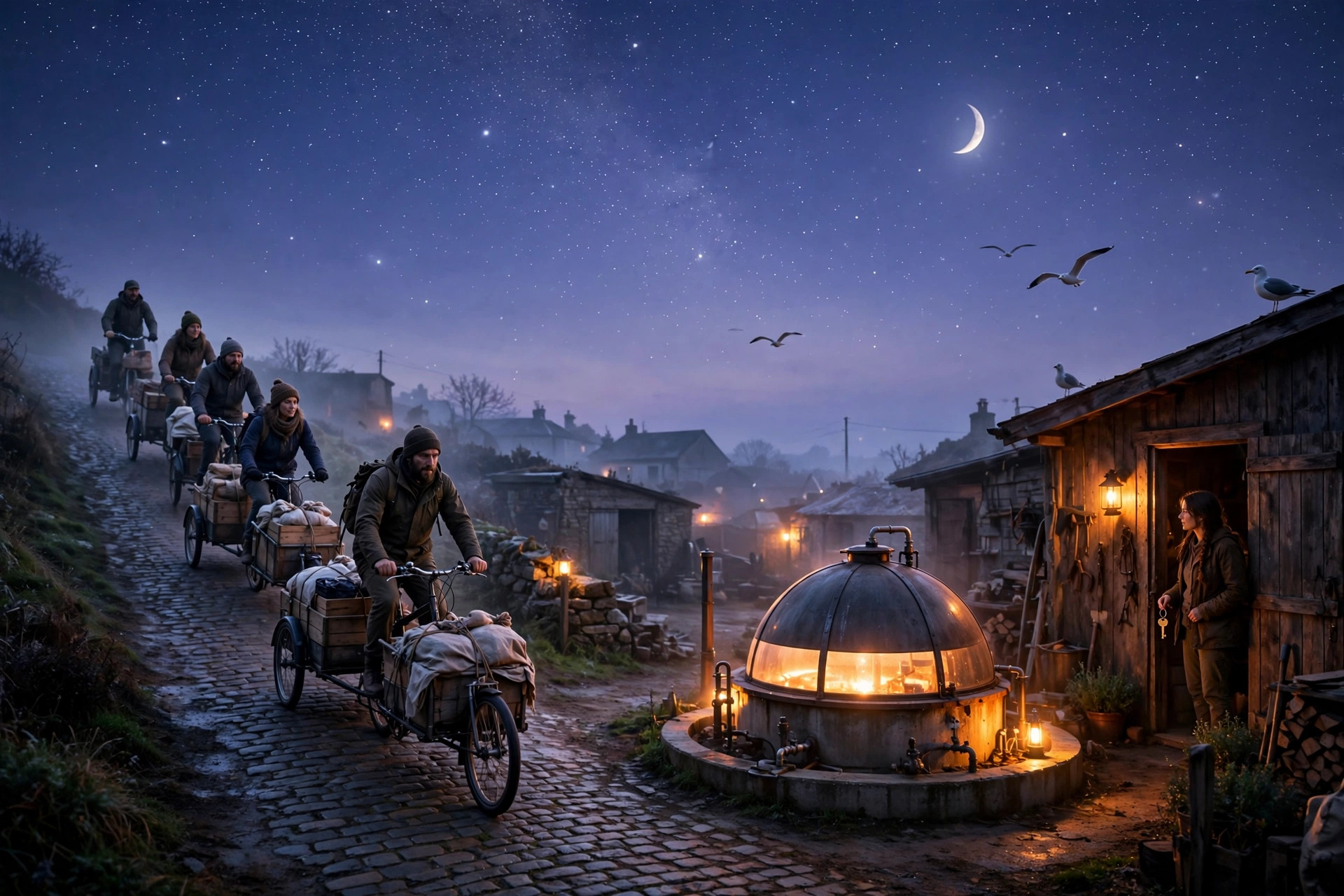
The first cargo bikes came down the hill before the gulls were properly awake, their trailers rattling over the cobbles of Cauldwell Yard with that hollow, cheerful noise Adaeze had stopped hearing years ago and only noticed now because she was listening for something else. She stood at the shed door with the yard key in her fist, its brass teeth worn so smooth they barely caught the lock. Behind her the digester dome sat on its concrete ring like a sleeping animal, faintly warm, breathing its slow gas into the holder.
Baptiste rode in third, as he always did, because he liked to see the first two arrive safely. He swung off before the bike stopped and caught the trailer handle with one hand.
"Bressing's heavy today. Someone had a wedding."
"Or a funeral."
"Too much cake for a funeral." He tipped the bins onto the steel lip of the intake table, and the morning's scraps slid out: rice gone grey, onion skins, a whole tray of iced sponge sagging under its own weight. A plastic cake board came with it, and a ribbon, and a tiny bride and groom in hard white resin.
Kofi picked the couple out before anyone else saw them and stood them upright on the oak rail. "They made it this far."
"Leave them there," Dolores said from the urn. "Every table needs a chaperone."
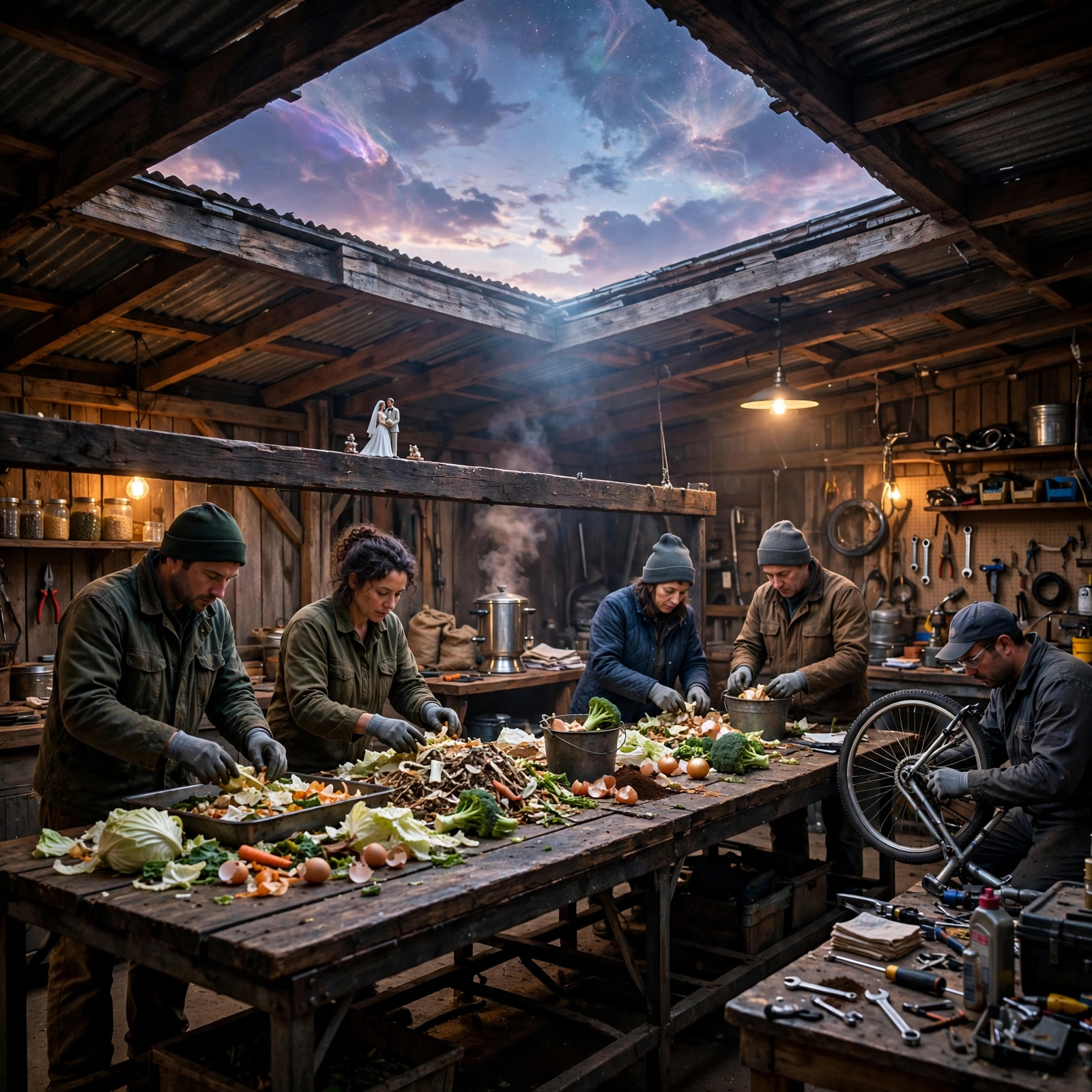
The table ran most of the length of the shed, oak planks from the old tannery floor bolted to a steel frame that Baptiste and Dolores had built the yard's first summer, when nobody yet believed a neighborhood could feed its own gas main. The wood had gone dark and soft along the near edge where hands rested. Gloved neighbors worked both sides of it in the mornings, pulling out what didn't belong: fruit stickers, twist ties, bread bags, a phone charger once, a set of false teeth twice. What passed went down the chute to the macerator and on into the dome, where the bacteria didn't care about weddings.
Adaeze pulled on gloves and took a place opposite Kofi. He worked fast and talked faster, sorting the way he rode, with his whole body.
"Tanner's Lane is flooding again," he said. "The reedbeds are taking it, but I had to walk the bike through the low bit. Mrs. in the yellow door gave me a jar of pickled something."
"Pickled what?"
"I didn't ask. It's rude to ask."
Baptiste had flipped his bike in the bay and was easing a stiff link with his thumbs, his glasses pushed up into his hair. Adaeze watched his hands for a moment longer than she meant to and then found a teabag string to pull out of the rice. She knew the shape of the moment well enough by now: she would look, he would almost look back, and one of them would find a reason to talk about chain lube.
"You've got that face," he said, without turning around.
"What face?"
"The one where you've rehearsed something in the shower."
"She's coming at nine."
He set the bike down on its wheels and turned. "Then it's a good thing the table's clean."
Nkem Halvard arrived at five past, on foot, which Adaeze hadn't expected. She wore the utility's green jacket zipped to the chin and carried a slate under her arm, and she paused at the gate to look at the dome with an expression Adaeze recognized from engineers and grandmothers: fond and assessing at once.
"It's a good little plant," Nkem said, by way of greeting. "I mean that. The gas quality on your feed is better than half the region's."
"That's the table," Dolores said, and handed her a cup of tea she hadn't asked for.
Nkem took it. "Thank you. I'd like to show you all something, if you've got ten minutes."
They had more than ten. The riders who'd finished drifted in from the bays, still in their reflective vests, and Adaeze counted them without meaning to, the way she always did. Fourteen riders on the routes, and most of them standing in her shed now, smelling of cold air and onion.
Nkem propped the slate against the urn and woke it. A rendering bloomed across the screen: a long, low hall in pale timber where the shed stood now, a second dome beside the first, both sealed, and at the front a loading bay where a small electric truck backed up to a hopper.
"Curbside bins, collected by truck on a fixed schedule," Nkem said. "Into a sealed intake. Optical sorting and a screw press pull the contaminants. Nothing's open to the air from the bin to the dome. That matters. Every time you tip a trailer onto this table, you lose a little methane and ammonia to the sky, and the neighbors on the east side lose a little sleep to the smell." She swiped, and two curves rose side by side on the screen, one well above the other. "Higher throughput. More gas into the district main. Lower fugitive emissions. And nobody has to stand here in January with frozen fingers picking plastic out of curry."
"I like January," Kofi said.
"You're young." Nkem smiled at him, and it seemed real. "I've run volunteer programs in three towns. They're wonderful until the one person who holds them together gets tired, or sick, or moves away. Then the feed gets dirty, the plant gets fragile, and the utility gets the phone calls."
Adaeze felt Baptiste shift beside her. She knew what he would say if she let him, and she knew it would be true and that it would sound like a man defending his bicycle.
"The riders aren't volunteers," she said. "They're paid. A route stipend each."
"I know. And the plan keeps a budget line for community roles at the new hall." Nkem's voice was patient, a voice that had sat through a lot of meetings. "Education, tours, outreach."
"Tours," Dolores said into her cup.
Adaeze looked at the table. The little resin couple stood on the rail, slightly crooked. She thought about what she wanted to say: that the bikes went down lanes no truck could take, that the riders knew which house had the new baby and which had stopped answering the door, that half the reason the feed was clean was that people sorted better when they'd hand their scraps to someone they knew. She thought about the district vote, and about how a fight now would make the utility dig in, and about how tired she was of being the one who always stood up.
"What are you asking for," she said.
"A trial. Run a portable sealed intake alongside your line for a week or so. Truck-collected bins from a few streets go straight in, no hand sorting, and we compare. Real numbers, from this yard, before the district decides." Nkem spread her hands. "If your table beats my machine, I'll say so in the room."
Behind Adaeze, someone's vest crackled as they folded their arms. Baptiste said nothing. That was worse.
"Which streets?"
"We'd start with a couple of the heavier routes. Fewer riders needed for the trial period."
Kofi's hands had stopped moving in the rice.
Adaeze reached for the lanyard at her neck and found the cord gone thin where it rubbed against the key. It had frayed through on one side. She untied it, slipped the key off, and knotted the cord again, shorter, while everyone waited. The brass was warm from her skin.
"All right," she said. "A trial."
Nkem let out a breath that might have been relief. "Thank you. Honestly." She reached into her jacket and drew out a tag on a loop of orange cable tie, the utility's logo printed on it beside a line of small black text and a scannable code. "This marks the table as a baseline station. It just tells my team which line is which when they log the feed."
She didn't hand it to Adaeze. She walked down the length of the table, past Kofi and the cake board and the little couple on the rail, and looped the tag around the steel frame at the near corner, where the oak was darkest from years of resting hands. She pulled the tie tight with a short, practiced click.
The tag swung once against the leg and went still.
Adaeze put the key back on its cord and the cord back around her neck. Across the shed, Baptiste was looking at her, and this time she was the one who looked away first.
Trucks at Dawn
The first truck came up the lane with its headlights still on, though the sky over the reedbeds had already gone the color of dishwater. It made almost no noise. Adaeze heard the tires before the motor, a wet hiss on the cobbles, and then the soft electric whine as it slowed for the yard gate she had unlocked herself, twenty minutes earlier, with the worn brass key that now lay against her sternum.
A second truck followed. Both were the utility's white, with green bands along the side and the bins already clamped in rows on their flatbeds, lids shut, each one stickered with a code. They'd been out since before light. They had gone down streets where, on any other Thursday, a rider would have knocked on a door, asked after somebody's knee, and lifted the scrap caddy into the cargo box by hand.
The trucks reversed toward the new unit by the hall. It had arrived on a low-loader late the evening before: a squat steel module the size of a garden shed, sealed seams, a hopper mouth with a rubber skirt, a conveyor folded against its flank like a cricket's leg. In the half-light it looked clean in the way hospital equipment looked clean. Someone from the utility crew was already unfolding the conveyor, and the end of it reached across the yard toward the intake shed doors.
Behind her, a bell rang twice. Then a third time, sharper.
Baptiste rolled his bike through the side gate with the box empty and the canvas cover still strapped down. He wore the reflective vest he'd patched at the shoulder so many times it had become a kind of map. He stopped beside her and watched the first truck tip its bins, one by one, into the hopper. The rubber skirt flexed, swallowed, closed. Nothing showed. That was the point of it.
"Hollins Road," he said. "And the whole of the top end of Bressing. I went to pick up and the caddies were gone. Mrs. from the corner house, the one with the parrot, came out in her dressing gown to ask if I'd been sacked."
"You haven't been sacked."
"I know that. She doesn't." He took his gloves off, finger by finger. "She'd put a note in the caddy. For me. Said her grandson was visiting and could I mind the eggshells because she'd been doing them in the oven again. Now that note's in there." He nodded at the module. "With whatever else."
The conveyor clicked into its last joint. One of the utility crew walked its length toward the shed, measuring with his eyes, and stopped at the threshold where the sorting table stood across the aisle like a bar in a pub.
Nkem came out of the hall office with a tablet in one hand and a paper cup of coffee in the other. She looked like she had slept, which Adaeze resented a little. She raised the cup in greeting.
"Good morning. It went in clean," she said. "No jams, no odor at the skirt. The seal's holding." She turned to Baptiste. "Mr. Ferrand. I hope nobody's route caused a fuss this morning. We sent notices."
"Notices," Baptiste said.
"Through the district app, and paper to every door on the trial streets." She seemed to mean it as a courtesy. "I know it's an adjustment."
The crewman leaned in the shed doorway. "Ms. Halvard, the feed line needs to run through here to the secondary tank. Table's in the way."
Nkem looked at the table, then at Adaeze. To her credit, she didn't pretend not to understand what it was. "We need the aisle for the length of the trial. That's all. Could we move it against the wall? I'll have the crew do it carefully."
"The crew won't touch it," Baptiste said.
Adaeze felt the morning tilt, the way it did when she knew she was about to be the person in the middle. "We'll move it," she said. "Us. Not the crew."
Inside the shed, the light came through the high plastic panels in grey stripes. The table ran most of the length of the room, the oak gone dark and smooth along the edges from years of forearms, the steel legs bolted through, the old plane marks still faint under the varnish if you knew where to look. The orange tag hung from the near leg where Nkem had pulled it tight. Below it, someone had stuck a second label in the night, white with red print: RELOCATE FOR TRIAL. DO NOT DISMANTLE.
Dolores was already at the far end, filling the urn from the standpipe, her cardigan buttoned wrong. She didn't look up when they came in.
"They told me at six," she said. "A boy in a hard hat. Very polite." She set the urn lid down. "I said, you'll have to wait until I've had my tea, and he waited."
Baptiste took the far corner without a word. Adaeze took the near one, the one with the tags. They lifted. The table had always been heavier than it looked; that was Baptiste's doing, the steel cross-bracing he'd added the first summer after a rota of retired men leaned on it all at once and it bowed. It came up off the concrete with a groan, then a scrape as one foot caught, and they walked it sideways in short shuffles, Dolores steering with one hand on the oak and the other holding her mug clear.
Halfway across, Baptiste said, low enough that only she could hear, "You could have told me which streets."
"I didn't know until last night."
"You could have rung me last night."
"And said what? That I'd agreed to it?" Her grip slipped on the steel; she caught it. "You were there when I agreed."
"I was there when you said yes to a comparison. I wasn't there when you said yes to trucks on Hollins Road at five in the morning with a note from a woman with a parrot in the bin." He set his end down a hand's width from the wall. The table jarred. "Fourteen of us, Ada. Fourteen riders, and this morning two of us had nothing to carry."
She lowered her end. The tags swung against the leg.
"If I'd said no," she said, "she'd have gone to the district with her slides and her emissions curves and no data from here at all. Just the other towns. Just the clean pictures. And they'd have voted on that." She heard herself and hated how reasonable it sounded. "This way at least our numbers are in the room."
"Our numbers." He laughed, short. "Her machine's not counting the note."
"Baptiste."
"You stood up for this place for years." He wiped his palms on his vest. "Last week you sat down. That's all I'm saying. I'm allowed to notice."
She wanted to say that she was tired, that every fight in this yard had been hers to start and hers to finish, that she had thought, for one evening, that maybe someone else's careful plan could carry some of the weight. She wanted to say she'd noticed him noticing her, for longer than either of them would admit. She didn't say any of it. He was close enough that she could smell chain oil and the cold on him, and she stepped back first, because that was easier.
The table sat against the wall now, its long edge to the breeze-block, the aisle bare behind it. The concrete where it had stood was paler, a ghost rectangle scuffed at the corners, a scatter of rice and a lone yogurt-pot lid along one side.
Nkem stood in the doorway. She had been there for some of it; Adaeze couldn't tell how much. The crewman came past her and began bolting brackets to the floor for the feed line, his drill a thin whine that filled the shed.
"Thank you," Nkem said. "I mean that. I know this table matters." She hesitated, then looked at Dolores, at the urn, at the cardigan. "But it matters because people show up to it, and people don't always show up. I've watched volunteer sites go under in a single bad winter. A hip goes, a rota collapses, and the feed goes to landfill for a month. The module doesn't get the flu." She tapped her tablet. "Every bin is logged going in. Every batch. Whatever happens this fortnight, it'll be on record. For both of us."
"I've had the flu," Dolores said. "I still came. Somebody brought me soup and I sorted with a scarf over my face."
"I believe you." Nkem's voice was gentle, and that was the worst part. "I'm not sure the district can plan around it."
She went out to watch the second truck unload. Through the doors Adaeze could see the hopper skirt opening and closing, opening and closing, swallowing lids she would never see lifted, scraps she would never see.
Baptiste picked up his gloves from the table's edge. He looked at the ghost rectangle on the floor, then at her. For a moment she thought he'd say something else. Instead he touched the oak once, flat-palmed, the way you'd settle a nervous horse, and walked out to his empty bike.
Dolores set her mug on the windowsill. From under the urn trolley she dragged the old green tarp they used when the roof panels leaked, the one with the grommets gone at one corner and the faded name of a builders' merchant along its hem. She shook it out. Grit and a dried leaf fell from its folds.
"Help me with this end," she said.
Adaeze took it. Together they drew the tarp over the table from the wall side outward, smoothing it down over the oak, over the plane marks, over the place where Kofi always stood. At the near corner, the orange tag and the white label pushed up a small tent in the cloth. Dolores pressed the tarp down around the steel leg with both hands and held it there, as if it might lift on its own.
Ostgate Badge
The smell reached Adaeze before the alarm did. It met her halfway across the yard: sour and sharp, a vinegar note under the usual low farmyard sweetness of the hall. She was running before she knew it, the yard key bouncing on its shortened lanyard against her breastbone.
Inside, the panel by the door was blinking amber. Nkem stood at the sight glass on the second tank with her tablet held against her chest. Behind the thick glass a grey froth had climbed nearly to the top of the window, packed with tiny bubbles that didn't rise or break. They only sat there.
"It's foaming," Nkem said without turning. "Since about four. The overnight load from the module went in at two."
Adaeze put her palm flat on the tank wall. It should have been warm and close to living, the way a cow's flank is warm. It was warm, still, but the faint tremor of mixing felt laboured, as if the paddles were working through porridge. Up on the gas holder the dome hung lower than it had any right to on a weekday morning, the fabric slack along one side.
"Have you dosed it?"
"Antifoam, twice. It's holding but it isn't dropping." Nkem finally looked at her. There were creases under her eyes that hadn't been there on the first day of the trial. "I've paused the feed. Nothing else goes into number two until I understand it."
"You don't understand it?"
"I understand that something in the load upset the culture. Fats, maybe. A cleaning product. A cold slug of feed on a cold night." She lifted the tablet a little, as if it might speak for her. "Everything's logged. I'll go through it."
Adaeze wanted to say that she knew what was in the load, or at least what wasn't taken out of it. She wanted to say lids, bags, the crushed tins of degreaser people threw in with their peelings when no one was looking at their bin. But she had agreed to this. She had stood in her own shed and helped Dolores pull a tarp over the table so there wouldn't be a fight. So she said nothing, and the sour smell sat in the back of her throat.
The side door banged. Baptiste came in wiping his hands on a rag, Kofi just behind him with his helmet still on, the strap undone and swinging.
"Smells like a pickle factory," Baptiste said. He went straight to the glass, looked, and his face shut. "Ah. No."
"It isn't lost," Nkem said. "Not yet."
"How long before you know?"
"Days. It depends how the culture responds once the feed's off. We'll see it in the gas." She glanced up at the slack dome. All of them did.
Kofi took his helmet off and held it by the strap against his leg. He had a scab across one knuckle from a bin lid, and a smear of chain grease along his jaw where he'd scratched it. "Is the other tank all right?"
"Number one's fine. It was on rider feed." Adaeze heard herself say it and saw Nkem hear it too. Nkem's mouth tightened, though she only nodded and wrote something down.
"That doesn't mean anything on its own," Nkem said. "Different loading, different day. I'm not going to draw a line from a sample of one."
"Nobody's drawing anything," Baptiste said.
"Good." She lowered the tablet. "Because there's a second problem and I'd rather say it now than have you hear it from the district office. If number two's down, the yard's gas sales drop for the month. The route stipends come out of that pool." She looked at Adaeze, then, carefully, at Kofi. "With the trucks covering Hollins Road and the top of Bressing, the riders are carrying less. The office's rule is that the stipend follows the tonnage. Somebody's route comes off the sheet this week."
The paddles in number two laboured on. Up in the roof a gull walked across the panels, its feet ticking.
"Somebody," Baptiste said.
"Last on, first off. That's the office's rule, not mine." Nkem's voice didn't waver, but she wasn't enjoying it. "I asked whether it could wait until after the vote. It can't. I'm sorry."
Kofi laughed once, very short. "That's me, then."
"Kofi." Adaeze stepped toward him and didn't know what to do with her hands. "I'll talk to the office."
"And say what?"
She had nothing to put after it. He watched her try, and that was almost worse than if she had argued.
Nkem took something from the pocket of her jacket. It was a lanyard in utility orange, the same colour as the tag on the table leg, with a plastic badge on the clip. "There's a depot crew at Ostgate short of hands," she said. "Proper contract, shift pay, sick days. They need people who know feedstock. I put your name forward on Monday. I didn't know then it would come to this. I thought you might want the choice."
"You put my name forward on Monday." Kofi turned the helmet over in his hands. "Before any of this."
"You're good at the table. Anyone can see that. I'd rather you were paid for it than not."
Baptiste made a sound in his chest, not quite a word. Adaeze felt him at her shoulder, close enough that his sleeve brushed hers, and neither of them moved away.
"The depot," Kofi said. "That's the trucks."
"That's the trucks."
He was quiet a long time. Adaeze could see him doing sums he wouldn't say out loud: rent on the flat above the launderette, his mother's bus fares, what the stipend had been and what it was now. He'd grown up three streets from the yard. He'd sorted at the table on school holidays before he was old enough to ride, standing on a crate so he could reach.
"I'll go look at the shed," he said.
They followed him, all three, though nobody had asked them to. The intake shed was dim and smelled of plastic and wet cardboard. The module's feed line ran down the middle of the aisle on its new brackets, sealed and silent. Against the far wall, the green tarp lay over the long shape of the table, the little tent still pushed up at the near corner.
Kofi went to it. He took hold of the tarp's edge and drew it back, slowly, from the near end to the wall side, the reverse of how Adaeze and Dolores had laid it. Grit slid off the folds onto the floor. The oak came out from under it pale and scarred, the plane marks catching what light there was, the dark patch at the middle where he always stood worn smoother than the rest.
He folded the tarp in halves, then halves again, corners squared, and set it on the end of the table. Then he unslung his rider bag.
It was the old canvas kind, waxed, with a reflective strip Baptiste had stitched on after the first winter and a patch on the flap where the buckle had torn through. Kofi held it for a second against his stomach. Then he held it out to Adaeze.
"You'll need it for whoever comes next," he said.
"There isn't anyone next."
"There will be." He pushed it gently toward her until she had to take it or let it fall. The canvas was warm from his back. "Fourteen riders. Now there's thirteen. Somebody'll fill it."
She took it. It weighed almost nothing empty. That was what undid her, more than the smell or the slack dome: how little it weighed.
"You've got till the vote," Baptiste said roughly. "Twelfth day. Things can change."
"Things can change at Ostgate too." Kofi smiled, and it was a real smile, which hurt. "I'm not leaving town, Baptiste. I'm going to a different shed."
He turned to Nkem and held out his hand. She looked at it, then put the orange lanyard into it instead of shaking. He hung it round his neck. The badge sat against his jersey, a small square of plastic with the utility's leaf mark and a blank line where his name would be printed.
"Shift starts at six," Nkem said. "Ask for the intake supervisor."
"I know where Ostgate is."
He went out. Through the open doors they watched him cross the yard to his bike, swing a leg over, and clip his helmet at last. Nkem's tablet chimed in her hand; she looked down at it, frowned, scrolled back, and looked again for longer than Adaeze expected. She didn't say anything. She tucked it under her arm.
Baptiste's hand found Adaeze's elbow, just for a moment, the way he steadied a frame on the stand before he trued a wheel. She let it stay there.
At the gate Kofi stood on the pedals. The orange badge swung out on its lanyard, caught the low sun, and flashed once as he turned down the lane toward Ostgate.
Scrubbed Oak
Dolores had the brush going before Adaeze had the bucket set down, working the stiff bristles along the grain in short strokes, the way she'd taught a hundred volunteers and corrected most of them. The table still stood against the shed wall where the trial had shoved it. Someone had used its far end as a shelf for the module's spare filter cartridges, and the boxes had left pale squares in the grime.
"Not in circles," Dolores said. "You'll lift the soft wood out of the plane marks."
"I know."
"You've been scrubbing in circles since you got here."
Adaeze straightened. The folded letter in her jacket pocket crackled when she moved, and she pressed it flat with her palm without meaning to. Kofi's bag hung from the hook by the door, the reflective strip catching the grey morning. Nobody had taken it down. Nobody had said they wouldn't.
By the urn, a handful of neighbors stood with their mugs: the man from the flats above the bakery who still brought his scraps in a biscuit tin, two of the Bressing riders out of their jerseys because there was nothing for them to ride, a woman with a toddler's spoon sticking out of her coat pocket. They'd come because Dolores had told them the planner was coming at nine. Dolores told people things, and they came.
Nkem arrived on time, tablet under her arm, a thermos of her own. She nodded to the room, took in the brushes and the wet oak, and didn't ask. Baptiste came in behind her with grease on his knuckles and a spoke wrench still in his back pocket. He stopped by the door when he saw Adaeze's face.
She hadn't rehearsed it aloud. That had seemed like the only way she'd actually do it.
"Before the review," she said. "I'm stepping down as lead. Effective today."
The bakery man lowered his tin. One of the riders said, "What?" under his breath.
"The lead post carries a stipend. It comes out of the same yard budget as the routes. If the post's empty, the money goes back to the route fund, and that's enough to put the cut routes back on." She took out the letter and set it on the dry end of the table, because her hand wanted something to do. "I've sent it to the office. This is the copy."
"Adaeze." Baptiste, quietly.
"Somebody still has to coordinate," Nkem said. She didn't sound triumphant. She sounded like a planner finding a hole in a schedule. "If there's no lead, the yard falls under the regional desk by default."
"Then it does. Dolores runs the rota already. The riders know their routes better than I do." Adaeze lifted the lanyard over her head. It snagged on her ear; she'd tied it too short after it frayed. The brass key swung free, its teeth worn so smooth she sometimes had to jiggle it twice in the hall lock. She held it out to Dolores.
Dolores looked at it for a long moment and didn't wipe her hands first. She took it wet. "You're a fool," she said, and closed her fingers around it.
"Probably."
"Thirteen riders," said one of the Bressing pair. "We'd all be back?"
"Everyone still on the list." Adaeze didn't look at the hook by the door. "Then the vote's on the twelfth day, and the district decides what it decides. But it'll decide with the routes running."
Nkem set her thermos down. "That's generous. It doesn't change the numbers. The sealed hall makes more gas and the emissions picture is cleaner. Volunteer schemes thin out. People move, they get tired, they get other jobs." She did look at the hook. "As we've seen."
"Then let's talk about the numbers," Adaeze said. "You said every bin going into the module is logged."
"It is."
"Open the intake log. Hollins Road and the top of Bressing, the night tank two went."
The urn ticked as it reheated. Nkem didn't move for a while, and Adaeze understood, from the stillness, that she'd already looked. Two days ago, by the doors, frowning at the screen while Kofi rode away.
Nkem woke the tablet and turned it around.
It was a long scroll of bin records, each with a tiny thumbnail from the intake camera: the scanner's false-colour picture of whatever had tipped down the chute. Most rows were plain. Some were flagged amber. Adaeze had expected a few. There were runs of them, and they clustered. Cling film balled around chicken bones. A whole bag of something greasy that the scanner had marked as fat and surfactant. Coffee pods. A tangle of produce netting. A row where the camera had caught what was unmistakably cat litter, still in its liner.
"Flagged," Adaeze said. "And accepted."
"The thresholds were set for pre-sorted feed." Nkem's voice was level, but her thumb kept scrolling past the point where she needed it to. "The module assumes upstream separation. It warns. It doesn't reject at that rate, or it would choke itself."
"Upstream separation." Dolores laughed once, without humor, and slapped the wet oak. "That's this. That's us."
"Pull up tank one's feed," Baptiste said from the door. "Same nights."
Nkem did. The rider-fed records came from the table's weigh station, the cheap scanner Baptiste had bolted over it the second winter, and they were almost dull: food, food, a flagged lid, food. The same streets on other days. The same households. The difference wasn't the neighborhood. It was whether a person had stood at this table with gloves on and pulled the film out.
The woman with the spoon in her pocket leaned in to see. "So the foam was the bins nobody looked at."
"The foam was the fats and detergents, and the plastic fouled the mixer," Nkem said. "Yes. From the unsorted bins." She set the tablet down on the dry corner, next to the resignation letter, and for the first time since she'd come to Cauldwell Yard she looked tired. "I'll have to put this in the review. All of it."
"Will you put it to the board before the vote?"
"I'll put it to the board. I can't tell you what they'll do with it. I can't tell you what I'll recommend yet either." She picked up her thermos, then didn't leave. She crouched by the table's near leg instead, and with a thumbnail she peeled off the label that said RELOCATE FOR TRIAL. She left the orange baseline tag where it was. She folded the label sticky-side in and put it in her pocket.
"Thank you for the tea," she said to Dolores, who hadn't given her any, and went out.
The neighbors drifted after her in ones and twos, talking low, the riders already arguing over whose route went back on first. Dolores went to the urn and stood with her back to the room, turning the brass key over and over in her fingers.
Adaeze picked up the brush again. Her hands were shaking now, which seemed unfair. Baptiste came to the other side of the table and took the second brush from the bucket, and they worked toward each other along the grain, not in circles, until the last grey streak lifted out of the plane marks and the oak showed pale and clean all the way across.
"You didn't tell me," he said.
"You'd have argued."
"I would." He put his brush down. "I'd have lost."
"You don't get paid either, Baptiste."
"I'm aware." He was close enough now that she could smell the chain oil on him. "Seven years you've been carrying that key around like it was holding you up."
"It was."
"Then lean on something else."
He reached across the scrubbed wood and touched her jaw with the back of his knuckles, the clean part, and waited. She was the one who closed the distance in the end. The kiss tasted of the shed's cold air and his coffee, and it was careful, and then it wasn't. Her hip pressed against the damp edge of the table. Somewhere behind them the urn clicked off.
"Finally," Dolores said, not turning round. "Now get it off the wall."
Baptiste laughed against Adaeze's temple. They took an end each. The table was as heavy as it had been the first summer, when he and Dolores had bolted the steel to the oak and planed it in the yard with half the street watching. They walked it out of the corner a little at a time, the feet scraping the concrete, Dolores calling left and left again, until it sat square under the skylight in the middle of the shed, where the floor was worn into a shallow dip from years of people standing at it, and its legs dropped into that dip like they'd never left.
Wet Concrete
The barrow came up the ramp with its wheel squealing, and Baptiste tipped it before Adaeze had finished saying wait. Grey wet mix slid into the shuttered trench at the new hall's doorway and slumped there, heavy and glossy, settling into the corners of the boxing like it was making itself comfortable.
"I said wait."
"You said it after." He set the barrow down and wiped his forearm across his brow, leaving a pale smear. "It's in now. Nobody's wheeling it back out."
Behind him the hall stood half-finished against a low white sky: steel ribs, a roof skinned on the north side only, the sealed module squatting in the middle of the slab under tarpaulin. Gulls had already found the open trusses. Somewhere inside, a contractor's radio played to nobody.
Nkem stood at the edge of the trench with her tablet against her chest. She'd come straight from the board in her good coat, and the hem was already spattered.
"If the district votes it down," she said, "that footing gets broken out with a jackhammer next week. I want everyone to understand that before you put the table in it."
"We understand it," Dolores said from the folding chair she'd planted beside the urn. Somebody had run an extension lead out from the site cabin so the urn could come too. "We heard you the first time. And at the board this morning."
"Then I'll stop saying it."
Adaeze looked down at the concrete. Her own voice from the morning was still in her ears, too loud in that carpeted room, the slide of Nkem's intake logs projected behind her while she pointed at each flagged bin, Hollins Road, the top end of Bressing, accepted, accepted, accepted. She'd watched two of the board members look at Nkem rather than at her while she talked. Nkem had sat through it without moving. Then she had stood up and said, in her flat, careful way, that the figures were the figures, and that she recommended the hybrid with conditions. Paid sorters on a fixed rota, not goodwill. A reject chute. A review in a year.
It hadn't sounded like surrender. It had sounded like a planner rewriting a plan, which was worse, because it meant she might still be right about everything else.
"Has it come through?" Baptiste asked.
Nkem woke the tablet, glanced, and shook her head. "District's still counting the ward returns. Bressing's in. The river wards aren't."
"Which way did Bressing go?"
"I'm not reading out partials."
"Nkem."
"I'm not." She turned the screen face-in. "If I read you a good one and the river wards sink it, you'll all hate me twice."
Dolores snorted into her tea. "Only twice."
The table waited on the trolley in the yard, upended, legs to the sky like something on its back. Someone had scrubbed the steel feet with a wire brush until they shone. The orange baseline tag was still tied round the near leg, faded to the color of a dried apricot. Thirteen bikes leaned along the fence beside it, trailers unhitched, their riders standing about with their hands in their pockets in the way people do when they've been told to help and there's nothing yet to lift.
Thirteen. Adaeze had counted them coming in, and then counted them again, as though a different answer might arrive.
"Concrete won't wait for the river wards," Baptiste said quietly, at her shoulder. "If we're doing it, it's now."
She felt the decision sit in her chest. If the vote went the wrong way they'd have set a table in a doorway that led nowhere, and every neighbor here would watch it get cut out of the ground. If they waited, the footing would go off around nothing and the hall would open with a blank threshold and a chute.
"Everyone," she called. "On the table."
They came. Riders took the corners, two neighbors from Tanner's Lane took the long sides, and Dolores stood up out of her chair, which she wasn't supposed to do, and put one hand flat on the oak as though that were lifting. They rolled the trolley to the trench lip and turned the table upright between them in one slow tilt, the oak groaning on its bolts.
"Left," Dolores said. "Left. Your left, not mine."
The feet went in. The concrete took them with a soft, sucking reluctance, rising round the steel in a grey collar. Baptiste crouched with the spirit level, frowned, tapped the near end down with the heel of his hand, frowned again.
"Near leg's sinking."
"It's the tag side," somebody said. "Always was the heavy end."
"Hold it." Baptiste got a length of batten under the stretcher bar and leaned on it, and two riders leaned with him, and the bubble crept back toward center and stopped there, trembling. "Nobody let go."
Nobody let go. They stood around the table holding it level in the wet ground, a dozen hands on wood and steel, and the tablet buzzed in Nkem's grip.
She looked at it a long time. Long enough that Adaeze's arms began to ache.
"Well?" Dolores said.
Nkem lowered it. Her face did something complicated. "River wards came in heavy. It passes. Hybrid, with a neighbor sorting intake at the hall door." She cleared her throat. "And the conditions. All of them. I'm going to hold you to the rota."
Nobody cheered at first. It was more like a long exhalation going round the table, hands loosening and then gripping again because Baptiste barked at them. Then one of the Tanner's Lane neighbors laughed out loud, and the riders by the fence started banging their bells, and the gulls went up off the trusses all at once in a white scatter.
"You'll have your rota," Adaeze said.
"Paid," Nkem said. "Not grateful volunteers who drift off in February."
"Paid."
Nkem nodded once, and then, as if it cost her something, she stepped forward and put her own palm on the table's edge beside Dolores's. Her good coat sleeve rode up into the grit. She didn't seem to notice.
That was when Adaeze heard the freewheel ticking down the access road.
Kofi came in through the gate slowly, on his own bike, the old long-tail with the cracked mudguard. He still had the depot's high-visibility vest on over his jumper, the Ostgate crest on the breast. He stopped well back from the crowd with one foot down and didn't get off.
"I heard," he said. "Someone posted it on the riders' channel. I was on break."
"Your break's a long way from here," Baptiste said, not looking up from the level.
"I came quick." Kofi looked at the table, at all of them holding it, at the concrete. "Is it true? About the routes?"
Adaeze nodded. Her throat had gone tight in a way she didn't trust. "Your route's funded. From today, if you want it."
"Funded how?" He looked at her properly then, and she saw him work it out, the lanyard missing from her neck, the way she stood at the corner with everyone else instead of at the head. "Oh. Adaeze. No."
"It's done."
"You can't just..."
"I did, though." She jerked her chin at the fence. "There's a gap at the end. Your bag's on the hook in the shed."
He sat there on the saddle a moment longer. Then he unzipped the vest, folded it with real care, and laid it over his handlebars. He wheeled the long-tail to the fence and leaned it in the gap, and the line along the fence was fourteen bikes again, and Adaeze didn't count it because she didn't need to.
Kofi came and took a corner from a tired neighbor without being asked.
"Bubble's good," Baptiste said at last. "Let it go. Gently."
They let it go. The table stood on its own in the doorway of the hall, legs sunk in grey, the oak catching the flat light. Somebody began smoothing the surface with a float, working toward the feet in short strokes.
Dolores came round the end of the table with something in her fist.
"I've held this two days," she said, and pushed it into Adaeze's palm. The brass was warm from her hand, the teeth worn smooth. "That's enough for me. I'm on the urn. I'm not opening gates at five in the morning."
"Dolores, it should be you."
"It shouldn't. And you know who it should be, so don't make me say it in front of him."
Adaeze turned the key over. Seven years of pockets. Of being first in and last out, of the gate's cold padlock in winter, of thinking that if she put it down the whole yard would slide off the hill.
Baptiste's shoulder found hers and stayed there.
Kofi was crouched at the near leg, pressing the concrete flush round the steel with his thumb where the float couldn't reach, the faded orange tag brushing his knuckles. She knelt beside him on the damp boards. He looked up, wary.
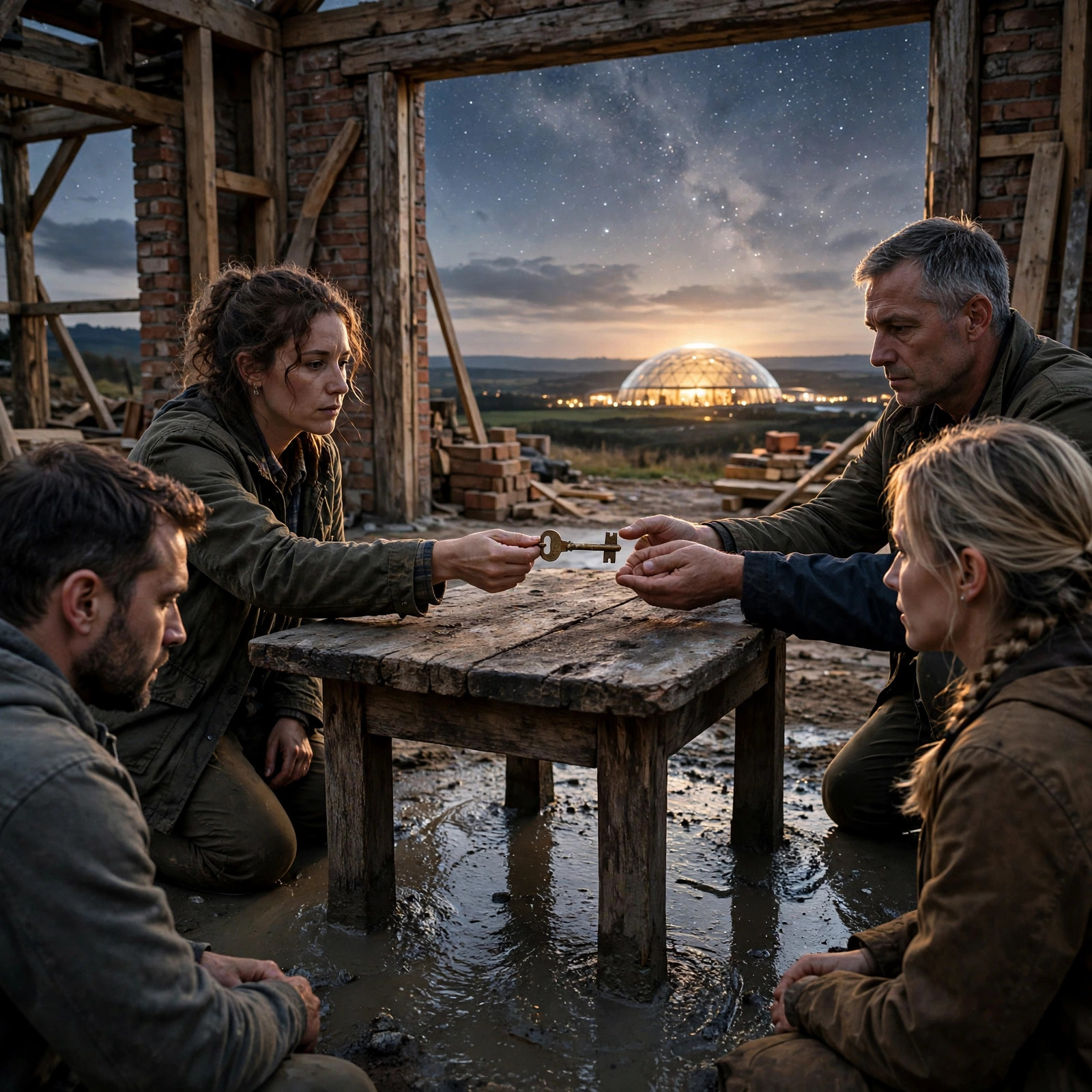
She took his grey-smeared hand, opened it, and pressed the key into it, folding his fingers shut over the brass while the footing went dull and firm around the table's feet, and the half-built hall stood open behind them, waiting for its first bins.
Get notified when new stories drop

Leo Stranek
Leo specializes in solarpunk abundance and near-future progress: livable futures, bright cities, and practical wonder.
Leave a comment
Comments