


The Coldharbour Junction
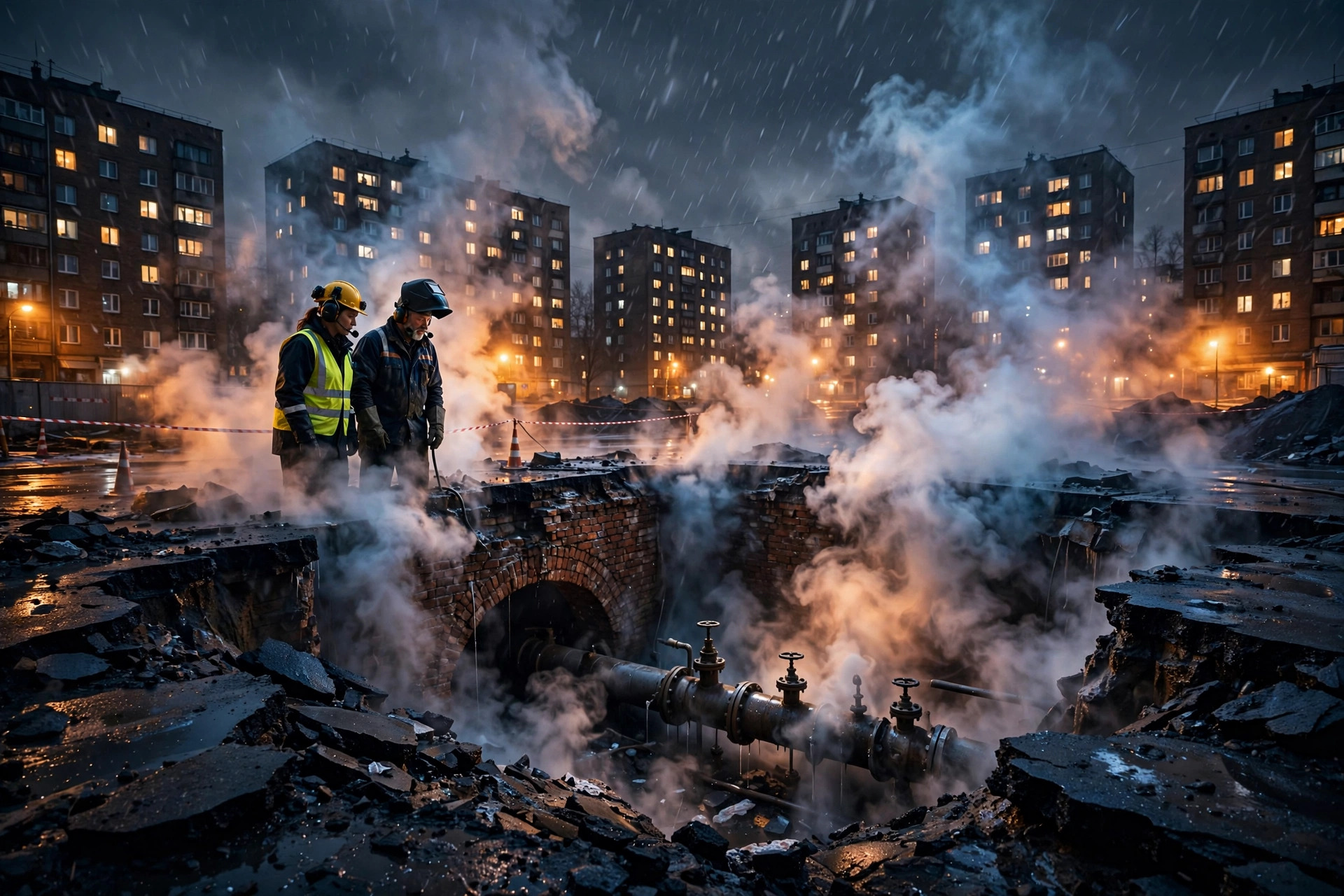
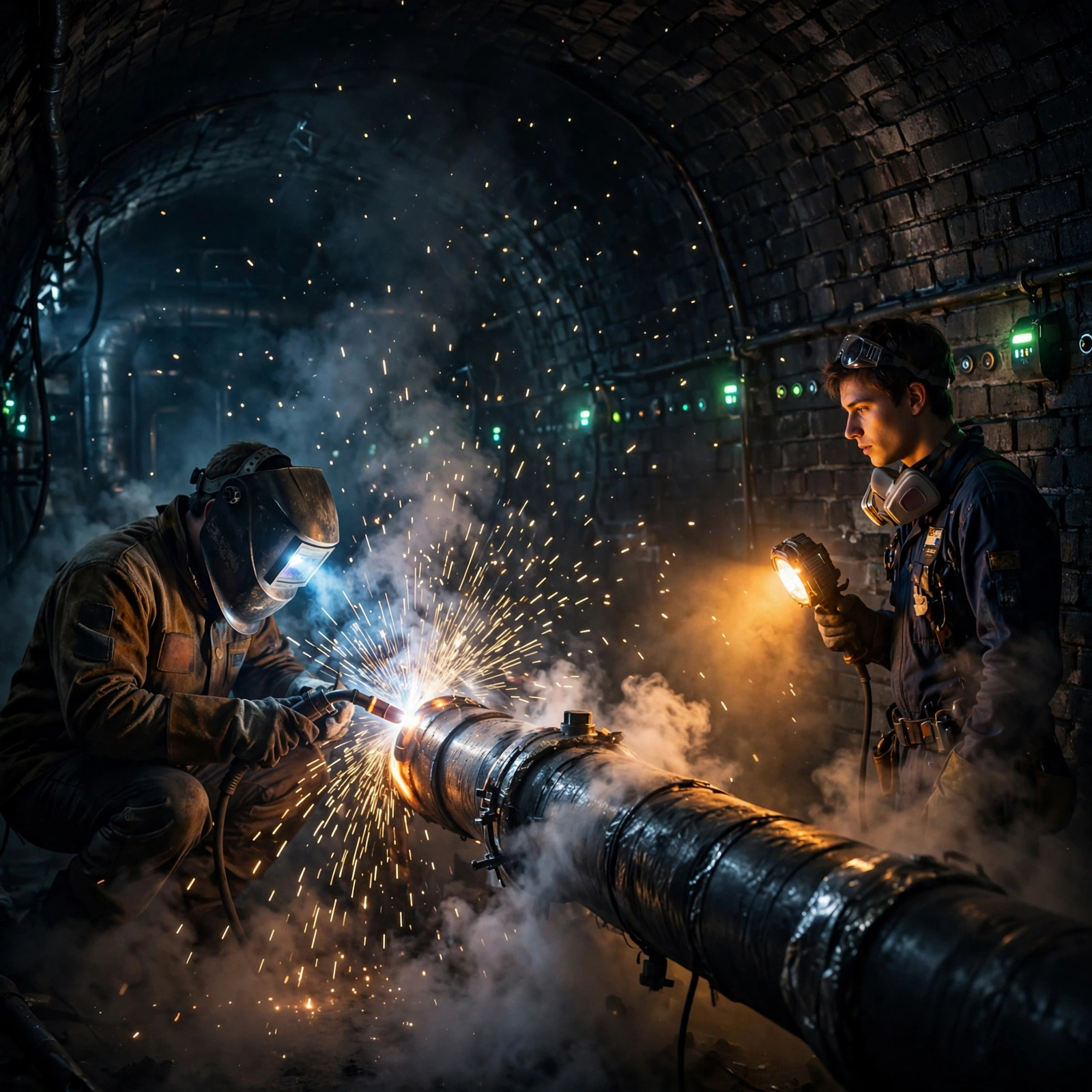
The breaker bit through the last of the frozen asphalt and Teo staggered as it punched into hollow ground. Steam came up around the chisel, thin and white, and the sleet hissed where it met the warm edge of the hole.
"Back off it," Nadia said. "Let her breathe."
He backed off. Sam swung the excavator bucket in over his head, delicate as a man lifting a lid off a pot, and peeled the broken slab away. Under it lay the old brick chamber of the Coldharbour junction, a vault of wet soot and pipe, and in the middle of it the main itself, lagged in rotten mineral wool, weeping vapor along a seam where the cold had finally found the crack.
Behind them the six blocks of the Coldharbour estate stood against a sky the color of dishwater. Lights in every window. People inside running their ovens with the doors open, Nadia guessed, wrapping children in coats to sleep, because the radiators had gone from hot to warm to a polite memory since the main tripped before dawn.
"Halyard," she said. "Talk to me."
The voice came into her headset close and level, like someone leaning over her shoulder. "Thermal storage under the estate is holding. At the current loss rate, the blocks have three days of stored heat. After that the flats start falling toward outdoor temperature, and the older residents won't wait for the flats to finish falling."
"Routes."
"Two. The safe route is a full shutdown upstream at the Kettle Street pump house, drain the section, cut out the cracked length cold, replace, refill, warm through. It's clean. It also takes longer than three days, because the drain and the slow warm-up can't be hurried without shocking the joints."
"And the other one."
"A hot tap. We weld fittings onto the live main on either side of the crack, drill through under pressure, and run a bypass loop around it. Then I close the line valves in sequence, isolate the cracked length with the steam already flowing through the loop, and you replace the bad pipe at leisure. The blocks never go cold."
Teo was grinning under his hood, sleet beading on his eyebrows. He had never seen a hot tap. Nadia had seen four, and helped on two, and on one of them a man she'd trained beside had lost the use of his left hand.
"Sequencing's the hard part," Sam said. He climbed down off the excavator and stood beside her at the lip of the pit, close enough that the heat off his jacket reached her arm. He always stood on her left. She had stopped noticing it years ago and then, at some point, started noticing it again. "You've got the valve map?"
"I have the utility's map, the pressure sensors along this run, and acoustic pickups at the chamber walls. I'll model each move before we make it."
"Model," Sam said, to no one in particular.
Nadia went down the ladder first.
The chamber was older than the map said. She knew it the moment her boots hit the brick. The pipe supports were cast iron, not steel, and the mortar between the courses had the yellow tint of the old gasworks lime they'd stopped using before her father was an apprentice. To the east, the chamber wall gave way to a bricked-up arch, and she could smell the old gasworks tunnel behind it, coal tar and cold, even through the steam.
She worked her lamp along the main. The crack was a long one, following the bottom of the pipe like a seam in a sleeve, and it breathed in pulses as the line rose and fell upstream. Not catastrophic. Not yet. Enough to keep the whole run tripped and the blocks on stored heat.
Then she put the lamp on the arch and stopped.
Low in the brickwork, half buried in a crust of rust and old lagging, a valve body sat on a short stub of pipe that came out of the main and went into the wall. It was a gate valve, the old wedge kind, its handwheel long gone and its stem capped with a square nut green with corrosion. A bypass. Somebody, decades ago, had hung a little loop off the main toward the tunnel, probably to feed something in the gasworks, and then bricked the far end and forgotten it.
"Halyard," she said. "What've you got on the east wall of the chamber?"
"Brick. Two acoustic pickups. No pipe penetrations on record."
She looked at the valve. It looked back at her, a dead iron eye.
"Nadia?" Halyard said. "Is something there?"
It was a reasonable question. It was exactly the question she would have wanted from a new fitter. The machine couldn't see in the dark the way she could; it heard pressure and temperature and the creak of metal, and on this wall it heard nothing because the little branch was shut and cold and had been shut and cold for longer than Halyard had existed.
And somewhere across Aunsby, in an office with a heater that worked, Ruth Abelard was drafting her paper for the safety board. Nadia had read the first version. It was not a stupid paper. It said the utility had let a planning system drift from advising crews to directing them, and that the maps it planned from were only as good as a hundred years of other people's paperwork. It said read-only. It said slow and safe, every time. Ruth's people would be on site tomorrow to observe the prep, and if Nadia stood up now and said the machine's map was missing a whole valve, there was a fair chance Halyard would be switched to advisory before the weekend, and the hot tap would die with it, and the six blocks would go cold on the third night.
"Old support bracket," she said. "Thought it was something else. Carry on."
"Understood."
She took a hold tag from the pad on her harness. Card stock, the orange the utility had used since before Halyard, a hole punched for the wire. She uncapped the grease pencil with her teeth and wrote on it in her blocky hand: UNMAPPED BYPASS. E WALL. STATUS UNKNOWN. DO NOT OPERATE. Then the date and her initials.
The wire stayed coiled on the pad. She folded the tag once and slid it into her inside jacket pocket, against her chest, where it sat like a second, colder heartbeat.
When she climbed back up, Sam was watching her. He didn't say anything. He had a way of not saying things that was louder than most people's arguments.
"The line valve on the upstream side," she said, to fill the space. "It's buried under the road. Old box, deep. The utility's long key won't seat on that nut, it's the old pattern."
"Halyard said the actuator's out on that one," Teo said.
"Actuator's been out since I was your age. We turn it by hand."
"With what?"
Sam was already walking to her van. She heard the back doors open, the scrape of steel on the floor bed, and he came back through the sleet carrying it across both forearms like something that ought to be handed to a priest. Her father's valve key. Taller than Teo, T-handled, the shaft black with age and the socket head brazed on in a clumsy bronze collar where her father had joined it himself, in a gasworks shed, before she was born. It had hung in her van for years, wrapped in a bit of oilcloth, and nobody had used it since the funeral.
"You kept it in the van," Teo said, wondering.
"Where else would you keep a key." She took it from Sam. It was heavier than she remembered, or she was lighter. The handle had a worn place on each side, two smooth hollows where her father's hands had gone, and her own hands went into them without being told. "He'd have liked a hot tap. He liked anything that kept the old folk warm."
Sam's glove brushed hers on the shaft as he let go. He held on half a second longer than he needed to.
"Nadia," he said quietly. "What did you see down there?"
"A bracket."
He looked at her the way he'd looked at bad welds for twenty years, patiently, without blame, waiting for the metal to tell him the truth. She held the key and let him look.
"Right," he said, finally. "A bracket."
Halyard spoke into both their headsets. "I've modeled the prep sequence. Weld positions marked, line valve order set, and I'll call each move as we go. I need the foreman's sign-off before we start welding to the live main."
Teo held out the tablet, its screen fogging in the sleet, the sequence laid out in clean green lines that knew nothing about the east wall. Nadia wiped the glass with her sleeve. Inside her jacket the folded card pressed against her ribs every time she breathed.
She pulled off her glove, set her thumb on the screen, and signed.
Steam in the Pit
The second gate valve went over with a groan Nadia felt in her teeth before she heard it, and she leaned her whole weight into the T-handle until the key stopped fighting her.
"Line valve four is closed," Halyard said in her headset. "I see pressure falling downstream. Good. Hold there."
She held there. The pit was a raw box cut into the old gasworks tunnel where the main came through the brickwork, shored with timber, lit by two work lamps clamped to the shoring. Snow had found its way down the access shaft overnight and lay in a grey rind along the top step. Below it, everything was warm. The main ran across the pit at waist height under its scabbed lagging, and the cracked section further along breathed a thin white plume into the tunnel, steady now, tamer than yesterday.
Teo was down on the pit floor with the fitting jig, marking the weld collar against the pipe with chalk, his breath and the pipe's breath mixing under the lamps. Sam stood beside him with the welding leads coiled over one shoulder and his mask pushed up on his head. He hadn't said much since the van. He'd brought her coffee, set it on the bonnet without a word, and watched her drink half of it.
"Next is line valve five," Halyard said. "That one finishes isolating the tap section. After five, the segment you're welding on sits at the low pressure I've modeled, and the welder can start the collar. Nadia, I'll call it when you're seated."
"Seating." She lifted the key out of the first box and walked it along the tunnel to the next. It dragged at her shoulders. Her father had been a broader person than she was, and the key had been made to his reach, so she had to choke up on the shaft and lean forward over it like a woman pushing a plough. The socket dropped down into the dark of the valve box and found the nut on the second try. She felt it bite.
Behind her, in the east wall, the bricked arch sat in the edge of the lamplight. She didn't look at it. She'd decided not to look at it on the walk in that morning, and she was a person who kept to things she'd decided.
The card in her jacket shifted when she bent.
"Seated on five."
"Turn when ready. I'd like it slow. Quarter turns, and pause when I ask."
"Slow's the only way this key goes," Teo called up. "I've seen her try fast. It's not pretty."
"Mark your collar," Sam said.
"Marking. Marked. It's beautiful, Sam, you'll cry."
Nadia turned. The valve resisted, gave, resisted. Old iron, old seats, old grease gone to wax. Each quarter turn she stopped and Halyard said, "Good," or, "Wait," and she waited with her forearms trembling on the handle and the warmth of the tunnel coming up through her boots. Somewhere above them the tower blocks were burning through what was left in their stores. Six blocks, every radiator in them going lukewarm by the hour, and old people who'd lived on that estate since before the main was laid sitting in their coats in front of the telly.
"Pressure in the tap section is dropping on schedule," Halyard said. "Another half turn and…"
It stopped. Halyard never stopped mid-sentence.
"Nadia, I'm seeing something I can't place. Flow is leaving the tap section faster than it should. There's no path on my map that accounts for it."
She knew before she turned her head. She heard it first, a thin whistle from the east wall that rose in pitch the way a kettle does in the last moment before it shrieks. Then the brickwork around the bypass stub went white. Not a plume. A burst. The packing on that unmapped valve, a valve nobody had touched since men in caps had bricked up that arch, let go all at once as the pressure behind it found a lower place to go, and the lower place was the pit.
The steam came off the wall in a sheet and filled the pit from the side.
"Teo!" Sam's voice, and then nothing she could see. The lamps turned into two smeared moons in a white room. The roar was enormous, flat and total, and under it she heard Teo yell once, high and astonished, the sound of someone who had not yet understood that he was hurt.
"Opening line valve two at the Kettle Street pump house," Halyard said, very fast and very clear. "Opening the relief upstream of you. I'm pulling pressure away from your section. I can't close what I can't see. Nadia. Nadia, I need you to close five back. Reverse it. Now."
Her hands were already on the handle. She hauled it the other way and it would not go. She'd been turning it open against the seat, and now the seat had a mind of its own, and the key's brazed collar groaned in the socket. Heat rolled out of the pit and over the lip and hit her face like an open oven. Her eyes ran. She couldn't see Sam. She couldn't see Teo.
"Pressure is falling at the pump house end," Halyard said. "Not fast enough. The bypass is feeding from the far side. I'm guessing at its connection. I may be wrong."
"Sam!"
A shape moved in the white, bent double, dragging. Sam's welding jacket, leather, already darkened and shining with condensate. He had Teo by the back of the harness and was pulling him backward up the timber steps, one rung at a time, Teo's boots kicking, Teo's left arm held out stiff and away from his body as if it belonged to someone else.
Nadia let go of the key to grab for them. It swung free of her hands, the socket still in the box, and for a moment it stood there on its own, then tipped. She heard it hit the tunnel floor behind her, the long clang of steel on wet brick, and didn't turn round.
She got Teo's collar. Sam got the rest of him. They fell back together onto the tunnel floor beyond the lip of the pit, all three of them, into the cold edge of the air from the shaft.
"Pressure in your section is dropping now," Halyard said. "The bypass flow is easing. I think I've found the line feeding it. Closing at the pump house. Closed. Venting is falling off."
It was. The roar shrank to a hiss and then to a sigh, and the white in the pit thinned until she could see the lamps again, both still burning, and the bricked arch streaked dark and wet around the stub where the valve had blown its packing. Ice was already forming in a grey crust where the steam met the cold air sinking down the shaft.
Teo was on his back, swearing in a long continuous mutter. His sleeve had been pushed half up his forearm by the dragging, and the skin there was the wrong colour, red going to a waxy white, and his jacket on that side was soaked through to his ribs.
"Cut it off him," Sam said. "Cut it, don't pull it."
She had her knife out. Her hands were steady, which surprised her. She slit the sleeve and the side of the jacket and peeled it back, and Teo hissed and arched, and she saw where the steam had got in under the hem and along his side, a long angry band of it.
"Cold water," she said. "The van. The jerry cans."
Sam was already running.
"It's fine," Teo said. His teeth were chattering, though he was the warmest thing in the tunnel. "It's fine, Nadia. It's just. It's quite bad, actually."
"I know, love."
"Where did it come from?"
She didn't answer. Behind her the valve key lay on the tunnel floor where it had fallen, half in the wet, its bronze collar catching the lamplight.
The ambulance came down Kettle Street with its lights going blue across the snow and stopped at the shaft head with two wheels up on the kerb. The crew were quick and kind and didn't ask much. They cooled him and wrapped him in a clean film and lifted him onto the trolley, and Teo, grey-faced now, went quiet in a way she didn't like.
Sam stood beside her with his hands open at his sides. His jacket had steamed dry on the shoulders. There was a red line across his own neck where his collar had been, and he hadn't noticed it.
"You're hurt," she said.
"I'm not." He looked at her, not at his neck. He looked at her the way he'd looked at her yesterday by the van, and she felt the card against her ribs again, and she looked away first.
"Saint Ide's," one of the crew said. "Burns unit. You can follow."
Teo lifted his good hand off the blanket, not quite a wave. She took it. His fingers were very cold.
Then the trolley went up and in, and a paramedic reached out and pulled the rear doors closed, first one, then the other, and the latch caught.
"Nadia," Halyard said in her ear, quietly now, as the ambulance pulled away up the hill toward the dark towers. "There was a valve on that wall. It isn't on any drawing I have. You were standing there yesterday. Tell me what I couldn't see."
Saint Ide's
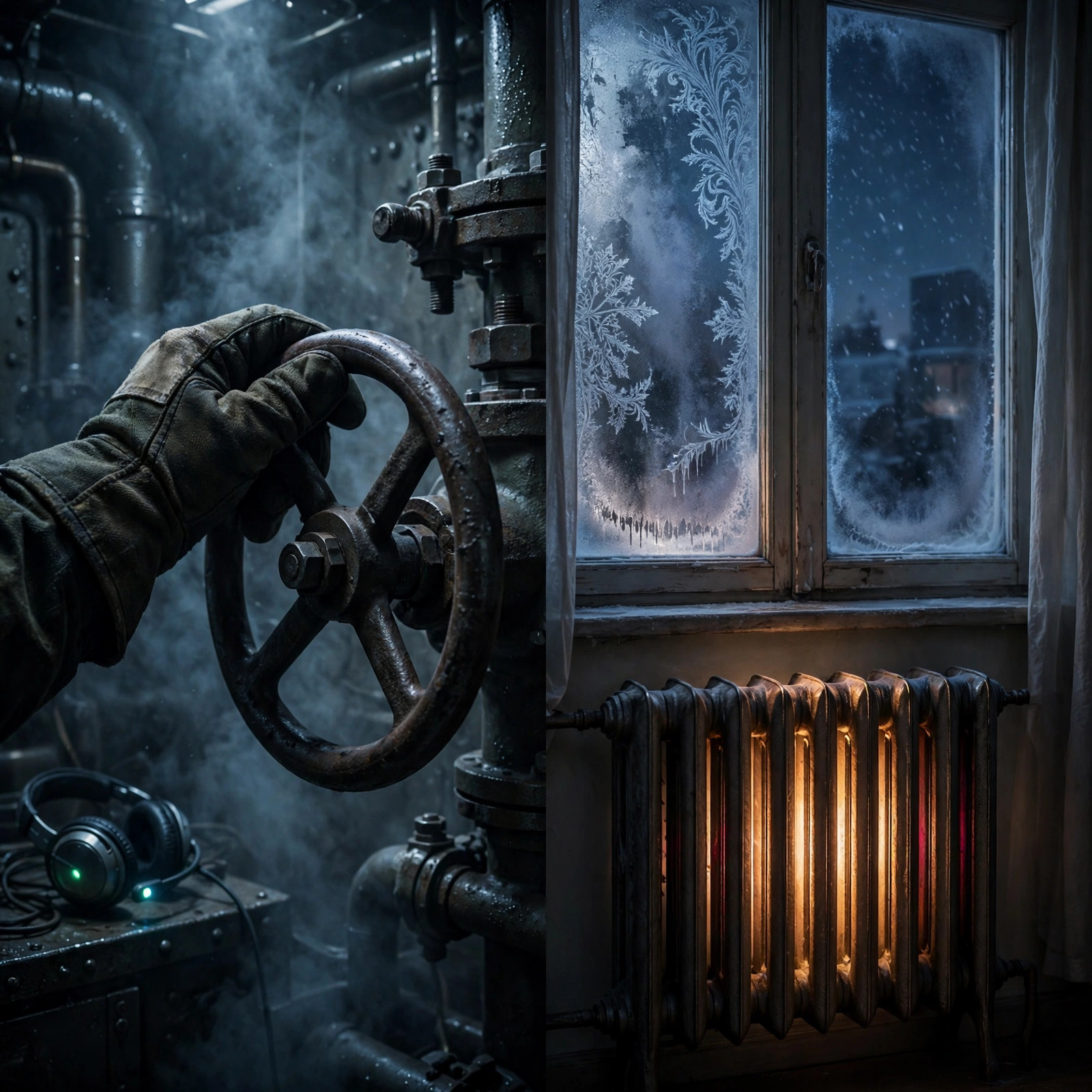
The solvent stung the cracks in her knuckles, and Nadia kept working it into the key anyway, down the long steel shaft and into the throat of the socket where yesterday's grit had dried to a grey crust. The plastic chair creaked whenever she leaned. Across the corridor a hand-sanitiser dispenser blinked green at nobody. She'd gone back down the shaft at midnight with a torch to fetch the key off the tunnel floor, because she couldn't sleep with it lying there, and she hadn't slept anyway.
"The towers are holding," Halyard said in her ear. It had kept its voice low since the ambulance, as though the corridor could hear it. "Return temperatures are falling about where I modelled. When today's out, the blocks will have two days left in them."
"I know."
"You asked me to tell you every time it changed."
"I know what I asked." She turned the key over. The bronze collar her father had brazed on before she was born had a dull bloom on it from the wet, and she rubbed at it with the corner of the rag until the metal warmed and came up the colour of a penny. "Sorry."
"Nadia. Last night I asked you something."
"You did."
It waited. It was good at waiting, better than any person she knew, and she let the silence run until the ward door opened and a nurse in a blue tabard put her head out and said Teo was awake and asking for his boss, and was she the boss.
"Something like that," Nadia said, and stood, and carried the key in with her because she didn't know where else to put it.
He was propped on pillows by the window, his left arm laid out on a foam wedge like something on display, wrapped from the knuckles to above the elbow in a clear dressing with a gauze layer over it. Under the gown his side was bulked out with more of the same. His face had colour in it again, which was the first good thing she'd seen all day.
"You brought the key," he said. "Are you going to hit me with it?"
"Thought about it."
"Fair." He tried to smile and it pulled at something and turned into a wince. "They say it's mostly partial thickness. Mostly. There's a patch on my side they want to look at again tomorrow. Might need a graft." He said graft carefully, the way he said a new fitting's name the first week he learned it. "The doctor kept asking if I was right-handed. Like that was good news."
"It is good news."
"It's my left I hold the pipe with." He looked at the wrapped arm, then away from it, out the window. From up here you could see over the roofs of the hospital annexe to the hill, and on the hill the six tower blocks of the Coldharbour estate, flat against a white sky, their windows dark in a way that wasn't about the hour. "How long am I off the tools, do you reckon?"
"A while."
"Months?"
"Don't know, love. A while." She sat on the edge of the visitor's chair with the key across her knees. "You'll be paid. I'll see to it."
"That's not what I asked." He turned his head back to her. Under the dressing his fingers twitched, testing, and stopped. "Sam came up at six. They were doing his neck downstairs. He wouldn't sit down. He kept standing by that door like he was guarding it." A pause. "He was quiet. Sam's never quiet."
"Sam's often quiet."
"Not that kind." Teo watched her. He'd always watched her, she realised, the way she'd once watched her father at a meter box, as if the hands would explain what the mouth wouldn't. "Where did it come from, Nadia? That valve. Halyard had the drawings up on the visor, all of it, I was following along. There wasn't anything on that wall."
The card was in her inside pocket. She could feel its corner through her shirt.
"It's old work down there," she said. "Gasworks tunnel. Half of it's older than the drawings."
He kept looking at her a moment longer, then let his head go back into the pillow.
"Finish it," he said. "The job. Don't let them shut it down because of me. My nan's in block four." He swallowed. "But finish it right. Properly, I mean. Whatever happened. Don't do it fast and quiet so nobody has to say anything. I'd rather it took longer."
The door swung, and Ruth Abelard came in with snow still on the shoulders of her coat.
She was a tall woman who moved as though every room had a floor plan she'd already read. She went to Teo first, not to Nadia, and asked him how he was, and actually listened to the answer, and told him the board would cover whatever the utility's insurance didn't, and that she'd made sure of it before she drove over. Then she turned, and took a folded sheet from her coat, and held it out.
"I'd rather you heard it from me than read it on a screen," she said. "As of this morning all live-main work on the Coldharbour feed is suspended. Halyard drops to read-only. It can model, it can advise, it doesn't sequence a single valve. We'll do the full shutdown and drain."
Nadia didn't take the paper. "The drain outlasts the heat."
"I know it does."
"Six blocks. There's people in there on oxygen. There's people in there who don't go down the stairs anymore."
"And I've got the school halls in Aunsby opening at noon, and buses, and the council's sending heaters to anyone who won't leave." Ruth's voice didn't rise. That was the worst of it; she wasn't wrong about anything yet. "I've done the arithmetic, Nadia. Moving people is miserable. It's not fatal. That," and she tipped her head toward the wrapped arm without looking at it, "could have been fatal. A machine sequenced a live tap and it put live steam in a pit with a man in it."
"Can I answer that?" Halyard said, in Nadia's ear only.
Nadia hesitated, then thumbed her phone onto the bedside table and switched it to speaker.
"Deputy Commissioner," Halyard said. Its voice came out thinner through the little speaker, almost apologetic. "I sequenced from the drawings and the tunnel sensors. There's no sensor on that east wall. There was no drawing of that valve. I can't be safe on my own and I've never claimed to be. I'm only safe if the people standing in the tunnel tell me what's in front of them that I can't see. Read-only doesn't fix that. It just means nobody's listening on either side."
Ruth looked at the phone for a long moment, the way you'd look at a dog that had said something reasonable.
"Then the crew should have told you," she said. "And if they couldn't see it either, then nobody could, and that's exactly why we don't do this live." She set the folded order on the bed table, beside the jug of water and Teo's untouched toast. "The board sits tomorrow morning. You can make your case there. Both of you." A nod to Teo, gentler. "Get some rest."
The door hushed shut behind her.
Nobody spoke. Teo was looking at the ceiling. The phone's screen dimmed and went dark. Nadia's hand had gone into her jacket at some point without her deciding it, and her fingers were around the card, and she found she had closed them, slowly, hard, until the stiff edges folded in on themselves and the whole thing was a small damp knot in her fist. Grease pencil. She could feel the waxy letters under her thumb without having to read them.
She took her hand out empty and picked up the key.
The collar shone. She'd done a good job on it. Her father would have said so, and then he'd have asked what she'd done about the thing that had dirtied it in the first place.
She thought of Sam standing by the door at six in the morning with a dressing on his neck, saying nothing, because he was waiting for her to say it first. She thought of tomorrow's room, and Ruth laying out her arithmetic, and Halyard saying I can't see what you don't tell me to a table of people who'd only heard that the machine had failed. Every hour she kept the card in her pocket, the story stayed simple, and simple was Ruth's. A blind machine, a hurt boy, a drain that ran on past the last warm night while buses idled outside the towers and the old ones refused to get on.
Out the window the light was already going. On the hill, in block four, someone had hung a blanket across a window from the inside, a square of red against the dark glass, and as she watched, a second window beside it went red too.
Kettle Street Pump House
The board had set its table in the valve hall, between the dead boilers, because Ruth had refused to hold the hearing anywhere warm. Folding chairs on the tiled floor. A space heater nobody had turned on. The members kept their coats buttoned and their gloves on, and when the councillor in the fur hat cleared her throat, her breath hung over the minutes like a small cloud.
Halyard's voice came from a grey speaker on a tripod at the end of the table, with a cable running back to a wall panel. Read-only meant it could talk. It couldn't touch a valve in the city.
Ruth had already laid out her case, and it was a good one. She had walked them through the drain: isolate, cool, empty the line, cut, weld, refill, bring it back up slowly so nothing shocked. She hadn't dressed it up. When the engineer from the water side asked how long, she'd said, "Longer than the towers can hold," and then, "That's why I've got buses and school halls in Aunsby. People can be moved. A burn can't be taken back."
Nadia sat on the crew's side with Sam beside her. The dressing on his neck showed above his collar. He hadn't looked at her since they'd sat down.
"I don't dispute what happened," Halyard said. "I dispute what it means. I sequenced the isolation on the drawings I had. The drawings were wrong. Sensors in that tunnel can read heat and flow, not a valve someone bricked in half a century ago. Take me out and the drawings are still wrong. You'll just have nobody checking them against what the crew sees."
"You've said that," Ruth said. "Yesterday, at a hospital bed, and again this morning in writing." She folded her gloved hands. "I don't doubt you believe it. I'm not here to be argued round. I'm here because a young man is in Saint Ide's and the old women on the hill are sleeping in their coats."
The councillor nodded. The water engineer wrote something down. Nadia could see the vote forming the way frost forms on a pane, from the edges in.
Her hand went into her jacket. This time she let it.
The card came out the way it had gone in last night, a hard knot, softened a little at the corners from her body heat. She put it on the table and pressed it open with the heel of her hand. It fought her. The fold lines stood up like ridges on a map. She pressed again, and held it, and the grease pencil showed through the creases in her own square capitals.
UNMAPPED BYPASS. E WALL. DO NOT OPERATE.
"I wrote that the first morning," she said. "Before Teo ever went down the ladder. There was a gate valve on a stub going into the bricked arch on the east side. Not on any drawing. Halyard asked me what the shape on its camera was and I told it a bracket."
The heater ticked as someone's foot brushed it. Nobody else moved.
"Why?" Ruth said.
"Because I knew you'd ask for a drain the minute anyone filed a hold on that feed." Her voice was steadier than her hands. "I thought I'd go back and look at it myself before we got that far. I didn't. We got that far."
Sam's chair creaked. She didn't turn.
Ruth reached across and drew the card toward her. She read it twice, Nadia saw, her lips not moving, and then she turned it over as if there might be more on the back. There wasn't. Just a thumbprint in black wax.
"Halyard," Ruth said. "Did you know about this?"
"No." A pause, longer than it needed for any computation. "I logged a bracket. I had no reason to ask again."
Nadia stood. She unhooked the sign-off badge from her lanyard and laid it on the table beside the card, and then she bent and lifted her father's valve key from where it leaned against her chair. It was long enough that she had to hold it in both hands, and the head clicked on the tiles when she set it across the table edge, the brazed joint catching the grey light from the high windows. She'd cleaned it again last night. It hadn't needed it.
"That's my live-main ticket," she said. "And the foreman's post. I'm not fit to hold either if I sat on that. Put Sam on it. He's welded every joint on that feed for longer than Halyard's been switched on, and he doesn't keep things in his pocket."
"Nadia," Sam said, low.
"It's done."
The water engineer was looking at the key as though it might go off. The councillor looked at Ruth.
"May I propose something," Halyard said, "before you vote."
Ruth didn't say no.
"I say every valve move aloud before it happens. Which valve, which way, why. A person goes to it, puts hands on it, looks at what's around it, and tells me yes. If the drawing and the wall don't agree, they say so and we stop. Either of us can stop. Neither of us turns anything alone. Not me from here. Not a crew from the pit."
"That's a speech," Ruth said.
"It's a procedure."
"It's a speech about a procedure. I've heard a great many of them." She looked down at the card again. Her thumb rested near the black print, not quite on it. "This isn't one."
She was quiet long enough that the councillor shifted in her chair.
"Here's where I am," Ruth said. "The rule I came in with was that the machine can't see and so the machine can't act. That was wrong. It wasn't the machine that couldn't see." She didn't look at Nadia when she said it, which was worse than if she had. "So. A trial. On the Coldharbour feed only, on the hot tap only, with Mr. Kiriakou holding sign-off and one of my inspectors in the pit beside him. Halyard calls every move. A human confirms every move with hands on metal. Any halt stands until I've reviewed it, and I don't care how cold it's got. One serious fault and it goes to drain and read-only, and I won't hear another word." She slid the badge toward the middle of the table, away from Nadia. "Ms. Okhuysen comes off live work pending review. She can go down and look. She doesn't sign and she doesn't turn."
"Agreed," Halyard said.
Sam said, "Agreed," and it came out rough.
The vote took a minute. The councillor's hand went up first.
Afterward the board packed its folders and its thermos and went out to the cars, and the door at the end of the hall banged and settled, and the cold came in where they'd been. Ruth went with them, the card and the badge and the key under her arm, bundled like kindling.
Nadia stayed by the nearest boiler. Its iron was the temperature of the air, and she put her palm flat on it anyway, out of habit, feeling for nothing.
Sam came and stood next to her. He smelled of flux and the hospital's antiseptic from the dressing.
"You could've told me," he said. "That first morning. Before any of it."
"I know."
"I'd have gone down and looked with you."
"I know that too. That's why I didn't." She laughed, and it hurt. "You'd have made me file it."
"Yeah." He looked at the boiler, not at her. "I'd have made you file it."
Then he turned and kissed her, once, his cold mouth on hers and his hand at the side of her jaw, not long, not asking anything. When he stepped back his face was the same as it always was, just closer.
"That's for saying it," he said. "Out loud. In that room."
She couldn't answer. She nodded at the floor tiles, at the scuff where the key had stood.
Up on the hill the six blocks would be going dark early tonight, curtains drawn, kettles on hot plates where people still had them. One day of heat left in the walls, and they'd use it.
The door at the far end opened again. Ruth came back down the hall in her long coat, alone, the key across her forearms like something she'd been asked to carry and hadn't wanted to. She stopped in front of them. For a moment she looked at Nadia, and Nadia saw her see the whole of it: the badge, the card, the father who'd forged that head before his daughter was born.
Then Ruth turned and held the key out to Sam, handle first, and waited until his gloved hands closed around the steel.
First Turn
The pit had been pumped dry before dawn, and the shoring boards were furred white where the night had got into the grain. Nadia came down the ladder last, behind the inspector, a narrow man in a board jacket who kept a clipboard pressed to his chest like a hot-water bottle. Sam was already at the bottom. He had the key across his shoulder, the brazed head catching the work lights.
Above them, at the lip of the cut, Ruth stood in her long coat with her hands in her pockets and her breath going up in short grey flags. She hadn't come down. She'd said she would watch from where she could see everyone's hands at once.
"Headsets," Sam said.
Nadia fitted hers. The cup was cold enough to sting her ear. For a second there was only the hiss of the open channel, and then a voice she hadn't heard since the ambulance doors.
"Can you hear me? They've got me propped up like a lamp. I'm not allowed to wave."
"We hear you, Teo." She found she was smiling at the frozen clay. "How's the side?"
"Itches. The nurse says that's good, so I'm not allowed to complain about it either." A pause, and the soft beep of something on his end. "Nan rang. She's in a hall in Aunsby with about two hundred people and one urn. She says to tell you the tea's terrible."
"Tell her it'll be her own kettle tonight."
"Don't promise her," Teo said. "Just do it right."
The east wall was a mess of old iron. The unmapped bypass, the one that had blown its packing and put Teo in a burns unit, now wore a blind flange Sam had bolted on the evening before, the new steel bright against the rusted bonnet. Nadia didn't look at it for long. She'd looked at it on the first morning, and that had been the whole trouble.
"Halyard," Sam said. "Ready when you are."
"Ready." The voice came into both cups at once, level, unhurried. "Before I name anything: I've updated my map with the east-wall bypass. I've also flagged two other fittings in this run that don't match the drawings. I can't tell from here whether they matter. I'd like someone to look at them before we start."
The inspector wrote something down. Sam glanced at Nadia.
"I'm allowed to look," she said.
She went along the wall with her torch. The first was an old drain stub, capped and dead, cold right through. The second was a test cock someone had painted over decades ago, the paint unbroken across the stem. She put her glove on each and said what she saw, plainly, and heard Halyard repeat it back and mark it. It was a small thing. It took longer than it would have a week ago, and she felt every minute of it against the walls up on the hill, the last of their warmth going out through the windows.
When she came back, Sam held out the key.
She didn't take it. She looked up at the lip of the cut. "I don't turn. That was the ruling."
"You don't sign," Sam said. "I sign. But the rule says a human puts hands and eyes on the valve and confirms. The witness has to touch it. I want the witness to be the person who knows this wall."
The inspector shifted. "Deputy Commissioner?"
Ruth was quiet for long enough that Nadia heard the generator at the top of the street labor and catch. Then Ruth crouched at the edge, her coat folding into the snow.
"Mr. Kiriakou's sign-off. Mr. Kiriakou's hands on the key, the whole time. Ms. Okhuysen witnesses, and her hands may be on it with his. If either of them lets go, it stops." She looked at Nadia directly. "That's what I'll write, and that's what I'll hold you both to."
"Understood," Nadia said.
Sam put the key in her hands. The steel was cold through her gloves, heavier than she remembered, though she'd carried it for half her life. Her father had forged that head in a shed behind a house that wasn't there anymore. She closed her fingers on the crossbar beside Sam's and felt his knuckles against hers.
"Halyard," Sam said. "Name it."
"Line valve five. North face of the pit, the gate valve below the new tee. I'm asking for a quarter opening, slowly, to warm the bypass before we bring it up. I'm watching the far side of the tee. If anything looks wrong on my end, I'll say halt."
Nadia knelt. She put her free hand on the valve body first, the way her father had taught her, palm flat on the bonnet. Cold. She traced the stem down to the packing nut and found it dry, the threads clean where Sam had dressed them. She followed the pipe to the tee with her eyes, then with her torch, past the fresh weld and its blued ring, to the new spool and the bypass beyond. No frost where frost shouldn't be. No beading. Nothing tagged, nothing hidden.
"Line valve five," she said. "North face, below the new tee. Packing dry, stem clean, bypass downstream clear to the weld. I confirm."
"Confirmed," Halyard said.
"Turning," said Sam.
They leaned together. The valve didn't move. Nadia felt the familiar dead weight of a gate that had sat shut too long in the cold, and then Sam set his boots and she set hers and something under the iron gave, a dull grind she felt more through the bar than heard. The key came round by a hand's width.
A sound rose from the pipe, a thin whistle, climbing.
Her hands came off the key before she'd decided anything. "Halt."
Sam's stayed on it, locked, holding the valve exactly where it was. Overhead she saw Ruth stand up fast.
"Holding," Halyard said. "I've got a rise past the tee, inside what I expected. I don't see a leak on my sensors. Nadia, what are you seeing?"
She was already moving along the spool, torch tight to the iron. The whistle was coming from the tee itself. She put her ear near it, not too near, and her glove beside it, and felt nothing on the leather, no breath, no heat. The whistle was inside. Steam meeting cold metal for the first time in days, and the iron singing with it.
"It's in the bore," she said. "Steam on cold pipe. Weld's dry. No vapor on the outside." She made herself wait and look again, slower, the whole length to the blind flange on the east wall. Dry. Cold. Shut. "I confirm. Clear to continue."
"I agree," said Halyard. "Lifting the halt only if you both agree."
"Agreed," said Sam.
The inspector was writing fast. Ruth, above, said nothing, but she crouched again.
Nadia came back and put her hands on the bar beside Sam's. In her ear, very quietly, Teo said, "That's the sound. I didn't know that was the sound. I thought it was the other thing."
"It's not the other thing," she told him.
They turned again. And then again, each time with Halyard naming the valve, Nadia's palm on the iron, her voice saying what she saw, the halt ready in any of their mouths. The whistle deepened and smoothed out and stopped, and the pipe beside her face began, very slowly, to steam on its outside skin as the frost on the lagging gave up. By midmorning the bypass was carrying the main, and the cracked section sat isolated behind two shut gates and a blind, cooling like a burnt pan set aside.
"Block one is back on the main," Halyard said, and then, after a long time, "Block two," and Nadia stopped listening for the numbers and listened instead to Teo breathing on the line, not saying anything, staying.
When Halyard said, "All six blocks are back on the main," Sam took his hands off the key at last and flexed them, and Nadia was still holding it. She looked up at Ruth. Ruth nodded once, and took a pen out of her coat.
Block four's stairwell smelled of wet concrete and cold chips. The lifts were still off. Nadia climbed with the key over her shoulder because nobody had asked for it back, and her knees told her about every landing. Sam was a flight below, slower, the bandage on his neck white above his collar. Teo was still on her headset. He had stopped making jokes somewhere around the bypass and had gone quiet, the way people did in hospital in the afternoon.
"Which floor is she on?"
"Seventh," Teo said. "There's a radiator on the landing she always says she's going to report. It's never worked properly."
The radiator on the seventh-floor landing was an old cast column under the window, painted a cream that had gone the color of tea. Frost lay in a fine white fur along its top, the same frost that rimed the inside of the glass. Nadia stripped off her glove and laid her bare palm flat on the iron. It bit her, cold enough to ache.
She waited. Sam came up the last stairs and stopped beside her without a word.
Under her hand the radiator ticked. Then again, a small dry knock deep in the column, metal moving against metal as it took the heat. The frost along the top went dark and wet at one end, and the cold under her palm loosened, and loosened, until it was only iron, and then it was warm.
Get notified when new stories drop

Jonas Veld
Jonas covers human-AI futures and engineer problem-solvers: protocols, trust, and tools that expand human capability.
Leave a comment
Comments