



Gannet Quay Loft
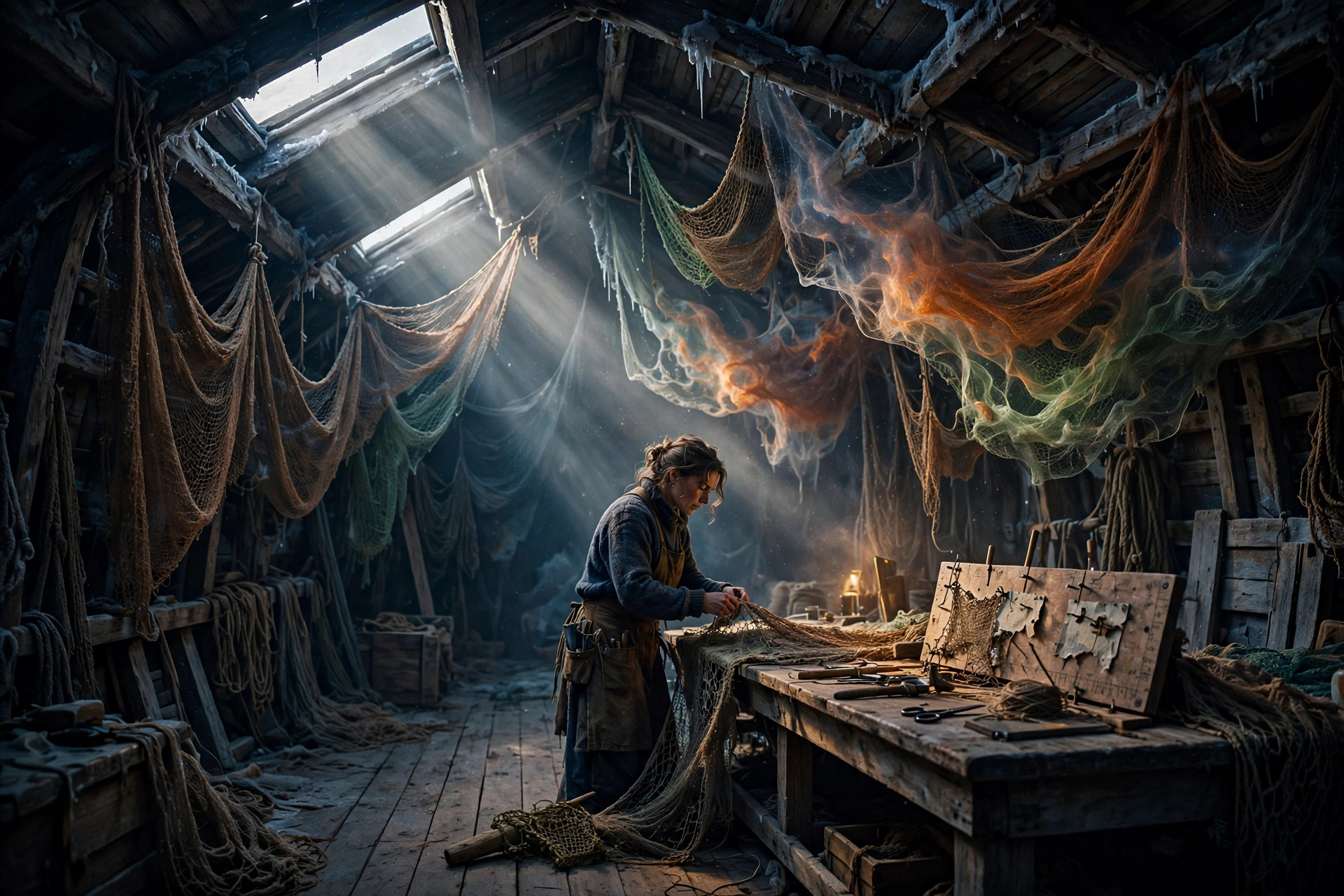
Her right thumb went first, as it always did now. Mireille had the torn panel of Callum's net stretched across the long bench, the good mesh pegged to the gauge boards on either side of the hole, and she was halfway along a row of sheet bends when the twine simply stopped being in her fingers. It was there, and then it wasn't. The loop she'd been drawing tight slid open, and the needle tipped out of her grip, bounced once off the bench edge and clattered on the floorboards beneath it.
She looked at her hand. It looked like a hand. That was the insulting part.
"I've got it." Callum was already crouching, his oilskins creaking, reaching under the bench among the coils of rope and the drift of old twine ends. He came up with the needle held flat across his palm, the way you'd offer a sugar cube to a horse. "Bit of a chip on the tip, look."
She took it. A sliver of the boxwood had split away at the point, pale against the old honey colour of the rest. The needle had been worn so smooth over the years that it felt warm even on a cold morning, and now there was a rough edge where there had never been one. She ran her left thumb over it twice. The right one she didn't trust to tell her anything.
"Sandpaper'll fix that." She said it to the needle, not to him.
"Mireille."
"It'll fix it."
The loft took up the whole top floor of the old ice house on Gannet Quay, and the morning came in through the long run of skylights in grey bands that lay across the nets hung from the rafters. Brown nets, green nets, the orange monofilament the younger crews liked. They swayed a little when the door downstairs opened and the draught climbed the stairs. Everything smelled of tar and weed and the cold mineral breath of the harbour. She had worked in that smell most of her life. She knew which boards creaked and which skylight leaked when the wind came round to the east. She knew the exact pull of every knot she'd ever been taught, and she knew, as of this past winter, that knowing wasn't enough.
She re-threaded the twine and found the loose end of the row. Callum stayed on his feet beside the bench, not sitting, not leaving. He'd always been bad at waiting. It was one of the things she'd been fond of, back when they'd shared a flat above the chandler's, and one of the things that had worn her down.
"How long?" he asked.
"Long as it takes."
"The herring are coming in early, the skippers up the coast are saying. If they're right I want to be out on the first good tide, not tied up watching everyone else go."
"Then you shouldn't have run your net over the wreck at the Shoulder."
"I didn't run it over anything. The wreck moved." He grinned when she glanced up, that lopsided thing that had got him out of trouble for as long as she'd known him, and she felt it land somewhere under her ribs and refused to do anything about it. He leaned on the bench end. "I'm not hurrying you. I'm only saying."
"You're only saying, at me, while I'm working."
"Fair." He was quiet for the space of a few knots. She made them slowly, watching her own fingers the way she'd watched an apprentice's once, waiting for the slip. Left hand forming the loop, right hand passing the needle through. Draw, seat, tighten. The right hand was slow. It shook a little at the end of the pull, a fine tremor like a line with a fish on it a long way down.
Callum reached into the chest pocket of his oilskins and came out with a folded sheet of paper, soft at the creases, the kind of thing nobody printed anymore unless they wanted it handed around a harbour. He laid it on the bench just out of reach of the work.
"Picked that up at the clinic. I was in having my shoulder looked at. They've got it pinned up by the front desk."
She didn't look at it. "Your shoulder's fine."
"My shoulder's forty kinds of not fine, but that's not why I'm showing you." He tapped the paper. "It's a trial. Some sleeve thing you wear on your forearm. It reads what's left of the nerve signal and works a glove that does the gripping for you. Fine work, it says. Fine motor work. They've got one place left."
"One place."
"One. The fitter there, she's not from here, I forget her name, she said they've been looking for people who use their hands for a living. Tradespeople. I thought of you before she'd finished the sentence."
Behind them the stairs creaked under a heavier tread, and Mireille knew the rhythm without turning. Teodor always took the last two steps as one, as if he were still a young man in a hurry. He came into the loft with his hands deep in the pockets of his canvas coat and stood at the far end of the bench, taking in the torn panel, the chipped needle, the paper.
"That's from the clinic," he said.
"Morning to you too." Callum straightened. "I was telling Mireille about the trial."
"I know about the trial. The co-op got a letter." Teodor didn't take his hands out of his pockets. "Did you tell her what they do with the recordings?"
Callum hesitated. "There's something about data. Everything's got something about data."
"Not like this." Teodor came closer and looked down at the paper without picking it up. His face, weathered and creased, had the stillness it got when he was angry and didn't want to be. "Every movement you make in that sleeve, they keep. Every knot. Every splice. That's how it learns your hand. And then it goes to the people paying for the trial, who are the same people building mending rigs for the big ports. You've seen those."
She had. A film the co-op had passed around last year: a long gantry over a factory floor, a dozen jointed arms working a trawl net at a speed that had made the room go quiet. It had got the knots wrong in places. Everyone had laughed at that. Nobody had laughed long.
"They'd have a rig that knows her hands," Teodor said. "Our hands. This loft's way of doing things, recorded and sold. I'm not saying the sleeve's no good. I'm saying there'll be an open version in a few years, once the trial's done and the patents settle. Then anyone can have it, and nobody's handed over their life's work to get it. We can wait a few years. We're not the ones who should go first."
"Not all of us can wait a few years," Callum said.
"I wasn't talking to you."
The loft went quiet, apart from the creak of the nets overhead. Mireille set the needle down on the bench. Teodor had carved it the winter she'd started under him, sitting by the stove downstairs with a pocketknife and a block of boxwood, and he'd given it to her without a word when it was done, just held it out until she took it. She had used it every working day since.
"Teo," she said. "Will you finish this row? Just the row. My hand's tired."
It was a small thing to ask. He'd done harder repairs one-handed while lecturing her about tension. He looked at the needle, and then at the panel, and for a moment she thought he would reach for it.
His hands stayed in his pockets.
"You'll do it better than me," he said. "Rest it a minute and get on. Callum, if you're waiting, wait downstairs. You're in her light." He turned and went back down, taking the last two steps the same way he'd come up, and she heard the street door bang.
Callum let out a breath through his nose. "He's never been in your light in his life."
"He's right about the rigs."
"Maybe. He's not the one dropping needles." He picked up his cap from the bench end and turned it in his hands. "I'll come back this afternoon. If you need me to hold the panel, or whatever it is a second pair of hands does, I'm about."
He went down. She listened to him go, lighter on the stairs than Teodor, and then to nothing at all.
The paper lay where he'd left it. She picked it up with her left hand. A photograph of a forearm in a grey sleeve, a glove with thin lines running along the knuckles like the veins of a leaf. Underneath, in plain type: one place remains. She read it twice, then folded it along its old creases, and slid it into the pocket of her apron beside the chipped needle.
The Demo Sleeve
The fitter was already pulling the sleeve from its case when Mireille came through the door. She hadn't knocked. The clinic's back room smelled of disinfectant and the lemon soap from the sink, and through the high window the harbour light came in flat and grey, the colour of the sleeve itself.
"You're the net-mender." The woman set the case on the bench between two chairs. "Anouk. Sit, if you like. Or don't. Most people stand for the first bit and then sit down very fast."
Mireille sat. She kept her right hand in her lap, the fingers curled in, the way she'd been keeping it the day before yesterday when Teodor had looked at the needle and not taken it.
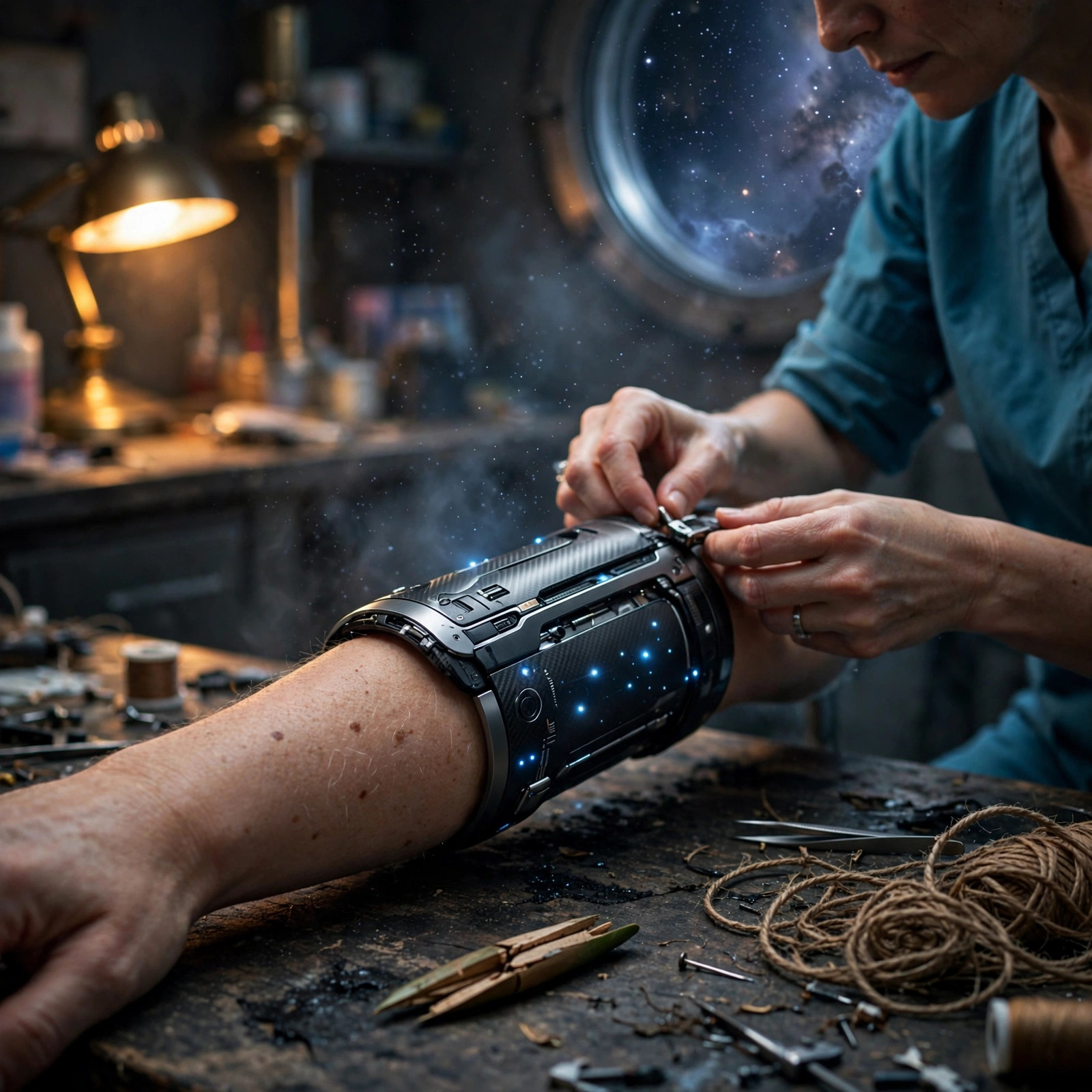
Anouk was younger than she'd expected, with short hair pushed back off her forehead and a pen behind each ear, as if she'd forgotten the first one. Her accent wasn't from anywhere on this coast. She had the flyer's photograph in front of her for real now: the soft grey sleeve, the glove with its fine lines running along the knuckles, and a little flat box where the two joined at the wrist.
"It doesn't go in," Anouk said. "People always ask first. Nothing under the skin. The sleeve sits on your forearm and listens to the muscles that still get the message. Your nerve's damaged further down, so the signal's weak by the time it reaches your fingers, but up here it's mostly still talking." She pressed two fingers to her own forearm below the elbow. "The glove does the pulling. Thin cables, little motors in the cuff. You think close, and it helps you close."
"And if I think wrong?"
"Then it helps you do the wrong thing, a bit. It learns you. The first week's mostly cursing."
She held out the sleeve. It was heavier than it looked and faintly warm, as though someone had worn it recently. The inside was ridged, soft as the belly of a cod. Mireille worked it up over her right wrist with her left hand, badly, and Anouk didn't help, just watched, which Mireille found she liked. The glove was harder. Her fingers wouldn't spread to meet it, and she had to push each one in like feeding twine through a mesh that was too small.
Anouk tapped something on the box. It gave a low tick against Mireille's wrist bone, and then nothing.
"Make a fist."
She tried. Her hand did what it had done for months: the first two fingers came in, the thumb lagged, the last fingers stayed half-open as if they'd stopped listening. Then something tightened along the back of the glove, and the fingers came the rest of the way. Not hard. Not pushed. It was the feeling of someone gently finishing her sentence.
She opened her hand. It opened. She closed it again, and this time the help came sooner, and the thumb found its place against the side of her first finger where it used to live.
"Oh," she said.
"That's the demo unit. It doesn't know you at all. Imagine it in a month." Anouk reached under the bench and came up with a hank of tarred twine and a short length of old mesh. "I asked at the chandlery what you'd use. The man there thought I was mad."
"He's not wrong." But Mireille was already reaching for it.
She hadn't brought the needle. She didn't need it for this. She found a broken bar in the mesh and pinched the end of the twine, and the glove tightened with her, and she passed the bight through, round, under, and drew it down into a sheet bend, the first knot Teodor had ever made her tie over and over until she could do it with her eyes shut. It sat there, square and small and correct, and when she tugged it with both hands it held.
She tied a second beside it, faster, to make sure she hadn't dreamed the first. It held too.
Anouk didn't say anything. She watched Mireille's face rather than the knot, which seemed to be the thing she'd been waiting to see.
Mireille set the bit of mesh on the bench. Her eyes were hot and she was furious about it. "How long does it last? The help."
"As long as you're in the trial, you keep the unit. After, if it's approved, the clinic can fit you a proper one. That part's not up to me." Anouk took a pen from behind her ear and turned it over. "You read the whole flyer?"
"The front."
"Then there's a thing I have to say, and I'd rather say it plainly than have you find it in the forms." She set the pen down. "The glove records. Everything you do with it: the signals from your arm, how the fingers move, how much pull, when you hesitate. That's how it learns you. But the trial keeps the recordings too. They go to the company that builds these, and the agreement says they can use them to train other systems. Not just gloves."
"Rigs," Mireille said.
"Possibly. Anything that has to handle soft, tangled, awkward things. I won't pretend otherwise. Somebody up the coast asked me the same question last month and I told him the same."
"Can I strike it out? The clause."
"No. I asked. I asked more than once." Anouk's mouth went tight. "It's the price of the trial being free. If you're in, your work's in. If you want a glove and no recordings, you wait for the open release, and that's years, and nobody can tell you how many."
Mireille looked at the knots on the bench. A sheet bend was nothing. Every child on the quay could tie one. But the way she tied it, the small twist she gave the bight at the end so it bedded down flat, she'd had from Teodor, and he'd had it from someone before him, and now a company somewhere would have it from a machine that had watched her.
"There's a man at the loft," she said, "who'd tell me I'm selling the co-op for a pair of gloves."
"Is he wrong?"
"He's never wrong. That's the trouble with him." She flexed her hand inside the glove, and it flexed. "He wouldn't take the needle off me the other day. Just stood there with his hands in his coat. I keep thinking about it."
Anouk waited. When nothing more came, she said, "There's one place left. Only one. I've got a list of people who'd like it and most of them aren't fishermen. A woman who paints. A man who was a surgeon before his stroke. The clinic fills it on the ninth day, whoever's signed by then. I'm not allowed to hold it."
"Would you? If you were allowed."
"I'd hold it for whoever looked like you just did, tying that knot." She shrugged. "So no, I'm not allowed."
Outside, a gull landed on the window ledge, looked in at them, and left. Somewhere down the hall a door opened and closed. Mireille thought of Callum on the loft stairs, turning his cap in his hands and saying a second pair of hands, as if it were a thing anyone could just be. She thought of the torn panel still waiting on the bench, the herring that wouldn't wait at all, and of how he'd said he'd come back in the afternoon and had, and had held the mesh taut for her without being asked twice, standing close enough that she could smell diesel and salt on his jumper, and neither of them had said a word about the years between.
She began to work the glove off. It came away easier than it had gone on; the cables loosened as she pulled. Her bare hand looked smaller after it, and paler, and when she closed it the last two fingers stayed open again, the old way.
Anouk picked up one of the knots and turned it over. "Can I keep this?"
"It's a sheet bend. You can have a thousand."
"I'll have this one."
Mireille rolled the sleeve down off her forearm and folded it once, the ridged side in, the way she'd fold a mended panel to keep the new knots from catching. It was still warm from her. She held it a moment longer than she needed to.
Then she handed the sleeve back.
Torn Mesh
The loft was still dark at the edges when Callum took the far side of the panel and leaned back on it, and the whole bench creaked with the weight of him.
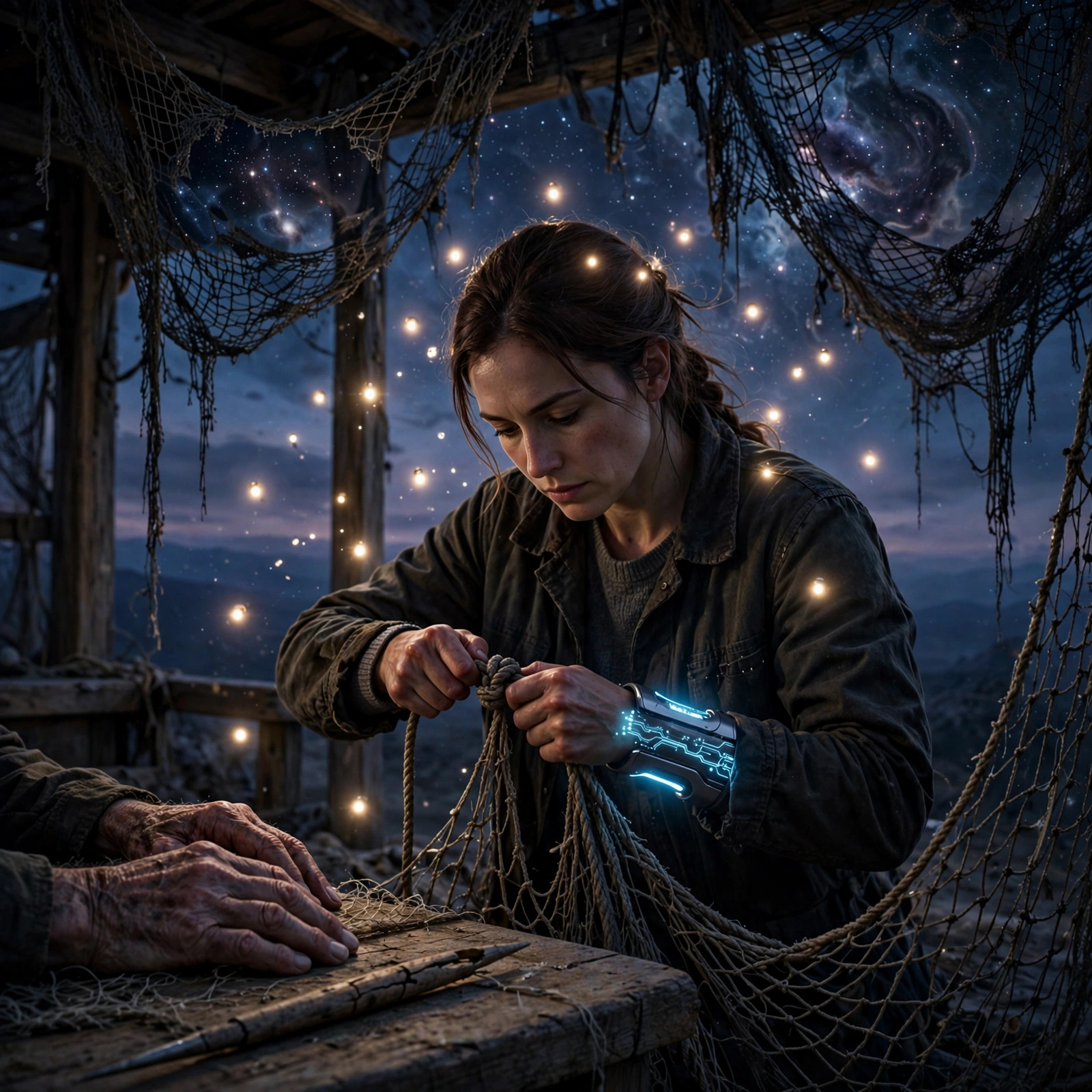
"Easy," Mireille said. "It's not a tug of war."
"Tide's turning in an hour or so. Feels like one."
She didn't look up. The lamp over the bench threw a hard circle of light on the twine, and outside the long window the harbour was the grey of wet slate, the first boats already showing their deck lights along Gannet Quay. She could hear engines warming below, diesel coughing through the floorboards. The herring had come early into the bay, the radio said, and would go as fast as it came.
The tear ran up from the cod end, a ragged channel where something big had gone through in the dark. She'd cut back to sound mesh the day before and built most of it back, knot by knot, and now there was only the join to the headrope left, where the strain would be worst. She'd left it for last on purpose. Her hand was always better after an hour of work, looser, warmer.
It had not been better this morning. She'd run it under the hot tap for a long time before coming down, and it had still closed slow, the outer edge of it lagging behind the rest like a deckhand who hadn't heard the call.
At the other end of the loft Teodor sat at his own bench with his coat on, though the stove was lit. He'd been there when she arrived, which he never was, and he hadn't touched the coil of twine in front of him. He was watching her the way he used to watch her in the first winter, when every knot she tied was a question.
"You'll want to go through that mesh, not round it," he said.
"I know."
"I know you know. I'm saying it anyway."
Callum glanced over his shoulder at the old man and then back at her, and she saw him decide not to say anything, which was new. Years ago he'd have had something to say. He shifted his grip so the panel sat square to her, and his knuckles brushed the back of her wrist, and he moved them away again without hurry.
She loaded the needle. The boxwood was dark with handling, smooth in the places her thumb had worn it, and the little chip at the tip caught the twine once before she smoothed it past. She went through the mesh. Over, under, round. She drew the knot down and felt it bite.
"Good," Callum said quietly.
"Don't."
"Don't what?"
"Say good. It's the headrope. Nothing's good till it's on."
Another knot. Another. The light through the window went from slate to pewter. A boat cleared the harbour mouth, and then a second, their wakes folding white across the bay. Callum didn't turn to watch them, but she felt him not turning.
The last join wanted a long hard pull, the kind she'd done ten thousand times without thinking, her whole forearm behind it. She set the needle, took the twine round her palm, and pulled.
For a moment the knot came down clean. Then her hand opened.
It didn't hurt. That was the strange part, every time. There was no cramp, no warning, just a sense of the grip going out of her like a light switched off in another room, and the twine sliding free across her palm. The needle jumped from her and struck the bench edge and went to the floor, and she heard the small dry crack of it on the boards.
Callum was still leaning back. He'd been leaning against her pull, and when her pull went, all his weight went into the mesh instead.
The new knots held. It was the old mesh beside them that gave, twine that had been sound enough to keep and not sound enough for that. It went in a run, one mesh after another, a soft tearing that sounded almost polite, and the panel sagged open between them in a hole wider than the one she'd started with.
Callum let go. Nobody spoke.
Mireille bent and picked up the needle. The tip had split along the grain, a hairline running back from the point where the chip had been. When she pressed it with her thumbnail the crack opened and closed.
"Mireille." Callum's voice was careful. "How long to put that right?"
She looked at the hole. She looked at her hand, which had come back now, as if nothing had happened, and was closing slow around the broken needle.
"Not by the tide."
He nodded. He kept nodding a little too long. Then he went to the window and stood there with his cap in his hands, watching the bay fill with other men's boats.
Teodor got up. He came down the length of the loft without his usual quickness and stopped by the bench and looked at the tear, not at her.
"Old twine," he said. "You should've cut further back."
"I know."
"You'd have cut further back a year ago without anyone telling you."
"I know, Teodor."
He was quiet. She thought he'd go, and he didn't. When he spoke again it was lower, for her, though Callum could surely hear.
"You went to the clinic."
She didn't ask how he knew. Everyone in Pell Harbour knew everything by the second pint.
"I tried the sleeve on. I gave it back."
"For now."
"For now."
"Then hear me once more and I'll stop." He kept his hands deep in his coat pockets. "They put that thing on you and every knot you tie in this loft goes down a wire to people who've never smelled a net. They'll teach a machine your hands. Then they'll sell the machine to every co-op on this coast, and the young ones who'd have come up the stairs to learn won't bother. Wait. There's an open version coming, a few years, no clause, nobody owning what you give it. Let somebody else be first."
"A few years." She held up the needle. "Look at it."
"I'm looking."
"I haven't got a few years of hands. I've got this. I've got the one place and the ninth day and a man at the window who's just lost his morning because of me."
"Because of a run of rotten twine," Callum said, without turning.
"Don't be kind about it."
"I'm not being kind. I'm being accurate."
Teodor looked at him then, and something passed between the two men that she couldn't read. Then Teodor looked down at the cracked boxwood in her palm, and for a moment his face did something it never did, and he turned away before it finished.
"I carved that from an offcut," he said. "Your first winter. You were hopeless."
"I remember."
"Glue it. It'll hold for the bench work. Not for headropes." He went back to his own bench and sat down with his coat on and didn't pick up his twine.
Callum put his cap on. "I've got the lads waiting."
She followed him down the outside stair. The wind off the water had an edge to it, and the quay was busy and loud, boxes of ice stacked by the fish market doors, gulls already working the gutters. His boat sat low and quiet at her mooring, the only one on that stretch with no engine running. Her crew stood on the stones beside her: the older deckhand with his arms folded, the young one in a borrowed oilskin too big for him, the cook smoking with his back to the wind.
"Net's not ready," Callum told them. "Next tide, maybe. Maybe tomorrow."
The older deckhand looked past him at Mireille, and she made herself meet it. He didn't say anything. He didn't need to. The young one just looked tired.
"You'll get your day," Callum said.
"Not your fault, skipper," the cook said.
"Didn't say it was. Said you'll get your day."
Mireille stood a little behind him. She could smell the diesel on his jumper again, and the salt, and the cold. She wanted to put her hand on his back and didn't trust it. Not the hand, exactly. Herself.
Callum took the fold of notes from his inside pocket, the money he'd kept back for fuel, and licked his thumb, and began to count it out on the quay, one wage into each open palm, while the last of the fleet cleared the harbour mouth behind him.
Teodor's Gloves
The loft door was already unbolted when she climbed the outside stair, and the lamp over the far bench was lit. Mireille stopped on the landing with her key out. Teodor never came in before her. In all the years she'd worked under him, he'd arrived second and stayed last, and made a point of both.
He was sitting at his bench with his back to the door, still in his coat, and he was wearing gloves. Not his fingerless wool ones. Thick yellow rubber gauntlets from the fish market, the kind the gutters used, and he had a hank of tarred twine in his lap and was trying to work a bight into it with the palms of both hands pressed together, the way a child holds a moth.
She didn't say anything. She shut the door behind her and the latch clicked and he went very still.
"You're early," he said.
"So are you."
"Couldn't sleep." He set the twine down on the bench. He did it carefully, and she saw that he had to lift it by trapping it between his two wrists, because the gloved hands wouldn't close around it.
She crossed the floor. The boards were cold and gritty with salt dried out of yesterday's mesh, and the torn net from Callum's boat still hung across the drying rails where they'd left it, the ragged hole gaping in the lamplight. She sat on the stool beside his bench, the one apprentices used, the one she'd used.
"Take them off," she said.
"They keep the warmth in."
"Teodor."
He looked at the window for a while. Down on the water a boat was coming in early, riding high, empty. Then he raised one hand to his mouth, caught the rubber cuff in his teeth, and pulled. The glove came away inside out. He did the other the same way.
His hands lay on the bench in front of him, palms up, and they were curled. Not into fists. Into a half-shape, the way hands look on someone sleeping, the knuckles swollen and shining and the tips drawn in toward the palm as though something had been taken out of them and they were still waiting for it to be put back. The skin between was raw where he'd been rubbing it.
"Close them," she said.
He tried. She watched him try. The tendons stood up along the backs of his wrists and his jaw set, and the hands moved perhaps the width of a matchstick and then stopped and shook.
"How long?"
"Long enough." He let them fall open again. "The left went over the winter. The right's been going since the autumn before. I've been doing the gutting knots with my thumbs and the rest by memory. You'd be amazed what you can do by memory."
"You let me think it was just me."
"It is just you. For the trial." He didn't look at her. "They'd never take me. Too far gone. Anouk said the nerve has to still be talking for the sleeve to hear it, and mine's gone quiet. I asked her. Before you did."
Mireille sat back on the stool. The flyer was still in her apron, folded soft from handling, and she could feel its corner against her hip. One place remaining. She thought of him sitting in that clinic in his coat, asking, being told no.
"So that's it," she said. "That's why."
"Why what."
"All of it. Wait for the open release. Don't be the first to feed the thing. The co-op can't afford to teach a machine our trade." She heard her voice going up and couldn't stop it. "You'd rather nobody had that place. If you can't have it, the loft can't have it."
"That's not fair."
"Isn't it?"
"No." Now he did look at her, and his eyes were wet and furious. "Everything I said is true. You put that sleeve on and every splice you tie goes off to some company that'll use it to build a mending rig, and in a few years there's one on every quay from here to the Sound, and the boys who'd have come up the stair to learn this go and drive delivery vans instead. That's true whether my hands work or not."
"And if I don't put it on, I'm you in a few years anyway. Sitting in here with market gloves on, tying knots with my teeth."
"Better that than--" He stopped.
"Say it."
"Better that than being the one who opened the door."
The empty boat bumped against the quay below. Somebody shouted a line across. Mireille looked at his hands on the bench, the swollen knuckles, the thumb he'd been using for everything, and understood that he'd known for two winters what was coming for her and had said nothing, because saying it would have meant saying it about himself.
"You taught me to splice," she said. "You sat on this stool and held my wrists and made me do the headrope join until I bled. Nobody's going to learn that from a recording. They'll learn the shape of it. They won't learn you."
"That's a pretty thing to say." He picked up one glove between his wrists and began working his hand back into it. "It won't matter to the lads on the stair."
She didn't help him with the glove. He wouldn't have let her.
She worked Callum's net alone through the afternoon, the left hand doing most of it, the right just feeding twine and steadying the mesh. Slow. Clumsy where it never used to be. Teodor sat at his bench with the lamp off and didn't work and didn't leave, and neither of them spoke again. Around dusk he stood, put both gloved hands in his coat pockets, and went down the stair without a word, and the door didn't latch behind him.
Callum came up after dark. She heard his boots on the stair and knew them before he reached the top. He'd brought chips in paper and set them on the end of the bench and didn't ask how far she'd got, which meant he'd looked from the quay and already knew.
"The lads have gone out with the Kerr boat," he said. "Day's work. They'll be all right."
"And you?"
"I'll be all right."
She'd turned the big lamp off to rest her eyes and only the small one over her bench was lit, so the loft was mostly dark, the nets on the rails hanging like weather. Callum stood beside her and looked at the hole. It was smaller than it had been. Not small enough.
"Hold this," she said, and gave him the mesh edge.
He held it. He'd held it before, years ago, when they'd lived over the chandlery and she brought work home and he'd sit on the floor with the selvedge across his knees, pulling it taut while she tied. He still knew where to put his hands. She tied a row, and another, and the right hand cramped and she shook it out and he didn't say anything, only kept the tension where she needed it.
"Teodor's hands are gone," she said, after a while. "Both of them. Worse than mine."
Callum was quiet. "I thought something was off. He's been holding his tea in both palms."
"He's been hiding it. From everyone. From me." She knotted, cut. "He'd rather nobody had the place than watch me take it."
"That sounds like him."
"Does it?"
"It sounds like anyone." He shifted the mesh a little so the next row lay flat. "Doesn't make him wrong about the rest."
"I know."
"Doesn't make him right."
She set the shuttle down. Her hand was shaking, and this time it wasn't the nerve. Callum let the mesh go slack and looked at her in the small light, and she could see the tiredness in him, the morning on the quay, the fuel money in other men's pockets.
"I'm sorry about your tide," she said.
"Stop saying that."
She reached up with her left hand, the good one, and touched his jaw, the stubble rough and cold from outside. He turned his face into her palm. Then he kissed her, or she kissed him, and it didn't matter which. It tasted of salt and vinegar and the old smell of the chandlery stairs, and it was slow, and there was no question in it about tomorrow or the flat or whose fault anything had been. When it ended he rested his forehead against hers for a moment and then straightened up.
"That's not a promise," he said.
"I know what it is."
"Good." He picked up the mesh edge again and held it out to her, taut. "Two more rows and I'll let you go home."
They did three. When he'd gone she wiped down her bench and banked the stove and stood for a while in the doorway between the dark and the one lamp. The clinic would fill the place tomorrow, the ninth day, whether she walked in or not.
She took the boxwood needle out of her apron. She hadn't glued it. The crack ran up from the chipped tip along the grain, fine as a hair, and the wood was worn smooth everywhere his hands had once held it and then hers. She crossed to Teodor's bench, moved his yellow gloves to one side, and set the cracked needle down in the middle where he'd see it first.
First Knot
The clinic door stuck on its swollen frame, and Mireille had to put her shoulder into it, the left one, before it gave. Inside the waiting room smelled of floor polish and wet coats. A man in a fleece sat with his leg up on a chair, reading the tide tables taped to the wall as though they might have changed overnight.
Anouk came out of the back room with a tablet under her arm and stopped when she saw who it was.
"I'd started writing the email," she said. "To the next person on the list."
"Don't send it."
"I haven't." Anouk looked at her a moment longer, then held the inner door open. "Come through before I lose my nerve on your behalf."
The fitting room was small and too warm, with a radiator ticking under the window and a view of the harbour wall where the gulls stood in a row facing the wind. On the bench lay a sleeve in a sealed bag, grey and soft, and a glove beside it with thin cables running along the back to a flat housing at the wrist. Not the demo. This one had her name printed on a sticker, spelled right.
Anouk set the tablet down and turned it so Mireille could read.
"You've seen it before. I'll show you the clause again anyway, because I'd rather you hate me now than in a year." She scrolled. "Everything the cuff records while you're working goes to the company. Signals, glove position, and the overhead capture at your bench. They're allowed to train other systems on it. Any systems. I asked them again on Tuesday. I asked in writing. The answer's the same."
"Mending rigs."
"Possibly. I don't know what they're building. I'd be lying if I said it wasn't on the list."
Mireille read it through anyway. The words were drier than she'd expected, a long paragraph about licences and derived works, and nowhere in it was there a loft, or a needle, or the particular way Teodor taught her to lay a sheet bend so the tail lay inside and didn't snag on a fish. It would all be in there, though. Her hands would carry it in without asking.
"Teodor thinks we should wait for the open version," she said. "Let some other town go first."
"He's not wrong that it'll come. A few years, probably. Maybe sooner." Anouk sat on the edge of the bench. "Your nerve won't wait that long. You know that better than I do."
"I do."
She picked up the stylus with her left hand. It felt clumsy there, a pen in a stranger's grip, and her name came out leaning backwards. She signed the second box, the one about the data, more slowly than the first. When she put the stylus down Anouk took the tablet without looking at the signature, which Mireille was grateful for.
"That's the one place filled," Anouk said quietly. "There's no one after you now."
"There wasn't anyone before me either. Not really."
Anouk didn't answer that. She broke the seal on the bag and rolled the sleeve out flat.
Fitting it took longer than Mireille had thought it would. The sleeve went on like a stocking pulled up over the forearm, cool at first and then not, and Anouk worked it into place with her thumbs, feeling for the muscle under the skin, pressing and moving it a little, pressing again. She talked while she did it, mostly to herself. Lower. No, there. Make a fist for me. Try.
Mireille tried. Her hand closed partway and stopped, the old familiar stall, the last of the strength going out of it.
"Good. That's what I need. It doesn't matter that the hand doesn't do it. The muscle still tries. The nerve still sends." Anouk tapped the tablet, and a set of faint traces jumped across the screen, ragged lines, like weather. "That's you asking."
Then the glove. It was snug across the palm and loose at the tips, and the cables along the back lay against her knuckles. Anouk clipped the housing to the cuff and the glove gave a small shiver, testing itself, each joint flexing in turn without her.
"That's the strange bit," Anouk said. "Ignore it. It's checking its own range. Now close."
Mireille closed. For a moment nothing, the same stall, and then the glove took up the slack. The cables drew tight along the back of her hand and her grip went on closing past where it had stopped for months, slow and certain, until her nails touched her palm. She opened her mouth and nothing came out of it.
"Again. Slower."
She did it slower. The glove lagged her by a breath and then caught up. On the third try it was there almost with her, and on the fifth it was hers, or close enough that she couldn't feel the seam.
"It'll learn you," Anouk said. "Over the next weeks it gets better at guessing. You'll get better at asking. Don't expect miracles on the first day." She handed over a hard case with a charger, a folded sheet of instructions, and a black sensor bar the length of a forearm with a clamp on one end. "This goes over your bench. When the light's on, it's recording. When you're in the loft working, it should be on. That's the deal."
"I know what the deal is."
"I know you know." Anouk's mouth tightened. "I'm sorry it's the deal."
The wind had swung round when Mireille stepped outside, coming straight off the water, and she walked down to Gannet Quay with the case in her left hand and her right in her coat pocket, the glove cables pressing against the lining. She kept closing her hand in there. She couldn't stop.
The loft stairs were dark. She climbed them slowly. At the top the door was already open and the stove was lit, which meant Teodor had been in since early.
He was at his bench with his back to the window. He didn't turn round when she came in, but he heard her, she could tell by how still he went. The yellow market gloves lay where she'd moved them. The boxwood needle was in his hands.
He was holding it the only way he could now, pressed between his two curled palms like something he'd caught and was afraid to drop. The crack along the grain showed pale in the light from the window.
Callum's net hung where they'd left it, stretched across the frame by her bench, the hole smaller than it had been but still there, a ragged mouth in the mesh with the cut ends sticking out like whiskers. She set the case down and took out the sensor bar. Teodor watched her clamp it to the beam above her bench. He watched her tighten the screw with her gloved hand, and she felt his eyes on the cables, on the grey sleeve showing at her wrist below the cuff of her jumper.
She waited for him to say something. Traitor. Fool. Anything at all.
He said nothing. He turned the needle over in his palms, once, and held it.
"I signed," she said. "This morning."
Nothing.
"It records everything at this bench. I won't work at yours. I won't touch the co-op's racks with it on unless the board says I can. That's yours to decide, not mine." Her voice was rougher than she meant. "Callum needs his net. I can't keep making him wait while I stand here."
The stove ticked. Down on the quay someone was dragging a fish box across the stones. Teodor looked at her for a long time, and his face didn't soften and didn't harden, it only stayed, the way the harbour wall stayed when the sea hit it. Then he looked down at the needle.
She took a new shuttle from the rack, a plastic one, filled it with twine and pulled the first length free. She found the edge of the hole where the good mesh began, and took the cut end in her left hand and the shuttle in her right.
Her thumb remembered. The glove didn't, not yet; she felt it hesitate as she looped the twine, a small lag, a stranger's hand on hers. She went slower. She made the loop, passed the shuttle through, brought the tail round and under, and laid it inside the way she'd been taught on a winter morning in this room with this same man watching.
Above her the sensor bar gave a soft click, and a small green light came on along its edge.
She closed her hand. The cables drew taut across her knuckles, and the knot pulled down hard and true on Callum's net, and held.
Get notified when new stories drop

Leo Stranek
Leo specializes in solarpunk abundance and near-future progress: livable futures, bright cities, and practical wonder.
Leave a comment
Comments