





Terrace Four
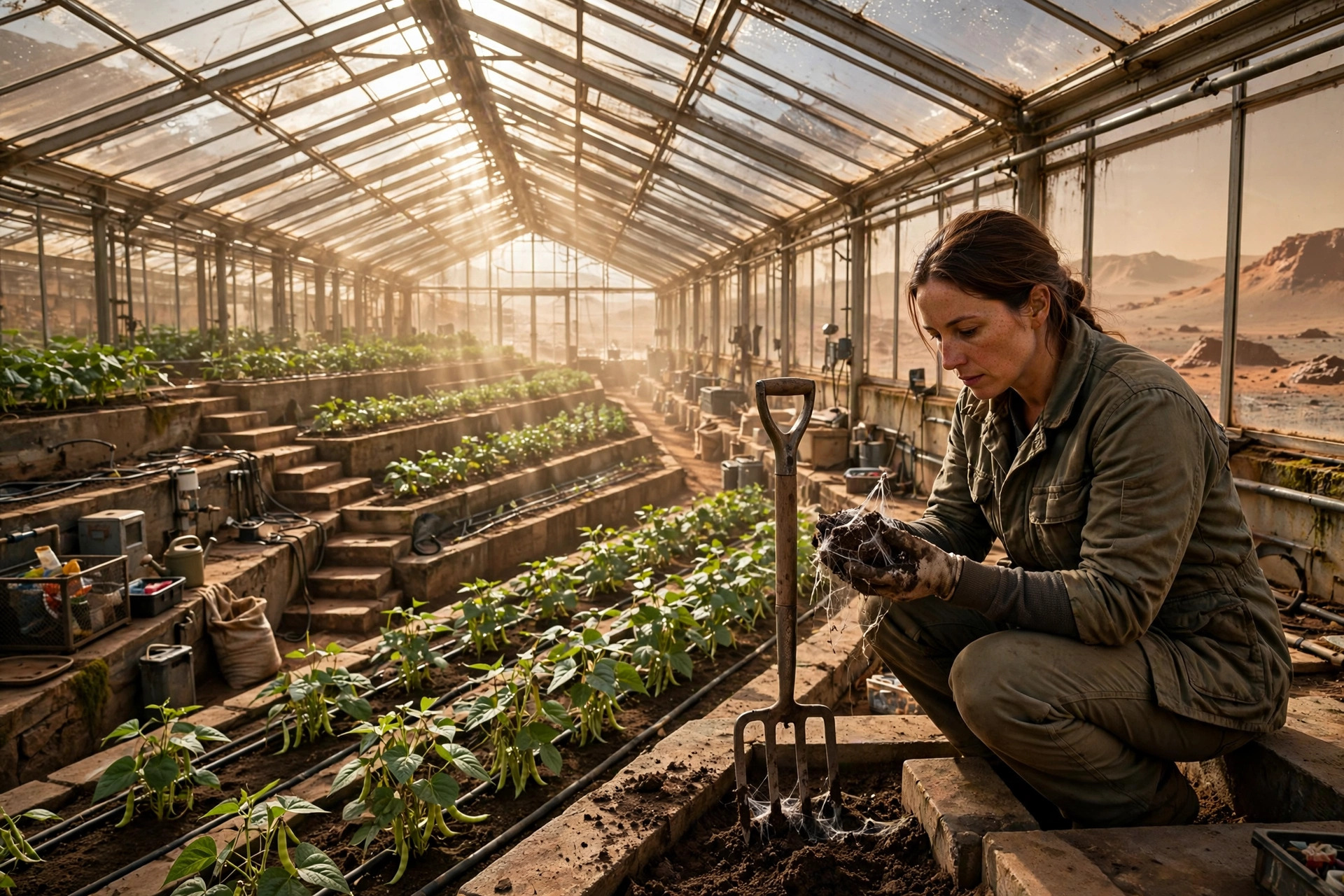
Wenna drove the fork in at a slant, levered back, and felt the soil give the way good soil gives, reluctantly and then all at once, as though it had been thinking about letting go for a while. The clod broke on the tines. Inside it, white threads ran like stitching through the dark. She turned it over and the smell came up, wet and faintly sweet. A smell that hadn't existed anywhere on this planet until people carried it here in a jar.
"Look at that," she said.
Djimon leaned on his own fork two rows down, sleeves pushed to the elbow, a smear of compost on one cheek he hadn't noticed. "It's thicker on the low side again."
"It's always thicker on the low side."
"You said that was drainage."
"I said I thought it was drainage." She crouched and pinched a strand of hyphae between two fingers. It held, then parted. Along the downslope edge of terrace four, where the bed met the old retaining wall of fused regolith, the white was nearly a felt. Up near the walkway it thinned to lace. Three seasons now she'd watched that gradient and written it down, and three seasons she hadn't understood it. The low edge was the saltiest ground on the terrace, the last place the rinse water reached when they'd first washed the raw basin dirt. By rights the fungus should have sulked there.
It didn't. It crowded in.
Above them the hall's long roof panels filtered the afternoon down to a butter color. Beyond the panels the sky over Tessaly basin was the shade of weak tea, and the far rim was a smudge of rust. Inside, the air was warm and close and full of breathing things. The beans on terrace two had come up in a single green rush the week before. Terrace six was lying fallow under a mulch of shredded stalks. All seven terraces stepped down the hall's length like a staircase built for someone very large and very patient, and every one of them had begun as grey grit that would kill a seedling outright.
Djimon worked his fork in, turned, broke the clod with the heel of his boot. He had good hands for it now. When he'd started he'd attacked the beds like they owed him money.
"You're going to tell me to slow down," he said.
"You're doing fine."
"You've got the face."
"I don't have a face."
"You've got about four of them, and that's the slow-down one." He grinned and kept turning, a little more gently.
The comm on the post at the end of the row chimed. Not the flat tone of the weather bulletins. The rising one, twice, that meant assembly business. Wenna stood, knees complaining, and wiped her palms down her trousers before she touched the screen, an old habit from years when every speck of soil was too precious to lose.
Ottilie Nakagawa-Reyes looked out at her from the assembly room, grey hair pinned up, the corner of a table and somebody's elbow visible behind her. Her voice came through the speaker with the faint compression of a hall-wide broadcast.
"All stewards and crew leads. The north reservoir has a fracture along its lower seam. We caught it on the morning pressure read. Some of the stored water has gone into the surrounding ground and frozen there, and some has vented as vapor through the cap before we isolated it. The rest is holding. Nobody is hurt. Rationing begins at the next shift change. Assembly will take proposals on supply. I'll post the schedule tonight."
The screen went back to its idle grid. Wenna stood with her hand still raised toward it.
"How much is gone?" Djimon had come up beside her. The grin had gone wherever grins go.
"She didn't say."
"That means a lot."
"It means she doesn't know yet." Wenna looked back down the hall. The terraces didn't drink much once they were established. A living soil held water the way a sponge held it, and the mycelium wove it through the beds so that almost nothing ran off. But almost nothing wasn't nothing. And the new beds, the ones still waiting for their first inoculation, would need a long soaking before anything would take.
"They'll want the drills," Djimon said.
"They've always got the drills."
"No. I mean the deep ones. Arvid's crew has been pitching that aquifer since I got here. There's water down there, everybody knows it. It just comes up full of salt."
Perchlorate. He didn't say it, and she didn't either, but the word sat between them all the same. The same salt that had made the raw basin dirt poison, that they had spent years rinsing out handful by handful. Bring up deep brine fast and you had to put the leftover somewhere. The terraces were downhill of nearly everything.
"Arvid's not stupid," she said.
Djimon gave her a look she chose not to interpret.
She went into the hut. The terrace huts were little more than sheds built against the hall's inner wall, shelving and a desk and a cot nobody admitted to using. Her logbook terminal sat under a lamp. Above it, on the highest shelf, between a coil of drip line and a box of seed envelopes, stood the jar.
She reached it down. Borosilicate glass, thick-walled, the steel lid gone dull with handling. Inside, a pale knot of the original culture lay dormant on its bed of grain, exactly as she'd sealed it in her first season here, when Tessaly settlement had been three pressure halls and a great deal of optimism. Everything growing out there in the beds had come from this. She hadn't opened it in years. She didn't open it now. She only held it, turning it so the lamp caught the threads pressed against the glass, and then she set it in her satchel on the desk, where she could see it.
Djimon leaned in the doorway. "What's that for?"
"Nothing. I just wanted it where I could reach it."
"You're going to go up there," he said. "To the assembly room. Tell them what the terraces need before somebody votes your water to a drill head."
She sat. Pulled the terminal toward her. Opened a new report.
"Wenna."
"I'm writing it down."
"You're writing it down," he repeated, as though he were trying the words for flavor and finding them thin.
"Ottilie reads everything that comes in. The assembly reads it. If I put the soil water budget and the leaching risk on the record, clearly, with the data, then it's there for anyone making a decision." She began typing. Current moisture by bed. Inoculation schedule for the new terraces. Known salt tolerance of the seed stocks. The gradient on terrace four, logged again, still unexplained, because she logged everything. "Shouting in a meeting doesn't make a number any truer."
"No, but it makes people hear it."
She kept typing. He watched her for a while and then went back out to the beds. She heard the fork bite, turn, bite.
She thought, without wanting to, about Arvid. About the winter years ago when the first drill line had frozen and the two of them had sat up all night in a supply hut with a heater between their knees, arguing about nothing, laughing at it, and she'd fallen asleep against his shoulder and woken with the print of his jacket seam on her cheek. They'd been easy with each other then. Somewhere after that the easiness had worn down into politeness, and she couldn't have said exactly when.
She finished the report, read it once, and filed it to the assembly queue. The screen thanked her in its toneless way.
Under her feet the floor began to tremble.
Not much. A low shiver up through the boot soles, through the desk legs, through the glass of the jar in her satchel so that it chimed faintly against a trowel. She stood and went out. Djimon had stopped turning. He was looking up at the roof panels on the downhill side, where the hall wall gave onto the open basin.
Out there, beyond the panels, in the thin cold air that would have frozen the water in their lungs, a line of heavy vehicles was crawling past. Drill rigs, their masts folded down along their backs like the legs of something sleeping, their wheels taller than the hut. Dust lifted from under them and hung, lazy in the weak gravity, catching the light. One after another they ground by, headed east, toward drill head three, close enough that she could read the stenciled crew marks on their flanks and see the frost of their own exhaust venting white from the rear housings and vanishing at once into nothing.
Djimon said nothing. Wenna stood among the seven terraces with dirt drying on her hands and watched the rigs roll past until the last one was gone and the floor went still.
Assembly Hall
Wenna came in through the east lock with regolith still in the creases of her gloves. She'd meant to change, and then the hut screen had shown her report sitting in the assembly queue, marked received and nothing else, while a line beneath it read Motion under discussion: Deep Aquifer Access. She hadn't changed.
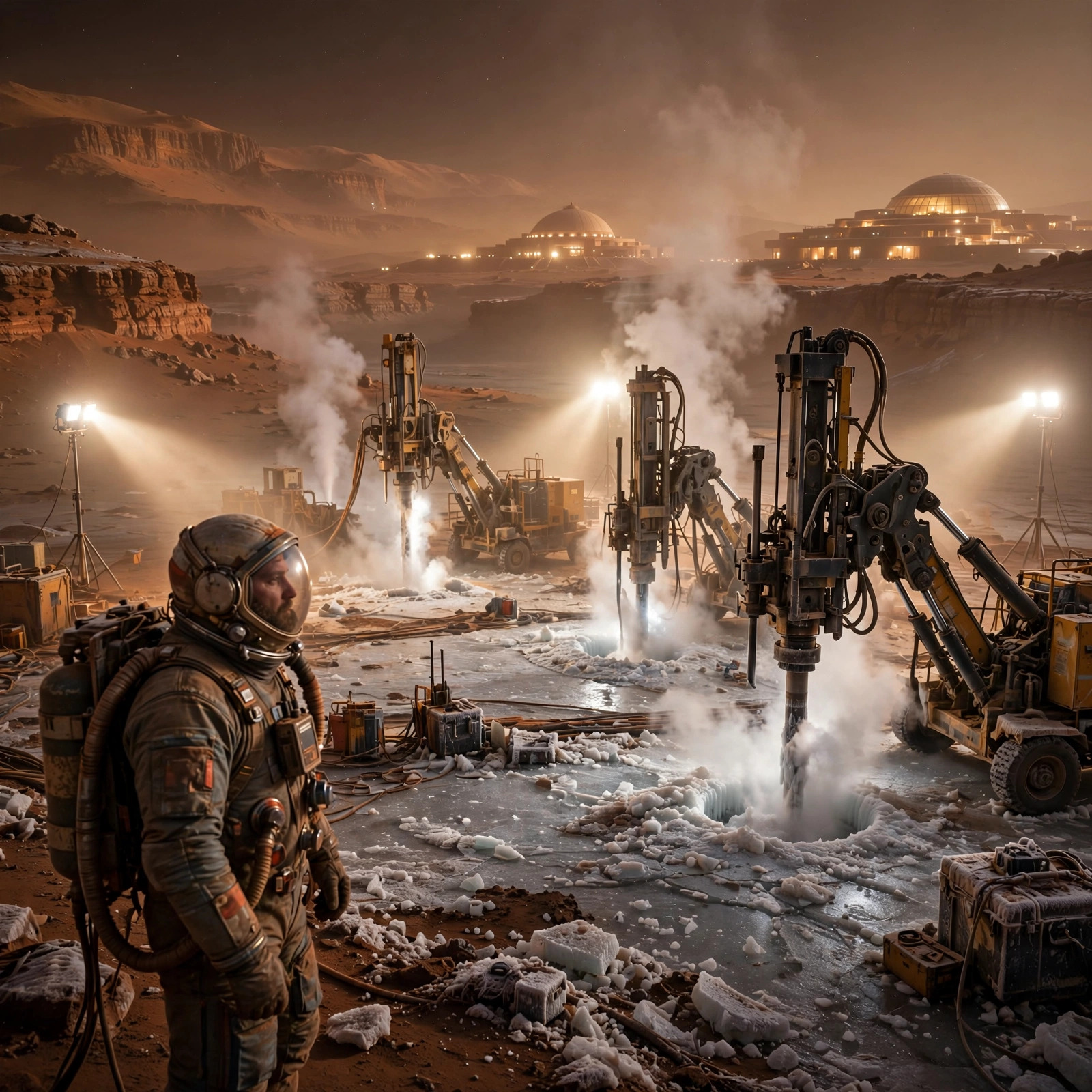
The hall was fuller than she had seen it since the founding anniversary. People stood along the back wall under the ration placards, some with their water bottles clipped to their belts the way everyone carried them now, half-empty and guarded. The light through the dusted roof panels was the color of weak tea. At the front, on the low platform where the assembly chair's table sat, Arvid Kuromaru was lifting something out of an insulated case.
It was an ice core, thick as a forearm and long as one, frosted white where the warm air of the hall touched it. He laid it in a shallow steel tray on the table and stepped back so the front rows could see.
"That came up from under the basin floor," he said. "Not the shallow lenses we've been scraping for nine years. The real aquifer. It's been sitting down there longer than there have been people to want it."
He didn't raise his voice. He never had. Wenna found a gap by the door and stood in it.
"We lost the north reservoir. You all know what that means because you're living it. The rationing we're on now holds until the cold season, and then it doesn't. The shallow lenses can't refill fast enough. I can sink a deep bore at drill head three, run it hard, and have the tanks climbing before the dust comes. Not next year. This year."
A murmur went along the benches, and it wasn't skeptical. It was the sound of people who'd been thirsty and careful for days hearing someone say the word climbing.
Ottilie Nakagawa-Reyes sat at the end of the chair's table with her hands folded on a slate. She had the stillness of someone who had heard many good arguments and didn't trust any of them until they'd been knocked around a little. "And the return line," she said.
"I'm getting there." Arvid touched the tray. The core had begun to sweat. A thin film of meltwater was gathering at the bottom, and it wasn't clear. It had a faint rusty cast, like tea gone cold. "Deep water comes up salty. Perchlorate, mostly, and other salts besides. We strip it for drinking, and what's left is brine. That brine has to go somewhere. Fast drilling means a lot of it."
"Where?" someone called from the side benches.
"Settling pits on the downslope, below the terrace huts. Lined." He looked out over the hall and, for the first time, found Wenna by the door. He held her eyes a moment and didn't look away from what he said next. "Linings fail. Ground shifts. Some of that brine will reach the lower terraces over time. I'm not going to stand here and tell you it won't."
Wenna felt the floor go strange under her, though it hadn't moved. She'd expected him to soften it. She'd half-built her answer around his softening it.
"So you'd salt the soil," Ottilie said.
"I'd keep people alive through the cold. Then we'd work on the soil." Arvid spread his hands. "I know what those beds are. I've walked them. I know how long they took. But nobody here can drink a terrace, and nobody here can eat one yet either. Water's now. That's the trade, and I'd rather you made it with your eyes open."
It was good. Wenna knew it was good because she found herself nodding before she caught it. He'd taken the strongest thing she could have said against him and said it first, plainly, and in his mouth it sounded like honesty instead of harm.
Ottilie tapped her slate. "We do have a written submission from the soil steward. It's been circulated." She glanced at the benches. "Has anyone read it?"
A few hands. Not many. A woman near the front, one of the hydroponics leads, said, "It's a lot of tables."
"It's moisture logs and salt tolerances," Ottilie said, not quite defending it. "It's careful. It doesn't say what she wants us to do." She looked down at her slate again. "Unless there's further discussion, I'm inclined to call this to a vote while we're all in the room. Water's on everyone's mind. I don't see much gained by…"
"I'm here."
It came out louder than Wenna intended. Heads turned. She was aware of her gloves, the grit in them, the dried crust at her knees where she'd knelt in terrace six that morning. She made herself walk down the aisle between the benches rather than speak from the door like someone who might leave.
Ottilie watched her come. "Wenna. I didn't see you on the speakers' list."
"I filed."
"You filed a report. That's not the same as asking to be heard." Ottilie said it mildly, the way she might correct a figure in the minutes. "Numbers don't stand up and ask questions. You have to do that part."
Wenna reached the edge of the platform. Up close, Arvid looked tired in a way the hall wouldn't have seen from the benches, the skin under his eyes grayish, a healed split on one knuckle from some rig coupling. He smelled of cold metal and the dry chalk of the drill shafts. He didn't step aside for her and didn't crowd her either.
"He's right about the water," she said, to Ottilie, but loud enough for the room. "I'm not going to pretend he isn't. The tanks need to climb." She turned so the benches could see her face. "But the seven terraces aren't decoration. They're the only ground on this planet that's alive because we made it alive. Every bed down there took seasons. You salt them, and you don't get them back next year. You start again from crushed rock."
"Then what do you propose?" Ottilie asked.
And there it was, the question Arvid had answered and she hadn't. Wenna opened her mouth and found only her tables in it. Moisture by bed. Tolerances. Terrace four, its low salty edge where the white threads of the fungus grew thickest for no reason she'd yet been able to name. She'd logged that gradient again, still unexplained. It was nothing she could stand on in front of a thirsty room.
"I propose you don't vote today," she said. "Give me time to show you what's actually down there. Not a summary. The ground itself."
Arvid spoke quietly, to her rather than the hall. "Every day we wait, the drill sits."
"I know."
"I'm not saying it to win." He held her eyes again, and something old moved under the politeness they'd worn for years, the shape of a long night in a supply hut and a heater between their knees. "I'm saying it because it's true."
"I know that too."
Ottilie looked between them for longer than was comfortable. Then she drew the slate toward her and wrote something on it with her stylus.
"Here's what I'll do," she said to the hall. "The motion stands as written. Arvid's crew prepares the bore site but doesn't break into the aquifer. We vote on day twelve. Between now and then, the soil steward makes her case in a form people will actually read, or walk, or whatever it takes." She turned to Wenna. "In person, this time. Not in the queue."
The murmur on the benches was less warm than before. Wenna heard someone near the back mutter about rations, and someone else hush them. She didn't look to see who.
In the tray, the core had shrunk to a rounded stub, and the meltwater beneath it lay rust-tinged and still. Arvid capped the tray with a lid so it wouldn't be spilled. His hand rested on it a moment longer than it needed to.
Ottilie reached under the slate and drew out a sheet of printed film, the motion in full, its text dense and plain, the brine pits marked on a sketch of the downslope in a hatched gray that ran right up to the lowest of the terraces. She held it out across the table.
Wenna took it. The film was cool from the hall air and slightly stiff, and her gloves left a faint brown thumbprint on its corner.
Drill Head Three
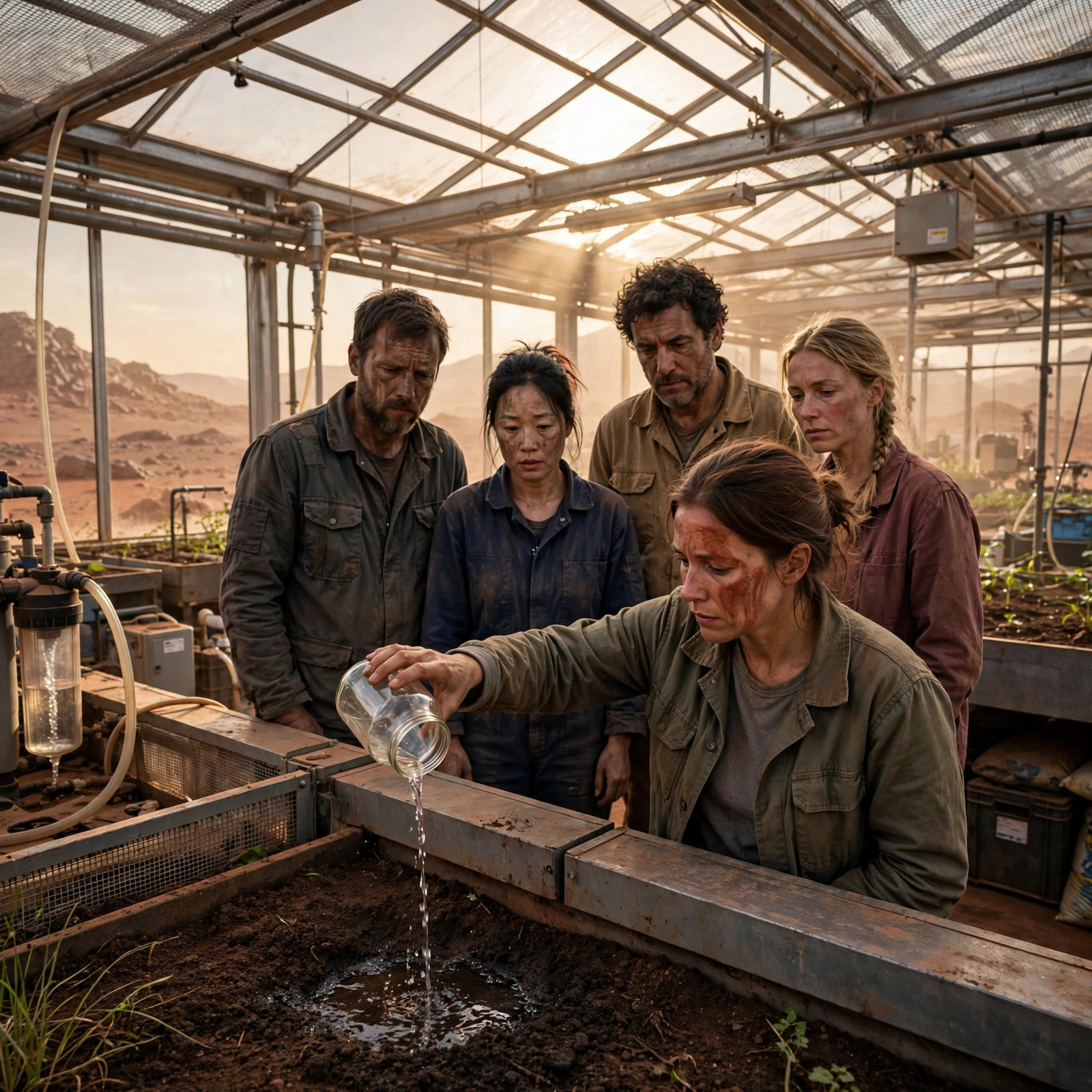
The bore rig groaned through its first slow turn as Wenna came up the ramp, the sound arriving thin and late through her helmet, more felt in her boot soles than heard. Arvid stood under the mast with one gloved hand on the brine return manifold, the way a man rests his palm on a horse's flank to tell it he's still there.
"You came," he said over the open channel.
"Ottilie said in person." She held up the printed motion, folded now into quarters, its corner still marked with her brown thumbprint. "I'm here to walk your line."
"It's a pipe. It goes downhill." But he waved her along the catwalk anyway, toward the steel hand valve his crew had welded into the return two winters back, frost-furred where it met the insulated hose. "We're pressure-testing this morning. Old brine from the shallow wells, nothing new from below. Ottilie's rules."
"Down to the pits?"
"Down to the pits. Past your huts." He didn't look away when he said it. He never had. That was the thing about Arvid she'd forgotten how to be angry at.
Her earpiece clicked. "Wenna, I'm at the bottom bed." Djimon's voice, a little breathless from the climb, the faint whistle he made between sentences when he'd been working. "Line runs right along the retaining wall here. I'm sitting on it like you said. If it so much as sweats I'll tell you."
"Don't sit on it," Arvid said. "It's under pressure."
"Then I'll sit next to it, foreman, and glare."
Wenna almost smiled. She'd sent him down there because someone should see the brine pass the soil, not read about it afterward. She had all seven terraces in her head as she stood on the catwalk, stacked down the slope below them like open drawers, the lowest one closest to the hatched gray on Arvid's sketch. She could see the huts from here, small domes squatting against the rust, and beyond them the faint green-black shine of the lowest bed under its film.
The crew chief at the pump panel called the pressure good. A shiver ran down the hose. Arvid watched his readouts with his jaw set, and Wenna watched the slope.
For a while there was nothing. Wind lifted a scarf of dust off the ridge and laid it down again. Djimon hummed something tuneless into the channel.
Then he stopped humming.
"There's frost," he said. "On the hose. Wenna, there's a white patch growing on the hose, about where it crosses the wall. It's... it's getting bigger."
"Shut it," Wenna said, and Arvid was already moving.
He reached the hand valve in two strides and threw his weight on the wheel. It didn't turn. He braced a boot against the manifold and heaved again, and Wenna saw ice crawl out from around the stem, a fine glittering spray boiling off into the thin air and freezing before it could go anywhere at all.
"It's frozen open," he said. Very flat. "Stem's iced in the packing."
"Then kill the pump."
"Pump's off." The crew chief, from the panel. "Line's still loaded. It's all head pressure now, downhill."
Downhill. Toward her soil. Toward Djimon.
"Djimon, get away from it," Wenna said. "Walk up the slope. Now."
"It's split." His voice had gone high and quick. "Wenna, it's venting, it's all coming out white, it's going right onto the bed. It's frosting the film. I've got a clamp, I've got the big clamp from the hut..."
"Leave it!"
"It's on the soil!"
She didn't decide to run. She was simply off the catwalk and down the ramp, boots skidding in the loose fines, the motion film crumpling in her fist and then gone, dropped somewhere behind her. Mars gave her that long floating stride and then punished her for it, every landing a little too far from where she'd aimed. She heard Arvid's breathing in her ear, close behind, then his voice snapping orders at his crew: heat wrap, the portable one, bring it, bring it now.
The slope ran out from under her near the huts. She went down hard on one hip and felt something in her thigh pocket crack against a rock. She knew what it was before she reached for it: the jar, her first season's starter culture, the thing she'd carried to every hearing like a talisman. No time. She was up again.
From the top of the bottom bed she could see the plume. It rose off the split in the hose as a white fan of flashing vapor and snow, glittering where the low sun caught it, collapsing back onto the soil film in a crust of salt-frost. And in the middle of it, on his knees, Djimon was wrestling the clamp jaws around the hose with both arms.
"Djimon!"
The clamp bit. The fan narrowed to a hissing jet, then a sputter. He rocked back on his heels, and she saw the front of his suit glazed white from collar to belt, the crust of brine-frost thick on his left wrist where the glove met the sleeve ring.
Then his suit alarm went off in her channel, a thin repeating chirp, and he began to cough.
She reached him on her knees. The wrist seal was lifting. She could see it, the gasket rolled where he'd forced his arm into the clamp handle, a pale line of skin showing beneath, already reddening, already blistering at the edges in a way skin should not. He coughed again, wet and dragging, and she understood that something had gotten into his air.
"Patch," she said. "Patch, patch," and found the roll on her own chest rig with shaking fingers and wrapped his wrist, around and around, pressing the tape flat with her palm while he gasped against his visor.
"It burns," he said. "Wenna, my chest, it burns when I..."
"Don't talk. Breathe shallow. Just small ones."
"Did I get it? On the bed, did I..."
"You got it."
Arvid arrived with the heat wrap's case banging against his leg and his face, through his visor, the color of the regolith. He looked at Djimon, at the clamp, at the white crust spread over the lowest bed's film, and he said nothing at all. Then he pulled out his own patch roll and went around her taping, over hers, a second layer, his hands sure where hers weren't.
"Head pressure's still on the line," he said. "Clamp won't hold forever."
"Then go close your valve."
"I can't close it from here." He keyed his crew channel. "Wrap the stem. Full heat. Don't force the wheel, let the packing melt first or you'll snap it." A pause, the crew chief answering. Arvid's eyes stayed on Djimon. "I don't care how long. Stay on it."
They waited, the three of them on the frosted soil. Djimon's coughing came in long, hitching bouts. The clamp trembled on the hose. Wenna kept one hand flat on his back as though she could hold his lungs together from the outside.
"Wheel's moving." The crew chief, far away and small. "It's turning. It's... closed. She's closed."
The sputter at the clamp died. The last vapor thinned and vanished, and what remained was the crust: a pale salt scar across the lowest bed, already settling into the fine dark soil she'd spent years building.
Arvid let out a breath she heard. "Rover," he said. "Hut lock's closest. Then medbay."
"He can't walk."
"I know." He crouched and got an arm under Djimon's shoulder. "Take his other side."
She did. Djimon's weight was nothing here and still almost too much, the stiff glazed suit, the boots dragging. As they rose, she felt the cracked jar shift in her pocket, and through her glove she found the steel lid sprung half off its rim, the seal broken, the old culture open to whatever cold had followed her down the hill. She left it. She tightened her grip on Djimon's belt.
Arvid's arm crossed hers behind Djimon's back, and held there.
They carried him up the slope between them, past the white-scarred bed, toward the huts and the waiting rover, his breath rattling in both their ears.
The Drill Shed
The scar had changed. Wenna knelt at its edge with her knees in the dark soil above it and her helmet lamp angled low, and for a long moment she didn't trust what the light was showing her. The brine-frost still lay across the lowest bed like spilled sugar, but along its upslope rim something pale had pushed out over the crust. It wasn't frost. It was thread, fine and branching, a mat of it creeping onto the salt as if the salt were a place it meant to go.
She touched the cracked jar in her pocket. Empty now. Two nights ago, after medbay had sealed Djimon into a breathing tent and told her to go home, she had walked back down here instead and tipped what was left of the old culture onto the edge of the scar. She hadn't had a reason she could have written in a report. She had needed to put something living on the place where he'd fallen.
She cored the mat, then the bare crust beside it, then clean soil above both, and carried the tubes up to the terrace huts in her arms like eggs.
The assay strips took their time. She sat on an upturned crate and watched them, and when the colors came she laid the strips side by side and stared. Bare crust read hot, the strip gone a dark, angry red. Soil under the mat read nearly as clean as the soil that had never seen brine at all.
The fungus wasn't surviving the perchlorate. It was taking it. Pulling it out of the brine and locking it into itself, the way it already locked up the iron and the sulfur she'd fed it for years. She thought of the low, salty edge of the old bed upslope, where the threads had always grown thickest and she had never known why. She had written that down, too. Filed it.
She ran the strips again to be sure. Then she went to find Arvid.
The drill shed at drill head three was warm and loud with pumps, pressurized so the crew could work in shirtsleeves around the bore collar. Arvid was on a ladder with a torque wrench, and he came down when he saw her, wiping his hands slowly on his thighs.
"How is he?"
"Coughing less. They won't let him talk." She set the core tubes on his bench. "I need you to open your valve."
He looked at the tubes, then at her. "Wenna."
"Not out there. In here. A trickle, through a box of my soil, and we test what comes out the bottom."
"You want to run brine through dirt inside my shed."
"Through dirt that's eating it." She held up the strips. He took them, and she watched him read them, his mouth going still the way it used to when they'd sat up late in the old commissary arguing about whether ice or soil would make this basin a place people stayed. He'd always read everything she gave him. That had never been the trouble.
They built the column out of a parts crate lined with sheeting, packed it with soil from the bed above the scar, mat and all. His crew rigged a bleed line off the return manifold. Arvid put his hand on the valve wheel where its stem came through the shed wall and looked at her once before he turned it.
Old brine from the shallow well hissed into the line, cloudy and cold. It soaked down through the soil and was gone. For a while nothing came out the bottom at all, and she began to think she had dragged him into this for a crate of wet regolith. Then the drain tube darkened and gave up a slow, tea-colored seep.
She dipped a strip. It came up faint. Not clean. Faint.
"Again," Arvid said.
She dipped again. Faint. He took the strip from her fingers and held it under the work lamp, and then he set it down very carefully on the bench, as though it might break.
"It'll clog," he said. "Saturate. You'll have to rest it, regrow it."
"Yes."
"And the rate. My full rate would drown this in an hour."
"So don't run your full rate."
He was quiet. Then: "Help me shut it."
The wheel had stiffened in the cold coming through the wall. He leaned into it and it didn't move, and she put her hands beside his on the rim and they pulled together, shoulders touching, until the packing gave and the wheel turned, and turned, and stopped. The hiss in the line died. In the sudden quiet the pumps seemed far away.
Neither of them let go of the wheel. She could feel him breathing against her arm. She was so tired that her eyes burned, and she thought of Djimon's hand on the clamp and Arvid's arm crossing hers behind his back on the slope, and she turned her head and Arvid was already there. He kissed her the way he'd done everything that week, carefully, as if checking first that it would hold. She kissed him back harder than that. His hands were cold from the wheel. She didn't mind.
"Nine years," he said into her hair, "and you still never come and argue in person."
"I'm here."
"You're in my shed. The assembly's the day after tomorrow."
"Then come stand with me."
The assembly room in Tessaly settlement was full and smelled of too many people breathing rationed air. Ottilie sat at the long table with the motion in front of her and her reading glasses pushed up into her grey hair, and when Wenna came down the aisle with Arvid behind her, she lowered the glasses and looked at them both over the rims.
"You're not on the speakers list, Steward. Your report is."
"I have a new one."
"Then you can read it to us. Briefly."
Wenna stood at the front with the strips in a sealed bag, because she didn't trust her voice, and found that she didn't need to read anything. "We have seven living terraces," she said. "Arvid's right. We need water this year, and his bore will get it. But the brine doesn't have to kill the soil. The soil can clean the brine, if we give it time. Let me cut the lowest beds into filters. He drills slower. We keep five terraces and we keep the water."
Someone near the back asked how much slower. Arvid answered before she could. Slow enough that rationing stretched well into the cold season. He didn't soften it. A murmur went through the room, and she watched faces close. People had been thirsty for days. They had children in the crèche and nobody wanted to be told to stay thirsty for the sake of fungus.
A water hand stood up. "And if it clogs? If your threads give out halfway through the season?"
"Then I'll tell you," Wenna said. "In this room. Not in the queue."
Ottilie let that sit. Then she tapped the table. "Amended motion. Bore at drill head three proceeds at reduced rate, brine routed through soil filters cut from the lowest terraces, the steward to report results here at each sitting. Hands."
The hands came up slowly. Some went up and came down again. Ottilie counted, frowned, and counted a second time with her pen moving along the rows, and when she set the pen down the room had gone so quiet Wenna could hear the air scrubbers.
"Carried," Ottilie said. "Barely. Don't make me regret it."
They went down to the terraces that same evening, Arvid's crew with their trenchers and Wenna with a fork, under floodlights that made the frost-scarred bed glitter. She walked the lowest bed once more before they started. Then she stepped aside and let the blades in.
By the time the far ridge went dark, the bottom beds were open to the subsoil, lined and terraced in narrow steps down toward the settling pits. Arvid climbed out of the last cut with soil to his elbows. Wenna knelt at its lip and pressed a handful of threaded soil from the old bed into the raw wall of the first filter, and then another, working along it until her gloves were black.
Terrace Eight
Djimon had the jar before Wenna could stop him, cradled against his chest in his good hand while the bandaged one hung at his side like something borrowed. He was already halfway up the new cut, boots sliding in the loose fill, the canopy ribs throwing long pale bars across him.
"You're supposed to be resting," she called after him.
"I am resting. I'm resting uphill." He coughed into his mask, a wet catch she could hear from the bottom of the slope, and kept climbing.
The new canopy had gone up three days ago, stretched over the bare shelf above the terrace huts where nobody had ever bothered to build because the ground there was the worst in Tessaly basin: raw regolith, rust and grit, full of the salts that made everything here so hard. Arvid's crew had inflated it on their off shift without being asked. Wenna had found it standing in the morning, taut and faintly humming with the fans that kept it warm, and she'd stood in front of it for a long moment with her coffee going cold in her glove.
Now the shelf was a bed. Rough, uneven, still more stone than soil, but a bed. She'd spent the past week hauling compost from the settlement digesters up here a cart at a time, folding it into the regolith with crushed basalt and the dark crumbs she'd scraped from the old filter walls. The fill smelled of iron and rot, which was the right smell.
She caught up with Djimon at the top. He'd sat down on the edge of the bed, breathing hard, the jar balanced on his knee.
"Give me that before you drop it."
"I've never dropped anything in my life."
"You dropped a soil corer on my foot your first month."
"That was a placement." He handed it over anyway.
The jar was ugly now. The crack ran from the shoulder almost to the base, a jagged white line she'd sealed with clear resin, and the steel lid had a dent in it from when she'd fallen running downslope with it in her pocket. For eight days it had sat in the warm cabinet in her hut, a slurry of mash and water and threads she'd teased out of the first filter wall with tweezers. She'd checked it every morning and every night. The mycelium had come back slow, then all at once, a pale fur climbing the inside of the glass until she could barely see through it.
It wasn't the culture she'd sealed her first season here. That one was gone, tipped onto the brine scar on the worst night of her life. This was its descendant, and it had grown up eating poison.
"You look like you're about to cry," Djimon said.
"I'm about to work." She set the jar down in the fill and knelt beside it. "Hold the trowel."
He held it with his right hand. The left stayed in his lap, wrapped to the knuckles in white gauze that had gone slightly grey at the edges. The medic had told him the burn would scar and the lungs would take longer. Wenna had been there when she said it. She'd watched him nod as if it were weather.
She'd tried, twice, to apologize. He had changed the subject both times.
A shadow crossed the canopy wall. Arvid came up the slope with a coil of hose over one shoulder and a pressure gauge clipped to his chest, still in his drill coveralls, the knees stiff with dried mud. He stopped at the edge of the bed and looked at the fill, and then at the jar, and then at Wenna.
"You started without me."
"We haven't started. I'm deciding."
"She's been deciding since breakfast," Djimon said.
Arvid set the hose down. He didn't kneel, not yet. Wenna had learned over the past days that he did this, waited at the edge of things that were hers until she looked up. It had surprised her. Years ago, when they used to sit up late in the old water hut arguing about everything, he'd never waited for anything.
"Head three's ready," he said. "We broke through this morning. Clean bore, good pressure. I've got the crew standing by on the line."
"How's the first filter?"
"Still holding. The strips came back pale from the outflow. Paler than yesterday." He scratched his jaw. "I don't really believe it yet."
"Neither do I."
"You'll have to say that at sitting, you know. That you don't believe it."
"I know." She'd stood in that room twice since the vote, with Ottilie watching her over her reading glasses, and told them exactly what the strips said and what she didn't understand. It hadn't gotten easier. But nobody had stood up and shouted, either.
She unscrewed the lid. The seal gave with a soft breath of warm air, and the smell rose up through her mask filter, sharp and sweet and earthy. She tilted the jar toward the light. The threads had knotted themselves through the slurry so thickly it moved as one mass, a pale wet cake that clung to the glass.
Djimon leaned in. "That's ours?"
"That's ours."
"It looks angry."
"It's hungry. Dig me a trench. Shallow, along the contour, from here to the far rib."
He looked at his bandaged hand, then at the trowel in his good one. "Shallow I can do."
He dug. He was slow, and twice he had to stop and cough with his head bowed, his shoulders shaking, and both times Wenna had to stop herself from reaching for the trowel. Arvid finally knelt down on the other side and began scraping fill back with his gloves to widen the furrow, and Djimon let him without comment, which told her more about how much it hurt than anything he'd said all week.
"You don't have to do this," she said quietly.
Djimon didn't look up. "I spent a night lying on terrace one with the hose clamped in my fist, thinking the whole basin was going to die because I couldn't hold the thing shut. You don't get to send me home for the good part."
She had nothing to say to that. She held the jar.
When the trench reached the far rib, Arvid sat back on his heels. His radio crackled and a voice from the drill crew asked whether they were clear to open. He looked at Wenna.
"Not yet," she said. "One minute."
"One minute," he told the radio.
She started at the near end. She tipped the jar and worked the cake out with two fingers, laying it into the furrow in a thin unbroken line, and Djimon came behind her pressing fill back over it with the side of his good hand. The threads stuck to her gloves. They stuck to the glass. She had to scrape the last of it from the bottom with the trowel tip, turning the jar under the canopy light, and the resin seam caught the glow so that for a moment the crack looked like a vein.
Then the jar was empty. Just glass and a smear of pale fur and the dented lid lying in the dirt.
She'd thought she would feel something enormous. What she felt was tired, and filthy, and very aware of Arvid's knee touching hers.
"Five living terraces," Djimon said, patting the last of the fill flat. "And this."
"This isn't living yet."
"It will be." He said it like a fact. Then he coughed again, hard, and Arvid put a hand flat between his shoulder blades and kept it there until it passed.
Wenna set the empty jar upright at the head of the trench, where she'd see it every time she came up the slope. Arvid picked up the radio.
"Clear," he said. "Bring it up. Easy."
For a while there was nothing. Then she felt it, not as sound but as a faint trembling coming up through her knees from the long brine line that ran past the terrace huts and down to the filters: the pumps at drill head three waking, slow, the way she'd fought for. Water rising out of the dark for the settlement. Brine sliding down into the soil she'd given up, to be eaten.
Arvid's hand found hers in the dirt. She let it stay. Djimon lay back on the edge of the new bed with his bandaged arm across his chest, mask fogging and clearing, and the three of them stayed like that, gloves black, listening to the ground.
Get notified when new stories drop

Ren Hollis
Ren writes frontier worlds and terraforming triumphs — habitats, gardens under glass, and the first rain on a new world.
Leave a comment
Comments