




Slack Water
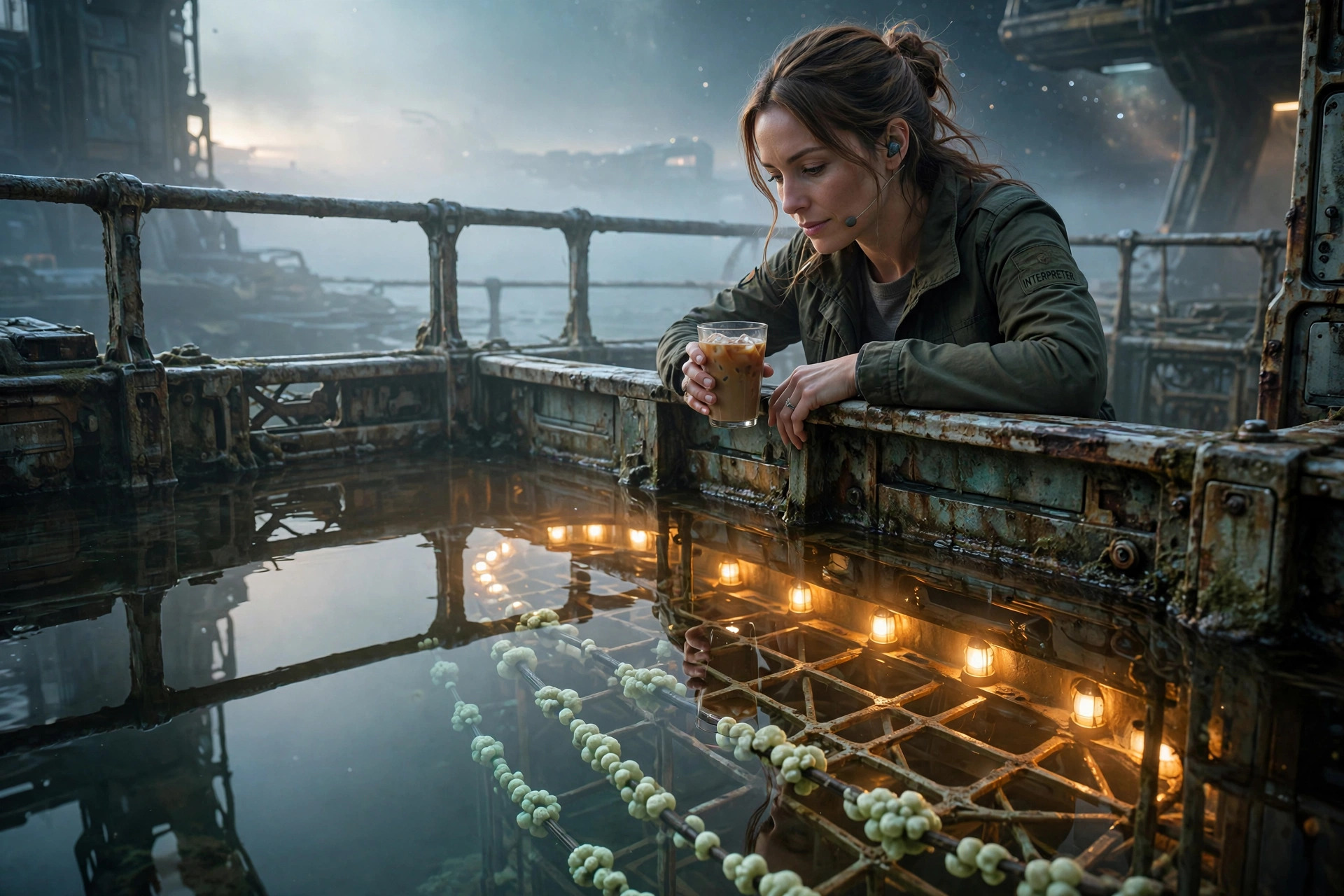
The channel went quiet the way it always did, all at once, as if someone had set down a held note. Calista Brannoch felt it in her boots before she saw it, the tidal pull easing off the pilings of the tide gallery, the brown water below turning from a muscle into a mirror.
"Slack," Dessa said, and flipped the hydrophone feed to the gallery speakers. The sound was a low, wet murmur, stones turning over in a far room.
"Light first. Give it the greeting."
Dessa's fingers moved on the array board. Down on the lattice shelf, the lamp ring pulsed twice, a slow double swell of amber. For a long moment nothing answered. Calista leaned on the rail with her coffee going cold and watched the mineral nodes under the surface, pale knots strung along the cable lines like beads on a wet thread. Then the nearest one brightened, a green-white bloom that crept outward through the biofilm, node to node, down the whole length of the shelf.
"Greeting returned," Dessa said. "Same cadence as yesterday. A little warmer in the pressure band."
"It's pleased to see us."
"It's a biofilm, Calista."
"It's a biofilm that remembers our names." She grinned, and could not stop. Nine winters she had stood at this rail, and every slack tide still felt like the first one, the water opening a door and something on the far side saying yes, you, come in.
They worked through the shared set the way a pair of musicians run scales. Calista called each sign from the paper index, though she no longer needed it. Dessa sent it in light and pressure, and the lattice returned it, slow, patient, always a little late, as though it were translating in its head. The sign for water-rising bloomed and was answered. The sign for shore. The sign for the dark under the shelf, which the lattice drew as a closing ring and Calista had learned to answer with her own palm cupped over the lamp. Thirty-one signs, each one fought for across seasons, each one confirmed from both sides until neither of them could find a crack in it.
"Thirty-one," Dessa said, ticking the last confirmation in the log. "You know that's the most anyone's ever gotten with anything that isn't us."
"Say it again."
"No. You'll get insufferable."
"I'm already insufferable. I'm happy." Calista pushed her hair back with a wrist. Out on the water a gull dropped, thought better of it, and wheeled away. Beyond the mouth of the Gannock Channel the pulse array stood on its concrete footing, steel and glass, dark and idle, a big blind lamp that she had trained herself not to look at.
She looked at it now, briefly, and then back at the shelf.
"I want to try something," she said.
Dessa raised an eyebrow without looking up. "That's how most of my bad afternoons start."
"Not bad. A gift." Calista reached into her jacket and brought out a small thing wrapped in a square of cloth, a smoothed disc of green sea glass she had carried in her pocket for weeks, polished by a decade of other people's rivers. She had meant it as a joke at first. Then it had stopped being one. "Piers is on the shelf at the next low. I'll ask him to set it by the third node. And we send give while he does it. The sign and the thing together. It's the one sign I've never closed. If it sees the sign and the glass at once..."
"It'll understand the glass is for it."
"It'll understand we meant well."
Dessa studied her for a moment, the way she studied a waveform that looked too clean. "You're sure it reads intent."
"Look at what it's done for us." Calista gestured at the log, the whole bright ladder of confirmed signs. "It's been generous for years. It knows what we are by now."
Dessa shrugged, which was not agreement but was not refusal either, and brought up the sign. Calista had drawn it so many times her hand did it without her: a spiral, three turns, closing at the end into a small neat knot. She fed it to the board and Dessa shaped it into light, a long curl of amber that wound outward along the lamp ring and held.
The lattice did nothing.
The water was perfectly still. A thread of mist lifted off the channel and thinned in the weak sun. Calista counted her own pulse in her ears. She had waited out longer silences, she told herself. The lattice thought slowly. It always had.
Then the farthest nodes, the ones near the shelf's drop-off, dimmed instead of brightening. Not out, only drawn down, a slow ebb of color running back toward the channel floor. The nearer nodes stayed pale. And the pressure band, which Dessa had piped into the gallery as a soft shudder, rose in a long, dragging stroke and fell away without a shape Calista could name.
"That's not a return," Dessa said quietly.
"No."
"It's not a refusal either. It's not any of ours."
"It's slow today. Tide's turning early maybe." Calista heard how thin it sounded. She watched the last of the pale glow slide out of the far nodes and felt something small and cold settle behind her sternum, and she set it aside the way she had set aside a hundred small oddities before. The lattice was a stranger. Strangers were odd. "We'll log it as unresolved. We'll come back to it."
"You want to resend?"
"Not now." She folded the cloth over the green glass again and put it away. The slack was already thickening, the water beginning to lean toward the sea. "Close the greeting. Say goodbye properly."
Dessa sent the farewell, and the lattice returned it, faithful and a beat slow, and Calista felt better, almost whole. She let herself believe the odd answer had been weather.
They climbed down to the workshop while the tide gathered itself. Dessa's bench sat under a window crusted with salt, tools laid out in rows like surgical instruments, the floor gritted with dust the color of wet slate. A hand-sized tile lay in the vise, one edge still rough where the diamond scribe had left its burr.
"You said you'd have it for me before the neap," Calista said.
"I said I'd try." Dessa fitted a fine stone to the edge and bent over it, working in short, patient strokes. The grit whispered. In the etched face Calista could see the spiral, three turns, cut deep and clean in the black basalt, the sign for give as the lattice itself drew it, copied from a year of recordings. She had asked for it so she would have something to hold when the signal was only light.
The stone passed over the last rough place and the edge went smooth. Dessa blew the dust away, ran a thumb along it, and checked it against the window light, turning it once. Then she held it out across the bench.
"Done."
Calista took it. It was heavier than it looked, cool, and finished to a grain as soft as skin. She turned it over and found the spiral with her fingertip, followed the turns inward. One side of it seemed to her, for a moment, strangely wide. She put the tile in her pocket beside the sea glass and said nothing.
The Armed Panel
Estrada had the funding letter printed. Calista noticed that first, before he said a word: paper, in a station where nothing was printed, laid flat on the table in the tide gallery with his coffee cup holding down one corner. Beyond the long window the Gannock Channel lay brown and heavy, the ebb running hard over the lattice shelf, and nothing out there glowed at all.
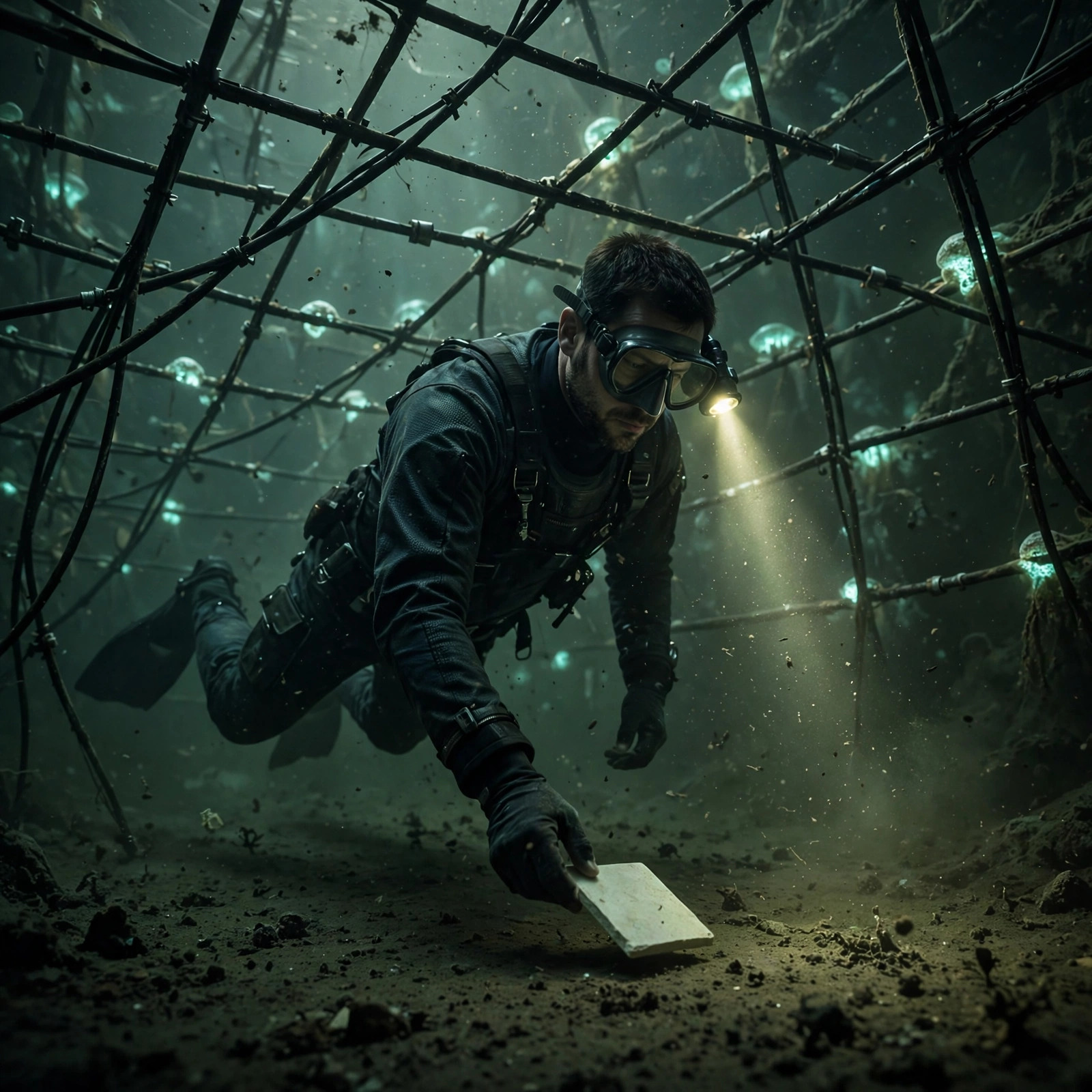
"Sit, Calista. Please." He said it plainly, like a man offering her the better chair. Dessa had already taken the stool by the wall, her laptop shut on her knees. Piers leaned in the doorway in his thermal undersuit, hair still damp from the morning check, a coil of cable looped over one shoulder.
"I read it twice on the walk over," Estrada said. "The consortium meets after the neap. If I bring them a good vocabulary and a good feeling, they cut us. They've said so. Not as a threat. They've simply run out of patience for good feelings."
"We have thirty-one signs," Calista said. "Nine years ago we had none."
"And they're beautiful. I mean that." He tapped the paper. "But thirty-one signs that mean greeting, tide, and light don't pay for a station. What pays is a clear, broad exchange. I want to fire the wide pulse at slack water, the whole band at once, light and pressure, and say to the lattice: here we are, all of us, answer in kind. If it answers, we have more in an afternoon than in a year."
"And if it answers wrongly?"
"Then we learn that, too." He spread his hands. "A clear signal protects everyone in this room. Mine is the only plan that does."
She had rehearsed this and still felt it slip. "The pulse can't hold back. It would have to carry the sign for give, because that's the only one that says we come in peace, and I don't know what it says on the other end. Yesterday it answered me slowly. Dimmed. I let it go, and I shouldn't have."
"Dimmed how?"
"Like it was pulling something back."
Estrada leaned forward. He wasn't impatient; that was what made it hard. "Can you show me that? In the record?"
"Not yet. There's a sign in the lattice's own set that looks almost the same as mine. I think it might mean take back what was lent. I can't prove it. I'd need more slack than we have."
"Might," he said, gently. "You've told me for years that you read this thing better than anyone alive. I believe it. But I can't take might to a board. I can take a result."
Dessa shifted on her stool. "The carved version is different from what we send by light," she said, carefully, to neither of them. "Mine's open on one side because that's how it drew it. But a pulse is wide. It'd blur the shape."
"Which could help us," Estrada said. "Blur it enough and it reads as a greeting."
"Or as nothing," said Calista. "Or as the other thing, louder."
For a while only the ebb spoke, a low scraping against the shelf pilings. Estrada rubbed his eyes. "Piers. What does the shelf look like to you?"
Piers unslung the cable and let it drop to the floor in a loose heap. "Cold. Nodes are sluggish after the turn. Winch on the east anchor's been jerking since the spring service. I'd not like a flare with that hauling on my line."
"Then check them. Every node on the shelf, before slack, and tell me what you'd change."
"I'll tell you the same as yesterday." Piers gave Calista a short, tired look, half apology. "But I'll check."
Estrada stood and gathered the paper. "I'm arming the array now. Not firing. Arming. Fire is tomorrow, at slack, unless someone shows me a reason by then. You have today, Calista. Use it however you like."
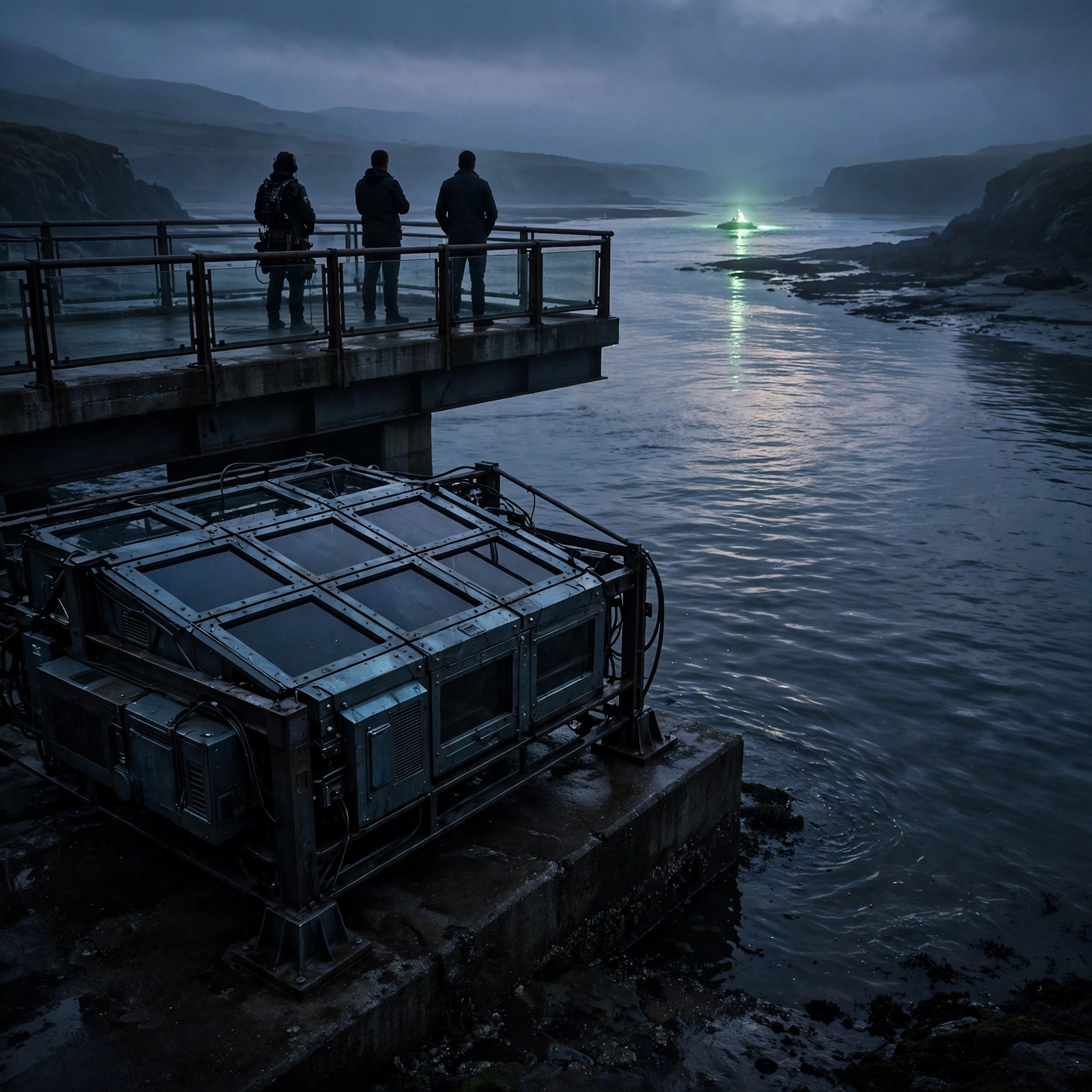
She followed him out onto the gantry above the channel mouth, wind pulling at her collar, Dessa a step behind. The pulse array squatted on its concrete footing, steel ribs and dark glass, salt-bitten, older than Calista's time here. Estrada knelt at the panel, turned his key, and waited. Dessa's key stayed in her pocket; Calista saw her hand close around it there.
The pouch at Calista's hip held the slate tile and the sea glass, one heavy, one light. She wanted very badly to believe the lattice would see the glass for what it was. The thought embarrassed her a little. Why should it?
Piers passed below them, carrying his rig along the shelf walkway without looking up. Then the panel clicked, and a small light beside Estrada's hand woke from black to amber, steady and patient, and Calista watched it burn.
Winch Cable
The slack came in over the channel like a held note, the ebb scraping at the pilings going thin and then gone. Calista stood on the gantry with her palms on the cold rail and watched the lattice shelf below. Piers was still out on it. She could see the orange of his drysuit bent over the third cluster of nodes, his rig clipped to the east cable, the winch drum above him wrapped in its salt-stiff line.
"He's not clear," she said.
"He said he'd be off by slack." Estrada didn't look up from the panel. His key was already turned, his thumb resting beside the amber light.
"He said he'd try. Joaquim, look at him. He's reseating a sensor."
"Then Dessa will tell him to move." He said it flatly, without heat. "Dessa, raise him."
Dessa sat at the hydrophone desk with a headset half off one ear. She keyed the channel. "Piers, array fires in a few minutes. Get off the shelf." A pause, then his voice came back thin through the speaker, shaped by the dive line. "Nearly done. Two more nodes." Dessa looked at Calista, then at Estrada. Neither of them spoke.
Calista had spent a night rehearsing the argument, and now it came out small. "Wait for him. Please. One more slack tide won't hurt you with the board."
"It might." Estrada straightened. His face was tired and not unkind, the face of a man who had read the consortium's letters twice. "If I wait for every good reason, there's no station by autumn. Then no one hears this thing at all. I won't lie to you about that. Not once have I."
"You haven't."
"Then give me this. A clear signal protects everyone down here, Calista. Including him."
She wanted to say that a clear signal was exactly what she couldn't promise. She had the slate tile in her pouch, the spiral open on one side, and a sign she'd used for years that she had never proved. Instead she watched the shelf. The water lay flat and pewter, the lattice faintly alight beneath it, a slow pulse of green in the nodes, patient as breathing.
Piers lifted his head. He raised one hand toward the gantry, a thumb up. Done, or nearly.
Estrada pressed the panel.
There was no sound to speak of, only the glass ribs of the array going white from the inside, a flat wide glare that made Calista flinch and look away. The gantry thrummed under her boots. When she turned back, the channel had changed. Every node along the shelf had flared at once, gold, then a hard blue-white, and the light ran through the lattice in a ripple, outward from the mouth, faster than she had ever seen it move.
"Piers!" Dessa's voice cracked on the speaker.
The east winch jerked. Calista saw the drum kick, the cable snapping taut, then slack, then taut again with a crack she felt in her teeth. Piers was yanked sideways off the walkway edge and swung hard into a piling, his rig dragging after him. The orange shape folded around one arm. He didn't cry out. That was worse.
"Cut the winch," Estrada said, already moving.
"It's not answering the panel." Dessa was on her feet, hands skidding over switches. "The flare's put noise on the control line, I can't--"
"Manual release, the housing on the left."
Calista was already on the ladder. She took the rungs too fast and her palm burned on the cold steel. By the time she reached the shelf walkway the winch had caught again and was dragging Piers by his harness toward the edge, inch by jolting inch, his boots scrabbling at the grating. Below him the lattice still burned, a bright, furious field.
She threw herself down beside him and got both hands on his harness. The line pulled. For a moment it was simply a contest of weight, hers and his against the drum, and she felt the cable winning. His face was gray under the hood. "Don't," he said through his teeth. "Arm's gone. Don't pull the arm."
"Then I'll pull the rest." She wedged a boot against a post and hauled. The cable sang. Something in her shoulder tore, bright and distant. Overhead the housing door banged open, and she heard Estrada swear, then the drum shuddered, a long grinding stop. The line went dead in her hands.
Neither of them moved. The channel slapped once against the pilings. Calista found she was shaking.
Estrada came down the ladder more carefully than she had. He knelt, saw the angle of Piers's forearm, and the color left his face. "Don't move him yet," he said, quietly. "Dessa, the stretcher, and call the clinic in town."
"I'm already calling." Dessa's voice came from above, high and controlled.
They got Piers onto the walkway and strapped the arm against his chest, Calista's hands slick and clumsy on the buckles. He bore it with his jaw locked. When Estrada tried to speak to him he shook his head once, and Estrada stopped. There was nothing in the man's face now of a director or a faction. He looked like someone who had done a sum and found it wrong.
Calista looked past them at the water. The flare had ebbed. The lattice lay dim, a scatter of ordinary green. She waited for the slow patterns that should have followed, the answering light she had read every slack tide for nine years. Nothing came. She tried the greeting sign on her hand lamp, the plain one, the first of the shared set. The nodes did not move.
Dessa came down at last with the stretcher and a slate of readings clutched against her chest. She did not look at Estrada. "Third cluster, the one Piers was working," she said. "One node's dark. Not faint. Dark. And the lattice isn't taking the confirmation sign. I ran it twice."
Calista stared at her. "Which sign?"
"The one for water returning." Dessa swallowed. "We had it counted."
On the stretcher Piers opened his eyes. He was white to the lips, sweat standing on his forehead in the cold, and his good hand lay open on his chest as if he'd forgotten what to do with it.
"I was right by it," he said. "When it went. I'm telling you what I saw, Calista. It looked like the lattice flinched."
The Tide Gallery
By the dawn after the pulse, the lattice had not spoken once. Calista had sat the whole slack at the long window of the tide gallery with her hand lamp and her notebooks, and the channel below had given her only ordinary green, rising and falling with the water, nothing that answered.
She did not go to bed. She spread the records across the sill, the old paper ones first, then Dessa's printouts of every exchange, and went back through the years the way she might go back through a house looking for a lost key. Her shoulder ached where the cable had torn it. She worked around the ache.
The give sign was easy to find. She had made it nine years ago, a spiral drawn with the lamp, closing as it turned inward. The lattice's answer to it had always been slow and dim. She had read that dimness as shyness, as politeness. Now she pulled the lattice's own drawings from the early seasons, the ones she had filed under other headings, and laid one beside her own.
The lattice's spiral for give was not closed. One side stood open, a gap where the arm of the curve failed to meet itself. She had always drawn it shut, because shut looked finished and generous to her. She turned the page. Beside it, in a record from her second year, was a sign she had labeled unclear, withdrawal? It was the same spiral, and the gap sat on the opposite side.
She held both pages up to the window until her arms shook. Open one way, a thing offered. Open the other way, what was lent being called back. And her own sign, closed, matched neither. For nine years she had been holding out her hand and the lattice had been trying to work out which of two things it meant. Yesterday, with a hundred lamps at full width, the array had shouted the wrong half of it.
"You look like you've seen a body," Dessa said from the door. She carried two cups and set one on the sill without asking. Her eyes were red. She had been at the clinic with Piers until the small hours.
"How is he?"
"Sedated. They're pinning the arm this afternoon. He asked if his rig was tied off." Dessa's laugh broke in the middle. "He won't dive this season. He knows. He asked about the rig anyway."
Calista showed her the two spirals. Dessa looked a long time, then touched the tile hanging in its cloth at Calista's belt, the slate she had cut with the diamond scribe and ground smooth, the spiral on it open on one side.
"I copied it from the lattice's own drawing," Dessa said slowly. "From the good photograph. I never asked which way it went."
"Nobody did. I didn't." Calista closed her fingers around the cold edge of it. "I can't tell you which it is. That's the trouble. I don't know yet whether it's give or take back."
Estrada came into the gallery while the tide was turning, still in yesterday's jacket. He had the look of a man who had also not slept. He stopped at the window and looked down at the dim lattice, the dark place on the third cluster like a missing tooth.
"Nothing?" he asked.
"Nothing since the pulse." She laid the pages in front of him and walked him through them, plainly, the gap on one side and the gap on the other. He read with his lips pressed together. He did not interrupt, which she had not expected.
"So it might have heard us say take back," he said at last.
"At a volume it had never met. Aimed at everything it is."
He sat down heavily on the bench. For a while he said nothing, and the water moved under the window. "I broke a man's arm," he said. "I know that. I'll carry it." He rubbed his face. "But listen to me, Calista. The consortium reviews us at the end of this window. I have told them there will be a result. If we go in there with a lamp and a slate and a guess, we'll get another dim answer you'll interpret three ways, and they'll close the station. Dessa loses her post. You lose nine years. There is no contact without a station."
"I know what it costs."
"Then one more pulse. Narrow, tuned down. We send the sign, we watch what it does. It's the only way to know which it means. Everything else is waiting, and we don't have the tide for waiting." He was not shouting. That was what made it hard. He believed every word, and half of them were true.
"And if it means take back? We tell it a second time, louder, that we want everything returned." She heard her voice crack. "It already went dark on us once. It stopped answering the water sign. I don't think it's confused, Joaquim. I think it's deciding about us."
"Or it's damaged, and silence is all you'll ever get from it unless we push."
"Then I'd rather get silence than a door shut for good."
He looked at her, and then past her, at the gallery window, at the shelf where Piers had lain gray in the cold. "You can't prove that," he said, more gently.
"No. I can't prove any of it." She breathed. "That's exactly why you can't fire."
He stood. "The array answers to me. The first key is mine."
"And the second is Dessa's."
Dessa had not moved from the sill. The cup was cold in her hands. She looked at Estrada, who had hired her, and at Calista, who had taught her to read the water. Then she set the cup down, drew a cord from inside her collar, and took off the small steel key.
"I'll go with you," she said. "If they fire us, they fire both."
The three of them went down the walkway to the housing at the channel mouth, and nobody spoke. The array stood on its concrete footing, glass dull in the gray light, its panel showing the armed amber Estrada had set two days before. Calista fitted her own key to the lower slot, and Dessa fitted hers to the upper. Estrada stood a pace behind them with his hand half raised, and she waited for it to fall on her shoulder.
They turned the keys together. The amber went out, and the bolts drew back into the housing with a short, heavy clack.
Estrada's hand came down to his side. He did not stop her.
Last Slack Tide
The winch took the weight with a low grind, and Piers swore at it softly, the way he swore at all machinery he had once trusted. His left arm hung in its sling, bound across his chest. His right hand rode the brake lever. Dessa stood at the drum beside him, her gloves pale with salt, feeding the cable through the guide with a care that looked almost like prayer.
"Easy," Piers said. "It likes to jump at the start."
"I know. You told me twice."
"Three times, then. Humor me."
Calista knelt at the lip of the platform above the Gannock Channel, the tile cradled in a net of soft line against her knees. Basalt slate, hand-sized, the grooves of Dessa's scribe filled with a dark paste so the spiral would show against the pale silt. She had looked at it so long in the past two days that the shape no longer meant anything. An open curve, a gap on one side. Give, as the lattice drew it. Or something she had misheard for nine years.
The water below was a flat, held green. It was the last of the slack tides, the final stretch before the springs came in and drowned the channel in noise. The current had not stopped so much as lost its argument with itself. Along the lattice shelf the nodes sat in their clusters, faintly luminous, patient as stones.
Estrada had come out onto the platform without announcing himself. He stood at the rail in his station coat, hands in his pockets, a careful distance from the array housing at the channel mouth, whose panel stayed dark. He had not touched it. He had not said he would not.
"Still no change on the third cluster?" Calista asked, not turning.
"One node dark. The rest are doing what they did yesterday. Which is nothing." He paused. "I read the logs again last night. Every answer it gave us before the pulse, it gave inside the slack. If this fails, you have no more slack."
"I know."
"I'm not here to stop you." His voice was level. "I'm here because if it goes wrong, I want to have seen it. Not read about it."
She nodded. It was the most generous thing he could have said, and it was not generous at all. It was only honest, and that was why she could bear it.
"Net's clear," Dessa called. "Ready when you are."
Calista stood, and her knees complained. The first time she had gone down to the shelf, she had been certain of her own kindness. She had made her signs slowly, a open hand, a lowered hand, and trusted the water to carry the warmth in them. She had never once asked what a lowered hand looked like to something that had lent the world a tide. Now she knew what it cost to find out. Piers's arm was the answer, and he was standing there anyway with his good hand on the brake.
"Piers," she said.
"Don't." He did not look up. "I'd have gone down on that shelf again this morning if the surgeon let me. Let me do this part."
She set the tile into the cradle and fastened the clasp. It looked very small over all that green. Dessa released the pawl, and the cable began to pay out, the net sinking slowly, the slate a pale square that blurred and wavered and dimmed.
Nobody spoke. The winch ticked. A gull complained somewhere over the housing, and then the sound drew off and left only the cable running through Dessa's fingers.
"It's drifting east," Piers said. "Current's got a thread in it yet."
"Can you hold?"
"For a minute."
"Hold." Calista leaned over the rail. The display on the platform showed the camera's view from the cable head, a murk of silt and drifting grain, then the ridge of the lattice shelf swinging into frame. The first cluster, glowing low. The second. The third, where one node sat black as a closed eye.
"There," she said. "Put it in front of the dark one. Not on the shelf. On the floor, in the open silt, where it has to come to it."
Piers eased the brake. The line swayed. Dessa whispered numbers she did not say aloud, adjusting by the feel of the cable. The net sank until the slate nearly touched, and Calista said, "Now," and Dessa tripped the clasp.
The tile slid free and tilted once. It settled flat on the silt with a small cloud rising and falling around it, the open spiral turned up toward the dark. Then the cloud thinned, and the tile lay there, so plainly a made thing that she felt ashamed of how much she had wanted it to speak.
"Winch is slack," Piers said. "Pulling the net."
"Leave the camera."
The three of them stood close to the screen. Estrada came up behind them, no closer than that. The silt settled. The light on the first cluster dimmed and brightened with the tide's last breath, then dimmed again, and nothing answered the tile.
A long time passed. Calista noticed her own hand on the rail, the knuckles pale, and made it let go. She thought of what she would say if it never answered. She thought of Estrada's consortium and the closed station and Dessa's post. She thought, with a dull clarity, that she would have lowered the tile anyway.
"It's reading it," Dessa said, very low. "Or ignoring it."
"Both look the same," Calista said.
"Joaquim." Piers did not turn. "You can go in. It's cold."
"I'll stay."
The green on the screen grew heavier. Somewhere under the platform the tide began, almost imperceptibly, to lean the other way, and the silt around the slate stirred and drifted. Calista watched the dark node until her eyes ached. It stayed dark. It stayed dark while Dessa shifted her weight, while Piers's breath fogged and cleared, while Estrada said nothing at all.
Then a glow rose in it, so faint she thought it was her own tired eyes. A slow brightening from the core outward, a pulse of pale light, and a long fall back to dark. Then, after a pause that seemed to belong to another scale of time, it brightened again.
No one on the platform moved. The tile lay in the silt, and the dark node breathed.
Get notified when new stories drop

Mira Okoye
Mira writes first contact and mentorship-across-species stories where curiosity beats fear.
Leave a comment
Comments