





Pearwood Wall

The wrist was swollen at the base of the thumb, and Odile pressed it with two fingers until the man flinched. "There," she said. "That's the one that's complaining."
"It's all of them," said the neighbor from Fennel Row. He ran the cheese cart and had spent a week hauling crates up the hill. His forearm lay across her knee on a folded wash-cloth, the skin warm and a little shiny.
"It's mostly that one." She turned the hand over, asked him to make a fist, and watched his face instead of his fingers. Steam from the big copper tubs drifted past the high windows and left the morning light milky. Somewhere behind her a mangle ticked as someone fed it sheets. "Not broken. Strained, and you've been lifting through it. I'll wrap it, and you'll carry nothing heavier than a loaf for a while."
"A while is how long?"
"Until I say. Lucette, the splint with the soft edge."
Lucette came from the bench by the window, where she had been bent over a block of pearwood with a knife no longer than her palm. Pale curls of wood clung to her sleeve. She set the splint down without a word and went back, but not all the way. She stopped by the wall, where she could see.
Odile wrapped the wrist firmly, from the knuckles toward the elbow, and tucked the end under. The man turned his hand and flexed it, testing, and grunted the grunt of someone who had expected worse.
"What do I owe?"
"A binding token. The plain one." She nodded at the wall.
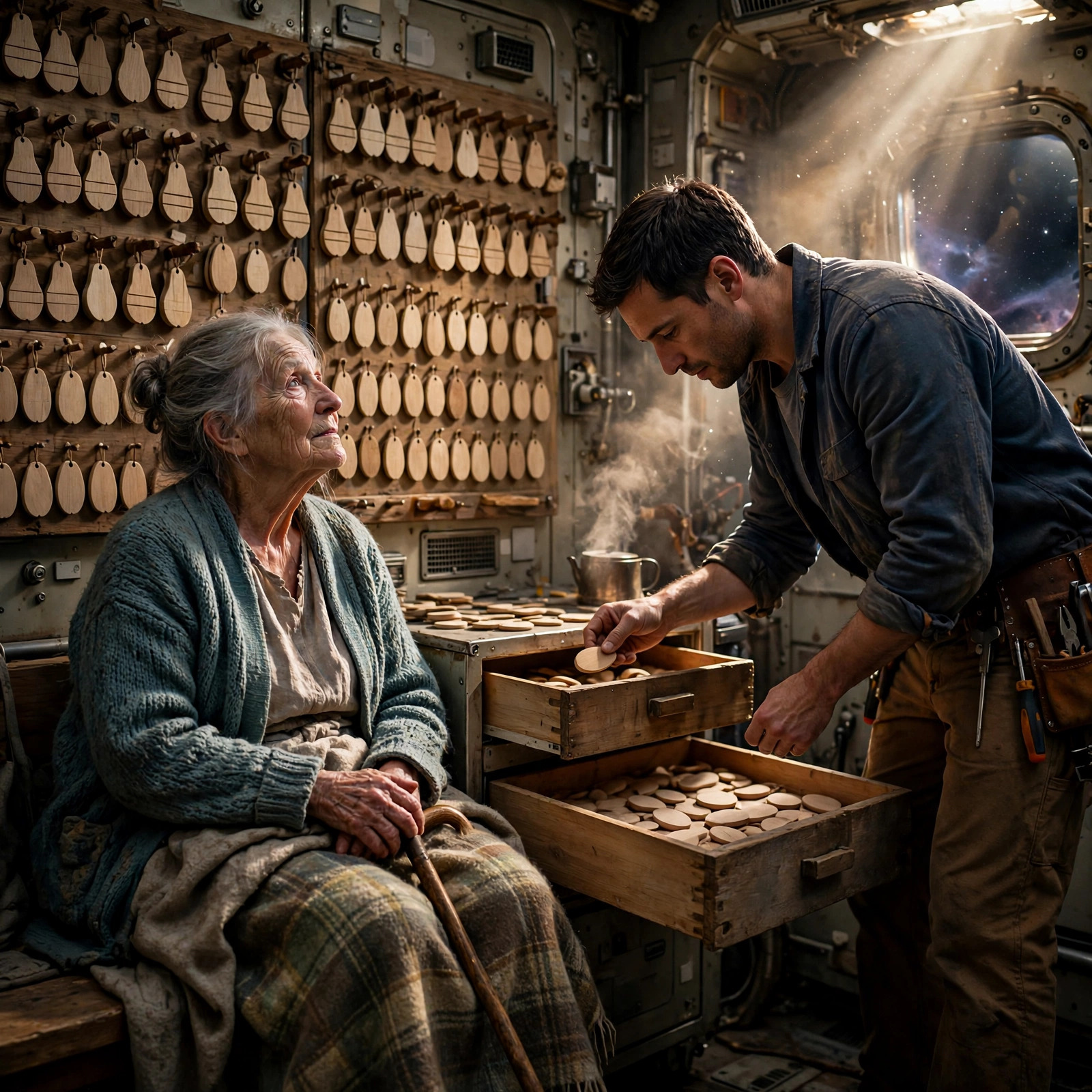
He crossed the room and she heard Ngozi's stool creak. Ngozi sat where she always sat, beside the board, a blanket over her knees even in the damp heat, her hands folded on a cane she rarely leaned on. She said nothing. She lifted her chin a fraction toward a drawer of blanks, and the man found the right one without being told, a small oval with a single band cut across it. He hung it on a free peg under the cheese cart's own name.
The whole wall was like that. Pearwood tokens, row upon row, each hung from its peg, each worn to the color of old honey where thumbs had passed over it. Some were shaped like leaves, some like knots or open hands. Odile had stood in front of it a thousand mornings and still found one she had to stop and read.
"Thank you," the man said to the room, and went out into the lane with his wrapped hand held carefully before him, like something borrowed.
"He'll carry a crate by noon," Ngozi said.
"Then he'll be back with a worse wrist and a bigger token."
"Good. We'll have the token."
Odile laughed, and then the door opened again and she knew by the quality of the quiet who it was. Tobiah Renquist wiped his boots on the mat longer than he needed to. He carried a flat case under one arm and a paper bag of pastries in the other hand, and he held the bag out first, as an apology for the case.
"From the bakery by the tram stop," he said. "I know you're mid-morning. I can wait."
"You can sit." She washed her hands at the basin. "Lucette, pastries are not a debt. Take one."
Lucette took one and did not eat it. Ngozi accepted hers and set it on the blanket, eyes on Tobiah.
He opened the case on the sorting table. Inside lay a thin gray slab with a glass eye at one end, and beneath it a folded sheet of the district's cream paper. He did not rush. That was the thing Odile could never quite hold against him. He smoothed the paper flat as if it might bruise.
"You've read the proposal," he said.
"I've read it twice."
"Then you know what I'm going to say, so let me say it plainly." He touched the slab. "Every hour anyone gives here gets logged once, by this, without anyone having to remember. Credit goes where it's earned. Nobody has to stand at a board and wonder whether they've paid enough. And the old carried debts are cleared, all of them, so nobody starts the new year underwater."
"All of them," Odile said.
"Every household that's still carrying. It's a clean start." He looked at the wall, not at her. "I've watched people here burn out, Odile. The ones who give more than they can write down. I've seen the digester worked half to death on favors. This stops that. I truly believe it does."
She did believe he believed it. His hands were open on the table, and he had the tired, careful face of a man who had sat through many meetings to get to this one.
"And the seat?" she asked, because it was there between them.
"Yours, if you'll take it. The board needs someone who has actually carried a bad night. I can write numbers. You know what they stand for." He paused. "It would come with money for the wash-house roof. I won't pretend that's separate."
Behind him, Lucette's knife had stopped moving. Odile felt it the way you feel a draft.
She might have said no then. The word was ready, plain and short. But the roof leaked over the east tubs every wet season, and the tiles were older than anyone's patience, and the man in front of her had brought pastries. She heard herself say, "It's generous."
"It's fair," Tobiah said gently. "That's all I'm after."
"May I ask something?" Ngozi's voice was dry and unhurried. Tobiah turned. "Your slab. When it logs an hour, does it know what the hour was for?"
"It records the kind of work, by category."
"There are two hundred and twelve kinds on that wall," Ngozi said. "How many categories?"
He did not bluff. "Fewer. Considerably."
"Then it will be a good ledger of something else." She picked up the pastry at last and bit it, and said no more.
Tobiah let out a short breath that was nearly a laugh. "That's fair too. It's why I want Odile on the board." He closed the case, left the paper on the table, and stood. "No answer today. Think it over. The vote's coming, and I'd like you inside the room when it happens, not outside it."
He nodded to Ngozi, then to Lucette, and the door took him back into the steam.
Nobody spoke. The mangle ticked. Lucette set down her knife and came to stand beside Odile at the wall, holding a finished token between two fingers, the grain still raw and pale. It was small, a hand closing around something, and Odile knew it, though Lucette had only learned it a month ago from the old woman's mouth.
"It's right?" Lucette asked quietly.
"Ask her."
Ngozi looked at it a long time. "The thumb is too short. It's a hand that holds on, not one that lets go." She held out her palm and Lucette gave it over, and the old woman ran a nail along the curve and handed it back. "Again, tomorrow."
Odile took the token from Lucette and turned it in the window light. It was meant for the cheese cart's wrist, a mark of care received. She found the empty peg under his name and hung it there, and the wood clicked softly against its neighbors.
She felt Ngozi watching her, steady and unreadable, the way she had watched her once before on a night Odile did not like to remember.
"I'll think about it," Odile said, to no one in particular, and to all of them.
Night Digester
The digester yard smelled of warm hay and something sweeter underneath, the smell of work being done in the dark by things too small to see. Odile came through the side gate with a covered pot against her hip and found Pavel on his knees beside the gas line, one ear almost to the pipe, as if it might tell him something.
"It's fine," he said without turning. "Pressure's just sulking."
"I didn't say anything."
"You walk like someone about to." He sat back on his heels and wiped his palms down his thighs. Lamplight caught the grey in the stubble he hadn't shaved for a day or two. The great dome of the digester sat behind him, patched in three shades of tarp, breathing slowly. Every so often its skin shifted, a long soft swell, and the yard seemed to lean toward it.
She held out the pot. "Barley and the last of the squash. Lucette made it, so it's good."
"Is this a payment or a present?"
"Does it matter?"
"To the board it does." But he took it, lifted the lid, and let the steam wash over his face. He ate standing, with the spoon from his own pocket, and she watched him do it the way she had watched a hundred people eat after a hard shift. Nobody paid Pavel to be here. Nobody had hired him. Every night he fed the digester its slurry, turned the greywater beds, and kept the little flame in the wash-house boiler fed for morning, and in the morning his pegs on the board crept a little further up the wall. A night of his bought a day of someone else's. Most of what kept the street warm was folded into those pegs, and the best of it was his.
She sat on an upturned crate by the sorting table. A cat she didn't know slept on the lid of the compost bin, and the beds beyond it showed pale green under the low lamps, rows of reed and mint drinking what the street had used and sending it back clean.
"My mother's bad again this week," Pavel said. He said it to the pot. "The cough. Ngozi's sending someone to sit with her days, so I can sleep. That's already pegged. It's all there."
"I know. I saw it."
"Good." He scraped the bottom. "Then you'll know what I'm asking." He set the pot on the table and looked at her fully for the first time. "Somebody came by the yard this afternoon with a grey box on a pole. Young, nice manners. Said it was only a pilot. Said it would read the wall tonight, while it's quiet, and match it to a list. Is that real?"
There it was. She had walked the whole length of Fennel Row rehearsing a clean answer, and every version had a door in it.
"It's real," she said. "It's a pilot. A trial."
"Of what?"
"Of reading the board. Tobiah wants to see what it can see. Where the waste is, who's burning out. That's all he's said."
"That's all he's said," Pavel repeated, evenly. "Did you agree to it?"
The cat stretched and resettled. The digester heaved its slow breath. She could say no now. She could walk to the wash-house, pull the box off its bracket, and carry it back to Tobiah in her two hands. The thought had a shape, a clear and rather satisfying one, and then she saw what came after it: Tobiah's honest face, the paper left on the table, the leaking east tubs through another wet season. He would not be angry. That was the trouble. He would only be disappointed, and kind about it, and she would have to stand in that kindness and explain why a wall of carved pear was worth more than a system that could see everyone's tiredness at once.
"I haven't said yes to the Scheme," she said. "Only that I'd think."
"That isn't what I asked."
"No." She turned her hands over on her knees. "I didn't stop the pilot. It's one night. It reads, it doesn't change anything. I'd rather see what it does than guess."
Pavel was quiet for a while. A pump ticked somewhere under the beds. When he spoke he wasn't angry, which was worse. "My pegs are three-quarters of the top row, Odile."
"I know."
"Ngozi told me once what each of them means. The little loaf is for the night I stayed on when the line froze. The two crossed reeds are for the funeral. A machine can count them. It can't know why I hung them." He wiped his mouth. "Will it count them kindly?"
"It's only reading."
"You keep saying only."
She heard it too. She stood, because staying on the crate had begun to feel like hiding. "If anything looks wrong in the morning, I'll go to Tobiah myself. Before anyone else has to. I promise you that."
"All right." He picked up the pot and pressed it back into her hands, still warm, scraped clean. "Tell Lucette it was good. Tell her the squash was a little sweet."
"I'll tell her."
"And Odile." He had already turned back to the gas line. "Next time, say it to my face before somebody else does."
She nodded, though he wasn't looking, and went out through the side gate with the empty pot knocking against her hip. The street was dark and the cobbles held the day's last warmth. Behind her the digester sighed, and a thin sweetness of gas followed her a little way before the cold took it.
At the wash-house she stopped, as she always did, with her palm flat on the door. Beyond it, in the dark, hung the wall: every peg, every small hand and loaf and reed. She had not hung the grey box there. Tobiah's young man had, politely, that afternoon, and she had watched him do it and said thank you.
She started to turn away. A scanner light blinked green on the wash-house door as she left.
Voided Pegs
Lucette was already at the wall when Odile came in, standing on the low stool with a rag in one hand and her face turned away. The morning light through the high windows lay across the top row, and the top row was wrong. Odile saw it before she understood it. A gap, a long pale gap, where the little loaves and crossed reeds had hung. The bare pegs stood out like teeth.
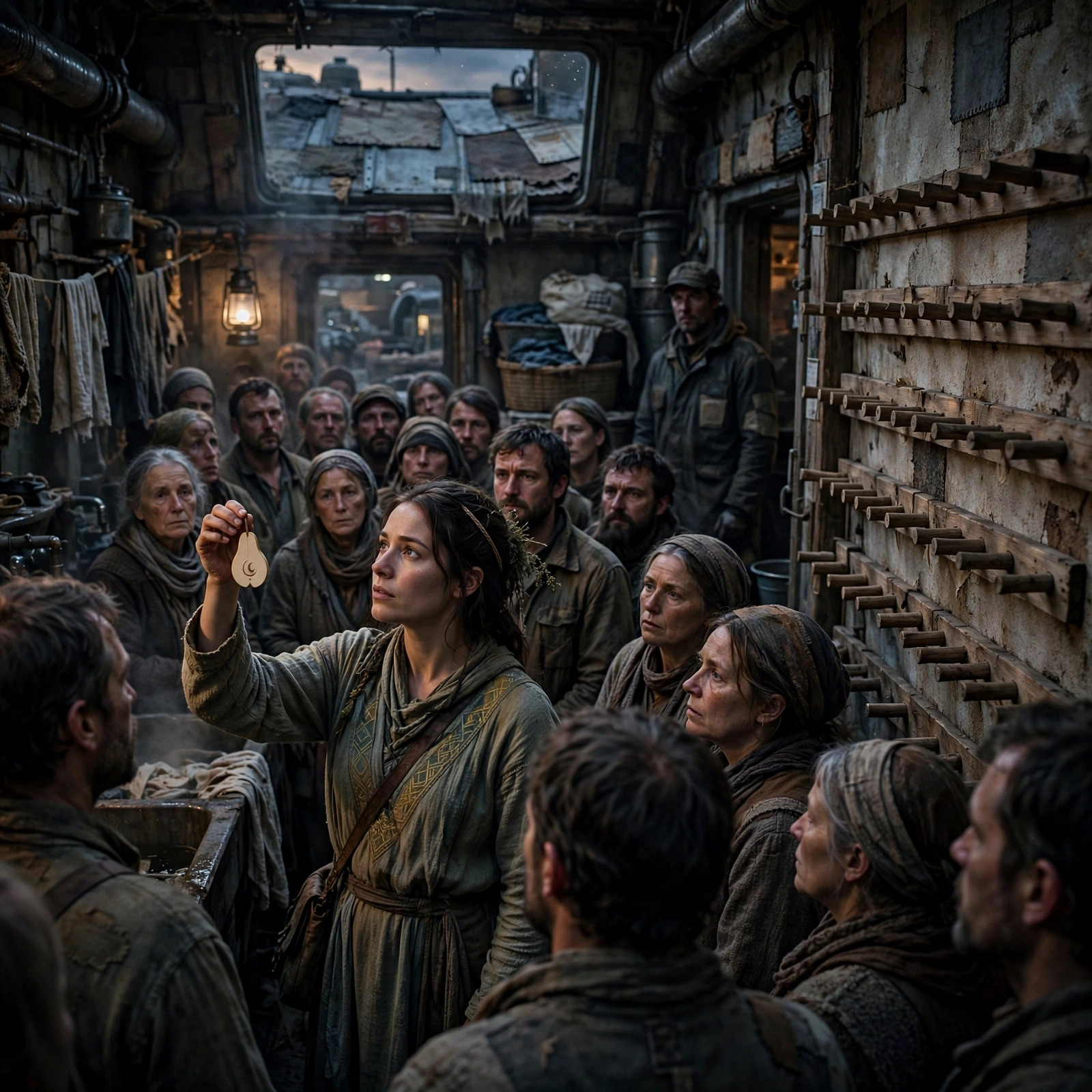
"I didn't touch them," Lucette said. "I came to oil the board and they were gone. All of Pavel's. They're not on the floor. I looked."
On the door frame the grey box showed a steady amber. Odile crossed to it and pressed the panel, and a line of clean script crawled over the little screen. Entries reconciled. Carried balances, unverified: released. She read it twice. It had not changed anything, Tobiah's young man had said. It only reads.
"Where are the tokens?"
"In the tray underneath." Lucette's voice wobbled. "It lifted them. There's a little arm. I didn't know it had an arm."
Neither had Odile. She knelt at the tray and found them in a heap, warm from the housing, pearwood gone dull under the amber light. A loaf. Two reeds. A hand with the thumb tucked in. She picked up the loaf and felt how light it was.
The door opened behind her. She knew his step without turning, the heavy tread of a man who had not slept, and the smell of the digester yard came in with him, sweet and sour at once.
"The clinic woman called," Pavel said. "Half an hour ago. She said my mother's daytime visits are withdrawn. No standing, she said. No pegs, no care." He stopped at the wall and looked at the gap. He did not shout. His hands hung open. "I thought she'd misread something."
"Pavel."
"You said you'd go to him. If anything looked wrong."
"I was going to go today." It sounded exactly as thin as it was. "I've only just seen it."
"You were going to go." He turned. His eyes were red-rimmed, and they were steady, which she could not bear. "Three days, Odile. It sat on your door for three days. You walked under it every morning."
"It was meant to be one night."
"And then?" He waited. Nobody filled the quiet. "I keep the digester running when the whole of Fennel Row is asleep. Nobody pays me for it. That's what the pegs were. Every cold night, somebody wrote it down in wood, so that when my mother got worse, the wood would answer." He pointed at the bare row. "It's answered."
Ngozi had come in at some point, leaning on her stick in the doorway, small and upright. She said nothing yet. Lucette had climbed down off the stool and stood with the rag twisted in both fists.
"I'll fix it," Odile said. "I'll put them back myself, right now, and then I'll go to Tobiah. He'll restore the standing. He isn't a cruel man."
"No. That's what's wrong with all of this." Pavel almost laughed. "He's decent. You're decent. Everybody's decent, and my mother's alone in the afternoons."
Odile stood with the loaf in her palm. She wanted to say that the harm was a mistake, a hiccup in a pilot, that it would be mended by evening. And it might be. But it would be mended because she had finally moved, and she had not moved when he asked her to, quietly, on a crate in the dark. That was the thing she could not argue past. He had said it to her face, and she had let the day go by.
"Say what you need from me," she said.
"I needed you to say no to him." He said it gently. "I think you know that. I think you've known since he hung that box."
"Pavel, hang them again," Ngozi said at last, her voice dry and low. "Put them back where you put them. I'll tell you what each one is as you go."
"It doesn't matter what they mean. Not to the box."
"It matters to me."
He looked at her for a long moment, and something in his shoulders gave way, not to comfort but to tiredness. "I know it does," he said. "That's the trouble. It's you and Lucette and a wall, and the rest of the world is a machine that can't read it." He turned to the wall again. Above the gap, further along, one peg still held a single token, set apart. His own, the plain one, the sign for a neighbor who belonged. The scanner had passed over it as though over a nail.
He reached up and lifted it free.
"Don't," Lucette whispered.
"I'll bring it back when somebody means it." He closed his hand around the carved wood. He did not look at Odile again. He walked past the stool, past the humming grey box, and out into the bright street, and the door swung shut behind him on its own slow weight.
Board Table
The district board met in the long room above the grain store, at a table so wide that Odile had to lean to see Tobiah's face across it. She had walked there with Ngozi on her arm, slowly, the old woman's stick tapping each stair. Neither had spoken on the way. Now Ngozi sat at the end of the bench with her hands folded over the stick, and the board members shuffled papers they had already read.
Tobiah had set a small model on the table. A wooden frame, a grey box, a ribbon of printed credit. He had made it himself, she could tell from the glue. He stood when the chair nodded to him, and he spoke well, plainly, without once looking at his notes.
"Nobody burns out under this," he said. "Nobody works a night shift on a promise and finds out in winter that the promise was never written anywhere. The debts get cleared. Everyone starts level. I'd call that kind."
A woman beside him nodded. A man by the window rubbed his jaw. It was a good argument, and Odile had spent days looking for the crack in it and finding only the shape of Pavel's empty peg.
"Odile," the chair said. "You've been offered a seat. Do you wish to speak before we vote?"
She stood. Her chair scraped, loud in the quiet. Her palms were damp and she pressed them flat against her skirt.
"I do. Tobiah, I'm sorry I'm saying this in a room full of people. I should have said it to you in the wash-house, days ago, on the first morning. I didn't. I let you think I was weighing it. I wasn't weighing anything. I was putting it off."
He did not flinch. He tilted his head, waiting, and she hated how fair he looked.
"No," she said. "I won't take the seat. I won't accept the cancellation. Forty households in Marrowgate carry debts the exchange remembers, and you'd wipe them clean and call it a gift. It isn't a gift to the man who sits up with the digester at night because he's owed. It was taken from him by a box on my wall, and his mother lost her afternoons for it."
"That was a fault in the pilot," Tobiah said, quietly. "I've said so. I'll say it again to anyone."
"It wasn't a fault. The box did what it was built to do. It read the pegs and couldn't read what they meant."
The man by the window leaned forward. "Then what would you have us do? Leave people to burn out on goodwill?"
"Count the waste. Use the scanner for that. Tell us how much bread we spoil and how many hours go unspent, and let us fix it ourselves. Keep the debts. They're not clutter." She heard her voice thin and made it steady. "And I'll give up my own. Mine is on that wall too, and it would be cleared first. I won't be cleared."
A murmur ran down the table. Tobiah set his pen down with care.
"You'd give up a cancelled debt," he said. "Odile, nobody's asking you to carry it."
"I know."
"Then I don't understand why you'd choose it."
"Because I don't know what it is." She turned, and there was no way to avoid the end of the bench. "I've owed one token for twenty years and never asked what the carving means. I know whose peg it hangs from. I know it's old."
Ngozi lifted her stick an inch off the floor and set it down again, and the room went still.
"I'll tell her," Ngozi said. "If the chair permits an old woman."
The chair, flustered, permitted it. Ngozi did not stand. She spoke from the bench, in the dry low voice that had once talked mothers through the dark hours.
"Odile's token is a small thing. A hand under a head. It means a night someone stayed. Twenty years ago she lay in the back room of the wash-house with a fever that wouldn't break, and nobody else was awake. I was. I sat with her until the light came and her skin cooled. She doesn't remember most of it." She paused. "The token is mine. The peg she hangs it on is mine. It's the one your machine would take, Mr. Renquist. Not hers. Mine. I would have been erased from my own wall, and nobody would have asked what I'd given."
Odile could not speak. She had known there was a debt, and had known it was large, but she had imagined a stranger's shape behind it. She had walked past that wood every day for twenty years and never once laid a finger on the carving.
Tobiah looked at Ngozi for a long moment. When he spoke, his voice had lost its polish.
"I didn't know that's what the numbers were," he said.
"No," Ngozi said. "They don't say."
He picked up the model and turned the box over in his hands, then set it down again, slowly, as a man sets down something he built for good reasons. "Mr. Chair. I'd amend the proposal. Waste data only. The exchange stays as it is, the scanner reads and reports, and nothing is lifted or voided. If the board agrees."
The board did not agree at once. Two members argued it back and forth, one for the whole scheme, one for none of it, and the vote, when it came, split narrowly across the table, hands rising unevenly. The chair counted twice. The amendment carried.
Ngozi took Odile's wrist as she sat. Odile bent, and the old woman's arms came up around her shoulders, thin and surprisingly strong, and held there a moment. "Thank you," Odile said into her hair, and had no other words.
Tobiah waited until the members began to drift. He came around the table with a folded paper and did not meet her eyes at first.
"The roof funding was tied to the seat," he said. "To the whole scheme. I can't carry it on a data-only arrangement. I'd be lying to the district. I'm sorry."
"I know," she said. "You're not wrong to."
"It was a good roof."
"It would have been."
He laid the withdrawal on the table and uncapped his pen, and she thought of the rain that would find the rafters before winter, and of every bucket she would have to set out. Then she took the pen from his fingers and signed.
Blank Pegs
The rain came back before Odile had finished sanding the blank. It found the gap in the wash-house rafters and ticked into the bucket she had set under the board, a flat tin sound that Lucette had stopped hearing and Odile had not.
"Pearwood or plum?" Lucette held up two offcuts. Her thumbs were pale with dust.
"Pear. Everything on that wall is pear."
"Ngozi said the newest ones have been plum, when pear ran short."
"Then Ngozi can tell us which she'd rather." Odile took the pear and turned it to the lamp. The grain ran straight, honey-colored, without a knot. She had expected to feel clumsy. She felt something nearer to fear, the way she had felt at twenty-seven, the first time she had put her hands on a stranger's body and been trusted to be right.
Ngozi sat in her chair by the stove with a blanket over her knees. She had not offered advice since they began, only watched. Now she said, "What did he give you?"
"Nights," Odile said. "He kept the digester running so the yard stayed warm and the beds didn't sour. He did it for nothing but pegs. And when the scanner lifted them, I was the one who let it stay on the wall."
"That isn't what you owe him."
"It's part of it."
"It's the part you're ashamed of. The token has to be the part he gave." Ngozi's voice was dry, not hard. "Shame carves badly. It comes out as a scar."
Odile set the gouge against the wood. The first cut skidded and left a ragged lip. Lucette reached over without a word and tilted Odile's wrist a little, so the blade sat shallower.
"Let the grain do half of it," Lucette said. "You're fighting it."
"I'm fighting everything this week."
"I noticed."
The second cut ran clean. The wood curled away in a pale ribbon and fell to the floor. Odile worked in short strokes, and gradually the shape came: a rounded base, a stem rising from it, and at the top a small cupped hollow, open to the sky. Not a hand, not a leaf. A vessel left uncovered through a cold night so that something could gather in it.
The door opened on wet air. A neighbor came in with a covered dish, looked at the three of them, and sat down on the bench without asking. Then another came, and a third, shaking out coats. Word moved along Fennel Row faster than the rain did. Soon the wash-house held more people than it had since the day the roof was mended the last time, and nobody spoke much. A child was shushed. Someone fed the stove.
Odile felt them at her back and kept cutting. Her shoulders ached. The hollow at the top of the token would not come even, one lip higher than the other, and she nearly started over.
"Leave it," Ngozi said. "Uneven is how a night looks."
So she left it. She rubbed oil into the wood with her thumb until the pear darkened and warmed. Lucette brought the burning iron, and Odile pressed the maker's mark into the base, the small crossed lines that meant the carver had a stake in what she carved. The smell of scorched fruitwood rose, sweet and bitter.
"It's done," Lucette said quietly. "You could hang it."
"Not yet."
"Odile."
"He should be here. It isn't a debt if only I know it."
The crowd shifted. Someone near the door stepped aside, and cold came in with a man in a work jacket, hair flattened by rain, a small carved token closed in his fist. Pavel stood on the threshold as though the floor might not take him. He looked at the bare space on the board where his own peg had been, then at the faces, then at Odile.
"I heard you were making something," he said.
"I am."
"I didn't come for it." He crossed the room slowly. The neighbors made a lane without being asked. "My mother's neighbor sits with her days now. Not on the board. Just because. I didn't want that to be the end of it, her being owed by people who can't mark it anywhere."
"I know."
"You said you'd go to him." There was no heat in it, only a flat tiredness, which was harder. "You said it in my yard. I believed you, and I stopped watching the scanner."
"I put it off," Odile said. "I told myself he'd listen better if I waited. He would have listened sooner. I was afraid of his kindness, because it was hard to say no to." Her throat tightened. "You paid for that. Your mother paid for that. I can't give back the week she lost."
Pavel was silent. Rain ticked into the bucket. Somewhere behind her, a person began to cry quietly and stopped.
"What does it say?" he asked, nodding at the token in her palm.
She held it out. He did not take it, only bent over it, close, studying the cupped hollow and the uneven lip.
"It means someone was cold and someone stayed up," Ngozi said from her chair. "It means the owing runs toward the one who stayed. Lucette, say it back."
Lucette swallowed. "A night kept for another. Owed by the one who was kept from the cost of it."
"Near enough," Ngozi said.
Pavel straightened. He opened his fist and looked at the small token he had carried out into the rain, the one that said he belonged to this wall. The wood was worn smooth where his thumb had worried it.
"I'd have kept it," he said. "I thought about it."
"I know."
"Seemed like it would be easier."
"It would have been."
He held it out to her, not to the board. She understood, and her eyes stung. She took his token and pressed it into Lucette's hands, and Lucette set it on its old peg, where it clicked against the pearwood. A murmur went through the room, low, like a thing let out.
Then Odile turned to the board. Among the rows of pegs a few stood bare, pale where debts had been lifted and not yet restored. She chose one at the height of her own shoulder, where she would have to meet it every morning. Her fingers were stiff. She set the new token's loop over the peg and pressed it home with the heel of her hand, and the wood seated with a small dry knock.
Neighbors stood all around her, shoulders touching, damp coats steaming faintly by the stove. Above them the rafters let in another thread of rain, and it struck the bucket, and nobody moved to stop it.
Get notified when new stories drop

Leo Stranek
Leo specializes in solarpunk abundance and near-future progress: livable futures, bright cities, and practical wonder.
Leave a comment
Comments