




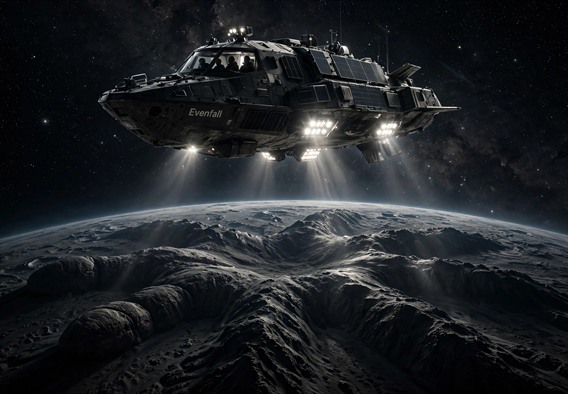
Pegboard at Dawn
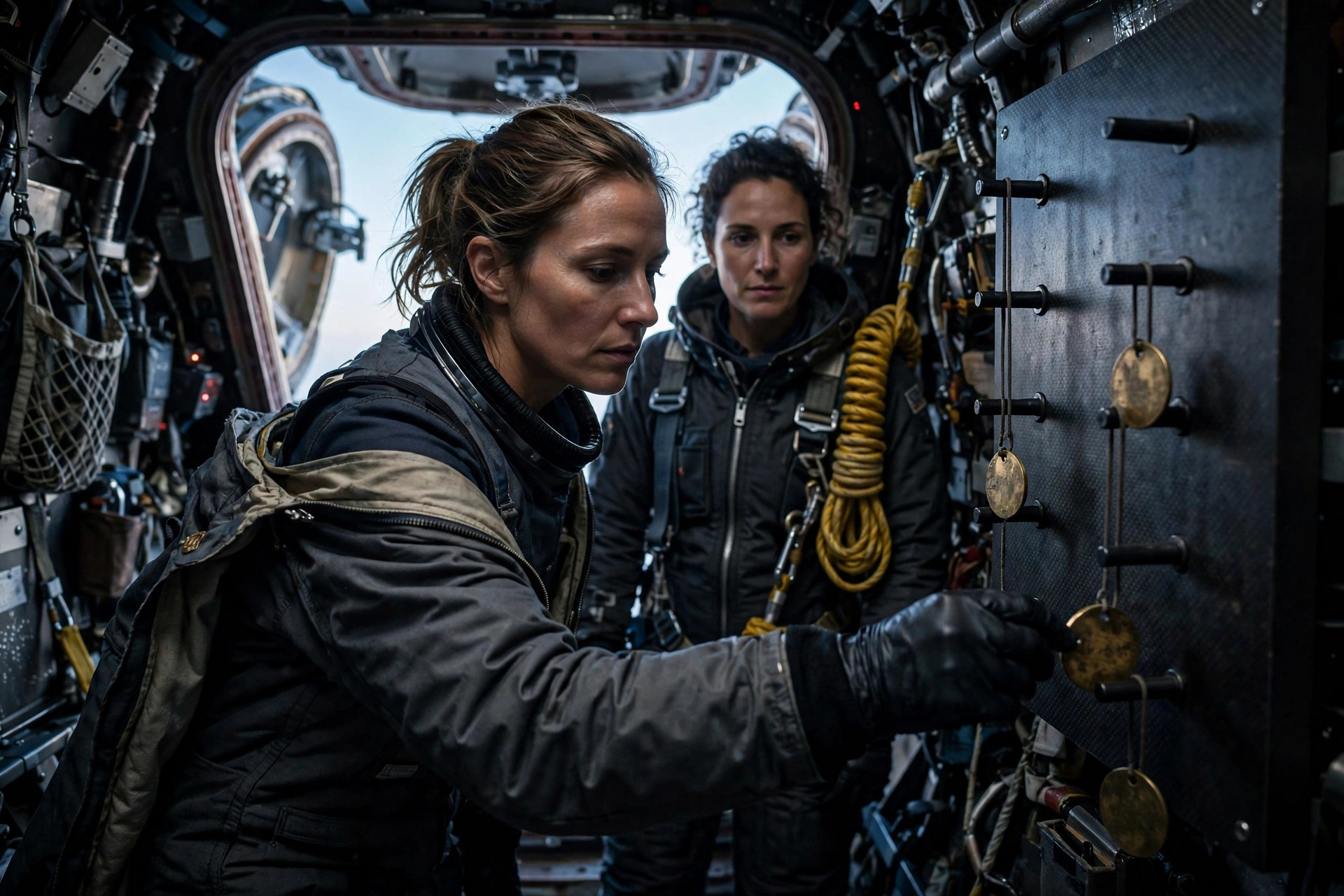
The pegboard hung beside the inner hatch of the airlock, a slab of dark composite with four pegs on the left and four on the right, and on the left, the inner pegs, four brass tokens turned slowly on their cords in the ship's air handling. Perpetua Lindahl-Oyelowo reached for hers first. It was the only one worn bright at the edge, where her thumb had rubbed it for years, and her mark was stamped just below the hole: a small anvil with a line through it.
"You're up early," Yarrow said from behind her. She was already suited to the waist, the upper half of her suit hanging from her hips like a shed skin, a coil of tether looped over one shoulder.
"Anchors don't check themselves."
"Dov would say the anchors don't care what hour it is."
"Dov's right about most things that don't involve coffee."
Yarrow laughed and took her own token down, thumbed it, hung it back. A habit. Nobody on the Tamsin Reach went out without touching the brass first. Perpetua slid hers to the outer peg, and the small click of metal on composite carried through the lock wall, a sound she had loved on every posting. It meant the ship knew where she was.
Casimir came in as she was sealing her collar ring. He had a mug in one hand and a slate in the other, and he looked at the board before he looked at either of them. Three tokens inside now, one out. Mostly he counted people that way, without seeming to.
"Routine?" he asked.
"Routine. The north line and the two on the spur. I want to see how the rubble has settled since we fired the rig anchors."
"Settled." He tasted the word. "It's ice and gravel with almost no weight to it. It doesn't settle so much as drift politely."
"Then I want to see how politely."
He nearly smiled. Over the years she had learned to read that near-smile, the way a mapmaker learns a coast. "Back before the sun's on the ridge," he said. "Dov wants the rig quiet while he fixes our position again."
"He fixed it yesterday."
"He fixes it every day. It's why we're going home."
She said nothing to that. Home was a word the ship used carefully, like a loan. In the yards they had taken her stamp away, and what remained was this: a survey posting at the far edge of anyone's interest, a rig on a lump of ice, and a clean record of other people's welds. Casimir had asked for her anyway. She had never asked him why.
"Don't be proud of your bad news," he said, reading her silence. "Go and look at the ice."
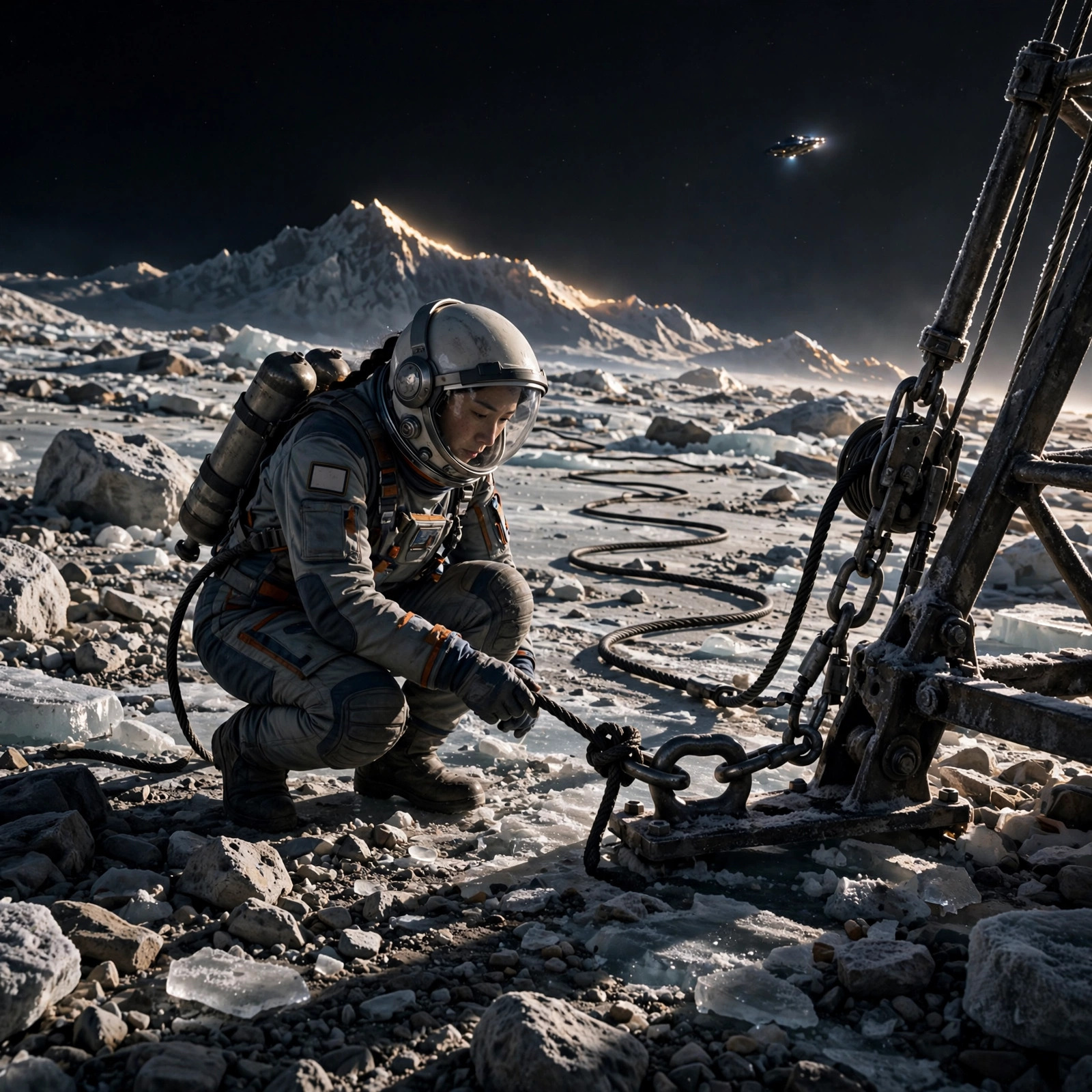
The outer door opened onto black. Not dark, exactly. Orsolya lay under them, a pale, dirty shoulder of frozen volatiles and dust, and the sun was a hard small point that threw every rock into a knife-edged shadow. Perpetua pulled herself out along the guide rail, Yarrow a body-length behind, the tether paying out between them with the slow, boneless ease of a thing that weighed almost nothing and could still take a person's arm off.
Gravity here was a suggestion. You didn't walk so much as agree, step by step, to stay. She clipped her line to the first rail stanchion, then the next, and let her boots find the ice, and felt the faint cold come up through the soles even through the insulation. Dust lifted where she stepped and rose in lazy arcs and did not come down for a long time.
"North anchor," Yarrow said on the suit channel. "I've got the head. Looks tight."
"Looks tight isn't a finding."
"Spoken like an inspector."
"Spoken like someone who's been lied to by tight-looking things."
She knelt at the anchor and ran her gloved hand along the collar where the shaft met the plate. She checked for hairline blooms in the ice around the bore, for the fine white crazing that meant the thread was working loose. She tapped the housing with the butt of her gauge and felt the answer through her palm, a dull, even note she could not hear, only feel. Sound, in a vacuum, was something you carried in your bones. This one was good. She marked it and moved on.
The spur anchors were harder. The rubble field lay thick there, a loose spill of ice cobbles that shifted if she leaned. Yarrow went ahead and set a spike and a short line, and they leapfrogged along it, tether hand over tether hand, until the second anchor came up out of the glare, its plate canted a degree or two from where Perpetua had last seen it.
"That's moved," she said.
"Or the light's lying."
"The light lies. Plates don't." She crouched. The plate had sunk, not far, into a shallow dish in the ice, and the cobbles around it were faintly darker, damp-looking in the way sublimed ice looks when the surface has been disturbed. She laid her bare gauge against the dish, expecting what the whole field had given her all morning, the deep, clean cold of a body that had never been warm.
The gauge read wrong.
Not by much. A whisper above the cold, a few tenths where there should have been none. She turned it over and checked the seal, wiped the sensor face with her thumb, and set it down again. The same. She held it there while the numbers settled, and as she watched them, they eased a little lower, as if whatever had breathed on the ice had thought better of it.
"Perpetua?" Yarrow's voice, near. "Something wrong with the plate?"
"Plate's fine. It's sat a bit." She stood. Her knees felt strange, though that was only the low gravity. "Reset the spike and give it a proper bite. I'll note the cant."
"You're quiet."
"I'm thinking about breakfast."
Yarrow snorted and bent to the spike. Perpetua turned her shoulder, a small deliberate movement, and let the gauge hang from its lanyard against her thigh. An instrument fault would be dull and easy. A fault that returned, she thought, would be something else, and she had been wrong in public once already. She did not mean to be wrong in public again, and she did not mean to be right in public either, not yet, not on one reading.
They finished the line in the long, slow light. When the lock cycled behind them and the pressure came up, she heard her own breath return first, then the soft tick of cooling metal. She moved her token back to the inner peg and held it a moment. Warm from her glove. The brass held the heat longer than she expected.
Dov was at the console in the cold bay when she passed, bent over a drift plot with his sleeves pushed up, murmuring numbers to himself. He lifted a hand without looking. She lifted one back. The ship's log lay open on the bench beside him, the day's page blank and ready, the cursor blinking where her entry would go.
She sat at the far end of the bench, took the small paper notebook from her thigh pocket, and wrote the time, the place, and the reading, in pencil, in her own cramped capitals. Then she closed the cover and left the log empty.
The Second Pass
The second pass began with Perpetua standing over the console in the cold bay, a cup of tea going lukewarm in her fist, watching the thermal trace walk across the screen. Two days had gone by since the gauge disagreed with her. She had told no one. She had spent them doing her real work, inspecting the rig's feet and the spur anchors, and every night she had opened the notebook and looked at the same pencilled line.
"Here it comes," Yarrow said. She was perched on an upturned sample case with her boots hooked on the rung, a woman who could not watch a screen without leaning into it. "That's the sweep over the rubble. Nothing, nothing, nothing."
The trace lay flat and cold along the bottom of the display. Then it lifted. Not a spike. A swell, slow and rounded, the way a chest rises. It climbed for a long while, held at its crown, and sank back until the line lay flat again.
Perpetua did not move. The tea touched her lip and she forgot to drink.
"Instrument ghost," Yarrow said, without conviction. "Sun on the optics."
"The sun's on the far side of the ridge." Perpetua set the cup down on the bench. "Give it time."
They gave it time. Dov came in from the flight deck with a tablet under his arm and a crease of sleep still pressed into his cheek, and stopped when he saw their faces. He did not ask. He set the tablet down, slid in beside Yarrow, and watched. Nobody spoke. The ship's air handlers breathed behind the wall, and Perpetua found herself counting without wanting to, the way a person counts between lightning and thunder.
The swell came again. The same shape, the same slow rise, the same patient fall. The same place on the surface, too, a shallow basin in the rubble field that the survey had marked only because it was flat.
"Oh," Yarrow said softly.
"Run it back," said Dov. His voice had gone careful. Perpetua keyed the replay and let the earlier pass lie over the new one, two pale curves, and they matched like a pair of hands pressed palm to palm. The spacing between the rises was long and even. Whatever made it did not hurry and did not skip.
"It's breathing," Yarrow said. Then, quickly, as if embarrassed: "I know. It's not. But look at it."
"It's periodic," Dov said. "Which is worse for the skeptics and better for us. A fault doesn't keep time."
Perpetua took the gauge from its lanyard and set it on the bench between them, a small dull thing with a scuffed face. "I read it on the first day," she said. "At the second spur. A few tenths over cold. I wrote it down and told nobody."
Yarrow looked at her, and Perpetua braced for the look. It did not come. Yarrow only said, "Well, now it's got company," and reached out to tap the screen where the curve crested.
Dov was quieter. He had taken up the gauge and turned it over, thumb on the seal, and she watched him decide to say nothing about the notebook. "How deep?" he asked instead.
"I don't know. The surface sensors only feel what leaks up. The warmth's got to come from somewhere below the rubble, through packed ice that ought to shut it out. Something's pushing heat up through it on a rhythm." She heard her own voice quicken and let it. "A pocket of something warm, a trapped vent, a body of slush. Or something nobody's got a name for. We could guess until the burn and never know. We could go and look."
"Go and look," Yarrow echoed.
"An anchored descent. Sink a line at the basin, set the rig over it, and put someone down the shaft with a probe string. Not far. Far enough to feel which way the warmth runs." She pulled the survey map up beside the trace and drew the basin with a fingertip. "The ice there is sound. I've walked its edge. I'd certify the anchor ground."
The word sat in the room a moment longer than she liked. She took a breath and carried on.
"It would take a good while to rig," Yarrow said, already thinking in knots and rated loads. "Two lines, minimum. Redundant. I'd want a third on the hand-over."
"You'd have your third."
Yarrow's grin broke out, quick and unguarded. She slid off the case and began pacing the narrow bay with her fingers twitching through invisible rope, muttering about swivel points. Perpetua felt it catch in her own chest, the old plain joy of a thing worth building, and she was ashamed of how glad she was.
Dov had not moved. He was watching the two curves lie one on the other. When Yarrow ducked out to fetch the line inventory, he stayed where he was, and lowered his voice until it barely carried over the air handlers.
"You should be careful how you put it to the captain."
"I mean to put it plainly."
"Plain is good. Just don't promise him it's cheap." He kept his eyes on the screen. "Every hour we spend down a hole is an hour the ship sits here. The burn doesn't care how interesting the ice is. I've been through the numbers more than once, and they're tighter than the posted schedule lets on."
She waited for more. He gave her none. His jaw worked once and went still, and she understood that he had said as much as he was willing to say, and that it was a kindness.
"How tight?" she asked.
"Tight enough that I'd want you to ask me again before you promise anyone anything." He set the gauge down beside her cup, squaring it to the edge of the bench. "I'm not saying don't. I want to see it as much as you do. I'm saying ask."
"I'll ask."
He nodded, once, and took his tablet and went, and the bay felt larger without him.
Perpetua stood a while with the trace still walking its slow hill. Then she saved both passes, pulled the data onto a slate, and added the replay with the curves laid over each other. She opened the ship's log, found the day's page waiting, and this time she typed. The time, the place, the reading, plain and dated and no longer hers alone. She read it back once and did not soften a word.
The slate was warm from the processor. She pressed it flat against her chest with both arms, the way she had once carried certificates out of a yard office, and went aft along the corridor toward the captain's cabin, past the airlock, past the pegboard where four brass tokens hung in a row, hers among them, bright at the edge.
Sheared Anchor
The anchor went with no sound at all, which was the worst of it. Perpetua saw it on the feed first, a small bright jerk at the edge of the frame, and then Yarrow's line came taut and snapped sideways like a plucked string, and the whole rig out in the rubble field lurched.
"Yarrow." She was already on her feet in the cold bay, the helmet display swimming with the camera's tumbling ice. "Yarrow, talk to me."
Static, then breathing. Ragged, close to the mic. "I'm moving. I'm not meant to be moving."
"Stay on your secondary. Don't touch the main line."
"Can't feel the main line." A grunt. "Something hit my arm. The swivel, I think. It came back at me."
On the feed, Yarrow's suit turned slowly against the grey blocks, one arm held wrong against her chest. The trial anchor had been Perpetua's to certify. She had stood over the test cradle two days ago and run her thumb along the collar, and she had put her mark on it. Now it hung from the end of a loose line, spinning lazily, and the face of the cut caught the light.
Dov's voice came over the bay speaker, flat and fast. "I have her drifting toward the spur. Slow. She'll touch ice, not rock. Casimir is on his way down."
"I'm going out," Perpetua said.
"You're not," Dov said. "You'll tangle the rescue line. Use the winch."
He was right, and she hated that he was. She ran the retrieval winch up from its idle and watched the safety line pay in, a long slow hauling, the kind that cannot be hurried without making it worse. Yarrow came back across the rubble with her good hand clamped on the line and her visor turned toward the ship. Twice she bumped a block and slid off it. Twice Perpetua's stomach tightened and let go.
At the sample lock she was waiting with the inner hatch open. Yarrow came through the cycle slumped, gloved fingers white where they gripped her own sleeve. When the helmet came off her eyes did not track properly. She looked at the ceiling lights and frowned at them as if they had been moved.
"Hey. Look at me." Perpetua took her chin gently. "What day is it?"
"Is it still the same one?"
"Close enough."
Casimir arrived with the medical kit, breathing hard, and did not waste a word on her. He cut the sleeve and the forearm beneath was already swelling, a bend in it that should not have been there. He splinted it with quick, sure hands while Yarrow stared at the wall.
"Concussion as well," he said quietly. "She hit the visor hard. Sick bay, and she stays there."
"I'll take her."
"No. Dov and I will. You've got the lock." He glanced up, and there was nothing accusing in it, which was somehow harder. "Do the token, Perpetua."
She went to the pegboard. Four brass tokens hung in their row, and Yarrow's was the one with the crooked notch someone had filed in the rim. It was meant to sit on the outer peg while a person was out in the field and come home to the inner peg when she did. Perpetua lifted it off the outer peg where it had hung since morning and set it on the inner one, and it clicked softly against the others. Then she lifted it off again. The hook was wrong. A person who goes to sick bay is not on the inner peg in the way the others are, not whole, not on call. She stood with it in her palm, warmer than it should have been from her own fist, and put it back on the outer peg because she could not make the board say anything truer.
Behind her, the others carried Yarrow out. Yarrow's voice drifted back, thick and amused. "Don't let her fix it without me."
"We won't," Casimir said, and his eyes met Perpetua's over the technician's shoulder for a moment before the door took them.
She went back to the winch. The anchor came in on the end of the line, and she took it into the lock light and turned it over. The shear was clean through the collar, bright and granular, not a fatigue crack, not rust of any kind. It had failed all at once under a load she had signed for. She set it on the bench and made herself measure the cut with her eyes, not her fears, and found nothing that had been wrong in the cradle. That was the trouble. If she could not see it, she could not trust her seeing.
Dov found her there a long while later. He stood in the lock door with the tablet dark against his hip.
"The rework is going to cost us," he said. "Fresh anchors, a new test series, someone to cover Yarrow's hands. Two days, and that's if nothing else goes."
"Two days from what?"
"From the slack." He said it carefully. "I told you it was tighter than posted. It's gone, Perpetua. Whatever margin we had before the burn, this ate nearly all of it. The window is seven days now, and I don't have a way to give any of it back."
She had known it would be bad. She had not known it would be this bare. "And the descent?"
"Takes what's left, if it goes perfectly." He looked at the anchor on the bench, and then at her. "I'm not telling you to quit. I'm telling you what's real."
"Thank you." She meant it, and it came out small.
When he had gone she lifted the broken anchor in both hands. It was heavier than it looked, the fracture cold against her palms. Past her shoulder, through the open bay door, the pegboard stood in the corridor light, and on the outer peg Yarrow's token swung a little on its hook, still settling from her touch.
What the Captain Allowed
Casimir had set two cups on the galley table before she arrived, and neither had been touched. He did not stand when she came in. He pushed one cup an inch toward her and waited, which was how he had always opened a hard conversation, and she hated that she remembered it.
"Dov's on his way," he said. "I wanted a minute first."
"You've decided."
"I've decided what I'd do if I were any other captain." He turned his cup by the handle. "Yarrow is in sick bay with a skull that's still ringing. We have one anchor design that just failed under a person's weight, and no reason why. The pulse has kept its rhythm for days. It'll keep it after we leave. Someone can come back with a proper rig."
"Someone might not come back for years."
"Then it waits years." He said it gently, which made it worse. "Perpetua, the return burn is the only thing aboard that can't be redone. Everything else I'll gamble. Not that."
She had rehearsed an argument in the corridor, built on the pulse and the basin and what it would mean for the whole system. It left her now. What she had instead was the plain thing, and she said it to the cup.
"You asked for me knowing why I was benched."
"I know the file."
"You know what the file says. A colleague flagged a hull, a seam he didn't like. I read the same seam and signed it. Clean on paper, clean to my eye." She made herself look up. "It held for a while. Then it didn't, and a crew spent a long night in the dark because of my hand. Nobody died. I've told myself that every day, as if it were an answer."
Casimir said nothing. The ship ticked around them, metal easing as the sunward side cooled.
"That anchor was mine," she went on. "I certified the collar. I looked at the break yesterday for hours and I can't find what I missed, and that's exactly what it felt like then. So when you say abort, part of me is relieved. I'm afraid, Casimir. Not of the ice. Of being sure again and being wrong, with all of you hanging on it, and nowhere to put us down."
"Stranding us."
"Yes."
He was quiet long enough that she heard the air handlers shift. Then he reached across and laid his hand over hers on the table, dry and warm, brief as a signature. "Thank you for saying it aloud," he said. "It doesn't change my arithmetic. But it matters that you can."
Dov came in with the tablet already lit. He looked at their hands, and Casimir took his away without hurry. Dov sat, set the tablet flat between the cups, and drew a line across it with his thumb.
"This is the burn," he said. "This is where we are. The gap between used to be wide enough to sleep in. Look at it now." The bar had a sliver of pale left at its end, hardly more than a scratch. "Anchors, retest, Yarrow's work redistributed. That's what's gone. What's left is one descent, one climb, and a clean turnaround. No second try. If anything goes wrong, a stuck winch, a bad weather bloom off the rubble, we don't get to fix it. We leave late, and late has a price I'm not going to guess at."
"Can the burn slip at all?" Casimir asked.
"A few days, and I'd hate every one. Fuel's fine. It's the geometry. We drift off the line and the cheap way home stops being cheap."
Perpetua studied the scratch of pale. It looked like something she could cover with a fingertip, and it was the whole of her future.
"One attempt," she said. "New anchors, doubled lines, and I test every collar myself, twice, with someone else watching me do it."
"Not enough," Casimir said.
"It's the only thing I have."
"I know." He rubbed his eyes. "Here is what I'll sign. One descent. If the line isn't back aboard by the hour Dov names, we cut and come home, whatever's down there. And nobody else goes out. Not Dov, not me. Yarrow's hurt and I won't spend anyone to replace her. If it's done, one person does it, and that person is the one who's carrying the doubt already, because she's the only one who'll respect it."
"That's me."
"That's you." His voice caught, barely. "I'd rather have said no. I want what's under that basin as much as you do. I won't buy it with the burn."
Dov exhaled through his teeth. "I'll write the hour on the board. It won't move."
"It shouldn't," she said.
Later she went down the corridor alone. Through the sick bay door Yarrow lay propped with her arm in a rigid sleeve, eyes half shut. "Did he say yes?" she murmured.
"Once."
"Then use it." Yarrow's good hand lifted and fell. "Check the collars twice."
At the lock the pegboard waited. Three tokens hung on the inner peg, Yarrow's alone on the outer. Perpetua found her own, the anvil mark worn bright at the edge, and lifted it off its hook. It lay in her palm, small and warm, and she closed her fingers around it and did not move it yet.
The Outer Peg
The first line came off the winch drum stiff, and Perpetua felt it before she saw anything wrong. She stood in the cold bay with the descent harness half buckled, running the primary tether through her gloves a hand's length at a time. Good line gave itself up smoothly. This one had a place, a dull flat stretch no longer than her thumb, where the weave had gone slack under the sheath.
She stopped and turned the stretch to the light.
"Talk to me," Casimir said over the bay channel. He stood behind the glass of the lock with Dov, his shoulders square.
"Crushed core. It was fine when we laid it out. It got pinched on the drum yesterday when we respooled in a hurry." She heard how level her voice was and disliked it. "I signed that spool as clean."
Nobody answered. Dov's mouth had gone thin.
The ship carried two spare lines, and the plan had been to rig both, a belt and braces, so that one could fail and the other carry her home. She looked at the second anchor line where it ran from the hull cleat out across the rubble to the surface rig. It was sound. She had tested its collar twice that morning, then a third time while Dov watched her hands. But a sound line tied beside a doubtful one was still a line that could tangle, snag, or drag a bad strand across a good one over sharp ice.
"I want the first line off the rig," she said. "All of it."
"Then you're down to one," Dov said. "No margin."
"I'm down to one I trust. That's different from one I'm hoping about."
Casimir leaned toward the glass. "Perpetua. The second line is the one tied to the hull. If you cut the spare away, there's nothing between you and the rig but what you've got."
"I know what it is." She unclipped the cutter from her thigh. "Two lines laid together fight each other over the rubble. I've watched it happen. I would rather have one that does what I tell it."
He was quiet for a moment. She watched him decide, the way she had watched him decide things for years, a small settling of the jaw.
"Do it," he said.
She went out to the rim of the bay where the first line ran through its fairlead, and with the cutter she severed it. The ends parted and drifted apart in the weak pull of the little world below, slow as weeds. Dov hauled the loose length in hand over hand, and she sent the cutter through the spare as well, the extra line she had meant to carry as comfort. It took a long time, because the sheath was tough and she would not rush it. When the last strand gave, the line that remained ran alone from hull to surface, taut and pale in the lamp.
Back at the lock the pegboard waited. Yarrow's token hung on the outer peg by itself. Two brass tokens still hung inside, and Perpetua took hers from her glove. The anvil mark was worn bright at the edge. She remembered the old inspector's thick fingers pressing it into her palm, the year of her first hull, and what he'd said about it, which was only, "Keep it honest."
Through the inner glass, Yarrow had come. She stood in the corridor with her arm in its sleeve and a sedated, stubborn set to her face, held up by the wall and by Dov's shoulder. Her eyes were clear enough to find the line.
"That's the one?" Yarrow asked. Her voice came thin through the speaker.
"That's the one. I tested the collar twice."
"Three times. Dov told me."
"Three," Perpetua admitted.
Casimir said nothing. He only nodded once, the way he did when the numbers were done and the rest was hers.
She hung the token on the outer peg beside Yarrow's. The two brass pieces touched and swung and settled, one worn, one bright. She watched them until they stopped.
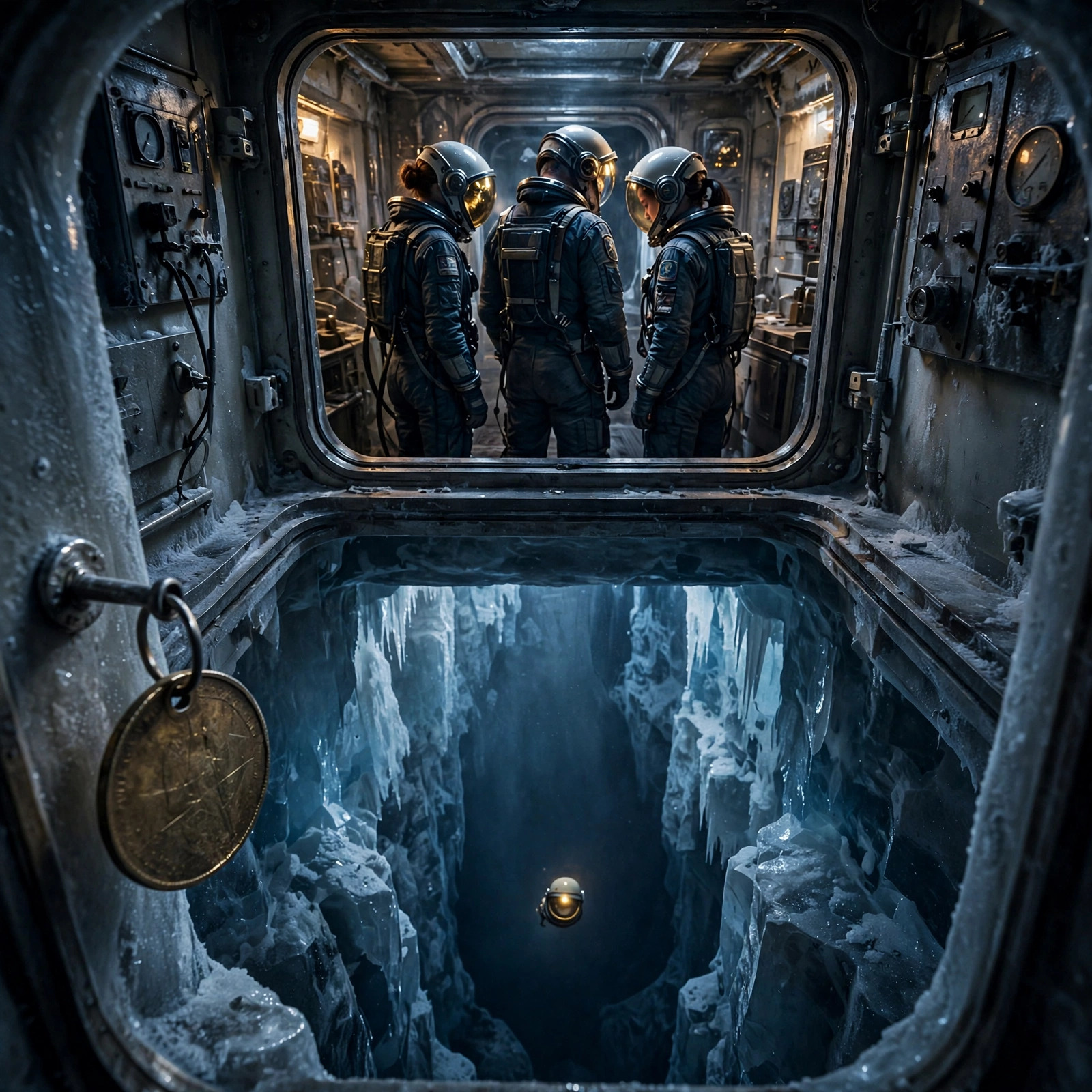
The sample lock cycled. Then there was the long slide out over the rubble, the ship shrinking behind her into a dark shape with a few lit ports. Orsolya's field opened below, grey and white, broken into slabs the size of rooms. She went hand over hand along the line, then let the winch carry her toward the basin. The pulse was there in her visor before she reached it, not a light but a change in the ice, a faint blue warmth that rose and ebbed on its patient rhythm.
At the lip she set the rim anchor herself. She tested the collar once, then again, and the second time her glove shook, and she did it a third time anyway.
"Holding," she said.
"We read you." Dov's voice carried the small delay of distance, a breath behind her own. "Hour's on the board. It hasn't moved."
"Going down."
She paid out line and slid over the edge. The walls of the basin closed around her, clouded white, then clearing as the lamp went deeper. The ice thinned to glass. Below her the shaft opened into a hollow, wider than she had dared guess, and the walls there were blue, and faintly warm to the sensor on her wrist. A vent. A chamber with a living heat in it, breathing out slow gas that froze in feathers on the stone.
She laughed once, a short sound inside her helmet, and nobody heard it.
Up in the lock window, three faces watched. Her token hung on the outer peg beside Yarrow's, and Perpetua's lamp went down into the warm blue ice.
Get notified when new stories drop

Ava Kepler
Ava writes space exploration and cosmic adventure with competent crews, hard problems, and awe that earns its hope.
Leave a comment
Comments