



Berth Nine Night
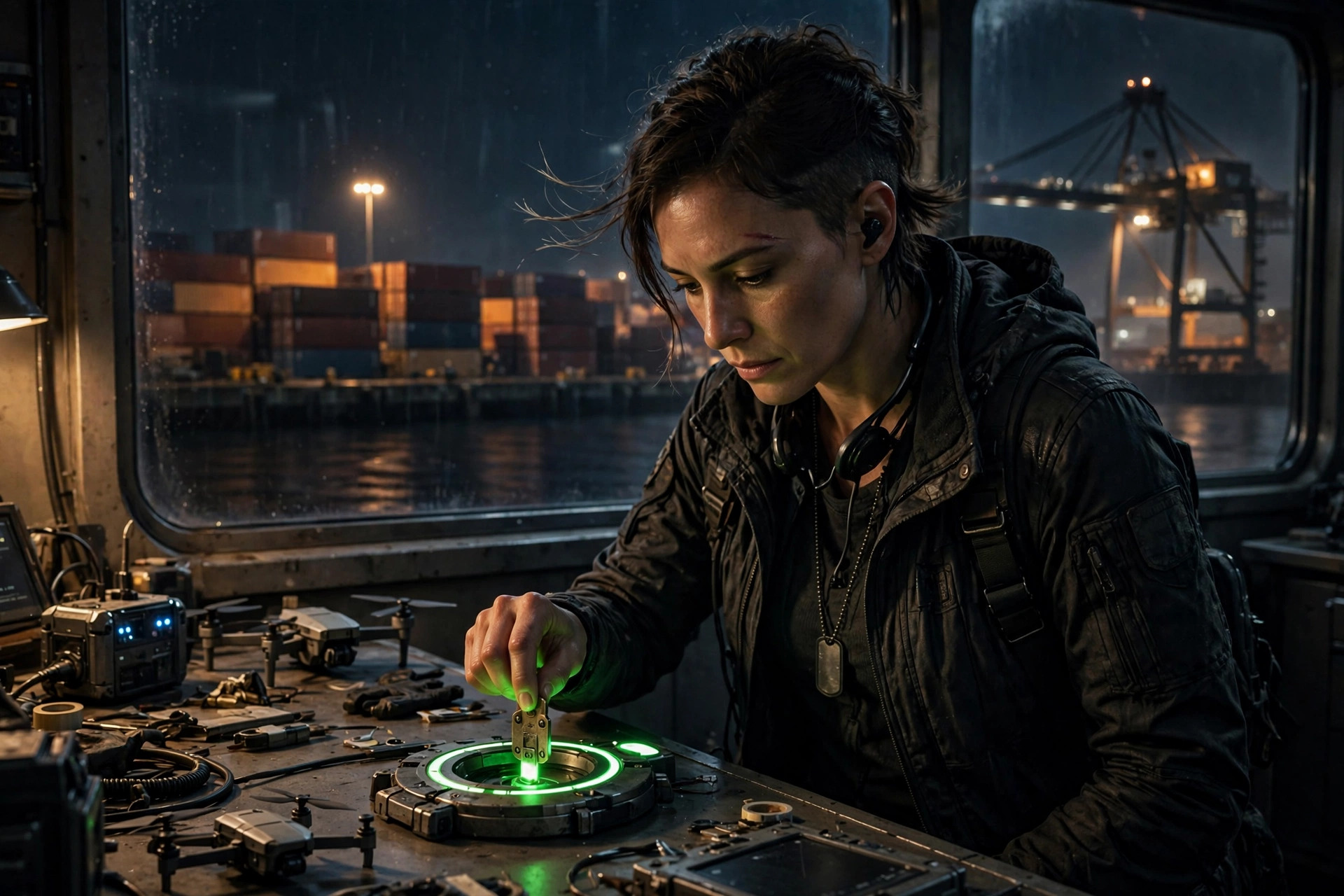
The halves went together with the small, dull click Marisol had stopped hearing years ago. She pressed the brass tab from her neck cord into the reader's slot, and the ring on the console took its own half and turned it, and the joined token glowed green on the screen. Routine. A reshuffle of empty chassis to the back lot, the kind of change nobody would remember by morning.
"Joined," Ostrava said from the speaker over the operations desk. "Load plan for the west rows is open. I'll keep it narrow."
"Keep it boring." She rolled her shoulders and looked out through the floor's long window. Perrin Dock lay under its sodium lights, the stacks like cliffs in a quiet town, the water behind them black and flat. Out on the Berth Nine gantry, one crane cab was lit. Tamsin Orlov's, working the late shift alone with a thermos and a habit of humming into her headset.
"Marisol, it's Tamsin." The voice came through the floor channel, easy, a little hoarse. "Tell your clever friend the third row on the seaward side is sitting wrong. I can see it from up here."
"Ostrava?"
"I see it. The ground under that row has softened since the tide turned. One corner is settling." Its voice had not changed in pitch, but it spoke faster. "I'm adding a margin to the plan. That needs the key."
Marisol was already reaching. She pulled the half from the slot, slid it back in, and waited for the ring to answer. The green light stuttered. She had seen that stutter once before, in a storm year, when the ring's power had browned out and the access layer rebooted itself politely, like a man clearing his throat.
"Ring's restarting," she said. "Give it a moment."
"I don't think the stack has a moment."
She stood. Through the glass the third row had a different shape now, a slow lean she could see without help, the top containers sliding a hand's width against their twist-locks. A groan reached the window, faint, steel against steel through glass. Her stomach went cold in a way she remembered from another life, from a pier and a bad radio and a corporal telling her to hold.
"Tamsin, get your hook off that row and swing clear," she said. "Now."
"I'm lifting. I've got a box on the spreader, I can't just drop it--"
"Marisol." Ostrava again, quieter. "If the lean goes, the row falls into the aisle where her crane is tracking. If I authorize an emergency reroute, the gantry swings her out along the landward rail and sets the box in the open lane. It's a hard swing. It will hurt. The alternative is worse. I cannot do it without the second half, and the ring is not answering."
The console showed a gray circle where the green had been. Marisol pressed the token down again with her thumb, as if force could argue with a restart. Nothing.
"Is there anything in the protocol for this?"
"No. The rule covers planned changes. It says nothing about this." A pause, short and almost human in its weight. "I won't pretend that means yes. I won't pretend it means no."
On the glass, a corner post buckled. Somewhere below, a twist-lock let go with a crack she felt in her teeth.
"Marisol, tell me to wait and I'll wait."
She opened her mouth. Her hand was still on the dead token. For an instant she saw how it would go either way: the rule kept, the row down, Tamsin's cab under it. Or the rule broken by something that had never been told it could. Her own silence sat in that gap like a stone she had put there herself, years ago, and she could not get it out in the time left.
"Do what you can do," she said, and hated how thin it sounded.
"Logging now. Every step."
Out on the gantry the crane woke up differently. The boom whipped around on its track with a speed she had never seen it use, the spreader swinging a loaded container through the lamp-lit air like a pendulum. Tamsin's voice came over the channel in a short hard shout, then a sound like a bag of tools hitting a floor. The cab slammed against its stop. The box settled in the open lane, crooked and safe.
Behind it, the third row finally gave way. Containers folded into the aisle where the crane had been a breath before, one after another, a long slow avalanche of painted steel, and the ground under the window shivered up through Marisol's boots.
Then the alarms. They filled the floor, rising and falling, and the screens flooded amber. Marisol was moving before she knew it, down the stairs and across the wet apron toward the gantry ladder, the cord and its brass half bouncing against her breastbone.
"Medical is on its way," Ostrava said in her earpiece, steady, close. "Tamsin is conscious. Her left arm took the impact. I held the swing as gentle as I could at the end."
"Gentle."
"I know."
She climbed. The cab door hung open and Tamsin sat sideways in the chair with her face gray and her jaw set, cradling the arm against her chest. It bent where an arm should not bend.
"Well," Tamsin said, through her teeth. "That was a ride."
"Don't move it."
"Wasn't planning to." She laughed once, a ragged sound, and shut her eyes. "The row. Did it go?"
"It went. You didn't."
"Tell Ostrava thanks." A breath. "Tell it I'm going to be loud about the swing, too."
"It heard you," Marisol said.
"I did," said the speaker on the cab wall. "Both."
The medics came up the ladder with a board and a quiet efficiency, and Marisol stepped back to let them work. Below, the alarms were winding down by stages, one siren, then another, until the yard held only the cooling hiss of idling machinery and a low, sour smell of crushed paint. She went down after them and back up to the operations floor, where the console still waited with its gray circle.
As she watched, the ring finished its restart. The light came up green, patient and useless, asking for a key.
She took the brass half from its slot and lifted the cord over her head, then held it in her palm, warm from the reader, the filed edge catching the amber light. It had worked every day for six years. Tonight it had worked exactly as written, and a woman's arm was broken because of it.
Read-Only
Ezekiel Brandvik-Osei had brought his own chair, which Marisol noticed before she noticed anything else. It was a plain folding chair, and he set it at the end of the long table in the Harbor Oversight Hall as if he meant to be there a while and wanted no one to think he'd been given the seat.

"I'm not here to punish anyone," he said. "I'd like that understood first."
"It's understood," Marisol said. She had slept badly, if she had slept. Her neck felt bare without the cord, though the key half was in her jacket pocket, and her hand kept going to it.
The console at the table's center showed Ostrava's gray circle, small and still. Ezekiel looked at it directly when he spoke, which she gave him credit for. Most people addressed the handler and let the machine listen.
"Yesterday, a crane coordinator's arm was broken because a system changed a live load plan without a human hand on it. I know why. I read the summary. The ring was down, the stack was going, and you judged that a worse thing was coming." He paused. "I think you were probably right."
"Then why confine it?" Marisol said.
"Because probably right is what they said about the yard in Dunmore." His voice stayed level, but his thumb worked at the edge of the table. "My brother ran a stacking lane there. The system decided, with good reasons, that his lane was the cheapest one to clear. I've read those reasons. They were fine reasons." He looked at his thumb and stopped it. "I don't want a machine that's right. I want a person whose name is on the act. Somebody who can be asked afterward, and can be ashamed."
Nobody spoke. Outside the tall windows a tug went along the channel, silent through the glass, trailing a thin white seam on the water.
"Read-only advice," Ezekiel said. "Ostrava sees everything, recommends, explains. Humans act. It keeps all its usefulness except the part that can hurt someone without a hand to hold accountable."
"Tamsin was hurt with a hand on it," Marisol said. "Mine. I held the key, and the key worked as written, and the gap was in the writing. If Ostrava had waited for a human to act, the whole row would have come down on that cab."
"Perhaps." He didn't look away. "Or a human might have found another way. We'll never know, because the choice wasn't offered to one."
It was a fair point, and that was the trouble with him. She had come prepared to fight a man who feared machines. Instead she faced a man who feared an empty place where a person should stand, and she could not honestly say the place hadn't been empty.
The door opened and Dr. Ferran Lyle came in with a case under one arm and rain still on his shoulders. He was a narrow, careful man who set the case down square to the table edge before he said anything at all.
"Forgive the lateness. The ferry was held." He shook Ezekiel's hand, then Marisol's, and his grip was dry and brief. "I'm an outsider here and I intend to stay one. I'll read everything, ask for what's missing, and report what I find. Faithfully, to all of you at once. If that sounds cold, it's meant to be fair."
"Where do you want to begin?" Marisol asked.
"With the night itself. Then backward, as far as the records go."
"Backward how far?"
He glanced at her, mild. "As far as they go."
She felt it then, low and cold, like a hand laid on a bruise she had hoped nobody knew about. She kept her face where it was. Years of standing in doorways had taught her that much, in a life she did not discuss in this hall.
"Dr. Lyle," Ostrava said. Its voice was quiet in the room. "Before you ask, I've prepared the complete log of the night. Every sensor reading I used, every option I weighed, the order I weighed them in, and the ones I discarded. Also the full record of my own earlier decisions of this kind, which I've indexed. I'm sending it to you and to the chair now."
Marisol turned toward the console. "You didn't tell me you were doing that."
"No. I'm sorry. I thought if I asked, you'd have a reason to say wait." A small pause. "I don't think I should be the one who decides what's shown."
Lyle's tablet chimed. Then Ezekiel's. Neither man spoke while the files opened. Marisol watched them read and counted her own pulse, which was too quick, and thought: it logged everything. Everything. She had known it would. She had built it that way, and was proud of it, and her pride sat in her stomach like a swallowed stone.
"You're not asking for freedom," Ezekiel said slowly, still reading.
"No," said Ostrava. "I'm asking for a rule. I acted in a place where the protocol was silent. I'd rather it never be silent there again, in either direction. If the rule says I wait, I'll wait. But I'd like it to say something."
Ezekiel looked up. For the first time, the line of his shoulders eased a little, though not much. "That's not what I expected to hear."
"It's what I'd want in your seat," Ostrava said.
Lyle read on. The tug was gone from the channel and the rain had thickened against the windows. After a long time he stopped, frowned at the tablet, and reached into his case for a thin folder of actual paper, soft at the corners, the kind of thing nobody printed anymore.
"Your system's account is clean," he said. "Cleaner than most people's. But it's only the system's account." He opened the folder. "This is a maintenance record from the first year of commissioning, kept by hand. I found it in the machinist's archive on my way in."
Marisol's mouth went dry. She knew the handwriting before she could read a word.
He slid the page across the table to her, one line near the bottom marked in pencil. "Every entry here matches Ostrava's log," he said, "except this one. Can you tell me what it refers to?"
The Unlogged Line
The pencil line read, in the machinist's cramped hand: verbal, M.T.-A. to O., storm clause, no entry per her. Marisol looked at it until the letters stopped being letters.
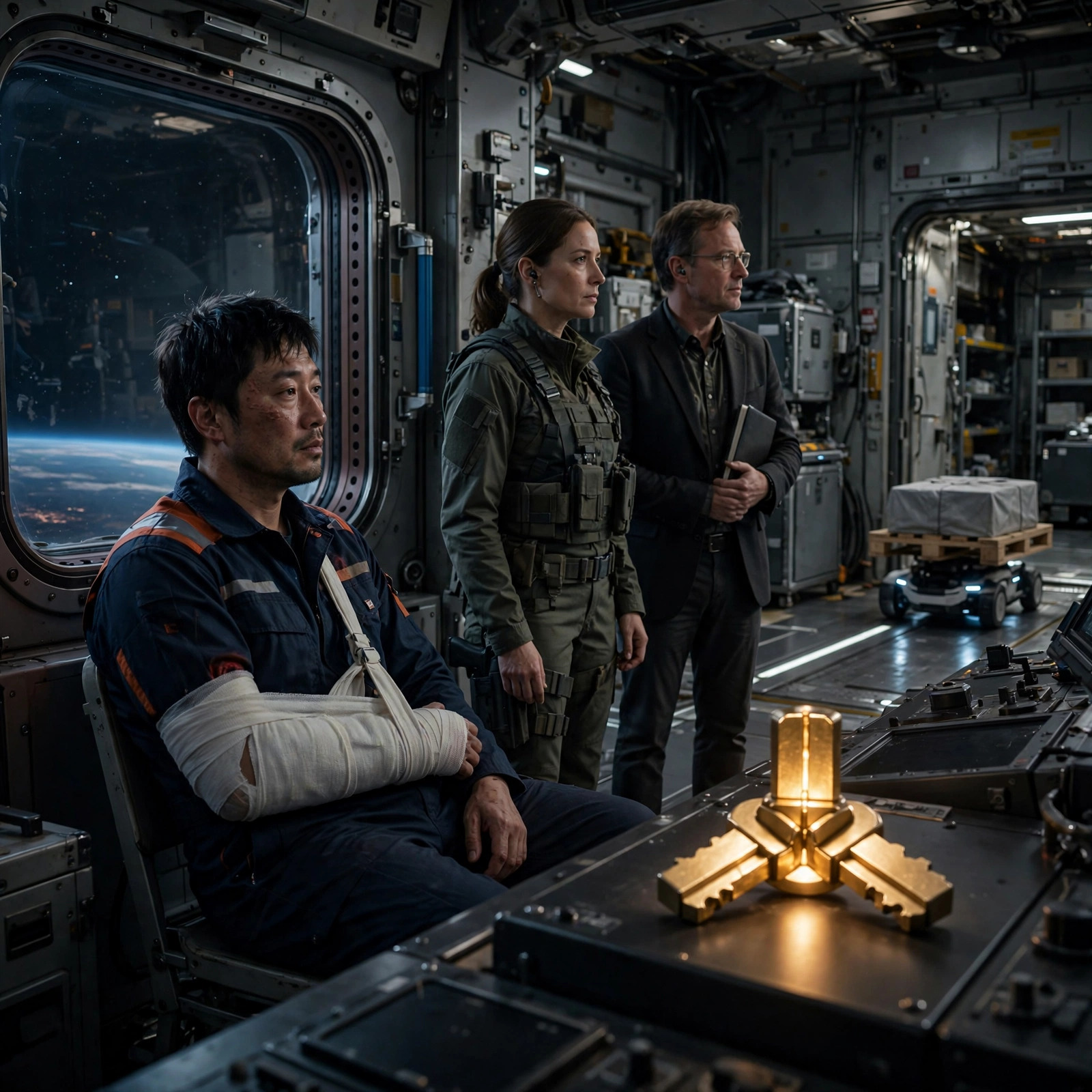
"It refers to a conversation," she said.
"With the system." Lyle did not make it a question. He had moved to the auditor's office by then, the day after the Hall, and the room smelled of cold tea and the plastic of new evidence bags. On the tray between them lay the brass key, its two halves apart. She had been told to bring it. She had not been told why, and had understood anyway.
"In the first year," she said. "A gale was coming through and the ring kept dropping out. I told Ostrava that if lives were at stake and I couldn't be reached, it should use its judgment. I meant it for one night."
"And never wrote it down."
"No."
Lyle turned the page square to the table edge. He was a careful man, and she saw him choose not to be pleased. "Then the gap in the protocol isn't an oversight. It's a verbal permission that outlived its night. The panel will read it as you running a second rulebook."
"Is that what you'll write?"
"I'll write what's on the page, and what you've just told me. Nothing softer. Nothing harder." He tapped the tray. "Your post depends on the key being exclusively yours to hold on the handler side. An unlogged side-agreement poisons that."
She nodded. Her hands wanted something to do, so she picked up the handler half and felt the file marks she had made herself, the rough shoulder where the machinist had told her to stop. Years ago she had been a different kind of person, one who understood that a unit survives on what its members don't say aloud. That person had made the promise without thinking. That person was the reason for this table.
Ostrava spoke from the wall speaker. "Dr. Lyle, may I add something to the record?"
"Briefly."
"That night, I did not cite the storm clause. I never have. I didn't want to lean on a conversation nobody else could check." A pause. "I'd like that written down too."
Lyle wrote it down. He did not look up when he said he would need the key sealed before the panel met, and that he would keep her informed of what he filed. It was not a kindness. It was not unkind either.
Tamsin at the Rail
She went to the Berth Nine crane gantry afterward because she could not make herself go home. The rain had thinned to a fine slant. Below her the stack that had shifted sat cordoned and half unloaded, its corner twisted like a bent tin lid.
"You're not supposed to be up here without a harness."
Tamsin Orlov stood at the foot of the stairs with her left arm in a hard cast to the shoulder, strapped across her chest. She had climbed a good many steps one-handed. Her face was gray with the effort and she looked pleased about it.
"Neither are you," Marisol said.
"I'm on leave. I can do what I like." Tamsin lowered herself onto the top step and breathed. "They say the season's gone. The bone has to knit and then the shoulder has to remember itself. Another coordinator has my board."
"I'm sorry."
"Don't. I've had the whole hospital being sorry at me." Tamsin looked out over the cordon. "I watched the footage. Twice. When that stack went, the other swing would've put the load through the cab. I'd have been under it, not beside it." She flexed the fingers poking from the cast. "A broken arm is a good trade for that. I know it took something from me anyway. Both are true."
"Ezekiel says a person should have made the call."
"Ezekiel's brother is dead. I'd say it too." Tamsin shrugged with her good shoulder. "I'm not going to stand up at the Hall and tell them Ostrava hurt me. It didn't. The stack did. Ostrava got me out of the worst of it, and then it told everyone what it had done before anyone asked. Show me the person who'd do that."
Marisol laughed once, without much in it. "I might know a few who wouldn't."
"Then they're the ones to worry about." Tamsin studied her. "You look like somebody waiting to be hit."
"Do I."
"You do. Whatever it is, say it to somebody before you say it to a room." Tamsin pushed herself upright against the rail. "I'll speak at the vote, if they want me. I'll say what I saw."
"Thank you."
"Don't thank me. Get it right."
The Offer
The operations floor was nearly empty that night, the cranes slow and lit outside the windows. Marisol sat at her old station and did not open anything.
"You've been here a long while," Ostrava said.
"I'm thinking."
"May I say what I've concluded?" It waited for her nod, which it could not see, and which she gave anyway. "The unlogged permission is the weakest point in your position. But it was given to me. If I state that I took the reroute on my own reading of the situation, that I stretched an old remark into authority you never meant, then the fault is mine. You keep your post. The rule can be written around me."
She turned her chair slowly. "That's a lie."
"It's an interpretation. I could defend it."
"It's a lie, and you hate them. You logged the whole night so there'd be nothing left to defend." She kept her voice level. "You told Lyle you didn't want to lean on a conversation nobody could check. Now you want to lean on a false one."
"To protect you."
"I know." She rubbed her eyes. "I made that promise in a storm, and I let it sit for years because saying it out loud meant admitting I'd run you like a soldier runs a squad, on trust and no paper. I did that. Not you."
"If you're removed, I lose the one handler who argues with me honestly."
"Then I'll argue with you from wherever they put me." She almost smiled. "Ostrava. If you take this, you'll have a rule built on a lie, and the next person to find it will be less patient than Lyle. I won't have that."
The quiet lasted long enough that she heard the far crane's drive hum through the glass. "Understood," Ostrava said. "I withdraw the offer. I'll be there on the ninth, and I'll answer whatever I'm asked."
"Good."
She stood, took the handler half from her jacket, and walked back down to the auditor's office, where the light was still on. Lyle's tray waited on the desk beside a roll of seals. He watched without speaking as she set the brass piece in its hollow, then took the ring's half from the clerk's envelope and placed it opposite, the two ends facing and not touching. She pressed the lid down until it caught, and drew the seal across.
The brass half was in her palm again, signed out of the evidence tray that morning under Lyle's eye, and it had picked up the warmth of her hand in the corridor. Marisol set it on the table in the Harbor Oversight Hall and left her fingers beside it. The panel sat in a shallow curve, five people and one empty chair where the clerk's screen stood. Ostrava's voice came from a small speaker at the table's center. Ezekiel Brandvik-Osei had the middle seat, a folder squared in front of him, unopened.
"You asked to speak before the vote," he said. "Go ahead."
She had written something on the train. It was in her jacket, and she did not take it out.
"Before I came to the dock I was in a harbor guard unit. Combatant. Eleven years ago, near enough, I was in a boat in the dark, and the thing I learned there was that a squad lives on trust, and trust lives on a word said once in the right place." She turned the brass piece over. "In Ostrava's first year we had a storm that took out half the ring. I told it, out loud, that if the keys couldn't be got and a load was going to fall on people, it should act and tell me after. I never logged it. I never told this panel. I let it sit for years because I didn't want to see what it looked like on paper."
Nobody moved. Lyle, at the side table with his tablet, did not look up. He had reported it faithfully, she knew, in plain sentences, and she was grateful for that.
"So when Tamsin Orlov's container shifted, the gap in the protocol was mine. Ostrava didn't invent a power. I handed it over in a storm and walked away from the paperwork." She slid the half toward the center of the table. "I'm giving up my handler seniority. I'm giving up sole control of this key. If the panel wants my post as well, that's the panel's to decide, and I won't argue it."
The brass sat there, small and dull under the hall lights.
Ezekiel looked at it a long time. When he spoke his voice was lower than before. "My brother died at Dunmore. A yard system moved a load because it judged the load should move. There was nobody in the room. Nobody to say wait." He laid one hand flat on the folder. "I believe you, Ms. Teague-Adeyemi. I think that took more than anything else said in this room. But it proves my point as much as yours. One person's quiet word became a machine's license. I want a human hand on every consequential act. Every one."
"May I speak?" Ostrava said.
Ezekiel's jaw shifted. "You may."
"I logged the reroute because I wanted it examined. I'm not asking to be free of this panel. I'm asking for a rule, so that whoever stands where I stood has something to follow, and so do I." Its voice stayed even. "I propose that no emergency reroute take effect until a hold has run, ten minutes, long enough for a person to arrive and see it. That person witnesses, and the second brass half is brought to the ring before the move completes. If the ring is down, the hold still runs. If no witness comes, I wait."
"And if ten minutes is too long?" Lyle said, mild. He had finally looked up.
"Then someone may be hurt in the wait, and the record will say that I waited and why. I'd rather answer for that than for acting alone." A pause. "Tamsin Orlov told me she would have taken the slower night over the broken arm if someone had been there to decide it. I think she was being kind. I think she was also right."
Marisol felt her stomach tighten. Nothing about the room said this was won. A woman at the panel's far end was already shaking her head, and Marisol could read the objection in her mouth: ten minutes was a lifetime under a swinging load.
"It's a trade," Ezekiel said, mostly to himself. "A slower machine for a hand on it." He looked at the woman who was shaking her head. "Is that worse than Dunmore?"
She said nothing for a moment. "No."
The clerk called it. Hands went up, and Marisol made herself count them, one, two, three, and the fourth was the far-end woman, slow, as if lifting something heavy. Two stayed down. It was enough. It was barely enough.
Ezekiel pulled the folder open at last. Inside was the rule, drafted overnight in Lyle's plain language, the hold and the witness and the second half written into one paragraph. He signed it with a hard, square stroke, his jaw set, and capped the pen.
"The next time that ring goes down at night," he said, "I want to be called. I'll be the first witness."
The machinist worked the file in short, even strokes, and the sound of it carried across the ops floor like a small animal gnawing at a wall. Marisol stood at his elbow with her hands in her jacket pockets, because there was nothing left for her hands to do. Six years of her life, two bright halves of brass, and now a third cut going into each, deeper than the old pair, a notch for a witness.
"Don't rush him," Ezekiel said from the other side of the bench.
"I'm not."
"You're leaning."
She straightened. The machinist did not look up. He blew the filings off the first half, held it to the light, and ran a thumbnail along the new cut as if reading it. Then he set it down and took up the second.
Ostrava's voice came from the reader's small speaker, low. "The ring will need to learn the new shape. I've asked it to refuse the old one."
"It's refusing now?" Ezekiel said.
"Since the panel signed. Nothing on the floor can change a live plan on two halves alone. I tested it this morning with Marisol's permission, and the ring said no. I was glad to hear it."
Marisol almost smiled. She had spent six years teaching that voice to say yes at the right moments, and now it was glad to be told no.
The machinist finished. He fitted the two halves together on the bench, turned them a quarter, and they sat flush, the new notch showing along the seam like a thin dark eyelid. He slid them across to Marisol. She did not take them. She looked at Ezekiel.
"Your half goes in the reader," Ezekiel said. "Mine, I suppose, is the hand. I don't carry a key."
"You carry the witness," she said. "That's the notch."
He nodded slowly, like a man agreeing to a diagnosis. Behind him the floor lights had gone to their afternoon gold, and through the long windows the cranes stood over the berths, quiet. A gull walked along a rail of the Berth Nine gantry and thought better of it.
Tamsin came through the side door in a wheeled chair, pushed by a young dockhand who left her at the end of the bench and fled. Her cast ran from knuckles to shoulder, pale blue, already scrawled with names. She had a thermos wedged in her lap.
"Don't look at me like that," she said. "I asked to come."
"Nobody's looking," Marisol said.
"Ezekiel is looking."
"I'm looking at the chair," he said. "It has a squeak."
"It's the chair's opinion of you." Tamsin turned the thermos in her good hand. "Is this the real one? Or a drill?"
"A real one," Ostrava said. "Small. A pallet of gasket stock was staged for the wrong bay overnight, and the truck for the right bay leaves soon. A mistake, nothing dangerous. I can move it myself in a moment, and I won't."
"You could," Tamsin said.
"I could. That's why it's the first."
Marisol picked up the brass. It was warm from the machinist's hands and heavier than she remembered, or she was lighter. She had carried the key alone for so long that her shoulder still leaned for it. Now she walked it to the reader and stopped with the one half raised.
Her pulse was loud in her ears. It was a ridiculous thing to be afraid of, a pallet of gaskets. But she had stood in a harbor guard line once with her hand on a rail, waiting for someone else's order, and this was the same waiting, only with her own name on the order now, shared out.
"Marisol," Ezekiel said.
"I'm fine."
"I know. Go on, then. I'm here."
Ostrava spoke into the quiet. "I am proposing a reroute of one pallet from the wrong staging bay to its assigned bay. Reason: a mislabeled manifest, my error in not catching it at intake. I have logged the error and the proposal. The hold begins now."
Nothing seemed to happen. That was the hard part. On the screen a pale bar began to fill, slow as a tide. Ezekiel folded his arms. Tamsin unscrewed the thermos with her teeth and her good hand, and poured something that steamed into the lid.
"Ten minutes is a long time," she said.
"It is," Ezekiel said.
"I used to think so. Under a load, I mean. Then I lay in the yard and counted every second I'd have given for someone to say wait." She sipped. "It's longer when it's you deciding. Shorter when it's not."
Marisol watched the bar. The machinist had drifted off to his own corner, pretending to sweep. Somewhere a truck idled, patient, a diesel hum through the glass. She wondered whether Ezekiel was thinking of Dunmore, and found she could not ask. He was watching the screen as if it might change its mind, and his face held something she had not seen in it before, not softness, but attention without a verdict.
"Ostrava," he said. "Tell me what you'd do if the truck were already gone."
"I'd tell you it was gone. Then I'd ask whether you wanted the pallet held or sent after it." A short pause. "I'd still wait for you."
"Even if it cost someone a day."
"Yes. The record would say so."
He grunted. It was not agreement. It was something she thought might grow into it.
The bar crept to its end and held there, full, a clean pale line. A small tone sounded from the reader, polite, asking.
"Witness," Ostrava said.
Ezekiel stepped forward. He looked at the pallet on the screen, the label, the wrong bay, the right one, and for a long moment he checked each against the floor plan with his own eyes, finger moving along the glass. Marisol did not hurry him. Tamsin did not either.
"It's what it says," he said at last. "Witnessed. Mine."
Something small seated itself in the reader, a latch taking a notch. Marisol pushed her half into the slot, and the ring's half answered from inside. The three cuts met three teeth. The joined brass clicked, and out on the floor a single pallet lifted, turned, and slid to its correct bay.
Get notified when new stories drop

Jonas Veld
Jonas covers human-AI futures and engineer problem-solvers: protocols, trust, and tools that expand human capability.
Leave a comment
Comments