





Pylon Row

The cell sat crooked in its cradle, and the whole lamp line down Pylon Row was sulking because of it. Marisol Tennant knelt on the service step with her sleeve pushed back and her palm flat against the housing, feeling the low, living hum of stored tide through the casing. Live wiring. No way to cut it without darkening forty windows on a cold evening.
"Say it properly," she told Imre. "I want to hear you hold the order."
He crouched beside her, young face tight with concentration. "Isolate the seat. Bleed the lead. Seat the cell, then close the lead."
"Close it last. Always last." She thumbed a brass token from the ring at her belt, worn so smooth the stamp was more memory than mark, and pressed it to the housing's contact plate. The old term went out of her mouth low and flat, the way the founders had cast it. The plate warmed. Somewhere inside, the cell's handshake with the grid loosened, a held thing let go.
She eased the cell upward. It came free with a soft, greasy reluctance, and she turned it a quarter and let it settle into the cradle. The seat took it. The hum climbed a half step and steadied, and down the row a window that had been dim went bright, then another.
"Close the lead," she said.
Imre did, and the line held. He let out a laugh that was mostly relief. "Twice I'd have gotten that wrong."
"Once. You'd have caught it on the second." She wiped her fingers on a rag. "That's the whole trade, really. Knowing which word keeps the current honest."
Behind them, boots scraped on wet stone. A woman stood at the foot of the step with a hard-sided crate balanced on a hand trolley, her jacket carrying the clinic's pale green stripe. She had watched the whole seating, Marisol realized, and had not interrupted.
"You're Tennant," the woman said. "Noor Halloran. Saltmarsh Clinic. I knocked at your flat first. Your mother said you'd be out here, and that I should bring a coat."
"She says that to everyone." Marisol stood, knees complaining. "You're early."
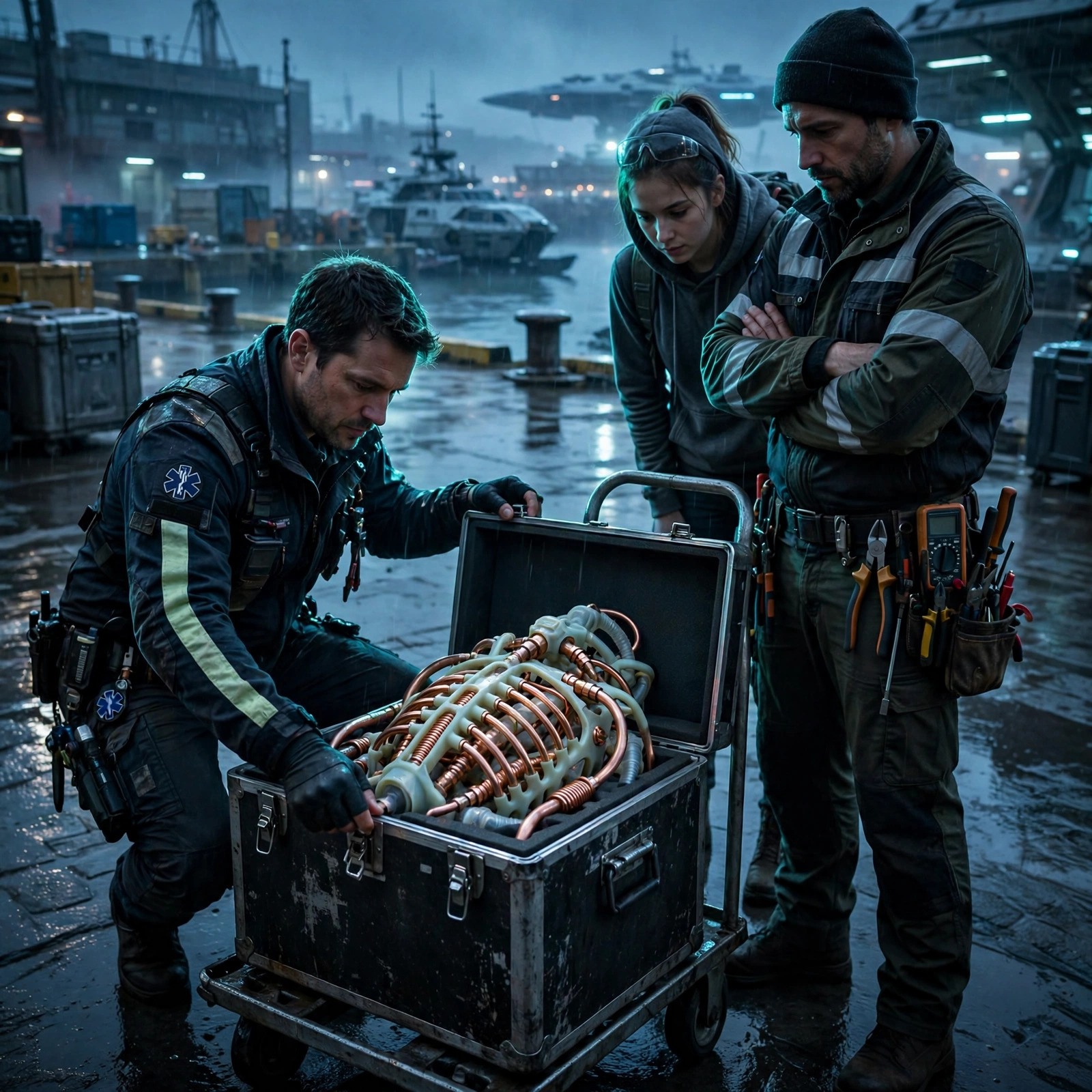
"I'm on time. The slot opened when I stepped off the ferry." Noor tipped the trolley back and let the crate settle on its feet. It was larger than Marisol had pictured, scuffed at the corners, a clinic seal across the lid. "Can we do this standing here? I'd rather you see it than hear about it."
Imre drifted a pace back, pretending to coil the lead. Marisol let him.
Noor unlatched the lid. Inside, nested in foam, lay the loom: a pale polymer body the length of a bookshelf, ribbed with copper, its fine mesh folded like a sleeping wing. Marisol had seen the diagrams. She had not expected it to look so quiet.
"It mounts on the wall by her bed," Noor said. "Draws on the district grid, breathes with her, takes up the work when her own lungs flag. In the ward it's wired to the clinic's own supply. At home it has to run on yours."
"Which is what I wire."
"Which is the problem." Noor met her eyes. "The loom only speaks the open standard. Your grid speaks guild. Somebody has to bridge the Tennant flat's feed, and the person who does it can't be using lexicon terms on that wiring, because the open standard rejects anything bound by oath. It reads it as a lock. It won't run."
Marisol looked at the foam, the copper, the folded mesh. "I know the rule. I've never had to live inside it."
"The clinic joins the trial in this district or it doesn't join at all. Part of that is you." Noor paused. "I'll be straight with you. It's failed twice elsewhere. Both were wiring faults, not the loom itself, but I won't tell you it's safe, because it's early. If something goes wrong, it goes wrong at her bedside."
"And the slot?"
"Three days. After that my installer's crew goes to the next town, and the loom goes with them. I can't extend it. I've asked, twice, and I'd rather you heard that from me." Noor's voice was even, but her thumb pressed hard at the latch. "If it were mine to give you, I would."
The lamps along the row flickered once, as lamps will when the tide turns, then settled. Marisol felt the ring at her belt, every token pulling a little against her hip. Two hundred and twelve of them. She had never counted them aloud in years, only carried them.
"What does the trial ask of me," she said, though she already knew.
"Forty tokens, given up. Your Hall's rule, not ours."
Imre made a small sound behind her. Marisol did not turn. Forty melted into the Hall's bell metal, struck out of her hands for good, and with them the right to speak a whole stretch of the trade on live wire. And Imre, who had sworn under her oath, would carry the forfeit with her. She did not say that. She did not have to. When she glanced back, he was studying the coil in his hands as if it might tell him something.
"I'll come to the flat," she said. "Give me a little while."
"Take the evening. Not much more."
The Tennant flat smelled of lavender and warm dust. Marisol found her mother in the chair by the window, a shawl over her knees, a half-wound spool of signal wire in her lap, the habit of thirty-five years still in her fingers. Prue looked up and smiled, and then the cough took her.
It was not a loud cough. It was worse than that: a small, folding, careful thing, a woman trying to spend as little breath as she could and failing. Her shoulders drew in. The spool rolled off her lap. Marisol caught it before it reached the floor and stood holding it while the long minute passed, and Prue waved her off with two fingers, and the room did not seem to have enough air in it for either of them.
"Don't fuss," Prue said at last, thin and hoarse. "Did she bring it?"
"She brought it."
"Good. Then you can stop hovering."
Marisol put the spool on the sill. Out in the passage, Noor had left the crate against the wall with the lid half closed, and she and Imre had gone down for the ferry office. Marisol knelt and looked once more at the pale wing folded in its foam. Then she lowered the lid, set both latches, and lifted the token ring from her belt to feel its whole weight in her palm. It had never felt heavier. She hung it back at her hip and walked it home through her own front door, the loom's crate at her back, every brass term chiming softly against the others.
The Hall Table
The Hall was already awake when Marisol came up the steps, and it had the look of a room that had argued all night without her. The long table sat under the high window, scarred by a century of soldering irons, and at its head the oath book lay open on its brass stand. Cedric Aldana was standing beside it with a rag, wiping a smudge off the cover that was not there.
"You came early," he said.
"I didn't sleep." She set her token ring on the table between them. It landed with a bright, crowded clatter. Imre had followed her in and stopped by the door, hat in his hands, as if the Hall might refuse him the floor.
Cedric looked at the ring a long moment. He did not touch it. "Say it plainly, Marisol. You'd rather say it than have me guess."
"I'm asking you to release me. Forty tokens, struck out of my hands and into the bell metal. I want the trial's terms, and I want them before the clinic's installer packs up and goes."
"For your mother's loom."
"For my mother's lungs."
He nodded slowly and pulled out the chair at the head of the table, then did not sit in it. "I've heard her cough from the street. I'm not made of brass." He tapped the open page. "But hear me, because nobody else in this Hall will say it as kindly. The open standard has failed two installs elsewhere. Two. One of them was a house like yours, on a grid like ours, and the family spent a night in the dark with a machine that had stopped helping them breathe."
"Noor told me about those. She told me the loom's faults before she told me its name."
"Then she's honest, and I like her for it. It doesn't change what happened." He finally laid the rag down. "The bond isn't spite. It exists because a wireman with a whole vocabulary knows what a live line will do before it does it. Those words are how we teach apprentices not to die. You want to put forty of them in the furnace and trust a standard that nobody here has watched run through a winter."
Marisol felt the old reflex rise in her, the one that wanted to quote the founding wardens back at him. She let it pass. He was not wrong, and it would have been a cheap thing to pretend he was.
"Wait a season," Cedric said. "Let the trial prove itself in some other town's flat. Then I'll cast the forfeit myself, and the Hall will stand behind you."
"A season is not a thing my mother has." It came out harder than she meant. She breathed and tried again. "The slot is three days at the start, and one is gone already. If I wait, the loom goes to another harbor and I'm back to carrying her to the clinic ward every time the damp turns. Do you know what the ward is like for her? Strangers measuring her. She'd be a case before she was a patient."
"I know it isn't kind."
"And if I go in as a Hall member who's been cut loose, the clinic can do what it likes with me. A cheap test, a name on their paper. I'd have nobody." She stopped. That was the fear, said aloud in the one room where she had hoped to keep it hidden.
Cedric's face changed, only a little. "You'd have the Hall."
"Would I? Once the tokens are gone I can't speak a word of the trade over live wire. I couldn't stand beside a colleague at a cell and tell him what I saw. You know how the room goes quiet around a forfeit."
He did not deny it. That, more than any argument, told her how heavy the thing was.
Behind her, Imre shifted. She heard his boots on the boards, then nothing. When she looked over her shoulder he was staring at the oath book, and she watched understanding cross him in slow stages. He had sworn under her. Her forfeit was his forfeit. His licence, three years of earning it, rested on the standing of the hand that had trained him, and that hand was sliding a ring across a table. He did not say anything. He turned his hat once around in his fingers and set his jaw, and she saw him decide, for now, to keep it to himself.
"Imre," she said quietly.
"I'm all right."
"You're not, and I'm sorry."
"Let the warden finish," he said, and his voice held, though only just.
Cedric looked between them. Something like discomfort moved over his broad, tired face. "That's the part I can't wave away," he said. "A master chooses for herself. An apprentice doesn't get the choosing. If I release you in a hurry, I've spent his licence in a morning because a clock was running."
"Then give him the choice. Ask him."
"Not in front of you, with that look in your eye." He said it gently. "And not under a deadline. That's how the bond gets broken badly."
The window had brightened, and a bar of light lay across the brass on the table, picking out the stamped terms one by one. Marisol knew each of them by touch. She laid two fingers on the page of the oath book, near the line where her name had been written twenty years back in a hand steadier than hers now.
"I'm asking you properly," she said. "As warden. Release me."
Cedric stood silent for as long as it took the bar of light to crawl past the ring. Then he lifted the book from its stand, closed it on his thumb, and held it a moment against his chest like something that might still be talked out of leaving.
"Not today," he said. "I won't rush it, and I won't have it rushed for me."
He set the book on the table, and with the flat of his hand slid it back across the wood, unsigned.
Cold Flat Window
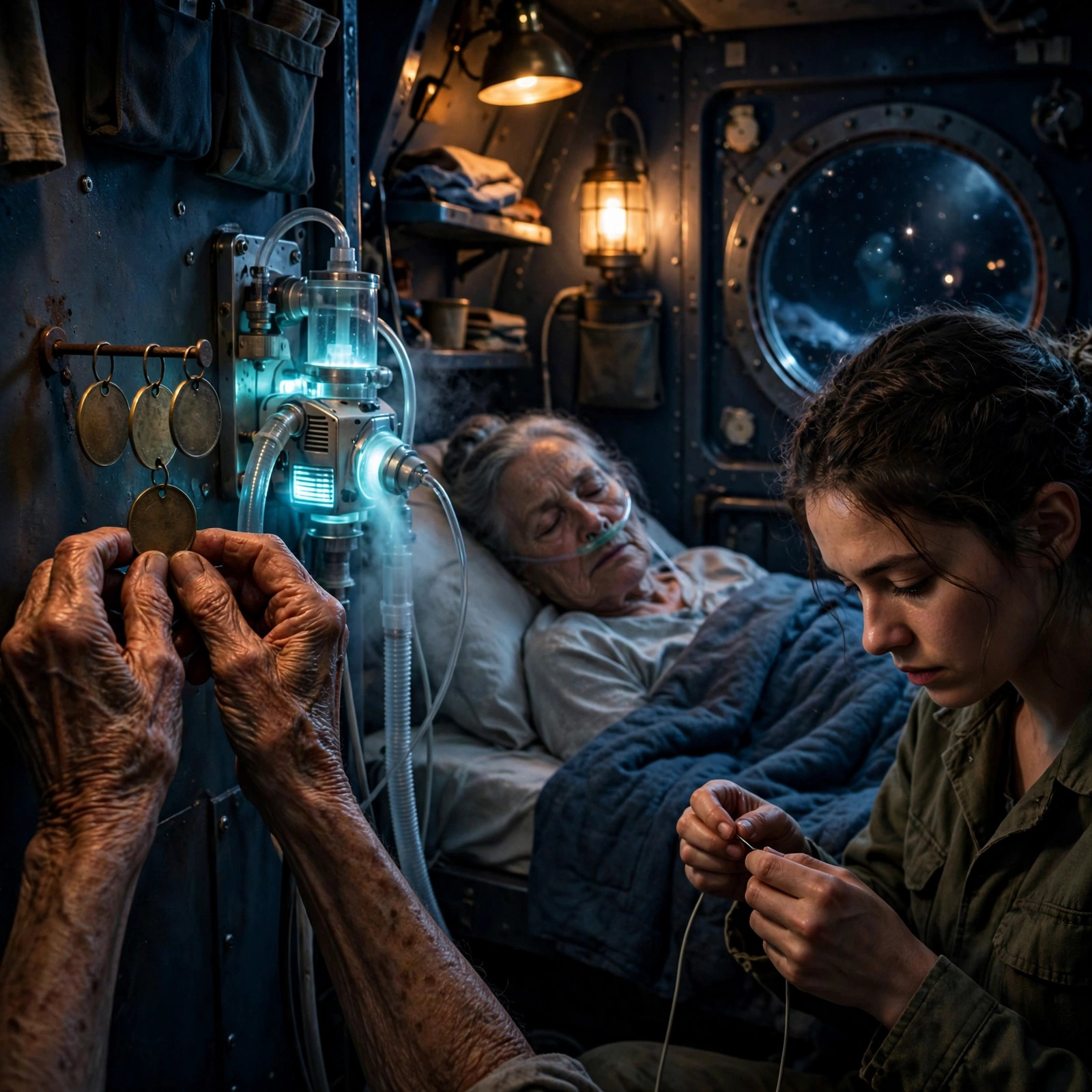
The Tennant flat was colder than the street. Marisol noticed it the moment she shouldered the door, because Prue had cracked the window again, and the harbor air came in smelling of tar and low tide. Her mother sat in the chair beside it with a blanket over her knees and a coil of signal wire in her lap, winding it around two fingers and off again, the way she had wound it all her life.
"Shut that," Marisol said.
"It helps me think."
"It doesn't help you breathe."
Prue only smiled and kept winding. Her breath had a rasp in it that Marisol had learned to hear from the stairwell. Noor was already in the bedroom, kneeling by a hard case, and the wall above the bed held a pale rectangle of polymer and copper, mounted in the night and still dark. A single green stud on its housing waited for current.
Marisol closed the window. Prue let her.
"Well?" Prue said. "Did the warden give you your freedom?"
"He gave me a season of waiting."
"A season." Prue held the coil still. "I've got a good many of those left, have I?"
"Mum."
"Don't. I heard the stair. You came up slowly, and you only do that when you've lost an argument and are working out how to tell me you've won it." She tipped her head toward the bedroom. "Noor says that thing won't wake while you hold your brass. Is it true?"
Noor appeared in the doorway, wiping her palms on her trousers. She was a spare woman with a clinic badge clipped crooked to her collar. "It's true," she said. "I'd rather show you than say it. Then you'll know I'm not selling anything."
They went in together. Noor had a bench lead from her case and clipped it to the loom's service port. She asked Marisol to take the token ring from her belt and stand with it by the housing. Marisol did, feeling the old weight against her hip, the cold of the brass through cloth.
"Say the first-line term for a live bus," Noor said. "Out loud. The way you'd say it on a job."
Marisol hesitated. She had said that word ten thousand times. She said it now, low, and felt the stamped token answer against her leg like a held note.
The green stud flickered. A thin amber line ran across the loom's little display, stalled halfway, and went out. The housing gave a single dry click. Then nothing.
"There," Noor said quietly. "It heard the oath in your mouth and refused the handshake. Same as it did with the two crews I tried it with before you. It's not spite. The standard won't take a conductor that someone has sworn to keep secret."
"And without the ring?"
"I don't know. I honestly don't. It's passed on the bench, and it's passed in the clinic ward. It has failed in two homes. I'd be lying if I said your mother's flat would be the third that works."
Prue had come to lean on the door frame, one hand on the wood, her chest working. "Two failed," she said. "You didn't mention that yesterday."
"I did mention it," Noor said. "You weren't listening to me. You were listening to her."
Prue gave a short laugh that turned into a cough. Marisol moved to her, but Prue waved her off until it passed. Then she looked at her daughter with the flat, level stare she used to give a bad splice.
"I'll say this once, because you've got your father's jaw and you'll do it anyway if I let you think it's for me. I won't be the reason."
"You're not the reason. The reason is you can't climb the stairs."
"That's a reason to move a bed downstairs. You're talking about trading your trade." She tapped the ring on Marisol's belt with one crooked finger. "Thirty years you've been in this town and twenty at that work. People know your name in every cellar on the quay. You'll be a woman who used to be somebody, wiring a dead mother's wall for a clinic that's keeping count of you."
That last was the fear itself, said aloud, and Marisol felt it land. She had not told her mother about the clinic men with their tidy forms, how they looked at her as a cheap proof, the first guild hand foolish enough to give a number to their trial.
"Who told you that?"
"Nobody. I wound signal for thirty-five years. I know what it looks like when a thing is being used." Prue reached up and, with unexpected tenderness, touched her forehead to Marisol's, dry skin against dry skin, a brief and papery pressure. "Don't trade a trade for lungs. Mine are old. Yours aren't."
Marisol closed her eyes. For a moment she was nine and feverish and the same forehead was cool against hers. Then Prue drew back, coughing again, and Noor quietly set a chair behind her knees.
"I'm going to work," Marisol said. "That's all. I'm going to check the mounting. Whatever happens after, I'd rather the thing be right on the wall."
"That's not nothing," said Noor. She was looking at the floor. "It's also my last good day. If the slot goes to another town, it goes, and I can't hold it. I wish I could."
"I know."
Marisol set the ring on the dresser, face down, the tokens clinking once. She did not unclip it from the belt loop. She only laid it where her eyes would not have to meet it, and took the driver from Noor's case.
The housing sat a finger's width off true. She loosened the upper anchors, shimmed the lower with a folded scrap of signal wire from her mother's own coil, and drew the bolts down until the polymer sat flat to the plaster. Her hands knew the work and did it without her. She checked the lead run along the skirting, followed it to the district tap behind the headboard, and found the terminal lug cold and clean and properly torqued. Everything was right, and she felt it in her wrists that it was right.
Noor watched her seat the last cover. "That's tidier than my crews manage."
"Try it."
Noor reached past and pressed the stud. The green light woke, held a long steady moment, and Marisol let something loosen in her chest. Then the amber line crawled across the display, reached the midpoint, and stopped exactly where it had stopped before.
"It's still reading her," Noor said. "The oath's in the room. In the air, in you, I can't tell you which."
Marisol pressed her palm flat to the cool housing. Behind her Prue's breath rasped slowly in the chair, and the late light moved across the bare wall.
The stud went out. The mounted loom stayed dark.
Forty Brass
The Hall's door was already open when Marisol reached it, propped with a brick, and the cold from the quay came in behind her and moved the loose papers on the warden's table. Imre was a step behind. He carried her bag as if it held something that might spill.
Cedric stood at the far end of the long table with his sleeves rolled. He had not slept, and neither had she. The token set lay in its case beside him, two hundred and twelve brass shapes on their rings, each stamped with a word she had spoken on live wire for twenty years without thinking of it as borrowed.
"You came early," he said.
"The slot closes today. Noor leaves with the evening tide, and she can't hold it."
"I know what the slot is." He looked past her at Imre, and something tightened at his jaw. "He shouldn't be in the room for this."
"He asked to be."
"I did," Imre said. His voice was steadier than his hands. "If it lands on me, I'd like to watch it land."
Cedric did not argue. He pulled out a chair for Imre, which was not a thing Marisol had expected, and Imre did not sit in it.
She unclipped her own ring from her belt. It was lighter than it should have been, she thought, for what it carried. She began to work the tokens loose one at a time, thumbnail against the split of the ring, and each one came away warm from her hip. Live, earth, bleed, shunt. She counted them onto the table and did not lose the count, because losing it would have been a way of hiding. When she had forty she pushed them across the wood with two fingers, and they slid in a loose brass line and stopped against his hand.
He did not take them yet. "You could still sit down. We'd talk a season. I'd cast the forfeit myself when the trial had proved itself."
"Prue doesn't have a season."
"The open standard has failed twice. Two installs, two houses. You've read the reports."
"I've read them. Noor told me the rest, the parts the reports leave out." Marisol kept her palm flat on the table. "She said the loom might fail with me standing right there. She said it to my face, Cedric. I'd have trusted her less if she hadn't."
"And if it fails?"
"Then I've lost the words, and my mother's no worse off than she is this morning. The clinic can have the case study. I'll be ugly about it."
Cedric turned one token over, shunt, and rubbed his thumb across its worn face. When he spoke he did not look up. "I had a sister. Two years younger. The district put a new cell on her street and wanted it live before the winter, and the crew was told to skip the second proving. Nobody was careless. They were hurried, and being hurried is a kind of carelessness that nobody has to own." He set the token down. "The housing wasn't earthed true. She was reaching for her lamp."
The room was very quiet. Imre had stopped moving altogether.
"That's why the bond is what it is," Cedric said. "Not the brass. The bond. It makes a master stop and think about what she's giving up, and who else pays." His eyes lifted to Imre then, and stayed there. "It makes her look at him."
"I've looked," Marisol said.
"Then say it to him."
She turned. Imre's face was young in the grey light, younger than his years, and she made herself keep looking at it. "Your standing goes with mine. Cedric won't hide that and neither will I. You'll hold a licence on paper and nobody in this Hall will let you near a live run."
"I know."
"You could walk out right now and be clean of it. I wouldn't think less."
"You'd think a bit less." A thin smile, gone quickly. "I'm not clean of it. I held the ladder for you yesterday." He swallowed. "Do it. Please. Before I think about it properly."
Cedric exhaled through his nose, long and slow, like a man setting down a heavy tool he had carried for a long way. "I'll say it once for the record. I think you're wrong. I think you're too quick, and the boy is the price of that."
"Noted."
"Noted." He gathered the forty into his palm. They clicked together, a small dull sound with no ring left in it. "But I won't have it said the Hall took a forfeit grudgingly. A thing given fairly is received fairly. Come."
The foundry stood at the back of the Hall, behind a door that stuck in damp weather. The crucible sat in its cradle of firebrick, a squat dark bowl already glowing at the lip, the common bell metal inside slumped and bright. Heat came off it in a flat wall. Imre stopped at the threshold and Marisol went on alone, with Cedric beside her.
He held out his hand. She did not take them back. She only looked at the brass one last time, the stamped letters crowding the faces, a vocabulary that had been hers and her teacher's before her.
Cedric tipped his palm over the bowl, and the tokens went into the bell-metal crucible.
Loom Running
Noor had the panel cover off before Marisol finished climbing the stairs, and she did not look up from it. "I've got until the light goes tonight. After that the slot goes to the next town, and the van goes with it."
"The window's three days. This is the last of it."
"It's the last of it." Noor sat back on her heels. The loom hung on Prue's bedroom wall where they had mounted it, a pale polymer shell with copper showing at the seams, dead as a slate. "Everything else is done. The handshake fails when a guild hand is on the ring, so no guild hand is on it. You know what that means for the next hour."
"I know."
Prue lay propped against three pillows by the window, a coil of signal wire in her lap, her fingers turning it over out of habit. Her breath had a wet edge to it. On the sill beside her sat the empty ring-clip where Marisol's tokens had hung for twenty years, and what was left of them rode in Marisol's pocket now, a short, light weight against her thigh.
"You did it," Prue said. It was not a question.
"I did."
"Then stop looking at me like I'm the bill. Come here and do the work."
Imre came in behind her carrying the meter and the roll of lead. He took his place at the foot of the wall without being told, and she saw how carefully he kept his eyes off the pocket. Neither of them said a word about his licence. It was in the room anyway, like the smell of the machine.
Marisol knelt at the junction. For two decades she had said the old words aloud when she touched live copper, the way you say a name to a dog before you reach for it. Now the words simply weren't there to be said. She reached for the first one and found a flat place where it had been.
"Imre. The line that comes in off the district grid. Not the sheathed one, the other."
"The grey one?"
"The grey one. Strip it back until the bright shows. A thumb's width, no more."
He did, slowly, and held it out on the flat of his blade. His hand shook a little. She took the bare end and seated it in the clamp, and it was strange how much heavier plain speech was. Every instruction had to be built from its parts. Hold this. Keep it dry. Tell me when it's tight and don't tell me when you think it's tight.
"Noor, the earth. Where does it want to go?"
"Lower left, the green lug. Don't trust the paint, the paint's from the first batch." Noor crouched beside her, close enough that their shoulders touched. "I'll say it plainly, since it matters now: the loom might trip on a surge. If the grid sags, the unit holds her breathing for a short while on its own cell and then it stops asking permission. It can't carry her through a long outage. That's real."
"I haven't forgotten."
"Good. I'd hate for you to have paid for it thinking it was finished."
Marisol ran the earth to the lug and tightened it until the metal gave its small complaint. The old habit rose, to name the joint, to say it was true, and it died in her mouth. She said instead, "That's sound. Check it, Imre."
He touched the meter's probes to the lug and the needle leaned and settled. "Sound," he said, and his voice cracked on it. He cleared his throat. "It's sound."
"Then the handshake."
Noor lifted the ring from its bracket and held it out. Marisol did not take it. That was the whole trouble of the last day, laid bare. Instead she set both hands flat on the wall beside the unit, away from the contacts, and let Noor close the circuit herself. A faint amber light woke at the loom's edge and stuttered. Marisol felt her own pulse in her fingertips. Prue's wire had gone still in her lap.
The light stuttered again. It held one long moment, and went out.
"No," Imre said.
"Give it a second," said Noor, though her jaw had tightened. She pressed a flat key twice. "It's polling the grid. The district side is slow at this hour. Everyone's got the kettle on."
"Then we wait for the kettles."
Nobody spoke. Out beyond the glass the harbor lights were coming on along Harrow Quay, one lamp and then the next. Marisol watched them because she could not watch the amber edge. She thought of Cedric's hand over the crucible, and of the brass going down into the glow, and the dull sound it had made going. She did not take her hands from the wall.
The light came back. It did not stutter this time. It climbed from amber to a steady pale green, and somewhere inside the shell a low note began, not a hum so much as a patience, a thing settling into its work. The cover over the vents lifted and fell. Lifted and fell.
Prue's chest rose with it.
She did not say anything for a while. The loom drew air for her and gave it back, and the wet edge in her breathing smoothed out a little at a time, like cloth being drawn flat. Her hand found the wire again and held it still.
"Well," she said at last, and her voice was thin but all her own. "That's a quiet sort of machine."
Noor laughed once, short and wrecked, and wiped her face with the back of her wrist. "It's running. Don't get comfortable. I'll want to see the surge logs tomorrow and again at the week's end, and I'll want the earth rechecked by someone who isn't me."
"Imre will do it," Marisol said.
He looked at her then, the first time since the foundry. "Will I be let?"
"I don't know." She said it plainly, because plain was all she had left. "The Hall may not let you near a live run. The clinic may want you for its own. I can't promise you anything past this wall."
He looked at the loom, at the green light on the polymer, at the bare grey line still clamped where she had set it. "Then I'll stay and hold the wire until somebody tells me to put it down."
Prue's eyes were closed, but she was smiling, and her fingers had started winding again, slow and absent.
Marisol took the short ring from her pocket. What remained of the lexicon was light enough to lose in a coat. She turned it once, feeling the stamped faces under her thumb, terms she could still hold and could not yet speak on a live wire. Then she crossed to the nail beside the loom and hung the tokens on it, where the green light fell across them and the quiet machine went on, steady, into the evening.
Get notified when new stories drop

Leo Stranek
Leo specializes in solarpunk abundance and near-future progress: livable futures, bright cities, and practical wonder.
Leave a comment
Comments