


Chart Room

Asha dragged a band of bad pixels off the stellar trace and the dip remained. She put the pixels back, removed them again with a wider margin, and watched the shallow notch sit where it had been, a small interruption in the light from a star that ought to have stayed level.
Across the chart table, Oren was checking the departure schedule against the observing queue. The table cast a pale grid across his sleeves. Asha turned her display away from him while she examined the detector mask. The survey had produced plenty of convincing defects; she had no wish to summon the commander for another.
She brought up the raw exposures. In the first useful frame the star was a tight pale smudge. Later, the smudge dimmed, then recovered. Nothing obvious crossed the image. A hot pixel glittered at the edge of the field, safely outside the aperture she had used to measure the star.
“Is the queue ready?” Oren asked.
“Nearly.” She compared the star with its neighbors. Their traces wandered together as the ship’s pointing shifted, but none showed the same notch. “I’m checking something.”
Oren slid the departure schedule aside. “A problem?”
“Maybe not.”
She opened the catalogue and overlaid the predicted passage of the known planet. Its broad signature lay elsewhere in the record, where the model placed it. The suspicious dip sat near enough to make her look again, separated from the planet’s transit by a stretch of ordinary starlight.
A companion could do that. So could something passing through the foreground with no connection to the planet at all. The instrument could have produced it despite the clean comparison stars. Asha had learned to keep such possibilities close, especially when the interesting explanation arrived first.
She adjusted the catalogue overlay until the labels no longer covered the trace. The listed planet had been observed often enough to earn a confident orbit and a modest paragraph of notes. There was no companion in the inventory.
Oren came around the table. “Show me.”
Asha enlarged the notch. “This is the target star. That’s the expected transit. This smaller dip isn’t in the model.”
He leaned in, bracing a hand on the table’s rim. “Could it be the detector?”
“It could. I haven’t found a bad region at the position where the star fell, but there are other ways to fool ourselves.” She called up the pointing record. “A jitter correction might have changed how much light we collected. Or something unrelated could have passed in front of the star.”
“And if it didn’t?”
“There may be another body near the catalogued planet.” She resisted enlarging the display further; the notch did not become more certain merely because it occupied more of the screen. “A companion, perhaps. I’d need another observation before I could argue for it.”
Oren studied the trace without touching it. “Can the ship look again?”
“I’m calculating that.” Asha drew the star’s apparent path across a chart of the Nacre System and added Wakeful’s projected departure. The lines met at an angle that made her sit forward. “We may catch another occultation before our trajectory takes us out of position. The timing’s uncertain, but there’s a window worth checking.”
She ran the calculation again with a less favorable estimate for the object’s motion. The window shifted. With a different orbit it vanished from the interval she had searched. She widened the uncertainty range, and the chart filled with possible paths.
“That’s a large family,” Oren observed.
“Yes. We don’t know what made the first dip, so we don’t know where it’s going. But the star and planet give us somewhere to begin.”
He returned to his schedule. “Put the ship on it if you can fit the observation around departure.”
“The ship alone may not tell us enough. A foreground object and a companion could both dim the star from here.” Asha brought the observatory’s reserved pointing plan onto the table. “If we send the autonomous instrument onto a slowly separating path, its view changes relative to ours. We could compare the light curves.”
Oren’s finger stopped above the queue. “You’re proposing a deployment?”
“I’m asking you to hold the observatory for another look while I see whether there’s a useful geometry. If the dip appears from both positions, or appears differently, that could help us test what crossed the star.”
“Could help.”
“It wouldn’t prove a companion by itself.” She drew a small arc on the display to represent a possible instrument path, then erased it. She had not yet calculated whether the separation would be useful. “I need to work through the alternatives.”
Oren opened the observing queue. The contracted fields appeared as patches on a sky chart, widely separated and each annotated with the observation requested. “Those are not empty slots, Asha.”
“I know.”
“Researchers built proposals around them. They’ll be waiting for the data.”
Asha selected a field. Its description opened beside the star trace: a long baseline for measuring faint sources in crowded background light. She knew the proposal well enough to remember the arguments over how much observing time it required. The instrument had been calibrated to deliver what the team needed, not merely an image pretty enough to include in a report.
“The ship can’t take those after departure,” Oren continued. “That’s why the observatory is reserved.”
“We might still have time before we leave.”
“Might.” He folded his arms. “You’d have to show me the schedule, including what happens if the geometry for your star is worse than you expect.”
She searched the queue for movable margins. There were some, though not where she needed them. The star would not wait while the instrument completed its assigned work, and the fields would not remain accessible from the ship once Wakeful departed. She could narrow the planned exposures, but the resulting data might be too thin for the people who had requested them.
Oren went to the chart room cabinet and drew out the authorization wafer. It was a small ceramic and silicon rectangle, plain except for the survey office seal. He placed it beside Asha’s display, with its contacts facing her. The wafer held the signed authorization for the three contracted fields.
“I’d rather not treat their work as a margin,” he said.
Asha touched the seal with the pad of her thumb. She had authenticated the observing plan herself. The researchers had trusted the survey team to carry it beyond the reach of their own instruments, and the data would be theirs to study long after Wakeful had moved on.
“Neither would I.” She looked back at the notch. “But if there’s a companion, it changes the inventory. We’ve been using that planet as though we know what’s around it.”
“We know what we’ve detected around it.” Oren pulled out the chair opposite her and sat. “That’s a useful distinction, especially now.”
His answer irritated her because it was fair. She had spent enough time defending uncertain results to recognize the danger in her own voice. Still, the little dip remained. She could not make herself treat it as a smudge on the screen.
“There’s only one observatory,” he went on. “Once it’s deployed onto that path, we can’t bring it back for the contracted fields. And I won’t approve an improvised deployment if it puts the crew or departure at risk.”
“I haven’t asked you to approve it.”
“You’ve asked me to hold the instrument. That affects the work already scheduled.”
Asha opened the observatory status. The instrument sat secured in its cradle in the instrument bay, its batteries ready, its pointing controls checked against the field list. She had watched Farah calibrate its optics until the engineer’s voice went flat with fatigue. Asha had persuaded her to extend that shift, promising the extra care would protect the survey from losing usable data. Farah had finished the calibration, but had not thanked her for the promise.
“I’ll need Farah’s assessment,” Asha said. “Not just the pointing. She’ll have to tell us whether an adaptation is possible.”
“And whether she can make it safe.” Oren tapped the authorization wafer. “I need an answer about these fields too. If you ask me to give them up, tell me whose work is lost, not just what you might find.”
Asha opened the proposal notes again. One team sought faint sources behind a dense region; another had requested a field where repeated measurements might distinguish slow changes from noise. She had approved the list because each request made use of the observatory’s long, unattended view. It was easier to see the researchers as entries in a queue than to imagine them opening a message that said the observations would not come.
“I’ll contact the teams if the numbers support a diversion,” she said. “I won’t let them find out through the archive.”
Oren nodded, though his hand remained beside the wafer. “Bring me a comparison that includes the cases where you’re wrong.”
“I will.”
He returned the departure schedule to the center of the table. Asha left the authorization where he had put it. The seal caught the display’s light whenever she moved her hand, drawing her eye away from the star.
She examined the raw frames once more, then opened the reduction log. Discarding the interval would make the catalogue update cleaner. Keeping it would mean spending attention she had promised elsewhere, with no assurance that the signal would survive a closer look.
Asha selected the suspect interval and marked it for a check.
Instrument Bay
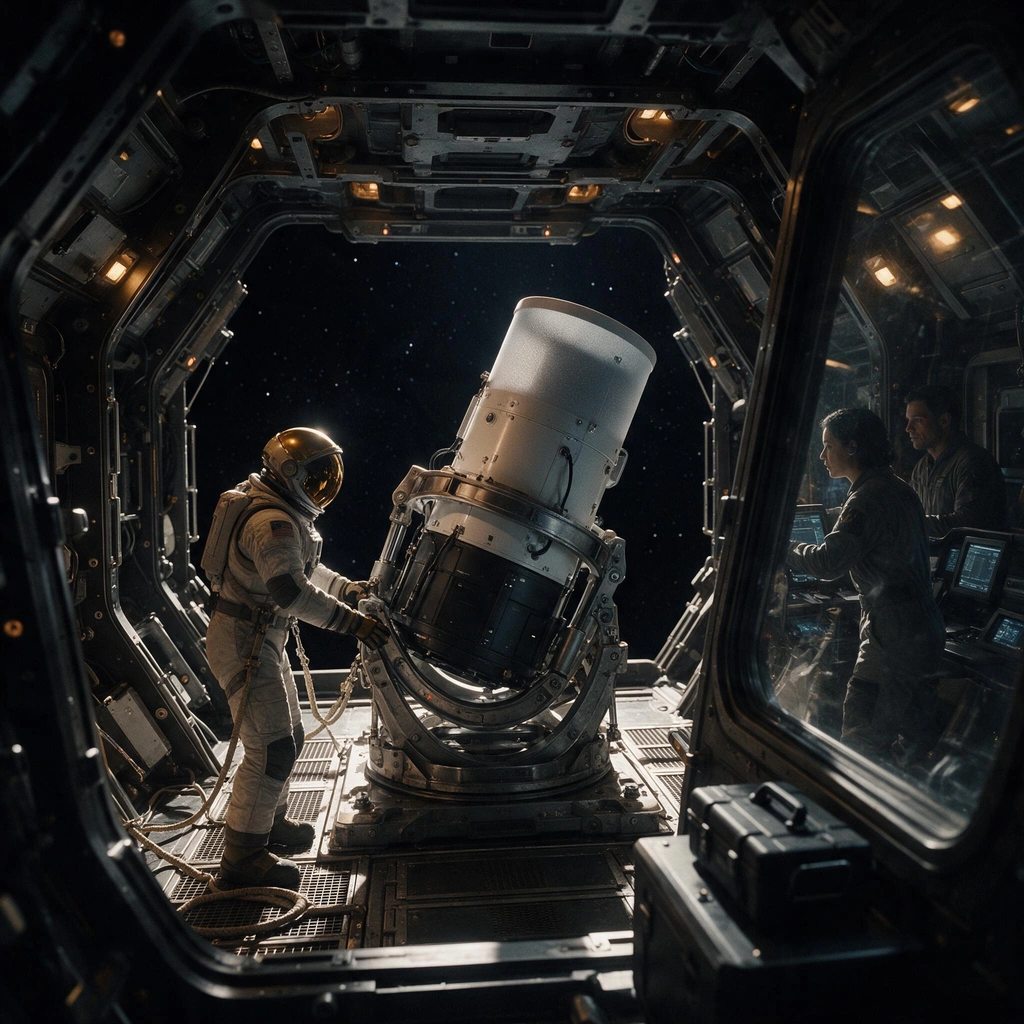
Asha caught the observatory before its loosened restraint strap could scrape across the lens housing. Farah took the strap from her and folded it against the cradle.
“It was secured,” Farah said.
“I thought I could get at the connection panel.”
“You can. Ask me first.”
Asha stepped back. The suitcase-sized instrument rested in its fitted cradle, its composite casing marked by the pale rectangles where test labels had been peeled away. Farah lifted a latch and opened the connection panel. Inside, the neatly bundled cables still bore the colored sleeves she had fitted during assembly.
Oren came through the bay door carrying a tablet. He stopped beside the restraint rail rather than crowding Farah. “Show us what you have, Asha.”
She set her display on the workbench and brought up the predicted view. A star sat beside the plotted path of a catalogued planet, with a narrow band of uncertainty around the planet’s apparent position. A separate line represented Wakeful’s departure trajectory.
“The planet passes in front of that star from our side,” she said. “There’s a chance something near it will cross too. The dip we recorded could be a companion that isn’t in the inventory.”
Oren looked at the display without touching it. “Could be.”
“It could also be a problem in the instrument, or something unrelated in the foreground. I can’t distinguish those from the data we have.” She enlarged the departure line. “The ship can watch the occultation while it follows its planned course. I’d like to release the observatory on a slowly separating trajectory and have it watch the same star.”
Farah leaned over the bench. “How far apart are the sight lines when the planet gets there?”
“Enough to make a useful comparison if the pointing and timing hold. I’ve put the uncertainties in the calculation. They’re broad.” Asha showed her the shaded region around the projected track. “A companion near the planet could interrupt the light differently at each instrument. The shape and timing of the dips would constrain where the obscuring material is.”
“Could,” Oren repeated.
Asha let the display settle. “If both instruments see nothing extra, or the curves don’t tell us enough, we may end up with no answer. Even a difference won’t automatically make it a companion. We’d have to test other explanations.”
“And if the original dip was in our detector?”
“The observatory has its own detector and electronics. A clean recording there would help us sort out whether the earlier signal was local to the ship’s instrument. It wouldn’t prove what caused it.”
Oren put his tablet on the bench. He had brought up the observing schedule. “The three contracted fields need that observatory precisely because Wakeful can’t come back around for a better look. Their teams built their proposals around having a long, unattended view.”
“I know.”
“Then tell me what you’d give them instead.”
Asha touched the schedule and opened the notes attached to the fields. The observing windows overlapped the proposed free flight. A different pointing would not solve the problem; the observatory would be moving away on a path chosen for the occultation. Its small propulsion system could manage release and pointing corrections, not a return to the ship and another deployment.
“We could preserve the requests and ask the survey office to place them on a later mission,” she said. “I can also give the teams the ship’s existing data, though it won’t have the coverage they requested.”
“You can ask. You can’t promise them a later mission.”
“No.”
Oren’s finger stopped on a field description. “This group is looking through a crowded region. They needed the instrument to hold its pointing long enough to separate faint sources from the background. Existing data won’t do that for them.”
Asha had approved the request. She remembered the careful explanation in its margins, the arguments for why the faint sources mattered and why a short look would not be enough. At the time, she had felt pleased that Wakeful could give the group what it needed.
“I’d tell them before the archive closes,” she said. “And I’d put my name on the change.”
Oren turned the tablet toward her. The schedule offered no blank space where she could insert the new target without moving something already promised. “That’s necessary. It doesn’t get their data.”
Farah was examining the open connection panel. She unplugged a test lead, capped it, and laid it in a tray. “The observatory can take a revised observing sequence. That part isn’t difficult. I’d need to check the attitude commands against the release orientation and make sure the radio plan works as it separates.”
Asha moved closer. “Can you do that from here?”
“I can make the changes inside. I can also work on the cradle through the sealed lock. Nobody needs to go outside.” Farah tapped the edge of the cradle with a knuckle. “That isn’t the same as telling you it’s ready.”
“What’s wrong with it?” Oren asked.
“I don’t know yet.” Farah reached beneath the housing and released a small service hatch. It swung open into her palm. Asha saw only shadow and the edge of a metal fitting. Farah angled a work light through the opening, then went still.
“There’s material on the guide.” She brought out a narrow inspection mirror and tilted it under the light. “The release assembly has been rubbing.”
Asha bent beside her. A gray smear traced the lip of the opening; farther in, a bright edge showed through a dull surface. It might have been harmless polishing, she thought, until Farah ran a swab along the guide and held up its darkened tip.
“Was that there during calibration?” Asha asked.
“The hatch was shut during calibration. The release passed its command checks, but those checks don’t show me every contact surface.” Farah set the swab in a clean tray. “I need the cover off and the assembly inspected properly.”
Oren moved closer to the hatch. “Could it jam with the observatory halfway out?”
“It could. I’m not going to guess how likely until I can see the mechanism.” Farah closed the hatch without latching it. “And I won’t certify the cradle based on a swab and a look through a slot.”
The projected departure line remained on Asha’s display. She had been measuring the diminishing opportunity in terms of the star and planet, not in terms of the work still unfinished aboard the ship. The inspection would occupy Farah and leave the cradle unavailable while the crew was preparing equipment for departure.
“That takes time from preparations,” Asha said. “Even if you find nothing we can’t fix.”
Farah rested her hands on the workbench. “It takes my time, and it takes the lock out of the schedule while I work. The crew checking the departure equipment will have to shift around me.”
“Can the inspection wait until after the other checks?” Oren asked.
“Yes. But then I may not have room to make changes before the geometry closes.” Farah glanced at Asha. “I’m not offering to skip the inspection.”
Asha reached for her display, then stopped. During the calibration shift she had kept bringing Farah fresh plots and pointing out differences that might disappear with another adjustment. Farah had asked to stop. Asha had persuaded her to stay by calling the work protection for everyone who would use the data.
“I pushed you to keep calibrating,” Asha said. “You told me you were tired, and I made it sound as if stopping would let the survey down.”
Farah kept her gaze on the service hatch. “You made it sound as if the only choice was to keep working.”
“I’m sorry.”
“I need more than that if you’re asking again. I’ll tell you what I can do, and you can take it to Oren. But you don’t get to promise my shift or decide I’ve accepted the risk.”
“All right.” Asha pulled the departure schedule onto her display and turned it so Farah could see. “Would you inspect it? You can say no. I’ll make the proposal without assuming you’ll do the work.”
Farah studied the schedule. She moved a task marker away from the lock and placed it beside a later interval, then frowned at the tasks already there. “I can ask the departure team whether they can change their sequence. If they can’t, this may have to wait.”
Oren examined the revised schedule. “I’ll ask them. No changes to the burn or return reserves, and I’m not authorizing release on a provisional cradle check.”
“I haven’t given you one,” Farah said.
“I know. If you can demonstrate the cradle is safe, I’ll consider deployment. Until then, the contracted schedule stands.”
Asha resisted the urge to argue that the schedule was already slipping. Oren was giving the inspection room, not the diversion. The distinction mattered to him, and she could see why. If the cradle trapped the observatory or damaged its release system, they might lose the instrument without obtaining either set of observations.
Oren sent a message from his tablet. Asha watched the departure tasks on her display while he waited for a reply. Farah packed the inspection mirror away, selected a driver, and checked its bit against the fasteners on the cradle. The instrument’s open connection panel stood between them, its cables exposed.
The reply arrived. Oren read it, then passed the tablet to Farah. “They can shift the equipment check. They need the lock back as soon as you can release it.”
Farah read the message. “I can start by examining the assembly here. If it needs work in the lock, I’ll tell them before I move anything.”
“And if it isn’t safe?” Asha asked.
“Then it doesn’t fly until I’ve made it safe, if I can.”
Asha nodded. She saved the proposed observation sequence separately from the active schedule. It remained a calculation on her display, not an instruction to the instrument. Outside the narrow prediction band, the star’s plotted position looked untouched by anything happening aboard Wakeful.
Farah loosened the cradle fasteners and set them in a magnetic dish. She opened the service hatch again, worked the cover free of its seating, and lifted it away. Beneath it, the release mechanism showed a bright, worn track along the guide.
Release Cradle
Farah slid the isolation fork into the release cradle, and Asha leaned closer to hold the work light where she had asked for it. The fork pressed against the loaded spring, taking its force from the worn retaining piece.
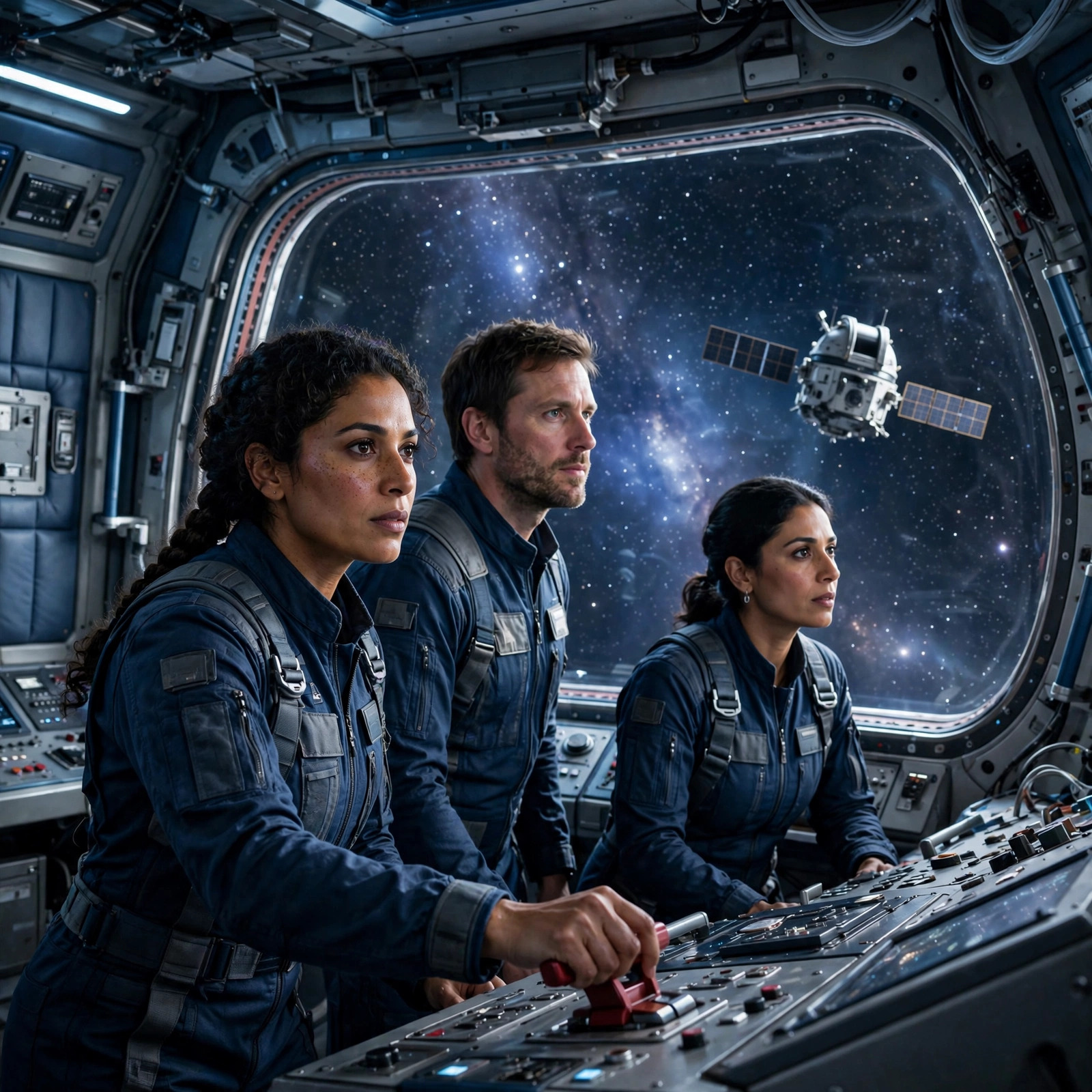
“A little to the left,” Farah said.
Asha shifted the light. The spring lay behind a narrow guard, its retaining piece exposed through the service opening. Farah eased the fork farther in. The retaining piece cracked at its polished edge and snapped free. The spring jumped against the guard, driving the broken metal into the back of her hand.
Farah jerked away. The driver struck the deck and spun beneath the workbench.
“Stop.” Asha caught Farah by the sleeve before she could reach back into the opening. “Leave it.”
For a moment Farah stared at the cradle. Then she tucked her injured hand against her chest. Blood showed between her fingers.
Asha set down the light and pulled the guard panel across the opening. She did not latch it; the spring had shifted, and she could not tell what it might press against. She backed away from the bench.
“Can you walk to the medical cabinet?”
“Of course I can walk.” Farah took a breath through her teeth. “Get the cabinet open.”
Asha brought the kit to the bench instead. Farah sat on a stool while Asha peeled open a sterile dressing. A cut crossed the back of her hand above the knuckles, and the skin around it was already swelling.
“Press here,” Asha said.
Farah held the dressing in place. Her face had gone pale under the bay lights. When she tried to flex her fingers, she stopped and looked away.
Asha opened the medical guide on the kit’s screen and followed its questions. Farah could feel the touch of a fingertip along each finger, though she swore when Asha reached the swollen area. The guide advised cleaning and dressing the cut, supporting the hand, and requesting a clinical assessment if movement or sensation changed.
“I’m sending the assessment request now,” Asha said.
Farah nodded. She kept pressure on the dressing while Asha used her tablet. The medical system accepted the request and indicated that a clinician would review it.
“Can you rinse it?” Asha asked.
“I’ll do it.”
At the sink, Farah held her hand beneath the gentle stream, turning it with visible care. Asha opened the fresh dressings and waited. Farah let her help wrap the cut, then accepted a cold pack from the kit. She settled back onto the stool with the pack against her hand.
The observatory sat in its cradle nearby, its aluminum composite housing reflecting the work light. Farah had helped assemble it before Wakeful left, and Asha had watched her calibrate its pointing system until the stars stayed where the instruments expected them. Now a strip of dark metal protruded from the service opening, caught against the edge of the guard.
“We should ask someone else to look at it,” Asha said.
“Someone else can check my hand. The cradle is mine until I hand it over.”
“I meant you could stop.”
Farah adjusted the cold pack. “You’ve offered me that before.”
Asha looked at her. Farah’s eyes stayed on the bench.
“During calibration,” Farah continued, “you asked if I could stay on after my shift. You told me the pointing error might erase a promising target. I was tired enough that I agreed just to make the conversation end.”
“I thought you were choosing to finish.”
“I was choosing between disappointing you and getting some sleep. That wasn’t permission to keep asking for more.” Farah lifted the pack and studied the dressing. “And it certainly wasn’t consent to this.”
Asha felt the urge to explain how much had depended on that calibration. The observatory’s target list, the confidence in its measurements, the chance to distinguish an astronomical signal from something the instrument had made itself. Farah knew all of it. She had been there.
“I’m sorry,” Asha said. “I should have let you go.”
Farah set the pack down. “You should have listened when I told you I was exhausted.”
“Yes.”
Farah rested her forearm on the bench. The apology had not softened her expression, and Asha did not ask it to. She gathered the discarded wrappers and put them in the medical bin, leaving Farah room to examine her hand.
“I can get another engineer,” Asha offered. “Or I can leave the bay. Neither depends on what happens to my proposal.”
“I know what happens if nobody repairs it.”
“It stays here.”
Farah glanced at the observatory. “And your star goes on being peculiar without us watching it from the right place.”
“Possibly.” Asha folded the cold pack’s empty wrapper. “The dip could still be an artifact. Or something passing in front of the star that has nothing to do with the planet.”
“That hasn’t made you less interested.”
“No.” Asha put the wrapper in the bin. “But you get to decide whether you work on this.”
Farah was quiet for a while. The ventilation moved a loose corner of the medical guide’s paper backing against the bench. She pressed it flat with her uninjured hand.
“I’ll repair it if I can isolate the spring safely,” she said. “I’m not promising you a release. You follow my instructions, and if I tell you to stop, you stop.”
“I will.”
“Bring the stool over. I don’t trust that hand for lifting.”
Asha moved the stool beside the bench. At Farah’s direction, she fetched the cradle’s maintenance case and laid its contents on a clean mat: tools, a spare spring, retaining hardware in sealed packets. Farah checked the part markings against the manual before opening anything.
The clinical reply arrived while she studied the mechanism. Asha read it aloud. The clinician advised keeping the hand supported, watching for increasing swelling or numbness, and avoiding work that demanded force from it. Farah asked Asha to send back a description of the tools she intended to use. The reply permitted light work with assistance and instructed her to report any change.
Farah had Asha position a transparent shield in front of the service opening. Through it, the broken retaining piece looked small enough to miss in the debris tray, but the jagged fracture showed where it had separated. The spring remained bowed against its guard.
“The fork slipped when the retainer failed,” Farah said. “We’ll secure the mechanism from the outside before touching either part.”
She directed Asha to bring a clamp from the case. Farah fitted it to the cradle frame with her uninjured hand, pausing when the injured hand shifted against her lap. Asha held the shield while Farah tightened the clamp with a ratcheting driver. The driver clicked in short movements. Farah stopped often to reposition her grip.
“Do you need me to take it?” Asha asked.
“Not yet.”
Farah checked the clamp’s seating with a mirror. Then she handed Asha the driver and pointed to the adjustment collar.
“Turn it toward the mark. Slowly. If anything moves outside the clamp, stop.”
Asha turned. The spring settled farther behind the guard as the clamp took its load. Her wrist ached from holding the tool at an awkward angle, but she kept the movement slow. Farah watched through the shield, directing her to pause while she checked the contact points.
Only when Farah was satisfied did she have Asha withdraw the isolation fork. The broken retainer came out with a retrieval tool and dropped into the magnetic dish. Farah examined its fractured edge under the light.
“Wear opened a crack here,” she said. “The inspection found the track, but I couldn’t see this side until it failed.”
Asha looked at the dish. The metal had left a faint stain on the dressing where Farah’s hand had bled through.
“We can stop now,” she said.
“We can. I’m choosing to continue.” Farah indicated the spare spring. “Open that packet, please.”
Removing the damaged spring took patience. Farah directed the tools through the access opening while Asha supported the guard and kept the loose hardware clear. When Farah reached for the guide rail with her bandaged hand, pain made her draw back sharply. She closed her eyes, waited, and gave Asha the retrieval tool.
“Grip the end there. Don’t pull until I’ve freed the seat.”
Asha did as she was told. Farah worked the spring loose, using the edge of the bench to brace her forearm. Once it was out, she inspected the channel for scoring. The guide showed wear but no deep damage, and the manual gave her a way to check it with a fitted gauge. She passed the gauge through the channel, stopped to ease her hand, then checked the result beneath the light.
“The rail is usable,” she said. “The spring isn’t.”
Asha placed the damaged part beside the broken retainer. The replacement went into the cradle under Farah’s direction, its seat aligned with the guide and its load held by the clamp. Farah checked that the spring could not move into the release path while the retainer was absent.
Asha’s tablet lit with a reminder attached to the survey authorization. She turned it face down. The one observatory could still serve the three contracted fields if it stayed aboard; once released for the occultation, it could not be recovered for that work. The researchers waiting for those observations had made plans around them. Asha would have to answer for any change, but there was no change to authorize while the cradle remained untested.
Farah held out her uninjured hand. “The retainer packet.”
Asha passed it over. Farah opened the seal against the bench edge, then used tweezers to lift the replacement into view. She compared its shape with the broken piece and checked the part marking against the manual. Her bandaged hand rested on a folded pad, clear of the mechanism.
“Light on the seat,” she said.
Asha raised the work light. Farah guided the replacement into the narrow opening. It caught against the edge, and she withdrew it rather than forcing it. She adjusted the tweezers, approached from a different angle, and lowered the piece again. Her injured hand twitched when she braced herself; she stopped until the pain passed.
At last the retainer settled into its seat. Farah checked its position with the mirror, then set the tweezers down.
“It’s in,” Asha said.
“It is.” Farah left the clamp in place. “I won’t certify the cradle until we’ve tested it.”
Test Bench
Asha held the light over the cradle while Farah eased the clamp away from the new retainer. The metal arm stayed seated in its guide. Farah touched the edge of the housing with a probe, then moved her bandaged hand back onto the folded pad.
“It’s not under load yet,” she said. “Don’t put your fingers in there.”
Asha set the light in its bracket. Beside the bench, the autonomous observatory rested in its open case, its lens cap still fitted. Farah had built the cradle to launch it without anyone going outside. Asha looked at the replaced part and imagined it catching halfway through the stroke, leaving the instrument trapped against the lock wall.
Farah drew a wheeled test rig close with her uninjured hand. “Bring the harness over. The heavy one.”
Asha found the harness beneath the bench and laid it across the rig. Farah inspected its fittings, turning them slowly against the light. She tried to fasten a connector, winced, and pushed it toward Asha.
“There. Seat it until the collar covers the mark.”
Asha did, then checked the mark again when Farah pointed. The collar had stopped short. She backed it off and tried once more, pressing with the heel of her palm until it slid into place.
“Good. Now the restraint.” Farah nodded toward a transparent shield. “If the retainer lets go under load, that stays between us and it.”
Asha fitted the shield to the rig. Her tablet chimed on the shelf, and she nearly ignored it. Then she saw the source of the message: the survey reduction service, answering the independent check she had requested.
“Can I look at this?” she asked.
Farah was adjusting the rig with a small driver. “You don’t need my permission to read your mail.”
Asha picked up the tablet. The reduction service had processed the stellar observations without using her selection of reference pixels or her corrections for changes in the detector. Its report put a narrow dip in the same interval she had marked. She enlarged the plot, brought up the uncertainty bands, and checked the notes on rejected samples.
Farah laid down the driver. “You’ve found something.”
“Another reduction found it. Compatible in time and depth.” Asha turned the tablet toward her. “They used different reference stars and a different correction for the detector.”
Farah studied the curve without taking the tablet. “Same raw exposures?”
“Yes.”
“Then a defect in those exposures could still be there.”
“It could. Or something unrelated passed in front of the star.” Asha traced the shallow notch with a finger, careful not to touch the screen. “But it’s less likely I made it by choosing the wrong corrections. The geometry gives us a chance to look again.”
Wakeful would follow its own trajectory through the predicted interval. If the observatory were sent on a slowly separating path, its line of sight would shift relative to the ship’s. A companion near the catalogued planet might produce a different occultation in each record. So might some other arrangements of objects, and a clean pair of curves might still leave room for argument. But the comparison could expose an instrumental dip, and it could tell them whether there was something worth following from farther away.
Farah returned to the harness. “It’s a better reason to ask. It doesn’t make this part safe.”
“I know.”
“Help me load the dummy.”
The dummy was a block machined to fit the observatory’s cradle. Asha lifted it into position while Farah guided the mounting shoes into their sockets. The block settled with a dull contact Asha felt through her palms. Farah connected the rig to apply the expected load, then checked the readings against the test procedure on her own tablet.
Asha watched her work around the bandage. Farah could steady a tool with that hand, but only briefly; each time pressure reached the injured place, her mouth tightened. Asha offered to hold the probe. Farah passed it over and directed her to the test points without apology.
Oren came into the bay carrying the survey authorization wafer in its protective sleeve. He stopped short of the shield, where a strip of tape marked the safe working area.
“The flight checks have been moved,” he told Farah. “The lock is available when you’re ready. Is that the actual instrument?”
“Test mass. The instrument stays in its case until the cradle passes.”
Oren set the wafer on a clear corner of the bench. His gaze lingered on Farah’s hand. “Do you need a medic back here?”
“I’ve been seen. Asha can manage the connections.”
Farah brought the load up gradually. Asha watched the sensor trace, looking for movement where there should have been none. The retainer held. Farah increased the load to the prescribed test setting and left it there while she inspected the guide through the shield.
“Stroke test,” she said.
She operated the cradle from the rig’s control panel. The arm moved, paused, then stopped with the dummy still captured.
Asha felt her stomach drop. Farah leaned closer to the sensor readout, keeping her hand clear of the enclosure.
“The load fixture’s restraining strap is short,” she said. “It’s pulled tight before the arm reaches its stop.”
Oren peered through the shield. “Can you tell that without opening it?”
“The load rose at the same point the strap came taut. I can inspect it with the rig unloaded.” Farah reduced the load, checked the indicator, and opened the shield only after the arm was secured. She pointed to a bright scrape on the strap buckle. “That’s our obstruction.”
They repositioned the restraint. Asha threaded it through the proper anchor while Farah checked the routing. When the shield was closed again, Farah repeated the loaded stroke. This time the arm carried the dummy through its travel and returned it to the capture position. She ran the prescribed checks again, varying the load within the procedure’s limits, then inspected the retainer and guide for fresh scoring.
Oren waited while Farah reviewed the readings. Asha found herself staring at the certification field on Farah’s tablet, willing it to fill.
Farah flexed her injured fingers and stopped. “The mechanism passes. The replacement is seated, and the guide stayed within tolerance under the test load.” She entered her credentials. “I’m certifying it for deployment from inside the sealed lock, using this procedure. No one goes outside to coax it along.”
Oren accepted the report on his tablet. “That addresses the cradle. It doesn’t address the survey.”
Asha showed him the independent reduction. He read the report rather than looking only at the curve, and she waited while he examined its qualifications.
“It’s a stronger candidate,” he said. “Still the same exposures.”
“Yes. The comparison during the occultation could tell us more.”
“And the three contracted fields get nothing.” He set the tablet down. “Those teams chose targets we won’t be able to observe from the ship after we leave. Some of them have already committed their own observing time to follow ours.”
“I’ve read their proposals.”
“Then you know why I’m not eager to tell them we spent their instrument on a possibility.”
Asha looked at the wafer. Its sleeve had a worn corner where someone in the survey office had marked the authorization for handling. Until now, leaving it there had allowed her to speak of the other researchers as if they were simply part of a difficult calculation.
“If I amend it, my name goes on the decision,” she said. “I’ll write to each principal investigator, and I’ll give them the analysis and the records they need to contest it. The survey board can remove me from future assignments.”
Oren folded his arms. “That’s possible. It doesn’t replace their observations.”
“No. I can’t promise them replacement time.” She brought up the independent report again. “I can tell them why I chose this. A companion would change the inventory, and the chance to test it from separated viewpoints is closing. We won’t be able to come back for the same alignment.”
Oren looked toward the observatory’s case. “The burn plan stays as approved. So do the return reserves. I won’t trade either for a better view.”
“Agreed.”
“Put that in the amendment. The instrument follows a passive trajectory after deployment. No change to the ship’s maneuver, no borrowing from the return margin.”
Asha opened the wafer sleeve. The authorization appeared on her tablet when she connected it. She selected the remaining fields and entered the amendment, naming the occultation as the proposed target and acknowledging that the observatory could not be recovered for the contracted work. She added Oren’s conditions on the burn and reserves, then read the document through before signing.
The signature took longer than she expected. The tablet asked for confirmation, and she gave it. A copy went to the ship’s records; the authenticated original remained on the wafer.
Oren read the amended authorization. “I still object to losing those fields,” he said. “The mechanism is certified, and you’ve accepted responsibility. I approve the deployment under these conditions.”
He returned the wafer to its sleeve and placed it beside the observatory case. Asha reached for the programming lead, then stopped. Farah had moved away from the bench and was supporting her injured hand against her chest.
“I can load the observation plan,” Asha said. “You don’t have to stay.”
Farah looked at her. “You said something like that during calibration. Then you kept bringing me the next adjustment until the shift was over and neither of us could see straight.”
Asha let the lead hang from her hand. “I did. I’m sorry.”
“I know you can do the target list. The pointing sequence is mine to approve.” Farah considered the open case, then pulled a stool to the work surface. “I’ll help, if you let me stop when my hand tells me to.”
“Of course.”
“And don’t tell me it’s only a little longer.”
Asha put the lead into the observatory’s service port. Farah worked the interface with her uninjured hand, asking for the predicted stellar position and the ship’s trajectory file. Together they built a sequence that would acquire the star, preserve the raw images, and record the instrument’s pointing and detector conditions alongside the light measurements. Farah inserted checks to keep the observatory from mistaking the planet for its guide source. Asha reviewed the observing window and the radio instructions for sending the data back.
When Farah paused to rest, Asha fetched a fresh cold pack from the medical cabinet and left it within reach. Farah used it while the software ran its internal checks. A warning appeared in the pointing simulation, and they corrected the acquisition sequence before running it again. The warning cleared.
Oren compared the final deployment parameters with the approved flight plan. He sent the configuration to the navigation system for its own check and waited for acceptance before returning the tablet.
Farah disconnected the service lead. “It’s ready to close.”
Asha fitted the observatory’s cover, checked the seal around its edge, and secured the latches. Then she placed the signed wafer in its sleeve with the deployment materials beside the closed case.
Deployment Lock
Asha guided the observatory through the inner hatch while Farah kept its trailing corner clear of the frame. The suitcase-sized case rode on a padded carrier, its latches facing upward. Asha had almost brought it against the cradle when the carrier caught on the threshold.
“Stop there,” Farah said.
Asha took the weight while Farah crouched and freed a folded edge of padding from beneath a wheel. Her bandaged hand rested against her thigh. When she stood, she pushed the carrier forward with her uninjured hand, and the case slid into the cradle’s open jaws.
Oren followed them into the lock, pulling the inner hatch nearly shut behind him. The air smelled of clean metal and the adhesive on Farah’s bandage. Beyond the outer hatch lay the dark through which Wakeful was traveling, too deep for the ship’s lights to reach anything but the hull.
“Carrier’s clear,” Farah said.
She touched the cradle control. The padded supports rose around the case and held it without covering its optical aperture or antenna. Asha watched the contact indicators settle on the small panel. The cradle had passed its safety test, but she found herself looking for a sign that a support had seated crookedly.
Farah saw her looking. “It’s sitting correctly. I’d tell you if it weren’t.”
“I know.” Asha stepped back to let her reach the panel.
Farah braced her bandaged hand against the cradle housing and pressed gently. The observatory did not shift. She checked the mechanical position markers, then used the protected switch to confirm that the release circuit was connected. The panel acknowledged the check; the restraint stayed closed.
“I’m not testing the mechanism again with the instrument in it,” Farah said. “The indicators agree with what I can see.”
Oren leaned close enough to read them. “Is there anything you need before we seal up?”
“The carrier out of my way.”
Asha pulled it free and folded its handle. Farah watched the supports as it came away, then nodded. Oren took the carrier through the inner hatch and stowed it in the control alcove. Asha followed with the sleeve containing the authorization wafer tucked inside her jacket.
Farah lingered by the cradle. Her hand had begun to tremble against the housing. She lifted it away, flexed her fingers with evident care, and studied the observatory’s closed cover.
“Farah,” Asha began, then stopped.
Farah looked over. “I can leave when I’m ready.”
“I was going to ask whether the bandage was tight enough.”
“It is.” She came through the hatch and let Oren secure it. “You can ask me. Just don’t decide for me.”
Asha moved aside while Oren checked the seal. There was room for all of them in the alcove, though Farah had to turn her shoulder to pass behind the control chair. Through the lock window, the observatory sat under the work lights, ordinary and finished, with no hint of the long exposure sequence stored inside it.
Oren called up the navigation confirmation on the alcove console. Asha could see the approved trajectory alongside the observatory’s predicted separation path. The small craft would move slowly away from Wakeful, its own batteries and pointing controls carrying it through the observation. It would not have the propellant to return to the ship for the survey fields.
Oren studied the confirmation before he spoke. “We’re keeping the planned burn. Return reserves stay where they are, and nobody goes outside.”
“Understood,” Asha said.
“You have authority to send it. That isn’t my endorsement of the lost survey.”
He turned the console toward her. The signed amendment was attached to the deployment command. It would remain conditional until the observatory left the cradle. Afterward the ship’s records would show the contracted observations as abandoned under her authority, not deferred for somebody else to complete.
Asha read the field names. She knew the researchers waiting for them through messages, proposals, and corrections passed back and forth across the dark. They had chosen those regions because Wakeful would have a view that would be unavailable after its passage through the system. Their preparations had depended on the instrument staying with the ship.
She touched the edge of the console, not quite reaching for the command. “I’ll send each team the calibration files and everything we collected for them.”
Oren folded his arms. “That won’t replace their fields.”
“No. I’ll tell them that too.”
He did not soften the statement for her. He had made the ship available to those teams under agreements they had reason to trust. Asha had signed her name to the amendment, but the explanation would still arrive from Wakeful.
“The survey office will ask why we didn’t preserve the original plan,” he said.
“Send them to me.”
“They’ll ask me as well.”
Asha nodded. She had no answer that would spare him that conversation. She drew the wafer sleeve from her jacket and opened it enough to see the pale ceramic edge. The authenticated authorization was small enough to disappear beneath her thumb. She returned it to the sleeve and put it back inside her jacket.
Farah leaned against the bulkhead, watching the window rather than the console. “The instrument won’t know what made the star dim,” she said. “It’ll record what reaches the detector.”
“And where it was pointing,” Asha replied.
“If the acquisition works.”
Asha glanced at the stored sequence. Wakeful would observe from its own path while the autonomous observatory looked from the slowly separating trajectory. A difference between the light curves might support an object moving with the catalogued planet. A matching instrumental fault, or an unrelated object crossing the star, could still account for what they had seen. Even clean measurements might leave room for disagreement.
“We may get nothing we can use,” she said.
“We may get good data and still argue about it.” Farah shifted her injured hand onto the shelf beside the console. “I’d prefer that.”
Asha wanted that too. She had imagined a new entry in the planetary inventory, a name added to the system’s familiar arrangement. The desire had made the dimming seem almost personal when it first appeared. Now the case in the lock looked less like an answer than a piece of equipment entrusted to her judgment.
Oren checked the hatch seal and started the pump. The lock’s air pressure fell on the panel while the cabin air remained warm against Asha’s face. Farah watched the cradle indicators through the change, her good hand hovering near the abort control. The supports kept their grip. When the lock reached the required pressure, Oren opened the outer hatch.
The work lights illuminated a rim of hull and the observatory’s pale case. Past them, stars remained fixed to Asha’s eye. She knew the ship was carrying the whole scene along its trajectory; nothing in the window offered a useful sense of that motion.
A message appeared from the observatory. Its internal checks were complete, its battery was ready, and its receiver had accepted the final time reference. Farah read the message and compared it with the configuration on the console.
“The antenna will deploy after it’s clear,” she said. “If we lose the first transmission, don’t assume the sequence has stopped. Let it attempt the next contact.”
“I’ll keep the receiver assigned to it,” Oren replied.
He moved out of the control chair. Asha sat, then adjusted the screen so Farah could see it without leaning across her injured hand. The command was available beneath the navigation confirmation and the amendment. It asked for her authorization again, although her signature was already on the wafer.
She placed her thumb on the reader. The console accepted her identity but did not yet send the command.
“There’s still time to close the hatch,” Oren said. “We can bring it back in.”
He meant it. The fields were not lost while the observatory remained secured aboard. Asha could close the hatch, wait for the lock to repressurize, and return the instrument to the survey work. The unexpected dimming would remain in their records, inviting interpretations they could not test from Wakeful’s path alone.
She looked at Farah. “Do you see anything that should stop us?”
Farah examined the indicators once more. She set her bandaged hand beside the panel, carefully avoiding the switch. “No. The cradle is fit to send it.” She met Asha’s eyes. “The target is your decision.”
Asha brought up the list of contracted fields beside the occultation sequence. There was no space in the latter for the observatory to turn back and perform the former. She closed the list, leaving the names in the amended authorization rather than deleting them from view.
“I’m proceeding,” she said.
Oren remained beside her, close enough to reach the abort control. Farah stood on Asha’s other side, her bandaged hand resting flat on the console shelf. Asha pressed the release control, and through the lock window she watched the observatory move away from the cradle into the dark.
Get notified when new stories drop

Mira Okoye
Mira writes first contact and mentorship-across-species stories where curiosity beats fear.
Leave a comment
Comments