



The Chamber
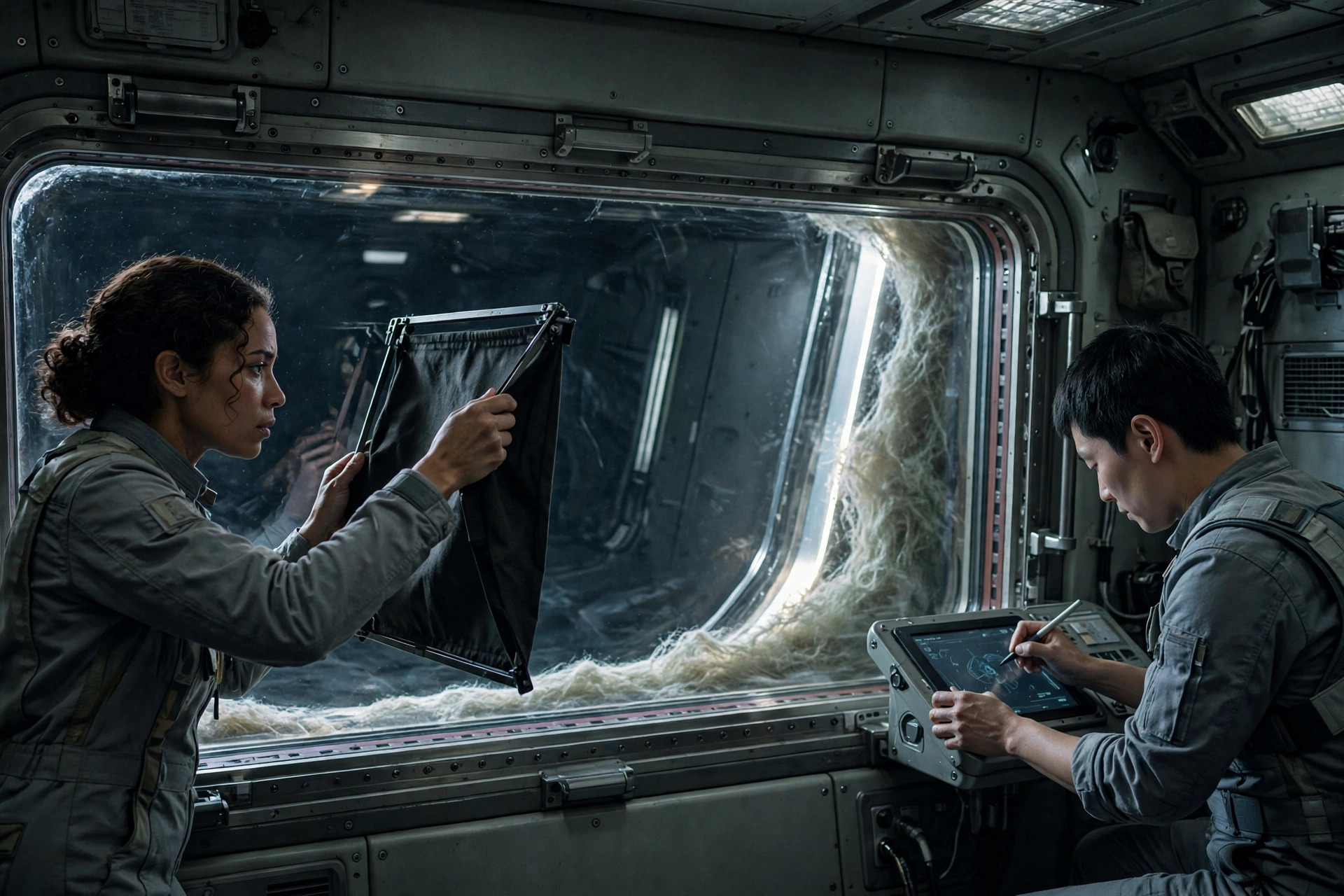
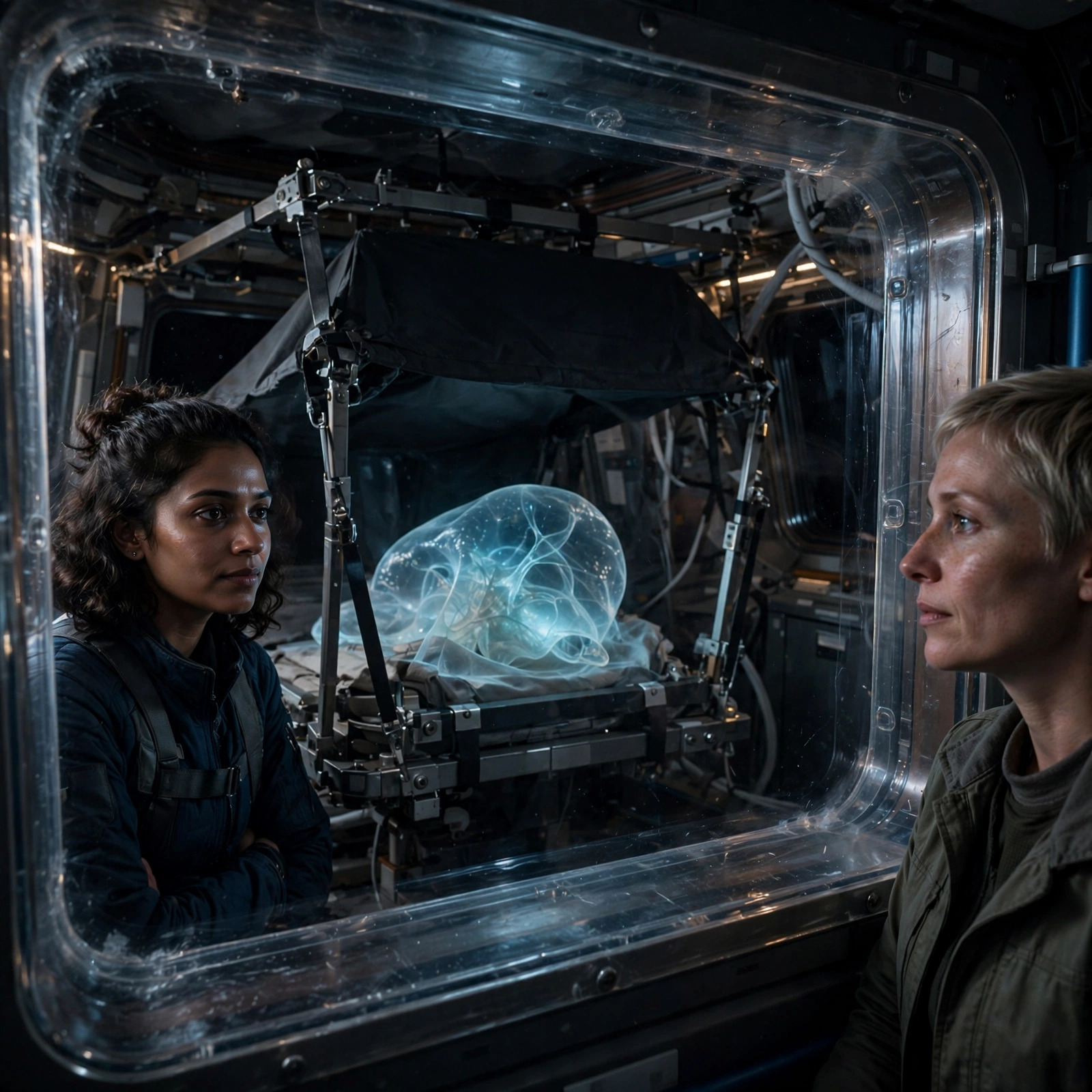
Asha caught the shade before it slid past its stop and held it against the observation panel. Behind the clear polymer, the organism drew a pale ridge across its surface. The ridge curled at the edge of the illuminated patch, loosened, and flattened.
“There,” she said. “Can you mark where it turned?”
Belen set her tool case on the console and leaned toward the panel. “The surface moved. I can mark that.”
“Please.”
Belen touched the display, leaving a thin line over the image. The organism lay inside the sealed chamber like a sheet of translucent felt, its margins folded against the ceramic floor. Nothing about it resembled an eye or a limb. Asha had learned to look for changes across its whole surface rather than search for parts she could name.
A second ridge appeared, farther from the light. Asha nearly lifted her hand from the shade to point, then kept her grip. The shade had slipped before, and Belen disliked having the panel knocked out of alignment.
“I’d like the light narrower,” Asha said.
“You’re blocking the sensor with your wrist. Let me do it.”
Belen released the shade’s catch and fitted a small brace against its track. She moved the shade until the lit strip on the chamber floor narrowed, then tightened the brace. Asha let go. The shade stayed where it was.
Inside, the organism’s nearest margin drew away from the bright strip. Its surface puckered, and a delicate fold traveled toward the darker ceramic. Asha watched until the fold had gone, then checked the recording. The earlier image showed a similar movement, though not in precisely the same place.
“Could be the same response,” she murmured.
“Could be the chamber settling after I moved the shade.” Belen tapped the housing. “You shifted the weight on this rail.”
“The chamber’s isolated from it.”
“Isolated enough for the measurements we’ve been making. You’re looking at finer movement now.”
Asha enlarged the trace from the chamber supports. A small vibration coincided with the adjustment, too small to disturb the pressure seal but large enough to complicate her reading. She added it to the record instead of discarding the observation.
“Can we keep the shade there while the support settles?”
“We can. What are you hoping it does?”
“Something we can recognize if we see it again.”
Belen studied the image. “It’s been giving us plenty to recognize. You’re asking it to put the pieces in an order.”
“I’m trying to give it an opening to answer.”
“You don’t know if it can see an opening.”
Asha knew. The ridges could be ordinary adjustments to a changing environment. They could also be responses that made sense to a creature whose body and chemistry had developed beyond any human habitat. She had no reliable way to distinguish those possibilities yet, and every attempt changed the conditions she was trying to understand.
Tovan entered carrying a tablet and stopped beside Belen’s tool case. Asha had expected him to call ahead. The tablet showed an allocation request, its columns compressed so that a longer list could fit on the screen.
“I came to see the chamber before we decide,” he said.
Belen moved her case from his path. “It’s stable. If that’s the question, I can send you the maintenance record.”
“I’ve read it.” He looked through the panel. “The medical staff at Kethra Habitat have asked for this environmental support equipment. Their treatment capacity is limited without it.”
Asha kept her eyes on the organism. A ripple passed through its center and disappeared under a fold. “They need the whole system?”
“They need the parts that regulate and verify the chamber atmosphere. We can’t give them what they need and keep this enclosure under the same protection.”
“Can they use the backup equipment?” Belen asked.
“They can, and they are. It’s less reliable. They’re postponing treatments because they can’t maintain the conditions patients require.” Tovan placed the tablet on the console, where both women could read the request. “I’m not asking you to trust my summary.”
Asha scanned the signatures and the description of the treatment rooms. She knew how carefully the chamber’s environment was monitored. Belen had assembled and pressure-sealed the enclosure before the mission began, then checked every seal herself. The organism had survived recovery and transport inside it. Asha had no comparable assurance that it would survive a change of habitat.
“I need more time,” she said.
Tovan rested a hand on the back of a chair. “For what test?”
“For observations under conditions we can repeat. If it responds to a change, we record that change and wait. Then we see whether the response returns under comparable conditions.”
“You’ve been watching it retreat from this margin. How long before watching tells you whether that’s deliberate?”
“It may not tell us at all.”
“Then let’s give it something harder to miss.” He touched the display, bringing up a proposed illumination pattern. “A bright pulse, followed by a rest. If the movement changes reliably when we introduce it, we’ll have evidence worth taking to the allocation board.”
Belen folded her arms. “How bright?”
Tovan showed her the proposed setting. She frowned and compared it with the limits on the chamber display.
“That’s within the enclosure’s operating range,” she said. “It doesn’t tell us what the organism can tolerate.”
“I understand the distinction. We’re already illuminating part of it.”
“And it keeps moving away.”
“Which may tell us it detects the light. A clearer response could help us establish that it has some control over what it’s doing.” Tovan glanced at Asha. “If we can make that case, I can argue for keeping the support here.”
Asha studied the proposed pattern. It was direct, repeatable, and easy to explain to people who needed a result. It might also drive the organism away from a larger area of its enclosure. There was nowhere else for it to go.
“A stronger stimulus could make it withdraw,” she said. “We’d learn that it can be driven back, not whether it’s participating.”
“If it changes its response according to what we do, that’s more than withdrawal.”
“Perhaps. But we can’t treat a lack of movement as evidence that it has no agency.”
Tovan nodded once, though he did not remove the proposal from the screen. “And I can’t tell the medical team to wait indefinitely because we might be asking the wrong question.”
The organism’s folded edge touched the border of the lit strip. Asha leaned closer. The edge remained there, then slowly lifted and settled somewhere beyond the border. She checked the support trace again. The vibration had diminished, but the movement was not quite like the earlier ridge. She could not offer Tovan a clean result.
Belen released the brace and adjusted it, careful not to let the shade slip. The lit strip shifted across the ceramic, away from the organism’s margin. Asha watched the recording update and resisted the urge to ask for another adjustment. Every movement of the shade would bring back the vibration.
“There’s an approved test,” she told Tovan. “Less intense than yours. A short illumination, then a pause.”
Belen turned from the rail. “Approved when?”
“Before the allocation request came through. I entered one stimulus authorization in the audit.”
“You didn’t tell me it was ready to run.”
“I hadn’t decided to run it.” Asha looked at the shade, not at Belen. “I thought we might learn enough from observation.”
Belen picked up the tablet and opened the test settings. “This uses the panel motor.”
“The motor positions the shield afterward,” Asha said. “The illumination itself is modest.”
“The shield track has been sticking.” Belen pointed to the brace she had just fitted. “I can free it, but I haven’t finished checking the sensor.”
Asha had seen the fault note when she approved the test. A sensor failure could leave the panel unable to complete its movement, and the light might continue longer than intended. The control system was meant to stop illumination if that happened, but the note called for a further check. She had read it as a precaution rather than a reason to delay. Now Belen was waiting for her answer, and Tovan’s allocation request remained open beside them.
“The light is set to stop before the shield moves,” Asha said. “Your brace should keep the track aligned.”
“That isn’t the check I asked about.”
“No. But we can watch it, and you’ll be at the controls.”
Belen set the tablet down more carefully than she had picked it up. At home she sometimes did the same with a cup when Asha answered a different question from the one she had asked. Asha reached toward her, then put her hand on the console instead. Belen had come here trusting her to identify a useful test, not to make the equipment safe by attention alone.
“If I see the track catch, I stop it,” Belen said.
“Yes.”
Tovan compared the approved setting with his proposal. “It may be too weak to establish anything.”
“It may,” Asha said. “But it gives us a defined change and leaves room afterward to observe. If we see a response, we can discuss what it means before increasing the light.”
“I’ll take the result to the allocation board. I won’t promise it will satisfy them.”
“I’m not asking you to.”
Belen took her position beside the panel controls. She checked the brace, then laid her fingers near the stop switch without pressing it. The organism rested beyond the illuminated strip, its surface faintly ridged. Asha opened the authorization on the console. The field for her credential remained blank.
She took the ceramic credential from her jacket and placed it at the chamber console.
The Panel
Asha pushed the ceramic credential into the reader, and the console brought up the remaining stimulus authorization. Belen kept her hand beside the stop switch. Across the chamber, Tovan leaned forward to read the settings over Asha’s shoulder.
“That’s the approved intensity,” he said. “Nothing stronger?”
“Nothing stronger.” Asha touched the confirmation field. “The lamp goes out before the shade closes. We watch what follows.”
The reader accepted her credential. A pale strip crossed the transparent wall of the habitat, laying a narrow band of light over the organism. Its surface drew tight along the edge of the band, then relaxed. Asha bent toward the monitor, where the camera made the movement easier to distinguish from the uneven texture beneath it.
“There,” Belen said.
“I see it.”
A ridge traveled across the exposed portion of the sheet and dispersed into finer lines. Elsewhere, the surface remained folded against the ceramic floor. Asha marked the change in the observation record without attaching an interpretation. She had hoped for something less ambiguous, a movement that would distinguish the organism’s response from the slow adjustments it made throughout the day. Still, the recording would preserve more than she could see at the console.
Tovan rested his palm on the back of an empty chair. “Can you tell whether it moved toward the lamp?”
“Not yet. We’ll compare the whole surface.”
“If it’s avoiding the light, that tells us something too.”
“It might. We need the interval afterward.”
The light remained on. Asha glanced at the test display. The illumination phase was still marked active, although the programmed interval had passed.
“Stop it,” Belen said, and pressed the switch.
The indicator beside it changed color. The lamp stayed lit.
Belen pressed again, harder. Asha opened the control log. Her authorization was recorded as used, and the test interface offered no further stimulus. Beneath it, a status line reported that the shade was moving into position. On the chamber wall, the shade had not moved.
“The sensor?” Asha asked.
“Could be.” Belen crouched beside the track. “The motor’s trying to take it forward.”
Asha selected the lamp’s independent shutdown. The command appeared in the log, followed by a notice that it was waiting for the positioning sequence to clear. She sent it again, then opened the service controls and searched for a way around the sequence. The cursor paused over the diagnostic access field.
“It won’t take the stop,” she told Belen.
“I can hear the drive.” Belen put her fingers against the housing. “It’s loaded against something.”
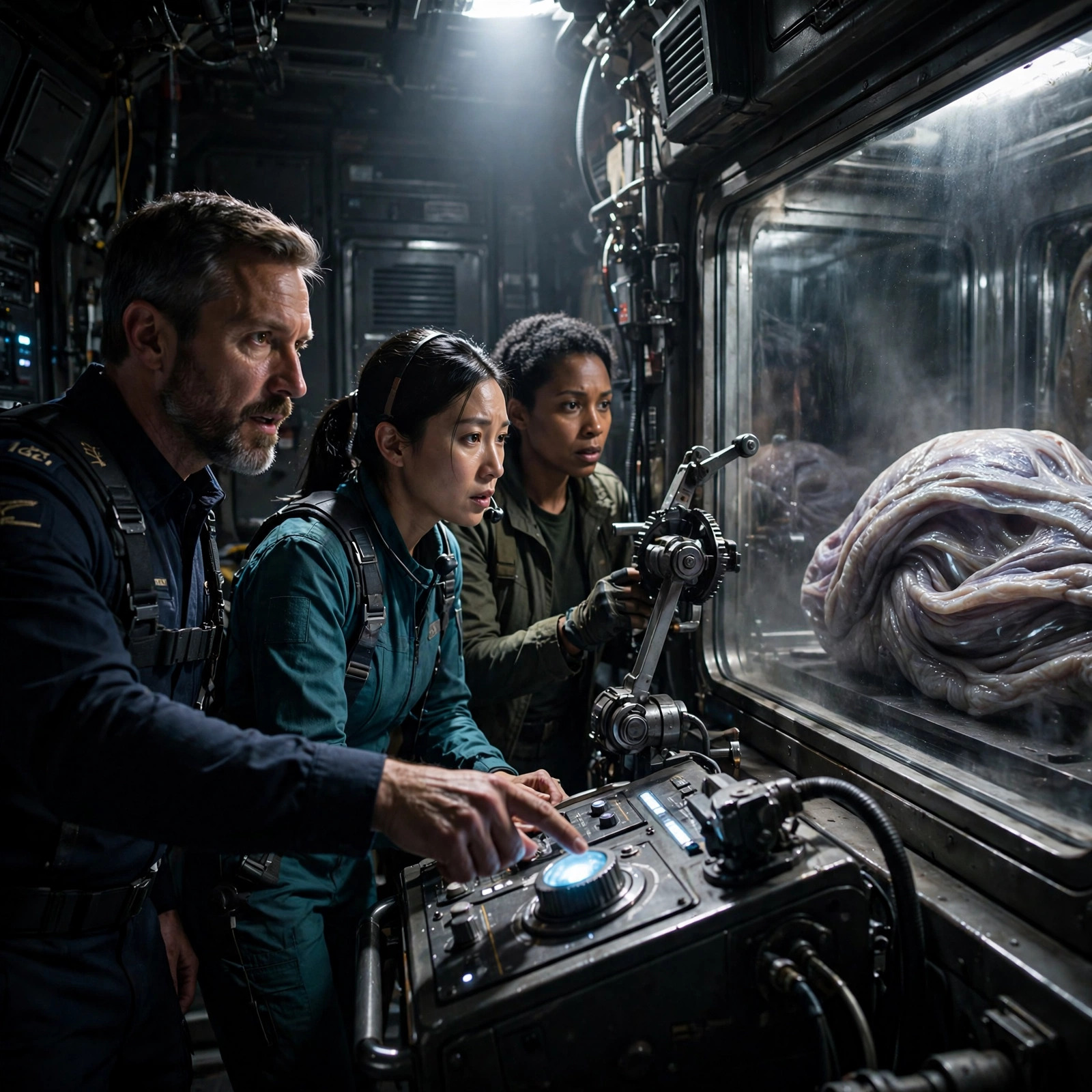
Through the window, the organism pulled away from the light. The movement was no longer subtle. Its exposed edge curled inward, lifting from the floor of the habitat. Asha enlarged the camera view. A pale patch had appeared near the center of the illuminated strip, where the ridges had been moving.
“Tovan, hold the track housing,” Belen said. “There, against the bracket. Don’t touch the chamber wall.”
He came around the workstation without arguing. The housing shifted under his hands as Belen released its latch. Asha heard the motor strain, an uneven vibration carried through the mounting. The sealed habitat stood behind it, undisturbed, its environmental indicators still within their usual range.
“Can you cut the lamp supply?” Tovan asked.
“Not from that cabinet,” Belen said. “The chamber support is on the same feed until it reaches the driver. I’m not pulling the whole feed.”
Asha found the driver on the service diagram. Its local disconnect was behind the track housing, near the jammed mechanism. Belen would have to remove the housing to reach it, and Tovan was already holding the cover against the force of the drive.
“The local disconnect’s behind your left hand,” Asha said.
“I know where it is.” Belen tested the cover. “If I lift this with the motor pushing, the bracket could tear loose. We’d have a live lamp and a loose shade over the window.”
“I can hold the bracket,” Tovan offered.
“You’re holding it now. Keep doing that.”
Asha returned to the console. She tried to cancel the positioning sequence. The interface accepted the request, then displayed the same waiting notice. She opened the service history and found the sensor fault note. It sat beneath her approval, accessible from the record she had signed.
She looked at Belen’s bent head. “The note said the lamp might continue if the sensor failed.”
Belen stopped working. “You read that?”
“Before I approved it. I thought the shutdown would interrupt the test.”
“And when I asked about the sensor?”
Asha had the answer ready, but she could not make it sound any less evasive than it had been. “I should have told you.”
Belen’s face tightened. She turned back to the track and pulled a manual handle from its recess. “The shutdown runs through the same controller. If the sequence has locked up, the command may never reach the driver.”
“Can the handle close the shade?”
“If the drive releases it.” Belen pulled. The handle moved a little and stopped. “It hasn’t.”
Asha went to the chamber. From here the organism’s contraction was visible without the monitor. Its edge had gathered into thick folds beyond the brightest part of the strip. The pale patch stayed exposed. She could not see it moving at all.
“We need the shade across,” she said.
“I know.” Belen braced her foot against the cabinet. “Tovan, keep the housing from twisting. Asha, release the drive clutch when I take the load.”
Asha found the recessed release behind the handle. The metal was warm against her fingertips. Belen pulled until the handle trembled, and Asha pushed the release inward. It resisted, then slipped under her thumb. The drive’s vibration changed pitch.
The shade advanced a short distance and caught with a hard knock. Belen let out a breath and eased the handle back. It would not return to its recess.
“The brace is holding the track straight,” she said. “The panel’s caught at the guide.”
Tovan shifted his grip. “Tell me where to help.”
“Keep that housing still. If it lifts, I lose the guide.”
Asha examined the narrow gap beside the panel. The edge had ridden against the guide instead of entering it. She reached for it, but Belen caught her wrist.
“Not there. If it moves, it’ll take your fingers with it.”
Asha withdrew her hand. On the console, the camera showed the pale patch more clearly now. Fine lines crossed it, but they did not alter as she watched. Beyond it, the folded edge continued its slow, uneven motion.
“We can leave the light on while I get the housing off,” Belen said. “Or I can force the panel past the guide. I don’t know if the track will survive that.”
“What happens to the seal?” Tovan asked.
“The shade is outside it. The habitat should stay sealed, provided the housing doesn’t strike the window.”
He looked at the contracting sheet. “Then I’ll keep the housing clear.”
Asha stood beside the console, close enough to send another shutdown command if the sequence released. She could also see the allocation request still open on Tovan’s screen. The chamber drew on equipment that patients at Kethra Habitat needed. He had made that plain when he proposed a brighter test. Now his arms were taut around the housing, and he was watching Belen’s hands rather than the request.
“Ready,” he said.
Belen pulled the handle. The panel scraped against its guide without advancing. Asha sent the shutdown command again. The notice returned.
“It’s still waiting,” she said.
Belen changed her grip and leaned back. The brace flexed. Tovan pressed the housing toward its mounts, keeping the loose edge away from the habitat wall. Asha moved alongside Belen and took hold of the handle below her.
“With me,” Belen said.
They pulled. The panel shifted, then jammed again. Asha’s palms slid on the smooth metal. She adjusted her grip and saw Belen’s fingers trapped close to the slot where the handle entered the mechanism.
“Your hand.”
“I have to keep it aligned.”
“Let me take it.”
“You can’t get in here.” Belen set her jaw. “Pull when I do.”
The panel jolted forward. Asha stumbled against the cabinet, and Belen cried out. The handle had driven back into the slot, catching her hand against its rim. She pulled free, but the panel was moving now, and she seized the handle again with her injured hand before Asha could reach it.
“Belen, stop.”
“Hold the clutch.”
Asha pushed the release in. Belen dragged the handle down until the shade covered the illuminated strip. The scrape ended with the latch engaging. Behind the panel, the lamp was still on; its indicator showed through the service display. Asha sent another shutdown command, and this time the indicator went dark.
Tovan did not let go of the housing until Belen told him it was secure. Asha checked the habitat readings. The chamber remained sealed and chemically stable. The camera could no longer see the damaged patch through the closed shade.
“Your hand needs attention,” Tovan said.
Belen held it against her jacket. “The mechanism first. If the latch slips, the panel could move back.”
“I’ll stay here,” he said. “Show me what to watch.”
She pointed out the latch through the service opening. Asha reached for the medical kit under the console, then stopped when Belen turned toward her. For a moment Asha thought Belen might accept her help. Belen looked instead at the handle, checking that it had seated fully.
Blood from her hand marked the handle she had forced shut.
The Dressing
Asha pulled the medical kit across the worktop before Belen could close it. The catch snagged on the edge, and packets slid against the transparent lid.
“Leave it open,” Asha said.
Belen stood beside the chamber with her injured hand wrapped in a temporary dressing. A dark stain had spread through the gauze since she came in that morning. With her other hand she checked the latch on the observation panel, pressing its recessed tab until it clicked against the manual stop.
“It’s secure,” she said. “The brace is taking the load.”
“Your hand isn’t.”
“I noticed.” Belen kept her eyes on the latch. “The seal readings?”
“Stable. No change in the chamber chemistry.”
Asha had checked them as soon as she arrived, then again when Belen came through the door. The surface inside was visible through a narrow section of the chamber’s transparent wall, beyond the edge of the shade. Most of it lay folded against the ceramic floor. A pale patch near the exposed edge remained still, its surface puckered where it had been smooth before the lamp stayed on.
Belen drew her hand back from the latch. “The patch?”
“I can see the rest of it shifting. Not there.”
“Can we get a better view?”
“Not without moving the shade.” Asha touched the kit lid. “Please.”
Belen looked at the chamber again, then sat on the stool beside the worktop. She rested her forearm on a folded cloth, keeping the injured hand clear of the surface.
“I had it checked,” she said. “They cleaned it and made sure nothing was broken. The dressing needs changing.”
Asha opened a sterile packet. The antiseptic smell rose between them. “Does it hurt more than it did?”
“It hurts differently.” Belen offered the hand, palm down. “Don’t tug at the wrap.”
Asha found the loose end and unwound it slowly. The gauze had adhered near the cut at the base of Belen’s thumb. She dampened it with the cleaning solution from the kit and waited until it lifted without pulling the skin. Bruising had spread across the heel of the hand and into the wrist. The cut itself was shallow but angry-looking, its edges held together by a narrow closure strip.
Belen watched Asha’s fingers. “You knew the sensor could fail.”
Asha set the used gauze on its wrapper. “I knew there was a fault report.”
“That’s not what I asked.”
“Yes. I knew it could fail.”
Belen’s thumb moved a little, then stopped. “You told me you’d approved a modest exposure. You told me you’d scheduled a pause afterward. You didn’t tell me the sensor might keep the lamp on.”
“The report described an intermittent delay. The controls had passed their checks since then.”
“Did you read what caused the delay?”
“The report didn’t establish a cause.”
“Then you didn’t know how it would fail.”
Asha opened a fresh pad and laid it over the cut. She had read the report at the chamber desk, with the proposed schedule beside it and Tovan’s allocation request waiting for her answer. She had seen the unresolved fault and approved the test anyway. Belen had asked about the intensity and duration. Asha had answered those questions accurately, then let the rest remain unspoken.
“I should have brought it to you,” she said.
“Before you approved it.”
“Yes.”
Belen pulled her hand away a fraction. The pad slipped. Asha caught its edge before it touched the worktop and held it out for Belen to inspect.
“That’s still clean,” Belen said. “Use it.”
Asha replaced the pad and began wrapping the hand, leaving the fingers free. Belen told her where the pressure was tolerable and where it pinched. The ordinary precision of the exchange made Asha’s throat tighten. They had dressed each other’s small injuries before, leaning against the kitchen counter, arguing over whether a scrape needed covering. Here Belen kept her arm rigid, and Asha had to ask before she adjusted it.
“I thought the pause would give us something to compare,” Asha said. “A response during the exposure, and whatever followed it. I hoped the interruption might make our intervention distinguishable.”
“To us, or to what’s in there?”
“I don’t know what it distinguishes. I shouldn’t have spoken as if I did.”
Belen flexed her fingers carefully. “And you thought I’d stop the test if you showed me the report.”
Asha drew the wrap across the back of the hand. She could have argued that Belen would have asked for another inspection, that Tovan would have pressed them about the habitat, that the time available had already been pared down. All of it was true, and none of it explained why she had kept the report to herself.
“I thought you might,” she said.
Belen turned her face toward the chamber. “I might have found the damaged guide. Or I might have cleared the test. You didn’t let me decide whether the equipment was ready.”
Asha tucked the end of the bandage beneath the last pass. “Is that too tight?”
“It’s all right.” Belen tested her grip against the cloth, then let her fingers open. “The guide wasn’t the only problem. The lamp command should have ended when the sensor stopped reporting. It waited instead.”
“I sent the shutdown again. It still waited.”
“I know.” Belen looked down at the dressing. “I’m not blaming you for the fault.”
Asha pressed the bandage flat. “You can blame me for approving the test without telling you.”
“I do.”
The words settled between them. Asha closed the cleaning solution and returned it to the kit. Belen did not take her hand away.
From the chamber came the faint hum of the circulating system. Its sealed environment had stayed within the specified limits through the failure. Asha had been grateful for that reading, though the still patch on the floor made the reassurance feel narrow.
“Can you see enough to tell if it’s alive?” Belen asked.
“The exposed edge is contracting. The damaged area hasn’t changed since I arrived.” Asha hesitated. “I can’t tell you what that means for the whole structure.”
“Then don’t.”
Belen rose from the stool. She took a moment to settle her balance, her injured hand held close to her body. Asha moved the kit out of her way. Belen stopped beside her instead of returning immediately to the chamber.
“I was frightened when the handle came back,” she said. “Not just for my hand. I thought the latch would let go and the lamp would stay on while we tried to reach it again.”
“I was frightened too.”
“I needed you to know that the report mattered before it happened.”
“I know it now.”
Belen studied her face, and Asha let her. She did not reach for Belen’s hand. At last Belen leaned close enough for Asha to feel her breath, then stopped. Asha met her halfway. The kiss was brief and careful; Belen’s uninjured hand touched Asha’s shoulder and slipped away when they parted.
“I’m still angry,” Belen said.
“I know.”
“I don’t know when I’ll trust you with a decision like that again.”
Asha nodded. Belen’s hand remained on her shoulder for a moment longer, then Belen stepped past her to inspect the chamber.
The external observation panel had buckled along its guide. Belen had secured it after the failure, setting the brace against the shade mechanism and locking the panel into its service position. It could be removed from that position without opening the transparent pressure boundary beneath it. The shade itself would remain latched over the illuminated strip.
“We can exchange the panel for the cover plate,” Belen said. “I don’t trust that bent guide under load.”
Asha fetched the cover from the storage rack. It was broad enough to span the service opening and light enough for her to carry. Belen directed her to seat its lower edge while she checked the locking tabs with her good hand. The plate slid into place over the transparent wall, leaving the narrow camera view unobstructed.
“Press there.”
Asha pressed. The tab engaged with a firm click. Belen checked the other fastenings, then tested the brace without putting weight on her bandaged hand.
“That’ll hold while we examine the guide.” She pointed to the panel. “Release it from this end first. Don’t let it twist.”
Asha worked the catch. The damaged panel came free reluctantly, its scraped edge dragging across the mount. She supported it against the worktop while Belen inspected the exposed rail. A small fragment of dark material remained lodged near the slot.
“There,” Belen said. “Leave that where it is until we’ve imaged it.”
Asha glanced at the waste container beneath the bench. The panel was a replaceable part, and its outer surface carried blood from the handle. She had almost asked for a disposal sleeve.
“Preserve the panel and the chamber record,” Belen said. “The guide marks, the sensor logs, the commands, all of it. If this goes into routine waste, we lose the chance to see what jammed.”
“I’ll seal it for analysis.”
“And the audit?”
Asha looked toward the chamber controls. Her ceramic credential still rested in its reader, where she had placed it for the test. The display offered access to the complete record, including her authorization and the fault report attached to it. An independent safety review would preserve that record outside the mission’s control. It would also suspend her authority to alter chamber settings while the review proceeded.
“I’ll submit it,” she said.
Belen’s expression did not soften. “The complete audit.”
“Yes.”
Asha crossed to the controls and opened the review request. The display showed the files to be transferred. She added the chamber logs and Belen’s preliminary maintenance note, then left her own authorization in the packet. Her hand paused above the submission field. Without control access she could still analyze the observations, but she would have to ask someone else to approve even a harmless change to the chamber’s schedule.
She sent the request. The acknowledgement appeared, followed by a notice that chamber-control authority had been suspended pending review. Asha touched the setting for the observation camera to confirm it. The control was unavailable.
“It’s with the reviewers,” she told Belen.
Belen came to look at the acknowledgement. “Good. Don’t clear the local copy.”
“I won’t.”
They stood beside the display while Asha exported the unaltered record to protected storage. Belen pointed out where the service logs were kept, and Asha included those too. When the transfer finished, Belen returned to the chamber and checked the cover plate. Her bandaged hand remained tucked against her side.
Asha took an evidence sleeve from the cabinet and opened it on the worktop. The panel’s bent edge resisted the opening until she eased it in at an angle. Through the clear material she could see the scrape along the guide and the dried mark on the handle. She sealed the sleeve, supported its weight against her body, and carried the damaged panel to the analysis bench.
The Audit
Asha dragged the panel record beneath the chamber images and aligned the moment the shade had reached its stop. The pale ridges in the recording shifted across the screen. She moved the record again, less than the width of her fingertip, and the ridges shifted with it.
The analysis bench still held the sealed sleeve. Inside it, the damaged panel lay at an angle, its scraped guide bright under the work light. Asha turned the sleeve over so the blood on the handle faced the bench. She could still see Belen’s hand closing around that handle, the fingers tightening before the mechanism gave way.
The door opened behind her. Tovan came in carrying a flat allocation readout, its cover folded back against his palm. He paused at the bench rather than looking into the chamber.
“Belen’s with the medic,” he said. “She told me the panel was here.”
“The reviewers have the record. I sent it before she left.” Asha pointed to the acknowledgement at the edge of her screen. “The maintenance note and my authorization went with it.”
Tovan set down his display. “I saw the notice. You’ve lost control access.”
“Yes.”
He looked at the damaged panel through its sleeve. “Is there anything I need to sign for preservation?”
“Not for that. The review locked the local copy too.”
He nodded, but kept his hand on the edge of his display. Asha knew the allocation figures would be waiting beneath its cover: the habitat’s power, maintenance time, the chamber safeguards. She had seen enough of those reports to recognize the narrowness of every margin.
“I’ve found something in the images,” she said. “I’m not sure yet what it means.”
She enlarged a strip of the panel record. It showed the shade’s reported position, the illumination command and the light measured inside the sealed chamber. Beneath it she placed the camera sequence. The chamber’s faint monitoring light had remained on throughout; it was dim enough that the images needed amplification, leaving a granular haze over the living sheet.
“We marked the response from the command,” she said. “I’ve been using the wrong edge.”
Tovan moved beside her. On the screen, a pale ridge gathered in the sheet and traveled toward its margin. The shade trace above it showed the panel descending. The ridge appeared to begin while the light was still on.
“That’s what I’d expect,” he said. “A response to illumination, delayed by however long it takes the tissue to react.”
“Watch the sensor, not the motor command.”
Asha separated the traces. The motor had been ordered to close, but the shade did not move at once. The measured light stayed high until the guide released and the panel crossed the window. Only then did the chamber grow dark.
The ridge appeared after that change.
Tovan leaned closer. “Can you put the earlier observations alongside it?”
She brought them up, resisting the impulse to choose only the clearest. Some recordings showed little more than noise; in others the sheet had folded across itself, obscuring the region she needed. She included those as well. The useful images were uneven, taken at different camera settings and with the shade moving at different speeds.
“There,” Tovan said, touching the screen near a dim line. “That looks like it begins before the light drops.”
Asha magnified the image. The line remained visible, though its edges dissolved into the grain. She checked the camera’s original frames and found the same feature there.
“It might,” she said. “Or it might be a fold already present. I can’t separate it from the background.”
“So you can’t say the dark caused the ridge.”
“No. But the cleanest examples follow the return to darkness. They don’t line up nearly as well with the light coming on.” She shifted the recordings against the sensor trace. “I thought the pause after the test would tell it we weren’t simply keeping the lamp on. I don’t know whether the pause meant anything to it at all.”
She opened the recording from the fault. The shade had stopped short, and the light had stayed high while the motor pressed against the jam. A patch near the center of the sheet became pale and still. It remained still after Belen forced the mechanism shut.
Tovan watched the frames advance. “Is that damage?”
“It stopped showing visible motion during the extended exposure. The surrounding tissue still changes shape. The patch hasn’t.”
“Could it recover?”
“I can’t tell.”
Asha let the recording continue. Near the edge of the damaged patch, a faint ridge appeared after the sensor showed the shade closed. It traveled a short distance and disappeared into a fold. The rest of the sheet barely changed.
Tovan lifted his hand from the bench. “My test would have used a brighter lamp.”
“Yes.”
“For a controlled interval. Not with a jammed panel.”
“I know what you proposed.”
He drew the allocation display toward him and opened the cover. “If the response changed with intensity, we might have learned whether it could distinguish what we were doing. That was the point. We’ve been looking at patterns we can’t interpret.”
Asha studied the ridge again. She had argued for restraint, yet her own approved test had put light into the chamber. She had counted on the pause afterward, and she had accepted a fault report without making certain Belen understood the full risk before working the mechanism.
“I signed the modest test,” she said. “The fault was in the packet I approved. Belen knew about the test, but I didn’t discuss that risk with her.”
“The review will examine the mechanism.”
“It will examine my decision too.” She turned the audit acknowledgement toward him. The authorization was visible in the attachment list, along with the sensor logs and maintenance note. “I didn’t remove anything.”
Tovan read the list. “I’m not asking you to defend it to me.”
“I’m not sure I can.”
He closed the attachment list and returned to the chamber images. His finger hovered over the still patch without touching it. “A stronger exposure could make that larger. Even if the panel worked.”
“It could. We don’t know whether the light itself did it, or how much the duration mattered. The association is enough for me to stop.”
“It’s enough for me to withdraw my proposal.” His voice had gone quieter. “Not enough to make the allocation problem disappear.”
He opened a diagram on his display and turned it toward her. The chamber shared infrastructure with a proposed medical expansion at Kethra Habitat. Equipment had been assigned, reassigned and marked for eventual transfer. Asha knew the patients were not symbols on a display, though she had never met them. She had also heard Tovan explain why moving the chamber was not a matter of unplugging it and carrying it away.
“They need the treatment capacity,” he said. “I can’t simply promise this room indefinitely.”
“I’m not asking for indefinitely.”
“You’re asking for protection without a test that might settle the question.”
“I’m asking us not to assume the question can be settled by doing more of what may have hurt it.” She pointed to the dim frames. “We can examine the recordings without changing its conditions. We can compare what happened when the shade closed naturally. Belen’s notes may tell us which sensor readings are reliable.”
“That could leave us uncertain.”
“It probably will.”
Tovan looked from the diagram to the chamber. Through the observation window, the shade was closed; the live image on the bench showed only a faint, uneven field. No ridge appeared while Asha watched.
“I can reserve a limited allocation,” he said. “Enough to maintain the chamber and its present monitoring. I can’t give you sole authority over it, and I’ll need the safety review to establish the conditions. Without that, I can’t protect the habitat from the next demand on the equipment.”
“And later?”
“I reserve the right to bring it back for allocation review. The medical need won’t wait for our interpretation to become certain.”
Asha wanted to argue for a longer guarantee, but the display remained open between them. Tovan had not hidden the competing claim. He had also withdrawn the brighter test, something he had defended because he believed it might give them an answer while there was still room to look.
“Limited protection,” she said. “Independent safeguards, no bright test.”
“Pending the reviewers’ conditions.”
He entered the allocation on his display and forwarded it to the review record. Asha added the aligned images and the uncertainty in her analysis, including the frame Tovan had questioned. The submission field accepted her evidence without offering access to any chamber setting.
She went to the chamber controls and selected the shade schedule. The field remained gray beneath her touch. Her credential was still seated in its reader, but the authorization display showed it had been revoked. The bright-stimulus control was disabled under the review safeguards; the chamber’s monitoring and environmental systems continued to run independently.
Tovan came to stand beside her. “I’ll hold the credential for security.”
Asha released it from the reader. The ceramic was warm where the machine had enclosed it. She passed it to him, and for a moment her empty hand stayed open between them.
“I can still work with the images,” she said.
“And send recommendations. Someone outside the contact team will have to approve changes.”
She lowered her hand. Belen would be able to see the submission, the unchanged audit and the new analysis. None of them would make her hand well or settle what had been left unsaid between them.
On the live image, a faint edge of the sheet lifted and settled beyond the still patch. Asha reached for the screen, then stopped before touching the disabled controls.
Tovan placed the revoked credential beside the disabled control.
The Shade
Belen caught the opaque strip against the chamber wall with her bandaged hand, and the free end swung toward the floor. Asha seized it before the adhesive touched anything.
“Not there,” Belen said. “Lift from underneath. The edge has to stay clean.”
Asha shifted her grip. The strip was light enough to carry, but it flexed along its length, and its backing clung to her glove. Belen braced the upper end with her good hand and guided it toward the marked rail on the outside of the transparent chamber. Inside, the pale sheet lay against the ceramic bed, its still patch visible through the clear wall.
“I can support it while you fasten it,” Asha said.
“You can support it where I tell you. Don’t put your hand over the seal.”
Asha moved her glove away. Belen’s dressing made a stiff white shape against the dark material. She had tucked its loose edge under a protective cover, but she was holding her injured hand close to her body whenever she could.
They had room to work around the chamber without opening it. The strip would fit over the exterior, blocking the research lamps from a portion of the habitat while leaving the environmental lines and the angled observation window clear. The temporary shade was already closed. Once the strip was secured, Belen would remove that movable shade, and the chamber would have a sheltered region that couldn’t be erased by a faulty schedule.
“A little higher,” Belen said.
Asha raised the strip. Belen checked the alignment against the rail, then reached for the fastening tool. Her injured hand brushed the chamber wall. She stopped, pressed her lips together and let the tool rest against her thigh.
“Give it to me,” Asha said, then amended it. “If you’ll let me.”
Belen looked at her. “I’ll set the pressure. You hold the strip and follow the rail. If it catches, stop.”
She adjusted the tool with her good hand and passed it over. Asha felt the difference immediately when she pressed it to the first fastening point: less force than she would have chosen, enough to seat the strip without stressing the polymer wall. She worked along the rail, pausing for Belen to check each attachment. The black material settled flat. At its lower end, a narrow gap remained where the final cover would lock the shield in place.
Tovan came from the disabled chamber controls carrying the revoked ceramic credential. He kept it between his fingers rather than offering it to the reader. Asha had left it beside the machine; seeing it in his hand made her glance at the controls, though she knew they would remain inaccessible to her.
“Security cleared it for disposal,” he said. “The encoding is dead. I thought you should decide how to dispose of it.”
Belen examined the fastening Asha had just seated. “The shield has a cavity in the end cap. We could seal it there. It would need to be broken first, or it won’t fit.”
Asha looked at her. The suggestion seemed practical, and Belen’s face gave her no reason to read anything else into it.
Tovan set the credential on the workbench beside the cap. “There’s another matter. Kethra Habitat has challenged the reservation. Their medical team needs the same support equipment we’re using here.”
The strip shifted under Asha’s glove. She tightened her hold and waited for Belen to tell her where to put the tool.
“Have they asked you to take it away?” Asha asked.
“They’ve asked for the reservation to be reviewed. I told them the chamber stays supported while the safety review is underway. I also told them I’d bring their case forward afterward.”
“You could defend the reservation.”
“I can defend the present arrangement. I can’t promise the equipment indefinitely when patients are waiting for it.” Tovan rested his hand on the bench. “They’re not arguing that this work has no value. They’re asking what can be moved, borrowed or built elsewhere. I’ll have to give them an answer.”
Asha looked through the window. A narrow ridge had formed near the sheltered side of the chamber bed, beyond the motionless patch. She couldn’t see whether it had risen while they were working or had been there before she looked.
“I can prepare the observations for them,” she said. “With the uncertainty included.”
“Do that. They’ll need to know what the protection is for, not just that we’ve asked for it.”
Belen touched the edge of the strip with her good hand. “They should also know why we can’t simply shut the chamber down. I’ll send the maintenance requirements.”
Tovan nodded, but he didn’t take the credential back. He drew the end cap closer to Belen so she could examine its fit. Asha fastened the remaining length of strip, and Belen checked it with a thin gauge, sliding the edge beneath each exposed seam. At a stubborn spot she tried to turn the gauge with her injured hand. It slipped from her covered fingers and tapped the floor.
Asha bent to retrieve it. Belen got there first, awkwardly, using her good hand while keeping the other against her chest. When she straightened, her face had gone pale.
“You should sit down,” Asha said.
“I need to finish the check.”
“Tell me how.”
Belen held out the gauge. Asha took it and waited as Belen showed her the angle. The seam resisted at a slight rise in the wall; Asha nearly forced the gauge farther, then withdrew it.
“There,” she said. “It catches.”
“Mark it. Don’t loosen the strip.”
Asha made a small mark beside the raised place. Belen examined it, then adjusted the adjacent fastening until the gauge passed cleanly. She used only her good hand. When she was satisfied, she put the tool down and flexed her covered fingers with obvious care.
“I read what you submitted,” she said.
Asha kept the gauge in her palm. “All of it?”
“The authorization too.” Belen’s gaze stayed on the rail. “You approved that test believing the pause would make it clear. You didn’t tell me what might happen if the light stayed on.”
“I didn’t think the panel would jam.”
“Neither did I. That isn’t what I’m asking you.”
Asha set the gauge on the bench. “I knew the chamber could be exposed longer if the timing failed. I thought the safeguard was enough, and I didn’t bring that possibility to you.”
Belen’s good hand closed around the edge of the bench. “I was maintaining the mechanism. I should have had the chance to look at it with that risk in mind.”
“Yes.”
“I’m glad you sent the audit. I’m not ready to treat it as if sending it settled everything between us.”
Asha could see the dressing where it emerged from the protective cover. She had helped Belen open a meal packet that morning because the sealed edge had defeated her. Belen had thanked her, and they had eaten together, and neither of them had found an easy way back to the conversation.
“I don’t expect it to,” Asha said. “I can tell you what I’m considering before I send recommendations. You can tell me when I’ve left something out.”
“I will. And I need you to ask before you decide I’ve heard enough.”
Asha nodded. Belen picked up the fastening tool again and placed it in her hand.
“The cap needs its clips seated before we seal it. Hold it against the end while I check the fit.”
Asha did as she was asked. Tovan steadied the opposite edge at Belen’s direction. Together they brought the cap into line with the strip, leaving its outer cover open for the credential fragments. Belen inspected the junction and gave Asha permission to engage the clips. The tool pressed them into place with small, dry clicks.
“I’ll open the temporary shade,” Belen said. “The lamps stay at their ordinary setting. No adjustments.”
She used the local mechanical release, which the reviewers had left available for maintenance. The shade moved aside, revealing the protected portion through the angled window. Light reached it faintly around the edges, enough for Asha to make out the pale sheet against the ceramic. The damaged patch remained dull and still.
Near the edge of the shelter, the sheet gathered into a low fold. Asha leaned closer. The fold advanced slowly across the bed and stopped short of the bright region. Its edge settled, then lifted again without passing the boundary.
“It’s near the light,” Tovan said.
“Near the shadow’s edge,” Asha replied. “We can record where it goes. We can’t say why it stopped.”
Belen watched from beside her. “The shield is staying either way.”
Tovan studied the window, then moved his hand away from the bench so Asha could reach the credential. “Under the present reservation,” he said. “I’ll bring the maintenance record to the medical team as well.”
The ceramic piece lay where he had left it, its encoded face scuffed from the reader. Asha picked it up. Belen passed her the small cutting press, then watched as Asha fitted the credential beneath its jaws. Asha pushed the handle down. The ceramic broke, and she gathered the pieces into the shield’s end cap. With the pale sheet visible through the angled window beyond the strip, she closed the cover and pressed the seal into place.
Get notified when new stories drop

Sasha Quill
Sasha writes bold exploration and cosmic wonder with lyrical scale and grounded character work.
Leave a comment
Comments