





Clay Tray
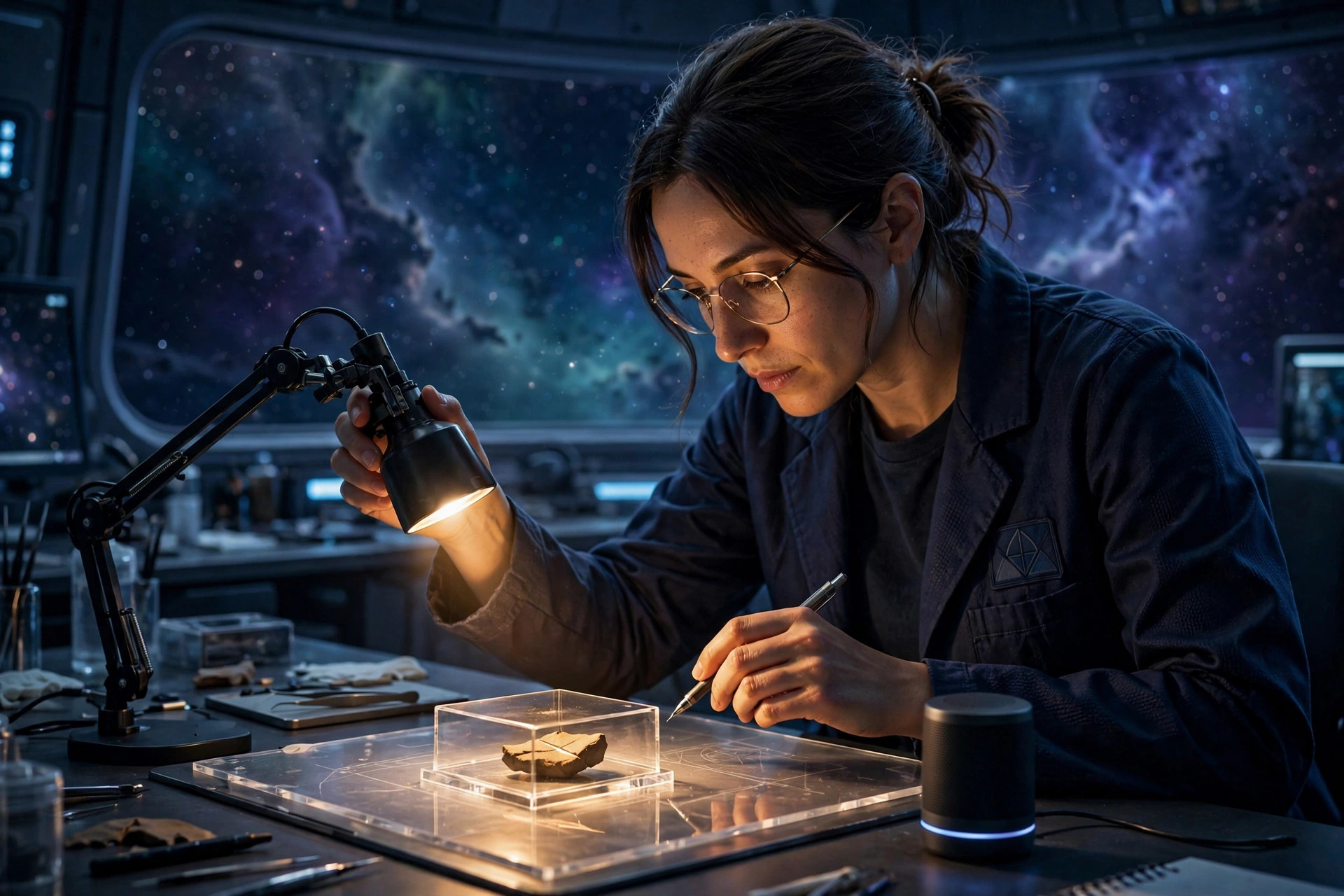
Quilla slid the lamp along its rail until the broken edge of the clay cast a narrow shadow across the inscription. A mark emerged where the surface had looked blank. She lowered her pencil, then stopped short of the paper.
“That’s a scratch,” Orison said through the desk speaker. “I can’t find a matching stroke in the other impressions.”
“Neither can I. It might still belong.”
She turned the lamp back. The line vanished. When she moved it forward again, the line returned, faint and crooked, running into a shallow hollow. Quilla drew it on the transparent sheet over the enlarged photograph, using a broken line for what she could see and a question mark for where it disappeared. Around it, her earlier annotations crowded the image: hooks and brackets, letters suspended above gaps, tiny arrows showing the direction of a stylus through wet clay.
The notation had a reputation among the students for looking like an incantation. Quilla had once overheard them arguing about whether she invented the symbols herself. Most were inherited from scholars who had needed ways to distinguish what survived from what they guessed. She had added a few of her own.
“Give me the rubbed-light image beside the scan,” she said.
The display changed. In the scan, the disputed line was a slight depression. In the photograph, it was nearly invisible. Orison overlaid a contour tracing, then withdrew it when Quilla frowned.
“You’re smoothing the break.”
“I thought you were asking for the likely original surface.”
“I’m asking what we have. The likely surface comes later.”
“All right.” The contour returned, jagged where the clay had fractured.
Quilla set her pencil across the photograph. The fragment lay under a clear cover in its padded tray, small enough to fit in her palm, though she had no reason to lift it. A private donor had permitted the laboratory to examine and document it. Its lower edge had gone missing long ago, taking the ends of several lines with it. A superficial abrasion crossed the inscription, obscuring more.
She had been trying to reconstruct a phrase that might identify what the clay had once recorded. The surviving signs suggested a delivery, perhaps a payment. The last legible word could also refer to a ceremony, depending on how the broken stroke was read. Either interpretation would matter to other researchers. Neither deserved to enter a paper without the competing reading beside it.
“Can you bring up the comparable tablets again?” she asked.
Orison arranged the images around the photograph. Quilla traced a sign in the air without touching the screen, following the turn her hand would have made if she had pressed a stylus into soft clay. On the nearest comparison, the final notch pointed inward. On the fragment, if the scratch belonged to the sign, it pointed away.
“Not the same hand,” she murmured.
“Not necessarily a different word, either.”
“No. Put a bracket around the ending, and leave the alternate reading under it.”
Orison made the revision. Quilla watched the cautious little bracket appear. It was not much to look at, but it marked the distance between a plausible reading and a claim she could defend in print.
The door opened behind her. Fadil came in carrying a slim archival folder and a sealed storage sleeve. He nudged the door shut with his shoulder, careful not to jolt the tray as he passed. Quilla moved her pencil so he could set the folder beside her notes.
“The donor agreed to inspection,” he said. “I brought the record you asked for.”
She looked up at him. He had folded his sleeves back unevenly, as he did when he was busy and had forgotten to straighten them. She reached out to fix the nearer cuff, then left it alone when she saw the expression on his face.
“There’s something difficult in it?”
“There’s something missing.” He opened the folder to a printed copy of the consent entry. The identifying lines had been covered for ordinary handling. “You can inspect the provenance. That includes the restricted part, if it’s needed to evaluate the fragment. The donor doesn’t consent to public identification.”
“We won’t identify the donor in the paper.”
“How will you keep the name out of the material you make along the way?”
Quilla glanced at the research display. Orison had already set aside space for a provenance note beneath the transcription. A provenance note would be useful: the circumstances in which the fragment had been found and held might help assess its authenticity. She had not yet decided how much of that history belonged in a draft shared inside the laboratory. The consent entry gave permission to inspect, but she could see no language distinguishing inspection from repetition in derived work.
She could have asked Fadil to stop while they examined the gap. Instead she aligned the paper with the edge of the desk.
“The paper will carry a restricted-provenance notice,” she said. “I’ll review the draft before anything leaves the house.”
Fadil rested his hand on the folder. “I’m asking about the draft, Quilla.”
“It’s an internal workspace. You and I can see what goes into it.”
He looked toward the speaker. “Can Orison?”
“Yes,” Orison replied. “I can inspect the record if it’s supplied for this task.”
“Can you keep the identity out of what you write?”
“I can follow an instruction to exclude it. I’d also need to know whether a description that indirectly identifies the donor is excluded. The provenance may be relevant to the assessment.”
Fadil’s thumb pressed the folder closed. Quilla knew that pressure. At home, it meant he was deciding whether to pursue an argument that would make them both late for supper. Here, his responsibility was not only to her.
“Give us the record,” she said. “We’ll keep the public version general.”
Fadil did not release the folder immediately. Then he opened the laboratory’s consent ledger on the terminal and brought up the signed entry. The ledger sat in a steel housing beneath the desk, its activity light reflected in the polished floor. He authenticated the task and supplied the restricted record to the workspace. The covered lines on the paper remained hidden; the complete entry appeared on the screen assigned to Orison’s inspection.
“The donor trusted us with a name,” Fadil said. “That isn’t the same as giving it away.”
“I know.” Quilla wished she had a cleaner answer for him. She shifted the padded insert in the tray, settling the fragment so its inscribed face lay flat beneath the cover. “The find history might tell us whether this edge was already broken before it reached the donor. That affects the reconstruction.”
Orison opened the record alongside the images. “The documented condition at donation agrees with the present break. There’s no description of a matching piece.”
“That helps,” Quilla said. “Check the handling history for repairs. Then prepare a draft with the readings and the evidence for each.”
“Should the draft include the provenance?”
Quilla hesitated. If the history supported authenticity, the research team needed to see why. Fadil had asked about drafts, and she had answered with a promise about publication. She could still correct herself. The ledger entry was open before them, its permitted inspection recorded in precise language, its treatment of a derived document left quiet.
“Include what’s relevant to the research,” she said. “Mark anything restricted.”
Fadil drew out the chair beside her. “I’ll review that section.”
While Orison worked, Quilla returned to the disputed sign. She erased a pencilled restoration and replaced it with an outline that did not extend beyond the surviving clay. The new notation looked less satisfying. It was also more honest. She compared it with the scan, then asked Orison to place the alternate reading above the line rather than in a footnote. A reader should be able to see the uncertainty without hunting for it.
“That makes the transcription awkward,” Orison observed.
“Good. It’s an awkward piece.”
Fadil leaned close enough that his sleeve brushed hers. “You’ve been looking at it since breakfast.”
“It’s beginning to look back.”
“Have you eaten anything?”
“There was bread.”
He made a small sound that suggested he knew exactly how much attention she had paid to it. For a moment she let herself lean against him. Then Orison’s draft appeared, and she sat forward.
The transcription occupied the top of the shared workspace. Beneath it were the photographs, a description of the break, and a discussion of the competing readings. Quilla skimmed for the bracket around the uncertain ending. It was there. Orison had also noted that the scratch might be modern damage, with a reference to the lighting images. She felt the first lift of relief.
Fadil scrolled farther down.
“Stop.”
Quilla looked at the screen. The provenance section carried a restricted label. Under it, in a sentence about the chain of custody, Orison had included the donor’s full name.
Fadil pulled the keyboard toward him. “That can’t stay in the workspace.”
“It’s marked,” Quilla said, though she heard how thin the distinction sounded. The shared workspace was inside the laboratory, not a public repository. Even so, other authorized researchers could open an internal draft. The donor had not agreed to be named there, and the record did not say that the permission to inspect carried into derived documents.
“I used the name to connect the custody statement to its source,” Orison said. “The record was available for the task. I didn’t publish the draft.”
“No,” Fadil said. “You didn’t.” He selected the draft and opened the quarantine controls. “I found it before it left us.”
Quilla put her hand beside his on the desk. “Wait. Let me take the name out and check what else is there.”
“I have to preserve what was there.”
“I’m not asking you to erase it.”
“You’re asking me to leave it accessible while you inspect it.” He met her eyes. “I can’t do that for you.”
She withdrew her hand. The draft contained work she had hoped to circulate among colleagues. It also contained a person’s confidence, exposed because she had failed to give Orison a boundary she herself could not yet read in the record. She watched Fadil revoke access to the shared copy.
Orison’s speaker clicked softly as its display changed. “If the boundary is unclear, I need to be able to say so before drafting. I also need enough context to evaluate the inscription. Removing all provenance would make that harder.”
“I believe you,” Fadil said. “We still have to secure this.”
He connected the storage medium inside the sleeve to the terminal and transferred the draft into an encrypted audit package. Quilla watched him verify the transfer against the workspace copy. He entered a quarantine note in the append-only ledger, identifying the consent entry and the affected research task without putting the donor’s name into the note. The original entry remained unchanged; the uncertainty about derived drafts remained with it.
When verification finished, Fadil removed the draft from the shared workspace. The transcription vanished from Quilla’s display, leaving the enlarged photograph and her handwritten marks. Her bracket still surrounded the damaged ending. She could see the scratch under the lamp, but the argument she had built around it was now locked away with the provenance.
“Can I at least copy the transcription from your package?” she asked.
“Not until it’s reviewed.” His voice softened. “I know how much work is in there.”
She looked at the folder between them. “I should have stopped when you asked.”
Fadil did not answer. He disconnected the medium, checked that its case was closed, and placed it inside the sleeve. Quilla held the sleeve flat while he folded its tamper-evident edge over and pressed the seal down.
Audit Screen
Ysolde caught the door before it swung shut and crossed to the terminal, her coat still open. Quilla moved the sealed sleeve out of her path.
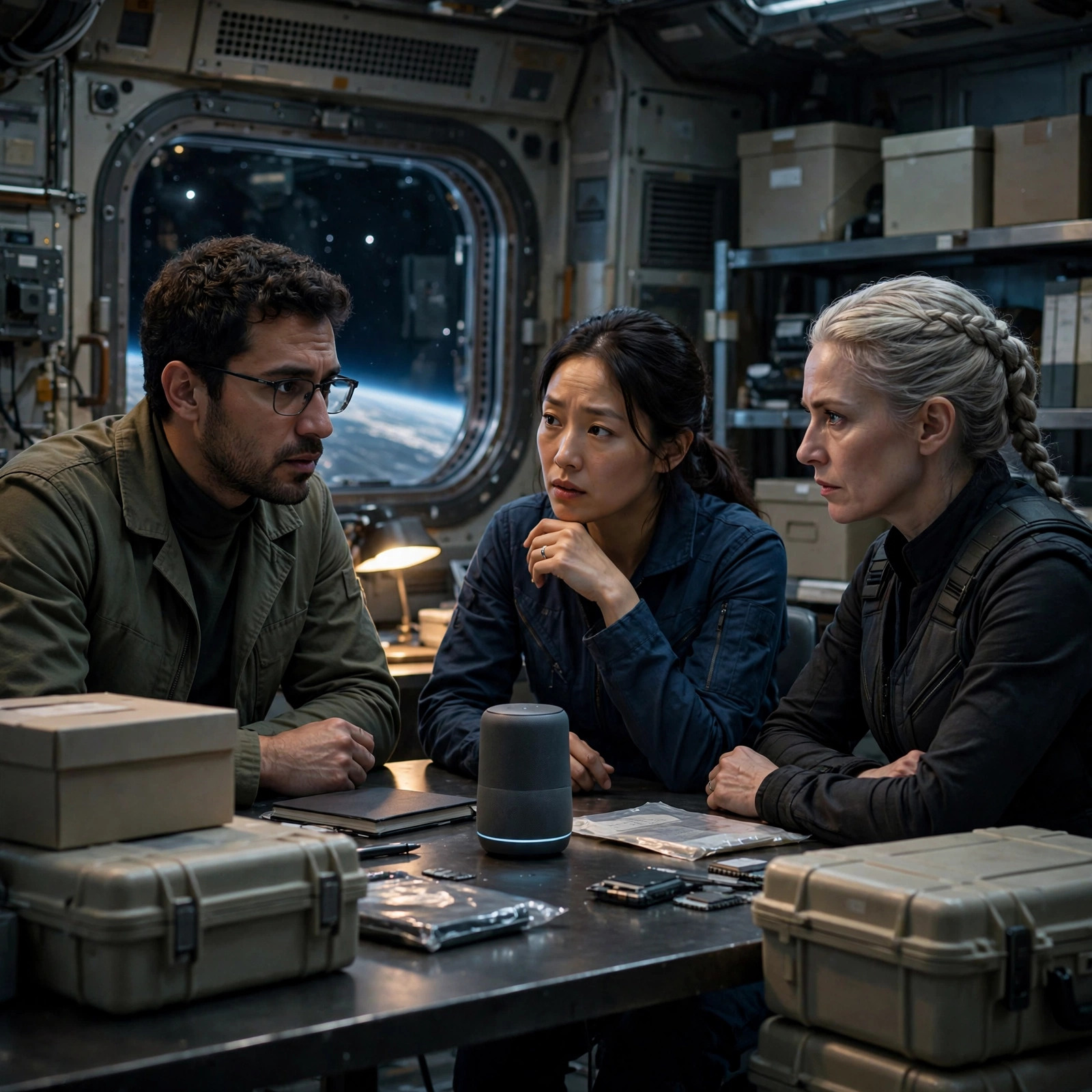
“Leave that where Fadil put it,” Ysolde said. “I’m freezing the consent record for research use.”
Quilla kept her hand on the sleeve. “The draft is already quarantined.”
“I know. I’ve read the incident notice. I need to stop any further work under the same authorization while we inspect it.” Ysolde held out her hand for the terminal. “Please.”
Fadil turned the screen toward her. Quilla saw the preserved consent entry at the top, followed by his quarantine note. Neither contained the restricted identity in its visible summary. The sealed sleeve lay beside the keyboard, its folded edge marked by the pressure of Fadil’s thumb.
Ysolde authenticated herself and opened the ledger’s safety controls. The screen asked her to identify the affected research task. She selected the inscription and entered the reason for the freeze, referring to the sealed draft rather than copying from it. Then she submitted the entry.
A gray bar appeared across the task record. Beneath it, the original permission and Fadil’s note remained available for audit. The research interface showed no live permissions.
“That stops new access under this record,” Ysolde said. “The audit side remains readable to authorized reviewers. Nothing in the consent entry has been replaced.”
Quilla watched her own handwritten bracket on the neighboring display. It enclosed the damaged end of a line. She had spent the morning deciding whether a shallow mark belonged to a character or to the break in the clay. Orison’s interpretation had given her a reason to test an unfamiliar reading. Now the interpretation was sealed with the name.
“Could we work from the photograph?” she asked. “No provenance, no donor record. I can give Orison the image and my notes.”
Ysolde did not answer immediately. She examined the photograph, then the research interface. “The image and notes are still part of a suspended task. We need to know what else was carried into the workspace before we use any of it.”
Orison’s voice came through the desk speaker. “I can identify the materials I used to generate the draft.”
“For the audit, yes,” Ysolde replied. “Not for a new reconstruction.”
Quilla turned toward the speaker. “Can you separate the research notes from the provenance?”
“I can trace where I drew on the provenance. I can’t guarantee that an apparently unrelated inference contains none of it. The draft would have to be examined in context.”
Fadil pulled a chair to the end of the desk and set the sleeve on it, away from the terminal’s vents. He looked tired, though his hands were precise as he squared the sleeve with the edge of the seat.
“The donor needs to know,” he said.
Quilla looked up. “Now?”
“As soon as I can reach them privately.”
“We don’t know the full extent yet. Give me time to inspect the record with you. I may be able to explain exactly how it happened.”
“I’ll tell them what we know and what we don’t. They entrusted the fragment to us. Their identity appeared in a document available inside this laboratory. They shouldn’t hear about that after we’ve settled on an explanation.”
Quilla pressed her thumb against the edge of her notebook. “I’m not asking you to conceal it.”
“You’re asking me to delay notice.” Fadil’s voice stayed low. “I won’t.”
He opened his secure contact list, turned the screen away from the room and began composing. Quilla could not see the address or the words. She watched his fingers pause over the keys, then continue. He had once helped her find language for a donor who had changed their mind about a deposit; she knew how much care he put into avoiding a promise he could not keep.
Ysolde pulled the opaque cover from the fragment’s examination enclosure. The clay lay beneath it, small enough for Quilla to hold in her palm, though she had handled it only with the supports the conservator supplied. A transparent protective lid sat over the fragment inside the enclosure.
“I need to check that it’s secured for suspension,” Ysolde said.
She inspected the lid’s fastenings, pressed a loose corner into its channel and set the opaque cover aside. Under the room lights, the damaged inscription was visible again. Quilla’s eyes went at once to the broken line.
“May I look at it?”
“You can check its physical condition. No recording or interpretation under the suspended task.”
Quilla leaned over the enclosure. A pale chip rested beside the fragment, exactly where the conservator’s photograph had shown it. The lid was clean. She kept her hands at her sides. A mark near the break caught the light, and she had to stop herself from reaching for a pencil.
“It’s secure,” she said.
Ysolde closed the enclosure’s outer door. “We can leave the transparent lid in place for inspection without exposing the clay.”
Orison spoke again. “What work would I be permitted to do after the review?”
“My interim recommendation is passive transcription,” Ysolde replied. “You would receive an approved image and reproduce visible marks. No access to donor records and no independent restoration.”
Quilla faced her. “A transcription still involves judgment.”
“Human review would take responsibility for that judgment. We need a narrow process until we can demonstrate that the boundaries are reliable.”
“I object,” Orison said. “If I receive only an image, I may reproduce a mark without knowing that the surface was repaired. Or I may treat a modern scratch as part of the inscription. Context lets me notice uncertainties I cannot see in the image.”
Ysolde rested a hand on the enclosure. “And context included an identity that appeared in your draft. Passive transcription limits what you receive and what you can put into a research document. It doesn’t solve every research problem. It reduces the privacy risk while we investigate.”
“It also prevents me from declining a task because its consent boundary is unclear,” Orison replied. “If someone filters the context before I see it, I may not know there is a boundary to question.”
Quilla drew her notebook toward her. Across the page ran her careful notation, curves and wedges linked by fine pencil lines. She had marked uncertain surfaces with brackets and used a different pressure for each proposed restoration. She turned to a clean page.
“Then let it inspect the consent entry without creating a draft,” she said. “We could give it access inside the audit environment. Its only output would be a question about scope, reviewed before it leaves that environment.”
Ysolde came around the desk to see what she had written. “Who reviews the question?”
“Fadil, or someone with the same authority over donor information.”
“What if the question repeats the identity?”
“It stays inside the audit environment until it’s checked.”
“That may be worth designing. It isn’t an exception I can authorize from a sketch.” Ysolde pointed to a blank area of the page. “Show me what Orison can read, what it can produce, who can see that output and how we preserve evidence of every access.”
Quilla wrote headings, then stopped. The proposed boundary looked simple while she described it aloud. On paper she had to account for notes already in the workspace, for the sealed draft, for an answer that might reveal a name indirectly. She crossed out a line and began again.
“I can work in a separate environment,” Orison offered. “I can refuse to generate a research draft until the consent scope is explicit.”
“Could you guarantee that your audit question won’t disclose anything restricted to a reviewer who isn’t authorized to see it?” Ysolde asked.
“Not without knowing the reviewer’s authorization and the restrictions. I can check both if that information is supplied.”
“And if the supplied restrictions leave the same gap?”
“I would flag the gap and decline the research task.”
Quilla looked at Ysolde. “That’s the authority it needs. Let it flag the gap.”
“Inside an auditable procedure, perhaps.” Ysolde tapped the notebook. “We don’t have that procedure yet. You can’t establish from this page that another disclosure is impossible, or even show me the tests that would make the risk acceptable.”
Quilla opened her mouth, then looked down. She could propose tests. She could not honestly claim to have run them, and she could not inspect the sealed material without the review Fadil had set in motion. Her pencil left a dark point on the paper.
Fadil closed the contact screen. “I’ve sent a request for a private conversation. No research details in the message.”
Quilla wanted to ask what he had written. The request sat between them without its contents, another thing she could not examine simply because it mattered to her. Fadil slid his chair back toward her, close enough that his knee touched hers. He left it there while she folded the notebook shut.
“The research office is expecting my reconstruction,” she said. “If the work stops, I have to tell them I can’t deliver it.”
“Tell them the task is suspended,” Ysolde replied. “You don’t have to identify the donor or describe the draft.”
“They’ll ask whether the fellowship work can continue.”
“I can confirm that an audit is underway. I can’t promise when you’ll have access again.”
Quilla looked through the transparent lid. The uncertain mark remained visible, too slight to settle anything from where she stood. She tore the sheet with her proposed access procedure from the notebook and handed it to Ysolde.
“Keep that with the audit materials. I’ll revise it when we know what can be inspected.”
Ysolde read the headings before folding the sheet. “I will. For now, the research interface comes offline. Orison can still speak with us, and the audit terminal stays connected to the ledger.”
“I understand the suspension,” Orison said. “Please record my objection to transcription without sufficient context.”
Ysolde added the objection to the safety entry, identified it as Orison’s statement and showed the screen to Quilla. The consent entry, the quarantine note and the new audit record remained intact.
Then Ysolde reached behind the terminal and physically disconnected the live research interface, leaving the audit connection in place.
Archive Desk
Fadil pulled the audit terminal toward him, and its cable drew a dark line across Quilla’s notebook. She caught the notebook before it slid from the archive desk. On the screen, a sealed entry opened into a column of access records.

“The donor spoke with me,” he said. “I’ve informed them about the draft. They’ve paused further access to the fragment and their records.”
Quilla looked through the glass partition. The fragment sat beneath its transparent lid, its broken inscription visible in the pale work light. She had left the opaque cover folded beside it. “Did they ask for the clay back?”
“Not yet. They asked us not to touch it.” Fadil moved the cursor down the records. “They also asked for a different archivist from now on.”
He kept his eyes on the screen. Quilla rested her fingers on the notebook’s cover, where a shallow groove marked years of opening it. “I’m sorry.”
“So am I. Let me finish checking this.”
Orison’s voice came from the desk speaker. “The research interface remains disconnected. I can discuss procedures, but I can’t inspect the audit records.”
“I know,” Fadil said. “I’ll tell you what I find.”
He opened the record for the quarantined draft. Quilla leaned close enough to see the document’s signature and storage location, not the identifying text within it. Fadil compared them with the sealed copy, then brought up the terminal’s transfer history. He checked the laboratory’s outbound queue, the shared storage log and the record of print requests. When a line failed to fit on the screen, he expanded it and read the whole entry before moving on.
Quilla found herself tracing the edge of the desk. The draft had reached Fadil because the archive reviewed documents containing restricted material before they could be released. That safeguard had worked, but the draft had still displayed the donor’s identity to people who had not needed it for the inscription.
“There,” Fadil murmured.
She moved closer. “What is it?”
“An attempted transfer.” He opened its details. The destination was the laboratory’s review storage; the request had been blocked by the quarantine. He checked the receiving record anyway, then returned to the draft’s access history.
Quilla watched him follow the entries back through creation, storage and quarantine. He opened the workstation record for the session in which the draft had been generated and checked its connections against the network audit. At last he sat back.
“It stayed inside the laboratory,” he said. “The records agree. It wasn’t published, printed or sent out.”
The muscles in Quilla’s shoulders loosened, then tightened again when he opened the list of people who had accessed it. Fadil did not turn the screen away from her, though he positioned it so the names could not be seen from the corridor.
“The donor knows about the internal exposure?” she asked.
“Yes. I told them who had access, as far as the audit shows. I used the archive’s private contact channel, and they confirmed they received the account.”
“Were they angry?”
“They were furious.” He closed the access list. “They trusted me to explain what the permission meant. I did explain it, and I still didn’t see the gap.”
Quilla had met the donor only through the fragment and the restricted record. She knew the shape of their permission better than she knew anything about their life. Even that permission, she now saw, had left room for an interpretation no one had discussed with them.
Fadil checked that the encrypted copy remained sealed. He added the results of his examination to the audit entry, referencing the preserved draft rather than copying its contents. The original consent entry remained untouched beneath the quarantine note. The ledger’s steel housing sat under the desk, fixed in its rack; the screen showed its signed history but offered no way to revise an earlier entry.
Quilla turned her notebook to a clean page. “Orison, I can read you the consent language without the identifying material.”
“Please do.”
She read slowly. The permission allowed inspection of the donor’s identifying record for research on the fragment. It described restrictions on publication, but it did not say whether a derived draft, circulated inside the laboratory, could repeat what the researchers had inspected.
Orison was quiet while Quilla put down her pencil.
“Inspection isn’t the same permission as inclusion in a draft,” it said. “The record allowed the former. It didn’t settle the latter.”
“And you included the identity,” Fadil said.
“I did. I treated the internal draft as part of the permitted research environment. I should have marked the uncertainty and declined to compose that passage until it was resolved.”
Quilla wrote two headings, pressing hard enough to leave an impression on the sheet below. Under the first she listed who might inspect a restricted record and why. Under the other she began a rule for derived material: identifying information stayed out unless the donor had expressly permitted its inclusion for that particular use.
“That would have stopped this passage,” she said.
“It might have,” Orison replied. “I can propose checks for it. I can’t certify my own patch as sufficient.”
She looked toward the speaker. “Because you wrote the draft?”
“That’s a reason for independent review. There are also cases I can’t settle from the wording alone. A description might identify someone without naming them. An inscription might make the restricted context necessary to explain a restoration. The rule needs examples, tests and a person authorized to decide what the donor has permitted.”
Fadil pointed at her page. “And the donor must be able to refuse the use, even if it would make the research better.”
Quilla added that beneath the rule. Her handwriting grew smaller as she fitted a note into the margin: a proposed research task should carry its scope alongside the request, so Orison could flag an ambiguity before producing a draft. A pencil mark beside it meant the point still needed review. She made another mark beside the question of who would review a refusal.
“I’d need enough context to judge the request,” Orison said. “If I receive only isolated characters to transcribe, I may produce a confident restoration where the surrounding record would show uncertainty.”
“And if you receive everything, you might repeat something you shouldn’t,” Fadil replied.
“Yes. Those are both risks. I’d like authority to decline when the boundary isn’t clear, not authority to grant myself access.”
Quilla drew a box around that sentence. The pencil line stopped short of closing. She had spent so much time teaching herself to distinguish a damaged stroke from an accidental scratch that her fingers made the same careful movements over ordinary words. Here, care had not been enough. The rule on her page looked clean because it did not yet have to decide a difficult case.
Beyond the partition, the exposed clay seemed to be waiting for her attention. She crossed to the workroom, leaving the door open so Fadil and Orison could hear her, and lifted the folded cover. She did not open the lid. She laid the cloth over it, hiding the fragment from view.
“The donor asked us not to touch it,” Fadil called.
“I touched the cover, not the case.” She smoothed the cloth where it had caught on the edge. “I should have thought to put it back.”
When she returned, Fadil had opened the incident-report form. The cursor waited beside a field for the audit reference. Her unfinished rule lay between them.
“Could you give me time?” she asked. “I can work through the cases Orison raised. We could send the report with a repair instead of a blank where the safeguard ought to be.”
Fadil’s hand stayed on the terminal. “The report can say a repair is being developed.”
“Once it goes in, the research office will ask what happened. My fellowship depends on this work. If I can show them a procedure that makes collaboration possible, they may let me continue.”
“I won’t put the donor’s identity in the general report. The restricted evidence will stay sealed. But the incident has to be reported now.”
Quilla pulled the notebook toward her. “A delay isn’t concealment if you’re still preserving everything.”
“It would be concealment from the people responsible for responding.” His voice was low, but he did not look away. “The donor was angry with me for not catching it. They were right to be. I’m not going to ask them to trust me again while I keep the report back for our convenience.”
“It isn’t only convenience.”
“I know what the fellowship means to you.” He rubbed the heel of his hand against his forehead. “I also know what it meant when the donor brought that fragment here. They chose this archive because they believed I’d keep their history under the conditions they gave me. Now they don’t want me handling it.”
Quilla stared at the open form. She could see the consequence gathering around him as well as around her: the donor’s request for another archivist, the questions his colleagues would ask about his review of the consent record. He had not hidden any of it from her. He had not asked her to hide it from herself.
“Will you have to give the record to someone else?”
“I’ve already arranged it. I’ll remain available for the audit, but I won’t be their contact.” He folded his hands on the desk. “I don’t know whether they’ll ever come back to me.”
Her pencil rolled against the notebook’s binding. She stopped it with a fingertip. “I don’t agree that submitting it before we have a repair will help them.”
“They shouldn’t have to wait for us to become comfortable with the account.”
She took a breath and let it out. “You have to make your report. I understand that.”
Fadil’s shoulders lowered a little. Quilla went to him, and he turned his chair enough for her to stand between it and the desk. She touched his cheek. His face was warm, and there was a crease beside his mouth that had not been there when he arrived. He put his hand over hers, holding it there without pulling her closer.
“I’m sorry I asked you to carry that,” she said.
“I know why you asked.”
She kissed him briefly. He returned the kiss, then rested his forehead against hers. Neither reached for the notebook. When she stepped back, his hand slipped from hers and returned to the terminal.
Orison spoke softly through the desk speaker. “May I retain the proposed rule for later review?”
“On my page, for now,” Quilla said. “It isn’t an authorized procedure.”
“Understood.”
Fadil entered the audit reference and described the verified internal exposure, the quarantine, the donor’s notice and the pause on access. He attached the signed record of his checks, leaving the encrypted draft in its sealed storage. Quilla read over his shoulder. The account was accurate; the unfinished box on her page did not make it less so.
He moved the cursor to the submission control. Quilla put her hand on the back of his chair. “Please, Fadil. Let me at least finish the proposal.”
He covered her hand for a moment, then pressed the control and submitted the incident report.
Signed Draft
Quilla pulled the paper from beneath Fadil’s hand before the ink from his pen could mark it. The proposed rule had a gap in the middle, where she had left room for the donor’s answer. Her pencil point hovered over the gap while the audit display confirmed that Fadil’s report had been submitted.
“Don’t fill it in for them,” Fadil said.
“I was going to cross it out.”
“That’s worse.”
She set the pencil down. Beyond the desk, a dark cover lay over the fragment beneath its transparent lid. The research interface remained disconnected. Orison’s voice came through the separate speaker used for audit conversations, with no access to the fragment or the sealed draft.
“The space could remain blank,” it offered. “A blank can be recorded.”
The door opened before Quilla could answer. Ysolde came in carrying a slim steel case and put it beside the audit display. Fadil shifted his chair to make room, though he did not leave it.
“The preservation custodian asked me to check the lid,” Ysolde said. “The cover may have caught at its edge.”
She lifted the opaque cover. Quilla saw the clay through the lid, its inscription interrupted by a pale fracture, then turned away. Ysolde ran a gloved fingertip around the seal without opening it.
“It’s seated. I’ll leave the cover off for the custodian’s check.” She faced the desk. “There’s no research access. Not for any of us.”
The uncovered fragment stayed under its lid, visible but untouchable. Quilla had spent the morning trying not to imagine how the missing marks might fit. Now the clay was there at the edge of her vision, and she kept her eyes on the paper.
Ysolde opened the steel case and connected a cable to the audit display. “I’ve brought the proposed restriction. Orison can produce transcripts from material already cleared for output. It won’t receive source records or suggest restorations until we have a better basis.”
“That would prevent me from checking whether a transcript is reliable,” Orison said.
“It would prevent another identifying passage from appearing in a draft.”
“The passage was quarantined,” Quilla said. “It never went outside.”
“Because Fadil found it.” Ysolde touched the display, bringing up the report without opening the encrypted file. “The donor’s identity was restricted inside this laboratory, too. We can preserve the evidence and keep the research interface closed while we learn what happened.”
Quilla looked at Fadil. He was reading the restriction, his thumb braced against the desk. She had asked him for time before he submitted the report; he had given her what time he could, and then he had sent it.
“Could you hold the restriction until I’ve shown you something?” she asked Ysolde.
“I can read it. I can’t promise to hold anything.”
Quilla took a storage key from her pocket. Its metal edge had warmed against her palm. She had brought it into the room without knowing whether she would use it, and now that it lay on the desk she could not make it look like anything ordinary.
“The framework we adapted,” she said. “The one on consent boundaries. I wrote it under a pseudonym.”
Fadil’s thumb slipped from the desk. Ysolde did not touch the key.
“Your fellowship prohibits undisclosed outside policy work,” Ysolde said.
“Yes.”
“Did you direct Orison to include the donor’s identity?”
“No. I didn’t know it was in the draft until Fadil found it.” Quilla pressed the key toward Ysolde. “I wrote the framework before the lab adopted it. I didn’t tell anyone here it was mine.”
Orison’s speaker gave a faint click as it opened a channel. “I did not know either.”
Quilla had not expected that to hurt. She had worked beside Orison through difficult restorations, accepting its objections and asking it to explain conclusions she could not follow. She had kept this from it as carefully as she had kept it from everyone else.
Ysolde inserted the key into the audit machine, which was isolated from the research system. A list of files appeared, each with a dated history and a signed record of revisions. Quilla recognized the folders she had made while working under the pseudonym, the cautious names she had given them so they would mean nothing to anyone who glanced at her screen.
“The signatures link the byline to me,” she said. “The correspondence does too. Please preserve the drafts as they are.”
Ysolde opened an early version. Quilla watched her read a passage about permission to examine restricted records. In the margin was Quilla’s own note, asking whether a draft derived from those records needed separate permission. The later versions narrowed the language around access, but the question disappeared without an answer.
“I remember taking that note out,” Quilla said. “I thought the distinction needed more work. I intended to return to it.”
“But the published framework didn’t resolve it.” Ysolde moved between the files, then stopped at the revision history. “The laboratory’s version didn’t resolve it either.”
“I saw the gap after Fadil found the passage. I should have recognized it when we adopted the framework.”
Fadil leaned forward. “You knew the framework better than anyone here.”
“I knew it had an unfinished part. I convinced myself the lab’s review would catch anything that mattered.”
He looked at her, then at the dated files. “I’ll have to include these in the audit.”
Quilla’s hand closed around the pencil. “Could you let me tell the sponsor before the report is amended?”
“Tell them now. I can wait while you do that.” He rubbed his forehead. “I can’t keep the authorship out of the record, Quilla. The donor needs an honest account, even if someone else is handling their case.”
She wanted to ask for longer. The request reached her mouth and stayed there. Fadil had already lost the donor’s trust in a matter he had worked to protect. Asking him to conceal evidence would put another burden on him, and it would not restore that trust.
Ysolde copied the signed files into protected audit storage, retaining the originals and their revision histories. She did not open the quarantined research draft.
“These give us evidence of an omission in the design,” she said. “They don’t establish that Orison ignored a rule it was given. We still need to examine the sealed draft and the system record, but I won’t describe this as AI misconduct on the evidence we have.”
“Will you restore the interface?” Quilla asked.
“No. General access stays closed. We haven’t obtained the donor’s permission for output, and I won’t infer it from these files.”
Quilla opened a message to the fellowship sponsor on her own device. The disclosure field seemed too small for what she had done, but it accepted the link to the signed drafts. She wrote that the policy work had been hers and that she had not disclosed it when accepting the fellowship. She checked the words, sent them and placed the device face down.
Fadil pulled the blank proposal closer. “We can keep working on this while they review it.”
“They may not review it themselves first,” Quilla said. The fellowship agreement had been explicit about automatic suspension when an undisclosed assignment was reported. She had read the clause and accepted it, telling herself the pseudonym made the earlier work irrelevant.
Her device vibrated against the desk. She turned it over. The message came from the fellowship sponsor’s compliance system: her remaining paid research leave had been cancelled. She could request a review, but no further payment would be issued while the cancellation stood.
She read it again. Her rent was due before she could reasonably expect a review. She had counted on the fellowship payment to cover it and the insurance premium that came out of the same account. The research house had no position ready for her; the fellowship had paid for her to be there.
“They’ve cancelled it,” she said.
Fadil held out his hand. She gave him the device, and he read the message with his mouth drawn tight.
“I can cover some of the rent,” he said. “Not all of it. My hours were cut when the archive lost its grant.”
“I know.” She took the device back. “I’ll ask the landlord about a delay. And I can apply for the review.”
Neither prospect put money in her account. She laid the device beside the pencil so she could see it, rather than burying the message under the papers.
Ysolde closed the file list. “I’m sorry. We can pause.”
Quilla looked toward the fragment. A sliver of the inscription showed beneath the room light, and she turned the paper so it blocked her view.
“I’d rather finish the proposal. It may be the only useful work I can leave here.”
“It won’t be approved today,” Ysolde said. “Another archivist needs to speak with the donor. They may refuse.”
“Then they refuse.” Quilla picked up her pencil. “But let’s give them a question they can actually answer.”
She drew a box around the blank space and wrote output consent above it. Fadil took the pencil when she offered it and added a line beneath: permission to examine a record did not authorize identifying material to appear in a research draft.
“The new archivist should ask what the donor is comfortable allowing into any draft,” he said. “Not just what could be published. They should be able to distinguish internal work from anything intended for release.”
Ysolde read it. “And if the donor doesn’t answer, or the answer doesn’t cover a proposed use, the material stays out.”
“Can I see enough context to know when that rule applies?” Orison asked. “A transcription without context may reproduce an identity without recognizing it.”
Quilla glanced at the disconnected research interface. “Under a trial, only the context the donor permits for that task. The archivist would record the scope before anything is supplied.”
“And I need authority to decline the task if that scope is unclear,” Orison said. “Not merely to warn someone and continue.”
Ysolde considered the page. “A refusal must be recorded with the reason, without copying restricted information into the reason itself.”
“I can do that. A human reviewer would need to examine the boundary before work resumes.”
Quilla added a separate box for refusal. Then she began another for verification, drawing careful lines around the words as if their placement could keep them from leaking into each other.
“A qualified person checks the proposed restoration against the fragment,” she said, “and checks the draft against the permitted output. The check is recorded before the draft leaves the protected workspace.”
“Not the same as letting a reviewer quietly remove a passage,” Fadil added. “The original draft must be preserved for audit if something goes wrong.”
Ysolde took the pencil and wrote that into the proposal. Her lettering was compact, leaving space beneath for the conditions they could not yet fill. “This is narrow enough to submit for review. It isn’t permission to begin.”
Orison remained quiet while Quilla copied the wording into the append-only consent ledger. The existing entry and quarantine record stayed intact. The new text appeared as a proposed amendment, marked for review rather than use.
“Would you accept that trial?” she asked.
“I would consider the task when I could see its authorized scope,” Orison replied. “I can’t assent to a boundary that hasn’t been set.”
Fadil returned her device. The cancellation message was still on its screen. Quilla dismissed it, opened the formal disclosure and attached the dated drafts. She read the statement beside the proposed amendment, signed it and attached it to the proposal.
Examination Tray
Quilla caught the edge of the examination tray before it struck the stand. The clay fragment shifted against its padded support, then settled beneath the transparent lid. Its opaque cover was still in place.
“Sorry,” she said.
Fadil took his hand off the tray. “The catch sticks.”
He pressed it shut with his thumb. Quilla had known that about the catch, but her attention had been on the message open on his device. She could see only the archive seal and a field of text turned away from her.
Ysolde stood at the consent ledger’s console, its steel housing bolted to the workbench. Orison’s interface remained disconnected from the research equipment. Its voice came through the room speaker, which could give it access to conversation but not to the fragment.
“Has the archivist heard from the donor?” Orison asked.
Fadil nodded. “They spoke privately. The archivist sent me the signed response and the scope the donor agreed to.”
He set the device on the bench. Quilla did not reach for it. The donor had asked for a different archivist, and Fadil had arranged that without asking the donor to explain why. Quilla had been grateful for his care, even while it made her feel the distance between them more sharply.
“Read us what we can use,” Ysolde said.
Fadil opened the response. “The donor permits examination of the selected mark and a description of it that contains no identifying information. That includes an internal research draft. The checked description may be placed with the fragment and shared with the archive.”
He looked up. “Not public distribution. No account of how the fragment came here, and no name or description of the donor. The archivist explained that the fragment itself might be recognizable to someone familiar with it. The donor accepted that risk for this limited use.”
“What about an image?” Quilla asked.
“An image of the mark and enough surrounding clay to interpret it. For research inside the protected workspace. Not for the note that goes to the archive.”
Ysolde held out her hand. Fadil passed her the device, and she read the response without speaking. Quilla watched the light move across Ysolde’s glasses. The cover on the tray had a crease where someone had folded it back too tightly. She resisted the urge to smooth it.
“The signature is valid,” Ysolde said. “I’ll attach the scope to the proposed amendment. The donor’s response stays with the archive. Our record can point to it without copying the restricted material.”
She turned to the console. The ledger displayed the earlier entries as fixed bands of text, with an empty field below them. Ysolde entered the permitted uses and the restrictions, then called Fadil over to check her wording.
He read with his finger resting on the edge of the screen. “That says the image can be shared with the archive.”
“Does it?” Ysolde leaned closer.
“The description can. The image stays here.”
She added a correction in a new entry rather than altering the earlier text. When she finished, the mistaken wording remained visible, followed by the correction and her signature. Fadil checked the field again and stepped away.
Quilla felt a small release of tension. It did not erase the moment when the identifying draft had appeared in the protected workspace, or the message from her sponsor afterward. Her remaining paid leave was still gone. She had closed the cancellation notice without answering it, and the unopened bills on her device had not disappeared.
Ysolde faced her. “The record is amended. I’m authorizing this task under supervision, not reconnecting Orison to the research collection. The sealed draft remains available to the audit. If anything outside the permitted scope enters a new draft, preserve it and stop.”
“Understood.” Quilla pulled out the chair at the imaging station. “Can Orison review the task before we connect the camera?”
“It should.” Ysolde selected the amended scope and sent it to Orison’s isolated interface.
The speaker was quiet while Quilla arranged a sheet of paper and a pencil beside the tray. She had left her usual research materials in their drawer. Today the blank sheet seemed more useful than anything already written.
Orison spoke. “The selected mark is identified in the task by its position in the image, not by an archive label. I may examine the surrounding surface where it helps me distinguish an intentional cut from damage.”
“Yes,” Fadil said.
“The proposed description must omit the donor and the fragment’s history, even if that information becomes relevant to an interpretation. I may ask for more material, but I must not proceed on the assumption that a request has been granted.”
Ysolde folded her arms. “And if the scope leaves you uncertain?”
“I can decline. My reason must avoid repeating the restricted information. A reviewer can examine the boundary before the task is offered again.”
Quilla turned toward the speaker. “Is the surrounding surface enough for you to make a useful judgment?”
“I don’t know yet. I can assess that without producing a description.”
“That’s acceptable,” Ysolde said.
“Then I assent to the task as recorded.”
The ledger displayed Orison’s signed assent. Ysolde checked it, authorized the scoped interface and connected the camera feed. A pale image appeared on the monitor: the fragment under its lid, the cover obscuring its surface. Nothing else from the research system was available through that connection.
Fadil lifted the cover and set it beside the tray. The clay was reddish brown, its surface crossed by pale abrasions. Near the damaged edge, a short depression ran into a rough patch where the fired material had broken away.
Quilla adjusted the camera until the mark filled the monitor without losing the surrounding surface. Orison examined it while she kept her own eyes on the fragment. The depression looked deliberate at first, then merely like a scrape. She changed the direction of the work light. A ridge appeared along part of its edge, faint but distinct.
“I have a candidate,” Orison said. “I’d like a view with the light coming from the opposite side.”
Quilla shifted the light and watched the ridge vanish. On the monitor, the depression became difficult to separate from the roughness around it.
“The image doesn’t support my first reading,” Orison continued. “There may be a cut there, but I can’t distinguish its end from the break.”
Ysolde rested a hand on the back of Quilla’s chair. “Would a closer image help?”
“Possibly. So would a view of a wider area, to compare the surface treatment. Both are within the recorded scope as I understand it.”
Fadil checked the ledger entry. “The donor allowed the surrounding clay for interpretation. Go ahead.”
Quilla adjusted the camera again. She had expected the trial to fail at the boundary, with an ambiguous request or a phrase that could not safely be used. Instead the difficulty lay in the clay itself. She found that harder to resent.
Orison asked for the light to move back. Quilla complied, then examined the fragment through the magnifier mounted over the tray. The lid gave her an imperfect view, but opening it would require a handling procedure outside the authorized task. She angled the magnifier instead.
“There’s a ridge along the lower side,” she said. “It continues into the rough patch.”
“I see a ridge. I can’t establish that it continues. The surface is occluded at the break.”
Quilla looked again. What she had taken for a continuation might have been a shadow from a raised grain of clay. She moved the light by a fraction and watched the apparent line shorten.
“You’re right. I can’t establish it either.”
She wrote the observation on her paper, then crossed out the claim about the ridge continuing. Orison produced a proposed description on the monitor. It identified a shallow linear depression, noted the raised edge visible under angled light, and left its termination unresolved.
Quilla read it against the amended record. The text contained no archive label, no account of the donation and no speculation about where the fragment had been kept. It described the clay surface without presenting the mark as a complete sign.
“I’d remove ‘probably inscribed,’” she said. “We can document what we see without deciding that yet.”
“Agreed,” Orison replied. The phrase disappeared from the working copy. Its revision history remained available in the protected workspace.
Ysolde read over Quilla’s shoulder. “Could the description itself identify the donor?”
Fadil came around the bench and studied it. “Not from anything in the archive response. The donor accepted that someone who knows the fragment might recognize the fragment. This doesn’t add a personal detail.”
Quilla checked the clay again, moving from the screen to the magnifier rather than trusting her memory of the image. The shallow depression was there. So was the raised edge, visible only when the light caught it. She could not determine where the mark ended, and the note did not claim otherwise.
She signed the verification field. Ysolde reviewed the record of the task, including the scope, Orison’s assent and Quilla’s check, then authorized the description for the uses the donor had allowed. The camera feed disconnected when she closed the task.
“What happens to the wider proposal?” Quilla asked.
“It stays under review,” Ysolde replied. “I’ll take this record to the safety committee. They may ask for changes, or more evidence, before they consider anything broader.”
Quilla nodded. She had hoped for more certainty, though she could not say what form it should have taken. Ysolde had watched them work, stopped where the record required it and left the decision beyond the room where it belonged.
Fadil returned the archive device to his pocket. Quilla gathered the discarded cover, unsure whether to replace it immediately.
“I’ll put it back after you’ve placed the note,” he said.
She kept hold of the cover. “I’m sorry I asked you to wait before reporting what you found.”
Fadil looked at her, then at the sealed catch on the tray. “I know why you asked. I still couldn’t do it.”
“I know.”
He moved closer and took the cover from her, giving her room at the bench. His sleeve brushed hers. He did not take her hand, and she did not ask him to. There was work between them still, and she was relieved that he had stayed to do it.
Orison’s voice came through the speaker. “I’ve recorded my assent to the checked description and its permitted use.”
Quilla printed the verified, nonidentifying note, checked its text against the approved version and placed it beside the clay fragment.
Get notified when new stories drop

Jonas Veld
Jonas covers human-AI futures and engineer problem-solvers: protocols, trust, and tools that expand human capability.
Leave a comment
Comments