




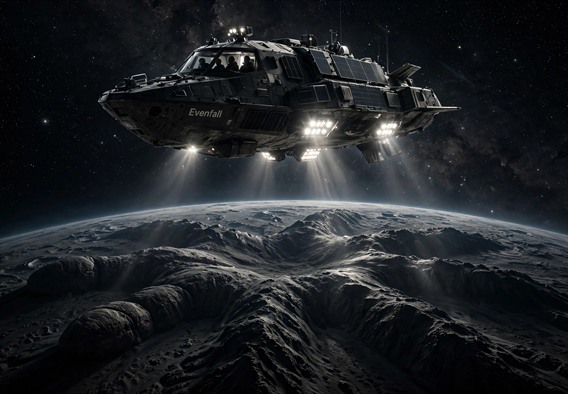
The Workbench
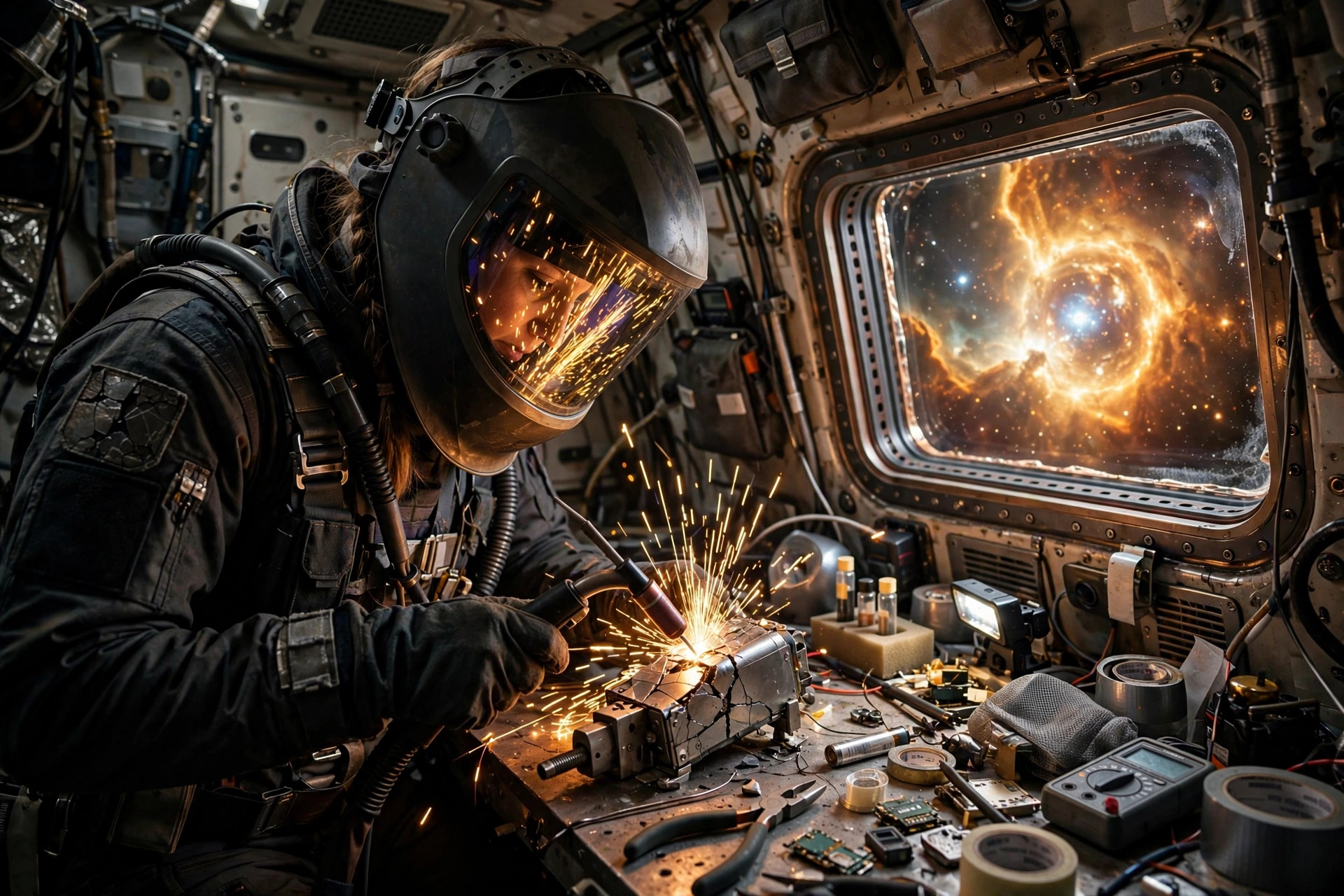
Runa drew the welding tip along the cracked cradle, following the pale seam through her dark visor. The workbench clamps held the metal firm against the platform’s faint vibration. When she lifted the tip, the seam glowed briefly beneath the extractor hood, then dulled.
Across the bench, Yara opened the medical kit and pulled a sealed dressing from its slot. “Tell me you’ve stopped trying to weld in your shirtsleeves.”
Runa raised her gloved hands. “I’ve even put the apron on.”
“I noticed. I’m hoping the habit survives the retrieval.”
Yara pressed the dressing packet, checking its seal, then tucked it back beside the injectors. She worked methodically, lifting each item into the light before returning it. Runa had seen her do the same with instrument parts: no matter how familiar a piece was, Yara looked at it as if it might have acquired a secret while she wasn’t watching.
The cradle had acquired its crack during the approach to Morrow Reach, when a loose tool had struck it. It was meant to hold the instrument package’s sample container after retrieval. Runa had clamped the damage shut before welding, but she could still feel a slight ridge where the edges met.
She set the tip down and slid a file across the seam. Fine metal dust gathered on the bench mat. The cradle was shaped to surround the sample container without crushing its delicate seals; if the repair distorted it, the container could shift when the platform maneuvered.
“Try the gauge,” Yara suggested.
“It’s cooling.”
“I meant when it’s cool.”
Runa glanced up. Yara’s hair had escaped its tie, and she was trying to push it back with the wrist she hadn’t used to handle the sterile packets. Runa reached across and caught the loose tie before it drifted away. Yara held still while Runa placed it in her palm.
“Thanks,” Yara murmured.
Runa returned to the file before she could make too much of the pause. She liked the workbench because it gave her hands somewhere definite to go.
Beside the cradle lay the fabric sleeve of ceramic tiles. She had pressed and fired them before departure, shaping ridges into each surface that a glove could distinguish by touch. The ridges represented messages they had agreed on: stop, injured, seal, pull, release. They were useful only within reach, but there were places on a working platform where radio reception could vanish behind metal and a suited person might need to communicate without letting go of a handhold.
Runa tipped the tiles onto the mat. Yara looked over as they settled against the bench’s retaining lip.
“You’re sorting those again?”
“You put seal next to release.”
“They feel different.”
“They do if your fingers aren’t numb.”
Yara came around the bench, took a tile, and closed her eyes. Her thumb traced the raised lines. “Pull.”
“Turn it over.”
Yara did. The reverse bore a shallow notch Runa had cut to orient it. Her thumb found the pattern again, slower this time.
“Stop.” She put the tile down carefully. “All right. Sort them.”
Runa arranged the tiles in their sleeve with the emergency messages nearest the opening. She left space between the ones most easily confused, folding the fabric into little dividers. Yara watched for a moment, then returned to the kit and checked the pressure bandage.
The cabin display showed the instrument package against a field of stars, a small bright speck marked by a tracking reticle. Runa could not make out its shape at this distance. It had been deployed to observe the merger remnant before the crew arrived, gathering spectra and collecting material for a sample. The signal from it had grown ragged, though Yara had coaxed enough status data from its transmitter to know that the data module was still responding.
Runa wanted to touch the container, to fit it into the cradle herself. She had spent too many nights looking at borrowed images of heavy elements made in stellar catastrophes, imagining what it would be like to bring back evidence from a place like this. A spectrum might show them what had happened in the remnant. A physical sample might let other laboratories examine the material directly.
“The tether head is ready,” Yara told her. “If the module’s release hasn’t jammed, I can catch its handle without bringing the whole package in.”
“And if it has?”
“Then I get closer and try the latch.” Yara closed the kit, checked the catch, and opened it again. “Mikel’s still arguing for a private launch.”
“He’s not wrong about the transmitter.”
“No. He’s also not the one who has to get the sample into a capsule while the package is coming apart.”
Runa rubbed a tile between finger and thumb. Mikel had his own competing claim, and the promise of a rapid return had helped finance his expedition. Public evidence would leave neither claimant much to sell. She understood why he kept asking about the launch. She also understood why Yara’s mouth had tightened.
Yara drew a slim diagnostic strip from the kit and held it up. A fault mark showed near its edge.
“That’s new,” Runa said.
“The reader’s fine. The strip isn’t.” Yara dropped it into the disposal pouch. “I’ll use the manual test if I have to.”
Runa considered the contents of the kit. The missing strip was small, easily replaced at a well-supplied station. Out here it was another thing Yara would have to work around. “Put it on my account when we get back.”
Yara gave her a level look. “Your account has enough on it.”
The words landed harder than Runa expected. She brushed the metal dust from the gauge and fitted it into the cradle. It passed through without catching. She tried again from the other side, feeling for resistance.
“The equipment lender sent the revised schedule,” Yara continued. “It came through with the navigation updates.”
Runa kept her eyes on the gauge. “Did you read it?”
“I’m the guarantor. They sent it to me as well.” Yara pulled a folded payment notice from the kit’s outer pocket and laid it on the bench. “They’ve moved the first collection forward. If the claim pays what you expect, we can clear it. If it doesn’t, they’ll take my earnings until your equipment loan is covered.”
Runa put down the gauge. She had signed the loan to buy the welding gear, the certified components for her claim, and the retrieval equipment. The notice had a box for her signature and another for Yara’s. Both boxes were filled.
“You knew they could ask you,” Runa said.
“I did.” Yara folded the notice again, more sharply than before. “Knowing isn’t the same as agreeing to give up every contract I haven’t even taken yet.”
“I never thought you had.”
“You keep saying you’ll cover little things from your account. You talk as if there’s a wall between what you owe and what I owe.”
Runa took off a glove and pressed her thumb against the edge of the notice. “I asked because you were the only person who could guarantee it.”
“You asked because I owed you.”
“I didn’t say that.”
“You didn’t need to.” Yara softened the fold with her fingers. “You rebuilt the instrument housing when my supervisor was ready to blame me for losing the readings. I kept my position because you stayed and fixed it. I was glad I could help you get here.”
Runa remembered the long shift at the old bench, Yara sitting beside her with a lamp while the housing cooled. She had not expected repayment then. Later, standing in the lender’s office with the application open, she had remembered exactly who might sign.
“I should have asked what you’d do if the claim failed,” Runa said.
“I probably would have told you I’d be fine.” Yara returned the notice to her pocket. “I’m telling you now that I don’t know.”
The cradle had cooled enough to handle. Runa released the clamps and carried it to the receiving station beside the retrieval port. She guided its feet into the mounting slots and pushed until the retaining catches engaged. The repaired seam faced inward, clear of the sample container’s seal.
Yara brought the gauge and passed it to her. Runa seated it in the cradle and tugged at the handle. The frame stayed firm. She pushed from the side, then from above, and felt no movement where she had welded it.
“That part I trust,” Yara said.
“Only that part?”
“The part I can see.”
Below the receiving station, an access panel exposed the visible side of a maneuvering cartridge mount. The platform carried two propellant cartridges, secured to mounts beyond the cabin bulkhead. Runa took an inspection mirror from the bench and angled it around the mount’s outer fittings. The fasteners looked seated; no fresh metal showed at their edges.
The cover for a closer inspection sat beside her hand, its captive screws reachable with the driver in her belt. Beyond the port, the package’s tracking mark drifted toward the edge of the display. Runa chose the mirror, working it along the outside of the mount until she had seen what she could. Then she put the tool away and latched the access panel.
“Exterior looks clear,” she told Yara.
Yara crouched to check the cradle catch herself. She pulled it hard enough to make the receiving station shudder, then gave Runa a brief nod.
Runa went to the cabin locker and opened the padded compartment inside. Her claim key lay there in its sealed steel casing. She lifted it out, feeling the weight of the certified components she had assembled and paid for with borrowed money. The circuit inside could authorize public release of the evidence, but doing so would destroy the secure circuit and void her exclusive priority claim.
Yara rose as Runa tucked the key into an inner pocket of her apron. “You’re taking that to the port?”
“I don’t want it loose in the locker if we have to maneuver.”
“Fair enough.” Yara closed the medical kit and secured it to her harness. “Let’s get the module first. We can argue about the rest when we know what we have.”
Runa picked up the tile sleeve and checked the opening. The folded dividers held the ceramic pieces apart. She passed it to Yara, who felt the first tile through the fabric and then pocketed the sleeve for the approaching retrieval.
The Observation Port
Runa caught the handrail as the observation port turned beneath her. The remnant filled the glass, a vast veil of ragged color made visible by the port’s light-gathering skin. Its inner region burned pale against the surrounding dark, while long threads of ejecta crossed the view. A navigation mark crawled over them.
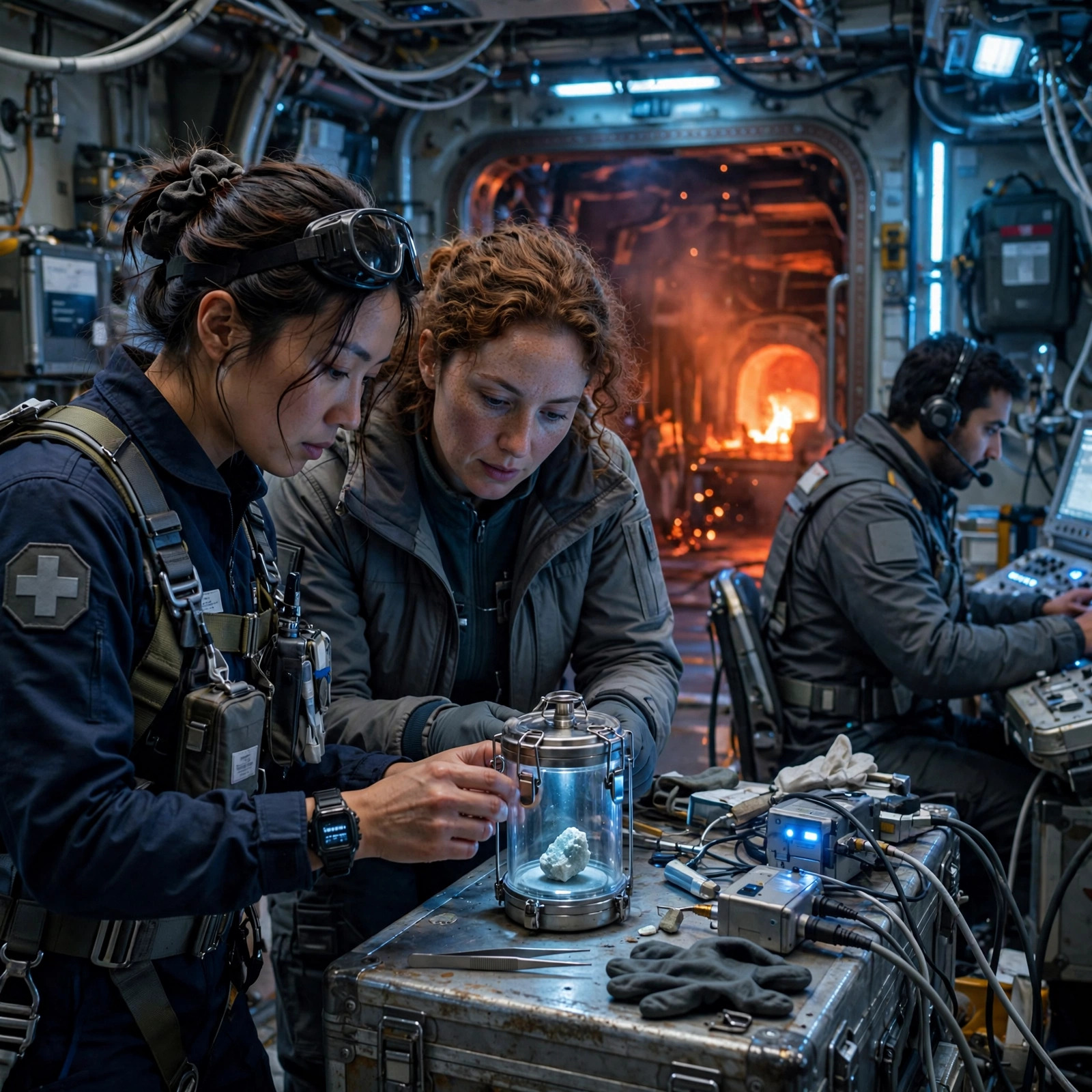
“There,” Yara said, pushing past her to the console. “The mark’s slipping.”
Runa braced her boots in the floor loops. The mark wasn’t slipping. Another, fainter point had separated from it, almost lost against the remnant. She reached for the display controls, but Mikel got there from the navigator’s seat.
“That’s the package. The bright mark is its predicted position.” He enlarged the view. “It’s moving away from where we expected.”
The magnification gave them a smudge, not the tidy shape Runa remembered fitting to its cradle before deployment. The package had been built to expose its instruments and sample collector to material passing through the remnant, then close itself for retrieval. Now something bright flickered along its side.
Yara leaned close. “Can you get the diagnostic link?”
“Trying.” Mikel adjusted the antenna aim. A broken string of status symbols appeared beside the image, vanished, and returned. “Its pointing system’s fighting itself.”
“Or the sensor is blind,” Yara said. “Open the thermal view.”
The package became a grainy shape streaked with uneven heat. One end glowed more brightly than the other. Yara touched the display without quite putting her finger on it.
“That panel should be cooling the electronics. If it’s folded against the body, the recorder won’t last.”
Runa looked toward the receiving station. The cradle she had repaired waited open against the cabin wall, its catches ready to take the instrument. The package was close enough now to fill a corner of the enlarged view, yet it seemed impossibly remote from the empty frame.
Mikel brought up a second trace. “The sample container reports closed. The recorder has spectra. We should send the container as soon as we can get it into the launch cradle.”
“And the recorder?” Runa asked.
“Whatever we can pull over the link before it dies.”
Yara’s fingers moved across the console. Fragments of spectral data appeared, bands and peaks interrupted by gaps. She isolated a section and enlarged it. Runa could follow the landmarks Yara had taught her to recognize, though she would not have trusted herself to interpret the lines alone.
“The calibration lamps are in there,” Yara said. “Some of the heavy-element signatures look credible. We need the rest of the record and the sample before anyone can say what we’ve found.”
Mikel turned his seat toward them. “Then let’s give them the sample. A private return gets it to a laboratory under claim. If the recorder fails before we reach it, the container may be all either expedition can use to secure financing.”
His expression was tired, not triumphant. Runa had seen him studying the tracking display through meals, checking their approach against the changing position of an object that no longer flew quite as designed. His expedition had backers waiting for evidence too.
“The launch takes a maneuvering cartridge,” she said. “We need that reserve to bring the crew home.”
“We have two propellant cartridges. The approach burn uses the other.”
“If the approach goes exactly as planned.”
“If it doesn’t, I revise the trajectory.” Mikel rubbed his thumb over the edge of the console. “I’m not proposing we strand ourselves. A successful claim pays for assistance if we need it.”
“Assistance from where?” Runa asked.
“From someone who can see a return on the expense.”
“And if the container comes back empty, or damaged?”
“Then the risk is mine as well.”
Runa glanced at Yara. The debt was hers, but the guarantee had put Yara’s future earnings against it too. Exclusive credit for the discovery could clear them both. A public release would void Runa’s priority claim and leave the lender entitled to collect.
Yara was still studying the broken spectra. “We don’t know whether the container is damaged. We also don’t know how much longer the recorder will answer. Those are different problems.”
“Which is why I’m asking for the launch,” Mikel replied. “It protects the part we can’t transmit.”
Runa felt the sealed key through her apron pocket. She had assembled its certified components herself, checking each seal before the expedition. The key could authorize release of the evidence to everyone, but its secure circuit would be destroyed in the process. Her priority would go with it.
She took it out and held it in her palm. The steel casing had warmed against her body. Yara noticed and looked away from the screen.
“I’m not asking you to use it,” Yara said quietly.
“I know.”
“I guaranteed the loan because I knew what I was signing. I haven’t agreed to pay it for the rest of my life.”
Runa closed her fingers around the key. Yara had made the guarantee after Runa’s work kept a failed instrument housing from ending Yara’s career. They had never settled on what that help was worth. Runa had hoped the discovery would make the question unnecessary.
“I don’t have a buyer for a dead crew,” Runa said to Mikel. “Bring the recorder in on the tether. We can keep the sample sealed while we decide how to send it.”
“The package isn’t holding attitude. A tether catch could hit the wrong surface and tear the radiator loose.”
“Then I’ll guide it,” Yara said.
Mikel looked at her medical harness. “Outside?”
“If the remote catch won’t seat. I know where the attachment ring is.”
“And if the package swings into you?”
“I keep my safety line short and wait for it to settle.”
“It may not settle.”
“Then I come back.”
Runa opened the padded locker beside the port and set the key inside. She drew the retaining strap over it, checked that the latch had taken, and shut the door. She could not bear having it loose against her ribs while she worked the tether controls.
Yara had already opened the suit locker. She took the sleeve of ceramic tiles from her pocket and slid it into a pouch on the suit’s forearm, where a gloved hand could reach it. Runa had pressed and fired the pieces before departure, making raised shapes for a small set of messages they had agreed upon. They were useful only when someone could place a tile in another person’s hand. With a radio, Yara would not need them; without one, they might keep a damaged helmet from making her mute.
“Check the pouch,” Yara said.
Runa tugged its flap. The fastener held. She took out a tile and pressed its raised surface into Yara’s palm through the liner glove.
“Return,” Yara answered.
Runa put it away. “You can still feel it.”
“I helped choose the shapes.” Yara pulled the outer glove over the liner and flexed her hand. “You made that ridge too sharp on the first batch.”
“You complained until I fixed it.”
“You fixed it because I was right.”
Runa found herself smiling. Yara’s hand remained open between them, the glove stiff and unfinished at the wrist. Runa fastened the seal carefully, running her thumb around its rim. Yara watched her face rather than the glove, and Runa had to look down to finish the check.
At the console, Mikel muted an alarm and called them over. The package’s bright end had grown brighter. Its diagnostic link showed more missing sections.
“The recorder housing is heating,” he said. “I can turn us to give the tether a clear line. We’re already approaching slowly enough to try, but the reel has to manage the remaining drift. No burn until I know where the package is going.”
Runa returned to the rail. “You’ll give us the line?”
“I’ll give you a chance at the recorder. I still think we should launch the sample when it’s aboard.” He brought up the maneuver controls. “Don’t mistake this for agreement about the cartridge.”
“I don’t.”
The port view shifted as the platform’s attitude controls turned it. The remnant moved across the glass, its filaments sliding behind the navigation marks. Runa felt the faint change through the rail, then saw the tether housing swing into alignment with the package.
Yara climbed into the lower half of her suit and drew the torso up around her shoulders. Runa helped settle the collar, then connected the suit’s communications lead for its cabin check. Yara spoke into the microphone; her voice came cleanly from the test speaker. Runa disconnected the lead and fitted the helmet into its cradle beside her.
“You’re not going out yet,” Runa told her.
“I’d rather be ready than watch the recorder cook while I dress.”
Mikel sent a command to the tether head. On the port display, the small device eased out from its housing, paying line behind it. Its guidance jets made brief pale puffs that vanished against the dark. He angled it toward the package’s attachment ring, using the camera mounted above the catch.
The camera view showed the package turning slowly. The damaged thermal panel stood partly open, its edge reflecting the remnant’s light. Runa could see the ring below it, a dark loop on the instrument body.
“There’s clearance,” she said.
“At this angle.” Mikel trimmed the tether head’s course. “The line can pull it around if the catch takes.”
Yara stood beside Runa with her helmet against her hip. “Don’t pull hard. The ring’s fixed to the recorder housing, not the sample container.”
“I know where it’s fixed.” Mikel’s hand hovered over the reel control. “Tell me if the panel moves.”
They watched the package fill the tether camera’s view. The broken panel hid the ring, then moved aside as the instrument turned. Mikel checked the line tension and let the head coast closer. Runa gripped the rail. In the cabin, a fan rattled inside its housing; she had meant to fasten it before the approach.
“The link’s dropping again,” Yara said. The spectral display had frozen.
“I see it.” Mikel corrected the tether head with another brief jet pulse. “I can’t make the package turn for me.”
Runa leaned toward the port. The head was almost against the instrument now, its open catch aligned with the ring. Mikel fed out line, then drew it in gently to take up the slack. The tether reached the package, but the catch struck the ring and failed to seat.
The Tether
Yara caught the tether control before Mikel could try the catch again. “Stop. You’ll bend the ring.”
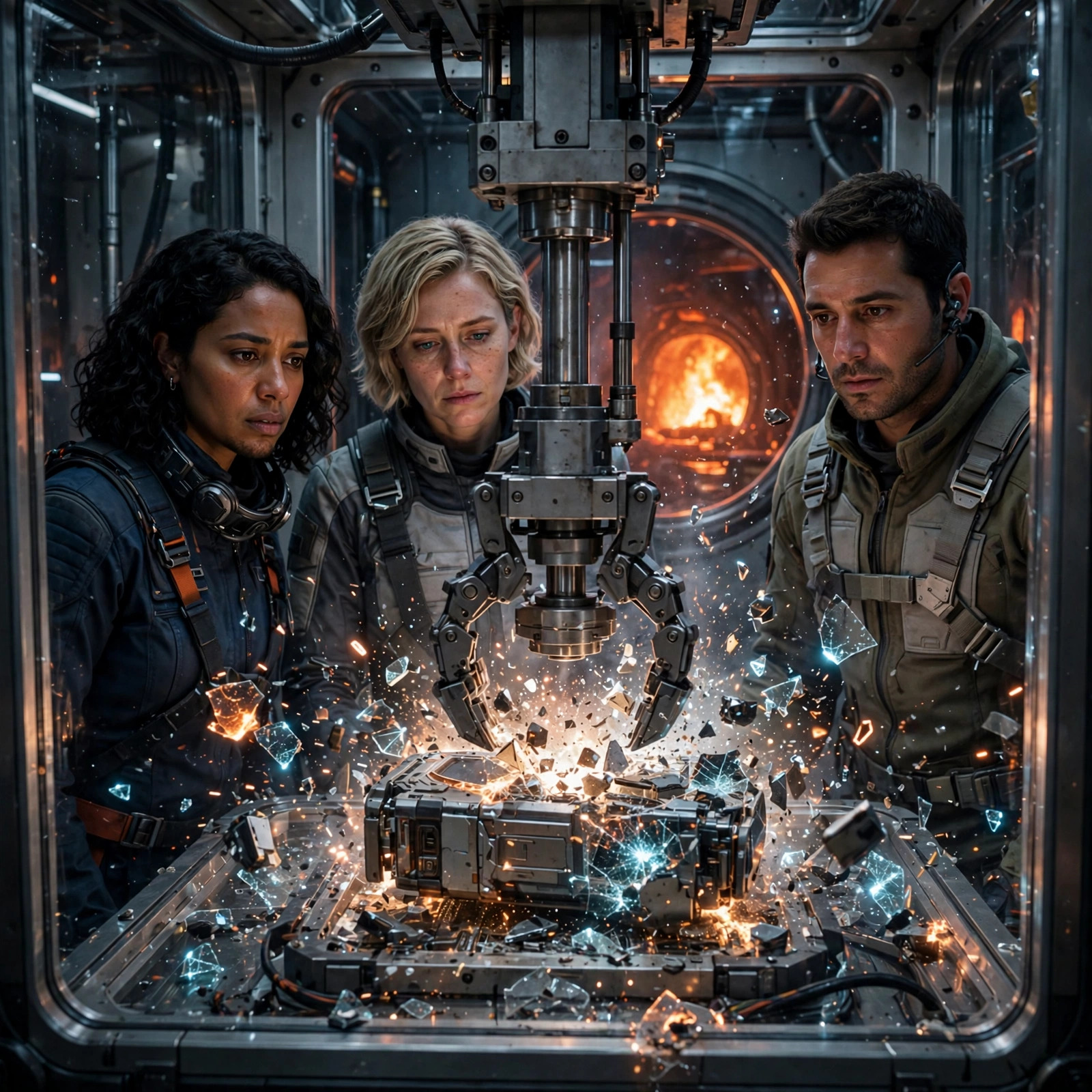
On the display, the open jaws drifted away from the instrument. The line bowed between the head and its housing, too slack to guide the catch and too taut to ignore. Beyond it, the damaged thermal panel flashed dull silver as the instrument turned.
Mikel took his hand off the control. “I can bring the ring around.”
“With the line?” Yara shook her head. “The recorder housing won’t take that strain.”
Runa moved to the window. The instrument had come close enough for her to make out the welds on the cradle she had repaired. The catch hung just short of the ring, separated from it by a gap that looked manageable until she considered the slow turn of both objects.
“I can seat it by hand,” Yara said.
Mikel brought up the navigation display. “I need to arrest our drift first. The attitude jets won’t give us enough sideways movement without wasting gas.”
“Use a cartridge,” Runa told him.
He turned toward her. “There are two propellant cartridges. The private return vehicle needs one, and we need the other to get home.”
“A short correction won’t empty it.”
“No. If the mount behaves.”
Runa looked through the window toward the cartridge housing, where the structure crossed her view of the remnant. She had checked its visible exterior before the approach. The fasteners had looked seated, the accessible welds intact. She wished now that she could see them under a work light instead of through reflected glare.
Yara lifted her helmet. “I’ll stay clipped to the Loom. Put the catch within reach and hold us there while I close it.”
“The instrument’s turning,” Mikel said. “I can match its drift, not its rotation.”
“Then I’ll wait for the ring.”
Runa helped settle the helmet over Yara’s collar. The seal indicator changed color beneath her thumb. Yara flexed her gloved fingers and checked the small pouch fastened along her forearm. Runa had made the ceramic tiles inside it before departure, pressing their raised markings into clay and firing them until they were hard enough to endure the suit’s rough handling. The tiles carried a small set of agreed messages, useful only when someone was close enough to feel them.
“You’ve got your radio,” Runa said.
“And I’ve got these.” Yara tapped the pouch. “You made the fastening easy to open with gloves. I’m not leaving them behind just because you’re embarrassed by the color.”
“I’m embarrassed by the glaze.”
Yara’s visor reflected the cabin lights. “It’s a terrible glaze.”
Runa tightened the pouch strap. Her fingers lingered against Yara’s wrist until Mikel cleared his throat at the console. Yara turned toward the airlock, and Runa followed, carrying the tool Yara had asked for: a short hooked bar that could draw the catch into place without putting a hand between the jaws.
At the hatch, Yara took it and clipped it to her suit. “Don’t let him fire while I’m crossing the hull.”
“I won’t.”
“And don’t promise me we can afford this.”
Runa met her eyes through the visor. “I wasn’t going to.”
Yara touched the edge of Runa’s apron pocket, then lowered her hand. Runa had put the sealed claim key in the cabin locker, out of the way while they worked. It was safe there. Nothing about the debt was safe.
The inner hatch closed. Runa watched the lock gauges and then the exterior camera. Yara emerged beside the tether housing, clipped her safety line to the rail and worked along it toward the fixture. Her movements were deliberate, but the loose fabric at her elbow caught on a bracket, and Runa found herself gripping the console until Yara freed it.
“At the fixture,” Yara reported. Her voice was clear. “The catch is past my reach.”
Mikel studied the relative-motion display. “Runa, confirm she’s anchored.”
“Anchored.”
Yara braced her boots against the hull. The tether head drifted in front of her, its camera giving Runa a close view of the ring and the dark recess beneath the damaged panel. The recorder’s temperature had continued to climb. The last spectra received from it were still on the cabin display, pale lines against black.
“Ready,” Yara said.
Mikel fired the maneuvering cartridge.
The deck pressed against Runa’s boots. On the camera, the ring moved toward the catch. Yara extended the hooked bar, waiting for the slow turn to bring the opening around.
The deck jolted sideways. A harsh vibration ran through the console, and the navigation display filled with warnings. Runa grabbed the rail as the cabin rotated around her. Outside, Yara’s boots came free of the hull. Her safety line snapped taut and swung her hard into the tether fixture.
The camera lurched away from the ring. Something bright broke loose beyond the window, followed by a cloud of glittering crystals that spread and thinned against the dark. Mikel cut the burn. The vibration stopped, but the cabin kept turning.
“Yara?” Runa called. “Yara, answer.”
There was no reply. Mikel fought the controls, firing the attitude jets in brief bursts. The remnant crossed the window, disappeared behind the frame and came back at a different angle.
“The mount failed,” he said. “Cartridge is gone.”
Runa pulled herself to the exterior camera controls. The damaged housing came into view, twisted away from its support. The cartridge had ruptured at the mounting end; its contents had vented, and the casing was unusable. Only one propellant cartridge remained.
“Her suit,” Runa said.
“I’m trying to stop the rotation.”
She found Yara on another camera. Her safety line still held. She had struck the fixture near her shoulder and was folded awkwardly against it, one arm trapped between her body and the rail. For a moment she did not move. Then her free hand opened and closed.
“Yara, can you hear me?” Runa switched channels and called again. The suit telemetry reached the console, but the voice circuit returned only a fault indicator. Its pressure reading remained in the safe range. Runa searched the image for frost or a spray of escaping gas and found neither.
“She’s sealed,” she told Mikel. “The radio’s failed.”
Yara pulled at the rail with her free hand. Her injured arm came loose, but when she tried to use it, she recoiled and let it float against her chest. Runa could see the effort in the way her shoulders tightened inside the suit. Yara hooked her good arm around the fixture and held on.
The pouch had come open. Ceramic tiles slipped from Yara’s sleeve and drifted away, their raised faces turning in the sunlight. She reached after them, missed, and caught the fixture again before her safety line carried her out from the hull.
Runa headed for the airlock.
“Wait,” Mikel called.
She pulled open the suit rack. “She can’t secure herself.”
“The platform’s still rotating. If you open the outer hatch now, you’ll be fighting the hull as well as your line.”
“Then stop it.”
“I am.” His voice sharpened. “I need room to fire the jets without sending the tether across the instrument.”
Runa dragged on the lower half of her suit. The cabin’s motion made the rack swing toward her, and she shoved it away. On the display, Yara had found a handhold but could not reach the closer clip on her safety line. The tether head floated beyond her, its catch still open.
“Cut the tether,” Runa said.
“The loose end could strike her.”
“Then reel it in.”
“Not while it’s crossing the hull.” Mikel touched the controls, then stopped. “If I fire now, it’ll go tight against the fixture.”
Runa hauled the suit torso over her shoulders. Mikel was right; she could see the line on the display. It lay close to Yara’s legs, shifting as the Loom turned. Runa secured her collar and went to the tether controls, her gloves still hanging from the rack.
“I can pay it out,” she said. “Give it enough slack to clear her.”
“Slowly.”
She eased the reel forward. The line moved across the image, lifting away from the fixture. Yara kept her grip as it passed her boots. When the tether head had drifted clear, Mikel fired a jet. The line curved gently behind the moving hull instead of pulling tight.
“Again,” he said.
Runa fed out more line. Each time Mikel corrected the rotation, she watched for the tether and checked Yara’s position. Yara remained conscious, shifting her grip when she could. Her free hand pressed against her upper arm, then returned to the rail.
The movement on the navigation display gradually slowed. Mikel used the smaller jets sparingly, checking their gas supply between corrections. He did not touch the remaining cartridge control.
“If we lose the recorder,” he said, “the sample may still be good.”
Runa looked at him. “Yara’s out there.”
“I know. I’m not launching anything.” He kept his eyes on the display. “I need to know what you’ll do when she’s aboard. The claims are what pay for these flights.”
“Mine would clear the equipment loan. Hers too.”
“And a public release clears neither of us.”
Runa fitted her gloves. She had asked Yara to guarantee the loan because the equipment was necessary and because Yara trusted her. Yara had known what she was signing. She had not offered the rest of her income to settle it.
Outside, Yara raised her good hand toward the camera. Her fingers formed a shape Runa could not read through the thick glove. A loose tile passed close to her visor and continued into the dark.
“We’ll talk when she can hear us,” Runa said.
Mikel made another correction. The hull settled against the background stars, with only a slow residual drift. He checked the tether’s path and the instrument’s position before taking his hands from the controls.
“It’s stable enough. Keep your line short until you reach the rail.”
Runa locked her helmet in place and tested the radio. Mikel’s answer came through, clipped but clear. She entered the airlock, secured her tools and waited through the pressure cycle while watching Yara on the small monitor beside the hatch. Yara had managed to hook her good arm more firmly around the fixture. The injured arm hung close to her body.
The outer hatch opened onto black space and the dim red light of the remnant. Runa pulled herself to the threshold. The tether head was beyond Yara now, turning slowly with its open jaws exposed. Farther away, the instrument’s broken panel caught the light.
Runa clipped herself to the exterior line and reached for Yara.
The Airlock
Runa pulled along the rail, her safety line sliding through its guide, and caught Yara’s shoulder before she drifted clear. Yara’s glove tightened on the fixture. Her other arm lay crooked against her chest, held there by the stiffness of her suit.
“I’ve got you,” Runa said, though Yara’s failed radio could not carry the words.
The damaged fixture trapped a fold of Yara’s equipment harness against the hull. Runa tried lifting the bent edge. It did not move. Yara watched her through the visor, face pale, jaw clenched. When Runa reached for the harness buckle, Yara caught her wrist and shook her head.
A loose ceramic tile passed between them. Runa closed her glove around it and looked at the raised marks. Wait. She caught another against the rail, then opened the pouch on Yara’s forearm. The pouch flap had torn loose; most of the tiles were still inside.
Runa selected the tile for release and pressed its ridged face into Yara’s good palm. Yara felt the pattern, then pointed at the trapped harness. Runa pressed the tile into her glove again, followed by the tile for ready.
Yara nodded. Runa braced a boot against the rail and eased a cutting tool under the webbing. The blade met a stubborn seam. She worked it along, careful not to touch the suit beneath. Each pull sent a tremor through the fixture and through Yara’s body.
“Mikel, the tether head’s still open. Can you bring it back to us?”
“Working on it. Don’t cut her loose yet.” His voice broke under a hiss, then returned. “The line’s moving across your path.”
Runa looked past Yara. The tether head turned slowly beyond the rail, its jaws spread. The winch could draw it in, but the line had caught on a projecting handhold. As Mikel reeled it toward the hull, it began to slide along the metal toward them.
“Stop there,” Runa said. “If it comes over the fixture, it could pull her with it.”
The tether stopped. Runa hooked her tool to her belt and reached for the line, stretching until her shoulder pressed against Yara’s visor. Her glove closed on it, but she could not lift it clear while maintaining her grip on the rail. She passed Yara the tile for hold and laid the line across her good palm.
Yara curled her fingers around it. Together they eased it over the handhold. Runa felt the slight change in tension and flattened her body against the hull.
“Try now.”
The tether moved. Its head came within reach, then swung away as the line straightened. Runa missed it and caught only empty dark. She felt her safety line tug and forced herself back to the rail rather than lunging after it.
“A little slack,” she told Mikel. “Let it settle.”
“I’m watching the camera. Your line is crossing mine.”
“I see it.”
She guided her safety line beneath the tether, keeping the strands apart. Mikel paid out slowly. The open jaws drifted back toward her, and this time she caught the head by its insulated grip. She checked that the catch had no debris lodged in it, then locked it to the rescue ring on Yara’s harness. A pull on the head confirmed it had seated.
Runa touched the ready tile to Yara’s glove. Yara answered with a stiff lift of her thumb. Runa returned to the trapped webbing and cut through the remaining fibers. The harness came free so suddenly that Yara rolled away from the hull.
Runa grabbed for her, missed, and felt the tether pull taut. Yara swung beyond the rail, her good hand reaching for nothing. The movement carried Runa outward too, until her own line checked her. She could see the tether rubbing against the bent fixture.
“Mikel, ease her in. The line’s against an edge.”
“I can see it. Keep your hand clear.”
Runa hooked a short strap around the rail and pushed the tether away from the metal with the handle of her tool. The winch drew Yara toward her, slowly enough that Runa could guide the line past the fixture. Yara’s visor bumped Runa’s shoulder. Runa secured her with the strap, then clipped them both to the line leading back to the hatch.
Inside the airlock, Yara sagged against the wall while the pressure rose. Runa held her upright and watched the suit indicator. It stayed reassuringly stable. Only when air was available did Runa release Yara’s helmet seal and lift the shell away.
Yara’s hair was damp at the temples. “The radio went when I hit the mount,” she whispered. “I thought you couldn’t see me.”
“I could see you. I couldn’t understand you until I found the tiles.”
Yara looked at the pouch, its flap hanging open. “I should’ve fastened it better.”
“You were trying to keep hold of the rail.” Runa set the recovered tiles in the pouch and pressed the flap closed. “Can you move your fingers?”
Yara did, with a sharp intake of breath. “The hand works. Don’t ask about the rest.”
Mikel opened the inner hatch and helped Runa guide her into the cabin. The cabin’s medical kit had been strapped beside the bench. Yara directed them through the removal of her suit, stopping Runa when the injured arm shifted. Mikel cut the sleeve rather than tugging it over her shoulder.
Under the scanner, Yara’s upper arm showed a fracture. She studied the image herself, then instructed Runa to prepare the splint. Runa cushioned it, wrapped it in place and held the arm steady while Yara administered pain relief with her good hand. The work gave Runa something to do with her hands. It did nothing for the pressure in her chest.
Mikel secured the scanner and returned to the navigation station. Beyond the cabin window, the damaged thermal panel reflected a dull red from the distant merger debris. The tether head was no longer near the instrument. The data module remained there, exposed to the heat building inside its damaged housing.
“The sample launcher is still available,” Mikel said. “I’ve checked its guidance. If we use the remaining propellant, it can leave on a fast trajectory.”
Yara leaned back against the bench. “And we stay here?”
“We’d have the attitude gas. I’d look for another way to change our orbit.” He turned toward them. “I can’t promise I’d find one. But that sample could clear Runa’s loan and the guarantee. My claim would pay for my expedition too. If the data goes public first, none of those claims will finance us.”
Runa knew the balance on the loan well enough to picture what would happen when payment came due. The equipment had made the expedition possible. Yara had signed because she understood the risk, and because Runa had helped save her career when the foundry was ready to dismiss her. That signature had not given Runa permission to decide what Yara would lose.
She put the used dressings into the waste pouch. “The mount should have been opened.”
Yara’s eyes came up. “What?”
“Before we fired it. I checked the outside. I saw the scoring by the fasteners, but I left the complete inspection until later. I thought I could reinforce it if it got worse.”
“You thought?” Yara pushed herself upright and stopped when her arm shifted. Her face tightened. “I was beside it because you told me it was fit to use.”
“I know.”
“No, you don’t get to say that and make it small.” Yara’s voice had gone rough. “You knew I’d be out there. You knew I was on your loan. You let me trust the work anyway.”
Runa gripped the edge of the bench. “I’m sorry.”
“I’m angry with you.” Yara looked down at the splint. “I can’t do my work with this arm, and the payments won’t wait for it to mend.”
Mikel let the silence last. Then he laid the projected launch path over the return navigation on his screen. “If I send the sample, there’s a real chance the claim pays both of you. I’m not pretending the alternative is safe. I’m asking you to look at what we’d be giving up.”
Runa went to his station. The sample’s projected course arced away from the platform. Beside it was the path home, marked with a broad region of uncertainty where the remaining propellant had not yet been assigned. Mikel’s hands were poised above the controls, but he did not enter either command.
“Can the tether get the data module later?” Runa asked.
“Perhaps. The catch works now, but the housing is hot and getting hotter. I can’t guarantee what will be readable.”
The sealed claim key lay in the cabin locker, where she had put it before going outside. It could authorize release of the evidence, but doing that would destroy its secure circuit and end her exclusive priority. She could not decide for Yara what public access would mean for their debt, and she did not yet know what the module would yield.
“Use the propellant for our return,” Runa said.
Mikel’s jaw set. “Let me check the route before you commit it.”
He brought up the platform’s current motion and tested the burn against the life-support stores. Runa watched him revise the orientation, reject a path that carried them too far from help, and enter another. The cabin was quiet except for the ventilator and the faint contact of his fingertips with the controls.
“That reaches Asterion Foundry,” he said at last. “The margin on air and power is viable, provided we keep the cabin systems conservative. I’ll send the approach information as soon as the antenna is aligned.”
He looked at the private launch path again before clearing it from the screen. Runa saw the hesitation in his hand. Then he secured the cabin for the maneuver and turned the platform with its smaller jets.
Yara closed her eyes as the burn began. Runa sat beside her, strapped in, and watched the cabin window shift against the distant stars. The acceleration pressed her into the seat. It lasted long enough for her to think of the cut webbing floating outside, then eased away.
Mikel checked the resulting trajectory without speaking. At last he released his restraints. “We’re on it. The margin still holds.”
Runa unfastened herself and knelt beside Yara’s bench. “I’ll tell the lender what I did. I won’t ask you to cover it quietly.”
“You’ll tell them,” Yara agreed. “That doesn’t tell me how we’re paying.”
“No.” Runa rested her hand on the bench, leaving space between them. “It doesn’t.”
Yara studied her for a moment, then touched Runa’s wrist with her uninjured hand. Runa leaned closer, slowly enough to stop. Their kiss was brief and hesitant. Yara drew back before Runa could touch her cheek.
“I’m still angry,” she said.
“I know.”
Mikel opened the propulsion panel and engaged the lockout on the spent cartridge. Beyond the window, the private sample remained aboard the damaged instrument.
The Cabin
Runa hauled the tether through the hatch until the data module knocked against the threshold. Its improvised sling had twisted around the casing. She caught the warm metal before it could strike again and guided it into the cabin.
“Don’t put it against the bench,” Yara said. “The casing needs air around it.”
Mikel shut the hatch behind the line and dogged it. Runa laid the module in a mesh cradle beneath a ventilator, then eased the sling free. The line bore a dark scrape where it had dragged across the damaged housing outside. She rubbed the mark with her thumb and found metal dust.
Yara leaned forward from her seat, her splinted arm supported against her chest. “Connector cover. Can you get it off without pulling the socket?”
Runa braced the casing with her palm and worked a thumbnail under the cover. It resisted. She reached for a pry tool.
“Wait.” Yara pointed with her uninjured hand. “The latch is under the edge. Press it in.”
Runa did, and the cover lifted cleanly. She set the pry tool down. The exposed contacts looked intact, though a film of pale dust had settled in the recess.
Mikel passed her a brush from the repair tray. “The navigation terminal can read it. I’ve isolated the external link until we know what’s on there.”
She cleaned the contacts and fitted the cable. For a moment the terminal showed only the module’s identification and a temperature warning. Then a directory appeared. Yara shifted close enough to read, wincing as the restraint across her splint pulled tight.
“Let me.” Runa loosened the strap at the buckle and held the splint while Yara settled it more comfortably.
“Thanks. Open the calibration record.”
Runa expected graphs, and there they were, curves laid over curves, accompanied by entries Yara had made before the mission. Reference exposures, detector temperatures, corrections for the spectrometer’s response. Some later entries carried warning marks. The thermal panel outside had failed to keep the electronics within their preferred range.
Yara studied the sequence. “The reference source was checked before the heating began. Open the later comparison.”
Runa did. The trace appeared ragged at its edges.
“That’s ugly,” Mikel murmured.
“It is.” Yara indicated a region where the reference lines still held their positions. “But the shift was measured. We can give people the raw readings and the correction, not just the processed result.”
Runa opened the spectra from Morrow Reach. Bands of color resolved into lines across the screen. She had seen simulations of such patterns in proposals and watched researchers argue over them in borrowed meeting rooms. These readings had come from their own detector, after its long exposure to the fading light of the merger debris.
“There,” Yara said. “And there. The features we were looking for.”
“Could the heat have made them?” Runa asked.
“I don’t think so. The reference gives us a way to test that. Other groups will have their own models, and they may identify the lines differently.” Yara tapped the screen with a careful fingertip. “But the signal’s real. We can show how we got it.”
Runa let herself look at the spectrum without searching for damage. The narrow marks were evidence of matter remade under conditions no foundry could reproduce. The physical sample remained outside, beyond their ability to send home separately, but the light had reached the detector and left a record they could carry.
Mikel pulled the terminal toward him. “Copy the files locally before we do anything else.”
Runa watched the transfer indicator move. It paused at a damaged segment, retried, and moved again. Mikel’s hand rested on the edge of the bench until the directory reappeared on the cabin drive. He opened files at random, checking that they could be read.
“The observation log’s intact,” he said. “Calibration too.”
Yara lifted her good hand toward the pouch on her suit forearm. Runa unfastened it for her and took out the small ceramic tiles. Their raised marks had helped them communicate outside when Yara’s radio failed. Here, with cabin air between them, Yara could speak, but she ran a fingertip across the tiles before passing them over.
“The sleeve’s beside me.”
Runa tucked them away within Yara’s reach. One tile caught on the cloth, and she eased it past the seam rather than forcing it. Yara watched her do it.
Mikel closed the navigation window and brought up a draft addressed to an open scientific archive. “That’s ready if we decide to send it.”
Runa looked at the blank authorization field. “You don’t agree.”
“No.” He sat back, folding his hands over his knee. “My claim isn’t as strong as yours, but it exists. My backers paid for the navigation work because there was a chance of a return. Public access strips that away.”
“Keeping it private won’t get the sample home ahead of us,” Runa said.
“I know what we spent to come back. We can still keep the data restricted until we reach the Foundry. The module is inside now.”
Yara shook her head. “The copy on the cabin drive is readable. That doesn’t guarantee the whole record will stay intact. We’ve got power limits on the way home, and the original was running hot. We should send the raw files while we can verify them.”
Mikel regarded the module in its cradle. “A restricted transmission would preserve priority.”
“To whom?” Runa asked.
He opened his mouth, then stopped. Any private recipient would have to be trusted with evidence that carried competing claims. A damaged file, a delayed response, a dispute over custody: she could imagine each argument lasting beyond the value of the data.
“My financiers would take it,” he said.
“And mine wouldn’t accept them as custodians.”
“Then we find a neutral service.”
Yara shifted in her seat. “Can you find one from here and establish terms before we lose the clean connection?”
Mikel’s jaw tightened. He checked the antenna status, then the stored contact list. Runa let him work. He had brought them onto a viable return path, and she had no right to treat his objections as simple greed. The names on his screen represented people who had paid for the work and would expect him to defend it.
At last he closed the list. “I can’t establish custody from here without everyone agreeing to the terms. That could take longer than our link stays useful.”
He opened another folder, containing the platform’s navigation record. “The spectrum needs its observing position and pointing history. Mine is independent of the detector’s log. I’ll attach it, with the uncertainty estimates.”
Runa’s shoulders eased, but he raised a hand.
“I’m not saying I’m happy about the money. I’m recording that I objected to surrendering my claim. My backers can read that too.”
“Attach the objection,” she told him.
He studied her, then added a note to the transmission manifest. His fingers moved quickly through the navigation files, selecting the observations and the records needed to check them. He left his private correspondence out.
Yara waited until he had finished. “Runa, bring me the loan agreement.”
The request made Runa’s stomach tighten. She retrieved it from her personal files and opened it on the bench. The lender’s seal sat above her name and Yara’s guarantee. The equipment listed below had made the expedition possible: fabrication tools, replacement stock, the hardware for their repairs.
“If the data go out openly,” Yara said, “your priority payout is gone.”
“Yes.”
“And I’m still liable if you can’t pay.”
Runa nodded. “I’ll take every repair contract I can find.”
“That’s not an agreement with the lender. It’s you deciding what happens to both of us.” Yara pressed her hand against the bench, close to the loan document. “I signed because your work saved my career when I had no other way to keep it. I knew what the guarantee meant. I didn’t agree to hand over my future income without being asked.”
“You’re right.” Runa looked at the line carrying Yara’s name. “I should have brought this to you before I prepared the transmission.”
“You should have. I’m here now.”
Runa pulled up the work notices cached from Asterion Foundry. Most were routine maintenance requests. She filtered for the jobs that needed welders and found a berth assembly with cracked access rails, along with repair work on a service tug. Both notices named a rate and invited bids after inspection.
“Those aren’t contracts yet,” Yara said.
“No. I know the shop that posted the berth work. They’ll pay for an inspection, and if they accept my bid, I can do the repair.”
Yara read the notice. “There’s a call for technicians on the tug. I could inspect its monitoring equipment, once the arm heals enough.”
Runa almost told her she shouldn’t have to. Instead she moved the notice where Yara could see its terms.
“We approach the lender together,” Yara said. “We ask for a revised schedule and show them the work we can take. If they refuse, we look at the agreement again before either of us promises anything.”
“Together,” Runa agreed. “And I’ll tell them why the claim payout isn’t coming.”
Yara held her gaze. “You’ll also tell them the equipment did its work. They may be more interested in getting paid than assigning blame.”
Runa saved the notices alongside the agreement. The amount owed remained on the screen until she closed the file. Nothing about the conversation had erased it, but Yara had chosen where to put her hand next, on the edge of Runa’s sleeve.
Mikel cleared his throat. “The antenna is aligned. I’ve checked the archive address and the file list.”
Runa went to the locker and took out the sealed steel key. She had assembled it herself from certified components, checking each seal before she closed the casing. Until now, she had carried it as proof that the work could pay for itself. In her palm it was cool and heavier than it looked.
She returned to the bench. Mikel had attached the raw spectra, the calibration record, the observation log, his navigation files, and his objection. Runa read the manifest aloud. Yara stopped her at the calibration files and asked to inspect the reference exposures again.
A warning appeared beside an incomplete segment. Runa felt her hand tighten around the key.
“That section was a diagnostic after the thermal fault,” Yara said, examining its timestamp against the log. “Include it as damaged. Don’t let anyone mistake the gap for a clean reading.”
Mikel added a note and reopened the manifest for her approval. Yara checked it carefully, then moved her hand away from the terminal.
Runa fitted the key into the release socket. A confirmation panel appeared, identifying her claim and warning that public authorization would void its exclusive priority and destroy the secure circuit. She read the warning, then turned the screen so the others could see it.
“I agree to sending the evidence,” Yara said. “We still have to deal with the lender.”
“I agree to attach my record,” Mikel said. “My objection stands.”
Runa placed her thumb on the authorization pad. The terminal accepted her identity and armed the transmission. Beside her, Mikel kept his hand on the bench; Yara sat close enough that the sleeve of tiles touched her leg.
Runa pressed the release lever. The socket crushed the key’s secure circuit, and the transmission indicator lit beneath her thumb.
Get notified when new stories drop

Sasha Quill
Sasha writes bold exploration and cosmic wonder with lyrical scale and grounded character work.
Leave a comment
Comments