



Firing Gallery
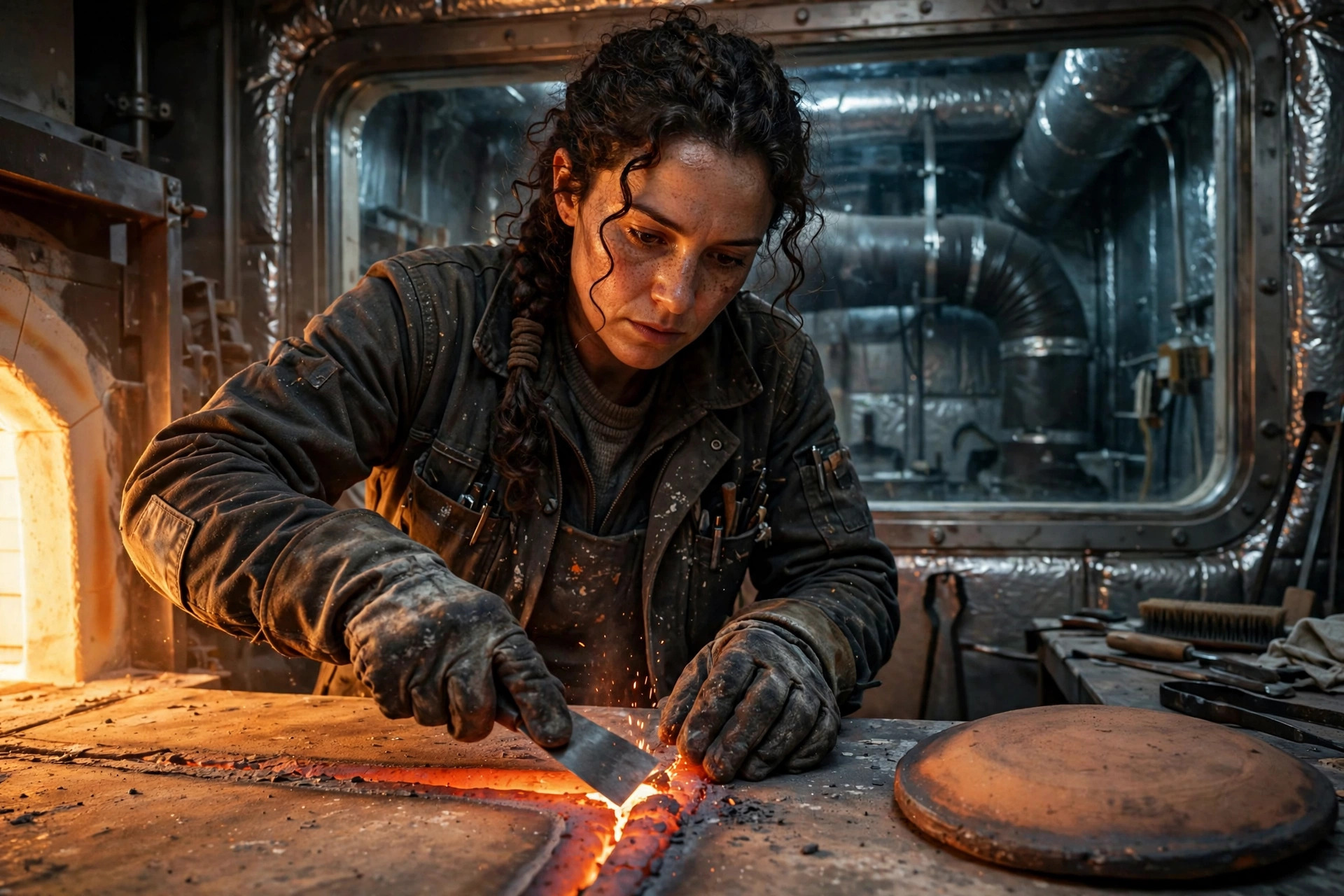
Rowena drew the scraper along the hot joint, shaving away a curl of temporary packing before it could harden against the ceramic. The tool caught. She eased it back, adjusted the heel of her glove, and felt the seam give.
Behind her, the gallery door opened. Davit came through with a canvas bag against his hip and a strip of paper held carefully away from his coat. Mineral grit silvered the creases at his elbows.
“Don’t put that on the bench,” she told him.
He stopped short. “I was going to show you.”
“Then keep it there until I’ve covered this.”
She set a fired cover plate over the repaired joint. It sat flush along the near edge, but rocked at the far corner. Rowena lifted it again and scraped a grain of hardened packing from the lip. This time the plate settled. She pressed the retaining clips into their slots and ran her glove over the seam.
The gallery smelled of warm clay and the sharp binder used in the repairs. Through the inspection window, the extraction duct passed behind its ceramic lining, a dark shape against the insulated steel of the shell. The joint she had just covered belonged to a service channel alongside it. She had repaired it because the packing had dried and pulled away, leaving the channel exposed to grit.
“All right,” she said.
Davit laid the paper on a clean patch of bench. A dark line wandered across it, doubling back on itself in a series of tight bends. He weighted the end with his bag.
“The movement gauge was sticking, so I put paper under the stylus. It’s free now. That’s what it drew while the duct was running hard.”
Rowena bent over the trace. There were places where the stylus had dug deep enough to roughen the paper. She followed the mark with a thumbnail, then looked through the window again.
“Does the gauge sit at the collar?”
“At the outer bracket. I checked the mounting before I brought it.”
“And when they slowed the feed?”
“The line narrowed. I kept that part too.” He unfolded the strip farther, revealing a gentler, nearly straight mark. “It came back when they opened the feed again.”
Rowena held the paper at an angle to the light. The deeper marks were not evidence of a broken shell. They were evidence of movement where the fired joints had been made for less of it. Each time the metal shifted, the lining had to accommodate the strain. Ceramic could carry a great deal when properly supported; it did not forgive a joint that had lost its packing.
“You took this to the controller?”
“I took it to the shift board. The crew can see it there.”
“And the schedule?”
He reached into his bag and brought out two filter cartridges, still wrapped in their protective sleeves. He placed them beside the trace, as though their clean white surfaces belonged with it.
“The schedule stays. We’re meant to clear the filters more often.”
Rowena picked up a cartridge. Its pleated media was pristine beneath the mesh. “That doesn’t make the duct move less.”
“No. It keeps what comes out of it away from our lungs.” Davit took the cartridge from her and checked the seal around its rim. “I asked for spares because the old ones are clogging early. If the feed slows, there’s less fuel for the heaters. Keira has already pulled from the medical reserve.”
Rowena looked back at the trace. She had seen the reserve notice clipped beside the gallery entrance. The treatment rooms needed warmth and power continuously; they could not take an extra blanket or finish a shift early. The people tending them had asked for fuel, and the extraction crew had found a way to deliver it.
“I can send her this,” she said.
“She’s seen the schedule. She’s the one who issued it.”
“She hasn’t seen my joint.” Rowena folded the trace without creasing the darkest marks. “I’ll ask her to cut the feed while I inspect the lining properly.”
Davit’s fingers tightened around the wrapped cartridge. “If she does, they’ll send us home.”
“Until I’ve checked it.”
“You don’t know how long that’ll take.” He put the cartridge back beside its mate. “I need the shift, Row. We both do.”
She set the folded paper down. The repaired service joint lay beneath its cover, neat enough to pass inspection. Beside it, the duct lining curved out of sight around the collar. She had built that collar to shed heat and grit away from the structural shell. The packing between its fired segments let them expand without grinding against each other. If movement had crushed the packing, the segments would bear directly on their edges.
“I need you to have work,” she said. “I also need there to be a shell around it.”
Davit pulled out the stool beside the bench and sat. The canvas bag slid from his lap to the floor. He rubbed his thumb along the wrapped cartridge, smoothing a wrinkle that returned as soon as he let go.
Rowena crossed to the cabinet where the authorization tiles rested in a shallow tray. She had made them before Davit joined the extraction crew, pressing the shapes in a die and cutting the identifying marks while the clay was still soft. The kiln had darkened the incisions. They looked almost black against the pale ceramic.
She picked up her tile and brought it to the keyed socket on the bench. Its notched edge entered the recess cleanly. When she turned it, the raised mark on its face aligned with the mark beside the socket: permission to inspect and maintain the duct lining. The tile did not open a valve or read a gauge. It gave the crew a durable way to check an authorization against the printed register when the network was unavailable.
Davit came over and lifted his tile from the tray. The incised mark on his identified his extraction clearance. He fitted it into the neighboring recess. A narrow bridge of ceramic joined the shapes across the bench plate, framing the lease mark cut between the sockets.
“It’s still the same,” he said.
“I know.”
She pressed her tile farther in, making sure the shoulders seated. A chipped tile could look sound until it was needed; she had replaced enough of them to be cautious. The register beside the socket listed the permissions carried by each shape and what followed if work stopped without the agreed authorization. Their dwelling lease appeared on the same page as Davit’s clearance.
He touched the lease mark. “Keira’s got the key at the Supply Counter.”
Rowena pictured the little steel key on its labeled hook. Keira had cut it for them when the lease was issued, then placed it in escrow when they accepted the emergency work bond. Their rooms remained theirs to use while the bond stood, but the key secured the arrangement.
“A worker shuts the duct alone,” Davit said, tracing the line in the register, “and they can put one bond claim against the lease.”
“They can.”
“You’re not on the extraction roster. You can ask for an inspection without shutting it.”
“I can ask.” She drew her tile out, then returned it to its place in the tray. “I’d rather have Keira slow the feed than force a shutdown.”
Davit removed his tile too. He turned it over in his palm, inspecting the smooth back where Rowena had polished away the marks of the die. A thin pale scar crossed the pad of his thumb. She had seen that scar so often that she noticed it most when his hands were still.
“We signed because you said the dwelling would give me room for a proper bench,” she said.
“You said that.”
“I remember you measuring the alcove with your arms.”
“I was checking whether the bench would fit.” His mouth shifted, not quite a smile. “It does, if you don’t mind climbing over it to reach the cupboard.”
She took the tile from him long enough to examine its edge, then returned it. There was no chip. He placed it beside hers in the tray.
At the message terminal, Rowena attached an image of the trace and wrote that the accelerated schedule should be suspended until the collar could be opened and inspected. She included the repaired service joint and the movement gauge in her report. Before sending it, she added a request for fuel to fire a permanent seal if the lining proved unsafe.
Davit read over her shoulder. “That fuel comes from somewhere.”
“I know where.”
“If she gives it to you, the treatment rooms get less.”
“If the collar fails, they may get none.”
He rested his hand on the back of her chair. “Ask for a reduced feed first. Give her something she can use.”
Rowena stared at the message. She had asked for suspension because it would give her the safest conditions to examine the joint. A reduced feed would leave the duct moving, but it would also leave the settlement with some fuel while Keira considered the evidence. She changed the request and sent it.
A reply appeared before she had closed the terminal. Keira’s note acknowledged the trace, refused the reduction for the current shift, and offered a short inspection interval when the crew next cleared the filters. A longer interruption would require fuel she could not yet spare.
Davit read it without moving his hand. “She gave you the interval.”
“Not enough for the seal.”
“You haven’t found that you need it.”
Rowena rose. “Then I’d better look.”
She fetched the insulated case containing her joint tools and carried it to the inspection window. Davit gathered the cartridges and stood by the door, watching as she released the window’s catches. Beyond the glass, the collar was accessible from the pressurized gallery through a service recess. The duct remained enclosed by the steel shell behind the lining; opening the recess did not open the settlement to the ground outside.
“I can stay,” he said.
“Your crew needs those.” She nodded at the cartridges.
“They can begin without me.”
“You’re the mechanic. They’ll wait, and then you’ll have to make up the work.”
He set his bag down anyway and held the inspection lamp while she unfastened the inner cover. Its light picked out the pale fired segments around the duct. Dark scuffs crossed the edges near the collar. Rowena put her gloved fingertip against the nearest segment and felt a roughness where there should have been a smooth bed of packing.
“Keep the lamp there.”
She worked a narrow blade into the seam. The packing came away in brittle crumbs. Under it, a fractured segment shifted against its neighbor. Davit moved closer, and the beam trembled across the ceramic.
“Can you patch that like the other joint?” he asked.
“Not until I know what’s behind it.”
She supported the neighboring segment with a padded clamp, then eased the blade beneath the fractured piece. It resisted. She changed the angle, protecting the lip that still held, and drew the piece free into her palm. The surface behind the barrier lining had been clean when she last opened it. Now fresh mineral dust lay in the recess.
Supply Counter
Rowena slid the broken fired segment across the counter before Keira could close the allocation book. It rasped over the metal and stopped against the controller’s wrist.

“That came out of the duct collar,” Rowena said. “I need fuel for the kiln and the local heaters. Shut the feed and let me seal the gate.”
Keira lifted her hand from the book. The segment was curved, pale on its exposed face and dark along the back. A crack ran through the lip that had seated it against the neighboring piece. Rowena had wrapped the fragment in a cloth, but mineral dust had escaped into the fold.
“You had an inspection interval,” Keira said.
“I used it.” Rowena turned the segment so the broken lip faced the light. “The packing behind this was ground to crumbs. There’s fresh dust in the recess.”
Keira drew the allocation book away from the ceramic. The pages were crowded with pencil marks and narrow slips of paper. “Dust from the duct?”
“It matches what comes through the extraction system. I haven’t tested it.”
“Then it might have reached the recess during installation.”
“I cleaned the recess when I fitted this lining. I’d have seen it.”
Keira touched the crack with a fingernail, then withdrew her hand. Beyond her shoulder, a cabinet with a clear front held lease keys on labeled hooks. Rowena recognized the flat steel head of hers. Keira had cut it from stamped stock for the dwelling, filing the edges until it worked smoothly in the lock. Now it hung with its teeth visible, secured behind the cabinet latch.
Rowena had put the matching key in Davit’s work bag when he first took the extraction assignment. The key in escrow belonged to the settlement until the bond was discharged.
Keira opened a drawer, took out a clean cloth and laid it beside the sample. “Show me what the fracture tells you.”
Rowena picked up the segment. Its broken edge caught on her glove. “This face should stay in compression. The collar moves, but the joint is meant to take that movement without rubbing the lining. See the polish here?”
She angled it under the counter lamp. A narrow band shone along the edge, interrupted by the rough break.
“Something’s pressing it sideways,” she went on. “The packing failed first. Then the segment started bearing where it shouldn’t.”
“Could you replace the packing?”
“Not while the duct keeps pulling at the collar. I could fill the gap and make the surface look sound, but the movement would work it loose.”
Keira spread the cloth and accepted the segment. She inspected its back, holding it close enough that Rowena could see dust gathering in the creases of her fingers.
“The lining isn’t the pressure shell,” Keira said.
“No. The shell is behind it. I can’t see all of the steel from the recess, and I’m not telling you it has failed. I’m telling you the duct is moving more than the joint was built to accommodate.”
“Davit’s trace showed that.”
“And now we have the piece that took the movement.” Rowena pressed her palm flat on the counter. “If the collar distorts the shell, closing the gate won’t put the steel back where it belongs. We can still isolate the duct and repair what we can reach.”
Keira set the segment down carefully. “How much of the lining would you have to remove?”
“Enough to expose the gate seating and the surrounding joint. I’d fit the ceramic closure against clean surfaces, pack it, and fire the joint under controlled heat. Then we test it before we call it sound.”
“And the feed stays off through all of that.”
“Yes.”
Keira opened the allocation book again and turned it toward Rowena. Colored slips marked the fuel already assigned to the settlement’s generators. Rowena saw entries for heat distribution, medical power, reserve charging and the extraction equipment itself. Some figures had been rubbed out and written over so often that the paper had thinned.
“The clinic has patients on powered support,” Keira said. “It also needs heat and clean air. I can shift some demand, but I can’t make the equipment stop drawing power.”
“I know.”
“The dwelling heaters are already running low. If I take more fuel from them, I’ll have people moving into shared rooms. That helps until the rooms are full.” She tapped a slip near the back. “This reserve is what keeps those loads going if extraction stops unexpectedly. The fuel for your heaters would come out of it, and I’d still need to keep the clinic running while the duct was sealed.”
Rowena looked at the slip. “If the collar fails, you’ll spend the reserve without getting a seal.”
“Possibly. I’m weighing that against people who need the heat now.” Keira closed the book halfway. “You’ve found a damaged segment. You haven’t shown me damage to the shell.”
“The segment is what lets me avoid waiting for that.”
Keira’s mouth tightened. “I won’t order an immediate shutdown.”
Rowena reached into her tool case and brought out the tile lexicon. The palm-sized set had traveled in a padded sleeve beside her gauges. She unfolded the sleeve and arranged the fired ceramic shapes on the counter. Their incised faces were worn where thumbs had handled them, but the keyed edges still fitted precisely.
“The work bond permits a shutdown when a worker judges the installation unsafe,” she said. She placed the shutdown tile against the bond tile. Their edges joined; a notch remained open along the outside. “That notch takes the lease consequence.”
Keira drew the lease tile from the sleeve and fitted it into place. “A unilateral shutdown creates a claim against your dwelling lease.”
“I remember agreeing to it.” Rowena kept her fingers on the counter. “Davit and I needed the work. We needed somewhere to live.”
The tiles described the permission and its consequence. They did not establish whether the duct was safe, or whether a shutdown would be justified. Rowena had pressed and fired the pieces herself, taking care that no pair would fit except where the authorization allowed it. She had not expected to use these particular shapes at Keira’s counter.
Keira separated the lease tile from the others. “I can allocate fuel for a seal if I can make room for it. I can’t make a valid claim disappear.”
Rowena glanced at the cabinet. The key had turned on its hook, its label facing away. Keira noticed and opened the cabinet, then straightened the key so the label could be read. She latched the door again without taking it out.
“If I invoke the permission, will you release the fuel?” Rowena asked.
“You’d be stopping the feed without an allocation in place. I’d have to find fuel for the clinic first, then decide what remained for the gate.”
“So I could lose the lease and still be waiting to seal it.”
“You could. I’d be trying to get you what you needed.”
Rowena drew the shutdown tile back from the bond tile. She had imagined arriving with the fractured ceramic and making the risk plain enough that Keira would send a stop order herself. Instead, the sample lay on a clean cloth while the fuel slips stayed in the book.
“Let me inspect the collar through the next filter clearance,” she said. “Give me access to the gate seating, not just the lining.”
Keira considered the request. “The crew can clear the area while the filters are serviced. That was the interval I offered.”
“The seating is farther in. I’ll need the cover off and the collar supported before I can get a gauge against it.”
“Can you leave it safe to run afterward?”
“If the steel is still where it belongs, I can refit the cover. I won’t promise that until I’ve measured it.”
Keira took a form from beneath the counter. “Inspection only. No fuel release and no authority to close the gate under this form.”
“I have authority under the bond.”
“You do. This doesn’t remove it.” Keira laid the form beside the tiles. “It also doesn’t protect the lease if you use it.”
Rowena read the inspection terms. The permitted work covered removal of the service cover, support of the collar and access to the gate seating. It did not allow her to interrupt the feed beyond the clearance interval. She pointed to the line requiring the cover to be refitted.
“Add ‘unless the condition makes refitting unsafe.’ I won’t put damaged ceramic back just to satisfy a form.”
Keira took up her pencil. “I can accept that. If you leave it open, the crew will need to know exactly what you found before they restart.”
“They’ll have my measurements.”
Keira wrote the qualification in the margin. Rowena checked the words, then gathered the tiles into their sleeve. She left the broken segment with Keira, who folded the cloth over it and placed it clear of the book.
From the drawer Keira brought out the authorization stamp. Rowena watched her set the inspection form square on the counter. Keira pressed the stamp onto it, then returned the fuel slip to the allocation book and closed the cover.
Extraction Airlock
Rowena shoved the support jack beneath the duct collar as Davit eased the service cover away. The metal had shifted enough that the cover caught on its studs. He worked it free and lowered it onto a padded mat.

“There,” he said. “Don’t trust that lower lip. It’s been rubbing.”
She slid a thin gauge into the exposed joint. Behind her, the airlock door stood shut against the rest of the settlement. The work area was pressurized and warm enough for shirtsleeves, though the idle extraction machinery left a chill in the steel.
Keira held the authorization form clear of the work light. “The crew needs the feed back after the filter service. Tell me if you find anything that prevents you from refitting the cover.”
“I haven’t reached the seating yet.” Rowena nudged the gauge deeper. It caught on a rough edge where the fired lining should have met the collar without a gap. She withdrew it and rubbed gray dust from its tip.
Davit crouched beside her. “That wasn’t there when I serviced the drive.”
“The lining may have moved, or the collar did.” She held the gauge against the light. “I need to see farther in.”
Keira looked toward the filter housing. Two filter cartridges lay wrapped on a shelf beside it. “The mechanic assigned to the service was called to the heating plant. Can you change that while Rowena checks the joint?”
Davit pushed himself up. “I can isolate the fan. I’ll leave the housing open until she’s clear of the collar.”
He reached for the switch, then paused. A rough rattle came from the ventilation return. Rowena felt it through the jack handle before she understood that the sound had changed. Davit crossed to the housing and put his hand on it.
“That filter’s loaded hard.”
The rattle broke into a sharp crack. Dust burst through the return grille and spread across the work light. Davit turned away, coughing, but he had already drawn a breath. He bent against the wall, his coughs coming so close together that Rowena could not hear him take air between them.
“Fan,” she shouted.
Keira hit the switch. The current through the grille faltered, but the cloud kept drifting in the room. Rowena pulled her work mask over her face and grabbed Davit’s from the shelf. He tried to take it, missed, and braced himself against the housing.
“Out through the door,” Keira called. “I’ll get medical.”
Rowena pressed the mask into Davit’s hand and guided him across the room. His shoulders jerked with each cough. At the door he stopped, fighting for a breath, and she thought she would have to carry him. Keira got the inner door open, then shut it behind them before calling for help on the wall panel.
A medical worker arrived with oxygen and led Davit to a bench beyond the airlock. Rowena stayed close while the worker fitted a mask over his nose and mouth. Dust streaked his cheeks where he had rubbed them. His breathing remained quick, but the gaps between coughs grew longer.
“He needs examination and observation,” the worker told her. “Keep him away from extraction until he’s cleared.”
Davit lifted a hand from his knee. “The housing’s still…”
Another cough cut him off. The worker adjusted the oxygen flow and asked him to rest. He obeyed with an angry glance toward the closed door.
Keira leaned against the panel, speaking quietly into its handset. She gave the medical worker’s restriction to the shift office and asked for another mechanic. When she finished, she tucked the handset away without looking at Rowena.
“His extraction clearance is suspended for now,” she said. “The shift office will mark him off the rota.”
“With pay?”
“Treatment is covered. The missed extraction shifts aren’t.” Keira rubbed dust from her sleeve. “I can put in for emergency support if he’s off longer.”
Rowena looked at Davit’s work boots, planted wide beneath the bench. He had patched the leather himself after the toe split. He had counted on this shift’s pay for their lease payment, and there was no substitute waiting in their account.
“Put it in,” she said.
“I will.” Keira glanced at the airlock. “We still have to make that room safe.”
The medical worker drew a screen around the bench. Davit caught Rowena’s wrist before she followed Keira.
“Don’t open the housing until the fan’s locked out,” he managed.
“I know.”
His fingers tightened. “The latch catches on the left.”
She covered his hand with hers, then eased free. At the airlock door, Keira passed her a sealed respirator from the emergency cabinet and fitted another over her own face. Through the window, dust had settled on the service cover and the jack. More still hung in the work light.
They entered together. Rowena checked the fan switch and fastened its lockout. Keira brought a vacuum from the cleaning cabinet and tested its filter seal before plugging it in. Working carefully, they drew dust from the bench and the floor around the housing.
“The grille faces right at the collar,” Rowena said through her respirator. “He was standing in its path.”
Keira followed the line with her eyes. “I’ll have it redirected.”
“Once we can work in here again.”
“Yes.”
Keira opened the housing while Rowena held the vacuum nozzle beneath it. The old filter had buckled under its load. A tear ran across its folded face, and a crust of fine mineral powder had packed the gaps. Keira eased it into a disposal bag without shaking it. Rowena sealed the bag and set it away from the open joint.
They unwrapped a replacement cartridge. Keira guided its far edge into the track while Rowena pressed the near edge past the catch Davit had mentioned. The seal folded under itself.
“Back it out,” Rowena said. “It won’t seat like that.”
Keira drew it toward her. Rowena smoothed the seal with a gloved thumb, then they pushed again. This time the cartridge slid home. Keira checked the retaining clips before closing the housing. One cartridge remained on the shelf.
Rowena unlocked the fan and started it at the service setting. They watched from beside the housing while air moved through the clean filter. No dust appeared at the grille. Keira held a strip of light packing paper near the return and watched it pull toward the vent.
“That should clear what’s left in here,” Keira said. “We’ll keep the room closed until it’s checked.”
Rowena went back to the collar. The jack still supported its weight, but the exposed lip had shifted against the gauge. She laid the tool along the edge and saw a narrow opening where fired material had separated from metal.
“If the collar keeps moving, the packing will grind out,” she said. “Then the lining takes the load unevenly.”
Keira came close enough to see. “Can you refit the cover?”
Rowena pressed gently on the lip. It held, though a trace of powder came away on her glove. “For now. The cover isn’t what seals the pressure shell. But the gate needs closing before the movement travels farther.”
“Closing it permanently takes fuel we haven’t released. We’re already short for heat, and the clinic can’t run its equipment on promises.”
“I’m not asking you to heat the joint with promises.” Rowena set the gauge down. “I’m asking you not to make the repair larger while we argue.”
Keira looked at the open housing, then at the collar. “I can keep the feed stopped while the room is checked and another mechanic examines the housing. After that, I have to account for the fuel we lose.”
It was more time than Rowena had expected, and less than she needed. Together they lifted the cover onto its studs. Rowena tightened it only after checking that it did not press against the damaged lip. She marked the affected edge with a strip of bright tape for the crew.
When they left the room, the medical worker had moved the screen aside. Davit sat upright, the oxygen mask resting in his lap. A clean patch showed on his cheek where the worker had wiped away the dust. His voice was rough when he asked what they had found.
“The replacement’s seated,” Rowena told him. “Keira’s keeping the feed stopped until the room and housing are checked.”
“And the collar?”
“It’s moving against the lining. I put the cover back, but I don’t trust it under another run.”
He studied her face. “You’re thinking about using your tile.”
Keira remained by the door. “The inspection form doesn’t authorize a shutdown. The work bond does, but a unilateral shutdown creates a claim against the lease. I can allocate fuel if the settlement agrees to seal the duct. I can’t erase that claim.”
Davit reached into the pocket of his work shirt. His hand shook enough that he had trouble freeing the small fired tile from its sleeve. He held it out to Rowena, its notched edge facing her. She had pressed that shape herself, cutting the key before firing it. It identified his clearance and the shared liability he had accepted with her. The tile could authorize nothing by itself.
“Keep it with yours,” he said.
She did not take it yet. “You still think we should wait.”
“I think Keira needs a chance to find the fuel. If you shut it now, we could lose the dwelling before there’s anything to seal with.” He stopped to cough, then swallowed. “I also saw that collar.”
Rowena looked at his dusty sleeve and the medical worker’s note clipped to it. No extraction duty. No shift pay. Their steel dwelling key was still held at the Supply Counter against the bond they had accepted together.
“I can’t promise to protect both,” she said. “The dwelling and the barrier. I don’t know how.”
Davit moved the tile into her palm and closed her fingers around it. He leaned toward her slowly enough that she could have drawn back. She met him, careful of the oxygen tubing, and kissed him. His lips were dry. When they parted, he rested his forehead briefly against hers.
“Give her time to look,” he whispered.
“I’ll give her the time the joint has.”
He did not agree, but he let her go. The medical worker returned to escort him for further examination. Keira held the door while Davit rose, and Rowena stayed beside him until he had his balance. Then she opened her tool roll on the bench. She placed Davit’s tile beside her own.
Firing Gallery
Rowena caught the tile before it slid off the workbench. The sleeve beneath it had buckled against a jar of glaze, and Davit’s authorization key had started toward the floor.
“You can put that away,” Davit told her.
She flattened the sleeve and set the tile back on it. Davit sat on a stool near the gallery’s warm wall, his breathing tube tucked beneath his collar. He had insisted on walking from treatment. The effort had left a grayness around his mouth that the warmth hadn’t shifted.
Keira came through the gallery door carrying a paper folder and a detachable socket in a padded case. She put both on the bench, taking care not to disturb the tiles.
“The gate housing is still open,” she told Rowena. “I had the socket brought here so you can check the key against it. Nothing can be authorized until it’s back in place.”
Rowena opened the case. The socket was a shallow steel fitting, small enough to cradle in her palm, with a shaped recess and a contact plate protected behind it. Its cable plug had been capped. She knew the scratches around its rim; she had made them while fitting it to the gate.
Keira slid the folder toward Davit. “I found your maintenance warning.”
Davit looked at it without reaching. “I gave it to the desk.”
“You did. It was entered.” Keira opened the folder to a sheet bearing his mark and a copy of the collar readings. “I deferred the repair request. We needed the feed running, and I thought the movement would stay within the lining’s allowance until we had a chance to examine it.”
Rowena read the lines over Davit’s shoulder. He had described the collar shifting under load, the noise through its mount, and the fresh wear on the packing. At the bottom was Keira’s acknowledgment, followed by her instruction to continue extraction and schedule an examination.
Davit pressed his thumb against the edge of the sheet. “You told me it hadn’t reached you.”
“I told you I hadn’t seen a shutdown request. That was true, but it let you think I hadn’t seen this.” Keira kept her hand on the folder. “I should have told you what I’d deferred.”
The gallery kiln ticked as it cooled. Rowena turned the sheet over, looking for an amendment, some later instruction that might have put the collar out of use. The reverse was blank except for an inventory stamp.
“Does this get us clear of the bond?” she asked.
Keira shook her head. “It establishes that the warning was reviewed before the proposed shutdown. If you use your authority, I can register it as a shutdown under the bond, not leave it as an unreviewed allegation of sabotage. The claim against your lease still applies.”
“Even though you deferred it.”
“Yes. The bond covers a unilateral stop. It doesn’t say the controller has to agree with the worker’s reason.” Keira drew another sheet from the folder. “I’ve checked the terms. I can dispute my own deferral when the settlement reviews it. I can’t cancel a claim the agreement makes valid.”
Davit took the agreement and scanned it. His finger stopped at the clause he and Rowena had signed when the extraction crew offered him clearance. The dwelling had come with that clearance. They had read the clause at their kitchen table, before there was a kitchen table in the dwelling, before Rowena had fitted shelves into its uneven wall.
“You could hold the feed while the council considers it,” he told Keira. “A stop ordered by supply wouldn’t be hers.”
“The feed is stopped for the room and housing check. That isn’t authority to close the duct permanently. I’d have to bring a proposal for closure, and I don’t have an agreed source of heat and medical power to replace what we’d lose.”
“Then bring it.”
“I will. I can’t promise the council will approve it before the extraction schedule resumes.”
Rowena laid her palm on the bench. Under the skin of her fingertips she could still feel the gritty edge of the damaged lining she had left at the counter. Behind that piece, dust had worked its way into a seam meant to remain tight. The collar’s movement was forcing the fired joints apart. Another run might leave damage too deep to reach from this side of the shell.
“If the packing breaks farther back,” she told Davit, “I can’t simply lift out the lining and replace it. We’d have to open the barrier around the duct. Until then, every change in pressure would keep working that joint.”
He looked at the socket. “Could you brace the collar?”
“Not where it’s moving. I can close the gate and fuse the seam around it. That takes the load off the damaged section.”
“And uses fuel we haven’t got.”
“It uses fuel Keira hasn’t allocated.” Rowena turned to her. “How much can you give us?”
Keira’s mouth tightened. “I can reserve some for the seal if there’s agreement to use it. The infirmary is already asking for a larger share. The heating crew is asking for a larger share. I’m not going to write down an allocation I may have to take straight back.”
Davit pushed the bond sheet away. “Then we lose the dwelling for a closure nobody can finish.”
Rowena had no answer that would make the risk smaller. The authorization would stop the duct from being put back to work; it would not heat the gate or lay the new joint for her. She could keep the tile uncut and take the proposal to the council beside Keira. Meanwhile the collar would remain where it was, worn and accessible only while the shell around it held.
Davit lifted his head. “We can move our things before anyone reassigns the place?”
Keira glanced at him. “If she settles the claim, yes. I’d arrange temporary shared quarters for you. There’s a room near the infirmary, and it has heat. You’d have time to collect your belongings.”
“A room.” Davit rubbed his thumb over the bond’s edge until the paper curled. “The shelves won’t fit in a room.”
Rowena pictured the shelf he had leveled with scraps from her workshop, the plant he kept shifting along it to catch the best light, the shallow dent in the table where he always set his cup. She had planned to mend the dent with a plug of pale wood. The plug was still in a drawer at home.
“We could ask someone to store them,” she offered.
“I built them for that wall.” His voice frayed, and he stopped to cough. When he could speak again, he faced her rather than Keira. “I gave you my tile because I trusted you to look at the joint. I didn’t mean I’d agreed to this.”
“I know.”
“Wait for the council. Let me come with you.”
He was asking her to carry the uncertainty with him, not asking her to pretend the collar was sound. She pulled her own tile from its sleeve and laid it beside his. The notches along their edges registered different permissions. His identified extraction clearance; hers identified the mason authorized to alter a pressure barrier. The shapes carried the bond terms in a vocabulary the settlement could read without a network. They knew nothing about the condition of the duct.
“I’m not going to wait for another run,” she said.
Davit’s hand closed around the edge of the bench. “Rowena.”
“I’ll accept the claim. We’ll give up the lease.”
He turned his face toward the kiln. She stayed beside him, close enough to touch his shoulder, but he kept his hand where it was. Keira drew the agreement back and added the settlement to its margin. Rowena signed beneath it, pressing hard enough to score the sheet below.
“The claim is settled,” Keira told her. “I’ll issue the temporary room. It isn’t a replacement lease, and you won’t be returned to your dwelling when the room is needed for someone else.”
“I understand.” Rowena set down the pen.
The Supply Counter opened into the gallery through a broad serving hatch. Behind it stood the drawers where Keira kept bonded property. Keira crossed to the hatch and unlocked the security drawer. Rowena saw their key among the labeled sleeves, the plain steel bow polished by handling before it had been deposited there.
Keira lifted it out. For a moment she held it above the counter, waiting, perhaps, for Rowena to object. Rowena’s signature was already on the paper. She nodded.
Keira placed the key in a reassignment sleeve, wrote the dwelling’s location on the label and put it into the neighboring drawer. The drawer slid shut. Davit’s fingers loosened from the bench, leaving a faint chalk mark on the wood.
Rowena opened the lexicon box. Its tiles lay in fitted recesses, each shaped for a particular permission or consequence. She chose a fired blank with enough depth at the edges for the closure key. A fresh clay tile would shrink in the kiln; she needed this shape to match the socket now, not after another firing.
She secured the blank in a small vise and marked it from the reference tiles. Keira came back through the hatch carrying a form for the temporary room. Davit took it, folded it along the crease and put it in his pocket without reading it.
“The seal will need a clean bearing surface,” Rowena told Keira as she worked. “The gate face is prepared, but I’ll have to heat the joint evenly. If the edge goes hot while the rest is cold, it can crack before it takes pressure.”
“I’ll bring that to the fuel meeting,” Keira replied. “I can make the case for reserving the heat. I can’t make the decision alone.”
The cutter rasped through the fired blank. Rowena turned it under the light, removed a sliver and checked the new edge against her own tile. The closure shape carried her authority and the registered bond consequence; it would not operate the gate unless a person put it into the installed socket and completed the procedure. She brushed the dust into a tray and passed the cut edge over a fine stone.
Davit watched her hands. “Will it hold without me there?”
“You’re not cleared to work.”
“I know what the note says. Will it hold?”
“If we get the fuel and the joint takes properly, yes.” She looked up at him. “I’ll check it under pressure before anyone calls it finished.”
He nodded, though his gaze went to the closed drawer beyond the hatch. Keira gathered the warning and the signed agreement, leaving the socket case open. Rowena lifted the fitting in her palm, aligned the newly cut tile with its shaped recess and pressed. It fitted the gate’s authorization socket in her hand.
Kiln Gate
Rowena shoved the filter housing closed with her shoulder while Keira tightened its clamps. Powder sifted from the old cartridge into the disposal bag at their feet. Beyond the gate, the extraction duct trembled under the pull of its fans.
“Not yet,” Keira said, reaching for the fan control.
Rowena kept her palm against the housing. The replacement cartridge had loaded faster than either of them had expected. Its indicator showed a narrowing margin. If the crew lost extraction airflow while the duct was open, dust could escape into the work area.
Through the window of the clean enclosure, Davit sat at a console, a respirator resting unused on the desk beside him. Treatment had left him pale, and his voice came thinly through the speaker.
“The branch valve is answering,” he said. “It hasn’t reached its seat.”
Keira touched the control. On the display, the valve indicator crept toward closed and stopped short. Davit worked the override from his console. The indicator moved again, then settled against its mark.
Rowena watched the pressure reading ease down in the isolated length of duct. The fans continued to draw the remaining dusty air through the cartridge. Only when the gauge leveled did she release the housing.
Keira opened a channel to the supply meeting. Voices overlapped briefly, then an engineer came through clearly enough to be understood.
“The heating mains still need their insulation. If we give up that fuel, the galleries lose heat all through the cold season.”
Keira pulled the allocation board toward her. “The mains can run while they’re bare. The gate can’t be sealed without heat.”
“We could slow extraction and finish the insulation first.”
Rowena bent to the gauge again. Fine dust had collected at the edge of its casing. She rubbed it between finger and thumb through her glove, feeling the grit. It had come from material grinding loose upstream, where the duct passed close to the shell.
“Slowing it won’t stop the duct flexing,” she said. “The seating’s already shifted. I can seal against what’s here, but I can’t promise there’ll be enough sound edge left if it runs again.”
The engineer asked whether the gate could be clamped temporarily. Rowena looked at the ring of fasteners. They would hold the gate against its seat, but the damaged lining behind it needed a continuous bond, not a clamp that could relax under heat and pressure.
“Not against the shell,” she answered. “A temporary clamp would leave the bad edge in place.”
Keira listened while the engineer argued for the insulation. Davit leaned back in his chair and shut his eyes. His hand stayed on the console, close to the valve control, and Rowena found herself watching that hand instead of the allocation board.
“I’m releasing the fuel for the gate,” Keira said at last. “The heating mains wait. So does the new washroom block. Keep the equipment heaters and the occupied rooms on reserve.”
The engineer’s reply was sharp. Keira let it run, then signed the allocation and sent it. She took the fuel manifold from its bracket and rolled it toward the gate. The meeting channel remained open long enough for another voice to ask who would explain the delay to the work crews. Keira answered that she would, then closed it.
“They’re right about the galleries,” she told Rowena. “People will feel that loss.”
“I know.” Rowena picked up the spent cartridge bag. “Help me keep this closed.”
They sealed the bag and clipped it into a disposal container. Keira brought out the remaining cartridge, still wrapped against the dust, and fitted it into the housing. Rowena checked the gasket by touch before she latched the cover. The fresh filter would keep the air in the work area clean while they opened the access collar and set the gate against the duct.
Davit coughed into his sleeve. He turned away from the window until it passed. Rowena waited for him to look back.
“You can leave the console,” she told him.
“The valve can creep. I can watch it from here.”
“You can watch it from a chair farther back, too.”
He shifted the chair away from the desk. After a moment he pulled the display closer so he could still see it. Rowena let that stand. He had spent enough strength getting to the enclosure, and there was a cot just behind him if he needed it.
Keira opened the access collar. Under the filtered airflow, Rowena scraped packed dust from the gate seat and collected it in a lidded tray. The gate was heavy steel, faced where it met the shell with fired lining. She had made the lining to spread heat along the joint and give the metal room to move without tearing the bond apart.
Keira worked the lifting screw while Rowena guided the gate into its seat. It came down crooked. Rowena caught the lower edge before it struck the prepared surface.
“Back it off.”
Keira reversed the screw. Rowena cleared a hard grain of debris from the track, then nodded for her to lower it again. This time the gate settled evenly. They tightened the clamps around the flange, working across the ring so the pressure built without twisting it.
The heater hood went over the joint. Keira connected its fuel line and checked the exhaust coupling; Rowena set strips of insulating board around the shell where stray heat might travel. The hood glowed faintly as it warmed. Inside it, the metal collar and fired lining took heat together.
Rowena checked the witness tabs and adjusted the flow. Too much heat at the outer edge would put the collar under strain as it cooled. Too little at the inner edge would leave the sealing alloy sitting on the surface instead of bonding to it.
Keira fetched the filler rod from the tool roll. “Is that enough?”
“For the joint I can see.” Rowena held out her hand. “Let’s find out about the rest.”
She fed the rod into the heated seam. The alloy softened and drew along the prepared metal. Where the lining met the collar, it disappeared into the narrow gap. Rowena moved the hood in small increments, keeping the heat ahead of her work. Sweat gathered under her respirator seal. She wiped her forehead with the back of her wrist and kept the rod clear of the dusty floor.
Through the window, Davit raised his hand. The valve indicator had shifted. Keira went to the local panel and nudged the actuator while he watched its response. The mark returned to its seat.
“It’s holding now,” Davit said. His voice had gone rough.
“Tell us if it moves again,” Keira replied.
When Rowena finished the seam, they banked the heater and let the joint cool under its insulation. Keira checked the fuel remaining on the manifold. She did not speak, but she left the gauge turned where Rowena could see it.
Rowena connected the test line to the narrow cavity around the new seal. Clean gas entered from a cylinder, pressing against the joint without putting the isolated duct back into operation. The test gauge climbed. She closed the supply and watched.
At first the needle stayed where it was. Keira set down her wrench. Then the needle edged backward.
Rowena checked the test fittings. The line was tight. She brushed leak-detection solution over the accessible seam, and a small bubble swelled beside the lower clamp.
Keira crouched next to her. “Can we tighten it?”
“The clamp isn’t the seal.” Rowena touched the metal beside the bubble. “There’s a gap under the alloy.”
She opened the test vent and waited until the cavity had lost pressure. With a pick, she lifted the flawed patch. The alloy came away more easily than it should have, revealing a dark trace of dust beneath it. She must have missed the grit when the gate was lowered, or the edge had dragged more from the track.
Keira looked at the fuel gauge again. “If it takes another full heating, I’ll have to go back to them.”
Rowena examined the collar. The rest of the bond had held pressure. She could confine the repair to the damaged area if she warmed the surrounding metal gradually and kept the hood shielded. She explained where she would place the insulation and showed Keira the sound edge she meant to join.
Keira listened, then pulled the boards closer. “I’ll watch the heat.”
Rowena cleaned the gap until the pick came away bright. She cut a narrow piece from the unused end of the filler rod and laid it beside the opening. The heater came back on, lower than before. Keira held the hood while Rowena watched the witness tabs and shifted the shielding.
In the enclosure, Davit had moved to the cot. He lay on his side facing the console, his hand hanging near the display. The folded paper for their temporary room protruded from his pocket. Rowena thought of the key in the reassignment drawer and the shelves she had fixed to the wall of their dwelling. She had left a bowl on those shelves that morning. Someone would have to pack it.
The filler settled into the cleaned seam. Rowena kept the hood there until the metal at each edge had taken it, then withdrew the heat. Keira wrapped the repair for cooling and sat down heavily beside the manifold.
“The washroom crew will be furious,” she murmured.
“Will they have somewhere else to work?”
“I’ll find something. It may not be work they like.” Keira pulled off a glove and flexed her fingers. “I didn’t make this easy for them.”
Rowena had no answer that would make the allocation lighter. She checked the valve display instead. Davit lifted his hand from the cot, showing her the reading was still within its mark.
Once the joint had cooled, she pressurized the test cavity again. The gauge rose and held. Keira brushed solution across the repaired patch and along the adjoining seam. No bubbles appeared. They left the test connected while they put away the heater and secured the fuel line.
The needle remained fixed. Rowena released the test gas and disconnected the line. Her arms ached when she reached for the authorization case.
Inside, the cut tile sat in its recess. She lifted it out, wiped her glove on a clean cloth and checked the keyed edges. Its shape gave her permission to close the gate and recorded the consequence she had accepted. It could not tell her whether the joint was sound. For that, she looked once more at the test gauge and the clean seam.
Keira stood by the locking lever. Beyond the glass, Davit pushed himself upright on the cot. His respirator and the console controls were within reach, though the valve no longer needed him.
Rowena fitted the tile into the gate’s authorization socket. It seated flush. Keira drew the lever down, driving the locking pins through the flange. Rowena took the crimping tool from the floor and closed its jaws over the socket collar. The collar folded around the tile, capturing it. Beside their scattered tools, Keira held the lever while Rowena sealed its retaining plate over the pins.
Get notified when new stories drop

Ren Hollis
Ren writes frontier worlds and terraforming triumphs — habitats, gardens under glass, and the first rain on a new world.
Leave a comment
Comments