





The Sorting Table
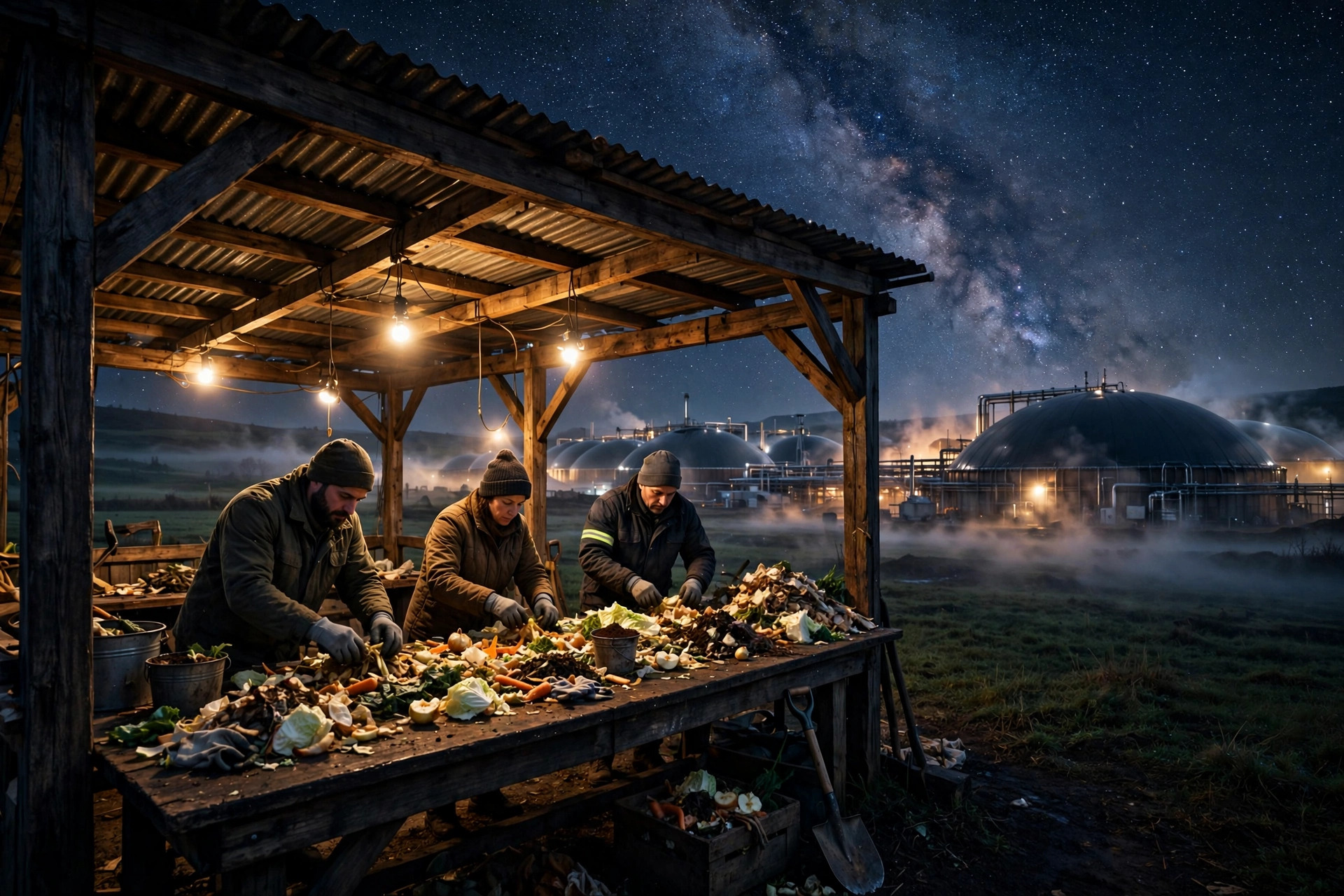
The first crate of the night hit the sorting table with a wet, settling thump. Teodora Vance was already reaching into it. Coffee grounds, onion skins, the soft grey collapse of a lettuce someone had meant to eat. Under that lay a twist of rubber band and a bottle cap, and she flicked both into the reject bin without looking.
"Bottle cap," Wren said from the far end. She didn't look up either.
"Got it."
"I know you got it. I'm telling you I heard it."
The oak had gone dark and smooth along its edges where years of forearms had leaned. Wren had planed those boards herself, the first winter, when the cooperative was a shed, a borrowed tank, and a lot of argument. Pale grooves ran down its length where steel scrapers had pushed scraps toward the chutes. The chutes fed the hopper, and the hopper fed the digesters. Out past the shed wall the big domes sat breathing in the dark, their membranes swelled up with gas, a warm sour smell hanging over the whole of Saltmarrow Yard. Neighbors on the Harlan Quay side complained about the smell every summer. Every winter they bought the heat.
Priya worked the station beside Teodora. She was fast and careful, and she apologized too much. She held up a fruit sticker on the tip of one gloved finger. "These ones, always?"
"Always. They don't break down. You'll find them in the finished compost a year from now and curse whoever let them through."
"Then I curse myself in advance." Priya flicked it away. "In my town we fed scraps to goats. The goats ate the stickers too."
"Did the goats complain?"
"The goats complained about everything."
Wren laughed, a short dry sound, and pulled something from her crate that made her go quiet. A foil-backed card, half its pockets punched through, two still sealed. She turned it in the overhead light, read the print on the back, and set it in the small steel tray she kept at her elbow. Then she wrote in the stained notebook beside it. Teodora had seen her do this for years and had never once asked what the notebook was for. Wren wrote in it the way other people hummed.
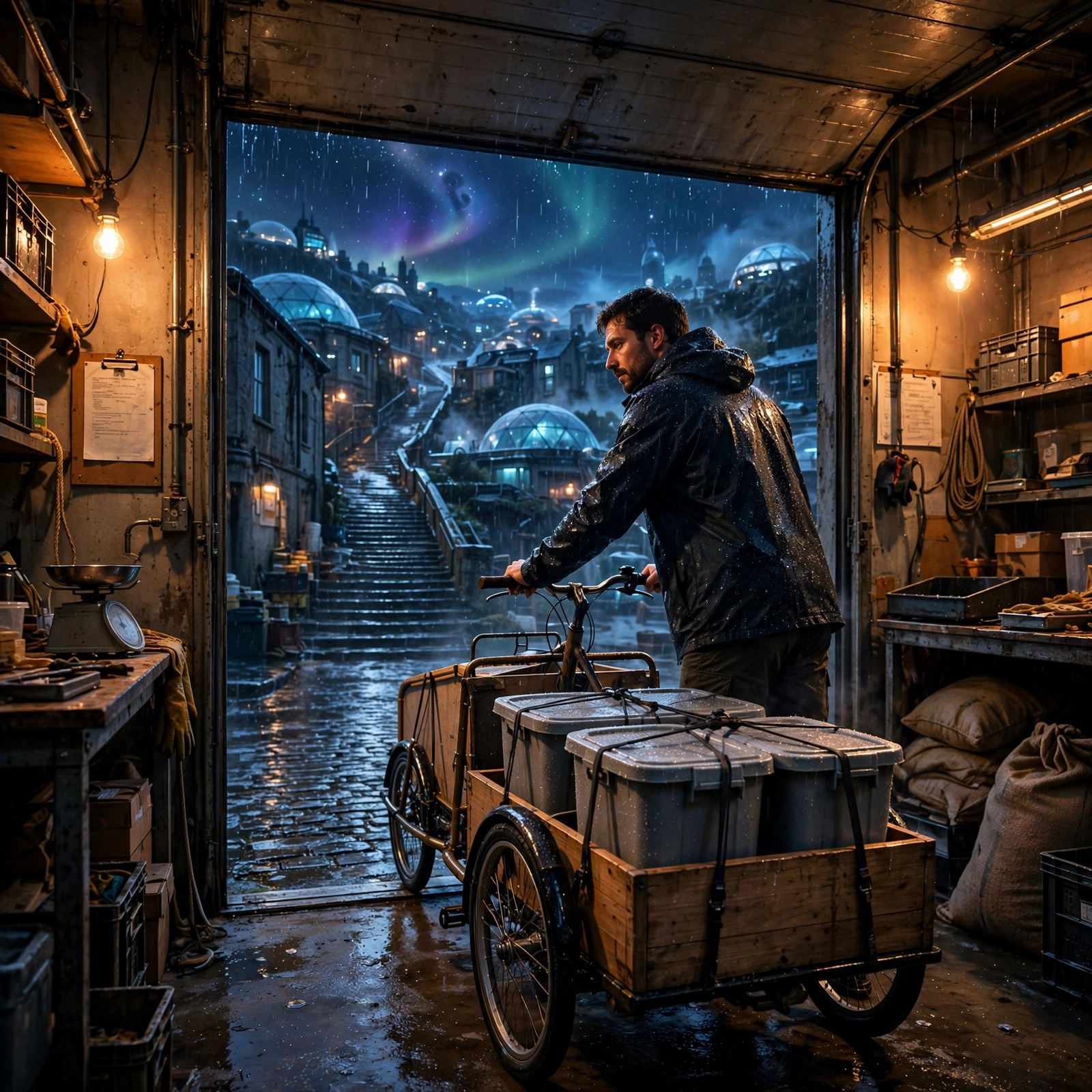
The bay door rattled up. Callum backed his cargo bike in, the long box on the front stacked with lidded bins, rain beaded across his jacket. He had the night look, cheeks flushed with cold, eyes still somewhere out on the route.
"Harbour end's done," he said. "Upper Quay's done except number nine on the stair street. Nobody answered."
Wren's pen stopped. "The man with the bad leg?"
"Light was on. Bin was out from yesterday, not today's." Callum unstrapped the first bin and slid it onto the table. "I knocked twice. I'll swing back after the run."
"Swing back now," Wren said.
"Wren, I've got another loop--"
"Then I'll call his daughter." She was already peeling off a glove. "Bin's out from yesterday is not nothing."
Nobody had ever written this into the rota. It had grown, like moss, out of the fact that Callum knocked on the same doors every night and the sorters knew what came out of every kitchen. Somebody stopped eating. Somebody started throwing out whole meals. A household that had always sent peelings sent nothing at all. Wren noticed, and she made calls, and twice in the years Teodora had run the yard, somebody had been found on a kitchen floor in time.
Callum didn't lift the next bin right away. He stood at the end of the table, dripping, and took a folded paper from inside his jacket.
"This was pinned at the gate. Same one's up outside the Tidewell Assembly Hall. They're posting it at every stop."
Teodora knew what it was before he opened it. She knew the district seal, the clean grey type. She'd seen the earlier versions on her screen for weeks and had closed the file each time, telling herself it would stall in committee the way most things did. Augustin Mbeki's plant. Sealed, automated, efficient, the kind of drawing that showed no people in it at all.
"It's the full draft," Callum said. "Not the summary. They've set the vote for day six."
Priya's hands slowed. Wren's didn't.
"Read it out," Wren said.
Teodora held out her hand, and Callum gave her the paper. It was heavier than it looked, several sheets folded together, damp at one corner. She didn't unfold it. She tucked it into the chest pocket of her apron, under the strap, and pressed it flat.
"After shift," she said.
"Teo."
"After shift, Callum. We've got the whole of Upper Quay still on the table."
He looked at her the way he'd been looking at her since autumn. It wasn't angry. It was tired, like a man watching someone step around the same hole every morning when they could just fill it in. He'd asked her twice to come with him to Augustin's open session. Both times she'd had a digester to burp, a schedule to fix, a reason.
"I'll go check on number nine," he said finally, and turned the bike around.
"Callum." She caught the cuff of his jacket. Under the wet canvas his wrist was warm. For a moment neither of them moved. She could have said something then, the true thing, which was that she was frightened and didn't know how to be frightened in front of him. What she said was "Take the dry gloves. They're on the hook."
His mouth tilted, not quite a smile. He took the gloves. The bay door rattled down behind him.
Wren had stopped writing. "You've read it, I suppose."
"Not this version."
"But the others."
Teodora pulled the next bin toward her and began working through it. Tea bags, a heel of bread gone blue, eggshells crushed fine by someone who cared. "Optical sorters," she said. "Cameras and air jets on a belt. It picks out anything that isn't food and blows it into a side bin. Sealed hall, no smell, cleaner gas. He's got numbers on every time we've let plastic into the tanks."
"We have let plastic into the tanks," Wren said.
"I know."
"The batch last spring. That was my shift."
"I know, Wren."
Priya had gone very still. "The belt," she said. "It doesn't need..." She tipped her head down the table, at all of them.
"It needs some people," Teodora said. "Fewer."
"How many fewer?"
Teodora didn't answer. Priya had been at the yard for a single year. She'd come with one bag and a cousin's address, and the rota had been the first place in this country that printed her name in a list next to other names. Teodora had watched her find it on the board that first week, touching the chalk letters as if testing they were real.
Wren picked up the foil card from her tray and held it a moment longer than she needed to, then put it back. "Cameras see a great deal," she said, mildly, and went back to her crate.
They worked. The rain eased on the roof. The domes outside ticked and settled as the night cooled. Teodora's hands knew the job well enough that her mind could wander, and it wandered to the paper against her ribs. She had a sense of its weight, the corner that had gone soft with damp, the words she hadn't let herself read. Somewhere in it would be a figure for crew. She already knew it wasn't forty.
Near the end of the shift Callum's message came through on the shed speaker, thin over the wind. Number nine had fallen in his hallway. He was cold and embarrassed and fine. The daughter was on her way. Wren closed her notebook and let out a long breath through her nose, and that was all.
At dawn Teodora wiped down the table, the oak darker still where the wet cloth passed. Then she crossed to the slate board on the shed wall, chalk in hand, the way she did at the end of every night. She planned the next week here and made the swaps. She rubbed out a name when someone left and wrote one in when someone came.
Forty names, in her own square capitals, edge to edge. Wren's at the top of the night column. Priya's near the bottom, the chalk slightly fresher. The board was full. It had been full for a long time, and the frame she'd salvaged that first year had begun to split at one corner.
She stood there with the chalk until the light came grey through the high windows. Then she set the chalk down on the ledge, the paper still unread against her chest, and erased nothing.
Augustin's Model
Augustin had brought the model in a cake box. He set it on the end of the sorting table, where the oak was cleanest, and lifted the lid with both hands as if something inside might wake.
"I know how this looks," he said. "A man from the district office, carrying a toy into your shed the morning after the draft goes up."
"It looks like a cake box," Teodora said.
"It was my wife's idea. She said nobody shouts at a cake box."
Callum stood by the door with his helmet still on, rain beading on the shell. He'd come straight off the early loop, and the cargo bike ticked behind him under the eave, its bins half full of peelings and coffee grounds. He didn't sit down. Teodora noticed that and tried not to.
The model was white printed resin, the size of a sleeping cat. A long sealed hall with a sloped roof, a run of conveyors inside it visible through a cutaway wall, two squat digesters at the far end that were plainly the cousins of the domes outside, only tighter, cleaner, with no patched seams. Augustin turned it so the cutaway faced her. Tiny camera heads hung over the belt like reading lamps.
"Nothing escapes the building," he said. "Air's pulled through a biofilter before it leaves. The neighbors on the quay stop smelling you on warm evenings. The gas comes out steadier, so the district can lean on it in winter instead of treating it like a pleasant extra."
"We've never been a pleasant extra."
"No. You've been the reason half of Harlan Quay district cooks dinner." He said it simply, and she believed he meant it. That was the trouble with Augustin. He always meant it.
He unfolded a tablet and laid it flat beside the model, and the screen filled with the yard. Not a photograph. A map of the past few years, with small marks scattered across it, some grey, some amber, a handful red. He touched one of the red marks and it opened into a note in a clerk's flat language. Digester two, foaming event, feedstock contaminated. Another: plastic film fouling the outlet, gas flow interrupted, households on the east lane switched to backup. Another: a dome taken offline for cleaning after something in the feed soured the microbes for days.
"These are yours," Augustin said. "I didn't invent any of them. They come from the gas side, from the meters and from the maintenance crews you call out. I just put them on one page."
Teodora looked at the red marks. She remembered most of them. The foaming in the wet spring, the crew in waders and masks skimming grey froth off the inspection hatch while the whole shed reeked of something rotten and sweet. The week the east lane went cold because a roll of cling film had come through in a bin of carrot tops and nobody's hands had found it.
"Hands get tired," Augustin said. "That's not a criticism of anyone. At the end of a night shift a person is looking at their hundredth crate, and the light's bad, and they miss things. A camera at the end of a night shift is looking at its hundredth crate exactly the way it looked at its first."
"And it misses other things," Callum said from the door.
Augustin turned toward him, open, interested. "Tell me which. I want the list."
Callum glanced at Teodora. It was a short look, and it asked her to answer, and she felt it land somewhere under her sternum. The draft was still in her apron. She could feel its soft corner. She had told herself, all through the weeks it had sat on the district noticeboard as a rumor and then as a summary and then as a full document with a vote attached, that something would happen. Funding would slip. Someone louder than her would object. Augustin would get a better offer from a bigger town.
"It's not a list," she said. "It's more that we know the route."
"Know it how?"
She opened her mouth and found she didn't have a sentence ready. That wasn't how the yard worked. The yard worked because Callum came back off the loop and mentioned that a house on the hill hadn't put a bin out in three days, and somebody on the shift knew the woman who lived there, and somebody else walked up after work. It worked because a crate of scraps told you things if you'd been reading them for years. She couldn't put that on a tablet.
"People pay attention," she said finally. "That's all. The crew pays attention."
Augustin nodded slowly, and she watched him decide to be kind about it. "I believe that. I'd like the new plant to keep some of that. There'd be jobs. Maintenance, the control room, outreach. Not forty. I won't pretend forty."
The number hung in the shed. Out on the wall, under the high windows, the slate board held every one of those names in her square chalk capitals, and none of the three of them looked at it.
"How many, then?" Callum asked.
"That's for the assembly. I've proposed a range."
"You've proposed a range." Callum pulled his helmet off at last and held it against his hip. His hair was flattened and wet. "Teo. Say something."
"I'm listening to him."
"You've been listening for weeks."
Augustin put the lid back on the cake box, gently, the way someone might give a couple privacy in a kitchen that wasn't theirs. "The vote's on day 6," he said. "Tidewell Assembly Hall, morning session. I'd rather go in with your objections than without them. If the cameras are blind to something, I need to know what. I'm not trying to win against you, Teodora. I'm trying not to build the wrong thing."
"Then why does it look like a building with no people in it?"
It was Callum who said that, not her. She heard how it should have come from her mouth.
Augustin didn't flinch. "Because the people I talk to on the quay want to open their windows in August. Because last winter a family on the east lane ran a space heater off a battery for two nights and the battery caught. Nobody was hurt. Next time somebody might be." He looked back at Teodora. "Those are real neighbors too."
She knew the family. She'd sent a crew over with soup.
Callum set his helmet down on the table so hard the resin model jumped in its box. "I've got the second loop," he said, to nobody, and went out. Through the open door she watched him swing onto the bike and push off into the drizzle, bins rattling, not looking back. The door swung most of the way shut and stuck on the warped sill, letting in a cold blade of air that smelled of the domes.
The shed was quiet. A crate of last night's pulls sat at her elbow, waiting for the morning shift: bread bags, a rubber band, a coil of twine. Beyond it, at the night end of the table, Wren's steel tray sat empty and wiped, her notebook gone home with her.
"I'm sorry," Augustin said. "I didn't come to start that."
"You didn't start it."
He waited. He was good at waiting. She thought that, under other circumstances, she might have liked working with him.
Under the bench, in the drawer with the spare gloves and the first-aid kit, was the yard's own record. A cloth-bound book, swollen with damp, its spine taped twice. Every shift lead had written in it since the first winter: what came through that shouldn't have, what was pulled, what got missed, who noticed. Wren's handwriting ran all through it, small and slanted. Teodora had never thought of it as evidence. It was just what they did.
She knelt and pulled the drawer. The book stuck on a corner of the kit and came free with a tear of tape. She stood up holding it in both hands, the cover cool and slightly soft, and for a moment she thought about putting it back.
Then she held it out across the oak. "You wanted our side," she said. "It's in here. Bring it back."
Augustin took the incident log carefully, as if it were heavier than it looked.
Night Shift
The domes were breathing when Teodora came back across the yard, their skins lifting and settling under the floodlights the way they always did after a heavy feed. She had meant to go home. She had got as far as the gate and stood there with her hand on the latch, thinking of Callum's side of the bed, and turned around.
The shed door was propped with a brick. Inside, the night end of the table was lit and busy. Wren worked at her station with her sleeves pushed up and her glasses on a cord, and Priya worked beside her, both of them moving fast, hands in and out of the scrap stream like birds at a feeder.
"You're on days," Teodora said.
"I was on days." Wren didn't look up. She lifted a wad of onion skins, shook it, and something small and foil-backed dropped into her steel tray with a click. "Now I'm on nights as well. Someone has to get the numbers down before that man counts them."
"Wren, you did a full shift this morning."
"And I'll do one tomorrow. Priya, the lid bin. There, under the peel."
Priya fished out a jar lid with two fingers and set it aside. She glanced at Teodora, a quick apologetic look, as if she'd been caught somewhere she shouldn't be. "I asked to stay," she said. "She said I could learn faster on nights."
"She's right about that." Wren's voice had a dry, ward-sister briskness that Teodora had heard soften exactly twice in all the years she'd known her. "Mornings, everybody's polite. Nights, you see what people actually throw out."
Teodora took a pair of gloves from the drawer and stood across from them. It was easier than talking. The stream came off the bike crates sour and warm: coffee grounds, rice crusts, a whole bruised cabbage, tea bags with the strings still on, a plastic fork. She pulled the fork. Her hands knew this better than any meeting.
The draft was still in her apron pocket. She could feel the fold of it against her hip every time she leaned in.
"Callum came through on the second loop," Wren said after a while. "He didn't stop for tea."
"He's angry with me."
"I gathered." Another click in the tray. "He told the woman at the end of the east lane her hallway smelled of gas, and she called the supply people, and they found the fitting loose. That's what he does when he's angry. He looks harder at everything."
Teodora didn't answer. Priya looked between them and bent closer to the stream.
They worked. The floodlights buzzed. Somewhere out in the yard a pressure relief vented with a long soft sigh and the smell drifted in, eggy and faint, and was gone. Wren's pace didn't slow, but around midnight Teodora noticed her standing with one hip against the oak, taking her weight off her left leg, and then a little after that, pausing with a tea bag in her hand and looking at it as if she'd forgotten what it was.
"Sit down for ten minutes," Teodora said.
"When this crate's done."
"Wren."
"When this crate's done, Teodora." She reached across for the far edge of the pile, and her knee went.
It wasn't dramatic. That was the worst of it. Her face went slack and puzzled, and she tipped sideways onto the table the way a tall coat slides off a hook. Her left hand shot out to catch herself and found the gap between two boards. Her whole weight came down on that arm and that corner at once. Teodora heard the wrist before she heard the wood, a small wet snap, and then the leg under the night end split with a crack like a branch in frost, and the table dropped at that corner and threw scraps across the floor.
Wren landed on her side among the peelings and didn't make a sound.
Teodora was around the table without knowing how. Priya was already kneeling, already saying Wren's name in a low steady voice, already turning her own body so Wren's head rested on her thigh and not the concrete.
"Don't move her arm," Wren said. Her eyes were open now, very clear. "Radius. Distal. I felt it go." She breathed through her teeth. "I didn't hit my head. I went light. Didn't eat. Stupid."
"Ambulance," Teodora said, and her hands were shaking so badly on her handset she had to say it twice to make it understand.
The dispatcher's voice was calm and far away. Somebody was coming from the Harlan Quay station. Keep her warm. Don't give her anything to drink. Teodora pulled her jacket off and laid it over Wren, and Wren made a face at the smell of it and almost laughed and then went grey around the mouth and stopped.
"I'm sorry," Teodora said. "I should have sent you home. I should have said something days ago."
"You should have said something weeks ago," Wren said, with her eyes shut. "But not to me."
The broken leg of the table stood beside them, split along the grain, the steel bracket Wren and the first crew had bolted on bent outward like an elbow. The whole night end sagged. Wren's tray had slid down the slope and wedged against the cabbage, and her little book had skidded off the oak and lay open on the floor, face down, its pages bent.
Priya reached for it to keep it out of the mess. She turned it over, and stopped.
"Teodora."
"Leave it, love, it's just her tally."
"No, look." Priya held it up into the light. The pages were ruled in Wren's small slanted hand, column after column, but they weren't the general log. Every line was the same kind of thing. Dates, route sections, a house described by its door colour or its dog, and beside each one a word: blister, blister, foil strip, blister, half-full, blister. Some lines had a second note squeezed in. Same house as last week. Heart pills, I think. Tell C. Insulin pen cap. Told C, he knocked, she was fine. Full strip, unopened, the old man by the chandlery. C says he's stopped taking them. Rang the clinic.
Teodora took the book. The paper was soft at the edges from handling.
"They come through in the peels," Priya said quietly. "Blister packs. The plastic's clear and the foil's wet and crumpled, it looks like onion skin, like nothing. Wren showed me my first week. She said you only find them with your fingers." She swallowed. "On the quay, before, we had machines at the depot. Cameras over a belt. They used to miss exactly this. Clear plastic on wet green. Everybody knew. Nobody wrote it down."
On the floor, Wren opened her eyes. "His sorters," she said. "Light ones. I read the spec sheet at the library." She drew a breath against the pain. "They'll catch a fork. They won't see these. And they won't tell Callum which door."
Teodora stared at the page. She thought of the incident log she'd handed across the oak, all those years of what got pulled, and how nowhere in it had anyone written why it mattered whose it was. Wren had kept that part separately. Wren had known it was the part nobody would count.
"Why didn't you show me?"
"I was going to. Day of the vote." Wren's mouth twisted. "You weren't asking."
Outside, the yard filled with pulsing blue. Boots on gravel, a stretcher, two paramedics who knelt in the onion skins without comment. One of them splinted the wrist while Wren told her, crisply, how to do it. Priya held the free hand the whole way out to the door. At the threshold Wren turned her head on the pillow.
"Forty names on that board, Teodora," she said. "Every one of them has hands."
The doors closed. Priya climbed in after her. Teodora stood on the gravel in her shirtsleeves with the domes breathing behind her and the ambulance light sweeping over her again and again, blue across the split corner of the shed, blue across the notebook open in her two hands, Wren's slanted columns running on past where the light could reach.
Tidewell Assembly Hall
The rota board was heavier than Teodora remembered, and the split corner of its frame bit her palm every time she shifted her grip on the hall steps. She carried it slate-out against her chest the way she'd once carried it up from the salvage barge, before there was a yard, before there were names to chalk on it. The doors of Tidewell Assembly Hall stood open to the morning. Inside, the folding chairs were already filling with people from the Harlan Quay district, raincoats steaming, children's drawings of the harbour pinned along the back wall.
Priya held the door with her hip. "You want it at the front?"
"Where he can see it."
They propped it against the table leg beneath the dais, where Augustin's resin model already sat on its plinth: the sealed domes, the clean conveyor, the little white cameras on their gantry like a row of patient birds. Beside it, the board looked like what it was. Old slate, chalk smeared by forty different thumbs, the names in Wren's careful capitals and Callum's scrawl and Teodora's own blocky hand. Priya's name was the newest, near the bottom, still bright.
Callum was standing by the side aisle with his bike helmet hooked on two fingers. He hadn't come home last night. He'd slept, she guessed, on the cot in the route shed, and now he looked at the board, and then at her, and didn't come over.
Augustin came over instead. He wore a pressed shirt and had her cloth-bound incident log under his arm, a coloured tab sticking out of every few pages.
"I'm sorry about Mrs Okonjo," he said. "I heard this morning. Is she--"
"Cast to the elbow. She's furious she can't come." Teodora pulled Wren's notebook from her apron and held it out. "She wanted you to have this before the vote. She meant to give it to me today. I should've asked for it weeks ago."
He took it carefully, as if it might be evidence, and opened it standing there. She watched him read the columns. Blister. Foil strip. Told C, he knocked. His thumb stopped on a line and stayed there.
"Your sorters won't see those," she said. "Clear plastic on wet greens. Priya worked a depot with the same cameras."
"They miss them," Priya said. "Every shift. We used to joke the machines were blind on salad."
Augustin didn't argue, which was worse. He turned another page. "I have digester fouling from pharmaceutical load," he said quietly. "I've been treating it as a gas-side problem. I never asked where it came from in a household sense." He looked up. "This is a welfare register, Teodora. Kept in pencil. By one woman."
"Two now. Priya's been learning it."
"It isn't a reason to keep the odours and the grit and the fouled pipes. People downwind of your yard file complaints. Those are real. The children's ward at the clinic has had respiratory visits I can map against your bad weeks."
"I know they're real." She did. She'd known it the first day, with his draft folded unread in her apron, and she'd let it sit there because reading it meant answering it. "So I'm not here to beat you."
He waited.
"Put your domes in. Seal it. Clean gas, no smell over the quay. But keep the hand line ahead of the cameras, and keep the crew on it. All of them. Written into the plant charter, with crew seats on the operating board, not advisory, voting." She made herself say the rest. "And I step down as lead. You run one plant. You don't have to fight me inside it."
Across the aisle Callum's helmet slipped off his fingers and knocked against a chair.
Augustin closed the notebook. "You'd give up the yard."
"I'd give up being in charge of it. That's different. Wren taught me the difference about three days ago, lying on the floor."
He looked at the model, then at the board, for a long moment. "A hand line costs more than the cameras. The finance committee will hate it."
"Then tell them what the lenses catch."
The chair rang the bell for order before he could answer. He went up to the dais with the notebook still in his hand.
The debate went badly at first. A woman from the downwind terraces stood and described keeping her windows shut through summer. A finance member asked why a modern plant should carry forty salaries it didn't need. Teodora answered as plainly as she could and heard her own voice thin out in the high room. Someone near the back muttered that the yard was a charity with a smell. She felt the vote leaving.
Then Augustin stood. He amended his own motion from the floor, read three lines from Wren's notebook aloud without the house numbers, and said, "My cameras would have passed every one of these into the digester and told no one. I'd like the crew kept, and seated." He sat down before anyone could applaud or object.
The chair called a short recess before the count. Teodora walked out the side door into the bike shed, where the district's cargo bikes stood in their racks smelling of rain and oil, and leaned against a crate of panniers because her knees had gone strange.
Callum followed her in. He stood a little way off, the way he had all week.
"You didn't tell me," he said.
"I didn't decide until I saw his face reading her book."
"Nine years, Teo."
"I know."
"You built that board."
"It'll still have the names on it. That's what it's for."
He crossed the shed then, fast, and took her face in both cold hands and kissed her, hard, his forehead pressing hers after. She tasted rain and the salt of one of them crying, she couldn't tell whose. It was relief and it was a funeral, both at once, and she held his jacket in her fists until the bell rang inside.
"Go on," he said hoarsely. "I'll be at the back."
The count was by raised hands, then recounted by cards because it was close. Teodora stood beside the rota board and did not look at the tellers. Priya's fingers found her sleeve and gripped. The chair read the numbers twice, frowning, then once more aloud.
The hybrid plan passed by a margin so thin that a single rained-out voter would have sunk it. Nobody cheered. Priya let out a long shaking breath, and from the back of the hall Callum raised his helmet over his head like a lantern, and Augustin came down off the dais and set Wren's notebook gently on top of the slate, square against the split corner, holding it closed.
New Planks
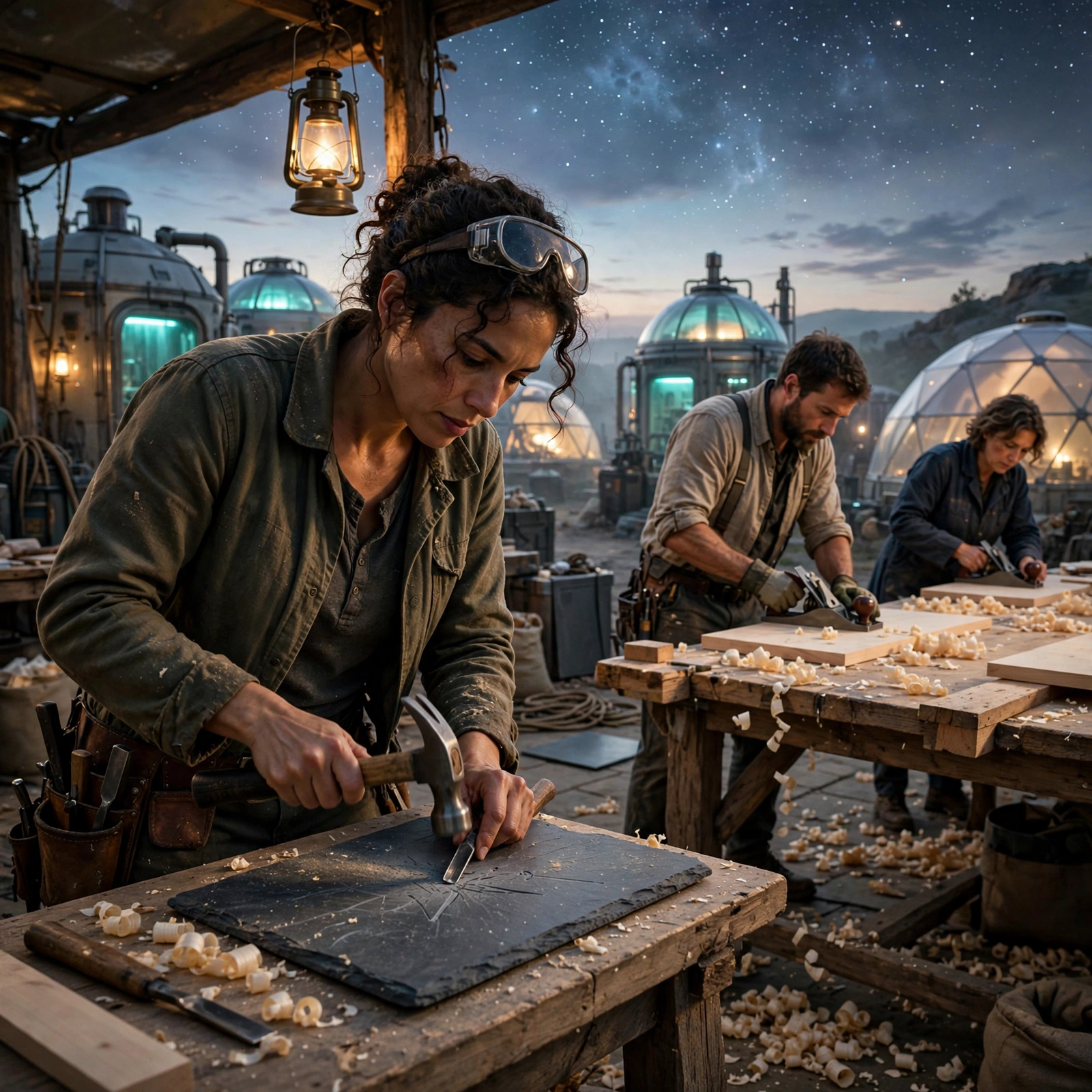
The new oak came off the cart still smelling of the barn it had been pulled from. Callum and Priya walked each plank in between them while Wren stood at the night end of the table and pointed with her good hand. Her left wrist was a stiff white shell from knuckles to elbow. She had drawn chalk marks on the floor where the extension would meet the old wood.
"Not there. You'll catch the bracket. Further." Wren tapped the air. "There."
Teodora held the far end of the next plank and did not say anything. Three days ago she would have been the one pointing. This morning she had clocked in at the shed door like everyone else. Her apron was the plain canvas kind, and her name was on the slate in the same chalk as the others. Nobody had made a fuss. Priya had handed her a pair of sorting gloves, and that had been the whole ceremony.
The night-end leg Wren had split in her fall lay against the wall with its bent bracket still bolted on. Callum had cut a new leg from a beam salvaged at the quay. He knelt now with the drill and set it, and the table took the weight with a long complaint of old joints. Then it held.
"She's always talked," Wren said. "Means she's listening."
Augustin arrived mid-morning with a roll of drawings under his arm and his good shoes already ruined by the yard. He stopped inside the door and looked at the table, which now ran past the drain channel almost to the leachate grate. He didn't step in until Wren waved him in.
"Longer than I drew it," he said.
"Your drawing had room for twelve hands on the line," Teodora said. "We rotate forty. Some days we need more than twelve standing."
He unrolled the sheet on a clean stretch of the new oak and weighted the corners with a jar of bolts and a brick. The hybrid layout was all there. The sealed digesters stood where the old open bays had been, with the cameras and air jets downstream, and a short red line crossed ahead of everything. In his neat hand, the red line read HAND LINE.
"The charter wall goes here." He touched the spot by the new entrance. "Board approved the inscription last night. Every crew name, cut in, not painted. If anyone ever wants to automate the hand line out, they'll have to take down a wall with forty names on it at a public meeting."
Priya looked at him for a long moment. "Cut in by who?"
"There's a stonecutter on the district list."
"No," Wren said.
Augustin waited. He had learned that much this week.
"The slate goes into the wall," Wren said. "Her board." She tipped her chin toward Teodora. "Bolt it in whole, split corner and all. We cut the names ourselves. Chalk washes off. I'm tired of things that wash off."
Teodora felt the room turn toward her and kept her hands on the plank. She had built that frame from a broken school blackboard and a door lintel her first winter as lead, when there were barely enough people to fill one shift. Now it was not hers to give. That was the strange part.
"Ask the crew," she said. "I just sort here."
Callum glanced up from the drill. It wasn't quite a smile. Something in his face had loosened since the bike shed and hadn't tightened again.
The morning tubs came in at eleven. The work did not stop for drawings. Teodora took a place midway down the old wood with Priya on her left. The first tub was mostly greens, slick from rain and the ride, coffee grounds packed between them, a twist of string, a ceramic shard. Her hands knew the work better than her head did these days. Plastic went in one bin, grit in another, and the clean mass slid down the boards to the hopper.
Halfway through the second tub, Priya's glove stopped.
She lifted a clear blister pack out of a fold of spinach. It was almost invisible, wet plastic on wet leaves. Half the pills were still in their bubbles. She turned it to read the foil and her mouth went flat.
"Whose route?" Teodora asked.
Callum leaned over from the new end. "Mine. Upper terraces." He took the pack, wiped the foil with his thumb, and frowned. "That's the man above the chandlery. He's been tossing them every week since the flooding."
"Tossing full ones?" Wren came down the table, one-handed, and held the pack to the window. Her nurse's voice came back, the one she didn't use for anything but this. "That's not a refill he forgot. He's stopped taking them."
Augustin had gone very still beside his drawing.
"I'll knock on my way out," Callum said. "Bring him bread. He'll talk if there's bread."
Wren took a pencil from behind her ear and held it out, not to Callum but to Priya. "You found it. You log it."
Priya looked at the cloth-bound book on the shelf, then at Wren's wrist. She took the pencil. Her writing was small and careful and slanted the wrong way from Wren's. She wrote the house, the day, what was in the pack. She wrote for Callum at the end and underlined it.
Augustin rolled his drawing up slowly. "The cameras would have read that as leaf glare," he said, to nobody in particular.
"Yes," Wren said. "They would."
They took the vote on the slate at the lunch break, standing around the table with their tea. It was a shed vote, by hands. Nobody counted out loud. Nobody had to. Afterward Callum unscrewed the board from the wall, carrying it as if it might bite, and laid it face up across the old end of the table on folded sacking. The split corner had widened in the damp. All forty names were still there in chalk, some fresh, some ghosted where they had been wiped and rewritten over the years.
Augustin produced a cold chisel and a small mallet from his bag. He looked a little embarrassed about it.
"I thought someone might ask," he said.
The first cuts went slowly. Wren could only steady the slate, so Callum cut her name while she told him where his line wandered. The stone came away in pale grey flakes that settled into the grain of the oak. Then the crew took turns. Some names were cut cleanly. Some were crooked, and their owners laughed and said leave it. Teodora cut her own small, in the bottom corner where she'd always written it, and found she didn't mind how small.
When it came round to Priya, the young woman shook her head and held out the chisel.
"You do mine. My hand shakes."
"So does mine."
"Then it'll match."
Behind them the rest of the oak lay stacked against the wall, unplaned, the boards for the next length of table that Wren already had chalked on the floor. Callum had gone out to the cargo bike with a loaf under his arm and the blister pack in his breast pocket. The afternoon tubs were rattling up the ramp.
Teodora set the chisel point on the slate, just under Wren's name, close enough that the two would share an edge. She checked the angle once. Then she brought the mallet down, and the first stroke of the P bit clean into the stone.
Get notified when new stories drop

Ren Hollis
Ren writes frontier worlds and terraforming triumphs — habitats, gardens under glass, and the first rain on a new world.
Leave a comment
Comments