





Night Intakes
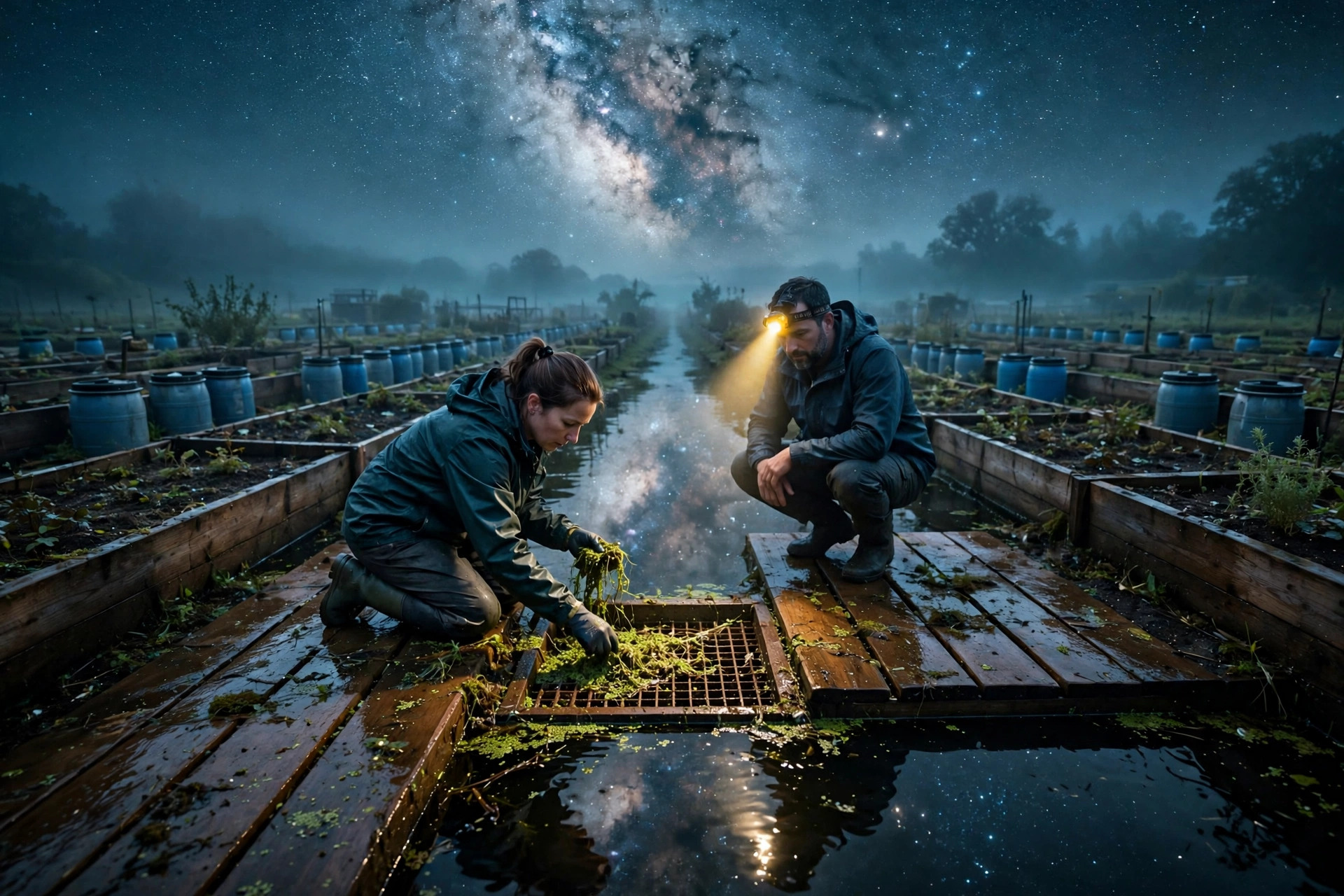
The intake grate at the third pump had already caught a fist of duckweed and a plastic seed tray. By the time Dagny Ostrander knelt on the wet planks, the lift pump had begun to labor. She heard it in the motor, a low complaint, the way a dog growls before it decides to bite.
"Again," Paavo said from the bank. His headlamp swung over the channel and found her hands. "That tray's from the Nakamura-side beds. Somebody's compost is walking."
"Somebody's compost is always walking." She hooked the tray free and flung it onto the grass. Then she worked her fingers through the mesh, pulling out weed in cold green ropes. The pump's note rose and evened. Upstream the solar bank had gone dark hours ago, and the batteries were carrying the night shift. They carried it well as long as nobody made the motors fight.
Paavo crouched beside her and ran a thumb along the grate's welded edge. He'd rebuilt this one in the spring. He'd rebuilt most of them. "Board people came through the sluice house this afternoon. Took pictures of the wheel."
"The wheel's photogenic."
"They took pictures of the grease, Dagny." He let that sit. "Like they were checking whether it was real."
She sat back on her heels. Across the Lowfield gardens the beds lay in long dark strips, raised a hand's height above the ditches, each with its rain barrel and its clutter of stakes. The river was a smell more than a sight tonight, mud and cold stone. Behind her, in her shed, the roster book lay open on the bench where she'd left it, every household's turn at the pumps written in her own cramped pencil. Forty-one households. She'd written the first page her first season as lead, when there had been fewer names and more hope that someone else would do the arithmetic.
A second light came along the main path. It moved carefully and stopped often. It was the light of someone who didn't know where the soft places were.
"That'll be him," Paavo said.
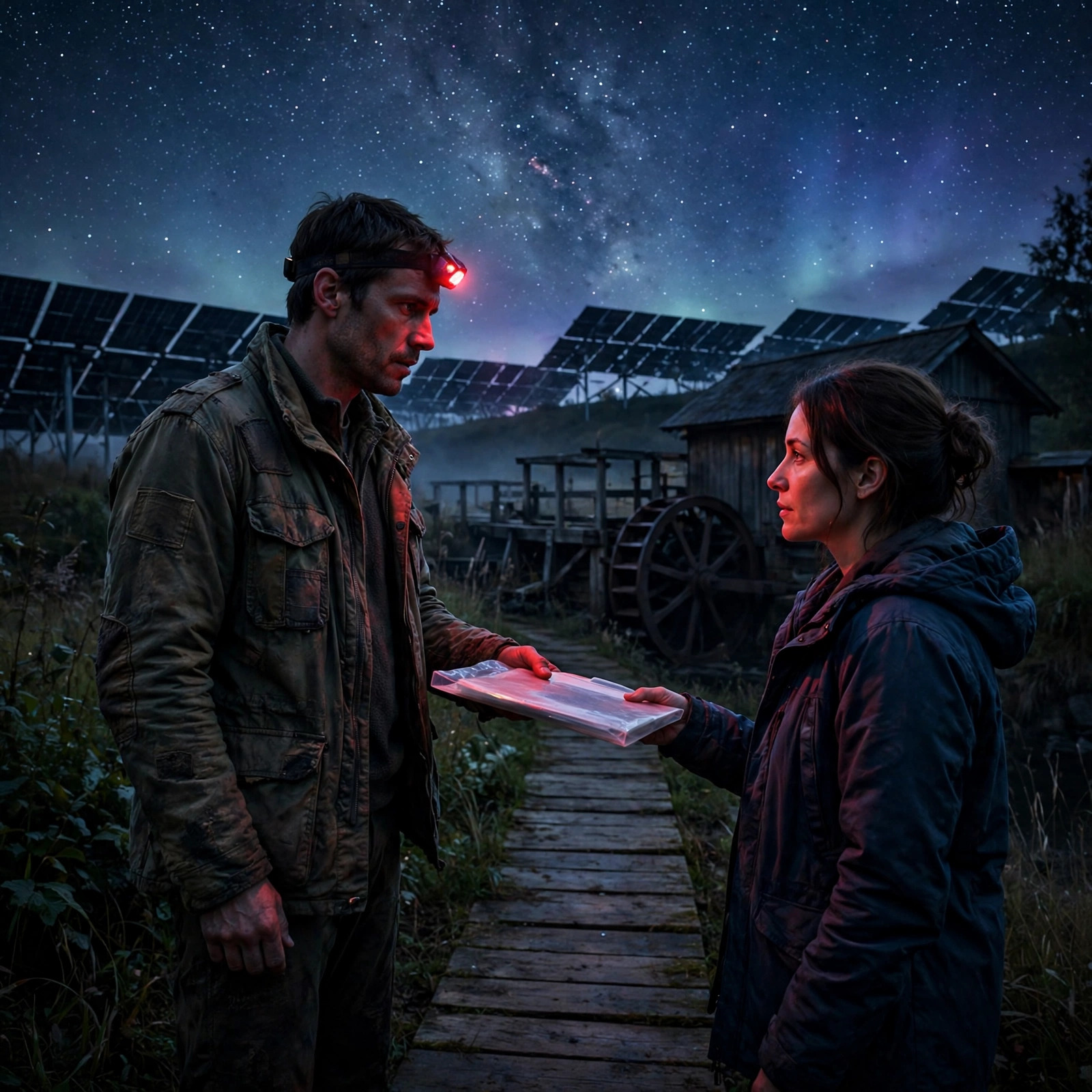
Ikenna Batiste stopped at the edge of the planks and switched his lamp to red so he wouldn't blind them. That was the first thing Dagny noticed, and she resented liking it. He was tall and wore a Water Board jacket that had seen actual weather. He carried a slim folder under one arm, wrapped in a plastic sleeve against the damp.
"I didn't want to come at a meeting," he said. "Meetings make people perform. I thought you should have it first."
"Have what?"
"The plan." He held out the folder. "The full draft. The modeling's in the appendix. I'm presenting it to council next week, and Rosalind wants it on the table before the vote."
Dagny wiped her hands on her trousers. They didn't get much cleaner. She took the folder anyway, and it was heavier than it looked.
"What's it say?"
"It says the floodplain becomes a certified wetland. Restored reed margins, a managed overflow basin, real carbon credit." He looked past her at the beds. "And it says that two winters ago this place came within a few hand-spans of putting the river into the lower streets of Port Calder."
"It held."
"It held because people stood out here all night with sandbags and luck. I've got the gauge records. I've also got the houses on Tanner Row that would've taken that water." His voice stayed even. He wasn't arguing yet. He sounded like a man reading from something he had already decided. "I'm not trying to take anybody's tomatoes, Ms. Ostrander."
"Dagny."
"Dagny. I'm trying to make sure the next one doesn't need luck."
Paavo had gone quiet. He'd gone back to the grate. Dagny knew he was listening, because his hands had stopped moving.
"And who runs it?" she asked. "Your wetland."
"Contracted maintenance. Scheduled inspections. It's fenced for the certification, public viewing paths along the levee..." He caught her face in the red light. "It's in there. All of it. I'd rather you read it than hear me summarize it badly."
The pump note dropped again. Paavo swore under his breath and plunged his arm into the channel. He came up with a knot of root and a drowned glove.
Ikenna watched this with real interest. "Does that happen often?"
"Every night," Paavo said. He didn't look up. "Twice, if the river's turning."
"The intake screens should be rated for…"
"They're rated for a river that doesn't carry a town's worth of garden in it." Paavo slapped the glove onto the planks. "Ask your contractor how often he plans to kneel here at two in the morning."
Ikenna seemed to write that down somewhere behind his eyes. He didn't answer it. Dagny thought that was either honesty or strategy, and she was too tired to tell which.
A third light bobbed down from the upper beds, low and slow, and with it came a voice that had once quieted thirty children at a time.
"Is that the Board man? Has he come to measure my bees?"
Gwendolyn Achterberg came onto the planks in rubber boots and an old cardigan, a smoker tucked under one arm out of habit though she'd have no use for it at night. She was small and moved like someone who'd decided long ago that stairs and mud were opinions.
"Nobody's measuring your bees, Gwen," Dagny said.
"He measures everything else." Gwendolyn peered up at Ikenna. "My husband built that sluice wheel out of a scrapyard and a bad temper. You'll want to photograph that too. Your people did this afternoon."
"It's a fine wheel," Ikenna said, and he sounded as if he meant it.
"It's a fine wheel because Paavo greases it and I nag him." She turned to Dagny. "My hive row's dry at the moment, but the ditch below it's been seeping. You'll mind it?"
"I'll mind it."
Ikenna shifted. "Your hives are along the lower ditch? Toward the east edge?"
"Since before you were born, young man."
He nodded slowly, and something passed over his face that Dagny didn't like and couldn't name. He looked at the dark beds the way he'd looked at the folder. He was seeing lines on a map that she couldn't see.
"There'll be a test," he said to Dagny. "A short drawdown through the sluice, to check the basin model before the vote. It's scheduled. I'll send the dates."
That was when she should have said it. She had the sentence ready. You can't run this place with a schedule, and you can't fence out the people who keep the pumps breathing. The words were right there. She could feel their weight, the way she could feel the folder's weight.
She looked at Paavo's wet arm, at Gwendolyn's boots, at the red light softening Ikenna's tired face. If she said it now, out here, it would be a fight in the dark with nobody to hear it but the people who already agreed with her.
"Send the dates," she said. "We'll talk properly. Before the council."
"I'd like that." He looked at her a beat longer than he needed to, and then he looked away at the river. "Thank you for the shift. I mean that. I've never seen one."
He went back up the path, picking his way, slower than he'd come.
Gwendolyn sniffed. "Polite," she said, as if it were a diagnosis.
Paavo stood and shook water off his sleeve. "You didn't tell him."
"I'll tell him."
"Before or after he drains the channels?"
She didn't answer. She finished the shift. She cleared the grate twice more before the sky went grey over the far bank. When the morning crew came down with their thermoses, she walked to her shed with the folder under her arm.
Inside it smelled of seed and machine oil. The roster book lay open where she'd left it, its pages swollen from damp, every line filled. She closed it gently. Then she set Ikenna's folder beside it on the shelf, still in its plastic sleeve, its seal unbroken. She pressed both flat with her palm, as if one might keep the other from blowing away.
The Board Notice
The notice came on the third morning, pinned to the door of the Lowfield sluice house with a Board staple gun. Dagny found it while the dew was still lifting off the brassica beds. It was a single laminated sheet, printed crisp, with a little map of the channels shaded blue where the water would go down.
She read it twice. Test drawdown authorized. Sluice to be held open for the duration. Garden pumping suspended in the affected cells. Then came the date, three days off, and a phone line for questions.
Paavo came up the path behind her with his tool roll slung over one shoulder. He read it over her arm and didn't say anything for a while.
"Three days," he said finally.
"I know."
"You said you'd tell him."
"I know what I said." She pulled the staple out with her thumbnail and folded the sheet in half. Her own handwriting would have been kinder to the paper. "Where's he working from?"
"Board's got a trailer at the top of the levee road. He sleeps in it, I think. Saw a light there at four."
She went up the road with the notice in her back pocket and mud drying grey on her boots. The trailer was white and humming, a solar skin over its roof, a satellite dish angled south. When Ikenna opened the door he had a mug in one hand and the look of a man who'd been up longer than he wanted to admit.
"You got it," he said.
"I got it on a door. You said you'd send dates."
"I sent them to the garden address. Day before yesterday." He stepped back to let her in. "I don't think anyone reads it."
Nobody did. The garden address was a mailbox on a server that Dagny had set up her first season and checked whenever the seed co-op complained. She felt the heat climb her neck and didn't sit down when he offered the folding chair.
"You can't hold the sluice open," she said. "Not like this. Not without us running the pumps alongside."
"That's the point of the test. I need to see the basin without the pumps. Without anyone." He set the mug on a stack of printouts. A screen behind him showed the floodplain in false color, the low cells bruised dark. "If the wetland's going to hold a winter flood on its own, I have to know what it does when nobody's touching it."
"Nobody's ever not touching it. That's what I'm telling you."
"Then you should have told me on the first night." He said it flatly, without any triumph, and somehow that was worse. "I'd have listened. I'm listening now. But the crew's booked, the river gauge is in its window, and the council wants the model before they vote."
She looked at the screen. Her eyes went where they always went, to the eastern edge, the lowest ground, the place where the ditch bent and her own beds ran out to meet it. It was the darkest patch on his map. She looked away before he could see her looking.
"Then I'll take it to Rosalind," she said.
"Please do." He meant it. That was the trouble with him.
Rosalind Okeke kept office hours at the Calder Reach council hall on the fourth and fifth mornings, in a back room that had been a school library before the district consolidated. The shelves still held faded readers. Rosalind sat under a window with her reading glasses pushed into her hair and a jar of Gwendolyn's honey on the sill, which Dagny took as either a good sign or a bribe someone had already tried.
Ikenna was there too. Rosalind had asked for both of them. Paavo came because Dagny asked him, and he stood by the door with his arms folded and grease still under his nails.
"I'll be honest," Rosalind said. "I've read his plan. Have you?"
Dagny opened her mouth and closed it.
"That's a no." Rosalind didn't look angry. She looked tired the way council chairs always looked tired. "Two winters ago the river came over the east ditch and three streets in Port Calder had water in their front rooms. I was in one of those rooms with a bucket. His plan says it won't happen again. Your gardens nearly didn't hold, Dagny."
"They did hold."
"Nearly." Ikenna kept his voice low. "I've run it a hundred ways. The managed wetland takes more water and stores more carbon, and it doesn't depend on whether people show up on a cold night."
"It depends on that now," Paavo said from the door.
Everyone turned.
He unfolded his arms. "Every night somebody goes down and clears the intakes by hand. Leaves, reed mat, plastic off the river. If you don't, the lift pumps choke before morning and the channels back up. Your contractor's going to come once a week, or once a month. Is that in your model?"
Ikenna was quiet for a moment. "The reserve wouldn't use the lift pumps."
"Then what moves the water when the river's low and the beds are dry?"
"Nothing has to. It's a wetland. It's allowed to be dry."
"And the people who eat out of it?" Dagny said.
Rosalind lifted a hand. "That's the vote. That's exactly the vote." She pulled a calendar toward her, a paper one, and ran her pen down it. "The test goes ahead. I won't stop the Board from collecting its own data, and frankly I want to see it. Then we vote, on the twelfth day, in the hall, with the gardens in the room. Forty-one households, Dagny. I want every one of them there, or I want to know why not."
"Forty-one households," Dagny repeated, and the number sat in her chest like a stone she'd carried so long she'd forgotten its weight. She knew every name. She'd written every one of them into the roster book, in her own hand, in a cloth binding gone soft at the corners.
"And you'll read the plan," Rosalind added.
"I'll read it."
Out in the corridor, Ikenna caught up with her by the old card catalog. Paavo had gone ahead to the truck.
"I'm not trying to take something from you," he said.
"You're doing it very efficiently for someone who isn't trying."
He almost smiled. His face was close and tired, and she noticed for the first time a small scar through one eyebrow, white against brown. She didn't know why she noticed. "Walk the channels with me before the test. Show me what Paavo means. If I'm missing something, I want it in the model."
"Why?"
"Because I'd rather be right than win."
She didn't believe him and she half did. "Tomorrow," she said. "Early."
But tomorrow the Board crew came first.
They arrived on the fifth evening in two electric flatbeds, their headlights sweeping the beds where the beans stood staked and silver in the dusk. Dagny was on the bank with Paavo when they climbed out in orange vests and went into the sluice house without knocking. She followed them in. The room smelled the way it always had, of river and old grease, and the great cast-iron wheel sat in its frame where Gwendolyn's husband and the first crew had bolted it, its spokes worn smooth by decades of hands.
One of the crew, a broad woman with a clipboard, nodded at her. "Evening. Just securing it for the morning."
"Securing it how?"
The woman held up a length of galvanized chain and a padlock the size of a fist.
Paavo stepped forward. "That wheel's never been locked."
"It's protocol for a controlled test. Nobody adjusts the gate mid-run." The woman wasn't unpleasant about it. She sounded like she'd done this at a dozen sluices. "Engineer's orders."
Dagny looked out the small window. Up the levee road, the trailer's light was on.
Two of the crew put their shoulders to the wheel and turned it. The gate groaned somewhere below them, and Dagny heard the river change its voice as it came through, a low steady rush filling the main channel toward the cells. They turned it to the stop. Then the broad woman fed the chain through the spokes and around the iron frame, twice, and snapped the lock shut. The chain was bright and new against the old black metal.
Paavo touched the lock once, lightly, the way he touched a pump that was running hot.
"Hive row's on the east ditch," Dagny said, to no one, to all of them.
The crew were already walking back to the flatbeds. Below the sluice house the water kept coming, dark and patient, out across the Lowfield gardens toward the lowest ground.
Hive Row
Dagny was halfway down the east ditch when she saw the water had already crossed it. The dawn was grey, the sky low over Port Calder, and the river had come through the night without hurry. It had filled the main channel, then the cells, then found the old seam where the east bank had always been soft. Now it lay across the lower path in a brown sheet. It carried bean stakes and a child's sun hat she recognized from the Varga-side beds, though she couldn't have said whose.
Ikenna was beside her in rubber boots too new to have creased. He'd met her at the trailer before first light as promised, a tablet in a waterproof sleeve under his arm, and for a quarter hour they'd walked the upper channels while he pointed and she listened. Then she'd heard Paavo shouting from the east side, and she'd stopped listening.
"That's not in the run," Ikenna said. He was staring at the ditch. "The east margin should hold to the berm line."
"The east margin's a mole warren under the grass. Paavo told your crew that."
"He told them about intakes."
She didn't answer, because she was running.
Hive row sat on a low shelf of ground under the willows, two tidy lines of white and yellow boxes on cinderblock stands. Gwendolyn had kept bees there longer than Dagny had lived in town. The water had reached the stands and was climbing them. The bottom boxes of the front row were already dark to the handholds, and the air over the row was thick with bees. They weren't flying out to forage. They hung and circled in a low, furious cloud, and the hum of them carried over the slap of water against the blocks.
Paavo was at the edge of it, soaked to the thigh, holding Gwendolyn by the arm.
"Let go of me," Gwendolyn was saying. "Paavo. Let go."
"You can't lift them. They're full of honey, they're too heavy."
"I've lifted them for thirty years."
She pulled free. She was in her nightgown under an old waxed coat, and her white hair was loose. She went into the water up to her knees, then deeper, her coat spreading behind her. The bees closed around her. She didn't flinch from them. She went to the second stand in the back row, the one still above the waterline by a hand's width, and set both arms around the box.
"Gwen," Dagny said. "Wait for me."
Gwendolyn didn't wait. She lifted, and the box came up off the stand, and her foot went out from under her on the slick block beneath the surface. Dagny saw it happen slowly. The old woman twisted to keep the hive upright, took the fall on her hip and her wrist instead, and went under to the shoulder with the box held high above her like an offering.
Dagny was in the water before she'd decided to be. It was colder than the morning, and it pulled at her shins with a quiet insistence she'd never felt in the gardens before. She got her hands under the hive. Paavo came in behind her and got Gwendolyn under the arms, and together they hauled toward the willow roots and the bank.
A bee stung Dagny on the neck, another on the back of her hand. She kept walking.
On the bank Gwendolyn sat in the mud and held her left wrist against her chest. Her face had gone a color Dagny didn't like. Her lip was bleeding where she'd bitten it.
"Broken?" Paavo asked.
"Don't fuss." Gwendolyn looked past them at the row. "Get the others."
Dagny looked. The front row was gone to the lids now. In the back row, the water was over the stands. Behind the swarm she could see the brood boxes darkening one after another, the way a page soaks through.
"Gwen. There aren't others."
Gwendolyn closed her eyes. When she opened them she didn't cry. She put her good hand flat on top of the hive Dagny had set beside her, on the wood her husband had planed, and left it there.
Ikenna had come down the path. He stood at the edge of the bank with his tablet, his new boots muddy at last, and he looked at the row for a long time.
"I'm going to call the sluice crew to close the gate," he said. His voice was low. "Now. Before the run ends."
"You locked it," Paavo said.
"I know what I did." He was already speaking into his collar. Then, to the bank, quieter: "I'm sorry, Mrs. Achterberg."
Gwendolyn didn't look at him. "Sorry is for children who break windows."
Paavo took off his jacket and wrapped her wrist against her body with the sleeves, firm and quick, the way he'd strap a hose. "Clinic," he said. "I'll take the cart."
"Bring the bees."
"Dagny will bring the bees."
While Paavo went for the cart, Ikenna crouched down beside Dagny. He didn't touch her. He turned the tablet so she could see it, the sleeve beaded with river water. On the screen the Lowfield gardens lay as a map of colored cells, blue for where the water had gone and was going, and in the middle of the lowest blue, one cell shaded darker than the rest.
"I wanted to show you this on the walk," he said. "Before. I should have shown you on the first day."
She knew the shape before she let herself know it. The crooked western edge where the old hedge ran. The notch where she'd cut a path to the shed.
"That's mine."
"It's the lowest ground on the floodplain. Lower than hive row. Everything in the east and middle cells drains toward it, and if it's wetland, if it holds water instead of beds, the whole system has somewhere to put a bad winter." He swallowed. "Two winters ago, when the gardens nearly went over, that's where the water was trying to go. Your beds were in the way."
"I built them up. Paavo cut a relief channel."
"You held it. Barely. I've read the reports." He looked at the drowned row and back at her. "Without that cell, my plan doesn't work. With it, maybe a lot else could stay."
"Maybe."
"I can't promise more than maybe. Not yet."
She thought of the roster book on the shelf in her shed, its cloth spine gone soft at the corners, every household's name in her own hand. Forty-one households, and she'd ordered them by nights at the pumps. Her own name sat at the bottom of every page because the lowest bed went to the coordinator, and nobody had thought anything of it. She hadn't either, until this moment.
"You knew," she said. "When you gave me the plan."
"It's on page four."
She hadn't read page four. She hadn't read page one. The plan was still where she'd set it, on that same shelf, beside the book. The vote was on the twelfth day, and she'd promised Rosalind she would read it, and instead she'd let a padlock decide the order of things.
The scar through his eyebrow showed white in the grey light. He was close enough that she could smell the river on him, and something like smoke from the trailer's stove. She looked away first.
"Close the gate," she said. "Then come back and walk the channels with me. Properly. I'll show you where the moles are."
"I will."
Somewhere up the levee a motor whined, and after a while the water along the bank stopped climbing and began, very slightly, to lie still.
The cart came bumping down the path. Paavo lifted Gwendolyn in, careful of the wrist, and she let him, and that frightened Dagny more than the color of her face.
Dagny knelt and set her arms around the last hive. It was heavy with comb and with water in the bottom board, and the bees inside were roaring. She lifted it against her chest, and the stings on her neck throbbed, and she started up the slope toward the high beds, one muddy step at a time, with the swarm following her like smoke.
Council Hall
The pump shed smelled of river silt and bearing grease, and Dagny had the roster book open on the workbench under the hanging lamp, turning pages she already knew by heart. It was the eleventh night. Outside, the second lift pump ticked as it cooled, and Paavo was on his knees in the doorway scraping a mat of drowned reed off an intake screen with a putty knife.
"You're reading it again," he said without looking up.
"I'm reading the plan. Page four." She tapped the Board's document, spread beside the book, its margins crowded now with her pencil. "He's right about the low cell. If my bed goes back to marsh, the east margin never has to hold what it held two winters ago."
"And the rest of us?"
"That's the part he's wrong about." She turned the roster toward the lamp. Forty-one households, nine seasons of her handwriting, nights at the pumps in tight columns. "His contractor schedule clears your intakes once a week. You clear them every night. If nobody's down here at midnight pulling weed, the pumps choke by spring."
Paavo sat back on his heels. Mud had dried grey to his elbows. "So you tell them that."
"I tell them that, and then I tell them they can have my plot. And the post. All of it, for good." She heard her own voice go thin and kept going anyway. "On condition the households hold the wetland. Legally. Our names on the deed of care, not a fence."
He was quiet long enough that the pump finished ticking. "Your bed's the only thing you ever kept for yourself."
"I know."
"You built it up with your hands after the flood. I watched you."
"I know, Paavo."
He got up, wiped his palms on his trousers, which did nothing, and came around the bench. He didn't ask. He put one greasy thumb at the edge of her jaw, and she leaned into it before she'd decided to, and he kissed her there among the coiled hoses and the spare impellers, the lamp swinging a little where his shoulder had brushed it. He tasted of tea and machine oil. When he stepped back there was a smear of black on her cheek, and he looked at it with something like apology and didn't wipe it off.
"Bring the book," he said. "Not a copy. The real one."
The next evening Calder Reach council hall was too warm and too full. Folding chairs ran to the back wall and people stood behind them, still in their boots, and the windows were fogged from breath. Dagny counted faces without meaning to and stopped herself. Rosalind Okeke sat at the long table under the Port Calder flag with the gavel by her elbow, reading glasses pushed into her hair, and to her left Ikenna had his maps pinned on easels, the low cell shaded blue.
Gwendolyn was in the front row in a wheelchair the clinic had lent her, her wrist in a hard brace and a blanket over her hip. She had refused the space by the aisle and parked herself dead center. When Dagny passed, Gwendolyn caught her sleeve with the good hand.
"Don't you dare be polite," she said.
Ikenna spoke first. He was good at it, plain, not selling. He showed the flood line from two winters ago, the houses on the downstream side, the street where the water had come within a step of front doors. He didn't mention the hives. When someone in the back shouted about them, he stopped and said, "Yes. That was the test. That was my order. I'm sorry," and waited, and the room let him go on.
Rosalind called Dagny up.
She didn't bring notes. She set the roster book on the table and opened it, and the cloth spine lay flat with a soft crack that the front rows heard. "This is who runs the Lowfield pumps," she said. "Every name. Every night. Mr. Batiste's plan is better than mine on the water. I read it. I should have read it the first day, and I didn't, and hive row is gone partly because of that." She didn't look at Gwendolyn. "But his plan has the intakes cleared once a week by a crew from the city. Paavo?"
Paavo stood up from the third row. "They'd clog in a fortnight in leaf season. Faster after a storm. I'm down there every night, or someone on that list is."
Ikenna frowned at his own appendix, flipping. Dagny saw the moment he found the schedule and understood it.
"So here's what I'm offering." She turned the book so Rosalind could see the bottom of the page, her own name under all the others. "My plot. The lowest bed, the one his model needs. It goes back to marsh, permanently. And I step down as coordinator, permanently. In exchange, the wetland's stewards are the households in this book. Written into the certification. We pump, we clear, we plant the margins. The Board audits us. Nobody fences us out."
The hall made a sound she couldn't sort into for or against. A woman near the windows said, "Dagny, no," quite loudly. Gwendolyn said nothing at all, and her mouth was a hard line.
Rosalind took off her glasses. "Mr. Batiste. Can your certification carry a stewardship covenant?"
He was slow answering, and Dagny didn't know which way he'd fall. "Not as written," he said finally. "The insurers want a professional maintenance contract. I can't drop that." A groan went round. He raised a hand. "But I can make the households the contractor of record, for the intakes and the margins, if the Board inspects quarterly and holds the right to step in after a failure. One failure. Not a technicality." He looked at Paavo. "And I want the night schedule in the appendix. Your schedule, not mine. Mine was wrong."
"Two failures," Gwendolyn said from her chair. "Everybody gets one bad winter."
Ikenna almost smiled. "Two failures."
It wasn't everything. The fence clause stayed for the core cell. The Board kept its padlock key. Dagny felt the edges of what she'd given away and what she'd got for it and could not yet tell if the two weighed the same.
Rosalind put it to the hall on the twelfth day, as she'd said she would: certified wetland with household stewardship, the low plot ceded, the coordinator post dissolved into a rotating council. The hands went up raggedly, some fast, some after a long look at the floor. Not all of them. Enough.
Dagny closed the roster book and slid it across to Rosalind, and Rosalind laid her palm flat on its cover for a second before she picked up the gavel and brought it down once on the scarred wood.
First Reeds
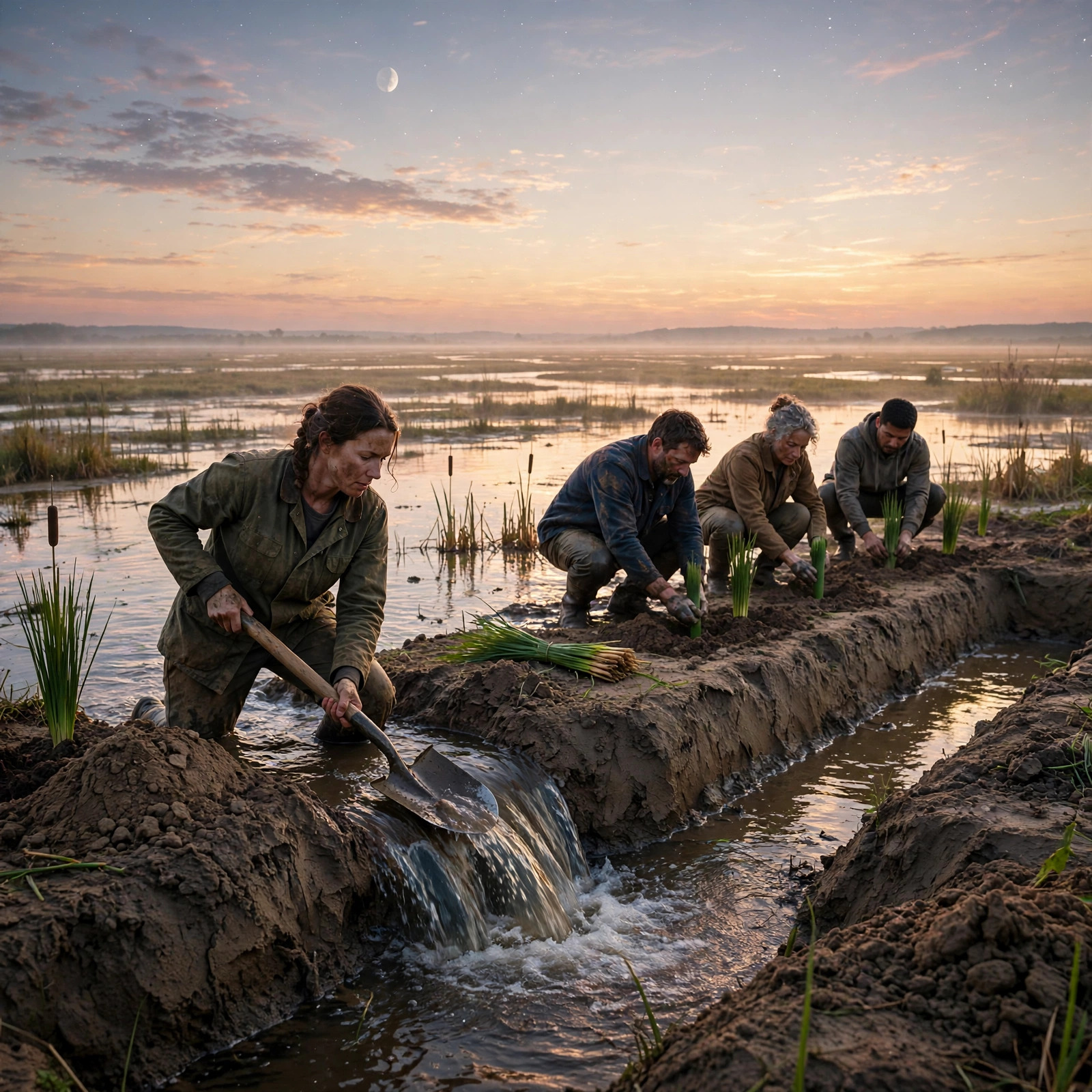
The spade went in clean on the first stroke and stopped hard on the second, and Dagny leaned her weight into the handle until something under the turf gave. Clay. Of course it was clay. She'd packed this berm herself the spring she took over the beds. She had tamped it with her boots while Gwendolyn told her she was doing it wrong, and it had held through every winter since.
"You're cutting it too square," Paavo said from the half-dug channel behind her. He stood in it to his knees, mud slicked up his forearms, and he was grinning. "The river doesn't like corners."
"The river doesn't like anything."
"It likes a slope. Give it a slope."
She angled the blade and tried again. Behind him the channel ran crooked toward the reed edge, where it stopped in a ragged face of earth. Three days of digging had got it that far. Neighbors had come in the evenings after their own shifts, two or three at a time, some with proper spades and some with whatever they'd found in a shed. Nobody had organized it. Dagny had made very sure of that. Each time someone asked her where to dig she had pointed them to Paavo, or to the rotating council's sheet pinned on the sluice-house door, or simply shrugged, and she had watched them take it in. She used to be the one who knew.
Now she was a woman with a spade, opening her own bed to the river.
The bed itself looked smaller than she remembered, now that it was empty. The chard was gone. She'd lifted the last of the leeks and given them away. The raspberry canes she'd started from Gwendolyn's cuttings had gone up the slope to a neighbor's plot, roots wrapped in wet sacking. What was left was a dark rectangle of turned soil, low and slightly dished, the ground the whole floodplain drained toward when it rained hard. It was lower than she'd ever let herself notice. She'd seen it on Ikenna's survey, the blue thumbprint at the bottom of everything, and she had felt it in her stomach then. She felt it now under her boots.
Along the far side of the bed, people were already kneeling.
They'd come down from the upper gardens with flats of rush and sedge and bundled reed rhizomes, pale and knuckled, that Ikenna's crew had brought out in the Board's truck that morning. A man who usually ran the second pump shift was pressing plugs into the soft margin with his thumbs. Two women from the terraces worked side by side without talking. Someone had brought a child's red trowel and was using it seriously, the way you'd use a good tool. The soil was wet enough already that their knees left deep marks.
Ikenna stood at the end of the row with a tablet he wasn't looking at. He'd rolled his trousers to the shin, which Dagny suspected had been a careful decision. His boots were new and already ruined.
"The spacing's fine," he said, to no one in particular, and then, because the man from the second shift had glanced up at him, "Honestly. Closer than I'd have specified. It'll fill in faster."
"You'd have specified wrong," Paavo called.
"I've been told."
It was easier between them than Dagny had expected. Something had shifted in the hall on the twelfth day, when Ikenna read the night schedule in his own appendix and saw what he'd missed. He hadn't apologized in any way you could quote. He'd just started turning up at dusk. Twice now she'd seen him at the intakes after dark with Paavo's headlamp, crouched by the grates, learning which debris came down on which tide. He was bad at it. He kept at it anyway.
She drove the spade in again. A clot of clay came away and the berm sagged a little at the cut.
"Slow," Paavo said. "Let it think about it."
Up the slope, a cart creaked.
Dagny turned. Gwendolyn was coming down the path between the bean frames, and it was taking her a long time. One of the terrace neighbors walked beside her, pushing the garden cart. Gwendolyn had a cane in her good hand. Her other wrist was still strapped in the clinic's grey brace, held close against her body, and she moved with a hitch that made Dagny's own hip ache to watch. She hadn't been down to the low ground since the drawdown. She had told the rotating council, quite flatly, that she would come when there was a reason.
In the cart, wrapped in an old wool blanket and strapped down with a belt, was the hive.
It was the only one. It had been the one at the end of the row, nearest the path, the one Gwendolyn had reached when the east margin went and the water came across hive row brown and fast. Dagny had seen the others afterward, the boxes tipped and silted, the frames drowned. Gwendolyn had stood in water to her thighs with her arms around this one, and she had slipped, and she had not let go.
Nobody on the planting row said anything. A few of them sat back on their heels.
Ikenna had gone very still. Dagny watched him decide whether to step forward and saw him not do it. Good, she thought. Let her come to it.
Gwendolyn stopped at the edge of the empty bed and looked at it for a long while. Then she looked at Dagny, at the spade, at the cut in the berm.
"You built that crooked," she said.
"You told me at the time."
"I tell everyone everything at the time. Nobody listens until it's being dug up." She shifted her weight on the cane and winced, and covered the wince badly. "Where's the edge going to be? The real edge. When it's full."
Dagny glanced at Ikenna. That was his to answer, and she wanted him to have to.
He came forward then, not quickly. He crouched, so he wasn't standing over her, and pointed along the planting row with an open hand. "Here, mostly. The water will sit just below where they're putting the sedge. In a wet winter it'll come up to here." He touched the ground a little higher. "It won't come further. The margin's been rebuilt. Your old hive row is higher than this now."
"You said something like that before."
"I did." He didn't look away. "I was wrong about the east side. I'm not wrong about this. And if I am, the people who'll know first are the ones out here at night, not me."
Gwendolyn considered him. It was the look she'd once given Dagny over a badly made berm, and Dagny almost felt sorry for him.
"Bees want water close," Gwendolyn said at last. "Not on top of them. Close." She pointed with the cane to a hummock at the head of the planting row, a little island of firmer ground where an old willow stump had rotted down into a mound of dark soil. "There. Facing the reeds. Facing the morning."
Paavo was already climbing out of the channel. He and the terrace neighbor lifted the hive out of the cart between them, careful as if it might wake angry, and Gwendolyn walked beside them the whole way, one hand hovering over the blanket. They set it on the hummock. Gwendolyn made them turn it twice before the entrance faced the way she wanted. Then she lowered herself, slowly, awfully slowly, until she was kneeling in the wet, brace and all. Paavo started to protest and she silenced him with a look.
She unbuckled the belt with one hand. She folded back the blanket. Somebody passed her a flat of sedge, and she worked a plug into the soil in front of the hive, pressing it in with her good palm until it stood.
A single bee came out onto the landing board, and then another, walking in the thin light, testing the air.
Dagny turned back to the berm. Her hands were shaking a little, and she let them. She set the spade against the last of the clay, on the slope Paavo wanted, and stood on it.
It went through.
The cut opened all at once, and the river came into the channel low and brown and unhurried, feeling its way along the crooked bottom Paavo had dug, slicking the clay dark. It reached the lip of her empty bed and spilled over, spreading across the turned soil she had worked for nine years of evenings, filling the hollow that had always been waiting for it. It came up around the new reeds, around the knees of the neighbors who didn't move back but kept on planting, and stopped just short of the hummock where Gwendolyn knelt with her hand flat on the earth and her bees going out over the water.
Get notified when new stories drop

Leo Stranek
Leo specializes in solarpunk abundance and near-future progress: livable futures, bright cities, and practical wonder.
Leave a comment
Comments