





Night Console
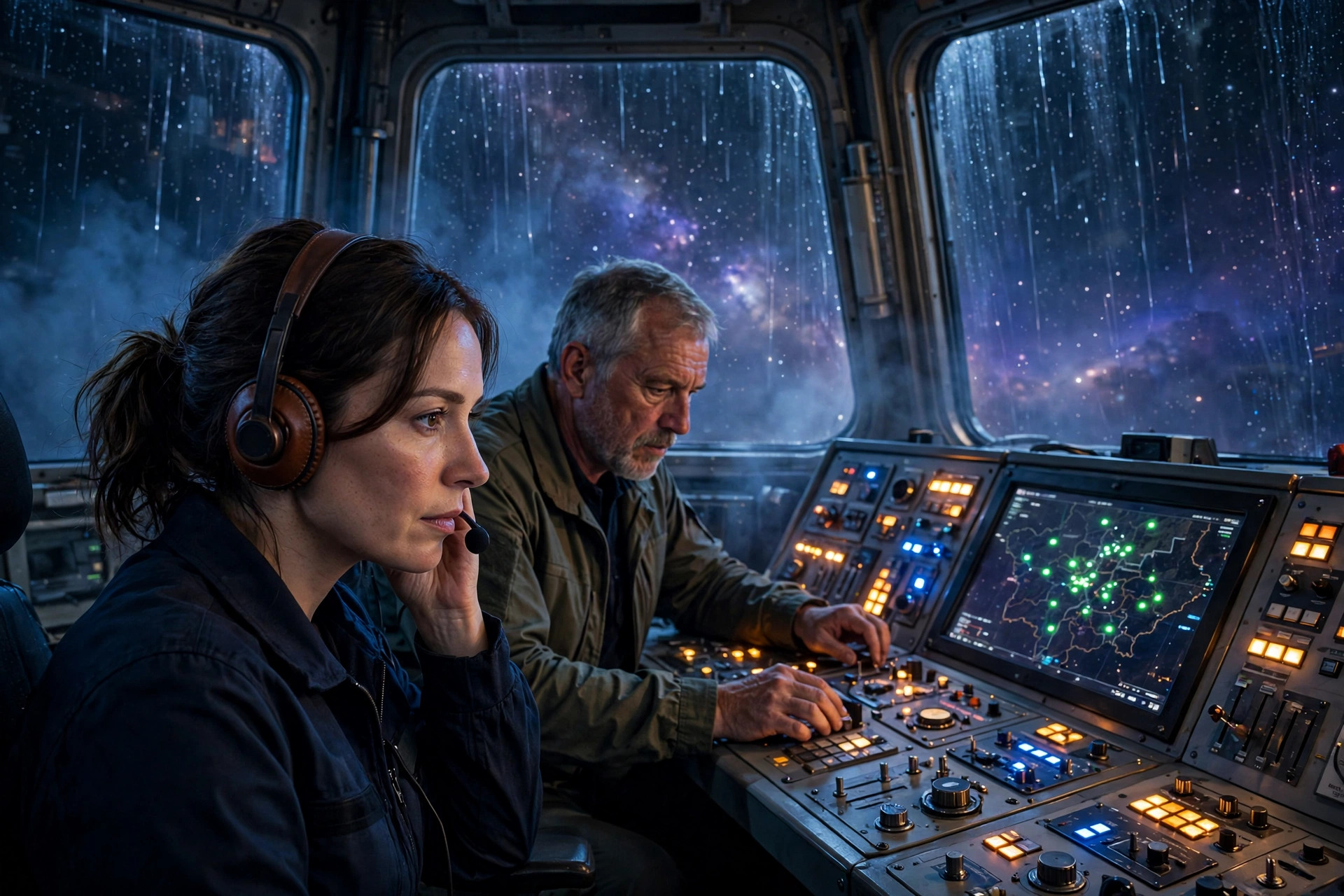
The third line lit before the second had finished crying, and Neve Castellan tipped her head a fraction to the right, the way a bird listens for worms. The headset cup sat warm against her good ear. Everything that mattered in Mossgate after midnight came through that single circle of leather.
"Ambulance, what's the address?"
A man, breathing through his teeth. Behind him a television, a kettle clicking off, a dog that wouldn't stop. She let the dog fall away and kept the breathing. Not panic. Pain, the clenched kind, held low in the chest.
"Bram. Cardiac, Weir Lane, he's talking but he's grey in the voice."
Across the console Bram Okafor-Lind didn't look up. He was already pushing the call to the nearest crew, his big hands moving over the board as if he'd built it. He trusted her ear the way other people trusted a thermometer. Years of nights had taught him that when Neve said grey, she meant it.
Tobiah Rusk sat at the trainee station behind them with his own headset, both cups, both ears, listening to the same line. He'd written grey? on his pad and underlined it twice.
"How'd you get grey out of that?" he asked when the line closed.
"He kept stopping before the ends of words." Neve turned in her chair, not all the way. She never turned all the way. The left side of the room was a wall of nothing to her, and she'd long ago arranged her life so that nothing important ever came from there. "People with chest pain ration their air. They don't know they're doing it."
"I heard the dog."
"Everyone hears the dog."
Bram made a noise that might have been a laugh. "She's got one ear and it's better than our four put together. Don't try to copy it. Just watch which calls she leans toward."
The depot was quiet between rushes, the kind of quiet that had a hum underneath it, the server racks in the back room and the refrigerator by the lockers. Rain worked at the high windows. On the wall the regional map glowed with the little green tokens of crews parked, waiting.
Her personal slate buzzed on the desk, face up. She meant to ignore it. Then she saw the clinic's crest.
Kestrow Clinic, Regenerative Hearing Programme. A place has become available in the current cohort. Our records show you previously expressed interest. There is 1 remaining place. Enrolment closes on day 9. Please contact Dr. Sabine Haldorsen to arrange consultation.
She read it, and then she read it again, slower, as if the words might rearrange themselves into something smaller.
She'd put her name on that list two years ago, late at night, the way some people buy lottery tickets. Gene-guided therapy, the brochure had said. Coax the dead cells in the cochlea to grow back the fine hairs that turn trembling into sound. She'd stopped reading where it talked about recovery, because she hadn't imagined they would ever call.
"Something wrong?" Bram said.
She turned the slate so he could see.
He read it with his reading face, lips not quite moving. Then he set it down very gently, the way he set down a receiver when a caller had stopped answering.
"Well," he said.
"Well."
"You'd hear on both sides."
"Eventually." She heard how it sounded. Eventually was a word with months inside it. "They said the first people in had a rough time. Like living inside a radio between stations. You can't tell where anything comes from."
"So you'd be off the console."
"For a while."
Behind them, Tobiah had gone very still at his station, the specific stillness of a man trying not to look like he was listening. Bram glanced back at him and then away, and Neve saw the thought cross his face before he could hide it. Not a cruel thought. A practical one. A seat that needed filling, and a trainee who had both ears and wanted it.
"They're running a second version next year, I heard," Bram said. "Shorter recovery. Fewer side effects. You could wait for that."
"You heard that from who?"
"From the papers. From people." He rubbed his thumb along the edge of the desk. "We're two people short since spring, Neve. If you go now, I'm doubling every week until autumn. And the kid's good, but he's not you."
"I'm right here," Tobiah said.
"I know you are. That's my point."
Line one lit. Neve reached for it before either man could, and tipped her head toward the voice, and the conversation broke off like a thread pulled too hard.
A woman, old, apologetic. She'd slipped getting up for the toilet, she was on the floor, she was so sorry to be a bother. Neve listened past the apology to the breath and found it even, unhurried, embarrassed rather than frightened. She kept her voice low and warm, the voice her mother used to use when Neve was small and turned the wrong way at the kitchen table and missed what was said. The voice that came around to the right side, patient, so she wouldn't have to ask twice.
"Is the floor cold?" she asked. "Can you reach a blanket? Someone's coming. You just keep talking to me."
She flagged it non-urgent with a sweep of her finger. Bram nodded without being asked.
Her mother would be asleep now, in the Harl Street flat, the radio on low on the right-hand side of the bed out of a habit she'd never lost, though Neve hadn't slept there in twenty years. All her life Neve had heard her mother from one side only. She'd wondered, sometimes, what Ione's voice sounded like when it came from everywhere at once. Whether it was rounder. Whether it would surprise her.
When the old woman was handed off to a crew, Neve pulled the headset away from her head to ease the ache behind her ear, and her elbow caught the arm of the chair, and the headset swung out of her hand and struck the edge of the console.
The sound was small and terrible. A flat click, like a knuckle.
She turned it over. The leather her mother had stitched around the depot frame was intact, the tight little stitches still holding the winter she'd started here, the winter Ione had sat up three nights because the issue headset pinched. But the hard shell of the cup under the leather had split, a hairline running from the rim almost to the centre.
"Oh, no," Tobiah said. "Can it be swapped? There's spares in the cupboard."
"Not that one." Bram said it before she could. He knew.
Neve held the cup to her ear. The hum of the room came through, a little thinner, a little rattling, as if something had come loose inside a wall. She could still hear. She could still work. It just wasn't quite the same.
"It'll do," she said.
Bram was looking at her slate again, still lit on the desk with the clinic's crest. He looked at it for longer than he needed to. There was something in his face she didn't recognise, an old weight, the look of a man remembering a door he'd walked past once. Then he blinked and it was gone.
"You don't have to decide tonight," he said.
"I know."
"Day nine's not tomorrow."
"I know, Bram."
Line two lit, then line four. Tobiah sat forward. Bram took the second. Neve opened the drawer under the console and found the roll of black electrical tape she kept for frayed cables, and she pulled a length free with her teeth, and she wound it around the cracked cup, once, twice, smoothing it flat with her thumb over her mother's stitches, and put the headset back on her good ear, and leaned toward the light.
Kestrow Clinic
The receptionist at Kestrow Clinic spoke to Neve's left side, and Neve turned before she knew she was turning. It was a dance she had done all her life. She half-pivoted, offered her good ear, and watched the young man's mouth to fill in whatever the air had dropped.

"Dr. Haldorsen's ready for you," he repeated, a little louder, and she thanked him and followed a corridor that smelled of floor polish and cold coffee.
Sabine Haldorsen's office had no desk between the chairs. That was the first thing Neve noticed. The second was the model on the windowsill, a resin spiral the size of a snail shell, sliced open so the inside showed. Sabine picked it up as Neve sat and set it on the arm of her own chair, within reach.
"I'm going to sit on your right," Sabine said, and moved her chair before Neve could answer. "Tell me if that's wrong."
"It's not wrong."
"Good. Then I'll tell you the things the brochure softens." She turned the spiral so its cut face caught the window light. "Your inner ear on the left had hair cells once. They died early, and they don't come back on their own. The therapy carries instructions into the supporting cells and coaxes some of them to become hair cells again. In the animals, and in our first group, they do. They grow. They connect."
"But."
Sabine smiled, briefly. "But a nerve that's been quiet for most of a life doesn't know what to do with a signal. The brain gave that territory away a long time ago. When the new cells start firing, you'll get sound. Mostly it won't be words. It'll be hiss and pressure and tones that don't match anything. Some of our people heard crowds where there were none. One woman heard every footstep twice."
Neve thought of the cracked cup at home, the faint rattle in it now, as though something small were loose behind the leather. "How long?"
"I don't know. That's the honest answer. For some, a season of it. For some, longer. And there's a chance the left side gives you noise and never gives you speech at all." She held Neve's eyes. "I won't promise you your mother's voice. I'd like to. I can't."
Neve hadn't said anything about her mother. Not here, not on the forms. She found she didn't mind that Sabine had guessed. Maybe everyone who came through this door wanted a particular voice.
"And my right ear," she said. "During all that."
"Untouched. But you'll be living with two ears arguing. Balance can go. Some days you won't know where a sound comes from. You'll turn the wrong way." Sabine set the spiral back on the sill. "You told the intake nurse you work dispatch."
"Nights. At the Mossgate depot."
"Then you'll need to be off the console for a while. I'd write that down for anyone who asked."
Neve had known that. She had known it yesterday, sitting under the hum of the room with the tape still tacky under her thumb. Hearing it said aloud in this bright office was different. It made the knowledge into furniture, something she would have to walk around.
"What do you get out of me?" she asked.
Sabine didn't flinch. "Data. Scans, hearing tests, your reports of what you hear. You'd be a long-deafness case, and we have very few of those. That's why the place is yours if you want it." She paused. "I won't pretend it isn't useful to me. It is. But nobody on my team gets to treat you as a number on a chart, and if they do, you tell me."
"And if I say no?"
"Then someone else gets it, and next year there may be a gentler version. Maybe. I'm not going to sell you a maybe either way."
She reached under the chair and brought out a slate, thin glass, the clinic crest glowing pale at the top. There was one trial place left, the screen said, and enrolment closed on day 9. Below that, a long scroll of risks in plain type, and a blank box for a signature.
"Take it home," Sabine said. "Read it with someone. Read it alone. Don't sign it in this room."
Neve took the slate. It was lighter than she'd expected, almost nothing in her hands.
The bus back into Mossgate ran along the river. A child two seats behind her was singing, and Neve could tell it was singing only by the shape of the woman next to him, the way she bent toward him and laughed. The slate sat on her knees, screen dark. Every so often she pressed it awake and read a line and let it go dark again.
Possible persistent tinnitus. Dark. Possible vertigo. Dark. Speech recognition in the treated ear is not guaranteed.
The Harl Street flat was warm when she let herself in, the radiator ticking, the kitchen light on. Her mother was at the table with a pair of trousers belonging to the neighbour downstairs, taking up a hem by hand, though her fingers had slowed and she'd sworn off other people's mending twice this year. The thread tin sat open at her elbow, the old biscuit tin with its lid dented on one corner, spools packed in by colour.
Ione looked up and shifted her chair, the small scrape of it, to put herself on Neve's right. She had done it so often it no longer looked like a choice. It looked like weather.
"You're early," she said.
"The doctor didn't keep me long."
"And?"
Neve put the slate on the table. She had meant to explain it properly, start with the good news, the new cells, and get to the noise afterward. Instead she said, "They can grow it back. The left. Maybe."
Ione's needle stopped. It stayed where it was, halfway through the cloth, the thread pulled taut to her fingers.
"It takes months to settle," Neve went on, and heard herself hurrying. "Longer, maybe. It might only ever be noise. She was very straight about that. I'd be off the console. I'd…" She stopped. "I could hear you from both sides, Mam. If it works."
Her mother looked at the slate. She did not touch it. She looked at it the way she looked at a garment someone else had ruined and brought to her to save, measuring how much was left.
Neve waited. She was used to waiting for sound, to watching mouths. Ione's mouth didn't move. The radiator ticked. Downstairs a door shut, and Neve felt it through the floor more than she heard it.
"Say something."
Ione pulled the needle the rest of the way through. She made a stitch. She made another, small and even, the same stitches that held the leather on the headset still hanging by the door, the cup taped black now, cracked under it.
"The headset broke," Neve said, because the silence needed filling. "Last night. The cup split. I taped it."
That made her mother look up. Something crossed her face, quick and private, and was gone. "I saw," she said. "I can fix the leather. I can't fix the inside."
"I know."
"You'd not need it, then. After." It wasn't a question, the way she said it. She bit the thread off and laid the trousers flat and smoothed them with both palms, longer than they needed smoothing.
"Mam."
"Your tea's in the pot." Ione stood, slower than she used to, a hand on the table edge. She went to the window and stood with her back to the room, and Neve, who could see her mother's shoulders but not her mouth, heard nothing at all.
Neve sat a long time with the slate glowing in front of her, the blank box at the bottom. Then she turned it over so the crest went dark against the wood, and pushed it a little way across the table, until its edge rested against the dented corner of the thread tin.
The Left Side
Neve was halfway through the bread when her mother said something from the hall.
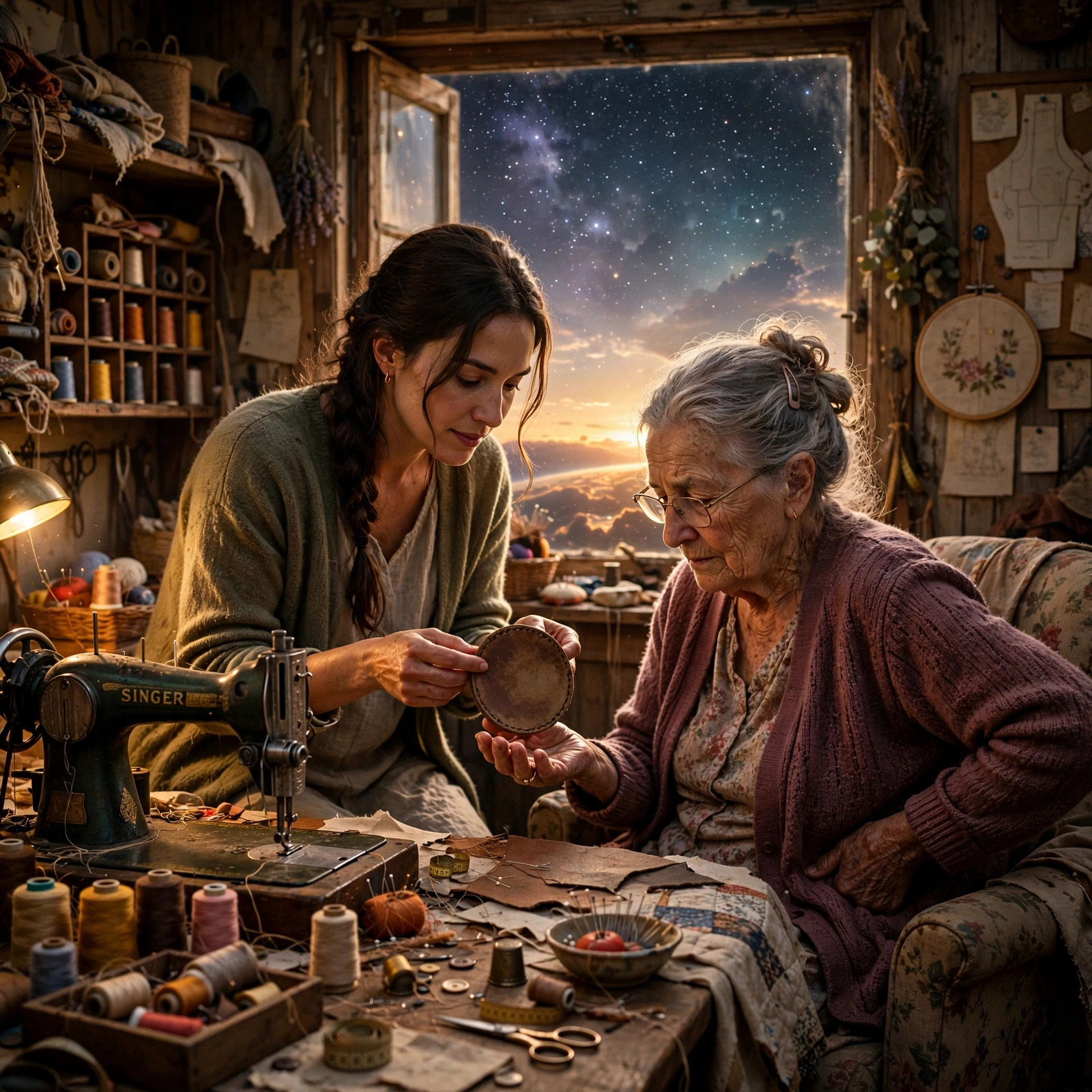
She did not hear it as words. She heard it, afterwards, as a change in the flat: a draught where the bedroom door had opened, a shift in the air on the side of her head that had been silent since she was small. She was standing at the counter with the knife in one hand and her phone propped against the kettle, scrolling the depot roster, and her good ear was turned to the window and the street.
Then the thump. That she heard. It came up through the floorboards into the soles of her feet, heavy and soft at once, and she dropped the knife and turned so fast she struck her hip on the drawer.
Ione was on the floor of the hall at the bottom of the little step down from the bedroom, one leg folded, one hand flat on the boards. Her face was white and furious.
"Mam. Mam, don't move."
"I said wait." Ione's mouth was tight. "I said, hold the door, I've got the basket. I said it twice."
The laundry basket lay on its side. Folded pillowcases had slid out across the floor in a fan. Neve knelt in them.
"I didn't hear you."
"I know you didn't." Her mother shut her eyes. "I was on the wrong side. I'm always on the right side. I forgot."
Neve put her palm along her mother's hip, gently, the way crews were taught and she had told a thousand strangers to do over the phone. Ione hissed. Nothing grated. Nothing looked wrong in the shape of her. But she was seventy and she had come down hard on the edge of the step, and Neve had sat on the other end of too many calls that began exactly like this.
"I'm ringing the depot."
"You'll do no such thing. Help me up."
"No."
She dialled with a thumb that would not keep still. It went through the town line and then the click she knew from the other side, the half-second of hollow air before the console picked up, and then a voice. Young. Careful. Tobiah.
"Mossgate ambulance, what's the address of your emergency?"
He said it the way she had taught him, the address first, before anything. She gave him Harl Street and the flat, and heard her own voice come out flat and quick, the dispatcher's voice, as if this was any call.
"Neve?" A pause. "It's you."
"My mother's had a fall. Conscious, breathing, talking. Left hip. She went down on a step."
"Okay. Okay." She could hear him typing. She could hear something else too, close against his words, a faint rasp every time he leaned in: the tape on the cracked cup catching on his collar. She had left the headset at the depot that morning, after Bram had rung to say Tobiah's had split at the jack and there was nothing in stores. She had hung it on the hook by the console herself and told Tobiah the band ran tight.
He was wearing it now. Her mother's stitches against his ear.
"Is she on blood thinners?"
"No."
"Can she bear weight?"
"I'm not letting her try."
"Good. Don't." Keys. "I've got a crew clearing in town. It'll be a little while. Keep her warm, keep her still." Then, behind him, faint, another voice she knew: Bram on the second line. Low, slow, too slow. Someone on that line was talking, a woman, and Neve caught a scrap of it through Tobiah's mouthpiece, a word that came out with its edges gone soft, smeared, the consonants falling into each other.
Bram said, "And has he had anything to drink today, love?"
Neve's skin went cold. She knew that sound. Not drink. It was the sound a mouth made when one half of the face had stopped answering.
"Tobiah," she said. "Line two."
"What?"
"Bram's woman. On two. Listen to her, not him. She's slurring. Flag it."
A silence. She heard him lift the cup off his ear, the tape rasp. Then muffled, away from the mic, Tobiah saying Bram's name, saying something urgent. She could not make out the rest. On the floor her mother had caught hold of her wrist and was gripping it hard.
"Who are you shouting at?"
"Nobody, Mam."
When Tobiah came back he sounded younger. "He's upgrading it. He's got it. Neve, I've got your crew. Stay on with me."
She stayed on. She had never in her life been on this end of it, the waiting end, and she found she did not know what to do with her hands except keep one on her mother and the other around the phone. Ione's grip loosened by degrees. The pillowcases went on lying in their fan, white, ironed, each with its corner turned in the way Ione had always folded them.
"You were stood there," her mother said, after a while, not to her exactly. "With your back to me. Fifty times a day you stand like that and I come round. I just come round. I don't think about it."
"I know."
"Today I didn't." She looked at the step. "Today I thought, she's going to be hearing from both sides soon, best get used to it."
Neve could not answer that.
The crew, when they came, were two she'd sent out herself more times than she could count. They called her by name and were kind to Ione and lifted her onto the chair with a care that made Neve's throat close. In the back of the ambulance her mother lay with her eyes open, watching the roof, and once she reached out, without looking, and found the side of Neve's head, her right side, and laid two fingers on the hair above the good ear, as if checking it was still there.
The hospital took Ione through a pair of doors and kept her. Bruised, they said later, deep and nasty, nothing broken, but they wanted pictures and they wanted her overnight, at her age, with that colour coming up on the skin. Neve sat on a plastic chair in the corridor with her coat still buttoned.
Bram found her there near midnight. He was still in his depot fleece, and he had the grey look he got at the end of a double, the skin under his eyes gone loose. He sat down beside her on the right without being asked. He had always sat on the right.
"How is she?"
"Bruised. Angry. She'll mend." Neve looked at him. "The woman on two."
He rubbed his face with both hands. "Crew got there. They're treating it as a stroke. They should've been treating it as a stroke from the first minute. I had her husband down as drunk." He let his hands fall. "I'd been on since yesterday. I was listening to the words. You'd have heard it straight off. You always hear it."
"Tobiah heard it."
"Tobiah heard you." He was quiet. "He's still got your set on. Wouldn't take it off when I sent him home. Said it was the only one that didn't hurt."
"Mam stitched it."
"I know who stitched it."
She wanted to be angry with him, and could find no handle on it. He was right that they were short. He was right that tonight proved it. Somebody in Mossgate had lost minutes they could not get back because the depot was thin and the man on the console was tired, and Neve had been on her knees in a hall with her back turned to her own mother.
"You'll say this is why I should wait," she said.
"I wasn't going to say anything." He looked down the corridor and for a moment his face did something she didn't recognise, folded in on itself. "Waiting's not free either. I'd not tell anybody it's free."
She almost asked him what he meant. He stood up before she could, stiffly, a hand on his knee, and touched her shoulder, once, the right one, and went off to find coffee that would be bad.
Neve sat. The corridor ran away on both sides of her, long and lit. To the right she could hear everything: a trolley wheel squeaking, a nurse laughing low into a phone, the soft repeated chime of a monitor behind a curtain, footsteps going away. To the left there was nothing. Doors opened down there; she saw them swing. Someone was talking; she saw a mouth move. Somewhere behind them, behind the doors, her mother lay in a bed in the dark on the side Neve couldn't reach.
She turned her head toward it, as she always did, and the right side of the corridor went on making its noises into an ear that faced the wall.
Depot Roof
The fire door stuck the way it always stuck, and Neve put her shoulder into it and came out onto the flat roof of the Mossgate ambulance depot with two paper cups. The tea had gone tepid on the stairs. Bram was already there, sitting on the low wall by the ventilation housing with his back to the town, the way he'd sat on smoke breaks back when he still smoked.
She came round to his right. Then she stopped, and went round to his left instead, so he was on her good side.
He noticed. He took the cup without comment.
Below them the bays were open and one of the night crews was hosing the back of a rig, a long flat hiss she caught clearly and then lost when she turned to sit. The town ran downhill in strings of sodium light toward the estuary. Somewhere out there a dog went on and on about something.
"She's home," Neve said. "They let her out this afternoon. She won't use the stick. She leans on the furniture and calls it exercise."
"That's your mam."
"She was on the step because she was calling me. From the left. I was in the kitchen with the tap running." Neve turned the cup in her hands. "I didn't even know she'd fallen until I heard the stair rail rattle. I heard the rail. Not her."
Bram drank. He made a face at the tea and drank again anyway.
"Enrolment closes tomorrow," she said. "Day nine. There's one place left. Sabine rang to check I'd not lost the slate."
"Have you?"
"It's face-down on the kitchen table. Next to the thread tin. I keep laying it down so I don't have to look at it."
He set his cup on the wall between them, carefully, the way he set things down when he was about to say something he'd rehearsed.
"I'll make my case once more and then I'll shut up." He spread his hands on his knees. "The second trial's coming. Everybody says so. Shorter recovery, the cells come in quicker, less of the noise. You'd be off the board weeks instead of months. We're thin, Neve. You saw what thin looks like this week. I can't run nights on Tobiah and me and whatever agency body they send up from the city. Not for months. Wait a year and you'd still get your ear, and the depot would still have you."
"Maybe a year."
"Maybe."
"Maybe never. Maybe the money goes somewhere else. Maybe they find something in the first lot that shuts it all down." She looked at him. "And Sabine said it might be noise anyway. Not words. A long while, she said. Maybe always."
"Then that's another reason."
"It's not, though. Is it." She heard her own voice go flat. "You're right about the depot. You've been right all week. I can't argue with the rota."
He didn't say anything. The hose below cut off and the quiet came up the wall at them.
"You said something at the hospital," she said. "That waiting wasn't free."
He picked the cup back up and didn't drink from it. He looked out at the estuary, and his face did the thing again, the folding, and this time she was close enough to watch it happen.
"My heart," he said. "Before you came on nights. The rhythm was off, had been since I was a lad. There was a trial at Kestrow then too, earlier version. They'd grow a patch of new muscle and put it in where the old stuff misfired." He tapped his chest, not hard. "They offered me a place. I was the only one on nights who knew the old switchboard. I told them I'd wait for the next round. Better results, they said it'd be. Sure it would."
"What happened?"
"The first lot did fine. Most of them. The next round got delayed, and then I was too old for the criteria, and then they changed the criteria and I'd got the pills sorted and the pills were good enough." He shrugged. "So I take the pills. I can't run for the bus. I can't take the grandkids up Harrow Fell, my sister's lot. I sleep sitting up when it's bad. It's fine. It's a life." He was quiet. "And the old switchboard got pulled out the next year anyway. They'd have managed. I'd made myself the man they couldn't do without and it turned out they could."
Neve sat very still.
"So I'm a hypocrite," he said. "That's the case for waiting. From a man who waited."
"Why didn't you tell me?"
"Because I wanted you on the board." He said it plainly. "Because I'm tired and you're the best ears in this building and I'm selfish. And because if I told you, you'd go, and I'd be sitting on the right of an empty chair."
The dog had stopped. A rig pulled out below, no lights, heading for a standby post. She watched it turn onto the main road and go down the hill.
"You always sit on the right," she said.
"So you can hear me."
"Seventeen years I've been turning my head toward you." She hadn't meant to say a number; it came out. "You know what I want? I want to hear somebody without turning round. I want Mam to say my name from the hall and I want it to just arrive. Like it does for everyone else."
He looked at her for a long moment. Then he stood, a hand on his knee, and stepped round behind her and sat down again on her left.
She didn't turn. She could feel him there, the warmth of him along her arm, the shift of the wall's grit when he settled. On that side the world was always a held-shut door. She saw nothing of him but the edge of his sleeve.
His mouth moved near her deaf ear. She felt his breath, felt the shape of words she would never catch, and understood that he'd chosen the side where she couldn't hear him because whatever it was, he couldn't say it to her face.
Then he kissed her there. Just below the ear, on the jaw, light, the way someone might test whether a wound had healed.
She turned then. She couldn't help turning. His face was very close and older than she kept it in her head, and she kissed him properly, on the mouth, with cold tea on both of them and the wind off the estuary pushing her hair across his cheek.
When they came apart he laughed once, a short surprised sound she heard perfectly.
"Well," he said.
"Well."
"That's not an argument for anything."
"No."
He reached into the deep pocket of his fleece and drew out a tangle of steel band and leather. Her headset. The cup still wore its black wrap of electrical tape, the stitching round the frame worn shiny with her own neck's sweat. The leather had a new pucker on one side where somebody had bent it to fit a smaller head.
"Took it off Tobiah at shift change," he said. "Told him your mam made it and it wasn't a spare. He went red. He'll get used to the depot ones. They're not so bad once you stop fighting them."
"He needs one that doesn't hurt. If he's going to be on all night."
"Then he can ask her." Bram turned the set over once in his big hands, smoothed the leather with his thumb, and held it out to her across the space between them, the cracked cup facing up, toward her good ear.
Unpicked Stitches
The waiting room at Kestrow Clinic smelled of hand gel and the cold that came in each time the outer door opened. Ione sat in a plastic chair with her stick hooked over its arm, holding herself a little crooked to spare the bruised hip. She had the headset across her knees and a seam ripper between her fingers, small as a bird's beak.
"You don't have to do it here, Mam."
"Where else would I do it? You'll not want it on in there, and I'm not leaving it half-done in a drawer." Ione slid the blade under the first stitch at the frame and lifted. The thread came up waxed and grey, older than any of the furniture in the room. "Sit on my right. No. Sit where you like."
Neve sat on her mother's right, which put Ione on her good side, the way it had been at every table and bus stop and hospital bed of her life. She watched the stitches come away one by one. Each stitch gave a tiny pop she could hear clearly, and each left a pinhole in the leather like a pore.
The winter she'd started at the depot, Ione had sat up three nights with that leather, cutting it from an old handbag and shaping it round a frame that rubbed Neve raw. She'd never said what the handbag had been. Neve had guessed it was the good one, the one from her parents' wedding photographs.
"Tobiah rang," Neve said. "Before we left the flat."
"And?"
"He's on tonight. And tomorrow. Bram's put him on the rota through spring." She kept her voice level. "It's sensible. Somebody has to be in the chair."
Ione pulled another stitch. "Sensible's a word men use when they've already decided."
"Bram didn't decide. I did. I told him this morning." She'd told him on the phone, standing at the kitchen window, the slate still face-down by the thread tin. He hadn't argued. He'd said, Right, and then, after a long pause she'd listened to with her whole good ear, I'll keep it warm, which they both knew he couldn't promise. Tobiah was quick. Tobiah had flagged the stroke when Neve fed it to him, and he'd learn the rest, and in a few months the depot would have shaped itself round him the way water shapes round a stone. She tried not to finish that thought.
The inner door hissed. Dr. Haldorsen came out in a cardigan over her scrubs, the trial slate under one arm. She crouched rather than standing over them, which Neve had noticed about her on the first visit and liked against her will.
"Morning, Mrs Castellan. How's the hip?"
"Purple," Ione said. "Going yellow at the edges."
"That's the right direction." Sabine turned to Neve. "Enrolment closes today. There's one place left. I've not offered it to anyone else, but I will if you walk out."
"I know."
"Then I'll say the rest again, because I'd rather you hear it twice than sign on the first telling." She held Neve's eyes. "The cells grow back. We've seen that. What the brain makes of them is another matter. You've had silence on that side since you were small. It might give you a roar for a long while. Hiss, clicks, a sort of weather. Words may come late. They may not come."
"And you'd still get your data."
Sabine didn't flinch. "Yes. Whatever happens, we learn something. I won't pretend that isn't part of why I'm crouched here." She set the slate on Neve's knee. "But you'd be the one living in it. If you sign, I want it to be for something you want, not for me."
Neve turned the slate over. Her own name glowed at the top. The text was the same as on the second day, when Sabine had first handed it across the desk, and she had read it so many times at the kitchen table that she knew where every paragraph broke.
Beside her, Ione had stopped working. The ripper rested in the leather.
"Mam."
"Go on. I'm listening."
"You're not. You've gone quiet."
Ione looked at the headset in her lap. Half the stitching was gone, and the leather lifted away from the steel like a peeled bandage. "When you were four," she said, "you used to come into the kitchen and stand on my right foot. On it. So I'd know you were there and turn. I learned your good side before you knew you had one." She worked the blade under the next stitch but didn't pull. "If you can hear me from the hall, what do you need me standing on the right for?"
It wasn't a question Neve could answer from the chair. She thought of the hall step at Harl Street, her mother calling from the left, the call that never reached her, the dull sound of Ione going down that she *had* heard, because it came through the floor.
"I don't need you on the right," Neve said. "I need you not on the floor."
Ione's mouth pressed thin. She pulled the stitch. Then the next, faster, and the next, until the last length of thread came free and the leather slid off the frame into her hands, soft and warm and holding the curve of Neve's head even now.
The cup sat bare on the steel band, cracked, wrapped in its black tape. Without the leather it looked like what it was: a cheap depot part that had outlived its use.
Neve touched the screen. The slate asked her to confirm she understood the risks, and she did. It asked whether she'd had time to consider, and she had, nine days of it, and a whole childhood before. She signed with her finger. Her signature came out shaky, the tail of the C dragging off the line.
Sabine took the slate back and looked at it a moment before tucking it away. "That's the place gone, then. None left." She stood, knees cracking. "I'll give you a minute. Then we'll walk through together."
When she'd gone back inside, Ione held out the bare frame. "You'll want this, after. For something."
"Keep it. Make the cup into a pincushion."
"Don't be daft." But she put the frame in her bag, and the ripper after it, and her hand came out empty and stayed open on her knee, palm up, as if she'd forgotten what it was for.
Neve stood. Her good ear caught everything: the hum of the lights, a kettle somewhere behind reception, a telephone that wasn't hers ringing on and on. Tobiah would be setting up at the depot by nightfall, adjusting a depot headset that pinched, learning which callers sounded calm and weren't. She let it ring.
The inner door opened again. Sabine waited in the gap.
Neve bent and pressed the loose leather into her mother's palm, still warm from the shape of her, and closed Ione's fingers round it. Then she walked through, and behind her the clinic door sealed with a soft pneumatic sigh she heard, as she'd always heard everything, only on one side.
Get notified when new stories drop

Leo Stranek
Leo specializes in solarpunk abundance and near-future progress: livable futures, bright cities, and practical wonder.
Leave a comment
Comments