



Shard Gully Well
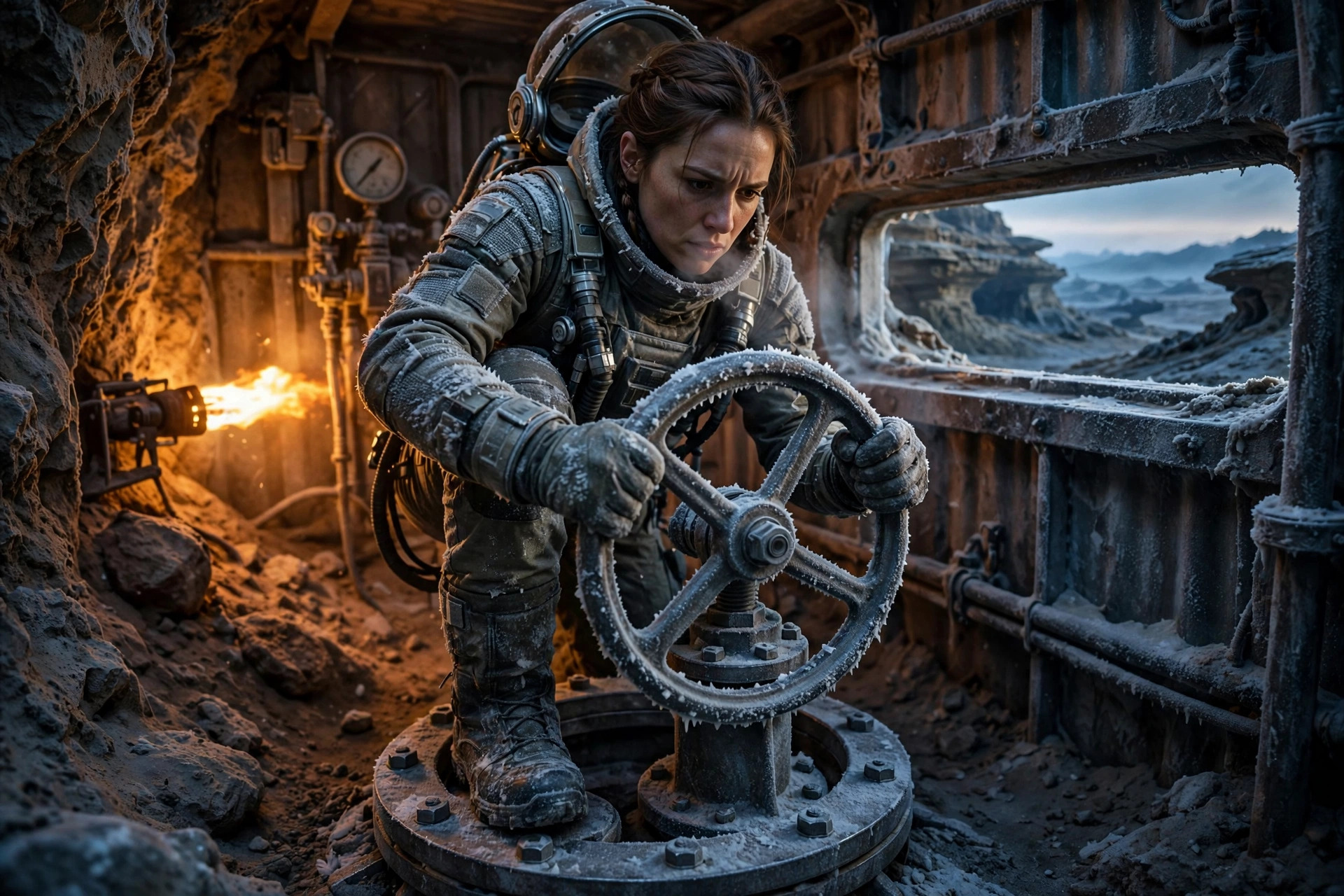
Ottilie Kask had her shoulder against the valve wheel before the well house door finished sealing behind her. The steel bit through the glove. She braced one boot on the casing flange and pulled until the tendons in her forearms stood up like wire. The wheel did not move.
Frost furred its spokes, white and fine as mold. She knew every one of those spokes. She had poured the wheel herself in her first year as steward, in the cooperative's little crucible behind the smithy, and filed the burrs off by lamplight while the colony still argued over whether a convicted forger should be trusted with anything that mattered. She had left a thumb-width notch on the rim so she could find true north on it in the dark. Her glove found the notch now. It was rimed solid.
"Come on," she told it. "You were warm last week."
The well house was a pressure shed dug into the lip of Shard Gully, half buried in regolith for the shielding, its single window a slot of thick glass looking down the gully toward Kettle Plain. Beneath her boots, beneath the floor and the fill and a long fall of rock, the buried glacier lay where it had lain since before anyone thought to name this world. The heat pipes went down into it like roots. They carried warmth from the shallow reactor loop to the ice, and the ice gave back meltwater slowly, a little at a time, and the water climbed back up through the casing to the terraces. It was slow. It was supposed to be slow. Slow was what kept the glacier standing.
Except that something in the return line had frozen, and now the whole well had backed up into a plug of ice around the valve seat.
She unslung the heat lance from her hip, clicked it to its lowest setting, and played it across the bonnet in long careful strokes. Too much heat at once and the steel would crack against the cold of the casing. She had seen that happen on her second winter, a hairline split opening with a sound like a knuckle and a jet of ice crystals hissing out into the shed before she got the bypass closed. She had not slept for two days after. She did not intend to see it again.
The frost on the bonnet went grey, then dark, then beaded. A thread of meltwater ran down the iron and gathered in the lowest rivet head. She watched it the way other people watched weather.
Behind her the outer lock cycled. Ottilie didn't turn. Only one person in the colony walked up Shard Gully on purpose before the terraces had their first shift lights on.
"You're not answering your band," Gerta Imbali said.
"My hands are busy."
"Your hands are always busy. That's what the band is for." Gerta came to stand at her shoulder, unhooking her helmet and setting it on the bench by the pressure gauges with the care she gave every object she didn't own. She was a small woman gone wiry with age, her grey braid pinned flat against her skull, and she carried the ledger satchel crosswise over her chest the way some people carried a weapon. "The east terrace lost another bed of beans overnight. The roots rotted in dry soil. Do you know how you get rot in dry soil?"
"Stress. The plants stop fighting."
"The families stop fighting too." Gerta looked at the wheel, then at the lance. "Is this the frozen return?"
"Seat's plugged. Something upstream dropped below freezing and the backflow locked it." Ottilie moved the lance a hand's width higher. "I'll have it."
"You said that about the north well."
"And I had it. Took a day longer than I said." She set the lance on the flange, gripped the wheel again, and heaved. Something inside gave a faint grinding shiver, ice against steel, and then nothing. She let go and shook out her hands.
Gerta was quiet for a moment. Then she unbuckled the satchel and drew out the consent ledger.
Ottilie had seen it more times than she wanted to count, and still it caught her. A hand-bound book, rag paper pressed from the colony's first worn-out shirts and sheets, sewn with basalt fiber Gerta had twisted herself in that first winter when nothing else would hold a stitch in the cold. Each page carried a household's name, its signature, and the brown whorl of its thumb. The archive kept a sealed mirror of every page, but Gerta trusted the book. Everyone trusted the book. That was the point of it.
She opened it on the bench. The petition was written across the top of the page in Gerta's square print: Authorization for thermal fracture of the Kettle Plain glacier by the Odeh rig, for immediate water delivery to the greenhouse terraces. Below it, the names went down in a long ragged column.
"Thirty-one," Gerta said. "As of last night."
Ottilie didn't look at the page. She looked at the meltwater bead swelling on the rivet. "Of forty."
"Of forty. Nine more households and it goes, and I'll certify it myself, and you'll stand on the plain and watch them crack your glacier like a dinner plate." Gerta's voice was level, not cruel. She said hard things the way she weighed rations, exactly. "I'm not here to argue with you about it. I'm here because Fenwick Odeh asked me to confirm that the steward has reviewed the ice survey and will file an opinion. He wants it on record before the count closes."
"He'll have it on record. Fracture the deep seam and you open channels the meltwater never had. It'll come fast, all right. All of it. And then the roof comes down on the wells, and your grandchildren drink whatever falls out of the sky."
"His survey says the seam will hold."
"His survey was done by people who leave after the contract."
"His survey was done by people who've seen the terraces," Gerta said. "So have I." She closed the ledger, but she didn't put it away. Her thumb rested on the binding. "Ottilie. You understand that your opinion carries the steward's weight, not your own."
There it was. Ottilie felt it settle between her shoulder blades, an old familiar load. "I know whose weight it carries."
"I'm reminding you anyway. Your clemency stands on the condition that your hand on any record is clean and your own. You owe the cooperative years of labor still, and every season you keep these wells running is a season off that debt. I hold it. I'll hold it fairly. But if your name goes on a survey opinion and anyone can say you shaded it to protect your own work, the clemency board will read it the way they read the old ledgers." She paused. "The ones you wrote for other people."
The bead on the rivet trembled and ran. Ottilie picked up the lance and went back to the bonnet, because it was easier than answering. Seven years in town and still, every time, it came back to the ledgers. The cargo manifests she'd rewritten on the transport out, the signatures she'd laid down in other men's hands so cleanly that customs officers had initialed them without looking twice. She'd been good. She and Paulo both. He'd run the cargo and she'd run the paper, and they'd never once been caught until the day she chose to be.
She thought of him now, down on Kettle Plain, already suited up on the Odeh rig with his crew, his big careful hands on a drill that would take the ice apart. They hadn't spoken properly in weeks. There was a lot they hadn't spoken about in years.
"I won't shade it," she said. "I'll write what the ice says."
"Good." Gerta slid the ledger back into its satchel and buckled it. "Then make it say something by tonight. Odeh's petition will be read in the hall on the third day, and I'd rather your opinion was in the book than in your mouth."
"Gerta." Ottilie kept her eyes on the wheel. "The thirty-one. Did you watch them all sign?"
Gerta's hands stopped on the buckle. "I watch every page, Ottilie. You know I do." Then, after a breath, more quietly: "Some came in through the rig office, from the shift crews. The foremen carried them up. The thumbs match."
"Of course they do."
Gerta studied her a moment longer, then lifted her helmet and went to the lock without another word.
When the door had sealed behind her, Ottilie switched the lance up a notch and worked it slowly around the seat, around and around, until the frost on the spokes turned to water and the water ran down into the grooves she had filed with her own hands six winters ago. Her arms ached. The lance grew warm in her grip. Down in the slot of the window, the first shift lights came on along the greenhouse terraces, one row and then the next, pale green against the dark plain.
She set the lance down, wrapped both hands around the rim, found the notch, and pulled with everything she had.
The wheel held. Beneath the thawed steel, deeper than her heat could reach, the ice in the seat stayed locked and white and would not turn.
Greenhouse Terraces
The blight had come up the terraces overnight, and by the time Ottilie reached the third tier the growers were already pulling plants. They worked in pairs along the beds under the long pressure domes, one lifting each stalk by its root ball and the other bagging it, and the stalks came up grey at the stem and soft where they should have been green. The smell was sweet and wrong. Somebody had propped the inner lock open with a crate, and the air moving through it was warmer than the domes were meant to run.

"It's the root rot," a grower told her without looking up. "Water's too shallow in the beds, salts climb, roots crack, and then it gets in. We knew it would come. We didn't think it'd come this fast."
Ottilie knelt and took a handful of the bed. It was dry a finger down and crusted white along the edges where the drip line had stopped reaching. She had sent every drop the slow wells could give her up this hill for weeks. It had never been enough. She knew it the way she knew the weight of a wrench.
At the end of the tier, beside a bench of seedling trays, Gerta's deputy had set up a folding table under the grow lamps. The consent ledger sat open on it, weighted at the corners with stones. A woman with soil to her elbows was pressing her thumb to the ink pad. A man behind her held a baby against his suit liner and waited his turn with his jaw set.
Ottilie stood and watched them sign. She did not stop them. There was nothing to stop. The deputy turned the book a little so the light fell on the column, and Ottilie read the names going in, careful and blocky, a family on the upper tier she'd fixed a pump for in her first year, another she'd only ever waved at. When the man with the baby straightened up, the deputy ran a finger down the page and said, mostly to herself, "Thirty-seven."
Someone near the beds let out a breath that was almost a laugh. Thirty-seven, and forty was the line. Three more households and the ice under Kettle Plain could be split open by heat and pressure and sent up the terraces in a rush.
"They're not wrong to sign."
Fenwick Odeh had come in through the open lock behind her. He had his helmet under one arm and the faint red seam on his forehead from wearing it too long. He didn't look triumphant. He looked like a man who had walked the whole hill that morning and counted the dead plants himself.
"I didn't say they were," Ottilie said.
"You didn't have to. You've got a face for it." He nodded down the tier at the bagged stalks. "I've done fracture work on three worlds. I've never once seen it bring water to a place that didn't need it badly. That's not a sales pitch. People only call me when the slow way's already lost."
"The slow way hasn't lost. It's just slow."
"Slow kills seedlings." He said it gently. "Walk with me a minute?"
They went out along the outer path, where the domes gave way to bare terrace wall and the plain opened below them, dark and flat and faintly ribbed with old meltwater channels long since frozen. Far out, the rig's lights burned on its tracks. From up here it was small enough to cover with a thumb.
"Your survey opinion," Odeh said. "Gerta tells me it goes in the book before the hall meets."
"It does."
"Then I'll be honest with you, because I think you'd catch me otherwise." He reached inside his chest pocket and drew out a folded sheet, the stiff waxed paper the rig office used for anything that had to survive a dust storm. "This is a stability certificate. It says the glacier's competent to take a fracture without losing the lower body. My engineers think that's true. Your wells say maybe. I'd rather have your name on it than theirs, because people here trust you."
"People here know what I was."
"That's why they trust you. You paid." He held the sheet out, not pushing it, just letting it hang between them. "And I know what you still owe. Gerta's not secretive about the ledger. I can clear it. The cooperative takes contract credit at face. I'd buy out every hour you've got left, and you'd walk off that debt the day you sign."
The offer landed somewhere under her ribs and stayed there. Years of clemency labor, the evening shifts in the well house, the quarterly review where Gerta read out her standing in that flat fair voice. Gone with a signature. She'd laid down a thousand signatures for less.
"And if I sign it and I'm wrong," she said, "the ice goes, and the wells go with it, and my grandchildren's grandchildren dig for water with their hands."
"And if you don't sign it and you're wrong, the terraces go this winter." Odeh didn't raise his voice. "I'm not asking you to lie. I'm asking you to decide which risk you can live with. I've had to do it. It's not pleasant."
She took the sheet. It was warm from his pocket. She unfolded it and read it through, the clean printed lines, the empty box at the foot where a steward's name would go. Then she folded it again along the same creases and slid it into the thigh pocket of her suit and sealed the flap.
Odeh watched her do it. He gave a small nod, as if that were an answer of a kind, and went back toward the domes.
She stayed at the wall a long while. Below, a crawler was climbing the switchback from the plain, its headlamps swinging across the terrace stone. It stopped at the lower lock. A tall figure got down from the cab and came up the path two steps at a time, and she knew him before she could see his face, by the way he carried his left shoulder slightly high, the way he had since a cargo crate fell on it years ago in a hold she still dreamed about.
Paulo stopped a few paces off. Frost had sublimed off his visor in the warmer air by the domes and left it streaked. He pushed it up.
"You saw the book," he said.
"I saw it."
"Thirty-seven." He looked past her toward the beds. "Odeh find you?"
"He found me."
Paulo didn't ask what was said. He'd never needed to ask her that kind of thing; he'd always read it off her the way he read a drill head's chatter through the grips. Instead he stood turning something over in his gloved fingers. She had stood near him through enough bad nights to know he was working up to a thing he didn't like.
"They've moved the casing crew up to Shard Gully," he said finally. "Pilot holes. The foremen say it's survey only, nothing hot, just cores." He shook his head once. "Nobody brings the heater sled for cores, Otti."
"Before the hall votes."
"Before anyone votes." His mouth tightened. "I said something. I got told the book's as good as full."
The wind of the domes' air handlers stirred the dead leaves along the path. She wanted to say a dozen things to him and had never had the habit of saying any of them, and the habit held now.
He held out what he'd been turning: his rig badge, the scuffed amber tag that opened every lock and log on the Odeh site. His name was cut into it in the rig's square letters.
"Take it," he said. "Go look at their logs. I can't be the one who goes looking."
"They'll know it was yours."
"Then they'll know." He pressed it into her palm and closed her fingers over it with his own big careful hand, and held on a moment longer than he had to, his eyes on the far small lights of the rig.
The Test Bore
Ottilie was halfway up Shard Gully when the ground answered the drill.
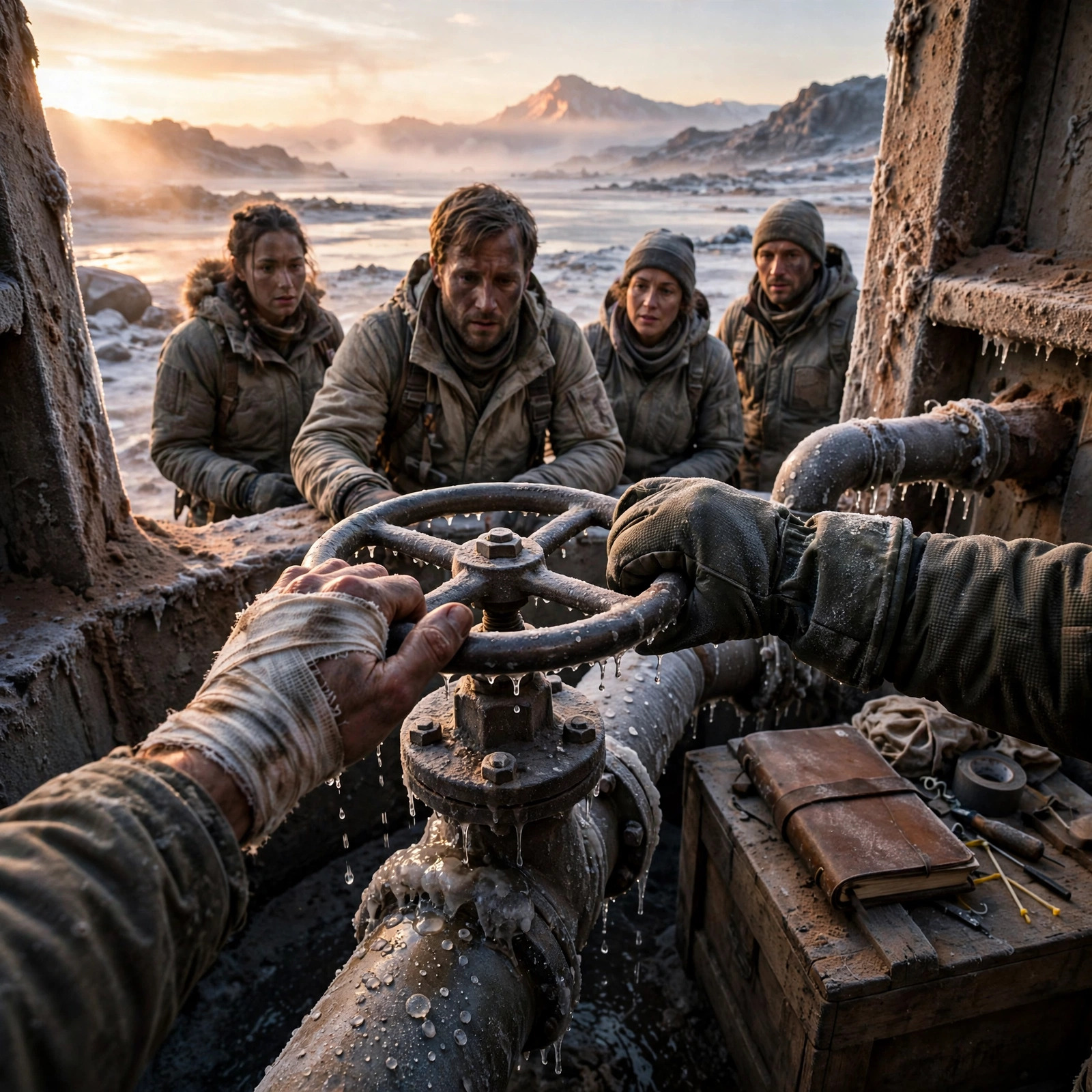
She felt it before she understood it, a shiver through the soles of her boots, then a second, deeper one, as if something under the scree had shifted its weight. Paulo's badge was clipped inside her collar. She had used it in the rig office the night before and found what she'd expected: heater sled requisitioned, pilot depth unlogged, a foreman's initials where a survey order should have been. She had come up the gully to see the hole for herself.
The casing tunnel mouth sat in the gully wall, braced with composite ribs and lit amber from inside. A plume was rising from it. It wasn't smoke. It was a pale, glittering column of ice crystals that the thin air took and scattered, and under it a fine rain of frost settled on the rocks and stayed there.
Men were running out of the tunnel. Not enough of them.
She keyed her suit channel. "Who's inside?"
A voice, ragged with breathing. "Drill lead went back for the sled cutoff. Brace went. Brace went down on him."
She was already moving.
Inside, the tunnel was a white blindness. The heated bore had punched through into a pocket of trapped gas in the ice, and the gas had come up the hole all at once, carrying shattered ice with it, sublimating as it went, frosting every surface it touched. Her helmet lamp made a fog of it. She went by feel along the left wall, glove on rock, the way she walked the old well galleries when the lights failed.
The vent was still hissing in her helmet mics, carried through the rock into her boots and up her bones. Overhead a rib had bowed. Beyond it another rib lay twisted across the floor, and under the end of it, an arm.
"Paulo."
"Here." His voice came strange and flat. "Otti, the sled's still on. I got the cutoff half-turned. It's still feeding the bit."
She looked. The heater sled squatted at the bore head, its cables glowing faintly, its feed line jammed into the casing. Frost fanned out from the collar in long branching blades. Every moment it ran, it melted deeper, and every moment it melted, the pocket below opened wider.
She could get Paulo, or she could reach the cutoff. Not both, not fast.
The brace pinned his right forearm against the floor. His glove there had split along the seam and the cold had gone in. She could see the fabric gone stiff and white, and the hand inside it not moving.
"Leave me a second," he said. "Turn it off first."
"Shut up."
She put her shoulder under the bowed end of the rib and lifted. It moved a finger's width. Her knees shook. The ice in the air was thickening; she could no longer see the sled at all, only the faint red of its cables.
"Otti. The cutoff. If that pocket goes, it's the whole face."
He was right, and she hated him for being right. She let the rib down as gently as she could, which was not gently, and he made a sound in the channel she would hear for a long time. She went for the sled on her hands and knees.
The cutoff was a lever housing on the sled's flank. He'd gotten it partway through its throw before the brace came down. Frost had locked it there. She hammered at it with the heel of her glove, then with a loose bolt from the floor, then braced her boots on the sled frame and hauled. Nothing. She thought of the valve wheel in the well house, still bound in its seat no matter what the surface did, and how she'd learned that ice in a joint does not care how strong you are.
So she stopped hauling. She pulled the sled's own diagnostic lead, found the heated coupling, and laid it against the lever housing. Ten heartbeats. Twenty. The frost on the housing softened to grey. She threw her weight once more, and the lever went home, and the red in the cables faded.
The hiss didn't stop. But it slowed.
Two of the casing crew had come back in behind her with a jack. Between them they got the rib up, and she got her arms under Paulo's and dragged him backward along the floor, his boots scraping, his ruined hand held against his chest by his other arm, until they were out under the open gully and the frost was settling on all of them like a fine dust.
He was laughing a little, in the way people do when it is that or the other thing. "You were supposed to just look at logs."
"I looked."
The medical tent stood at the foot of the gully, pressurized and too bright. Paulo lay on the cot with his right hand under a warming sleeve. The rig medic had cut away the glove and said things about tissue and time in a voice Ottilie recognized, the careful voice of someone who wasn't promising anything. Under the sleeve, through its clear panel, his fingers were mottled the color of old bruises.
Fenwick Odeh came in still in his suit, helmet under one arm. He didn't speak at first. He went to the foot of the cot and looked at the hand for a long moment.
"I didn't authorize hot drilling," he said. "I want you both to know that. I'll find out who did."
"Your foremen," Ottilie said.
"Then I'll find out which." He turned to her. His face was grey with something that looked to her like real distress. "That doesn't change what's on the terraces. The beds are still dying. I'm sorry for this, Venn. I'm sorry. And I'll still be asking the hall for water."
"I know you will," Paulo said.
The tent flap opened again and Gerta Imbali came in with the cold on her coat and the consent ledger held against her chest in both arms, the way she always carried it, as though it might try to leave. She had come up from the terraces on the first crawler.
"There's to be an inquiry," she said, to no one and everyone. "If there's an injury on a site the hall hasn't authorized, the ledger goes where the injury is. That's the rule. I wrote it." She set the book on the supply crate by the cot and opened it to the newest pages. "I'll need a statement from you, Mr. Venn, when you can. And I need to see whether any of this was done under color of the signatures."
Odeh stiffened. "The count's at thirty-seven. Nobody claims that's forty."
"Nobody claims anything yet," Gerta said. "I'm reading."
Ottilie looked down at the open page because it was there and because she couldn't look at Paulo's hand any longer.
The rag paper took ink softly, and every household's line was its own small creature: shaky, cramped, grand, careless. Thumbprints pressed in rust-colored seal paste beside each. She read without meaning to. And then she stopped reading and simply looked.
Six lines, scattered among the recent ones. Different names. Different hands, at a glance. But in each, the downstroke started a hair before the pen should have touched, a faint feathered entry, the trick of beginning a forged line in the air so the ink lands already moving. Each thumbprint was pressed slightly rolled toward the outer edge, so the ridges blurred where they would have been compared. It was a way of hiding a hand inside a crowd of hands.
She had invented it, in a hold on a cargo hauler, by lamplight, years before Kettle Plain. She had taught it to exactly one person.
She lifted her eyes to Paulo. He was already watching her.
Gerta said, "Ottilie? Something?"
"I need a minute with him."
Gerta's gaze went from one of them to the other, sharp and unhurried. Then she closed the ledger, though she left it on the crate, and took Odeh by the elbow. "Fenwick. Come and tell me which foremen." They went out. The flap settled.
Ottilie opened the book again and put her finger beside the first of the lines.
"I didn't," Paulo said.
"I know you didn't. You never could do the thumb right." She heard her voice shake and let it. "But somebody learned it. From you."
He shut his eyes. "Second winter on the rig. Night shift, the casing foreman, the big one with the bad teeth. We were drinking. He was bragging about papers he'd faked groundside. I showed him I could do better. Showed him your way. I was proud of it, Otti. Proud of you." He opened his eyes. "It was him. Him and whoever he showed."
"Then Gerta has to know how it's done. Or she'll see six ugly hands and call them honest."
"And how will you tell her?" He struggled up on his good elbow. The warming sleeve hummed. "You'd have to show her. Write it out on a page in that book, in front of the hall, so it's mirrored in the archive forever. Your method. Your hand. They void your clemency the moment you admit it was more than they knew."
"I know what it costs."
"Then don't." His good hand found her wrist and held it, too hard. "Please. I'll swear to it. Let me be the forger for once. I've got less owed. Otti, please, don't you put your name on it."
Page of Hands
The cooperative hall smelled of wet wool and heater dust, and every bench was full by the time Ottilie carried the ledger up the center aisle. Terrace families stood along the back wall with their arms folded, frost still melting off their hoods. Some of them had dirt from the dying greenhouse beds under their nails. She knew several by face. She had cleared their well lines in the first cold days of the season.
Gerta waited at the front table with the archive stylus, its mirror lamp already glowing green. Odeh sat to one side, coat open, hands flat on his knees as if to keep them from doing anything. Paulo had come too, against the medic's orders. He sat on the end of the front bench with his right arm in its warming sleeve, cradled against his chest. His face had gone the color of old snow.
Ottilie set the book down. The basalt-fiber spine creaked.
"The count stands at 37," Gerta told the room. Her voice carried without effort. "The threshold is 40. Before anyone else signs, the steward has asked to speak to the entries already made. I've agreed. Ottilie."
A murmur moved through the benches. Someone near the back said, "Speak to them how?" and nobody answered him.
Ottilie opened the ledger to a clean page at the back. Rag paper, thick and slightly toothed, Gerta's own stitching visible in the gutter. She had always liked this book. It was the one honest object in the colony she had never wanted to touch.
"I'm going to show you how six of these signatures were made," she said. "To do that I have to show you who taught it."
She uncapped the pen. Gerta turned the mirror lamp so it lit the page, and the archive took its first image with a soft click.
She wrote slowly, so they could see. I, Ottilie Kask, forged manifests and transit seals before arrival, and ledger entries in my first year here. This is the method. Then, below it, she wrote a stranger's name. A made-up name, a made-up household. She started the stroke in the air, a breath above the paper, so the nib landed already traveling and left that faint feathered tail. She inked her thumb and pressed it, rolling it a little toward the outer edge.
"Now," she said, and turned the book around for Gerta. "Page back to the recent entries."
Gerta did. She took a loupe from her pocket and bent over the paper for a long time. The hall went quiet enough that Ottilie could hear the heater ticking in the rafters. Gerta moved from her sample to the first suspect line, then the second, then on through them all.
"The entry," Gerta said finally. "Every one of them. And the thumbs smeared to the outside, where I'd look." She straightened. "Fenwick. Come see."
Odeh came. He looked through the loupe without hurry, the way a man reads a core sample he doesn't want to believe. When he lifted his head, he wasn't angry. He looked tired.
"These came through my rig office."
"Through your foremen," Ottilie said.
"Through my office. That's mine to answer for." He turned to the benches. "I didn't order it. You don't have to believe that today. But the greenhouses are short, I wasn't lying about that, and I'm not lying now."
A woman at the back wall pushed forward. "So that's it? My beds die because some foreman got clever?"
"Your beds are dying either way if we break the ice and lose it," Ottilie said. "I'm sorry. I am. But not on a lie."
The woman stared at her. Ottilie made herself hold the look until the woman turned away and pressed her face into a neighbor's shoulder.
Gerta took up the red striking pen. She drew a single clean line through each forged entry and initialed the margin, and the lamp clicked after every one. She didn't rush, and she didn't comment. Five lines. Then she paused over the sixth, checked it twice, and struck that too, while one of the pre-filled names she had first thought suspect she left standing, after setting the loupe on it and finding the hand honest.
No, Ottilie corrected herself, counting the red marks. Five. Gerta had cleared one.
"The count stands at 32," Gerta said. "Below threshold. Fracturing does not proceed. The inquiry into the rig office continues." She looked at Odeh. "Do you dispute it?"
Odeh glanced at Paulo's sleeve and the frost-scar along his wrist where the dressing ended. "No. I concede the count."
Gerta turned the ledger back toward Ottilie and turned to the page with her confession. She wrote beneath it in her small square hand, and read it aloud as she wrote. "Admitted conduct exceeds the record on which clemency was granted. Standing voided. Labor obligation to be reassessed." She set down the pen. "It will be more years, Ottilie. I won't pretend otherwise."
"I know."
"You could have let him take it."
"He'd have done the thumb wrong," Ottilie said, and a startled laugh went up from somewhere in the benches, quickly hushed.
Gerta's mouth moved, almost a smile. She pressed her own thumb to the margin beside the voiding note, cleanly, ridges sharp. Then she gathered her stylus and her lamp. "Hall's adjourned."
It emptied slowly. People went past the table in ones and twos, some looking at Ottilie, more not. The woman from the back wall didn't look at all. Odeh lingered at the door, coat buttoned now, and seemed about to say something. He nodded once instead and went out into the cold.
Gerta was the last. She left the ledger open on the table. "Close it when you're done. The archive's taken what it needs."
Then it was only the two of them, the dimmed heaters, and the red-lined pages lying open under the work lamp.
Paulo got up off the bench with some effort. He came to stand beside her and looked down at her confession, the fake name, the rolled thumb.
"You made it look easy," he said.
"It was always easy. That was the trouble."
"I'd have said it was me. I meant that."
"I know you did." She closed her hand around the edge of the table. "That's why I couldn't let you."
He was quiet a moment. The warming sleeve hummed against his chest. "Nine years I've been here," he said. "Longer before that, in all those holds. And I never once said it."
"Said what?"
"Otti."
He put his good hand to her jaw, clumsy, careful of the bandaged one between them, and kissed her. His mouth was chapped and tasted of the medic's bitter tea. She kissed him back and felt how badly he was shaking, or how badly she was, and stopped caring which. Over his shoulder the red lines lay across the pages like a row of closed doors.
When they broke apart, he rested his forehead against hers. "That's what."
"Took you long enough."
"Took both of us."
She reached into her thigh pocket. Odeh's stability certificate was still there, still sealed, the blank where her steward's name would go bent soft from days against her leg. Paulo watched her turn it over in her fingers.
She tore it in half, then in half again, and laid the pieces on the struck page beside Gerta's clean thumbprint.
Rig Heat
The line came across Kettle Plain on its back, dragged by four of Odeh's crew in harness, a fat grey serpent of insulated hose that left a groove in the frost behind it. Ottilie watched from the well house door with her hood up and her hands in her armpits. The rig stood far off on the rise where it had always stood, but its lamps were turned away from Shard Gully now, and for the first time since it arrived it was pointed at her.
"Mind the bend," she called. "If it kinks at the sill you'll crush the lining."
The lead hauler, a broad woman with ice in her eyebrows, lifted a hand without looking back. They walked the hose over the sill in a wide loop and laid it down beside the wellhead like something asleep.
Inside, the well house smelled of old grease and the faint mineral breath that always came up from the shaft. The first deep well sat in the floor under its iron collar, and the valve wheel she'd cast in her first year stood up from the pipe head, its spokes filed by hand, its rim still carrying the little pits where her pour had gone wrong and she'd been too proud to recast it. She had turned it open days ago. Nothing had answered. The heat pipe below was there, and the ice below that, but the pipe was starved. It moved warmth down into the glacier slowly, the way it was built to, and slow wasn't going to feed the terraces this season.
Paulo came in behind the haulers with his right arm strapped across his chest, the warming sleeve humming, and his rig coat hung off one shoulder because he couldn't get the other into it. He looked better than he had in the hall. He also looked like he hadn't slept.
"Coupling's cold-rated," he said. "Fen sent the good one."
"Fen."
"He told me to call him that. I'm trying it." He nudged the hose end with his boot. "Problem's the last stretch. Line's insulated out to here. Between the coupling and your pipe head it's bare metal. You'll bleed half of it into the floor before it ever goes down."
She'd known that. She'd known it since the night Odeh stood in the hall doorway and didn't say whatever he'd been going to say, and then came to her the next morning and said it plainly: I have heat I can't use. You have a hole that can. She'd spent two days measuring the gap with her hands and coming up short.
Odeh himself arrived while the haulers were stamping warmth back into their feet. He'd taken off the good coat and wore a rig jacket like his crew's, and he carried a folded square of something under his arm, heavy and silvered on one side.
"You asked what we had," he said. "This is what we have. Coolant jacket off the number two exchanger. It's been sitting in stores since we pulled that unit."
She took it from him. It was heavier than it looked, a quilted sleeve of channels meant to carry the rig's coolant around a hot vessel and carry the heat away. She unrolled it across a crate and ran her palm down the channels, feeling where they doubled back, where the inlets and outlets sat.
"It's backwards," she said.
"It's meant to take heat off," Odeh agreed. "I didn't say it was useful. I said it was what we had."
"No. It's backwards. That's good." She looked up at Paulo. "If we turn it inside out and put the silver to the outside, it'll hold heat in instead of throwing it off. And these channels..." She traced one with a fingertip. "We don't fill them. We leave them empty and seal them. Dead space is the best insulation there is."
Paulo leaned over her shoulder, close enough that she could feel the hum of the sleeve on his arm. "Seal them with what?"
"Cold-weld paste. I've got three tins of it and nobody to tell me not to use them."
Gerta's voice came from the doorway. "I'll tell you. That paste is cooperative stores."
The quartermaster stood with her lamp in one hand and the consent ledger under her other arm, wrapped in oilcloth against the cold. She had walked out from the cooperative hall alone; there was frost on the hem of her coat to the knee. She set the ledger down on the crate beside the jacket, and Ottilie felt the room change the way it always did when that book was in it.
"Put it on my account," Ottilie said.
"I intend to." Gerta unwrapped the oilcloth and opened the ledger to a page past Ottilie's confession, past the red lines and the torn certificate someone had swept up and filed. A clean page. She uncapped her stylus. "Clemency standing's void. You know that. What you don't know yet is the term." She wrote steadily. "Full restitution labor for the forged entries, reckoned from the original sentence, plus the years the original clemency would have spared you. Plus the paste."
"Plus the paste," Ottilie said.
Gerta didn't smile. She turned the book so Ottilie could read the figure, and Ottilie read it, and it was long. Longer than the time she'd already been in town. It sat on the page in Gerta's square hand like a wall someone had built without asking her where she wanted it.
Paulo made a small sound. She didn't look at him.
"Is that fair?" she asked.
"It's what the rule says. I didn't make it harder and I won't make it softer." Gerta held out the stylus. "Labor starts when you sign. I've marked the place of work as this well house. You'll be wanting to stay here anyway."
Ottilie took the stylus. Her own name, her real one, the one she'd almost stopped using on the long ships. She wrote it slowly and pressed her thumb into the margin, and when she lifted it the print was hers, every ridge where it should be, nothing rolled or doctored. Gerta looked at it a long moment, then closed the ledger and left it on the crate with the oilcloth folded on top.
"Now go and spend my paste," she said.
They worked into the dark of the afternoon. Ottilie turned the jacket inside out across her knees, and Paulo held the seams flat with his good hand while she ran a bead of paste down each open channel and pinched it shut. The paste stung her fingers through her gloves. Twice she sealed a channel and found, pressing it, that it still breathed air at the far end, and had to open it and do it again. Odeh crouched by the coupling with two of his crew and talked them through the joint, quiet and exact, and once he swore at himself for getting a thread wrong and did it over without blaming anyone else.
"You could've had this a season ago," Paulo said to him, not unfriendly. "Running your heat into her wells."
"I could have." Odeh didn't look up from the thread. "I didn't think it was enough. I still don't know that it is. The terraces need water before they need my opinion of geology."
"It'll be sooner than waiting," Ottilie said. "It won't be as soon as breaking the ice."
"No." He tightened the collar. "But the ice will still be here when my grandchildren are old men. I've done enough jobs where it wasn't."
When the last channel held, they wrapped the jacket around the bare pipe between the coupling and the pipe head, silver side out, and lashed it with rig strap. It looked ugly. It looked like something smugglers would have rigged in a cold hold to keep a crate alive. Paulo laughed when he saw it, and she knew he was thinking the same thing.
"Ready on the rig," the lead hauler said from the doorway, a handset at her ear.
Odeh nodded. "Send it."
For a while nothing seemed to happen. Then the hose along the floor began, very faintly, to lose its rime, a dark band spreading back from the coupling as the frost let go of it. Ottilie laid her hand on the jacket. Warm. Not hot, but warm the way a sleeping animal is warm, and holding.
She knelt by the valve wheel. She had forced the first seat to its stop in the days since, but the pipe head was built with a second seat below the first, a deep throat she'd never needed because there had never been heat enough to push past it. The wheel resisted. Frost had grown into the threads. She set both hands on the rim and leaned, and it didn't move, and for a moment she thought the whole long day had been for nothing, the paste, the page, the wall of years.
A hand came down beside hers on the rim. Paulo's left, the good one. Then, after a moment, Odeh's, broad and scarred. Gerta stood by the crate with her lamp and did not join them, and Ottilie was obscurely grateful for that.
"Together," Paulo said.
They pulled. The frost in the threads cracked. The wheel gave, a quarter turn, then a half, rough under the filed spokes, and somewhere below their knees the pipe gave a long low tick, and another, as warmth went down into the dark toward the ice.
Get notified when new stories drop

Ren Hollis
Ren writes frontier worlds and terraforming triumphs — habitats, gardens under glass, and the first rain on a new world.
Leave a comment
Comments